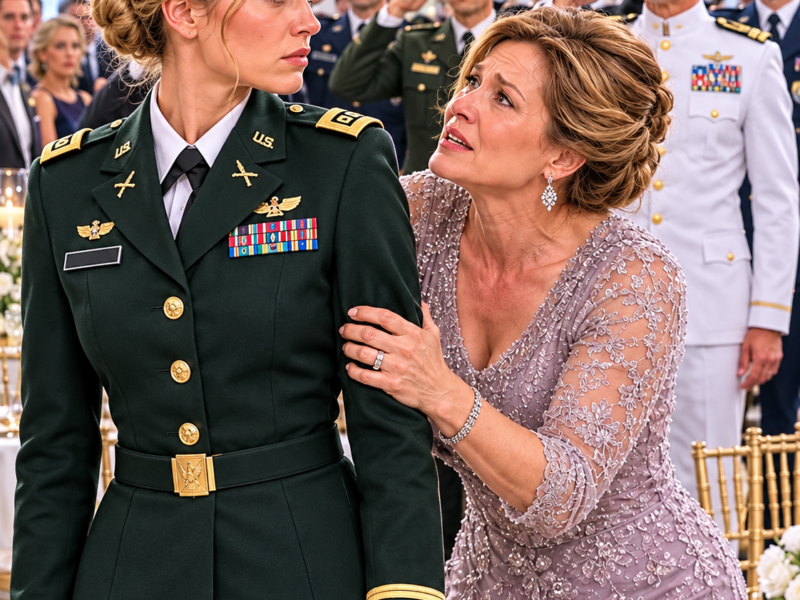
My mother grabbed my arm just as I stepped into the ballroom. “Please, Emily. Take it off.”
Robert Hayes stood in the middle of the ballroom, his eyes fixed on my brother.
“I think there’s something this family needs to understand about the woman sitting at that table.”
Nobody moved.
The music had stopped.
The servers stood frozen beside their carts, and two hundred wedding guests watched as twelve veterans remained on their feet.
I wanted to disappear.
Not because I was ashamed of my uniform, but because I knew Robert well enough to understand that he wasn’t going to let Daniel’s insult pass.
“Robert,” I whispered, barely loud enough for him to hear.
He glanced at me.
“Captain, with all due respect, you’ve spent enough years keeping quiet.”
My stomach tightened.
Daniel lowered the microphone.
“Sir, I don’t know who you are, but this is my wedding.”
Robert nodded politely.
“I understand. Congratulations.”
Then he turned toward the guests.
“My name is Robert Hayes. I served with Captain Emily Carter during a deployment that changed my life.”
He paused.
“And I suspect some of you have heard stories about what soldiers do overseas. But most people never hear about the people who quietly make sure those soldiers come home.”
My mother shifted in her chair.
My father looked increasingly uncomfortable.
Robert continued.
“Three years ago, our convoy was hit outside a remote village. The first vehicle took the worst of the blast. We lost communication, and several soldiers were badly wounded.”
I stared at the table.
I remembered that day.
I remembered the dust, the smoke, and the sound of someone shouting for a medic.
I remembered running toward the damaged vehicle before anyone could tell me whether the area was secure.
I remembered Robert lying on the ground, blood soaking through his uniform.
“Sergeant Hayes was trapped beneath part of the vehicle,” Robert said.
“He had a severe injury and was losing blood. The situation was chaotic. We were still under threat, and our evacuation route wasn’t clear.”
He looked at me.
“Captain Carter reached him.”
I swallowed.
“I was doing my job.”
Robert shook his head.
“You were doing more than that.”
He explained that I had stabilized Robert and several other wounded soldiers while coordinating their evacuation.
The medics had worked under impossible conditions.
There had been no proper operating room, no familiar hospital equipment, and no guarantee that help would arrive in time.
Robert had survived.
Two other soldiers from that convoy had survived, too.
One of them was standing beside him now.
A broad-shouldered veteran with a silver pin on his lapel stepped forward.
“I’m Daniel Brooks,” he said. “I was one of the wounded men that day.”
He looked at me.
“I remember you holding pressure on my leg and telling me to keep talking. You asked me about my daughter because you said I needed something to focus on besides the pain.”
His voice cracked.
“My daughter was four years old. She’s twelve now. She knows the reason her father came home.”
I lowered my eyes.
I remembered his face.
I remembered asking about his little girl.
I hadn’t known he was standing in the room.
A third veteran spoke.
“And I’m Marcus Reed. Captain Carter helped get me out before the second explosion.”
One by one, they introduced themselves.
Some had served with me.
Others had been patients I treated at different points in my career.
They had come to the wedding because Robert had invited them.
He hadn’t told me.
I looked at him in disbelief.
“You planned this?”
“Not the speech,” he said quietly. “I just wanted to be here when you celebrated your brother.”
I glanced at the other veterans.
“Why didn’t you tell me?”
Robert smiled sadly.
“Because you would have found a reason to talk us out of coming.”
He wasn’t wrong.
I had spent years minimizing what I had done.
I never wanted anyone to feel they owed me anything.
I had treated wounded soldiers because that was my responsibility.
I had never expected a thank-you at a wedding.
But now twelve people who had once trusted me with their lives were standing in a room where my own family had asked me to hide the uniform I wore while serving them.
Robert turned toward Daniel.
“You said some people choose careers that take them away from family.”
Daniel’s face reddened.
Robert continued.
“Sometimes we leave because someone needs help. Sometimes we miss birthdays and weddings and holidays because somebody else’s son or daughter is lying on a battlefield and needs a doctor.”
He paused.
“And sometimes we do it knowing that when we come home, the people we love might never understand.”
The silence became almost unbearable.
My mother looked at me.
For the first time that evening, I saw something other than embarrassment in her expression.
It looked like confusion.
Maybe even regret.
Daniel cleared his throat.
“I wasn’t talking about her specifically.”
Robert didn’t raise his voice.
“Then perhaps you should be more careful with your words.”
A few guests nodded.
My father finally stood.
“This is getting out of hand. Emily is our daughter. We know her.”
Robert turned toward him.
“Then you should be proud of her.”
My father didn’t respond.
I wanted to say something, but my throat felt tight.
I had imagined my family being proud of me countless times.
I had imagined my father asking about my work without making a joke.
I had imagined my mother telling her friends that her daughter was a military doctor.
I had imagined Daniel inviting me to speak at his wedding instead of asking me to remove my uniform.
But I had never imagined twelve veterans standing up for me.
And I didn’t know what to do with the feeling that came with it.
Robert walked over to my table.
“Captain, may I?”
I nodded.
He held out his hand.
I stood.
He saluted.
For a second, I forgot where I was.
Then I returned the salute.
The other eleven veterans followed.
Twelve salutes.
Twelve people who had seen me at my worst and trusted me anyway.
I felt tears gathering, but I refused to look away.
The room remained silent.
Then Olivia, my new sister-in-law, stood from the head table.
She walked toward me, still wearing her wedding gown.
“Emily,” she said softly, “I am so sorry.”
I looked at her.
“For what?”
“For not saying something earlier.”
She turned toward Daniel.
“I don’t want our marriage to begin with us pretending that what you said was okay.”
Daniel stared at her.
“Olivia, please. Not now.”
“Especially now.”
She took a breath.
“You’ve told me stories about your sister. You said she was distant, that she thought she was better than everyone because of her career.”
I looked at Daniel.
He looked away.
“But I’ve never heard you say what she actually does,” Olivia continued.
“Not once.”
Daniel’s jaw tightened.
Olivia faced me again.
“I knew you were in the Army. I didn’t know what you had been through. But I shouldn’t have needed a story about a battlefield to understand that asking you to hide your uniform was wrong.”
I didn’t know what to say.
So I simply reached for her hand.
“Thank you.”
My mother stood next.
“Emily, sweetheart…”
I looked at her.
She seemed smaller than I remembered.
“I only wanted the wedding to be perfect,” she said.
“I know.”
“I didn’t want people asking questions.”
“What questions, Mom?”
She looked down.
“About your work. About where you’ve been. About things we don’t understand.”
I took a slow breath.
“You could have asked me.”
Her eyes filled.
“I know.”
My father remained standing beside his chair.
He looked angry, but I could see something else beneath it.
Fear.
He had spent years treating my military service as an embarrassing choice.
Perhaps he had never considered what it meant to other people.
Daniel still held the microphone.
Finally, he set it down on the table.
“Can we just finish the reception?”
Robert stepped back.
“We’ve said what we came to say.”
The veterans returned to their seats, but the room didn’t immediately recover.
Guests began whispering.
Some approached me to shake my hand.
Others simply nodded.
I wished the attention would disappear.
I wasn’t used to being celebrated.
I was used to being needed.
There was a difference.
A few minutes later, I stepped outside onto the terrace.
The Washington evening air was cool against my face.
I rested my hands on the stone railing and tried to steady my breathing.
The ballroom doors opened behind me.
It was Robert.
“You all right?”
I nodded.
“I’m fine.”
He gave me a look.
“That’s what you used to tell us when you hadn’t slept in two days.”
I laughed softly.
“Some habits are hard to break.”
He stood beside me.
“You know, I almost didn’t come tonight.”
“Why?”
“I didn’t want to make trouble at your brother’s wedding.”
I turned toward him.
“You didn’t.”
He looked back through the glass doors.
“Your family should have heard it from you years ago.”
I shook my head.
“I tried.”
Robert didn’t argue.
He knew.
He had seen me call home after difficult deployments.
He had watched me end conversations with my mother because she couldn’t handle hearing where I was.
He had once found me sitting alone outside a hospital after a long shift, staring at my phone because my father had ignored another birthday message.
“Do you ever regret it?” he asked.
“Serving?”
He nodded.
I looked down at my uniform.
“No. I regret the people I couldn’t save. I regret the moments I missed. But I don’t regret becoming the person I am.”
Robert smiled.
“That’s what I hoped you’d say.”
He reached into his jacket and handed me a small envelope.
“What is this?”
“Something we collected.”
Inside was a photograph.
It showed the twelve veterans standing together outside the ballroom before the reception.
On the back, each had written a short message.
Some were simple.
Thank you for bringing me home.
My daughter knows your name.
You never gave up on us.
The final message was from Robert.
You told me once that saving one life was enough reason to keep going. I want you to know that you gave many of us the chance to live the lives we have today.
I pressed the photograph against my chest.
“Robert…”
“Don’t,” he said gently. “Just keep it.”
For a moment, neither of us spoke.
Then he added, “And for the record, you looked pretty impressive when your mother tried to order you out of your own uniform.”
I laughed through my tears.
“I’m sure Grandpa would have enjoyed that.”
“Your grandfather?”
I nodded.
“He was the first person in my family who never asked me to become someone else.”
Robert smiled.
“Then he would have been proud tonight.”
I looked through the glass doors again.
My mother was speaking with Olivia.
My father sat alone at the head table.
Daniel was standing near the dance floor, looking toward the terrace.
I knew I couldn’t repair thirty years of family history in one evening.
But perhaps something had shifted.
When I returned to the ballroom, Daniel approached me.
“Can we talk?”
I glanced at Robert.
He gave me a small nod and walked back to the veterans’ table.
Daniel waited until we were standing near a quiet corner.
“I shouldn’t have said what I said,” he began.
“No, you shouldn’t have.”
“I was nervous. I wanted everything to go perfectly.”
“So you decided my uniform was the problem?”
He looked down.
“I didn’t think about it that way.”
“That’s been the problem for a long time, Daniel. You don’t think about it from my side.”
He nodded slowly.
“I know.”
I waited.
He rubbed the back of his neck.
“Mom told me you had to change because she thought people would compare us. She said you would draw attention.”
I looked at him.
“Compare us?”
“She thought people would ask about your service. About your rank. About what you’ve done.”
I let out a quiet breath.
“I never asked anyone to compare us.”
“I know.”
He glanced toward the veterans.
“Those guys really served with you?”
“Yes.”
“And you saved them?”
“I helped them. There were other people there, too.”
He shook his head.
“You always do that.”
“Do what?”
“Make everything sound smaller.”
I didn’t answer.
He looked genuinely unsettled.
“I didn’t know you had been through all that.”
“You never asked.”
His eyes filled slightly.
“I guess I thought you were just… away.”
“Sometimes I was. Sometimes I was in a hospital treating people who had no one else.”
He swallowed.
“I am sorry, Em.”
I studied his face.
I wanted to believe him.
But I also knew that a single apology didn’t erase years of being treated like an inconvenient part of the family.
“I’m glad you said that,” I replied.
He nodded.
“Can we start over?”
“Maybe. But not tonight, and not because twelve people stood up.”
He looked confused.
I continued.
“I need you to respect me when nobody is watching. I need you to stop making jokes about my career. And I need you to understand that I won’t hide who I am to make other people comfortable.”
Daniel nodded again.
“I can do that.”
“I hope you mean it.”
He glanced toward Olivia.
“I do.”
I gave him a small smile.
“Then congratulations. I hope you have a wonderful marriage.”
He looked relieved.
“Thank you.”
We didn’t hug.
Not yet.
But for the first time in years, our conversation ended without either of us pretending the other was the problem.
My mother approached later that evening.
She stood beside me while the band played a slow song.
“I should have been proud of you,” she said.
I looked at her.
“Yes, you should have.”
She wiped her cheek.
“I was afraid people would ask questions I couldn’t answer.”
“You don’t have to understand every part of my life to respect it.”
“I know.”
She hesitated.
“Would you tell me about your work sometime?”
I looked at her for a long moment.
“I would.”
She nodded.
Then she surprised me by reaching for my hand.
I let her hold it.
It wasn’t forgiveness.
It was a chance.
And I had learned that sometimes a chance was all a person could honestly offer.
The reception continued.
The veterans eventually joined the dance floor.
Robert even convinced me to dance with him for one song, though I warned him that my military training had not included ballroom dancing.
He laughed so hard that he nearly stepped on my shoes.
Before the evening ended, Olivia asked for a photograph with me.
She wanted one with both of us standing beside the head table.
“Your uniform belongs in this picture,” she said.
So I stood beside her, medals catching the light, while Daniel joined us.
For once, nobody asked me to take off my jacket.
A few weeks later, I received a handwritten card from Olivia.
She thanked me for coming to the wedding and told me she had spoken with Daniel about making room for the parts of his family he had never bothered to understand.
She also included a photograph from that evening.
It showed the twelve veterans standing in a line, saluting me.
I kept it beside my military awards.
Not because I needed proof that I had done something important.
But because it reminded me that the people who understood sacrifice were not always the people who shared your last name.
Daniel called a month later.
He asked if I would come to dinner.
I agreed.
When I arrived, he had placed a small framed photograph on the living room shelf.
It was the picture of the twelve veterans.
I looked at him.
“You kept it?”
He nodded.
“I wanted to remember what you said.”
“I said a lot of things.”
“You said you needed us to respect you when nobody was watching.”
He paused.
“I’ve been trying to do that.”
I looked around the room.
For the first time, I believed he might mean it.
My father didn’t change as quickly.
He sent a short message saying he was proud of my service.
I thanked him, but I didn’t rush to rebuild a relationship that had taken years to break.
Eventually, he asked to meet for coffee.
We talked carefully.
He admitted that he had never understood why I chose the Army, and that he had mistaken his inability to understand my choices for a reason to criticize them.
I told him I didn’t need him to become an expert in military medicine.
I needed him to stop treating my life as something I should apologize for.
He listened.
It wasn’t a perfect conversation.
But it was honest.
And that was more than we had managed in years.
I still wear my uniform with pride.
Not to prove anything to my parents.
Not to compete with my brother.
And certainly not to draw attention at family gatherings.
I wear it because it represents the people who trusted me when they were afraid, the colleagues who stood beside me when everything went wrong, and the promise I made when I first chose to serve.
On the anniversary of that wedding, Robert sent me a message.
It was only one sentence.
Some people stand up because they respect your rank. We stood up because we remember your heart.
I read it twice.
Then I placed my phone beside the photograph.
For years, I had believed that being accepted by my family would mean finally feeling at home.
But that night taught me something different.
Home isn’t always the place where people share your blood.
Sometimes it’s the place where people recognize your sacrifices without asking you to explain them.
And sometimes the strongest family you will ever have is made up of the people who stood beside you when you had nothing left to give.
My mother once begged me to take off my uniform because she was afraid it would embarrass her.
Twelve veterans stood up and reminded everyone what that uniform meant.
I didn’t need them to make me important.
I already knew who I was.
But I will never forget that, when my own family asked me to disappear, twelve people who had once trusted me with their lives refused to let me stand alone.
The end.









