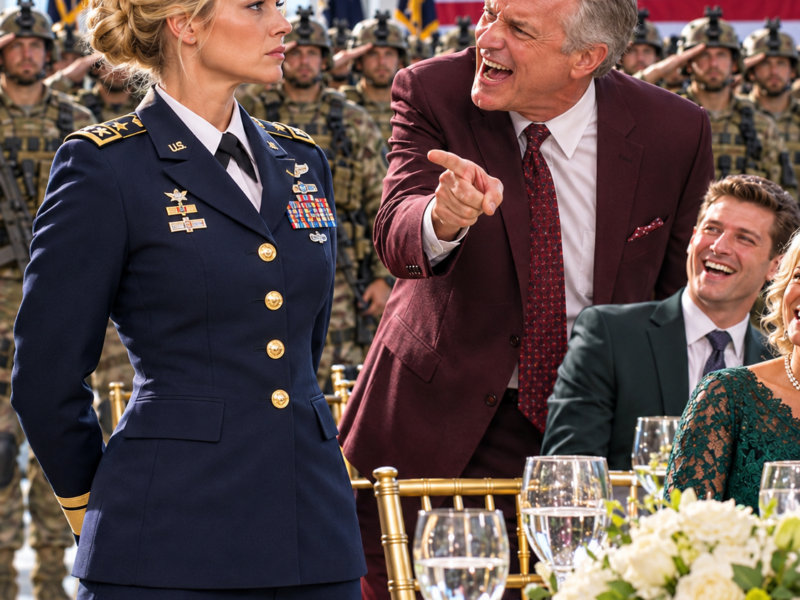
My father stood in front of four hundred motorcycle riders, pointed at my uniform, and laughed
Bear didn’t raise his voice.
He didn’t need to.
He looked at my father, then turned toward the four hundred riders gathered behind him.
“Everyone,” he said into the microphone. “Would you give me a moment?”
The crowd quieted.
Engines had already been switched off, but now even the conversations near the food tents stopped.
Bear faced me again.
“General Hayes, I apologize for the disrespect you’ve been shown.”
My father blinked.
“General?”
Bear nodded.
“Brigadier General Rebecca Hayes.”
The word traveled through the crowd like a sudden gust of wind.
A man near the front straightened.
Another removed his cap.
Then, one by one, several riders stood at attention.
My father stared at them.
“Wait. What?”
Bear continued.
“I served in the Army for thirty-one years. I’ve met a lot of officers. I’ve met a lot of leaders. And I know what it means when someone earns the trust of the people under their command.”
He turned toward the crowd.
“Some of you know General Hayes. Some of you don’t. But I want you to understand something. This woman has spent decades serving this country. She has led soldiers in dangerous places, made decisions that affected thousands of lives, and carried responsibilities most people will never understand.”
He paused.
“And she doesn’t need to prove any of that to anyone standing here.”
I felt my throat tighten.
I had spent years convincing myself that my father’s opinion no longer mattered.
But hearing someone acknowledge my service in front of him stirred something I hadn’t expected.
Bear handed me the microphone.
“Would you like to say something?”
I looked at the crowd.
Four hundred riders waited.
My father stood frozen beside the stage, his expression shifting between disbelief and embarrassment.
I could have used that moment to humiliate him.
I could have listed my assignments, awards, and deployments. I could have described the men and women I had lost.
Instead, I looked at the veterans.
“Thank you,” I said. “But today isn’t about my rank.”
I held up the folded flag.
“This belonged to my grandfather. He served during the Korean War. He taught me that wearing a uniform doesn’t make someone better than anyone else. It gives them a responsibility to serve people who may never know their name.”
I glanced at the older riders.
“Some of you served before I was born. Some of you came home to families who didn’t know how to talk about what you experienced. Some of you never received the welcome you deserved.”
A few heads lowered.
“I know what it feels like to have your service misunderstood. But I also know that the people who matter most are the ones who stand beside you when things become difficult.”
I returned the microphone to Bear.
The applause began quietly.
Then it grew.
Not the loud, theatrical kind my father usually encouraged at business events.
It was steady and sincere.
When I stepped away from the stage, a woman in a leather vest approached me.
She had a small Army insignia sewn above her club patch.
“General, my husband served with the 82nd,” she said. “He passed away last year. Thank you for remembering people like him.”
I shook her hand.
“He deserves to be remembered.”
More riders came forward.
Some wanted to thank me.
Others simply nodded.
My father watched from beside the stage.
For once, he had nothing to say.
But the day was far from over.
Michael approached me near the registration table.
“You could’ve warned us,” he muttered.
“Warned you about what?”
“That you’re a general.”
I stared at him.
“Why would I need to warn you?”
He looked toward our father.
“You know how he is. He gets carried away.”
“Michael, Dad has known what I do for twenty-four years.”
“He probably didn’t realize how far you’d gone.”
“He never asked.”
Michael took a sip from his glass.
“Look, this is embarrassing for him. Maybe you should just let it go.”
I studied my brother.
He had always been good at making other people’s discomfort sound like my responsibility.
“I’m not trying to embarrass him,” I said. “I’m just not going to pretend he didn’t embarrass me.”
Michael’s expression hardened.
“You always have to make everything about yourself.”
I almost answered.
Then I noticed my mother standing near the entrance to the catering tent.
She was watching us.
Her face looked tired.
I excused myself and walked over.
“Are you all right, Mom?”
She nodded, but her eyes were wet.
“I didn’t know Bear would recognize you.”
“I didn’t know either.”
She looked toward my father.
“He’s been telling people for years that you were just an administrative officer.”
I felt something tighten in my chest.
“Why didn’t you correct him?”
She looked down.
“Because every time I tried, he’d say I was making excuses for you.”
I waited.
She took a breath.
“I should have stood up for you.”
That meant more than any applause.
“Mom, you don’t have to explain everything today.”
“I do,” she whispered. “I’ve watched him dismiss your life for years because it was easier than disagreeing with him. And I’ve let you walk into this house knowing he might humiliate you again.”
I reached for her hand.
“You were trying to keep peace.”
“I was helping him keep control.”
Neither of us spoke for a moment.
Then she looked at the flag in my hands.
“Your grandfather would have been proud.”
I smiled.
“He would have told me to stop making such a fuss.”
She laughed through her tears.
“That sounds exactly like him.”
A little later, Bear invited me to sit with several veterans near the main tent.
They asked about my career, but not in the way my family did.
They didn’t ask how much I earned or whether my rank made me important.
They asked what I had learned from leading soldiers.
They asked what helped people adjust after deployment.
They asked whether younger service members were receiving the support they needed.
One former Marine named Curtis told me he had struggled for years after returning home.
“I thought I was supposed to handle everything myself,” he said.
“Did you eventually get help?”
“Eventually. Took me too long.”
I nodded.
“That’s one of the reasons these gatherings matter.”
Bear leaned forward.
“We’ve been trying to expand our veterans’ assistance program. Transportation to appointments, help with paperwork, support for families. We have volunteers, but we need someone who understands how to connect people with the right resources.”
He hesitated.
“Would you be willing to advise us? Not as a general. Just as someone who’s been around the system.”
I smiled.
“I’d be glad to help.”
He shook my hand.
“Then we’ll talk after the event.”
I didn’t realize my father had overheard.
He appeared beside the table a few minutes later.
“Rebecca, can we talk?”
Bear glanced at me.
I nodded.
We walked toward the far end of the parking lot, where the noise of the fundraiser was quieter.
My father folded his arms.
“You could have told me you were a general.”
I looked at him.
“I told you I was in the Army.”
“That’s not the same thing.”
“What did you think I did?”
He hesitated.
“Office work. Planning. Logistics. Something like that.”
“I commanded soldiers.”
“Why didn’t you explain?”
“I tried.”
He shook his head.
“You always made it sound complicated.”
I let out a slow breath.
“Dad, I sent you photographs from my commissioning ceremony. I told you when I was promoted. I invited you to my retirement-from-command ceremony at my previous assignment. You declined because Michael had a dealership opening that weekend.”
He looked away.
“I don’t remember that.”
“I do.”
He rubbed his forehead.
“You have to understand, Michael was here. He helped me build the business. I needed him.”
“And I wasn’t here because I was serving.”
“I never said that.”
“You didn’t have to.”
For several seconds, he stared at the pavement.
Then he said something I had never expected.
“I was afraid.”
I frowned.
“Of what?”
“Of you leaving. Of you getting hurt. Of you building a life that didn’t need me.”
I didn’t answer.
He continued.
“When you enlisted, I thought you’d change your mind. When you became an officer, I thought you’d eventually come home. Every time you got promoted, it felt like you were moving farther away.”
“So you decided to make my career sound small?”
His shoulders dropped.
“I didn’t know how to talk about it.”
“You could have asked.”
“I know.”
He looked toward the crowd.
“And Michael was always here. He needed me. The business needed me. I could understand that world.”
I studied him.
For the first time, I could see that some of his arrogance had been hiding something more complicated.
But understanding the reason didn’t erase the damage.
“You were proud of Michael because you could see what he was doing,” I said. “You never made the effort to understand what I was doing.”
He nodded slowly.
“I suppose I didn’t.”
Then he looked at my uniform.
“Are you really a brigadier general?”
I almost smiled.
“Yes, Dad.”
He swallowed.
“That’s quite an accomplishment.”
“It’s taken a long time.”
“I know.”
He looked down at his hands.
“I shouldn’t have said what I said today.”
“No. You shouldn’t have.”
“I thought people would laugh. I was trying to make a joke.”
“You were trying to make me smaller so Michael would look bigger.”
He opened his mouth, then closed it.
There was no convincing defense.
Finally, he said, “I’m sorry.”
I had imagined hearing those words for years.
I had imagined they would make everything feel different.
But they didn’t erase the birthdays he forgot, the promotions he ignored, or the times I returned from dangerous assignments only to be treated like a disappointment.
They were a beginning, not a cure.
“Thank you for saying that,” I replied.
He looked at me hopefully.
“So we’re all right?”
I shook my head gently.
“Not yet.”
His expression fell.
“I need you to understand that an apology doesn’t mean everything goes back to normal. If you want a relationship with me, you have to respect the person I actually am. Not the daughter you wanted me to become.”
He nodded.
“I can try.”
“Then start by not making jokes at my expense.”
“I won’t.”
We stood there for a moment.
Then my father looked toward the stage.
“Your grandfather would have been proud of you.”
I held the folded flag closer.
“I hope so.”
The fundraiser continued into the evening.
The Iron Vultures raised more money than they had expected, and Bear announced that the club would contribute additional funds to its veterans’ assistance program.
Before leaving, he approached me with a small wooden box.
“Something for you,” he said.
Inside was a silver challenge coin engraved with the club’s insignia on one side and the words Service Before Pride on the other.
I turned it over.
“Thank you.”
“It’s not for your rank,” he said. “It’s for the way you handled yourself today.”
I smiled.
“I appreciate that.”
He leaned closer.
“And General?”
“Yes?”
“Don’t wait so long before coming back to see your mother.”
I laughed.
“I won’t.”
The following weeks brought changes I hadn’t expected.
My father called.
At first, the conversations were awkward.
He asked about the weather near my assignment. He asked whether I was eating properly. Once, he even asked what my soldiers did during a typical training day.
It wasn’t much.
But it was more than he had asked in years.
My mother told me he had started attending the veterans’ support meetings.
He didn’t suddenly become a different person.
He still had opinions about everything.
He still interrupted people.
But he listened more often.
Michael took longer.
For a while, he avoided me.
Then he sent a message.
I didn’t know what Dad said to you all those years. I should’ve told him to stop.
I read it twice before replying.
You could have. But we can do better from here.
He didn’t answer immediately.
A few days later, he called.
We spoke for nearly an hour.
He admitted that he had enjoyed being treated as the successful son and hadn’t wanted to challenge the family arrangement.
“I thought you didn’t care,” he said.
“I cared. I just stopped asking you to notice.”
He was quiet.
Then he said, “I’m sorry.”
This time, I believed he meant it.
Not because everything had been repaired, but because he didn’t ask me to forgive him before he had finished listening.
Three months later, I returned home for another visit.
The dealership parking lot was empty when I arrived, but the veterans’ center next door was busy.
My father had helped convert an unused office into a small meeting room.
There were chairs, a coffee machine, shelves of information about veterans’ services, and a large board listing local support groups.
On the wall hung a photograph from the fundraiser.
I stood in the center, holding my grandfather’s flag.
Bear stood beside me.
Behind us were hundreds of riders.
My father had placed the photograph in a simple wooden frame.
Underneath it was a small plaque:
For everyone who served, everyone who came home, and everyone still finding their way.
He came out of his office when he saw me.
“I thought you’d like to see what we did with the space.”
I looked around.
“It’s good, Dad.”
“Bear helped organize it. Your mother handles the volunteer schedule.”
“Mom?”
“She said somebody had to make sure we didn’t spend the entire budget on coffee.”
I laughed.
My father smiled.
Then he became serious.
“I’ve been thinking about what you said.”
I waited.
“You spent your life trying to make me proud, and I spent too much of mine acting like you hadn’t done enough.”
I looked at him.
“I don’t need you to be proud of my rank.”
“I know.”
“I need you to be proud that I’m your daughter.”
He nodded.
“I am.”
For once, he didn’t add a qualification.
He didn’t compare me with Michael.
He didn’t turn the conversation toward the business.
He simply stood there and let the words remain.
I reached into my bag and took out the silver challenge coin Bear had given me.
“I want to leave this here.”
My father examined it.
“Why?”
“Because this room is about service, not status. And because I think you could use the reminder.”
He read the words engraved on it.
Service Before Pride.
Then he placed it on the counter.
“I’ll keep it here.”
That evening, we ate dinner at my mother’s house.
Michael came.
Bear stopped by for coffee.
My mother brought out an old photograph of my grandfather in uniform, and we spent an hour listening to stories none of us had heard before.
At one point, my father looked across the table at me.
“Rebecca?”
“Yes?”
“Would you tell us about your first command?”
I looked around the room.
Nobody was checking a phone.
Nobody was laughing.
Nobody was waiting to turn my answer into a joke.
So I told them.
I spoke about the soldiers who had trusted me, the mistakes that had taught me humility, and the people who had made it possible for me to keep going.
I didn’t tell every story.
Some belonged to the people who had lived them.
But for the first time, my family listened without making me feel that my life was something they needed to diminish.
Later, as I stood outside beneath the porch light, my mother came beside me.
“Your father is trying,” she said.
“I know.”
“Do you think things will be different?”
I looked through the window.
My father was laughing at something Michael had said.
“I think they already are.”
She slipped her arm through mine.
I had spent years believing that the greatest moment of my military career would be a promotion, a ceremony, or an award.
But that afternoon, standing before four hundred riders, I had learned something more important.
I didn’t need my father to call me a soldier.
I didn’t need a crowd to recognize my rank.
And I didn’t need to prove that my life had mattered.
I had served beside people who knew what sacrifice looked like.
I had led soldiers who trusted me.
I had carried the flag of a grandfather who taught me what duty meant.
That was enough.
Still, it meant something when my father finally looked at me without comparison or embarrassment.
A week before I returned to my command, he called me.
“I put your picture in the office,” he said.
“Which picture?”
“The one from the fundraiser. The one with the riders.”
I smiled.
“Why?”
There was a pause.
“Because I want people to know my daughter is a general.”
I looked down at the silver coin in my hand.
“Dad?”
“Yes?”
“Just tell them I’m your daughter.”
His voice softened.
“I can do that, Rebecca.”
And this time, I believed him.
The end.









