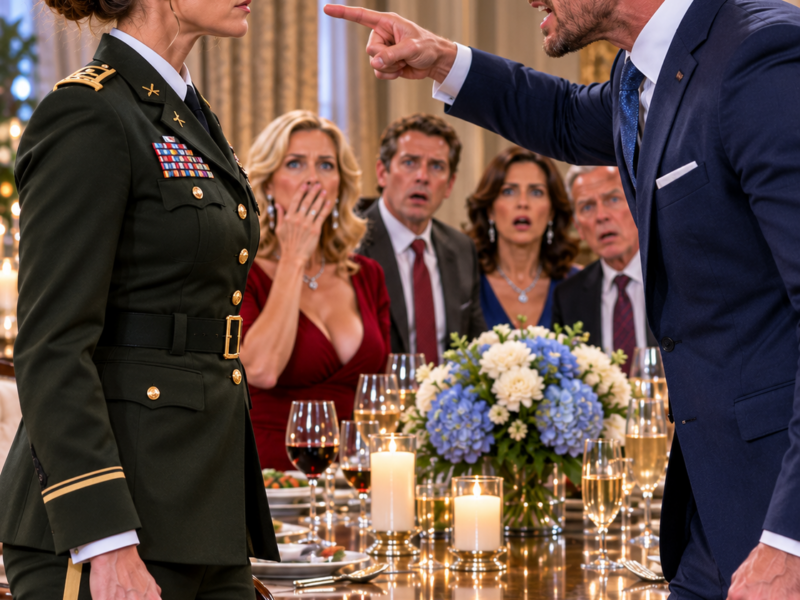
“My father called me a pathetic night guard in front of thirty wealthy guests, but when my sister’s fiancé recognized the three stars on my uniform
For several seconds, nobody at the table moved.
Daniel was still standing.
My father stared at him, waiting for the young judge to laugh and admit that he’d been making a joke.
But Daniel didn’t laugh.
He looked at me as if the next words out of his mouth might determine the rest of his career.
I placed my napkin beside my plate.
“Daniel, sit down.”
He obeyed immediately.
That small movement told my father more than any explanation could have.
“Evelyn,” he said slowly, “what is this?”
I looked at him.
“You tell me. You seem to know something about a document with my name on it.”
His eyes flickered toward Daniel.
Then toward my mother.
It was quick, but I caught it.
My father knew exactly what Daniel was talking about.
Rachel finally spoke.
“Dad? What document?”
“Nothing you need to worry about.”
Daniel’s expression tightened.
“Mr. Hayes, I don’t think you understand the seriousness of this.”
My father gave a short, irritated laugh.
“I understand that my daughter’s fiancé has apparently mistaken her for someone important.”
Daniel didn’t respond.
Instead, he reached into his jacket and took out his phone.
“Ma’am, may I show you something?”
I nodded.
He opened a secure message and turned the screen toward me.
The document was marked with a red classification banner.
At the top was the name of an operation I had not seen in almost four years.
OPERATION IRON VEIL.
Below it was a list of authorized command personnel.
My name appeared at the top.
Not as a consultant.
Not as an observer.
As the final authority for emergency intervention.
I read the page twice.
“Where did you get this?”
“It was distributed to the judicial panel this afternoon,” Daniel said. “We’re supposed to review the emergency jurisdiction procedures tomorrow.”
“Who distributed it?”
“The Northern Judicial Grid’s security liaison.”
“Name?”
“Deputy Director Malcolm Voss.”
I looked up.
“Voss is still in that position?”
Daniel hesitated.
“As far as I know.”
I handed the phone back.
My mother shifted in her chair.
“Would someone please explain what all this means?”
I didn’t answer her.
I was looking at my father.
“Why did you say the document had my name on it?”
He reached for his wine.
His fingers were unsteady now.
“I don’t know what you’re talking about.”
“Dad.”
“Don’t use that tone with me.”
For twenty years, that sentence had been enough to make me retreat.
It wasn’t anymore.
“Did you know Daniel’s court received a classified document naming me as emergency command authority?”
My father set his glass down.
“I said I don’t know.”
Daniel looked between us.
Then he asked something that made my stomach tighten.
“Sir, have you ever worked with Deputy Director Voss?”
My father’s face went still.
My mother turned toward him.
“Richard?”
He ignored her.
“I’m a retired regional infrastructure contractor,” he said. “I know a lot of people.”
Daniel nodded slowly.
“Your company was listed as a vendor on the original Iron Veil infrastructure proposal.”
The silence that followed was different from the earlier one.
This time, nobody was amused.
I looked at my father.
“What company?”
He stood.
“That’s enough.”
“Answer the question.”
“You don’t get to walk into my house after twenty years and interrogate me.”
I kept my voice level.
“Then don’t invite me into a room where my name is on a classified document.”
“I didn’t invite you.”
Rachel looked up sharply.
“You told me to invite her.”
My father turned toward her.
“Rachel, stay out of this.”
“You said it would be good for the family. You said we should all be together.”
Her voice trembled.
“Was that a lie?”
My mother reached for her hand.
“Sweetheart, this is not the time.”
Rachel pulled away.
For the first time that evening, she looked directly at me.
“Evie, what is happening?”
I wanted to tell her everything.
But I couldn’t.
Not because I didn’t trust her.
Because I still didn’t know what had brought us all to that table.
Twenty years earlier, my father had stood in the doorway of our childhood home with my two cardboard boxes at his feet.
I had just turned eighteen.
I had been accepted into a military academy program, and I wanted to leave for training instead of joining the family business.
My father called it an act of betrayal.
My mother called it a phase.
Rachel, then thirteen, stood halfway up the staircase with tears in her eyes.
I remembered asking my father for one more week.
Just one week to find somewhere to stay.
He had looked at the boxes and said, “If you’re old enough to make your own decisions, you’re old enough to live with them.”
Then he closed the door.
I slept in a friend’s car that night.
The next morning, I reported for training.
I never went back.
I had spent the years since then building a life that didn’t depend on his approval.
And eventually, I had earned a position that came with responsibilities I could barely explain to the people closest to me.
The Vanguard command wasn’t a private security agency.
It was a national emergency coordination authority created after a series of attacks exposed dangerous gaps between military, federal, and regional response systems.
Its command structure was deliberately small.
The three stars on my collar represented the highest operational level.
The insignia meant that, under specific emergency conditions, I could coordinate forces and agencies that normally answered to separate chains of command.
It did not make me above the law.
It did not make me a ruler.
It meant that when a crisis crossed jurisdictional boundaries, someone had to make decisions quickly enough to prevent people from dying.
And those decisions were reviewed afterward.
Every one of them.
The position had cost me friendships, sleep, and any hope of living a completely ordinary life.
But it had never cost me my sense of right and wrong.
At least, I had thought so.
Daniel leaned closer.
“Ma’am, I need to tell you something privately.”
I looked at Rachel.
“Can we use the study?”
My father moved immediately.
“No.”
Rachel stood too.
“Why not?”
“Because this is a family dinner.”
“Then stop acting like there’s something to hide.”
My mother looked at her daughter with disbelief.
“Rachel, please.”
But Rachel had already stepped away from the table.
“Come on, Evelyn.”
I followed her.
Daniel came behind us.
The study was at the end of the hallway, past the staircase where Rachel had watched me leave twenty years earlier.
The same framed family photographs still lined the wall.
In every picture, my place had been filled by a carefully arranged gap.
A holiday portrait.
Rachel’s high school graduation.
My parents’ anniversary.
There had been no photograph of me since I was seventeen.
Rachel closed the study door.
“Tell me what’s going on.”
Daniel took a breath.
“Earlier today, I received a sealed briefing packet. It concerned an emergency review of the Northern Grid’s judicial continuity procedures.”
“Why would judges need to review my command authority?”
“Because Iron Veil involves a coordinated response to threats against critical infrastructure. If the judicial system is disrupted, emergency orders have to be authenticated and routed through a secure authority.”
I frowned.
“That’s not unusual.”
“No. But the packet contained a proposed change to the authorization process.”
“What kind of change?”
Daniel hesitated.
“It would allow a private infrastructure contractor to submit emergency access requests directly to the regional command network.”
I stared at him.
“That is not permitted.”
“I know.”
“Who proposed it?”
“The document says the proposal originated from a technical advisory group.”
“Which company?”
He looked at me.
“Hayes Infrastructure Solutions.”
I felt a chill move across my shoulders.
“My father’s company?”
Daniel nodded.
Rachel covered her mouth.
“That can’t be right.”
I took the phone from Daniel and read the company name again.
My father had sold the business years ago, or so I had been told.
I had never asked for details.
“Is the company still active?”
“Not under that name,” Daniel said. “It was absorbed into a larger contractor two years ago.”
“Which one?”
“Northstar Strategic Systems.”
I knew the name.
Northstar had recently won several contracts involving communications infrastructure and emergency network maintenance.
I had reviewed its work in another capacity.
There had been concerns about access controls.
Nothing that had justified a formal intervention.
Not yet.
“Does the proposal have a technical review?”
“It’s scheduled for tomorrow.”
“Who signed it?”
Daniel brought up the final page.
There were three signatures.
One belonged to Deputy Director Voss.
One belonged to a Northstar executive.
The third was a private authorization reference.
I recognized the format.
It was an old Vanguard verification token.
My token.
But I had never signed the proposal.
“That’s forged,” I said.
Daniel nodded.
“I thought so.”
Rachel looked at me.
“Someone used your name?”
“Someone used my authorization reference.”
“Could Dad have done that?”
I didn’t answer.
I couldn’t accuse him without evidence.
But I could no longer pretend he was just a man who enjoyed humiliating his daughter.
“Daniel, did you approve the packet?”
“No. I flagged the authorization issue and requested a verification hearing.”
“When?”
“Tomorrow morning.”
I looked at him.
“That’s why you recognized me.”
“Yes.”
“And you were afraid because you thought I was here to take control of the hearing.”
He lowered his eyes.
“I was afraid because if the document is genuine, then someone has been trying to use your authority without your knowledge. If it’s forged, the person behind it may be trying to trigger a jurisdictional crisis.”
“Why didn’t you tell the security liaison?”
“I did. Voss told me the token was valid and instructed me to proceed.”
I felt my jaw tighten.
“Did he know you were engaged to Rachel?”
Daniel glanced at her.
“He asked about my family background last week.”
Rachel went pale.
“Why?”
“I thought it was routine.”
I looked at the closed door.
My father had not simply invited me to dinner.
He had placed me in front of a judge who was about to review a proposal bearing my forged authorization.
He had wanted to see how Daniel would react.
Or he had wanted to see whether I would recognize it.
Either way, the engagement dinner had become part of something much larger.
“Daniel, I need you to send the packet through the official verification channel. Do not forward it to anyone else.”
“I can do that.”
“Rachel, I need you to stay here.”
She shook her head.
“No.”
“Please.”
“You disappeared for twenty years because they made you feel like you didn’t belong here. I’m not going to stand in another room while they decide what happens to you.”
I looked at her.
She was no longer the thirteen-year-old on the staircase.
She was a grown woman who had finally chosen to speak.
“All right,” I said. “But if I tell you to leave, you leave.”
She nodded.
When we returned to the dining room, my father was standing beside the fireplace.
My mother had cleared the spilled wine.
The guests were pretending not to listen.
My father looked at Daniel.
“Are you finished with this nonsense?”
Daniel placed his phone on the table.
“No, sir.”
My father gave a humorless smile.
“You’re about to marry my daughter. I suggest you remember that.”
“I intend to marry Rachel,” Daniel replied. “That doesn’t mean I have to ignore evidence.”
My mother stood.
“Evidence of what?”
I stepped forward.
“Someone has submitted a proposal using my command authorization.”
My father’s expression barely changed.
“That’s ridiculous.”
“It’s a forged authorization.”
“Then report it.”
“I am.”
He shook his head.
“You’ve always had a talent for making simple things complicated.”
I looked at the guests.
“I apologize for bringing this into the evening. But I need everyone here to understand that no one should discuss the document, photograph it, or send it to anyone. It is part of a restricted review.”
One of Daniel’s relatives looked alarmed.
“Are we in trouble?”
“No. But I need you to leave your phones alone until the security liaison contacts you.”
My father laughed.
“Listen to her. She thinks she’s in charge of everyone.”
I turned to him.
“Tonight, I’m asking you to cooperate. That’s all.”
“And if I don’t?”
“Then the investigators will document that too.”
His smile disappeared.
For a moment, I saw something behind his anger.
Not fear of me.
Fear of what someone might discover.
The dinner ended without dessert.
Guests collected their coats and left in awkward silence.
Rachel stood near the front door, thanking people as they passed.
My mother remained beside the staircase.
My father went into his office and shut the door.
Daniel stayed with me.
“I’m sorry,” he said.
“For what?”
“For bringing your work into your family.”
“You didn’t.”
“I should have told you about the packet sooner.”
“You did the right thing by flagging it.”
He looked toward Rachel.
“I don’t want her caught in the middle.”
“Then don’t put her there.”
He nodded.
Rachel came over.
“I’m not leaving either of you.”
I looked at her.
“You don’t have to prove anything tonight.”
“I’m not proving anything. I’m telling you what I want.”
Her eyes were wet.
“I should have stood up for you earlier.”
I didn’t know what to say.
“I was scared,” she continued. “Every time I asked about you, Mom said you were unstable. Dad said you had chosen strangers over your family. Eventually I stopped asking.”
“You were thirteen.”
“I was old enough to know you were gone.”
I reached for her hand.
“You were a child, Rachel.”
“But I wasn’t a child forever.”
There was no easy answer.
So I squeezed her fingers.
“Let’s start with tomorrow.”
I stayed at a secure government residence that night.
I didn’t sleep much.
At 02:10, my phone rang.
It was Deputy Director Voss.
“General Hayes,” he said. “I understand you attended a private family gathering this evening.”
I sat up.
“Who told you that?”
“Your presence was reported.”
“By whom?”
“That’s not relevant.”
“It is if someone is monitoring my movements.”
He ignored the question.
“I’d like you to stand down from tomorrow’s review.”
“No.”
A pause.
“The authorization proposal is legitimate.”
“Then it can survive an independent audit.”
“Your personal involvement creates a conflict.”
“My authorization reference was used without my consent. That makes me a necessary witness.”
“You’re too close to this.”
“I’ll let the investigators determine that.”
His voice cooled.
“Be careful, Evelyn. The people involved in this program have spent years building it.”
“Then they should have built it properly.”
I ended the call.
A moment later, a secure message arrived.
It contained a photograph of my parents’ house.
Taken from across the street.
The time stamp was 23:48.
Beneath it was a single sentence.
“Family matters should stay in the family.”
I stared at the screen.
Then I forwarded it to the security team.
Whatever had begun at dinner was no longer limited to forged paperwork.
At 07:30, I entered the Northern Judicial Grid’s secure conference center.
Daniel was already there.
He looked tired, but steady.
Rachel had insisted on coming with him. She waited in the public reception area, outside the restricted briefing room.
The review panel included five judges, two federal security officers, and representatives from the emergency infrastructure authority.
Voss sat at the far end of the table.
He didn’t look surprised to see me.
“General Hayes,” he said. “I thought we agreed you would not participate.”
“We didn’t agree to anything.”
One of the federal officers opened the session.
“We are here to verify the authorization attached to the Northstar proposal and determine whether any emergency network access was improperly requested.”
Voss folded his hands.
“The authorization is valid.”
I placed my service token on the table.
“Then verify it against the live registry.”
The officer connected it.
A message appeared.
AUTHORIZATION REFERENCE: VALID.
Voss leaned back.
“There. I believe we can move on.”
I didn’t move.
“Check the signature time.”
The officer did.
His expression changed.
“That’s impossible.”
“What?” one of the judges asked.
“The token was used at 03:16 yesterday morning.”
I looked at the screen.
I had been aboard a government aircraft at that time, traveling between two secure facilities.
My token had been locked in a controlled case.
“Check the location.”
The officer opened the access log.
The signature had originated from a Northstar server.
Voss’s confidence slipped.
“That’s a routing artifact.”
“Then show us the original source,” I said.
He turned toward the officer.
“The system sometimes records intermediary locations.”
“Then the audit should establish that.”
The officer continued.
A second line appeared.
The authorization had been created using a duplicate credential.
Not my token.
A copied reference designed to imitate it.
The room went silent.
Daniel looked at me.
I kept my eyes on Voss.
“Who had access to the original credential format?”
Voss didn’t answer.
The federal officer closed the file.
“We’re suspending this proposal pending a full security investigation.”
Voss stood.
“You can’t suspend a national continuity program because of a clerical discrepancy.”
The senior judge spoke.
“This is not a clerical discrepancy. Someone has attempted to invoke emergency authority using a counterfeit credential.”
Voss looked toward me.
“You have no idea what this will cost.”
I met his eyes.
“Then perhaps you should have thought about that before using my name.”
The investigators moved quickly after the hearing.
Northstar’s servers were secured.
The contractor’s access credentials were frozen.
Voss was escorted to a separate interview room.
I didn’t celebrate.
A forged authorization was serious, but it was only one part of the problem.
We still needed to know whether the people behind it had already gained access to the emergency network.
At 10:42, the first alarm came in.
A regional communications center had received an unauthorized request to unlock a backup routing system.
At 10:46, another center reported the same request.
Then a third.
The requests carried the same counterfeit Vanguard reference.
Someone was trying to activate the system before the suspension took effect.
“Can they get in?” I asked the security officer.
“Not through the primary authentication layer.”
“What about the backup?”
He looked at his screen.
“It’s being tested.”
I turned to the operations team.
“Isolate the contractor interface. Keep the emergency channels operational. Do not shut down the entire network.”
A technician nodded.
“Understood.”
Daniel had been brought into the room as a judicial observer.
He stepped closer.
“Can I ask something?”
“Go ahead.”
“If the forged authorization was rejected, why keep sending it?”
“Because they may not be trying to gain full access.”
“What else?”
“Maybe they’re testing which centers still recognize the credential. Maybe they’re trying to create enough conflicting orders that no one knows which one is legitimate.”
He looked toward the screens.
“Could that trigger a judicial emergency?”
“Yes.”
The implications settled between us.
If emergency orders began arriving from competing sources, the courts could be forced to issue conflicting rulings.
That confusion could delay decisions when seconds mattered.
Someone had built a crisis that could make the system look incapable of protecting itself.
And they had used my name to start it.
At 11:03, the security officer found the source of the latest request.
A Northstar maintenance server.
The same server that had generated the false authorization.
I asked for the access history.
A user account appeared.
RICHARD.HAYES.
I stared at it.
My father’s name.
Daniel looked at me.
“Is that his account?”
“I don’t know.”
The officer opened the account details.
It had been created six months earlier.
The recovery address belonged to an email domain my father had used for his old company.
I felt the room narrow.
“Secure the account,” I said. “Don’t access it until the forensic team arrives.”
The officer nodded.
A few minutes later, my phone rang.
My mother.
I almost let it go to voicemail.
Then I answered.
“Evelyn,” she whispered. “You need to come home.”
“What’s happened?”
“Your father is in his office. There are people here.”
“Who?”
“I don’t know. They have identification, but he won’t open the door.”
“Are you safe?”
She hesitated.
“I’m in the kitchen.”
“Stay there. Don’t approach the office. I’m sending security personnel.”
“Evelyn, please. Your father says this is all your fault.”
I closed my eyes.
“Mother, listen to me. Do not let him convince you to interfere with the investigators.”
She began to cry.
“I didn’t know.”
I gripped the phone.
“Didn’t know what?”
“He said the company was just helping with communications. He said you had approved it.”
My stomach tightened.
“Who said that?”
“Your father.”
“Did he show you anything?”
“He showed me a letter with your name on it. He said you were finally going to help the family.”
I looked at the access record.
“Mother, where is the letter now?”
“In his office.”
“Don’t touch it.”
I ended the call and informed the security team.
Then I looked at Daniel.
“I need to go.”
He stood.
“I’ll come with you.”
“No. Stay here. The panel needs your testimony.”
“Rachel is at the house.”
I hesitated.
Then I nodded.
“Stay behind the security team. Don’t enter the office.”
When I arrived, two investigators were already at the house.
My mother stood in the kitchen doorway, clutching a dish towel.
She looked smaller than I remembered.
“Where is he?” I asked.
“His office.”
“Has he come out?”
“No.”
One investigator approached.
“General, we’ve asked him to open the door. He says he won’t speak without counsel.”
“That’s his right.”
“We have a warrant for the company records and electronic devices.”
“Then execute it properly.”
He nodded.
I stood in the hallway.
The old family photographs still lined the walls.
I was absent from all of them.
Behind the office door, I heard my father’s voice.
“Evelyn?”
I stepped closer.
“I’m here.”
“You did this.”
“No. I found it.”
“You have no idea what you’re destroying.”
“Then open the door and explain.”
A long silence followed.
Finally, the lock clicked.
My father stood in the doorway.
He looked older than he had at dinner.
His shirt collar was open, and his hair was untidy.
On the desk behind him sat a laptop, a stack of papers, and a framed photograph of the old family business.
He looked at my uniform.
“You always wanted to be better than us.”
I shook my head.
“I wanted to be allowed to leave.”
“You could have stayed.”
“You put my things outside.”
“You were eighteen. You were making a choice.”
“I was a child.”
“You were old enough to know what you wanted.”
“And you were old enough to know what you were doing.”
His eyes hardened.
“You think that uniform gives you the right to judge me?”
“No. The evidence does.”
He glanced toward the investigators.
“Those people don’t understand how this works.”
“Then help them understand.”
He looked back at me.
For a moment, I thought he might finally tell the truth.
Instead, he said, “I was trying to protect this family.”
I felt the words settle.
“From what?”
“From being forgotten. From losing everything.”
“You had a company. You had a home. You had two daughters.”
“And one of them walked away.”
“I walked away because you threw me out.”
He looked down.
It was the first time he had done that all evening.
“I thought you’d come back.”
I stared at him.
“After what?”
He didn’t answer.
An investigator stepped forward.
“Mr. Hayes, we need to secure the laptop.”
My father moved aside.
As the investigator approached the desk, a notification appeared on the screen.
A file transfer was still running.
The officer immediately disconnected the network cable.
“What’s being transferred?”
My father looked toward the laptop.
Then he looked at me.
“I don’t know.”
But his voice had changed.
The investigator opened the transfer log.
The destination was an external server registered to Northstar.
The file name was visible.
IRON_VEIL_FINAL_AUTHORIZATION.
My father sank into his chair.
The next several hours were spent in interviews.
My father eventually admitted that he had accepted money from a Northstar consultant to introduce the company to former infrastructure contacts.
He claimed he believed the work was legitimate.
He had signed access requests and allowed his old company credentials to be used.
He insisted he had never intended to compromise a national system.
But the evidence showed he had known the proposal carried my name.
He had also known that the credential was not genuine.
The investigators found an email in which he asked whether I would be present at the judicial review.
The reply was short.
“She will be useful if she recognizes the issue. If she does not, the record will show that she was aware of the proposal and failed to object.”
I read the message in silence.
They had planned for either outcome.
If I recognized the forgery, they could claim I had approved the original document and was now changing my story.
If I failed to recognize it, they could proceed with the false authorization.
The dinner had been a test.
My father had wanted to see whether I would notice.
And the humiliation had been part of it.
He had tried to make me look small before the one person in the room who knew what my insignia meant.
I wondered whether he had ever intended to apologize.
Or whether he had simply wanted to know how much power I had before deciding what I could do for him.
The answer hurt more than I expected.
The investigation continued for months.
Northstar’s executive team was charged with fraud, unauthorized access, and conspiracy related to the counterfeit emergency credentials.
Voss was removed from his post and later charged for his role in the scheme.
My father’s cooperation reduced some of the penalties he faced, but it did not erase his actions.
He pleaded guilty to knowingly providing access credentials and facilitating the false authorization process.
He was sentenced to probation, financial penalties, and a permanent ban from government contracting.
It was not the dramatic prison sentence some people expected.
It was the consequence supported by the evidence.
I didn’t attend the sentencing.
I had no desire to watch him stand in another room and explain why he thought the rules shouldn’t apply to him.
Daniel testified before the review panel.
He explained how he had recognized the insignia and why he had refused to approve the forged document.
The panel cleared him of any wrongdoing.
His career was not damaged.
If anything, his refusal to ignore the irregularity earned him the trust of colleagues who had previously considered him too young for difficult cases.
Rachel postponed the wedding.
Not because she stopped loving him.
Because she needed time to understand what her family had become.
Daniel waited.
He didn’t pressure her to make a decision.
That mattered.
My mother called me several times after the investigation.
The first conversations were awkward.
She asked about work.
She asked whether I was eating properly.
She asked if I still lived in government housing.
She didn’t ask about the night she let my father put my boxes outside.
Eventually, I told her I couldn’t keep pretending that those years had been ordinary.
She cried.
“I was afraid of him,” she said.
I sat quietly.
“So was I.”
“I thought you were strong enough to manage on your own.”
“I was eighteen.”
“I know.”
“No, Mother. You know now.”
She didn’t argue.
For once, she let the silence remain.
We didn’t repair twenty years in a single conversation.
We started with one honest one.
A month after the case closed, Rachel invited me to a small dinner at her apartment.
No chandelier.
No silver platters.
No formal seating plan.
Just four chairs around a kitchen table and a pot of pasta she had nearly burned.
Daniel opened the door when I arrived.
“General Hayes,” he said, smiling.
“Don’t start.”
“Sorry. Evelyn.”
Rachel came out of the kitchen and hugged me.
She held on longer than either of us expected.
“I should have stood up for you that night,” she whispered.
“You did eventually.”
“Not soon enough.”
I rested my cheek against her hair.
“We can’t change when we learned to be brave.”
She pulled back and wiped her eyes.
“I’m still sorry.”
“I know.”
We sat down to eat.
At one point, Daniel asked whether I would be wearing my uniform at the wedding.
Rachel rolled her eyes.
“Absolutely not. I want my sister, not a whole command structure.”
I laughed.
It was the first time I had laughed with my family in years.
“I’ll wear a dress.”
“Good,” she said. “And no work calls.”
“I can’t promise that.”
“Evelyn.”
“I’ll try.”
Daniel raised his glass.
“To trying.”
We clinked our glasses together.
The wedding took place six months later.
It was small, held in a garden outside the city.
Rachel wore a simple ivory dress.
Daniel looked nervous until she reached him.
I sat in the front row.
My uniform remained at home.
After the ceremony, Rachel came over and took my hand.
“I wish Dad could have been here,” she said.
I looked toward the garden gate.
My father had been invited to send a letter, but Rachel had decided she wasn’t ready to see him.
That was her choice.
I didn’t try to change it.
“Maybe someday,” I said.
She nodded.
Then she leaned her head against my shoulder.
“I missed you.”
I kissed the top of her head.
“I missed you too.”
Later that evening, I returned to my residence.
My uniform hung neatly in the closet.
The three stars caught the light.
For years, I had thought they were proof that I had become someone my father couldn’t dismiss.
But that wasn’t why I wore them.
They represented the people who trusted me to make difficult decisions.
The teams who worked through the night.
The pilots, judges, technicians, and officers who depended on one another even when they disagreed.
They were not a weapon to use against my family.
They were a responsibility.
My father had spent twenty years believing I had failed because I didn’t become the person he wanted.
I had spent too many of those years wondering whether he was right.
I no longer needed an answer from him.
My phone buzzed.
A message from Rachel.
“Next dinner is at my place. No uniforms. Just us.”
I smiled and typed back.
“Wouldn’t miss it.”
Then I turned off the light.
For the first time in a long time, I wasn’t thinking about the door my father had closed when I was eighteen.
I was thinking about the one my sister had opened.
The End.









