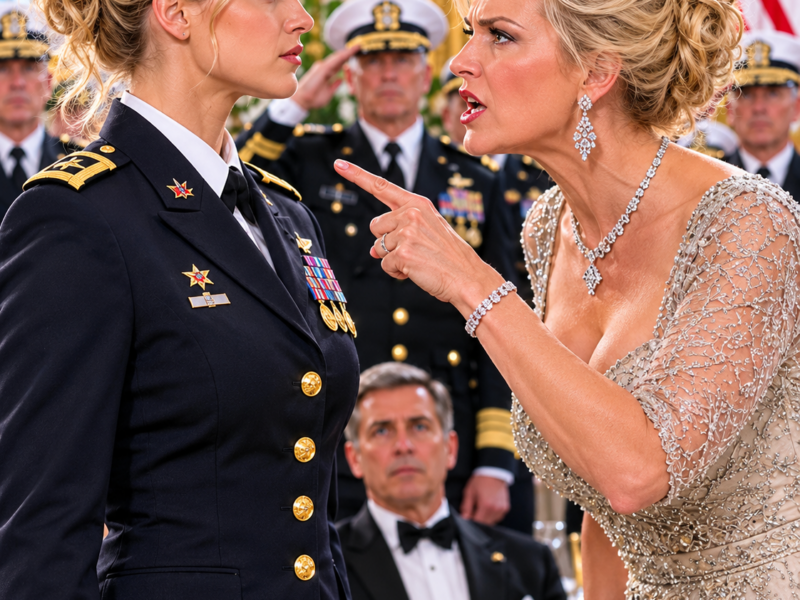
“My daughter plays dress-up in a uniform. Don’t ask her what she actually does. She’ll just tell you it’s classified.”
The White House protocol officer approached me just as the room began settling back into conversation.
“Lieutenant Commander Navarro?”
“Yes, ma’am.”
“It’s time to move to the staging area. The ceremony will begin shortly.”
I nodded.
My mother was still standing beside Aunt Patricia.
Neither of them had moved.
I glanced at Diane, waiting for something. An apology, perhaps. A question. Even a simple acknowledgment that what had just happened was unusual.
Instead, she looked at the Navy Cross ribbon on my uniform.
“Are you sure that’s what they’re giving you?” she asked.
I almost smiled.
“Yes, Mom. I’m sure.”
The protocol officer gestured toward the hallway.
I followed her.
Behind me, I heard Aunt Patricia whisper something. I couldn’t make out the words, but I recognized the tone. It was the same tone they used when they thought I was being unreasonable.
Commander James Wallace was waiting near the entrance to the staging area.
Everyone called him Wally.
He had served alongside me during the transition into the special aviation program, and he had a remarkable ability to know when someone needed a joke and when they needed silence.
He looked at my face.
“Everything all right?”
“Fine.”
He raised an eyebrow.
“That’s a convincing answer.”
“It’s the answer I’ve got.”
He nodded, accepting it.
Then he looked over my shoulder toward the reception room.
“Your family?”
“My mother and my aunt.”
“Big day for them.”
I considered that.
“I’m not sure they know that yet.”
Wally didn’t ask for an explanation.
He simply adjusted the cuff of his uniform.
“Well, the Navy knows. That’s why we’re here.”
We entered the staging area.
It was quieter than the reception hall. Staff members moved between tables, checking names and positions. A protocol officer reviewed the order of events. A photographer adjusted his equipment.
I found a chair near the wall and sat down.
My hands were steady.
That surprised me.
I had imagined being nervous. I had expected my heart to race, perhaps even a little shaking when the medal was placed around my neck.
Instead, I felt the same controlled stillness I had experienced before difficult missions.
There was a job to do.
I knew how to do it.
But my thoughts kept returning to my mother.
My father would have loved this room.
He would have recognized every uniform, every ribbon, every insignia.
He would have known which admiral had commanded which fleet and which aircraft carrier had been deployed where.
He would have understood the significance of the Navy Cross without anyone needing to explain it.
When I was a child, he used to take me to air shows.
He would stand beside me for hours, explaining aircraft until my mother finally called us both inside.
“Your daughter doesn’t need to know all that,” she would say.
My father would smile.
“Maybe she does.”
He never told me that I couldn’t do something because I was a girl.
He never suggested I should choose a more understandable career.
When I announced I wanted to fly fighter aircraft, he didn’t ask whether it was practical.
He asked what I needed to learn first.
That was the difference between my parents.
My father saw a future.
My mother saw a problem she needed to solve.
When I received my commission, Dad was the first person I called.
When I earned my wings, he cried.
When I made lieutenant commander at twenty-nine, he sent me a handwritten letter.
It was only four sentences.
You worked for this. Nobody handed it to you. Keep your standards high, keep your people safe, and never forget why you started.
I carried that letter in my desk for years.
After he died, I kept it in a small box with his old Navy photographs.
I wished he could have been there that afternoon.
Not because he would have understood every classified detail.
Because he would have known what it had cost to reach that moment.
“Commander?”
I looked up.
Wally stood beside my chair.
“You ready?”
I glanced at the clock.
“Ready.”
He gave me a small nod.
Then he leaned closer.
“For what it’s worth, your father would have been proud.”
I stared at him.
I hadn’t told him about the letter.
I hadn’t told him how much I missed Dad that afternoon.
Wally simply knew enough to understand.
I looked down at my hands.
“Thank you.”
He returned to his position.
A moment later, the protocol officer opened the doors.
“Lieutenant Commander Navarro, we’re ready for you.”
I stood.
And walked toward the ceremony.
The room was larger than the reception hall.
The ceiling rose high above rows of distinguished guests. Flags stood behind the ceremonial platform. Cameras lined the rear of the room.
There were senior military officers, government officials, members of the Navy leadership, and invited guests.
I could see my mother in the second row.
Aunt Patricia sat beside her.
My mother had stopped smiling.
She was sitting unusually straight, her hands folded tightly in her lap.
I did not look at her for long.
I focused forward.
The ceremony began with formal introductions.
Then the Chief of Naval Operations stepped to the podium.
Admiral Crane opened the citation.
His voice was calm and measured.
He read the date.
The location.
The mission.
He described the conditions facing the aircraft and the personnel involved.
He spoke about the decisions made under pressure, the risks accepted, and the actions that prevented a dangerous situation from becoming a tragedy.
He did not exaggerate.
He did not dramatize.
He simply read the facts.
And somehow, that made them more powerful.
He described how the situation had deteriorated during the operation.
How communication had become difficult.
How the available options had narrowed.
How eleven American personnel were placed in immediate danger.
Then he read the part I remembered most clearly.
The decisions made that night had not been easy.
There had been no perfect option.
There had only been a series of choices, each carrying consequences.
I remembered the cockpit.
The instruments.
The radio.
The darkness outside the canopy.
I remembered hearing voices that needed help.
I remembered knowing that if I made the wrong decision, eleven people might not come home.
I remembered the moment I committed.
And I remembered what happened afterward.
Eleven people survived.
Eleven families received phone calls that did not begin with the words nobody wants to hear.
The admiral continued reading.
He described my actions as courageous, decisive, and consistent with the highest traditions of naval service.
Then he reached the final sentence.
He announced that, for extraordinary heroism in combat, Lieutenant Commander Elena Navarro was awarded the Navy Cross.
For one second, the room was silent.
Then everyone stood.
The applause came like a wave.
I stepped forward.
Admiral Crane placed the medal around my neck.
He shook my hand.
“Congratulations, Commander.”
“Thank you, Admiral.”
The photographer took several pictures.
The Secretary of the Navy shook my hand next.
Vice Admiral Okafor gave me a brief nod.
Then I returned to my position.
I kept my eyes forward.
I did not search for my mother.
I didn’t need to.
For the first time in my life, I was standing in a room where nobody needed me to explain why my uniform mattered.
They already knew.
The ceremony lasted twenty-two minutes.
Afterward, guests began moving toward the reception area.
People approached me with congratulations.
Some were officers I had served with. Others were officials who had read the public citation. A few were people who had been involved in the operation, though I could not discuss the details with them in that setting.
They shook my hand.
They thanked me.
One older Navy captain placed a hand on my shoulder.
“Your father would have been proud.”
That nearly broke my composure.
I managed a quiet, “Thank you, sir.”
Wally appeared beside me with two glasses of water.
He handed me one.
“Drink.”
“I’m not dehydrated.”
“That’s not a request.”
I took the glass.
He smiled.
“You did well.”
“I stood in one place and listened to someone read.”
“You also spent years earning the right to stand there.”
I looked at the medal resting against my uniform.
The metal caught the light.
For a moment, I thought about all the things I could never explain publicly.
The people.
The decisions.
The fear.
The responsibility.
The hours spent replaying a moment and wondering whether another choice would have been better.
A medal could recognize an action.
It could not contain the entire experience.
But it didn’t have to.
It was enough that the people who understood had chosen to honor it.
I found my mother in the hallway outside the reception room.
She was standing alone.
Aunt Patricia was nowhere nearby.
My mother looked different now.
Not physically.
Her hair was still perfectly arranged. Her pearl necklace was still in place. Her dress was still the one she had chosen weeks earlier.
But something in her expression had changed.
She looked at the medal.
Then at me.
“I didn’t know,” she said.
I stood quietly.
“I know you didn’t.”
She swallowed.
“I didn’t know what you had done.”
I looked at her.
“You never asked.”
She nodded slowly.
“I know.”
For a moment, neither of us spoke.
Then she looked toward the ceremony room.
“When Admiral Crane spoke to you earlier, I thought perhaps he was just being polite.”
“He wasn’t.”
“I understand that now.”
I didn’t answer.
She took a breath.
“I said something terrible in front of those people.”
“Yes, you did.”
Her eyes lowered.
“I shouldn’t have called it dress-up.”
“No.”
“I didn’t mean to embarrass you.”
I considered that.
Maybe she hadn’t.
Maybe she had simply become so accustomed to dismissing my career that she no longer noticed how cruel her words sounded.
But intention did not erase the damage.
“I know you may not have meant to,” I said. “But you did.”
She looked at me again.
There was something unfamiliar in her face.
Not anger.
Not defensiveness.
Something closer to regret.
“I thought you were keeping me out of your life,” she said.
I was quiet for a moment.
“Some things I couldn’t tell you. But there were plenty of things I could have shared.”
“Like what?”
I almost laughed.
Not because it was funny.
Because the question had arrived eleven years too late.
“Like what it means to fly from a carrier. What my job was like. What it meant when I earned my wings. Why I moved into the special program.”
She listened.
“I could have told you about the people I worked with. The places I went. The responsibility I carried. I couldn’t tell you everything, Mom. But I could have told you enough.”
She nodded.
“I should have asked.”
“Yes.”
“I should have listened.”
“Yes.”
She looked down at the medal again.
“Do you go back soon?”
“In three days.”
“Back overseas?”
“Back to my assignment.”
She nodded.
Then she said something I hadn’t expected.
“I should have asked more questions before today.”
I studied her face.
For years, I had imagined this conversation.
In some versions, I told her everything she had done wrong.
In others, she apologized and I forgave her immediately.
In still others, she finally understood me so completely that every difficult year seemed to disappear.
But real life was not like that.
An apology did not erase eleven years.
And a medal did not repair a relationship.
I looked at her.
“There’s time.”
She seemed relieved by those two words.
But I hadn’t promised everything would be fine.
I had only left the door open.
There was a difference.
A few minutes later, Wally found me near the exit.
“Ready to leave?”
“Yes.”
He glanced toward my mother.
“Everything all right?”
“It’s complicated.”
He nodded.
“Most important things are.”
My mother approached us.
Wally offered a polite greeting.
“Ma’am.”
She returned it.
“Commander.”
Then she looked at me.
“Are you leaving now?”
“Yes.”
“May I come with you?”
I paused.
It was a simple question.
But it meant more than she probably realized.
“Of course.”
We walked through the exit together.
Outside, the afternoon air was cool.
The sky had turned gray, and the smell of rain hung over the street.
For a moment, I stopped and looked back at the White House.
The building stood exactly as it had when we arrived.
The same windows.
The same doors.
The same flags.
But I was not the same person who had entered that morning.
I had come hoping my mother would finally understand my career.
Instead, I had received something more complicated.
Recognition from the institution I had served.
A reminder of the father who had believed in me.
And a small, uncertain opening with the mother who had spent years misunderstanding me.
As we reached the car, my mother looked at the medal again.
“May I see it?”
I carefully lifted the ribbon from my chest so she could look.
She didn’t touch it.
She simply studied the medal.
“It’s beautiful,” she whispered.
I nodded.
“It means a lot.”
She looked up.
“I wish I had understood sooner.”
I didn’t tell her it was okay.
I didn’t tell her she had nothing to regret.
I simply said, “I wish that too.”
Then I got into the car.
During the drive, my mother sat quietly beside me.
For once, she didn’t talk about Aunt Patricia, my cousin Melissa, or what other people might think.
She didn’t complain about the reception.
She didn’t ask whether the medal would affect my salary.
She just looked out the window.
I rested my hand over the small case holding the Navy Cross.
Inside was the medal that represented a night I could never fully describe.
Eleven people had come home.
That was what mattered.
Not the applause.
Not the photographs.
Not the admiral’s handshake.
Not even the medal itself.
Those things were meaningful, but they were not the reason I had chosen this life.
I had chosen it because I believed in the people beside me.
Because I believed that when someone needed help, somebody had to be willing to go.
Because I knew that a uniform was not a costume.
It was a promise.
A promise to serve.
A promise to accept responsibility.
A promise to stand beside people who might never know how much you had risked for them.
My mother finally broke the silence.
“Will you tell me more about your work someday?”
I looked at her.
“Some of it.”
“Even if I don’t understand everything?”
“Especially then.”
She gave a small, uncertain smile.
“I can try.”
I looked back out the window.
For the first time that day, I believed she might mean it.
Three days later, I returned to my assignment.
The Navy Cross remained in its case, safely stored with the rest of my decorations.
My father’s letter was still in my desk.
I read it once before leaving.
You worked for this. Nobody handed it to you. Keep your standards high, keep your people safe, and never forget why you started.
I folded the letter carefully and put it back.
Then I went to work.
Because the ceremony was over.
The applause had ended.
The photographs had been taken.
And the responsibilities that mattered most were still waiting.
My mother and I did not suddenly become close.
She did not transform into the perfect military parent overnight.
There were still conversations we needed to have. There were still years of hurt that could not be repaired in one afternoon.
But a few weeks later, she called.
Not to ask about my pay.
Not to tell me what Aunt Patricia thought.
Not to compare my career with somebody else’s.
She called to ask whether I had eaten.
Then she asked how my day had been.
It was a small beginning.
But it was a beginning.
I don’t know whether she will ever understand everything I have done.
Some things will remain classified.
Some memories will remain mine.
And some parts of my life will always be difficult to explain to someone who has never stood where I stood.
But I no longer need my mother’s understanding to know the value of my service.
I know what happened that night.
I know the eleven people who came home.
I know what my father would have said.
And I know what that medal represents.
A uniform is not dress-up.
It is the most honest thing I own.
It says I went somewhere you didn’t see.
I did something I cannot always explain.
And if those eleven people needed me again, I would go.
The people who placed that medal around my neck understood that.
My mother is beginning to understand it too.
The rest is just time.
And sometimes, time is the only thing an apology can ask for.
The End









