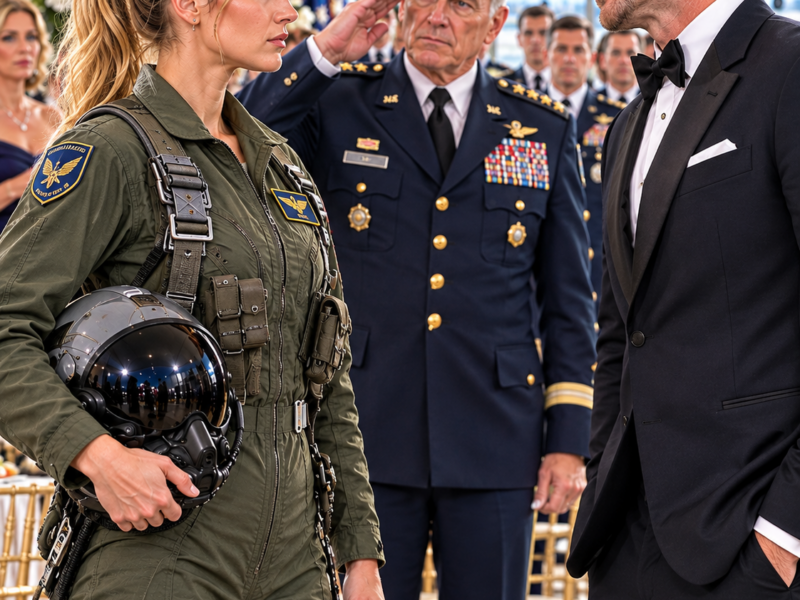
“My brother-in-law laughed loud enough for everyone at the Air Force retirement banquet to hear when he told me, ‘Real pilots only,’
I stared at the photograph on the table.
For several seconds, the banquet hall disappeared around me.
The image showed an F-15E Strike Eagle sitting on a runway at dusk, its nose pointed toward the fading orange light.
The aircraft’s identification number was visible beneath the cockpit.
I knew every inch of that jet.
I’d flown it on the night the photograph was taken.
But the handwriting on the back was what held my attention.
Ethan Cole.
My throat tightened.
Seven years earlier, Ethan had been my wingman, my closest friend in the squadron, and the one person who could tell when I was pretending to be fine.
He had also been the reason I stopped answering calls from almost everyone who knew me.
“Claire?” my father whispered.
I looked up.
General Whitaker pulled out the chair beside me and sat down.
“Perhaps we should move somewhere quieter.”
“No,” I said.
My voice came out steadier than I expected.
“If this concerns Ethan, I’d rather not have another conversation about him behind closed doors.”
The general studied me.
Then he nodded.
“Fair enough.”
Mark shifted uncomfortably.
“Excuse me, General, but I think there’s been some confusion. Ethan Cole was part of the 391st Fighter Squadron, wasn’t he?”
Whitaker looked at him.
“That’s correct.”
“I knew a few people in that unit.”
“Did you?”
Mark nodded quickly.
“Yes, sir. I worked with several aviation contractors supporting operations around that time.”
The general didn’t respond immediately.
Instead, he looked at the photograph again.
“Then you may remember what happened during the mission over northern Iraq on October 18, 2019.”
Mark’s expression changed.
Only slightly.
But I noticed.
So did my father.
“General,” I said quietly, “why are you bringing that up tonight?”
Whitaker folded his hands.
“Because your father’s retirement wasn’t the only reason I came here.”
He glanced toward the photograph.
“And because a personnel review recently uncovered information that should have been brought to your attention years ago.”
I felt my fingers curl against the edge of the table.
“What information?”
Before he could answer, Emily approached.
She had been standing near the back of the room, watching the exchange with increasing concern.
“Claire, what’s going on?”
I looked at her.
“Do you remember Ethan?”
She frowned.
“Your friend from the Air Force?”
I nodded.
“He died seven years ago.”
Emily’s eyes softened.
“I remember. You didn’t come home for Christmas that year.”
She paused.
“Mom said you were having a difficult time.”
I almost laughed.
Not because anything was funny.
Because that was the explanation my family had accepted for seven years.
A difficult time.
As though I’d lost a friend in an ordinary accident and simply needed a little space.
The truth was more complicated.
And much harder to carry.
On October 18, 2019, Ethan and I had been assigned to a mission supporting a ground unit operating near the Iraqi-Syrian border.
We were flying separate aircraft.
He was my wingman.
Our formation had been in the air for nearly three hours when we received an urgent request for support.
A convoy carrying American personnel had come under attack.
The weather was deteriorating, visibility was poor, and communication with the ground unit was breaking up.
Ethan had spotted a secondary threat near a ridge.
I told him to hold position.
He reported a damaged aircraft and asked for permission to disengage.
I remember the exact words he used.
“Falcon One, I’ve got a problem with my left engine.”
I ordered him to turn away from the threat.
Then the ground commander reported that several soldiers were pinned down.
We had a narrow window to help them.
I made a decision.
I diverted to cover the convoy while Ethan attempted to return to base.
For several minutes, everything appeared manageable.
Then his aircraft disappeared from our radar.
I called him.
Nothing.
I called again.
Still nothing.
I requested a search-and-rescue response, but the weather and hostile conditions delayed the operation.
By the time the recovery team reached the area, Ethan was gone.
His aircraft had crashed in rough terrain.
The official report later concluded that mechanical failure had contributed to the crash.
But there was another part of the report.
A recording of our final radio exchange had been used to suggest that I had delayed his withdrawal.
The implication was that I had prioritized the ground mission over my wingman’s safety.
I had followed the command structure.
I had acted on the information available to me.
But Ethan was dead.
And no explanation could change that.
The investigation cleared me of wrongdoing, but the questions never really stopped.
Some people thought I should have made a different decision.
Others believed I had done everything possible.
I stopped attending reunions.
I stopped discussing the mission.
Eventually, I requested a transfer.
My call sign became something I rarely heard outside official channels.
Until tonight.
General Whitaker tapped the photograph.
“Claire, the review found that the original mission recording was incomplete.”
I looked at him.
“What do you mean?”
“There was a second transmission.”
My mouth went dry.
“From whom?”
“Your wingman.”
I stared at him.
“That isn’t possible. We reviewed every available transmission.”
“We reviewed what was included in the investigation.”
He paused.
“The missing recording was recovered during a routine audit of archived communications.”
Mark shifted again.
“General, with respect, these old operational records can be difficult to interpret. There’s usually a reason certain material isn’t included in the final report.”
Whitaker turned his head.
“Indeed.”
Then he looked back at me.
“Which is why I’d like you to hear it before I explain anything else.”
He reached into a folder and removed a small digital recorder.
My father leaned forward.
“Thomas, what exactly are we listening to?”
The general took a breath.
“Something that may change how your daughter remembers the last flight she flew with Ethan.”
He pressed play.
Static filled the room.
Then a familiar voice emerged.
“Falcon One, this is Falcon Two. Do you copy?”
My hands went cold.
Ethan.
I hadn’t heard his voice in seven years.
“Falcon Two, I copy. State your condition.”
A burst of static.
Then his voice again.
“Left engine warning. Controls are responding. I’m attempting to disengage.”
My own recorded voice answered.
“Copy. Break east and return to base. I’ll cover your exit.”
There was a pause.
Then another voice entered the transmission.
Not mine.
Not Ethan’s.
A third voice, distorted but unmistakably deliberate.
“Falcon Two, disregard Falcon One. Continue south. Your route has been updated.”
I leaned forward.
“What?”
The recording continued.
Ethan sounded confused.
“Confirm the instruction source.”
No answer.
Then the third voice spoke again.
“Continue south. Do not return to base.”
I felt my stomach tighten.
That instruction had never appeared in the official investigation.
It had never appeared in any briefing I’d attended.
And it had certainly never been mentioned to me.
Ethan’s voice came through one final time.
“Falcon One, I’m getting conflicting instructions. Something’s wrong.”
Then the recording ended.
Nobody spoke.
My father stared at the device.
Emily covered her mouth.
Mark had stopped moving entirely.
I looked at the general.
“Who was that?”
“We don’t know yet.”
“You recovered the transmission. Surely you can identify the source.”
“We have narrowed it down to a ground relay connected to the operation’s communications network.”
“Who had access?”
“Several personnel.”
“Names, General.”
He hesitated.
That hesitation told me more than his words could have.
“One of the individuals involved was a civilian communications contractor.”
I looked toward Mark.
He had been staring at the recorder.
Now he looked at the floor.
The general noticed.
“Mr. Sullivan, does that mean something to you?”
Mark cleared his throat.
“No, sir. I was involved in a different support contract.”
“Which one?”
“I’d have to check my records.”
“Then I suggest you do.”
Mark forced a smile.
“General, I think we’re taking a leap here.”
Whitaker closed the folder.
“No accusations have been made. But the review team is examining every contractor who had access to the relay system.”
He turned toward me.
“Claire, there is one more thing.”
I waited.
“Ethan’s final flight data indicates that he may have been directed into an area different from the one he intended to reach.”
I looked at the photograph.
The name on the back seemed darker now.
“Are you saying someone redirected him?”
“I’m saying the evidence raises that possibility.”
For seven years, I’d carried the belief that my decision had cost Ethan his life.
Now someone was suggesting that the decision itself might not have been mine to make.
My father reached for my hand.
“Claire.”
I squeezed his fingers.
“Why didn’t anyone tell me?”
The general’s face tightened.
“Because we didn’t know. The missing data was misfiled, and the original communications contractor had been dissolved after the operation.”
“Who was the contractor?”
Whitaker opened the folder again.
“Northstar Defense Communications.”
Mark’s jaw tightened.
I looked at him.
“That’s the company you work for.”
He didn’t answer.
Emily turned toward her husband.
“Mark?”
He finally looked up.
“That was years ago.”
The words came out too quickly.
General Whitaker remained calm.
“Mr. Sullivan, did you work on the October 2019 communications contract?”
Mark straightened.
“I was a junior systems liaison. I didn’t make operational decisions.”
“Nobody has suggested that you did.”
“Then I don’t see why I’m being questioned.”
“Because your name appears in the archived access records.”
Emily stared at him.
“You told me you didn’t start working with Northstar until 2021.”
Mark looked at her.
“I said I moved into the position in 2021.”
“That’s not what you told me.”
“Emily, this isn’t the place.”
For the first time that evening, I saw something different in my brother-in-law’s face.
Not arrogance.
Fear.
The general closed the folder.
“I’d like to speak with you privately tomorrow, Mr. Sullivan. Please bring any relevant records.”
Mark nodded stiffly.
“Of course, sir.”
But his eyes never left the photograph.
The banquet ended early for our family.
My father insisted on driving me back to my hotel.
Emily went home with Mark, although she barely spoke to him.
I sat in the passenger seat, watching the lights of the base pass across the windshield.
After several minutes, Dad finally said something.
“Why didn’t you tell me what happened to Ethan?”
I looked out the window.
“You knew he died.”
“I knew you lost someone.”
He paused.
“I didn’t know you blamed yourself.”
I swallowed.
“I was his flight lead, Dad. I made the decisions.”
“That doesn’t mean you controlled everything that happened.”
I wanted to believe him.
But for seven years, I’d been living with the opposite.
At the hotel, I found three missed calls from Emily.
I called her back.
She answered immediately.
“Claire, I need you to tell me what happened.”
“About the mission?”
“About Mark.”
I sat on the edge of the bed.
“What do you mean?”
“He said the general misunderstood his role. He said he only handled routine communications.”
I said nothing.
Then she added, “But he was working for Northstar in 2019. I found an old tax document in our home office.”
I closed my eyes.
“Emily, don’t confront him until you know what you’re dealing with.”
“Why?”
“Because I don’t know whether he was involved in anything.”
She took a shaky breath.
“Claire, I think he’s been lying to me.”
I couldn’t offer her a comforting answer.
Neither of us slept much that night.
The following morning, General Whitaker arranged a meeting at the base.
I arrived at 8:30.
My father came with me.
Emily arrived ten minutes later, carrying a thin folder.
Mark did not come.
Whitaker met us in a secure conference room.
There were two officers from the review team and a civilian investigator.
On the table sat a laptop, several printed communications logs, and a photograph of the same F-15.
The general began without ceremony.
“We’ve confirmed that the third transmission originated from a relay station assigned to Northstar Defense Communications.”
He placed a document in front of me.
“The access credentials used to issue the instruction were assigned to a terminal operated by Mr. Sullivan.”
I stared at the page.
“You’re certain?”
“The credentials were active under his account.”
Emily looked down.
The investigator spoke carefully.
“That does not establish who physically entered the instruction. The credentials could have been shared, compromised, or accessed by another authorized employee.”
I appreciated that distinction.
For all my anger, I didn’t want an innocent person blamed because the evidence happened to point in his direction.
“Where is Mark now?” Emily asked.
“He’s been contacted and asked to cooperate,” the investigator replied.
“Has he?”
“He has not yet provided a statement.”
Emily opened her folder.
“I brought something.”
She removed an old photograph of Mark standing beside a younger man in front of a building.
I recognized the company logo on the glass entrance.
Northstar.
“Mark kept this in his desk,” she said. “I found it last night.”
The investigator examined it.
“Do you know the other individual?”
Emily nodded.
“He was Mark’s supervisor. Daniel Reeves.”
General Whitaker exchanged a glance with the investigator.
“Reeves is already part of the review.”
The investigator pulled up another document.
“Mr. Reeves was responsible for approving access permissions on the relay system. He left Northstar in 2020.”
“Where is he now?” I asked.
“He’s been located. He has agreed to an interview.”
I leaned back.
For the first time, I could see a path toward understanding what had happened.
It wasn’t yet a path toward justice.
That would take time.
But it was something.
Then the general opened another file.
“There’s a detail I think you should hear.”
He played a second recording.
This one was shorter.
The same static.
The same unfamiliar voice.
But after the instruction to continue south, Ethan spoke again.
“Falcon One, I have a visual on the relay signal. It’s coming from the ridge.”
My breath caught.
The recording continued.
“I think someone’s using our channel.”
Then a pause.
A faint alarm sounded in the background.
“Falcon One, I need you to know something. I didn’t follow the instruction. I’m turning east.”
The transmission broke apart.
A moment later, Ethan’s voice returned.
“Tell my sister I tried to get home.”
I covered my mouth.
I hadn’t known about his sister.
I’d never met her.
And I had spent seven years believing his final moments had been spent obeying an instruction I had given him.
The investigator stopped the recording.
My father placed a hand on my shoulder.
“Claire, breathe.”
I did.
But it felt as though the room had become too small.
The general waited until I looked up.
“There’s no evidence that Ethan knowingly disobeyed you. The flight data suggests he attempted to return east after recognizing the unauthorized transmission.”
“Then what caused the crash?”
“We’re still examining the aircraft data.”
He paused.
“But the new information supports the conclusion that the original investigation was incomplete.”
I stared at the recording device.
For seven years, I’d replayed my own final instructions in my head.
Turn east.
Return to base.
I’ll cover your exit.
I’d wondered whether I should have said something else.
Now I was hearing Ethan’s voice again, not as a casualty in a report, but as the friend who had tried to make it home.
The meeting continued for another hour.
The review team explained that the matter had been referred to the appropriate military authorities and federal investigators.
No one promised an easy answer.
No one declared Mark guilty.
And I was grateful for that.
I had spent too much time living with assumptions.
I didn’t want another person’s life destroyed by one.
But I also knew the truth had to be uncovered.
That afternoon, Emily and I met at a small coffee shop outside the base.
She sat across from me, stirring a cup of coffee she barely touched.
“I don’t know who I married,” she said.
I reached across the table.
“You don’t have to decide everything today.”
She looked at me.
“Did you know he was like this?”
“No.”
“Did you suspect?”
I considered the question.
“I knew he liked being important. I knew he sometimes exaggerated his work. But I didn’t know about Northstar.”
She nodded slowly.
Then her eyes filled.
“All those times he made fun of your career…”
I looked down at my coffee.
“I didn’t need him to understand it.”
“But he made you feel like you had to prove yourself.”
I didn’t answer.
She reached for my hand.
“I’m sorry I didn’t stand up for you.”
That hurt more than Mark’s insults.
Because she was my sister.
And because I knew she hadn’t meant to abandon me.
“I should have told you more,” I said.
“Maybe. But you shouldn’t have had to earn the right to be treated with respect.”
We sat quietly for a while.
Then she asked about Ethan.
Not about the mission.
Not about the investigation.
About the person.
So I told her.
I told her how he used to bring terrible coffee to early briefings because he insisted the machine on the second floor made it stronger.
How he kept a handwritten list of every city he wanted to visit after leaving the military.
How he once spent an entire afternoon helping a young mechanic fix a broken motorcycle.
How he called his younger sister every Sunday.
Emily listened without interrupting.
When I finished, she wiped her cheek.
“He sounds like someone I would have liked.”
“You would have.”
For the first time in years, I didn’t feel the need to stop talking when his name came up.
The investigation lasted another five months.
During that time, I was interviewed several times.
The recovered communications logs were compared with the aircraft’s flight data and the original mission recordings.
The evidence eventually showed that Daniel Reeves had used unauthorized access to manipulate the relay instructions.
He had redirected Ethan’s aircraft toward a different route while making the transmission appear to come from an authorized source.
Why?
Because Reeves had been concealing a serious failure in Northstar’s communications security system.
An earlier breach had exposed the relay network to outside interference.
Rather than report the vulnerability, he had attempted to control the situation himself.
When the operation became chaotic, he issued instructions he had no authority to give.
Those instructions contributed to Ethan being diverted into dangerous terrain.
The evidence also showed that Reeves had later altered access logs and withheld the complete transmission from the original review.
Mark’s role was more complicated.
He had been a junior systems liaison with access to the terminal.
The investigation found that Reeves had used Mark’s credentials to send the unauthorized transmission.
Mark had noticed unusual activity that night.
He had also received an internal message the following morning warning employees not to discuss the incident outside the company.
Instead of reporting the suspicious activity, Mark had accepted Reeves’s explanation that the system had malfunctioned.
He had remained silent.
Not because he had ordered Ethan into danger.
Not because he had wanted him dead.
But because admitting what he had seen could have cost him his job and damaged the career he was trying to build.
That silence had helped conceal the truth.
And for seven years, it had allowed people to question my decisions while the person who knew something was wrong continued attending family dinners.
When the final report was released, Reeves was charged with offenses related to the unauthorized transmission and the deliberate concealment of operational records.
Mark cooperated with investigators.
He provided internal messages and access records that helped establish what Reeves had done.
His cooperation mattered.
So did his failure to speak up when he first had the chance.
The company terminated his employment.
His professional future became uncertain.
But the hardest consequences were waiting at home.
Emily moved into a small apartment near her workplace.
She didn’t announce a divorce immediately.
She simply needed space to understand how much of her marriage had been built on stories Mark had told her.
One evening, she called me.
“He wants to see you.”
I was quiet.
“Why?”
“He says he owes you an apology.”
I looked at the photograph of Ethan on my desk.
The one General Whitaker had given me after the investigation concluded.
“Does he understand what he’s apologizing for?”
“I think so.”
I didn’t answer immediately.
Then I said, “I’ll meet him. But I’m not promising him forgiveness.”
Emily said she understood.
We met at a quiet restaurant near her apartment.
Mark arrived ten minutes early.
He looked different without his polished contractor’s jacket and confident smile.
His hair was untidy.
His eyes looked tired.
He stood when I approached.
“Claire.”
I sat across from him.
For a while, neither of us spoke.
Then he said, “I owe you an apology.”
I waited.
“I knew something was wrong that night. I didn’t know exactly what Reeves had done, but I knew the instructions coming through the relay weren’t right.”
“How long did you know?”
“Not long. A few minutes. Then the system logs were changed.”
“And you said nothing.”
He looked down.
“Yes.”
“Why?”
His fingers moved around the edge of his water glass.
“I was twenty-nine. I had just started getting serious responsibility. Reeves told me that if I reported an issue without proof, I’d be finished in the industry.”
“So you protected your career.”
“Yes.”
“And let everyone believe I had made the wrong decision.”
He closed his eyes briefly.
“I didn’t know the report would blame you.”
I leaned forward.
“But when you found out, you still said nothing.”
He nodded.
“Yes.”
The answer was small.
It was also the first honest thing he’d said to me.
I looked at him for a long moment.
“Do you know what seven years feels like when you believe your decision got your friend killed?”
He didn’t speak.
“I stopped talking about flying. I stopped visiting people who knew Ethan. I changed assignments because I couldn’t stand hearing his name.”
My voice began to shake.
“And you sat at family dinners making jokes about whether I was a real pilot.”
Mark stared at the table.
“I was ashamed.”
“That doesn’t make it better.”
“I know.”
He took a breath.
“I think I kept telling myself that you didn’t know anything about my work, so you couldn’t possibly understand what happened. And then every time I saw you, I felt like you were a reminder of what I’d done.”
I looked at him.
“So you made me smaller to make yourself feel bigger.”
He didn’t deny it.
For once, he didn’t try to explain his way out of something.
“I’m sorry,” he said.
I believed he was sorry.
I wasn’t sure he understood the full weight of what he had done.
Those were different things.
“I don’t hate you, Mark,” I said. “But I don’t trust you.”
He nodded.
“I understand.”
“I hope you learn to live with the truth without making someone else carry it for you.”
He looked up.
“Will you ever forgive me?”
I stood.
“That’s not something I can promise you today.”
He didn’t stop me.
And I didn’t look back.
A month later, I traveled to Colorado to meet Ethan’s younger sister, Rachel.
General Whitaker had helped locate her after the review.
She was thirty-two, worked as a physical therapist, and had kept a small collection of her brother’s belongings in a wooden box.
When she opened her front door, she looked at me for a long moment.
Then she smiled sadly.
“You’re Claire.”
I nodded.
“Yes.”
She stepped forward and hugged me.
“I’ve wanted to meet you for years.”
We sat in her living room.
She brought out photographs, letters, and a folded piece of paper Ethan had written during his final leave.
It was a list of places he wanted to visit.
Seattle.
New Orleans.
The Grand Canyon.
A little town in Maine he’d seen in a travel magazine.
At the bottom, he’d written:
Somewhere with terrible cell service and excellent pie.
I laughed.
Then I cried.
Rachel smiled through her own tears.
“That sounds like him.”
I told her about the recovered recording.
I told her he had tried to return east.
I told her the truth was finally being acknowledged.
She listened with both hands wrapped around a mug.
When I finished, she asked one question.
“Did he know you were trying to protect him?”
I thought about the final radio exchange.
About the moment he had said something was wrong.
About all the years I’d spent wondering whether he had understood my decision.
“Yes,” I said.
“I believe he did.”
Rachel nodded.
Then she reached into the wooden box and handed me a small envelope.
“I think he would have wanted you to have this.”
Inside was a photograph of Ethan and me standing beside our aircraft.
We were both wearing flight suits.
His arm was draped over my shoulder.
I was laughing at something outside the frame.
On the back, in his handwriting, were five words.
Don’t let one bad night define you.
I sat very still.
“Where did he get this?”
“He sent it to me before the deployment. He said you’d probably argue with him about the picture because your hair looked terrible.”
I laughed through my tears.
“He’s right.”
Rachel leaned forward.
“He talked about you all the time. Not just as his flight lead. As his friend.”
I looked at the photograph again.
For seven years, I’d remembered Ethan through the final minutes of his life.
The crash.
The radio silence.
The unanswered calls.
But he had been so much more than that.
He had been a man who made plans for road trips.
A brother who called every Sunday.
A pilot who complained about bad coffee.
A friend who believed I could handle more than I thought possible.
I had let the worst night of our lives become the only part of him I could remember.
That afternoon, Rachel and I went to a small park near her home.
We sat on a bench and talked about ordinary things.
For the first time in years, I felt no need to rush away from the conversation.
When I returned to Virginia, my father was waiting at the airport.
He had brought two cups of coffee.
“One is yours,” he said. “I remembered how you take it.”
I accepted the cup.
“Black?”
“Still.”
We walked toward the parking garage.
After a few steps, he said, “I’ve been thinking about something.”
“What?”
“I spent years being proud of your service without really knowing what you carried home.”
I looked at him.
“You didn’t have to know everything.”
“Maybe not. But I should have asked more.”
I slipped my arm through his.
“You were busy being Dad.”
He smiled faintly.
“That’s not a bad excuse.”
“No. It’s not.”
At the next retirement gathering, the Air Force invited me to attend as a guest speaker.
I almost declined.
Then I remembered my father’s words from the banquet.
He wanted his daughter beside him.
So I went.
This time, I wore my uniform.
My flight wings rested above my left pocket.
My call sign was displayed on a small nameplate beneath my ribbons.
FALCON ONE.
I stood at the podium and looked out at the audience.
There were young pilots, retired officers, families, and a few people who had served alongside me.
My father sat in the front row.
Emily was beside him.
Their marriage was still uncertain, but she had started counseling and was rebuilding her life on her own terms.
Mark wasn’t there.
I didn’t know whether he would ever earn his way back into the family.
That decision belonged to the people he had hurt.
I began my remarks by talking about teamwork.
Not the glamorous version people see in recruiting videos.
The real kind.
The kind that depends on trust, honest communication, and the willingness to speak up when something doesn’t look right.
I didn’t mention Mark.
I didn’t need to.
I didn’t turn Ethan into a symbol or pretend his death had become easier to understand.
I simply told the audience that the truth matters, even when it arrives years late.
Especially then.
After the event, a young female lieutenant approached me.
She looked nervous.
“Ma’am, may I ask you something?”
“Of course.”
“How did you handle being underestimated?”
I considered giving her the polished answer people expect from someone standing at a podium.
Instead, I told her the truth.
“Some days, I handled it badly. Some days, I let it get to me. And some days, I spent too much energy trying to prove something to people who had already decided what they thought.”
She nodded.
“How did you stop?”
I glanced toward my father, who was speaking with another retired officer.
“Eventually, I realized the people who mattered didn’t need me to perform my worth for them.”
She smiled.
“Thank you, ma’am.”
As she walked away, General Whitaker approached.
“Falcon One.”
I turned.
“General.”
He extended his hand.
“I should have pushed harder to reopen the review sooner.”
“You didn’t have the missing recording.”
“No. But I knew you were carrying more than you let people see.”
I shook his hand.
“Thank you for bringing the truth forward.”
He nodded.
“Thank you for being willing to face it.”
Later that evening, I returned to my father’s house.
The old photograph of Ethan and me sat on the kitchen counter.
Dad had placed it in a simple wooden frame.
I picked it up.
For a moment, I thought about the banquet.
Mark’s smirk.
The laughter.
The way he’d told me that real pilots only belonged in that room.
I remembered how quickly his confidence had disappeared when the general spoke my call sign.
But that wasn’t the moment I wanted to remember.
I wanted to remember Ethan laughing beside the aircraft.
I wanted to remember my father’s hand on my shoulder.
I wanted to remember the young lieutenant asking whether it was possible to keep going when people underestimated you.
Because the truth was, my worth had never depended on Mark’s opinion.
It hadn’t depended on the general recognizing me.
It hadn’t even depended on the call sign painted beneath my name.
I had been Falcon One long before anyone in that banquet hall knew what it meant.
And for the first time in seven years, I could look at the sky without hearing the last transmission as the only thing that mattered.
I placed Ethan’s photograph beside my father’s retirement picture.
Two men in my life had taught me different kinds of courage.
One had taught me how to fly.
The other had taught me how to keep flying when the past tried to pull me down.
That night, I turned off the kitchen light and left the photographs where they were.
I no longer needed to hide the people, the memories, or the truth that had shaped me.
Some things deserved to be remembered exactly as they were.
And some burdens were never supposed to be carried alone.
THE ENd.









