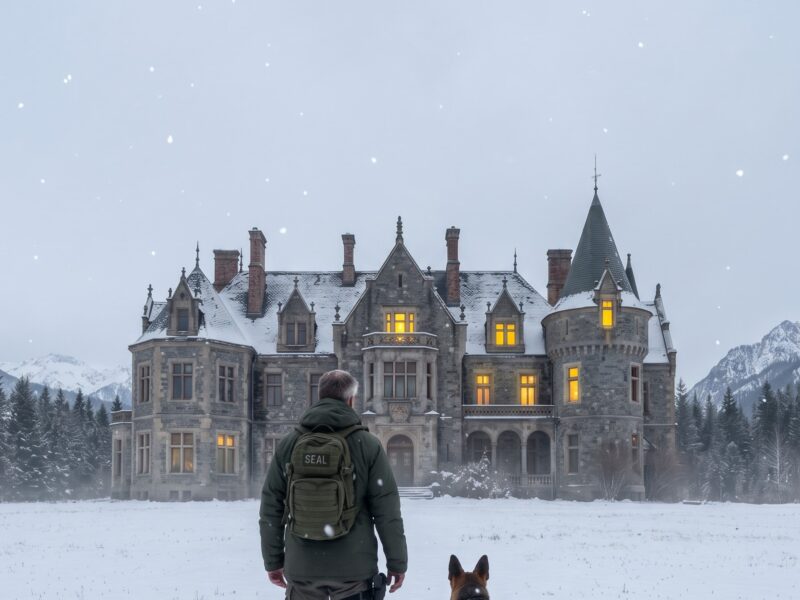
My brother handed me the keys to a frozen mansion in Montana and laughed as he told me I had inherited “a useless pile of snow,”
The mansion stood alone beneath a violent winter sky, its windows dark and its massive timber roof buried under two feet of fresh Montana snow. I had not seen the place since I was a child, back when the air was filled with my father’s roaring laughter and the smell of burning cedar in the double-sided stone fireplaces. Now, the grand estate felt less like a home and more like a mausoleum carved from black oak and granite, towering over the frozen pine forests of the Bitterroot Valley.
My father had owned the place, but after his sudden death six months ago, my family made it abundantly clear that the estate was a worthless, money-draining husk. They told me the bank accounts were drained, the investments liquidated to clear staggering tax debts, and that there was nothing left to divide.
Apparently, they had been wrong. Or maybe they had simply spent the last six months ensuring I would believe that lie.
My older brother, Daniel, handed me the heavy iron keys outside the padlocked front gate, his breath puffing into thick white clouds in the sub-zero air. He didn’t even turn off the engine of his oversized black SUV.
“Enjoy your inheritance, Leo,” he said, stepping back and leaning against his driver’s door. “Consider it a gift from the family. It’s all yours.”
His smile told me exactly what he thought of me—a broken former military contractor living on a disability stipend, clinging to a past that had left me crippled and isolated.
I looked up at the enormous, shadowed house sitting five hundred yards up the winding driveway. “If it’s such a burden, you could have sold the land. The timber alone is worth half a million.”
“Nobody wants it,” Daniel scoffed, pulling his leather gloves tight over his knuckles. “The property taxes are three years overdue, the plumbing is likely burst, and the county wants to condemn the structure. Dad died penniless, little brother. That place is just a useless pile of snow and rotting timber. Keep it, burn it down, or freeze in it. We don’t care.”
He didn’t wait for a reply. Daniel slid back into the heated leather interior of his SUV, shifted into reverse, and slammed his foot on the accelerator.
I stood in the silence of the rising blizzard with my German Shepherd, Ranger, watching Daniel’s red taillights disappear into the blinding swirl of white down the mountain road.
Ranger pressed his warm flank against my leg. He had served beside me through two deployments with Special Boat Team 22, tracking insurgents through sweltering river deltas until an IED blast in Helmand Province took half his hearing and shredded my left knee. He was older now, his muzzle frosted with white fur, his movements stiff from arthritis, and he was almost completely deaf to high frequencies. But he still noticed things I missed. His dark eyes were fixed on the second-story windows of the dark mansion, his ears pinned forward.
“Come on, boy,” I gritted out, pulling my collar up against the biting wind. “Let’s see just how bad they left it.”
We walked up the snowbound drive, our boots crunching loudly in the dead quiet of the valley. The front door was a massive slab of carved mahogany. The iron key turned with a heavy, rusted groan, and the door swung open, releasing a draft of trapped, frigid air that smelled of ancient dust, cedar, and something sharp—like ozone and copper.
That first night, the storm hit with full force. By nine o’clock, the main power grid failed, plunging the vast, vaulted living room into pitch blackness. The temperature inside began to plummet instantly. I lit a small tactical lantern, setting it on the floor, and began stacking firewood into the great stone hearth.
Then Ranger stood up.
He didn’t move with his usual slow, cautious gait. His spine stiffened, the hair along his shoulders bristled, and a low, guttural growl vibrated deep within his chest. He turned his head toward the shadowy grand staircase that led to the third-floor attic.
“Ranger?” I called out, my voice flat and sharp in the empty room. “What is it?”
He ignored me, his head tilted upward as if listening to a frequency I couldn’t hear. He began ascending the wooden stairs, his claws clicking on the bare hardwood.
I grabbed my heavy flashlight and followed him. The third floor was a cavernous attic beneath the exposed roof trusses, stacked high with dusty furniture, framed landscape paintings, and canvas-covered crates that had sat untouched for decades.
Ranger bypassed the furniture entirely. He trotted straight to the far western wall—a section of dark pine paneling buried behind a wall of stacked wardrobe boxes. He thrust his snout between two boxes and began furiously scratching at the wood with his front paws.
“Ranger, leave it,” I commanded, stepping forward to grab his tactical harness. “It’s just squirrels or mice in the insulation.”
He wouldn’t back down. He barked once—a sharp, booming command bark that he hadn’t used since our days in the service. He scratched harder, splintering the aged pine finish.
I hauled three heavy boxes out of the way and ran my gloved hand over the wall. The wood felt different here. It lacked the ice-cold chill of the exterior siding. I pulled a steel pry-bar from my tool belt and tapped the butt against the paneling.
Thump. Thump. Hollow.
My pulse quickened. The air currents in the room shifted, carrying a faint whisper of air from behind the wall.
I jammed the pry-bar into the seam between two tongue-and-groove boards and leaned my weight into it. The wood shrieked as dry nails pulled free, popping open a three-foot-wide section of the paneling. Behind it lay a pitch-black, narrow passage that angled downward into the stone heart of the house.
Ranger trotted straight through the gap without hesitation. I unholstered my sidearm—an old habits-die-hard habit—and clicked my light into high beam, following the dog into the dark.
The passage ended twenty feet in at a solid wall of reinforced steel. Set into the center of the smooth metal surface was a dark glass panel surrounded by a brushed titanium frame. There was no keyhole. No keypad. Only a high-resolution biometric fingerprint scanner.
I stared at the high-tech vault door in utter disbelief. A system like this cost tens of thousands of dollars to install, completely incongruous with my father’s supposed bankruptcy.
I approached the glass, reaching out my hand. I hesitated, my thumb hovering an inch above the sensor. I almost laughed at the absurdity. Why would my print work on a vault I never knew existed?
Then, a sudden memory hit me like a physical blow. When I was a boy, six or seven years old, my father used to walk me through this house. Every time we passed through the grand foyer or entered his study, he would hold my right hand tightly, pressing my thumb firmly against the heavy bronze doorknobs or iron fixtures, smiling down at me and saying, “Remember the grip, Leo. A family’s strength is in its foundation.”
He hadn’t been teaching me manners. He had been registering my biometrics on local capacitive pads he’d hidden around the estate.
My heart hammering against my ribs, I pressed my right thumb flat against the cold glass of the scanner.
A thin blue line of light swept up and down my print. A beat passed. Then another.
Click-clack. Whirrrrr.
A series of heavy steel locking bolts retracted inside the frame, soundless and perfectly greased. The heavy door swung outward six inches, breaking an airtight seal with a soft hiss.
I pushed the door open. The room inside was temperature-controlled, lit by low-voltage emergency strips powered by an independent battery bank. Shelves lined the concrete walls, holding rows of black leather binders, encrypted external hard drives, velvet-lined display trays, and stacks of yellowed legal documents.
I stepped inside, my eyes scanning the nearest shelf. I pulled down a thick black binder labeled Project Aeneis – Asset Ledger.
I opened the cover. The first page was a master balance sheet detailing offshore accounts, shell corporations in Panama and the Cayman Islands, and mineral rights across three continents. My father’s bold signature was at the bottom of every page. Beside it was Daniel’s.
I scrolled down to the bottom-line total on the audit summary dated just three months ago.
Total Liquid and Fixed Reserves: $265,410,000.00
My knees buckled slightly. I gripped the steel shelf to steady myself. Two hundred and sixty-five million dollars.
It wasn’t just a forgotten account; it was a massive, highly sophisticated wealth-shielding operation. The contracts clearly showed that within forty-eight hours of my father’s death, Daniel and my mother had systematically executed forged power-of-attorney documents to transfer control of the parent holding company into a private trust—a trust that explicitly excluded my name.
They hadn’t abandoned this mansion because it was a useless pile of snow. They had left it locked down, waiting for the probate period to expire so they could quietly liquidate the physical assets hidden within its walls. They had handed me the keys hoping I would freeze out here, abandon the deed, or sell it back to their shell company for pennies.
My blood turned to liquid ice. “You bastards,” I breathed.
Downstairs, Ranger let out a sharp, echoed bark.
The sound carried through the floorboards, followed immediately by the dull, heavy thud of a heavy vehicle door slamming shut outside in the driveway.
I froze, slipping the black binder under my arm. I moved quickly to the small narrow slit of a window set high in the attic gable wall that overlooked the front gates.
A massive black pickup truck had backed through the snow-drifted gate, its high beams cutting twin tunnels of yellow light through the swirling storm. Daniel stepped out into the knee-deep snow, pulling a heavy goose-down parka around his shoulders.
He wasn’t alone.
Two men stepped out of the passenger side. They were dressed in dark tactical coats, carrying heavy duffel bags, their movements practiced, quick, and silent. They weren’t family lawyers. They were private security contractors.
My cell phone in my pocket began to vibrate violently. The screen lit up with Daniel’s name.
I pressed the phone to my ear, keeping my eyes fixed on the figures moving toward the porch below. I didn’t say a word.
“Leo?” Daniel’s voice came through the speaker, tight, nervous, and lacking every bit of the smug arrogance he had displayed two hours ago. “Leo, listen to me very carefully. Are you inside?”
“I’m here, Daniel,” I said softly. “Just enjoying my inheritance.”
“Listen to me,” he hissed, his breath audible as he trudged through the snow. “Whatever you do, don’t open any doors in that house. Don’t go up to the attic. Don’t touch the west wall.”
I stared at the open vault door behind me, at the two hundred and sixty-five million dollar paper trail exposed under the LED lights.
“Why?” I asked, my voice deadly calm. “Scared I’ll find out just how much you stole from me?”
On the other end of the line, Daniel went dead silent for three long seconds. When he spoke again, his voice cracked with a terrifying, genuine panic.
“You idiot… you think this is about money?” Daniel whispered, his voice trembling. “Dad didn’t build that vault to hide his money from you, Leo. He built it to keep it inside.”
The blood drained completely from my face.
“What are you talking about?” I demanded.
Before Daniel could answer, Ranger suddenly let out a low, terrified whine—a sound I had never heard the hardened war dog make in all the years I’d owned him. He backed out of the steel vault, his fur standing straight up, his tail tucked tight against his hind legs.
He was staring not into the vault, but at the solid stone chimney stack that formed the back wall of the secret passage.
Knock. Knock. Knock.
Three deliberate, heavy impacts resonated from deep within the solid masonry of the wall.
The sound echoed through the hollow bones of the house, heavy and rhythmic, like a sledgehammer wrapped in leather striking solid granite.
My hand moved instinctively to the grip of my sidearm. “Daniel,” I rasped into the phone, my eyes locked on the stone chimney. “What is down here?”
The line crackled with static, the storm outside tearing at the cell tower down the mountain. “Leo, get out of the house!” Daniel screamed over the wind. “The money… the accounts, those are just the records! The real asset isn’t a bank account! It’s what Dad bought in ’98! If you opened the vault door, you broke the secondary seal!”
The call went dead. The screen on my phone flickered red before blacking out entirely as the battery succumbed to the bitter cold.
Downstairs, the heavy mahogany front door was struck with a violent force—Daniel’s men breaching the lock.
I was trapped between two fires. Above me, three armed mercenaries entering the ground floor; beside me, a dark stone wall echoing with deliberate, unnatural impacts.
Ranger backed up against my good knee, his chest vibrating with a growl so intense it shook his entire frame. He looked up at me, his milky, aged eyes wide with an instinct that transcended his deafness. He could feel the vibrations through the concrete floor.
Knock. Knock. Knock.
The sound was faster now. More urgent.
I pulled the steel pry-bar out of my belt and stepped toward the chimney stack. The masonry was ancient river rock bound by dark mortar, but looking closely under the bright beam of my tactical light, I saw that a six-foot section of the stone was actually a facade—a cast resin door painted to match the surrounding granite.
There was a heavy wheel-lock set into the center of the resin panel, painted dull black to blend into the shadow of the mortar. The wheel was bound by a heavy iron chain, held together with a massive brass padlock.
The padlock was old, its casing coated in green verdigris.
“Step back, Ranger,” I growled, raising my sidearm.
I pointed the muzzle directly at the shackle of the brass lock, turned my head, and squeezed the trigger twice.
The gunshots inside the enclosed attic were deafening, shattering the silence like thunderclaps. Sparks rained down as the brass shackle sheared off, dropping the heavy chain to the floor with a loud metallic clatter.
Without warning, the heavy wheel spin on its own—whirring counterclockwise with violent speed as if driven by immense pressure from the other side.
I hauled the resin door open, stepping back with my weapon raised.
Cold air rushed out of the opening—air that didn’t smell like the winter storm outside. It smelled of sulfur, damp earth, and ancient, unwashed canvas. A narrow set of spiral iron stairs led straight down into the foundation of the mountain, vanishing into an absolute, suffocating darkness.
From down in the depths came a sound that made my hair stand on end.
It was a voice. A raspy, mechanical human voice, broadcasting through an ancient, static-filled intercom speaker mounted above the staircase landing.
“…Subject grid secure… Core temperature nominal… Primary clearance recognized… Welcome back, Director.”
The voice was an automated recording, but it didn’t belong to a machine. It was my father’s voice. Recorded decades ago.
Downstairs, shouting erupted in the grand foyer.
“Attic! Shots fired in the attic!” a harsh, tactical voice yelled. “Go, go, go! Secure the package and eliminate any witness!”
Heavy boots began pounding up the wooden staircase toward the third floor. Daniel’s security team was moving fast, clearing rooms with military efficiency.
I didn’t have a choice. I grabbed Ranger by his harness handle, pulled him into the dark opening of the stone chimney, and slammed the heavy resin door shut behind us, spinning the inner locking wheel until the steel latches bit home.
We descended into the earth.
The spiral staircase went deep—far deeper than the cellar of the house. Sixty feet down into the bedrock of the mountain, the iron steps ended at a broad, concrete-walled corridor lit by flickering, amber-colored emergency bulbs that looked fifty years old.
The floor here was swept clean, marked with yellow painted lines and military hazard symbols. Thick, heavy black cables as thick as a man’s arm ran along the ceiling, humming with a low, electrical vibration that resonated in my teeth.
Ranger moved ahead of me, his posture changing from fear to alert tactical patrol. His nose was down, sniffing the dry concrete.
We followed the yellow line down the corridor for fifty yards until it opened into a massive underground bunker—a subterranean laboratory carved directly into the granite heart of the peak.
In the center of the cavernous room stood a massive steel cylinder, twenty feet tall, surrounded by liquid nitrogen dewars, banks of analog telemetry monitors, and hydraulic pressure pumps. Frost covered the thick glass viewing port set into the front of the tank.
Beside the cylinder sat a master control console covered in yellowed paper schematics, magnetic tape reels, and leather-bound notebooks stamped with a red top-secret classification: UNITED STATES ATOMIC ENERGY COMMISSION – PROJECT WINTERFALL – 1968.
I approached the console, my eyes wide as I scanned the faded documents laid out on the desk.
My father hadn’t just been a real estate developer and an investor. In the late 1960s, before he made his fortune, he was a senior metallurgical engineer for the Defense Advanced Research Projects Agency (DARPA).
I picked up the top file, my hands shaking.
Project Winterfall was not a weapons program. It was a black-budget military preservation initiative. During the height of the Cold War, the government had developed a specialized, self-sustaining bio-cryogenic stasis vault—a system designed to preserve high-value personnel or critical biological assets indefinitely in the event of a total nuclear exchange.
When the program was decommissioned and defunded in 1982, my father hadn’t destroyed the prototype. He had secretly purchased the land in Montana, built the mansion directly over the abandoned deep-underground bunker, and retrofitted the facility using his personal fortune.
The $265 million in the upper vault wasn’t just stolen wealth. It was the operating capital required to keep this underground bunker powered, maintained, and hidden from the federal government for over forty years.
I turned slowly to face the massive steel cylinder in the center of the room.
I wiped my gloved hand across the frost-covered glass of the viewing window, clearing a small circle.
I held my flashlight against the glass and peered inside.
Suspended in a clear, highly oxygenated fluorocarbon liquid inside the pressurized chamber was a man. He was suspended in zero-gravity straps, wearing a retro-style military flight suit. Tubes were connected to his chest and neck, and his skin was pale, perfectly preserved, locked in a state of deep, suspended animation.
I stared at the face behind the glass.
The strong jawline. The broad brow. The thin scar running across his left cheekbone.
I staggered back from the tank, dropping my flashlight to the concrete floor. The light bounced, illuminating the brass nameplate riveted to the base of the cylinder.
SUBJECT 01: COL. ARTHUR R. VANCE
STATUS: CRYOGENIC STASIS ACTIVE
BIOMETRIC LINK: DIRECT LINEAL DESCENDANT REQUIRED FOR AWAKENING
Arthur Vance was my grandfather. A decorated Air Force pilot who had officially gone “missing in action” over the Pacific in 1965.
My family hadn’t been hiding money from me. They had been hiding a living ghost.
Behind me, the heavy steel door at the top of the spiral stairs gave a loud, metallic screech as an oxyacetylene torch began biting into the outer seal.
The smell of vaporized steel drifted down the spiral shaft, sharp and acrid. They were cutting through the resin door. I had maybe five minutes before Daniel’s mercenaries breached the bunker.
I ran back to the master control console, my eyes frantically scanning the banks of switches, dials, and digital displays that had been retrofitted onto the 1960s framework.
Beside the main diagnostic monitor was a modern leather-bound journal with recent entries. I flipped it open. The handwriting belonged to my father, dated just three weeks before his fatal heart attack.
“The line must remain unbroken,” the final entry read. “Daniel lacks the stomach for what comes next. He sees only the cost, the risk, the burden of maintaining the power grid and the legal fronts. He wants to pull the plug. He wants to drain the trust and let the facility die. I have altered the biometric clearance. The awakening sequence cannot be initiated by anyone who did not bear the mark of the bloodline’s service. Only Leo… only my son who walked through the fire will have the authority to make the final choice.”
I looked from the journal to the frost-draped cylinder.
My father knew Daniel would try to liquidate the estate. He knew Daniel would sell out the family legacy for the $265 million liquid trust. So he locked the entire infrastructure behind a biometric security system tied specifically to me—to my fingerprint, my military service record registered in the defense network, and my physical presence.
If I died here tonight, the automated systems in this bunker would default into a hard purge within seventy-two hours, dumping liquid nitrogen into the chamber, destroying the facility, erasing the evidence, and killing my grandfather in his sleep.
A loud CRACK echoed down the spiral staircase, followed by the heavy clatter of a iron door falling inward against the concrete.
“They’re inside!” a man screamed from above. “Move down! Cover the angles!”
Ranger let out a low, warning bark, dropping into a defensive crouch at the base of the spiral stairs, his back bristling.
“Ranger, back!” I barked softly, pulling him behind the massive steel support pillars of the cryogenic tank.
I leaned my back against the cold steel of the cylinder, pulling my sidearm. Nine rounds in the magazine. One in the chamber. No spare reloads. Against three heavily armed private military contractors equipped with body armor and automatic carbines.
Footprints padded softly down the iron steps.
“Leo!” Daniel’s voice echoed down the concrete corridor. He wasn’t descending himself—he was shouting from the top landing, his voice trembling with a mixture of terror and desperation. “Leo, put the gun down! You don’t understand what you’re messing with! That thing down there… it’s a federal violation! If the Department of Energy or the Pentagon finds out what Dad kept down here, our entire family goes to prison for life! They’ll seize every dime of the trust!”
“You don’t care about prison, Daniel!” I shouted back, my voice bouncing off the granite walls. “You just want the $265 million! You brought shooters here to clear your paper trail!”
“They aren’t going to kill you, Leo!” Daniel lied, his voice cracking. “Just step away from the console! Let them secure the primary drive! We’ll split the liquid assets, I swear to God! Fifty-fifty! Just let us shut the facility down!”
“Shut it down?” I yelled, looking at the pale face of my grandfather behind the glass. “You mean murder him!”
There was a brief pause on the landing above.
Then a new voice spoke—a flat, professional, icy voice that belonged to the lead contractor. “Clear the floor,” he ordered his men. “Use non-lethal if possible, but secure the console. If the brother resists, terminate.”
Two tactical lights cut through the amber darkness of the subterranean cavern. The two contractors stepped into the open floor, their carbines held at low-ready, moving with disciplined, synchronized side-steps.
They were pro operators. They didn’t rush. They swept their lights across the diagnostic consoles, moving to flank the massive central tank from both sides.
I waited, holding my breath, watching the reflection of their lights in the shiny stainless steel of the pipe fixtures.
Five feet. Four feet.
Ranger didn’t bark. He knew the drill. He waited for my command, his muscles tense, his deaf ears picking up the physical hum of the boots against the floor.
“Now!” I hissed.
I kicked a heavy, forty-pound brass nitrogen canister sitting beside the support pillar. It tipped over, crashing into a high-pressure line connected to the auxiliary cooling loop.
FREEZE! HISS!
A blinding, pressurized cloud of white liquid nitrogen vapor erupted into the narrow aisle between the tanks, instantly dropping the localized room temperature by two hundred degrees and creating a impenetrable wall of thick, icy fog.
The contractor on the left panicked, spraying a short burst of automatic fire into the fog. The bullets smashed harmlessly into the thick steel casing of the cryogenic tank with sharp, metallic clangs.
“Cease fire! Cease fire, you idiot!” the lead contractor barked, his voice muffled by the thick frost forming in the air.
Out of the white haze, Ranger hit him like a freight train.
The old war dog jumped through the cloud of freezing vapor, throwing his seventy-pound body straight into the lead contractor’s chest. The man went down hard on the concrete floor, his carbine clattering across the room.
I stepped out of the shadow of the pillar, raised my sidearm, and fired two precise rounds into the second contractor’s tactical vest. The heavy kinetic impact knocked him backward into a bank of glass telemetry monitors, which shattered into a shower of dangerous sparks.
The contractor on the ground was fighting wildly, trying to draw his sidearm while Ranger held his forearm in a bone-crushing military bite grip.
“Drop it!” I roared, stepping over him and placing the hot muzzle of my pistol directly against the man’s forehead. “Drop it or I end it right here!”
The contractor froze, his hand dropping away from his sidearm. He released his grip on his rifle, panting heavily as his breath turned to ice in the freezing air.
“Ranger, heel!” I commanded.
The Shepherd released his grip instantly, stepping back and standing over the contractor with his teeth bared, blood from the man’s heavy sleeve dripping onto his white muzzle.
I kicked the contractor’s weapon across the floor, picked up his tactical carbine, and checked the magazine. Fully loaded.
I turned toward the spiral staircase, leveling the rifle at the dark opening above.
“Daniel!” I shouted into the cavern, my voice echoing up the shaft. “Your security team is down! Put your hands on your head and come down these stairs right now, or I come up there and drag you down myself!”
Silence hung in the air for five agonizing seconds.
Then, the slow, terrified sound of snow-boots on iron steps began to echo down the shaft.
Daniel descended the spiral stairs with his hands held high above his head, his face as white as the blizzard outside. He stumbled on the last step, his eyes wide as he looked at his two armed security contractors lying bound and disarmed on the floor, guarded by a blood-smeared German Shepherd.
“Leo… please,” Daniel stammered, backing up against the concrete wall as I kept the carbine aimed directly at his chest. “You don’t understand the whole picture. I didn’t have a choice!”
“You always had a choice,” I said, stepping toward him, the heavy barrel of the rifle never wavering. “You forged Dad’s will. You lied to me about the estate. You tried to freeze me out while you arranged to murder our grandfather to cover your tracks.”
“He’s not a man anymore, Leo!” Daniel shrieked, pointing a shaking finger at the frost-covered cylinder in the center of the room. “Look at him! He’s been in cryogenic suspension for sixty years! He’s a biological artifact! The technology used to preserve him was illegal, unregistered, and paid for with classified military funds Dad siphoned off defense contracts in the seventies!”
Daniel took a frantic step toward me, his hands pleading. “If the government audits this estate after Dad’s death, they won’t just take the money—they’ll tear this family apart! They’ll charge us with high treason! I was trying to save us! I was trying to secure the money so we could survive!”
“You were trying to secure the money for yourself,” I corrected flatly. “You bought shooters to clean up the site. What were you going to do with me, Daniel? What was the plan after your team secured the room?”
Daniel swallowed hard, his eyes darting to the floor. He couldn’t look me in the eye.
“That’s what I thought,” I said softly.
I backed away from him, keeping the rifle locked on his chest, and stepped up to the main control interface of the Project Winterfall console.
On the central screen, a glowing amber prompt was flashing repeatedly:
CRITICAL CLEARANCE REQUIRED
INITIATE AWAKENING SEQUENCE? [Y/N]
WARNING: REVERSAL OF CRYOGENIC STASIS IS IRREVERSIBLE.
“Don’t do it,” Daniel whispered, his voice cracking with absolute horror. “Leo, if you wake him up, you trigger an automated diagnostic ping directly to the Department of Defense’s legacy network. They’ll have a recovery team here in forty minutes!”
“Good,” I said. “Let them come.”
“He won’t survive the process!” Daniel pleaded. “The technology from 1968… the survival rate for neural recovery is less than twenty percent! You’ll just be killing him faster!”
I looked at the black leather journal my father had left on the desk. I turned to the last page, where a hand-drawn diagram showed a small steel keyhole set into the side of the console frame, labeled Manual Emergency Bypass.
Taped to the page was a small bronze key—the same key my father had worn around his neck every day of his life until the day he died.
I tore the key from the page. I slid it into the manual override slot on the console, turned it ninety degrees to the right, and pressed my right thumb flat against the primary biometric glass.
A deep, vibrating tone echoed through the subterranean laboratory.
BEEP. BEEP. BEEP.
The yellow emergency lights overhead shifted to a solid, bright white. The heavy hydraulic pumps surrounding the central cylinder began to roar to life with a deafening, mechanical thrum.
“…Biometric override confirmed,” the automated voice of my father echoed over the speakers. “…Initiating Stage 1 thermal heating sequence. Flushing fluorocarbon fluid. Neural stimulation active.”
“You crazy bastard…” Daniel breathed, collapsing against the concrete wall, sliding down until he was sitting in the dust with his hands clutching his head. “You’ve ruined everything. You’ve destroyed the family.”
“No,” I said, watching the thick liquid inside the cylinder begin to drain away through massive lower valves. “You destroyed this family when you decided a stack of bank accounts was worth more than human life.”
The liquid level inside the tank dropped rapidly, exposing the pale, still form of Colonel Arthur Vance. Steam rose from the interior walls as high-powered infrared heating lamps clicked on inside the dome, bathing the chamber in a warm, golden glow.
The banks of analog heart monitors on the console flickered to life. A flat, continuous green line ran across the cathode-ray screen.
Bzzzzzzzz…
For thirty terrifying seconds, there was no sound except the roar of the ventilation fans and the heavy thud of my own heart.
I stepped up to the frost-cleared window, pressing my hand against the warm glass. “Come on,” I whispered. “Come on, old man.”
Ranger walked up beside me, sitting down and tilting his head toward the tank, his ears perked forward in total silence.
On the monitor, the flat green line suddenly spiked upward.
Beep.
A pause. Then another spike.
Beep… Beep…
Inside the chamber, the pale chest of Colonel Arthur Vance expanded with a sharp, gasping intake of air. His eyes snapped open—bright, piercing blue eyes that looked wildly around the illuminated interior of the tank.
His fingers twitched against the harness straps. His head turned slowly, his gaze locking through the glass directly onto me.
He didn’t panic. He didn’t thrash. He was an officer, a test pilot who had spent his life staring into the abyss of the unknown.
He looked at my face, then at the tactical vest I wore, then down at the German Shepherd sitting at my side. A faint, weak nod passed through his chest.
Behind us, a loud, metallic CLANG echoed down the corridor.
The primary perimeter alarm on the bunker console began to flash red. A high-frequency satellite link icon illuminated on the main display, indicating an incoming secure military transmission from the NORAD early-warning grid in Cheyenne Mountain.
The awakening ping had gone through. The government knew Project Winterfall was active.
Thirty-five minutes later, the storm outside was shattered by the roaring twin rotors of two heavy Sikorsky CH-53 Sea Stallion helicopters hovering low over the frozen canopy of the estate.
Spotlights cut through the swirling snow, flooding the windows of the mansion with blinding white light. Tactical teams in unmarked winter camouflage repelled down onto the roof and surrounding grounds, securing the perimeter with absolute, terrifying speed.
Inside the subterranean laboratory, the air was warm, filled with the smell of warm saline and copper.
Colonel Arthur Vance sat on the edge of a medical cot, wrapped in a heavy thermal blanket. His face was pale, his voice raspy and deep, but his eyes were sharp, filled with an intelligence that sixty years of ice had failed to dim.
A senior military officer—a three-star General wearing a plain dark trench coat without branch insignias—stepped into the bunker corridor, accompanied by four armed Federal agents.
The General stopped in the center of the room, looking around the massive 1960s facility with a look of stunned, historical awe. His eyes swept over the diagnostic consoles, the disarmed mercenaries sitting cuffed against the wall, a shivering Daniel sitting in the corner, and finally landed on the old pilot sitting on the cot.
The General came to attention, snapping a crisp, formal salute to the man who had been listed as missing in action since the height of the Vietnam War.
“Colonel Vance,” the General said, his voice echoing in the concrete space. “I am General Marcus Vance of the Defense Logistics and Recovery Command. On behalf of the United States Air Force… welcome back, sir.”
My grandfather returned the salute slowly, his trembling hand coming down to rest on his knee. “How long, General?” he asked, his voice gravelly, like two stones grinding together.
“Fifty-eight years, eleven months, Colonel,” the General replied quietly. “Your son… your son kept you safe in the dark for a long time.”
My grandfather turned his head, looking at me where I stood beside Ranger. He reached out a frail, scarred hand.
I walked over and took his hand in mine. His grip was weak at first, but as his fingers wrapped around my palm, I felt the unmistakable strength of a man who refused to be erased.
“You’re Edward’s boy,” my grandfather rasped, a tiny smile touching the corner of his lips. “Leo.”
“Yes, sir,” I said, my voice thick with emotion. “I’m Leo.”
He looked past me to where Daniel sat, guarded by Federal agents who were already slapping heavy steel handcuffs onto his wrists. Daniel was blobering, trying frantically to explain to an agent that he was just protecting his legal assets, that he was the rightful trustee of the estate.
“What happens to the money, General?” I asked, looking the three-star officer in the eye. “The $265 million in the upper vault.”
The General took a heavy black file from his briefcase and laid it on the control console.
“The funds in the primary trust were audited three hours ago when your satellite ping breached the defense network,” the General explained flatly. “Seventy percent of those assets were covert operational funds deposited by DARPA between 1969 and 1978 to maintain this site. Those funds will be reclaimed by the federal government under national security recovery protocols.”
Daniel let out a pathetic, strangled sob from the corner of the room, realizing his multi-million dollar dream had vanished into thin air.
“However,” the General continued, turning his eyes to me and my grandfather, “the remaining thirty percent—approximately eighty-five million dollars—represents the legitimate personal real estate and investment holdings of your father, Edward Vance. Under the emergency directives signed by the President in 1972 regarding classified personnel preservation, those personal assets immediately revert to the primary surviving heir designated by the project operator.”
The General opened the file, pointing to a single line of text on a yellowed military document signed by my father forty years ago.
“In the event of facility breach or project activation, all non-governmental assets shall transfer immediately and exclusively to Captain Leo Vance, USN (Ret.), on the condition that he assumes full guardianship of Subject 01.”
The General closed the file and looked at me. “The mansion, the land, and eighty-five million dollars are yours, Captain Vance. Your brother will face federal charges for conspiracy, corporate fraud, and attempted murder. He won’t see a dime of this estate for the rest of his life.”
Daniel was led away by the Federal agents, his screams for mercy fading up the spiral staircase until they were swallowed entirely by the concrete walls.
An hour later, the subterranean bunker was quiet. The military medical team had set up a mobile transport unit to safely relocate my grandfather to a private, high-security recovery facility in Maryland, where he would spend the next six months receiving state-of-the-art rehabilitation.
Before they loaded him onto the transport gurney, my grandfather grabbed my forearm, pulling me down close to his face.
“The house, Leo,” he whispered, his eyes looking up toward the ceiling. “Don’t sell it.”
“It’s falling apart, Grandfather,” I said softly. “The taxes are overdue, the plumbing is shot, and it’s buried in snow.”
My grandfather let out a raspy, weak laugh that turned into a quiet cough. “Your father built that house to protect what mattered most. He didn’t build it for the money. He built it so our family would always have a fortress when the world came burning down.”
He squeezed my hand once more, then settled back into the gurney as the medical team wheeled him out toward the waiting helicopters.
I stood alone in the center of the underground cavern with Ranger. The roaring hum of the cryogenic pumps was gone, replaced by the soft, steady drip of melting ice on the concrete floor.
I picked up my flashlight, slung the tactical carbine over my shoulder, and looked down at my dog.
Ranger looked up at me, his tail giving a single, heavy thump against the floor. His old, grey-muzzled face looked tired, but for the first time in years, the tension had completely left his posture. The war was over. The mission was complete.
“Come on, boy,” I said, scratching him behind his deaf ears. “Let’s go fix up our house.”
We walked back up the spiral stairs, out of the dark earth, and stepped back into the grand foyer of the freezing mansion.
Outside, the storm had finally broken. The violent winter clouds were parting, revealing a vast, brilliant canopy of stars shining down over the snow-covered peaks of the Bitterroot Valley.
The house was cold, dark, and empty, but as I stacked fresh logs into the great stone fireplace and struck a match, watching the yellow flames catch on the dry pine, I knew it wasn’t a mausoleum anymore.
It was home.
The end.









