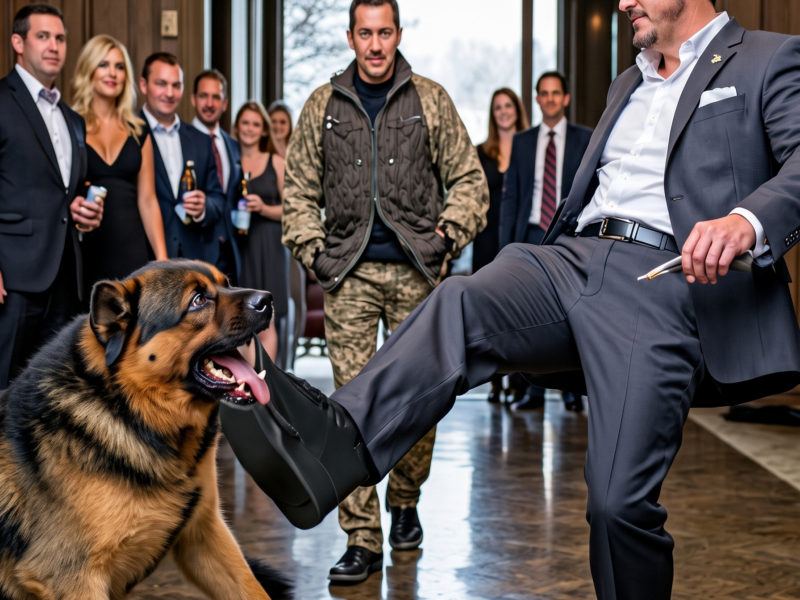
“It’s just a dog!” the manager shouted as he kicked the Navy SEAL K9 across a crowded Miami grocery store
The sound didn’t belong in a Miami grocery store.
It wasn’t the sharp rattle of a dropped jar of pasta sauce or the squeak of a wet shoe against freshly waxed linoleum. It was a wet, heavy thud followed by a truncated, high-pitched yelp—a sound of raw, confused pain that cut straight through the low hum of fluorescent lights, buzzing freezer doors, and mindless pop music drifting from overhead speakers.
My body reacted before my brain fully registered the sound. Ten years in Special Warfare Team 3 had carved certain neural pathways deep into my bone marrow; when you hear an ally take a strike, you move toward the noise. You don’t ask questions. You don’t pause to process. You clear the distance.
I dropped a basket containing a loaf of bread and a gallon of milk, rounded the end-cap of Aisle 4, and skidded to a halt near the register bays.
A crowd had formed near the double-sliding glass entrance doors. Standing in the middle of a spilled display of bottled water was a tall man in his late thirties wearing a crisp navy-blue polo shirt with Manager – Frank embroidered in white thread over his left chest. His face was flushed crimson, his fists clenched at his sides, his chest heaving with exaggerated, performative rage.
At his feet lay a Belgian Malinois.
The dog was lying on his side on the cold tile, his ribs rising and falling in rapid, shallow hitches. His fur, a rich burnished mahogany dusted with charcoal around the muzzle and back, was slick from the afternoon humidity outside. His right rear leg was tucked awkwardly beneath his belly, quivering with uncontrollable tremors.
It was Atlas.
“Get that damn thing out of my store!” the manager roared, his voice bouncing off the concrete ceiling. “I told you idiots to keep animals out of here! I don’t care if it’s a pet, a stray, or a service animal, it’s a health code violation!”
Atlas tried to push himself up. His front paws slipped on the slick tile, wet with spilled spring water from a crushed plastic bottle. He let out another soft, heartbreaking whine—a sound he had only ever made when heavy artillery shook the earth beneath our outpost in the Helmand Province. He raised his dark muzzle, his amber eyes searching the ring of passive, phone-wielding onlookers until they found me.
The moment our eyes locked, his ears flattened against his skull. He dragged his front body forward an inch, attempting to pull himself toward my boots.
The manager stepped forward, raising his heavy steel-toed work boot again. “I said get out!”
He pulled his leg back to kick the Malinois directly in the ribs a second time.
“Touch him again,” I said.
My voice wasn’t a yell. It was low, flat, and stripped of all emotional inflection—the exact tone I had used in breach-staging rooms when a flashbang had a faulty fuse. It wasn’t loud, but it possessed a dense, terrifying weight that caused three shoppers in the front row to physically flinch.
Manager Frank froze mid-swing, his boot hovering two inches above Atlas’s ribs. He turned his head slowly, his small, watery eyes narrowing as he took me in. I was wearing a faded grey t-shirt, worn denim jeans, and a dark cap pulled low over my eyes. I didn’t look like a threat. I looked like a quiet, sun-baked veteran living off a pension on the Florida coast.
“What did you say to me?” Frank demanded, dropping his foot to the floor with a loud snap. “Is this your brute? Keep him on a leash, or I’m calling security. It’s just a dog!”
“It’s just a dog,” I repeated softly.
I walked past him, completely ignoring his chest-puffed posture, and dropped to both knees in the middle of the puddle of water beside Atlas.
The moment my knees touched the linoleum, Atlas let out a long, shuddering breath. He shoved his wet black nose directly into the crook of my neck, his hot breath washing over my collarbone. His entire seventy-pound frame trembled violently against my chest as I ran my hand over his ribs, checking for broken bone fragments or internal swelling.
“Easy, brother,” I whispered into the soft fur behind his upright ears. “Easy. I’m right here. I’ve got you.”
Frank stepped closer, pointing a thick, sausage-like finger at the back of my head. “Hey! I’m talking to you, pal! You need to pack up your animal and clear out right now before I have the police trespass you off the property. You’re blocking the register, and you’re damaging store property!”
I didn’t look at Frank. I kept my left hand pressed against Atlas’s chest, feeling the frantic, galloping rhythm of his heart slowly begin to settle down.
The people standing in that air-conditioned grocery store saw an aggressive animal that had entered a commercial building illegally. They saw a nuisance. They saw a dog.
They didn’t see the forward operating base outside Sangin in 2017 when a secondary improvised explosive device tore through the floorboards of our Stryker vehicle, throwing me forty feet into a irrigation ditch with two broken legs and a shattered collarbone. They didn’t see Atlas—then an active-duty Multi-Purpose Canine with Special Warfare Group 2—crawling through hot, metallic shrapnel and flying lead to grab the shoulder strap of my plate carrier with his teeth, dragging my two-hundred-pound frame through forty yards of mud until I was behind a stone wall.
They didn’t see him lie across my bleeding torso for six hours while insurgent snipers pinned down our medevac element, keeping my core temperature warm in the desert cold while he took a piece of shrapnel through his left ear.
And they certainly didn’t know about the night outside Jalalabad—the night we lost Sergeant Ryan Miller.
“He saved my life twice,” I said softly, my fingers untangling a knot in Atlas’s coat. “When I was lying in a ditch in Afghanistan with my legs blown open, he didn’t run away. He didn’t complain about the noise. He stayed.”
I stood up slowly, turning my head to look directly into Frank’s face.
Frank took an involuntary step back, his defensive anger suddenly flickering into genuine uncertainty. “Look… mister… I don’t care about your military story. This is a private business. We have health standards—”
“You kicked a retired Navy SEAL,” I said, my voice dropping even lower. “A dog that has more courage in his pinky claw than you will ever have in your entire life.”
Frank’s face paled slightly, but he tried to maintain his position. “He shouldn’t be in here! He was wandering around the back aisle like he was tracking something!”
“Tracking something?” I repeated.
I looked down at Atlas. The Malinois was no longer looking at Frank. He had pushed himself fully into a standing position, his rear leg still trembling slightly, but his back was rigid as a steel beam. His head was thrust forward, his amber eyes locked onto a figure standing forty feet away near the automated exit doors.
The man was wearing a plain grey hooded sweatshirt pulled low over a black baseball cap, heavy sunglasses despite being indoors, and faded dark jeans. His hands were stuffed deep into the front pocket of his hoodie.
He wasn’t looking at the groceries. He wasn’t holding a basket. He was staring directly at Atlas and me.
Atlas didn’t bark. He didn’t make the wild, frantic noise of a pet dog reacting to a stranger. He let out a low, vibration-deep growl that rattled through the floorboards—the exact signature hum he made when an unidentified individual broke through a secure perimeter line during night watch.
The man in the hoodie saw Atlas tracking him. He didn’t flinch, but his right hand inside his hoodie pocket shifted subtly, pulling a rectangular black object closer to his chest. Then, he turned on his heel and walked out through the sliding glass doors into the blinding Miami sun.
“Atlas,” I commanded, my tone shifting instantly. “Search.”
The Malinois didn’t hesitate. Ignoring the pain in his hind leg, he took off across the front of the store, his claws traction-locking against the smooth tile, driving straight past the shocked manager and out into the heat of the parking lot.
The humid afternoon air hit my face like a wet blanket the moment I burst through the automatic sliding doors. The Miami heat was heavy and thick, smelling of baking asphalt, exhaust fumes, and salt water from the bay two miles away.
Atlas wasn’t chasing the man in the grey hoodie toward the street.
Instead, he was standing six feet outside the main entrance, his nose pressed firmly against the edge of a large, blue plastic recycling bin provided by the city. The bin was overflowing with discarded receipts, plastic soda bottles, and crumpled paper bags.
Atlas was scratching furiously at the bottom lip of the plastic container, his front paws making a sharp thrum-thrum-thrum against the blue synthetic wall.
“Hold,” I called out, reaching his side and dropping a hand onto his shoulder harness. “Hold, Atlas. What do you have?”
He stopped scratching immediately, sitting down on the hot concrete, but his eyes never left the narrow gap between the base of the plastic bin and the concrete pillar supporting the building’s overhang.
I dropped to one knee, ignoring the glare of the noon sun, and reached into the narrow, filthy gap beneath the bin. My fingers brushed against something hard, cold, and rough. I clamped my hand around it and pulled it out.
My throat went dry.
It was a small, olive-drab tactical pouch made of heavy-duty 1000D Cordura nylon. It was stained with oil, dirt, and water spots, its edges frayed from years of heavy wear. Attached to the front flap was a strip of hook-and-loop velcro holding a faded black nametape.
On the nametape, stitched in rough block letters, was a single word: MILLER.
My hands began to tremble.
This wasn’t a commercial knock-off. This was a custom-issued medical trauma kit pouch—the exact kind handed out to combat medics attached to elite special operations units in 2018. I knew every seam of this pouch. I had seen it hanging from the chest rig of Sergeant Ryan Miller for three years across three separate deployments.
Ryan had been my team mate, my spotter, and my best friend. Seven years ago, during an unacknowledged recon operation along the border region of Helmand and Kandahar, Ryan’s position was overrun by enemy fire. When the extraction helicopter finally touched down forty minutes later under intense mortar bombardment, we found his body lying near a dry riverbed.
The official military inquiry ruled his death a tragic accident—friendly fire from an artillery battery six miles away that had miscalculated its coordinates during the chaotic retreat. His body was returned home in a sealed casket, and I had stood in the pouring rain at Arlington National Cemetery as his mother was handed a folded flag.
I had spent seven years accepting that story. Seven years believing my brother had died because of a tragic mathematical error on an artillery computer screen.
I unzipped the corroded brass zipper of the pouch.
Inside was no medical gear. There were no bandages, no tourniquets, no clotting gauze.
There was only a single, heavy plastic ziplock bag designed to keep moisture out. Inside the bag was a glossy 4×6 photograph.
I pulled the photo out with numb fingers.
The photograph showed a dusty, sun-bleached courtyard flanked by mud-brick walls—a classic compound layout from southern Afghanistan. Standing in the center of the frame was Ryan. He was holding his M4 carbine across his chest, smiling widely at the camera, his face caked in sweat and road dust.
Sitting beside his knee, his head resting against Ryan’s tactical vest, was Atlas as a two-year-old dog.
My heart hammered against my chest. I remembered this picture. I had taken it myself outside a compound near the village of Sangin in the spring of 2018.
But then I looked closer at the background.
Standing in the shadow of a wooden gateway behind Ryan, half-obscured by a hanging woven mat, was a man. He was wearing an unmarked tan flight suit, a black baseball cap, and heavy dark sunglasses.
It was the exact same man I had seen standing near the exit of the Miami grocery store five minutes ago. The same facial structure. The same tight, downturned jawline.
I turned the photograph over.
On the back, written in thick, black permanent marker in Ryan’s distinct, sloping handwriting, were six words:
ATLAS KNOWS WHAT REALLY HAPPENED. RUN.
“No,” I whispered, the word escaping my lips as a hoarse gasp. “No, this isn’t possible. Ryan died in 2019.”
Atlas let out a sharp, demanding bark, snapping me out of my trance.
He had turned his body away from the recycling bin and was now straining against his leash, staring at a distant corner of the sprawling commercial parking lot.
A black sedan with heavily tinted windows and no rear license plate was parked near the shadow of a palm tree, eighty yards away. The driver’s side window was rolled down an inch. Through the dark glass, I could see the silhouette of a man holding a pair of long-range binoculars leveled directly at us.
“Atlas!” I barked, my instincts overtaking the numb shock in my head. “Forward!”
We sprinted across the hot asphalt, weaving between parked minivans, SUVs, and grocery carts. Atlas moved with terrifying speed, ignoring his swollen rear leg, driven purely by his operational conditioning.
As we closed the distance—sixty yards, forty yards, twenty yards—the driver of the black sedan realized we were coming. The engine roared to life with a deep, modified exhaust rumble.
“Stop!” I screamed, pulling my concealed-carry 9mm pistol from my waistband and bringing it up into a two-handed sight picture. “Stop the vehicle!”
The driver didn’t stop. He threw the car into reverse, tires screeching against the pavement, blue smoke billowing from the wheel wells, then slammed it into drive and tore out toward the main boulevard exit.
As the sedan rocketed past us, the rear passenger door window dropped two inches.
A hand reached out and dropped a white, heavy paper envelope onto the hot asphalt before the car vanished into the heavy Friday afternoon traffic of Biscayne Boulevard.
I skidded to a halt, my gun held low against my thigh, chest heaving, sweat stinging my eyes.
Atlas walked up to the white envelope, sniffed it once, and pressed his forehead against my knee.
I picked up the envelope. Written on the front in printed typewriter text was my home address—a small beach cottage three miles down the coast that I had rented six months ago under a quiet alias.
Inside the envelope was a second photograph.
This one wasn’t old. It wasn’t faded.
It showed a modern, concrete courtyard surrounded by high wire fencing and tropical vegetation. Sitting on a simple wooden bench in the center of the frame was a man in his late thirties with a thick beard and short-cropped gray hair. He was wearing plain blue surgical scrubs, his face pale and thin, but his eyes were bright, focused, and looking straight into the camera lens.
At the bottom corner of the print was a digital date and time stamp automatically generated by the camera:
JUNE 14, 2026 – 08:42 AM.
Three months ago.
Ryan was alive.
The small living room of my rented cottage smelled of sea salt, stale coffee, and wet dog.
Outside, the Atlantic Ocean pounded against the seawall, sending spray against the glass windows. Inside, the only light came from the glow of my military-grade tactical laptop resting on a cluttered wooden table alongside a half-empty mug of coffee, two hand-drawn maps of the Miami metro area, and the two photographs.
Atlas was lying on his side on his orthopedic bed near the door, a cold pack strapped to his swollen rear hip with medical tape. Every few minutes, his paws would twitch violently, his throat releasing small, silent huffs as he chased ghosts in his sleep.
I sat at the table, my fingers flying across the keyboard, accessing an encrypted veteran network server using credentials I hadn’t touched since leaving active service.
The photo from three months ago stared back at me from the screen. I had scanned it into high resolution, running digital enhancement protocols across the background details to identify where my dead spotter was being held.
“Come on,” I muttered under my breath, zooming in on the top-right corner of the image. “Give me something. A street sign, a building logo, anything.”
The background was dominated by high concrete walls topped with galvanized razor wire—standard high-security architecture. But tucked behind Ryan’s left shoulder, partially obscured by the fronds of a palm tree, was a small brass plaque attached to a doorframe.
I ran a sharpening filter across the metal plaque.
The letters cleared: KEY BREEZE MEDICAL RESEARCH FACILITY – UNIT 4.
I opened a secondary browser tab and ran a quick query on the facility name.
Key Breeze was an isolated, private medical installation situated on an eighteen-acre mangrove cay just off the coast of Key Largo—accessible only by a single two-lane causeway or by private boat. Officially, it was registered as a specialized psychiatric rehabilitation clinic catering to high-net-worth individuals suffering from severe degenerative neurological conditions.
Unofficially, according to foreign corporate ownership filings buried three layers deep in offshore registries, the facility was owned by a private military contractor called Aegis Global Operations.
Aegis Global.
The exact same contractor firm that had managed logistics for our sector in Helmand in 2019. The same firm that operated the artillery radar station six miles from our position the night Ryan supposedly died in an accident.
“They didn’t kill him,” I whispered, the realization settling into my stomach like jagged gravel. “They staged the artillery strike to collect his body, covered up the evidence, and brought him back state-side to keep him quiet.”
Why?
Why keep an elite SEAL sniper locked away in a private psychiatric facility for seven years instead of simply putting a bullet in his head?
I reached into my pocket and pulled out the small black Cordura pouch we had recovered from the grocery store recycling bin. I turned it over in my hands, feeling the thick synthetic seams.
There had to be something else inside.
I pulled out a small tactical knife from my belt and carefully sliced open the interior lining of the pouch. Between the heavy Cordura shell and the thin nylon liner slid a small, silver micro-SD memory card, no larger than a fingernail.
My hands were shaking as I inserted the card into my laptop’s media reader.
A single video file appeared on the screen: INCIDENT_RECORD_051219.MP4.
I clicked play.
The video was taken from an overhead thermal surveillance feed mounted to an unflagged drone. The date in the lower left corner confirmed it: MAY 12, 2019 – 02:14 AM.
The black-and-white thermal footage showed our small four-man recon team pinned down inside a ruined compound near Sangin. Bright white flashes indicated intense small-arms fire coming from a treeline three hundred yards away.
Then, a second vehicle appeared on the thermal camera—an unflagged, heavy armored transport truck approaching from the north. Four men in modern tactical gear dismounted from the truck.
They weren’t insurgents. They were wearing high-end Western plate carriers, NVG helmets, and carrying suppressed carbines.
The thermal feed showed these men flank our position from behind—not firing at the insurgents, but firing directly into the back of our defensive line.
I watched in horrifying clarity as Ryan was struck in the back by two high-velocity rounds. He collapsed against a mud wall. The men in Western gear didn’t finish him off. They dropped a smoke grenade, grabbed his unconscious body, dragged him into the back of the armored transport, and sped away toward the north.
Two minutes later, an artillery shell—fired from the Aegis Global base six miles away—struck the compound, completely obliterating the building where Ryan had been standing.
The entire event had been an abduction disguised as an enemy attack, cleansed by an artillery strike.
And Atlas had been there.
In the video, as the armored transport pulled away, a young Malinois could be seen charging out of the burning rubble, chasing the truck for half a mile down the dusty dirt road until his lungs gave out.
He had watched them steal his handler. He had smelled their uniforms, seen their transport, and remembered their faces for seven long years.
And today, in a crowded grocery store in Miami, one of those men had walked past him.
“They thought you were just an animal, Atlas,” I said, looking over at the bed where the Malinois was now awake, his dark amber eyes fixed on me with calm, unwavering intelligence. “They thought nobody would ever connect the dots.”
Atlas pushed himself up from his bed, ignoring his bad leg, and walked over to my chair. He placed his broad, heavy chin on my knee, letting out a long, quiet exhale.
The door to my cottage suddenly clicked.
It wasn’t a loud knock. It was the subtle, soft sound of a lock bypass tool sliding into the brass tumbler of the front door frame.
Atlas didn’t bark.
The moment he heard the metal tool inside the door lock, he backed away from my knee in absolute silence, dropping his chest to the floor, his tail straight out behind him, his hind legs coiled like steel springs.
I reached for my 9mm on the table, racking a round into the chamber with a quiet, practiced click, and stepped into the shadowed corner behind the front door.
The brass deadbolt turned. The door swung open six inches.
A flashbang grenade tumbled through the gap, bouncing twice across the wooden floorboards.
“Blind!” I shouted, turning my body away and pressing my face hard into the corner wall.
The grenade detonated with a blinding, white-hot flash and a deafening 160-decibel bang that shook the picture frames off the plaster walls. The glass in the front window shattered into a thousand tiny shards.
Two men in black tactical uniforms and gas masks surged through the doorway, their suppressed rifles raised to clear the room.
They expected a confused, disoriented civilian veteran staggering around in the smoke.
They didn’t expect a seventy-pound military working dog operating on pure muscle memory.
Atlas launched himself through the smoke like a dark cannonball. He didn’t go for the rifle barrels; he cleared the distance instantly, his jaws locking onto the throat guard of the lead operative’s tactical vest, using his full momentum to slam the two-hundred-pound man backward through the open doorway onto the porch.
The second operative swung his rifle toward Atlas, but I stepped out from the shadow of the door frame, caught his weapon barrel with my left hand, shoved it toward the ceiling, and drove the butt of my heavy tactical flashlight directly into his throat.
The man collapsed, gasping for air, dropping his rifle onto the floorboards.
I didn’t give him a chance to recover. I dragged him inside, threw him onto his stomach, and secured his wrists behind his back with heavy plastic flex-cuffs from his own tactical vest.
Outside on the porch, Atlas was standing over the first operative, his paws planted firmly on the man’s chest, his jaw hovers two inches from the man’s throat, releasing a low, rhythmic growl that vibrated through the operative’s helmet.
“Off, Atlas!” I called out. “Control!”
Atlas backed off an inch, but kept his eyes locked on the man’s face.
I walked out onto the porch, picked up the operative’s suppressed rifle, and pointed it at his gas mask. I reached down, ripped the mask off his face, and tossed it into the bushes.
It was the same man from the grocery store. The man in the grey hoodie.
“Who ordered the hit?” I asked, my voice terrifyingly calm.
The man spat blood onto the wooden porch deck, glaring up at me with open hatred. “You’re dead, Mercer. You and that damn dog. You should have stayed in your hole.”
“Where is Ryan Miller?” I demanded, pressing the hot barrel of the rifle against his collarbone.
The operative let out a cold, wheezing laugh. “He’s where he’s been for seven years. In a box. And by midnight tonight, the whole facility is being scrubbed. No records. No evidence. No ghosts.”
My blood ran cold. “Scrubbed?”
“Aegis is closing the Key Breeze facility,” the man whispered, his eyes glinting with malicious triumph. “They saw the photo you took from the sedan. They know you have the drive. The disposal team is already on site. If you go down there, you’re walking into a kill box.”
I didn’t answer him. I drove the heavy butt of the rifle into the side of his jaw, knocking him unconscious, then dragged his limp body inside the cottage alongside his partner and secured them both to the cast-iron plumbing pipes under the kitchen sink.
I picked up my tactical backpack, loaded three fresh magazines into my belt pouches, and looked down at Atlas.
The dog was standing near the door, his ears perked, his breath steady. His rear leg was no longer trembling. The adrenaline flowing through his system had completely erased the pain of his injuries.
“We have two hours to reach Key Largo,” I said, checking the action on my pistol. “We break him out tonight, or we lose him forever.”
Atlas let out a single, low bark—a clear, unambiguous confirmation.
We ran out into the rainy night, jumping into my heavy 4×4 utility truck parked in the driveway. I slammed the truck into gear, tore down the driveway, and headed south down the Florida Turnpike toward the dark, wet mangrove swamps of the Keys.
The rain fell in relentless sheets, blurring the red taillights of the traffic ahead. Beside me on the passenger seat, Atlas sat perfectly upright, his head turned toward the window, watching the dark highway slide by.
For seven years, I had lived with the crushing guilt of leaving my spotter behind in the dirt of Afghanistan. For seven years, I had believed I was a survivor who had failed his team.
Now, I knew the truth.
We hadn’t failed. We had been betrayed. And the dog they had dismissed as an insignificant piece of military property was about to lead me straight into the heart of their fortress.
The causeway leading to the Key Breeze Medical Facility was dark, slick, and completely unlit.
I parked the utility truck half a mile away, tucked inside a thick stand of black mangroves off the shoulder of the highway. The night was thick with the heavy scent of rotting salt marsh, stagnant water, and damp foliage.
I adjusted my dark tactical gear, pulled my night-vision goggles down over my eyes, and tapped Atlas on the shoulder. “Quiet movement, boy. Stay low.”
We moved through the thick mangrove swamp like twin shadows. The wet mud swallowed our footprints, the thick canopy above blocking out what little light came from the clouded night sky. Atlas moved with effortless grace, picking his path through the tangled root systems, stopping every fifty yards to test the wind with his nose.
At the edge of the tree line, the facility opened up before us.
It looked more like a modern military installation than a psychiatric hospital. A twelve-foot chain-link fence topped with high-voltage wire enclosed three low-slung concrete buildings. High-powered halogen floodlights swept across the perimeter grass every thirty seconds.
Near the central building, two large white unmarked transport vans were parked with their rear doors wide open. Men in black tactical uniforms were busy hauling heavy metal storage trunks out of the facility and throwing them into the vans.
They were clearing the facility out—just like the operative had said.
“Atlas,” I whispered, pulling my suppressed carbine close to my chest. “Find Ryan.”
I didn’t need to give him a scent sample. The dog had spent four years living in the same two-man sniper hide with Ryan Miller. That scent profile was hardwired into his brain until the day he died.
Atlas lowered his nose to the wet ground, took two deep sniffs toward the ocean breeze, and instantly turned his head toward the smallest concrete building at the far east corner of the complex—Unit 4.
“Good boy,” I murmured. “Breach position.”
We sprinted across the open perimeter grass during the ten-second blind spot between floodlight sweeps, reaching the shadow of Unit 4’s rear wall without raising the alarm.
The back entry was a heavy steel fire door with an electronic keypad lock. I pulled out a small linear shaped charge from my breach kit, slapped it against the lock mechanism, and pressed the five-second delay detonator.
POP.
The small directional blast sheared through the steel latch with a quiet, dull thud. I shoved the door open, and Atlas slid inside first, his weapon-mounted tactical light illuminating a long, sterile corridor lined with metal doors.
The corridor smelled of heavy chemical disinfectant and floor wax.
At the far end of the hallway, a single guard in an Aegis Global uniform was standing near a desk, holding a clipboard. When he saw the heavy steel door open and a black Malinois charge into the hall, his eyes widened in sheer terror.
He reached for his sidearm, but Atlas was on him before he could clear his holster. The dog hit his chest with full force, driving him back against the wall, taking him to the floor with a swift, non-lethal arm-bar bite that completely neutralized his ability to fight.
“Where is he?” I demanded, coming up behind Atlas and pinning the guard’s neck to the floor with my boot. “Which room?”
“Room 108!” the guard gasped, clutching his bleeding forearm. “At the end of the hall! Don’t shoot! I’m just security!”
I left the guard lying on the floor, sprinting down the hallway until I reached the heavy oak door labeled 108.
There was a small reinforced glass viewing window in the center of the door.
I looked inside.
Sitting on the edge of a simple metal cot in the center of a small, windowless room was a man. He was wearing gray sweatpants and a plain white t-shirt. His hair was long, streaked with gray, his body thin, but his posture was straight, alert, and calm.
It was Ryan.
“Ryan!” I shouted, hitting the heavy door frame with my palm.
The man on the cot turned his head slowly. His brow furrowed in disbelief as he stared through the glass window at my face.
I stepped back, aimed my suppressed carbine at the heavy deadbolt lock, and fired three rapid shots into the steel plate. The lock shattered, and I kicked the door open.
Ryan stood up, taking an uncertain step forward. “John…?” his voice was rough, dry, like gravel sliding down an empty pipe. “Is that… is that really you?”
Before I could answer, Atlas burst through the doorway past my legs.
The Malinois didn’t hesitate. He didn’t pause. He cleared the distance across the small room in a single bound, placing his heavy front paws directly onto Ryan’s chest, shoving his broad head against Ryan’s neck, letting out a loud, frantic, crying whine that filled the narrow room.
Ryan collapsed back onto the edge of the cot, his arms wrapping tightly around the dog’s thick neck, burying his face deep into the burnished mahogany fur.
“Atlas…” Ryan sobbed, his shoulders shaking with seven years of held-back tears. “You came back… you brought him back…”
“We’re going home, brother,” I said, my voice thick with emotion as I stepped into the room and grabbed Ryan’s hand, hauling him to his feet. “We’re going home right now.”
Outside in the main courtyard, alarms suddenly began to blare—a loud, piercing electronic siren that echoed across the mangrove swamp.
“They’re scrubbing the facility!” Ryan shouted over the noise, looking at me with sharp, focused intelligence that seven years of captivity hadn’t erased. “Miller’s main team is here! They have the transport vans loaded with the master files!”
“Not Miller,” I corrected him, pulling a spare pistol from my belt and slapping it into Ryan’s hand. “Major Miller was arrested five hours ago in Seattle by federal marshals. His entire network is collapsing. This is just the cleanup crew trying to burn the evidence.”
Ryan looked down at the weapon in his hands, a tight, lethal smile spreading across his face for the first time in seven years. “Then let’s make sure they don’t finish the job.”
We burst out of Unit 4 into the central courtyard just as three Aegis Global transport vehicles tried to accelerate toward the main gate.
“Atlas!” I yelled, pointing at the lead transport vehicle’s front tire. “Disable!”
The Malinois tore across the wet pavement like an arrow shot from a bow, leaping gracefully onto the front bumper of the moving transport van, his weight and sudden distraction causing the panicked driver to swerve violently off the driveway, slamming the heavy vehicle head-first into a concrete light pole.
The impact disabled the lead vehicle, blocking the narrow exit gate completely and trapping the rest of the extraction convoy inside the compound.
Within ten minutes, the sound of heavy military helicopter rotors thundered overhead.
Two dark MH-60 Black Hawk helicopters, bearing the distinct markings of the United States Coast Guard and Federal Bureau of Investigation tactical assault groups, swooped low over the mangrove trees, their searchlights blinding the remaining contractors in the courtyard.
Armed tactical operatives descended down fast-ropes onto the wet pavement, securing the facility within minutes, disarming the Aegis contractors, and securing the massive trove of classified records buried inside the transport vans.
I stood near the entrance gate, my arm slung over Ryan’s shoulder, as federal agents swarmed the compound.
The ocean breeze was blowing hard now, clearing away the heavy rain clouds, revealing a bright, star-filled sky above the Florida Keys.
Atlas walked up between us, his fur soaked with rain and mud, his chest rising and falling in steady, triumphant breaths. He sat down between my boots and Ryan’s legs, looking up at us with those bright, amber eyes that had seen the worst horrors of war and had refused to give up hope.
Ryan dropped to one knee, wrapping his hand gently around Atlas’s leather collar.
“Seven years,” Ryan murmured, looking up at me with tears shining in his eyes. “I thought everybody had forgotten.”
I looked down at the dog who had saved my life twice, dragged me from the brink of death, and brought a lost brother back from the grave.
“Some people forget, Ryan,” I said softly, patting Atlas’s broad head as the sun began to break over the eastern horizon. “But a SEAL never leaves a man behind. And a good dog never forgets.”
Atlas let out a long, peaceful sigh, leaning his body against our legs as the morning light washed over the Keys, signaling that the long, dark war was finally over.
The end.









