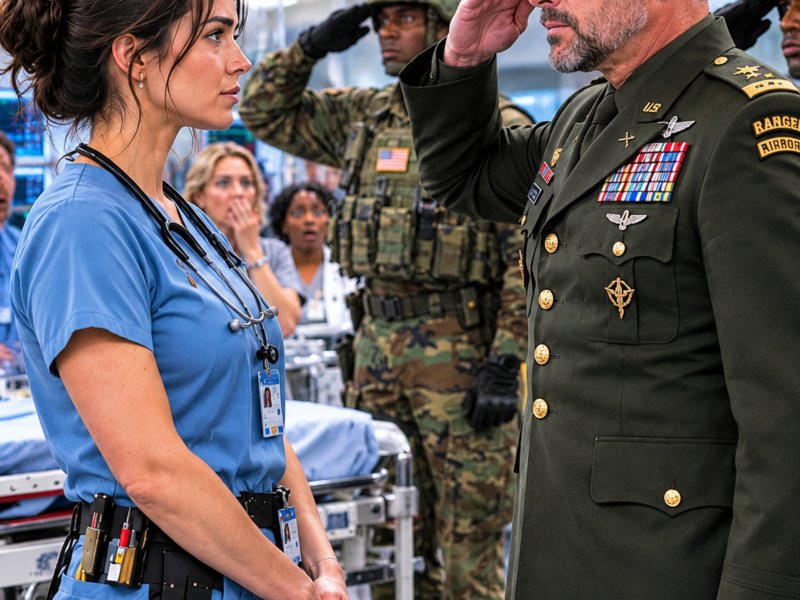
“In the middle of a packed emergency room in rural Kentucky, a colonel in full military uniform walked past three senior doctors
For a moment, nobody in the emergency department moved.
Dr. Collins stared at the colonel as though he had just spoken another language.
Then he gave a short, uncomfortable laugh.
“I’m sorry, Colonel, but I think there’s been some misunderstanding. Hannah is a registered nurse on my staff.”
The colonel didn’t smile.
“I know exactly what she is.”
He turned toward me.
“May I?”
I looked at him, then at the injured soldier waiting in trauma two.
“Sir, we have a patient who needs treatment.”
Something softened in his expression.
“Of course. That’s still your first priority.”
I nodded toward the trauma room.
“Then let’s get him stabilized.”
The colonel stepped aside immediately.
Dr. Collins seemed relieved to have something practical to focus on.
“Right. Let’s move.”
For the next twenty minutes, the department returned to its familiar rhythm.
I assessed the injured soldier, cleaned the wound, checked his circulation, and assisted Dr. Collins with the necessary procedures.
The soldier was twenty-six, named Daniel Brooks.
His injury looked worse than it was, and fortunately, there was no serious damage to the underlying structures.
While I secured the dressing, he watched me carefully.
“Ma’am, have we met?”
I glanced at him.
“I don’t think so.”
He looked at the colonel standing near the doorway.
“Sir, is this the nurse?”
The colonel nodded.
“Yes, Daniel. This is her.”
I finished taping the dressing.
“You’re going to be fine. Try not to use that arm too much for a few days.”
Daniel gave a small smile.
“Yes, ma’am.”
When I stepped into the hallway, the colonel was waiting.
His name was Colonel James Whitaker.
I had known him seven years earlier, when I was assigned to a military medical evacuation unit overseas.
Back then, he had been a lieutenant colonel.
And I had been Captain Hannah Mitchell.
Not a nurse.
Not an ordinary member of a hospital staff.
I had been a military medical officer responsible for coordinating emergency treatment and evacuation under combat conditions.
I had never told anyone at Briarwood.
I had my reasons.
“Colonel,” I said quietly, “we need to talk somewhere private.”
He glanced toward the crowded nurses’ station.
“Agreed.”
We stepped into the small consultation room beside the supply closet.
He closed the door.
For several seconds, neither of us spoke.
Then he said, “I spent almost two years trying to find you.”
I folded my arms.
“Why?”
“Because the people who served with you never forgot what happened.”
I looked away.
“That was a long time ago.”
“Not to the men and women who came home because of you.”
I shook my head.
“James, please don’t do this.”
He studied my face.
“You still think you have to make yourself smaller so nobody asks questions.”
I looked at him sharply.
He continued.
“I heard you left the service. I heard about your father’s illness. I heard you moved to Kentucky. But I never understood why you disappeared so completely.”
“My father died,” I said. “I needed to be somewhere quiet.”
“I understand that.”
“No, you don’t.”
My voice came out sharper than I intended.
I took a breath.
“After everything that happened, I couldn’t spend another day hearing helicopters, emergency alarms, or people asking me to make decisions that no human being should have to make.”
The colonel lowered his eyes.
“I know.”
For a moment, I could hear the rain hitting the window.
Then he reached into the inside pocket of his uniform and removed a small envelope.
“I didn’t come here just to see you.”
I looked at it.
“What’s that?”
“A letter from someone you haven’t heard from in a long time.”
He placed it on the table.
The handwriting on the front made my stomach tighten.
Sergeant Michael Reeves.
I hadn’t seen that name in seven years.
Michael had been one of the first people I worked with overseas.
He had been twenty-nine, stubborn, funny, and constantly stealing the terrible coffee from my desk.
During a night evacuation, he had been seriously injured.
I had stayed with him until the evacuation helicopter arrived.
For years, I had believed he wouldn’t survive.
I picked up the envelope.
“Is he alive?”
The colonel nodded.
“He’s alive. He’s been looking for you, too.”
My fingers trembled as I opened it.
Inside was a single sheet of paper.
Hannah,
I don’t know if you’ll ever read this.
I just want you to know that I remember the night you refused to leave me behind.
I remember your voice telling me to keep talking.
I remember thinking I wasn’t going to see my daughter grow up.
She’s nine now.
She knows your name.
I never got the chance to thank you properly.
I hope you’re doing well.
Michael.
I read it twice.
Then I sat down.
I hadn’t cried in years.
Not when I packed my belongings.
Not when I turned in my military identification.
Not even when I buried my father.
But that small piece of paper brought back a part of me I thought I’d lost.
The colonel waited.
Finally, I whispered, “I thought he died.”
“He almost did.”
I pressed the letter against the table.
“Why didn’t anyone tell me?”
“Your discharge paperwork was complicated. You changed your contact information, and the unit lost track of you. Michael only recently found an old record with your name.”
I stared at the envelope.
For seven years, I had carried the belief that I had failed to save someone.
And somewhere, that person had been living a life I had never known existed.
A daughter.
A home.
A future.
I wiped my cheek.
“Thank you for bringing this.”
The colonel nodded.
Then his expression became serious again.
“There’s something else.”
I looked up.
“What?”
He took a breath.
“I came to Briarwood because our medical command has been reviewing an incident involving a former military patient. Your name appeared in the records.”
My stomach tightened.
“What incident?”
“An injured veteran named Thomas Keller. He was admitted here three months ago.”
I knew the name.
Thomas had come into the emergency department one evening with severe abdominal pain.
He was in his late forties, a former Army mechanic who lived alone outside town.
I remembered him because he had been quiet and polite, even when the pain became unbearable.
I had noticed something unusual in his records.
His blood work was deteriorating, but the initial assessment described his condition as uncomplicated abdominal discomfort.
I had asked Dr. Collins to order additional imaging.
He had refused.
He said the patient was exaggerating.
I had documented my concerns and requested a second review.
The following morning, Thomas was transferred to another hospital.
I hadn’t seen him again.
“What happened to him?” I asked.
The colonel opened a folder.
“He underwent emergency surgery after the transfer. He survived, but his condition was much more serious than the initial assessment suggested.”
I felt the old anger return.
“Was he harmed because of the delay?”
“That’s part of what the review is examining.”
I looked toward the door.
“Why is my name in the records?”
“Because your written nursing notes were the first documentation identifying the change in his condition.”
I swallowed.
“And?”
“And your notes disappeared from the electronic record for several hours before they were restored.”
I stared at him.
“What?”
He placed a printed document on the table.
It showed the original time stamp of my assessment, followed by a later amendment.
Someone had accessed the record.
Someone had changed the documentation.
I recognized the initials attached to the amendment.
RC.
Richard Collins.
The colonel watched my face.
“We’re not here to accuse anyone without evidence. But Thomas’s attorney requested an independent review, and your original notes were recovered from the hospital’s audit archive.”
I looked at the paper.
All those months of being dismissed.
All those times Collins had told me to stop questioning him.
I had thought it was simply arrogance.
Now I wasn’t so sure.
“Why didn’t anyone tell me?”
“Because the investigation wasn’t ready to approach staff members. I only learned you were still here when I recognized your name on the record.”
I stood up.
“James, I can’t be part of another military investigation.”
“This isn’t about asking you to return to the service.”
He paused.
“It’s about making sure the truth isn’t buried.”
Before I could answer, someone knocked.
The door opened.
Dr. Collins stood outside.
His face was unusually pale.
“Hannah, I need you at the nurses’ station.”
I slipped the papers back into the folder.
“Is there an emergency?”
“Not exactly.”
His eyes moved toward the colonel.
“We need to discuss something.”
The colonel stepped forward.
“Then let’s discuss it together.”
Collins forced a smile.
“I don’t think that’s necessary.”
“Perhaps it is.”
We followed him into the main department.
Two hospital administrators had arrived.
One was the medical director, Dr. Elaine Parker.
The other was the hospital’s compliance officer, Mr. David Lewis.
They stood beside the nurses’ station with a laptop open.
When Dr. Parker saw me, she nodded.
“Hannah, thank you for coming. We need to ask you about a patient record.”
Dr. Collins interrupted.
“Before we do that, I want to make something clear. Any discrepancies in the documentation were clerical issues, not clinical decisions.”
Mr. Lewis looked up.
“Richard, we haven’t established that yet.”
Collins stiffened.
I felt every pair of eyes turning toward me.
Dr. Parker gestured to the laptop.
“This concerns Thomas Keller’s admission on August fourteenth.”
I nodded.
“I remember him.”
“Your nursing assessment documented worsening abdominal pain, abnormal vital signs, and a request for additional evaluation.”
“That’s correct.”
“Dr. Collins’s original note stated that the patient was stable and suitable for observation.”
I looked at Collins.
He kept his eyes on the computer.
Dr. Parker continued.
“However, the electronic audit log shows that your assessment was modified after your shift ended.”
My mouth went dry.
“Modified how?”
Mr. Lewis turned the laptop toward us.
The screen showed the original documentation beside the revised version.
My note had included the phrase: Physician notified of deterioration. Additional assessment requested.
The revised version contained a different statement: Patient remains stable. No additional concerns reported by nursing staff.
I felt sick.
“I didn’t write that.”
“We know,” Mr. Lewis said.
Dr. Collins stepped forward.
“Someone must have used my login.”
Mr. Lewis shook his head.
“The system requires two-factor authentication for amendments. The access record is linked to your workstation and your security token.”
Nobody spoke.
Collins looked at me.
“Hannah, you know how these systems work. You know mistakes happen.”
I met his eyes.
“Then why did you change my assessment?”
His jaw tightened.
“I didn’t.”
The colonel had remained silent until then.
Now he stepped closer.
“Doctor, the question isn’t whether you respect this nurse. The question is whether a patient received appropriate care and whether the records were altered afterward.”
Collins turned toward him.
“This is a civilian hospital. Military rank doesn’t give you authority here.”
“You’re absolutely right,” the colonel replied. “And I haven’t claimed otherwise.”
He looked at Dr. Parker.
“But a patient’s right to accurate medical documentation doesn’t depend on who happens to be wearing a uniform.”
That sentence seemed to settle over the room.
Dr. Parker closed the laptop.
“We’re placing the relevant records under preservation. Richard, you’ll be removed from clinical duties pending the independent review.”
Collins stared at her.
“You’re suspending me?”
“Administrative leave. Effective immediately.”
His eyes moved toward me.
“You’ve been waiting for this, haven’t you?”
I shook my head.
“No. I was waiting for you to listen when I told you something was wrong with a patient.”
He opened his mouth, but nothing came out.
For the first time since I’d started working at Briarwood, I didn’t feel the need to lower my voice.
I didn’t feel the need to apologize for taking up space.
I simply stood there.
And let the truth speak for itself.
The investigation took four months.
It was not as dramatic as people imagine.
There were interviews, document reviews, technical reports, and long afternoons answering questions about events I remembered more clearly than I wanted to.
The independent reviewers confirmed that Dr. Collins had altered my nursing documentation.
They also found similar changes in two other patient records.
The hospital could not establish that every alteration had directly caused harm, but the review found that the changes had compromised the accuracy of the medical records and interfered with proper clinical oversight.
Thomas Keller’s attorney received the findings.
Thomas himself eventually agreed to speak with the hospital.
When I met him again, he was sitting in the same wheelchair he had used during his transfer.
He looked thinner, but he was smiling.
“Well, look who it is,” he said.
I pulled a chair beside him.
“How are you feeling?”
“Better. Still can’t eat my wife’s cooking without regretting it.”
I laughed.
Then his expression became more serious.
“I heard what happened.”
I looked down at my hands.
“I’m sorry you went through that.”
He shook his head.
“You don’t owe me an apology.”
“I wish I’d been able to do more.”
“You did what you could. You wrote down what you saw. You kept asking people to look.”
He paused.
“That’s more than some people did.”
I felt my throat tighten.
For a long time, I had thought the only meaningful way to help someone was to save them in the moment.
Thomas reminded me that sometimes the truth needed someone to keep it alive long after the emergency was over.
Dr. Collins eventually resigned while the hospital’s professional review process was underway.
His departure wasn’t celebrated.
There were no cheers in the hallway.
Some nurses were relieved.
Others were uncomfortable.
I understood both reactions.
I had worked beside him for months.
I had seen him comfort frightened families and stay late to treat patients when the department was overwhelmed.
He wasn’t a monster in every moment.
But being capable of kindness sometimes didn’t excuse the harm he had caused.
The hospital also changed its documentation review procedures and established a formal process for nurses to escalate concerns without going through the physician involved.
Dr. Parker personally apologized to the nursing staff.
It wasn’t a perfect apology.
But it was a beginning.
A few weeks after the review ended, Colonel Whitaker returned to Briarwood.
This time, he wasn’t bringing an injured soldier.
He came carrying a framed photograph.
“I thought you might want this.”
I took it from him.
The photograph showed a group of military medical personnel standing outside a field hospital.
I was near the center, younger, thinner, and wearing the uniform I had packed away years earlier.
Michael stood beside me, grinning at the camera.
I traced the edge of the frame.
“I haven’t seen this in years.”
“Michael sent it.”
I smiled.
“How is he?”
“He’s doing well. He and his daughter are planning to visit next month.”
I looked up.
“Really?”
“He wants to thank you in person.”
I shook my head.
“He doesn’t have to.”
“I know. That’s why he’s coming.”
The colonel sat down across from me.
For a while, we talked about ordinary things.
The weather.
The hospital.
The terrible coffee.
Then he asked the question I had been avoiding.
“Have you thought about what comes next?”
I looked at the framed photograph.
“I don’t know.”
“You were an exceptional medical officer, Hannah. You still are.”
I smiled faintly.
“I’m also a pretty good nurse.”
He laughed.
“I never doubted that.”
He leaned forward.
“Our regional veterans’ medical program is expanding. We need someone who understands emergency care, military medicine, and what happens when veterans fall through the cracks.”
I studied him.
“Are you offering me a job?”
“I’m offering you an opportunity. You can say no.”
I thought about the little apartment.
The quiet mornings.
The years I had spent trying to become someone who didn’t have to remember the past.
Then I thought about Thomas.
Walter.
The frightened families who sat beside hospital beds waiting for someone to take them seriously.
And the young soldiers who would someday need help.
“What would I be doing?”
“Helping coordinate medical care for veterans across several rural counties. Training local emergency teams. Making sure people get the attention they need before a problem becomes a tragedy.”
I looked at him for a long moment.
“Would I have to wear a uniform?”
He smiled.
“Only if you want to.”
I laughed.
For the first time in years, the idea of using my experience didn’t feel like returning to something I had lost.
It felt like choosing something new.
I accepted the position two weeks later.
I stayed at Briarwood, too.
Not because I needed to prove anything to the people who had once ignored me, but because I still cared about the patients who came through those doors.
The hospital offered me a position as a senior emergency nursing coordinator, with authority to oversee clinical escalation procedures and help train new staff.
I accepted that role as well.
On my first day in the new position, a young nurse named Emily approached me near the medication room.
She looked nervous.
“Can I ask you something?”
“Of course.”
“I noticed something unusual in one of my patient’s lab results. Dr. Parker says we should wait, but I don’t feel comfortable.”
I set down my clipboard.
“Show me.”
She walked me through the results.
I listened without interrupting.
Then I asked her what she thought was happening.
She explained her concerns carefully.
I reviewed the chart and agreed that the patient needed further assessment.
“Let’s bring this to the physician together,” I said.
Emily hesitated.
“What if they think I’m overreacting?”
I looked at her.
“Then we’ll explain what we’re seeing. But don’t ever convince yourself that staying quiet is the same as being professional.”
She nodded.
As we walked toward the doctor’s office, I caught sight of my reflection in the glass.
For years, I had believed that leaving the military meant leaving an entire part of myself behind.
I had thought the only way to find peace was to make sure nobody knew who I used to be.
But perhaps I had misunderstood what peace meant.
Maybe it wasn’t forgetting.
Maybe it was finally being able to remember without being afraid.
The following month, Michael Reeves came to visit.
He arrived with his nine-year-old daughter, Lily, who wore a purple jacket and carried a small stuffed rabbit.
The moment she saw me, she walked straight over.
“Are you Captain Hannah?”
I crouched to her height.
“I used to be.”
“My dad says you helped him come home.”
I glanced at Michael.
He stood a few feet behind her, his eyes already shining.
“I was lucky to be there when he needed help,” I said.
Lily shook her head.
“Dad says you didn’t leave.”
I didn’t know what to say.
So I hugged her.
Michael waited until Lily wandered toward the vending machines before speaking.
“I’ve wanted to say thank you for seven years.”
“You don’t owe me anything.”
He smiled.
“I know. But I needed you to hear it.”
He reached into his jacket and handed me a small photograph.
It showed him standing beside Lily at her first day of school.
On the back, he had written:
Because you stayed, I got to be here.
I held the photograph for a long time.
That evening, after my shift ended, I walked through the emergency department.
The waiting room was quieter than usual.
A little boy slept against his mother’s shoulder.
A paramedic was finishing a report.
Emily was at the nurses’ station, reviewing a chart.
She looked up when I passed.
“Good night, Hannah.”
“Good night, Emily.”
I stopped beside the old framed photograph of the military medical team.
It now hung on the wall near the staff entrance.
I had spent years trying to bury the person in that picture.
Now I could look at her without wanting to turn away.
I still didn’t need a salute.
I didn’t need people to know my former rank.
I didn’t need anyone to call me a hero.
I only wanted the next frightened patient who walked through those doors to find someone willing to listen.
And if a young nurse stood in the hallway with a concern nobody else wanted to hear, I wanted her to know she didn’t have to stand there alone.
The colonel had saluted me that rainy Thursday because he remembered the officer I had once been.
But the greatest honor I ever received came later, in a quiet emergency room, when a frightened nurse trusted me enough to say, “I think something is wrong.”
This time, nobody ignored her.
And this time, I made sure someone listened.
The end.









