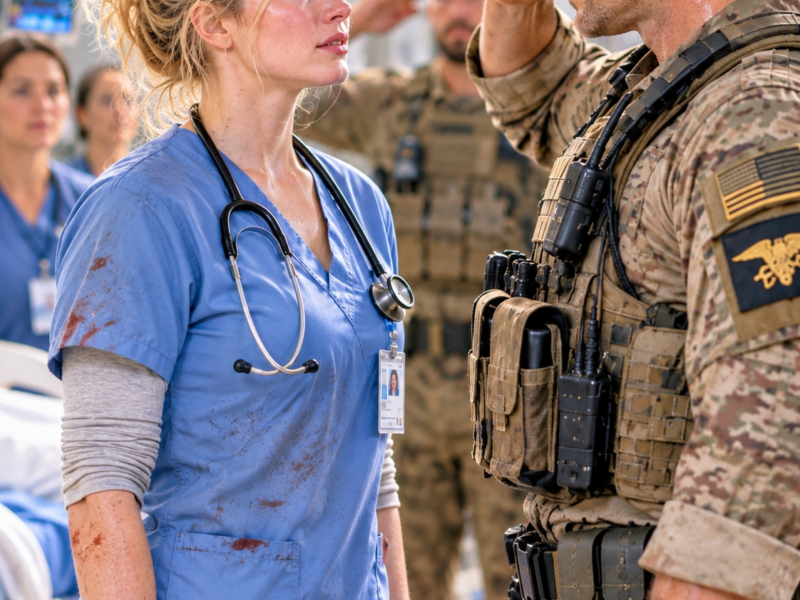
“In front of three ICU nurses, the hospital director tore the authority badge from my uniform and ordered security to escort me out
The admiral held the sealed envelope between two fingers, waiting for me to take it.
Behind him, the emergency lights continued flashing red across the ICU walls.
A nurse was manually ventilating an elderly patient. Another was checking the portable oxygen supply. Somewhere near the nurses’ station, a child was crying.
There was no time for ceremony.
“Sir, we have patients who need power restored,” I said. “Whatever is in that envelope can wait.”
Admiral Whitaker looked at me for a moment, then nodded.
“That’s exactly why I came looking for you.”
He turned toward his security detail.
“Captain Lewis, get the emergency medical generators operating. Lieutenant, coordinate with Naval Medical Command. I want every available transport team on standby.”
Then he faced Dr. Harlan.
“Doctor, I understand you removed Commander Carter from her emergency authority this morning.”
Harlan swallowed.
“Admiral, there appears to be some confusion. Ms. Carter is a civilian employee. We had legitimate administrative concerns.”
Whitaker’s expression hardened.
“Her civilian employment status does not erase her military commission.”
The room went silent.
Sarah looked at me.
“Commander?”
I closed my eyes briefly.
There it was.
The title I had spent years trying to leave behind.
Admiral Whitaker handed me the envelope.
“Evelyn, your reserve commission was never terminated. Your assignment was classified, and your civilian cover was part of the agreement.”
I looked at the document.
At the top was a heading I recognized immediately: NAVAL MEDICAL COMMAND — EMERGENCY CONTINUITY DIRECTIVE.
My name appeared beneath it.
Commander Evelyn Marie Carter.
But the line below my name was what made my fingers tighten around the paper.
SPECIAL OPERATIONS MEDICAL CONTINUITY OFFICER.
I hadn’t seen that designation in fifteen years.
And I had never expected to see it again.
“Why now?” I asked.
The admiral glanced toward the dark monitoring screens.
“Because the three casualties being transported here are members of a classified Navy medical evacuation team. They were carrying something that someone wanted recovered before it reached military custody.”
I looked toward room twelve.
The sealed patient.
The two men who had guarded his door.
The questions Harlan had refused to answer.
It was all connected.
“What happened to the transport team?”
“Two are stable. The third is critical. The fourth man, Lieutenant Commander Daniel Reeves, disappeared before the aircraft reached the hospital.”
I stared at him.
“Daniel Reeves?”
Whitaker nodded.
“He’s the patient in room twelve.”
My mouth went dry.
I had checked his pulse three nights earlier. I had noticed the unusual bruising around his wrists and the faint surgical scar beneath his left shoulder.
He had been unconscious, but his fingers had moved when I spoke to him.
I had assumed it was a reflex.
“He’s alive?” I asked.
“At least, he was when we lost contact with the hospital.”
I turned toward Harlan.
“Where is he?”
The doctor looked away.
“I don’t know.”
Whitaker took a step forward.
“Doctor, this is not the time to lie.”
Harlan’s face reddened.
“I have no idea what you’re talking about.”
I studied the corridor.
The security guards who had stood outside room twelve were gone.
The room itself was dark.
“Sarah,” I said, “check room twelve. Don’t touch anything until I get there.”
She nodded and hurried away.
I turned back to the admiral.
“Sir, I need to understand why I’m here. Not the official explanation. The real one.”
Whitaker lowered his voice.
“Three weeks ago, a Navy medical research team discovered that patient evacuation records from several military facilities had been altered. Some patients were listed as deceased when they were still alive. Others had disappeared from the system entirely.”
I remembered the sealed files.
The unusual transfer codes.
The two men who never signed the visitor log.
“Someone has been moving patients without authorization,” I said.
“Correct.”
“And Daniel Reeves discovered it?”
“He was investigating the transfers when his team was attacked.”
I looked down at the directive.
“Why was I assigned here?”
“Because your previous work involved the exact emergency protocols and patient-tracking systems now being compromised. You helped develop the original continuity procedures.”
I felt the old memories stirring.
Years earlier, I had served at a Navy medical facility where we treated wounded personnel during a period of intense overseas operations.
I had watched good people die because information arrived too late.
I had helped design a system that ensured no injured service member would disappear between evacuation, treatment, and transfer.
After leaving active duty, I had asked for a quieter life.
The Navy had agreed, but my reserve status and specialized responsibilities remained.
I had chosen St. Catherine’s because it was close to home and because I wanted to spend the rest of my career caring for patients without thinking about military operations.
Apparently, someone had other plans.
Sarah came running back.
“Evelyn!”
Her face was pale.
“Room twelve is empty.”
I followed her.
The bed was still made.
An IV line had been disconnected.
A disposable oxygen mask lay on the floor.
On the bedside table sat a folded piece of paper.
I picked it up.
There were only six words written on it.
THE WOMAN IN THE BLUE COAT KNOWS.
I read it twice.
“What woman?” Whitaker asked.
Before I could answer, I heard a sharp metallic noise from the service corridor.
One of the Navy security officers raised his hand.
“Movement near the loading entrance.”
Whitaker immediately ordered his team to secure the corridor.
I looked at the paper again.
The handwriting was shaky.
Daniel Reeves had written it.
I knew because I had seen his signature on the admission chart.
“Sir,” I said, “someone inside this hospital helped him leave.”
Whitaker nodded.
“That’s what I was afraid of.”
A few minutes later, the emergency generators finally came online.
The monitors flickered back to life.
The ventilation system started.
The ICU filled with familiar electronic beeps.
One of the nurses let out a breath she seemed to have been holding for an hour.
But the relief was brief.
The hospital’s security chief arrived with a tablet.
“Admiral, we recovered the security footage from the loading entrance.”
He turned the screen toward Whitaker.
The video showed a woman wearing a blue hospital coat pushing a wheelchair through the service corridor.
The patient in the chair had a blanket over his legs and a surgical mask over his face.
Even with the poor image quality, I recognized the woman.
It was Dr. Laura Bennett.
The hospital’s director of clinical operations.
She had been the person who recommended my appointment six years earlier.
She had trained Sarah.
She had attended my birthday dinner last year.
And she had been one of the few people who had defended my clinical decisions when Harlan challenged them.
“Where is she now?” I asked.
The security chief checked his tablet.
“Her office is empty. Her car is still in the parking garage.”
Whitaker looked at Harlan.
“Do you know where Dr. Bennett went?”
Harlan rubbed his forehead.
“I haven’t spoken to her today.”
I noticed something on his right hand.
A fresh red mark across his thumb.
It looked like the kind of injury someone might get from handling a metal security latch.
“Doctor,” I said quietly, “did you know Daniel Reeves was being moved?”
He stared at me.
“No.”
“Then why did you order his room cleared yesterday?”
His face changed.
Sarah looked at me.
“What?”
I explained.
The previous evening, I had noticed a maintenance worker removing the patient identification label from the room twelve door.
When I asked why, he said the room was being prepared for cleaning.
But the patient was still inside.
I had reported it to the charge nurse.
The next morning, the room had been listed as temporarily unavailable.
I hadn’t thought much about it.
Now I understood that someone had been preparing to make Daniel Reeves disappear from the hospital records.
Harlan stepped backward.
“You’re making accusations without evidence.”
I pointed to the tablet.
“The footage is evidence.”
“Dr. Bennett may have been helping a patient.”
“Then why was the patient missing from the transfer records?”
He didn’t answer.
Whitaker turned to his security chief.
“Find her. Quietly. I want the original transport records secured before anyone accesses the system again.”
The security chief nodded and left.
I looked toward the ICU.
“Admiral, we need to focus on the patients first. The rest can wait.”
He gave me a small, tired smile.
“Some things never change.”
For the next forty minutes, I worked beside the nursing team.
We stabilized the patients, transferred one man to the operating room, and arranged additional monitoring for the others.
I did not wear a military uniform.
I did not issue orders simply because an admiral had called me Commander.
I helped where I was needed.
That was still the part of the job that mattered most.
At 4:36 p.m., Sarah approached me with a small plastic evidence bag.
“We found this behind the cabinet in room twelve.”
Inside was a silver military identification tag.
I recognized the name immediately.
DANIEL REEVES.
But there was something else.
A tiny folded photograph had been tucked beneath the chain.
I opened it carefully.
It showed a younger version of me standing beside a group of Navy medical personnel.
The photograph had been taken at a military hospital in San Diego fifteen years earlier.
On the back, someone had written:
YOU SAVED MY LIFE. I OWE YOU THE TRUTH.
I stared at the handwriting.
I knew who had written it.
Dr. Laura Bennett.
For a moment, the ICU seemed to move farther away.
Laura had been a Navy nurse before she became a hospital administrator.
We had served together.
She had been the one person who knew why I had left active duty.
She also knew about the incident I had spent fifteen years trying not to remember.
I folded the photograph.
“Sarah, I need you to tell me something.”
“Anything.”
“Did Dr. Bennett ever ask you about the original patient transfer database?”
Sarah hesitated.
“Actually, yes. About two weeks ago.”
“What did she ask?”
“She wanted to know whether you still had access to the old emergency protocols.”
I looked at her.
“What did you tell her?”
“That you didn’t talk about your military work.”
Sarah’s voice softened.
“Evelyn, what’s happening?”
I glanced toward the admiral.
“I think someone I trusted has been trying to tell me something.”
Before Sarah could respond, my phone vibrated.
An unknown number.
One message.
IF YOU WANT THE REAL RECORDS, COME TO THE OLD CHAPEL. COME ALONE.
I showed the screen to Whitaker.
He shook his head immediately.
“Absolutely not.”
“She knows I saw the photograph.”
“That doesn’t mean she’s safe.”
“She may be the only person who knows where Reeves is.”
He studied me.
“Then we’ll go together.”
I nodded.
I had no intention of walking into an unknown situation without protection.
But I also knew that if Laura wanted to talk, she might refuse to speak in front of a room full of military personnel.
The old hospital chapel was on the second floor, near a corridor that had been closed for renovations.
It had not been used for regular services in years.
When we arrived, the lights were off.
A single lamp illuminated the back pew.
Laura was sitting there.
She wore a blue hospital coat.
Her hair was tied back, and her hands were trembling.
When she saw me, she stood.
“Evelyn.”
I stopped a few feet away.
“Where is Daniel?”
She looked toward the door.
“Is the admiral outside?”
“Yes.”
“Good.”
Her shoulders dropped slightly.
Then she looked at me.
“I didn’t know how else to reach you.”
“You could have called.”
“I tried. Someone was monitoring your hospital extension.”
I stared at her.
“Why did you move Daniel?”
“Because they were going to kill him.”
The words came out so quietly that I almost missed them.
Laura reached into her coat and removed a small flash drive.
“I have the original transfer records. Every unauthorized movement. Every false discharge. Every name.”
I looked at the drive.
“Who is responsible?”
She closed her eyes.
“Not just Harlan.”
A moment passed.
Then she said the name.
“Victor Shaw.”
I knew him.
He was the hospital’s chairman of the board.
A wealthy businessman who had funded the new surgical wing and appeared in newspaper photographs beside politicians, military officials, and hospital executives.
He was also the man who had personally approved my employment six years earlier.
“Why would he do this?”
Laura sat down again.
“Because the hospital has been receiving federal money for specialized military patient care. Shaw discovered that some of the patients transferred through the system were being billed twice. Then he found a way to make the records disappear.”
I listened without interrupting.
“He created a network of false transfers. Some patients were sent to facilities that didn’t exist. Others were moved to private clinics under different names. The money went through several shell companies.”
“How many patients?”
Laura looked down.
“Twenty-three confirmed cases.”
My stomach tightened.
“Twenty-three?”
“Some were veterans. Some were active-duty personnel. A few were civilian contractors injured during military operations.”
I thought about Mr. Dawson.
About the sealed room.
About the missing names.
“Why didn’t you report it?”
“I did.”
Her voice broke.
“I sent the records to the hospital compliance office. Two days later, my access was revoked. Harlan told me the documents were fabricated.”
“And then?”
“Then Daniel contacted me. He had found the same pattern during his investigation. He said someone inside the Navy had helped move the money.”
I stared at her.
“Someone inside the Navy?”
Laura nodded.
“That’s why I didn’t trust the normal reporting channels.”
She pushed the flash drive toward me.
“Daniel was supposed to meet an investigator at the hospital. Before he could, his transport was intercepted.”
“Who attacked him?”
“I don’t know. But I recognized one of the men from Shaw’s private security team.”
I took the drive.
“Where is Daniel now?”
Laura hesitated.
“He’s in the old records building across the parking lot.”
I frowned.
“That building has been closed for years.”
“Exactly. Nobody checks it.”
Before I could respond, a voice came from the chapel entrance.
“That’s enough, Laura.”
We turned.
Dr. Harlan stood in the doorway.
His tie was loose, and his face was flushed.
Behind him stood Victor Shaw.
Shaw looked exactly as he did in the hospital’s fundraising photographs.
Perfect suit.
Expensive watch.
A calm expression that made his presence more unsettling.
He looked at me.
“Commander Carter. I was hoping we could have a civilized conversation.”
I stepped slightly in front of Laura.
“You’ve had six years to have one.”
Shaw smiled.
“Your employment here was a mistake from the beginning.”
“Then why did you approve it?”
“Because I believed you were a good nurse who had no interest in the business side of medicine.”
I looked at Harlan.
“And you?”
Harlan avoided my eyes.
Shaw answered for him.
“Dr. Harlan was trying to protect this hospital.”
“By removing me from the ICU before the power failure?”
“By preventing an unnecessary military investigation.”
I felt the pieces settle into place.
The disciplinary document dated before Saturday’s incident.
The sudden removal of my authority.
The blackout.
The attempt to move Daniel.
It hadn’t been an ordinary power failure.
Someone had deliberately disabled the hospital’s primary and backup monitoring network to create confusion while Daniel was being removed.
“Did you cause the outage?” I asked.
Shaw didn’t answer directly.
“Old systems fail. Hospitals are complicated places.”
Laura stood.
“You told me nobody would get hurt.”
Shaw’s smile disappeared.
“I told you to cooperate.”
“I did cooperate. Until I saw what you were doing.”
He took a step toward her.
“Give me the drive.”
I kept my hand closed around it.
“No.”
Shaw looked at me.
“You have no idea what you’re interfering with.”
“I know there are twenty-three missing or misrepresented patients.”
“Those records are confidential.”
“Not when they’re being falsified.”
He turned toward Harlan.
“Call security.”
Harlan reached for his phone.
But before he could unlock it, the chapel doors opened again.
Admiral Whitaker entered with two Navy officers and the hospital security chief.
“Nobody moves.”
Shaw’s expression finally changed.
Whitaker approached him.
“Victor Shaw, you are being detained pending investigation into the suspected falsification of federal medical records, obstruction of a military investigation, and the unauthorized transfer of protected patients.”
Shaw gave a short laugh.
“You can’t detain me on the word of a nurse.”
Whitaker held up a second document.
“We don’t have only her word.”
He nodded toward the security chief.
The chief raised his tablet.
“We recovered the deleted transfer records from the hospital server. We also have footage of the loading entrance and the maintenance control room.”
Shaw looked at Harlan.
For the first time, the doctor looked genuinely frightened.
“You said the records were gone,” Harlan whispered.
Shaw turned sharply.
“Be quiet.”
That single sentence told me more than either man intended.
Harlan had known.
He had helped.
But Shaw had been the one directing everything.
The admiral’s officers separated the two men.
Shaw protested loudly, threatening lawsuits and calling several influential people by name.
Harlan said nothing.
As they escorted him out, he turned toward me.
“Evelyn, I never wanted anyone hurt.”
I looked at him.
“You wanted me quiet.”
He lowered his eyes.
I didn’t feel victorious.
I felt tired.
And I thought about the patients whose names had been erased from records while people in expensive offices discussed budgets.
That night, Daniel Reeves was found in the old records building.
He was weak, dehydrated, and suffering from an infection, but he was alive.
He had been hiding in a locked storage room after Laura helped him escape from the hospital.
When I entered the room, he looked up.
His eyes moved to my face.
“Commander Carter?”
I nodded.
“Daniel.”
He tried to sit up.
“Laura told me you were here.”
“She did.”
He studied me for a moment.
“I thought you were retired.”
“From active duty.”
He gave a faint smile.
“Some people never really leave.”
I pulled a chair beside his bed.
“You’re going to recover. But first, I need you to tell us everything you remember.”
He looked toward the doorway.
“Will the records be safe?”
“Yes.”
“All of them?”
I nodded.
“All of them.”
His eyes closed.
For the first time since arriving at St. Catherine’s, I saw his shoulders relax.
The investigation lasted several months.
The hospital board suspended Shaw, and federal investigators took control of the financial records.
Dr. Harlan resigned before the disciplinary hearing could begin.
He later agreed to cooperate with investigators, providing information about the falsified documents and the people who had helped maintain the transfer network.
His cooperation did not erase what he had done.
Neither did his eventual apology.
Laura was placed on administrative leave while the investigation proceeded.
She had broken several hospital procedures by moving Daniel, but investigators confirmed that her actions had prevented him from being transferred into the same network that had already concealed other patients.
The twenty-three cases were reviewed individually.
Some patients were located at legitimate facilities under incorrect names.
Others had been discharged without proper follow-up.
Three families had spent months believing their loved ones had died when they were actually receiving treatment elsewhere.
Those cases became the center of a larger investigation.
The hospital eventually established an independent patient-transfer oversight office, with direct reporting access to federal authorities for military-funded care.
The original records were restored.
And every patient whose identity had been altered received a formal correction.
I was asked to testify at the hearing.
I spoke about the night of the blackout, the unauthorized room transfers, and the disciplinary document that had been prepared before the incident it supposedly described.
I also spoke about something more personal.
The reason I had left active duty.
Fifteen years earlier, I had been part of a Navy medical evacuation team during an overseas operation.
A young corpsman named Michael had been brought to us with severe injuries.
We had the medical information we needed, but a communications failure delayed the transfer authorization.
I made a decision to begin treatment before the official clearance arrived.
Michael survived.
But the incident triggered an investigation, and although the medical review eventually cleared me, the experience stayed with me.
I remembered the sound of the alarms.
The faces of the people waiting for answers.
And the terrible feeling of knowing that a life could depend on a piece of information stuck in the wrong office.
I left active duty because I wanted to work somewhere that the patient came first.
I had believed that leaving the Navy meant leaving those memories behind.
I was wrong.
The hearing ended on a Thursday afternoon.
As I stepped outside the federal building, Admiral Whitaker was waiting near the steps.
“You did well,” he said.
“I told the truth.”
“Sometimes that’s the harder assignment.”
He handed me a folder.
Inside was a formal offer to return to a specialized Navy medical advisory position.
It was a senior role overseeing emergency patient continuity and military-civilian hospital coordination.
I read it twice.
“You’re asking me to come back?”
“I’m asking you to consider it.”
I closed the folder.
“Sir, I like being a nurse.”
He smiled.
“I know.”
“I don’t want a desk where people talk about patients as numbers.”
“Then don’t take a desk like that.”
I looked toward the street.
For years, I had believed that my life needed to be divided into two parts.
The Navy, where I had once served.
And the hospital, where I had hoped to find peace.
But perhaps the two parts had never been as separate as I wanted them to be.
“I’ll think about it,” I said.
“That’s all I’m asking.”
Three weeks later, I returned to St. Catherine’s.
The ICU had new backup generators, a revised emergency communication system, and a different leadership team.
Sarah was at the nurses’ station when I walked in.
She looked up, saw me, and smiled.
“Look who’s back.”
I held up my employee badge.
“Apparently, they still need nurses.”
She laughed.
“Just nurses?”
I clipped the badge onto my uniform.
“That’s what I came here to be.”
Mr. Dawson was still in room eight.
His recovery had been slow, but he was sitting upright in bed, reading a newspaper when I entered.
He lowered it.
“Well, Chief. Heard you had quite a week.”
I adjusted his blanket.
“News travels fast.”
“An admiral came looking for you, didn’t he?”
I smiled.
“He did.”
Mr. Dawson folded his newspaper.
“Did you go back?”
I knew what he meant.
I pulled the chair beside his bed closer.
“Not full-time. But I’m helping them fix some things.”
He nodded.
“Good. You always were better at fixing things than running away from them.”
I laughed softly.
Then he reached for my hand.
“Whatever they call you, Evelyn, don’t forget what matters.”
I squeezed his fingers.
“I won’t.”
A month later, I accepted the Navy advisory position on a part-time basis while continuing my work at St. Catherine’s.
I didn’t want to stop caring for patients.
I wanted to make sure fewer people ever had to wonder where their loved ones had gone.
Laura returned to work after the investigation cleared her of financial misconduct, although she accepted responsibility for bypassing the hospital’s formal transfer procedures.
We never pretended everything between us was suddenly normal.
Trust takes longer to rebuild than it takes to break.
But one evening, after a long shift, she brought two cups of coffee to the nurses’ station.
“Peace offering,” she said.
I looked at the cup.
“Is it terrible?”
“Probably.”
I took it anyway.
She sat beside me.
“I should have told you sooner.”
“Yes.”
“I was scared.”
“So was I.”
She nodded.
Neither of us said anything for a while.
Then she asked, “Do you think we can work together again?”
I looked through the glass toward the ICU.
A nurse was adjusting a patient’s pillow.
Another was explaining a medication to a worried family member.
The monitors were steady.
The lights were bright.
The ordinary sounds of a hospital filled the room.
“I think we can start by telling each other the truth,” I said.
Laura nodded.
It wasn’t a perfect reconciliation.
But it was honest.
Months later, the hospital held a small ceremony to recognize the ICU staff who had kept patients alive during the blackout.
The administration wanted to make it a large event.
I asked them to keep it simple.
Sarah received an award for her leadership.
The maintenance crew was recognized for restoring emergency power.
And every nurse who had stayed beside a patient when the monitors went dark was thanked by name.
When my turn came, the new hospital director handed me a framed certificate.
It read:
FOR COURAGE, LEADERSHIP, AND DEDICATION TO PATIENT CARE.
I looked at the words for a moment.
Then I looked at the nurses standing behind me.
I thought about the morning Harlan had taken my badge.
At the time, I had believed he was taking away the authority that allowed me to do my job.
But the truth was simpler.
My authority had never come from a piece of plastic, a title, or the approval of someone sitting in an office.
It came from knowing when to act, when to listen, and when another human being needed someone to stand beside them.
After the ceremony, Sarah approached me.
“Commander Carter?”
I turned.
She was smiling.
“Sorry. I mean, Evelyn.”
I laughed.
“You can call me either.”
She glanced at the framed certificate.
“Do you ever wish you had told us about the Navy?”
I considered the question.
“Sometimes. But I wanted people to know me for the work I did here, not for what I had done before.”
“Did you get that?”
I looked around the ICU.
At the nurses.
At the patients.
At the families who trusted us with the people they loved most.
“Eventually,” I said.
That evening, I stayed a little longer to check on Mr. Dawson.
He was asleep, his newspaper folded on the bedside table.
I turned down the light and checked his monitor.
His heartbeat was steady.
Before leaving, I noticed a small photograph tucked beside his water glass.
It showed him years earlier in his Marine uniform, standing beside a group of young sailors.
On the back, someone had written:
WE TAKE CARE OF OUR OWN.
I smiled and placed it carefully where he could see it when he woke.
Then I walked back into the hallway.
For fifteen years, I had tried to leave the past behind because I thought peace meant never having to face it again.
But peace wasn’t silence.
It wasn’t hiding.
And it certainly wasn’t allowing powerful people to decide whose life deserved to be recorded, protected, or remembered.
I had returned to St. Catherine’s as Evelyn Carter, a nurse.
I would continue serving as Commander Carter, too.
Not because an admiral had revealed my identity.
Not because a hospital director had finally understood my worth.
But because when the lights went out and people needed help, I knew exactly where I belonged.
Beside the patients.
Always.
The ENd.









