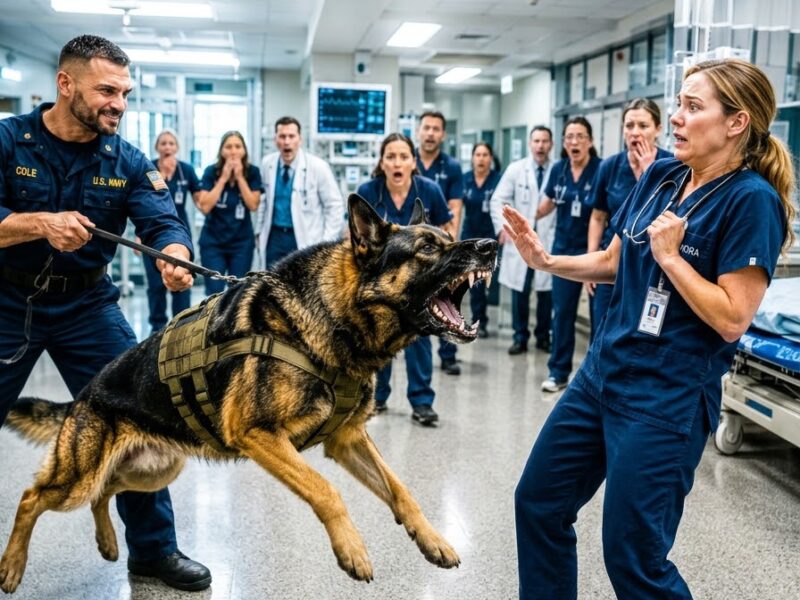
In a crowded San Diego hospital lobby, I unclipped my military K9’s leash and ordered him toward the nurse who had publicly accused me of lying
The fluorescent lights of the San Diego Veterans Memorial Hospital hummed with a low, buzzing vibration that rattled against the back of my teeth. To anyone else, it was just the sanitized background noise of a chaotic emergency room. To me, it sounded like the high-tension electrical wires outside a compound in Kandahar.
I kept my left hand buried deep in the pocket of my tactical jacket, my fingers wrapped tightly around the worn leather handle of a collapsible cane I refused to open. My right hand held the reinforced nylon lead connected to Ranger’s harness. Ranger, a ninety-pound Belgian Malinois with a scarred snout and eyes the color of dark amber, sat pressed firmly against my left leg. He felt the tremor in my hamstring before I did. He leaned his heavy shoulder against my knee, grounding me, forcing my pulse down from a sprint to a walk.
“Easy, boy,” I muttered, my voice barely audible above the din of crying infants, squeaking rubber-soled shoes, and the rhythmic chiming of telemetry monitors.
Twenty minutes ago, they had wheeled my seven-year-old daughter, Lily, through the double doors marked Trauma Bay 2. She had collapsed at breakfast, her skin paper-white, her lips tinged with a terrifying shade of blue. The doctors suspected a sudden, severe anaphylactic reaction or an acute cardiac anomaly, but nobody was giving me straight answers. As a former Navy SEAL who had spent twelve years navigating the fog of war, the uncertainty was an unbearable torment. In the field, action dissipated fear. Sitting in a plastic chair in a crowded lobby while my daughter fought for breath on the other side of a set of doors was pure, unadulterated hell.
“Sir, you can’t bring that dog in here.”
The voice was sharp, cutting through the haze of my anxiety like a serrated blade. I turned my head slowly. Standing behind the triage desk was a nurse in dark blue scrubs. Her badge identified her as Claire. She was in her early thirties, her dark hair pulled back into a tight bun, her expression pinched with a mix of exhaustion and authority.
“He’s a certified service animal,” I said, keeping my tone clipped and even. I reached into my chest pocket with my free hand and pulled out Ranger’s official Department of Defense identification card, alongside his service registration. “He stays with me.”
Claire didn’t even look at the card. She folded her arms across her chest, her posture rigid. “I don’t care what kind of paperwork you have. This is a sterile medical facility. Animals are a hazard, especially large, aggressive breeds. You need to take him outside immediately.”
“He’s a retired military working dog,” I replied, the temperature in my voice dropping several degrees. “He isn’t aggressive unless instructed to be, or unless he detects a threat. He stays.”
“Sir, you are creating a disturbance,” Claire snapped, her voice rising just enough to draw the eyes of the twenty-odd patients and family members sitting in the waiting area. “That doesn’t give you permission to threaten hospital staff.”
A quiet hush fell over the lobby. I felt every eye swing toward me. I was wearing an old navy-blue hoodie, jeans, and work boots, but my posture gave me away. The high-and-tight haircut, the hyper-vigilant scanning of the room, the scars visible on my neck—people instantly categorized me. Unstable veteran. Loose cannon.
“I haven’t threatened anyone,” I said, taking a half-step forward.
Claire stepped back, but her eyes weren’t locked on mine. She flashed a quick, nervous glance toward the floor, then looked back up, her chest heaving. “Then explain why your dog keeps watching me.”
I looked down at Ranger. His posture had shifted completely. His ears were rotated forward, his body locked into a low, coiled stance. Every muscle along his spine was tense. He wasn’t panting. He wasn’t watching her face, nor was he watching her hands in a defensive posture. His eyes were locked with laser-like focus on the left side-pocket of her blue scrubs.
“Ranger,” I whispered.
The command was a subtle friction of breath against teeth, a silent signal we had used during night raids in Helmand Province.
Ranger moved.
A collective gasp echoed through the lobby as the heavy Malinois stepped away from my side. He didn’t bark, nor did he display his teeth. He walked with a chilling, calculated purpose straight toward Claire.
“Security!” Claire yelled, her voice cracking with sudden panic. “Get this dog away from me!”
“Don’t move,” I said, my voice executing a command tone that made two nearby security guards instinctively freeze mid-step.
Ranger stopped inches from Claire. He didn’t jump. He didn’t snap. Instead, he lowered his heavy head, brought his nose within an inch of her left pocket, and let out a long, high-pitched whine.
It was a sound I had only heard three times in my life. It wasn’t an alert for explosives, nor was it an alert for narcotics. It was the specific, desperate whine Ranger reserved for medical distress—the sound he made when he found a wounded operator trapped under rubble, bleeding out in the dark.
“What’s in the pocket, Claire?” I demanded, moving up alongside my dog.
“Get away from me!” she shrieked, slapping frantically at my hand as I reached out. “Don’t touch me!”
Ranger lunged. He didn’t bite her skin; his jaw snapped with surgical precision onto the fabric of her scrub pocket. With a sharp tug, he ripped the small cloth pocket open.
A small, clear plastic evidence bag tumbled out onto the polished linoleum floor, accompanied by a syringe and a tiny glass vial with a bright red cap.
Claire dropped to her knees, scrambling to grab it, but an ER doctor—a tall man with graying hair who had just stepped out from the back—stepped on the bag first. He bent down, picked up the vial, and read the handwritten label affixed to the glass.
His face turned instantly ash-white. “Where did you get this?” Dr. Aris asked, his voice trembling. “This is Potassium Chloride. Concentrated. This is kept in the locked crash cart in the ICU.”
Claire wept silently, covering her face with her hands, refusing to answer.
Before anyone could process what was happening, a high-pitched alarm began shrieking from the monitor mounted above the central triage station. Red lights flashed across the board.
Bed 4 — Cardiac Arrest.
Dr. Aris looked at the vial, then at the monitor, horror dawning in his eyes. “This medication was never ordered for that patient. Bed 4 is…” He looked up at me, his eyes widening. “…that’s the pediatric admission.”
My heart stopped. Bed 4 was Lily.
“Claire, what did you do?!” Dr. Aris yelled, dropping the bag and sprinting toward the double doors.
I made to follow him, my blood turning to liquid fire, but Ranger suddenly spun around. He ignored the crying nurse on the floor. He ignored the commotion at the triage desk. He placed himself directly in front of me, his front paws planted, his spine arching as a deep, guttural growl vibrated from his chest.
It was a sound of pure hatred. A sound he hadn’t made since we left the military.
The double doors at the end of the hallway swung open. A man stepped out into the lobby. He wore a crisp white lab coat over a tailored charcoal suit, a stethoscope draped effortlessly around his neck. His posture was regal, his expression one of calm, professional concern.
Ranger’s lips pulled back, revealing gleaming white fangs. He wasn’t growling at Claire. He was growling at the man in the white coat.
And as I looked at the doctor’s face—at the distinct, jagged scar running beneath his left eye—my entire world shattered for the second time in five years.
I knew that scar. I knew those eyes.
The man standing in the doorway of the hospital, holding a tablet and looking down at us with cold detachment, was Dr. Marcus Vance.
The man who had signed my wife’s death certificate three years ago.
The room seemed to tilt on its axis. The frantic alarms of the hospital, the gasps of the onlookers, the heavy footfalls of security guards rushing to contain the scene—all of it faded into a muffled, distant echo. My focus narrowed until the only thing in the universe was the man standing at the end of the hall.
Dr. Marcus Vance.
Three years ago, my wife, Sarah, had been admitted to this exact hospital following a severe car accident. She had survived the crash with minor injuries—a fractured wrist and a mild concussion. I was deployed in Eastern Europe at the time. I remembered the satellite phone call, her laugh through the static, her reassuring me that she’d be home before my rotation ended.
Twelve hours later, she was dead.
The official cause of death was listed as a sudden, massive pulmonary embolism. An unpredictable complication, they called it. Tragic, but unavoidable. The head physician who signed off on her chart, who delivered the news to me via a cold, clinical letter when I landed at Travis Air Force Base, was Dr. Marcus Vance.
Now, he was standing thirty feet away from me, staring down at Ranger with an expression that was entirely devoid of fear or surprise. It was a look of cold, calculating irritation.
“Control your animal, Mr. Miller,” Vance said. His voice was smooth, baritone, polished like marble. “This is an emergency room, not a battlefield.”
“Lily,” I choked out, the name tearing through my throat like broken glass. I tried to push past him, but Vance extended a hand, blocking my path.
“Your daughter is currently undergoing emergency resuscitation,” Vance said smoothly, his eyes flashing with a dark, hidden intelligence. “Dr. Aris and the trauma team are with her. You stepping into that room with a hostile, unsterilized canine will only compromise her care. Stay here.”
Ranger let out a sharp, ear-splitting bark, snapping his jaws inches from Vance’s outstretched hand. Vance didn’t flinch. He merely pulled his hand back slowly, wiping his palm with a white handkerchief he pulled from his breast pocket.
“Security,” Vance said softly, not looking away from me. “Restrain this man and remove the dog from the building.”
Two heavy-set security guards hesitated, looking between Vance, the crying nurse on the floor, and me. They saw the posture of a man who had killed for a living, and they saw a dog capable of tearing through Kevlar.
“Stand down,” I warned the guards, my voice low and dangerous. “If anyone touches this dog, or stops me from seeing my daughter, God help you.”
“Jake!”
The call came from behind the double doors. Dr. Aris stepped out, his surgical mask hanging around his neck, his face dripping with sweat. He looked frantic.
“Jake, come here! Now!” Aris shouted.
I didn’t wait for Vance’s permission. I grabbed Ranger’s harness short, heel-stepping past Vance. As I passed the doctor, our shoulders brushed. Vance didn’t move away. Instead, he leaned in slightly, his voice a whisper that barely reached my ear.
“You should have stayed buried, Miller,” he murmured.
My blood roared in my ears, but the thought of Lily dragged me forward. I pushed through the double doors and sprinted down the hallway behind Dr. Aris, Ranger’s claws clicking wildly against the linoleum.
We burst into Trauma Bay 2.
The room was a nightmare of bright lights, discarded medical wrappers, and the rhythmic, terrifying scream of a flatlining heart monitor. Three nurses were surrounding the small gurney in the center. On the bed lay Lily, her tiny body pale, her dark curls plastered to her forehead with sweat. A clear mask was strapped over her face, pumping oxygen, but her chest wasn’t moving.
“What happened?!” I screamed, rushing to the side of the bed and gripping her ice-cold hand. “What did you do to her?!”
“Her heart stopped forty seconds ago,” Dr. Aris said, grabbing a pair of defibrillator paddles. “It wasn’t an allergic reaction, Jake. Her potassium levels just spiked through the roof. Someone injected her with a massive dose of hyperkalemia-inducing agents.”
The vial in Claire’s pocket.
“She was poisoned?” I whispered, horror choking the air from my lungs. “Why?! She’s a child!”
“Clear!” Aris barked.
The defibrillator charged with a high-pitched whine. The nurses backed away. Aris slammed the paddles onto Lily’s small chest. Her body jolted violently off the bed.
Beep… beep…
The flatline on the monitor broke into a ragged, erratic spike, then settled into a weak, desperately slow rhythm.
“We have a pulse,” a nurse breathed, wiping her forehead. “BP is 70 over 40. She’s stabilizing, but barely.”
“Get her on a continuous insulin-glucose drip and calcium chloride immediately,” Aris ordered, his hands shaking as he pulled off his gloves. “We need to force that potassium out of her bloodstream before her heart gives out completely.”
I fell to my knees beside the bed, burying my face in the thin hospital blanket covering Lily’s feet. Ranger rested his heavy head on her leg, letting out a soft, rhythmic whine, his warm breath soaking through the sheet.
“She’s going to live, Jake,” Aris said softly, placing a hand on my shoulder. “We caught it just in time. If your dog hadn’t stopped Claire in that lobby…”
He didn’t need to finish the sentence.
“Why would Claire do this?” I asked, looking up, my eyes bloodshot. “I’ve never seen that woman before in my life. Lily has never been to this hospital.”
Aris looked toward the heavy door of the trauma bay, then lowered his voice. “Claire isn’t a pediatric nurse. She works in the administrative wing—specifically, in the records department. She had no business being in the pharmacy vault, let alone near your daughter’s IV line.”
“Vance,” I spat, the name feeling like poison in my mouth. “She was working for Vance.”
Aris’s expression hardened, a look of profound fear crossing his features. “Jake… you don’t know what you’re dealing with. Dr. Vance isn’t just the Chief of Surgery here. He sits on the board of directors. He controls the funding, the staff, the security contracts. He’s untouchable.”
“Nobody is untouchable,” I said, standing up. The weak, desperate father in me vanished, replaced instantly by the operator who had spent a decade hunting monsters in the dark. “Why did my wife die, Aris? Tell me the truth. You were on duty the night Sarah was brought in.”
Aris paled. He stepped back, looking nervously at the glass window of the trauma bay. “I can’t… Jake, if I say anything, they’ll ruin me. They’ll take my license. They’ll—”
“My daughter almost died five minutes ago!” I growled, stepping into his space, grabbing the lapels of his scrubs. “My wife IS dead! Look at me, Aris! Look at my dog! We have survived landmines, sniper fire, and ambushes. I will tear this building down brick by brick until I get the truth.”
Aris swallowed hard. He looked down at Lily, then back at me, his eyes filled with immense guilt.
“Sarah didn’t die of a pulmonary embolism,” Aris whispered, his voice barely audible. “She was recovering fine. But… she saw something she shouldn’t have. She took a wrong turn down in the Sub-Level 3 research lab while looking for the physical therapy department. She saw Vance. She saw what he was doing down there.”
“Doing what?”
“Experimental trials,” Aris said, his tears finally breaking through. “Unregulated, highly toxic neurological drugs funded by a private defense contractor. Vance was using terminally ill patients—and veterans—as unrecorded trial subjects. When Sarah realized what she was looking at, she threatened to go to the federal authorities. Vance… Vance ordered a fatal air embolism. He made it look like a post-surgical complication.”
The room went completely silent, save for the weak, rhythmic beating of Lily’s heart on the monitor.
My wife hadn’t been killed by a tragic medical accident. She had been murdered. Executed in a cold, sterile room because she had a conscience.
“And Lily?” I asked, my voice terrifyingly calm. “Why attack a child?”
“Because of you,” Aris said. “Three days ago, you requested Sarah’s full, unredacted medical files from the state archive for a VA benefit audit. The request triggered an automatic flag in Vance’s system. He realized you were digging into her death. He couldn’t risk an investigation. He wanted to give you a tragedy so overwhelming—the loss of your daughter—that you would be too broken to ever look at a medical record again.”
A cold, razor-sharp clarity settled over my mind. The rage didn’t burn anymore; it solidified into tungsten.
“Where is Sub-Level 3?” I asked.
Before Aris could answer, the glass window of Trauma Bay 2 shattered into a shower of dangerous shards.
The sudden explosion of glass rained down over the metal trays and linoleum floor. In the same split second, the heavy magnetic locks on the trauma bay doors engaged with a loud, metallic CLANG.
A thick, grey chemical smoke began pouring through the broken window, smelling sharply of sulfur and tear gas.
“Get down!” I roared, grabbing a thick cotton medical blanket and throwing it over Lily’s body and face to protect her from the broken glass and fumes.
Ranger was already in action. He didn’t panic. He dropped low to the floor, where the air was cleanest, standing guard between the shattered window and Lily’s gurney.
Dr. Aris was coughing violently, dropping to his knees, his hands clutching his eyes. “The ventilation!” he gasped. “He’s shutting down the wing!”
Through the billowing smoke, I saw two dark figures stepping through the shattered window. They weren’t hospital security. They wore black tactical jumpsuits, reinforced vests, and full-face gas masks. In their hands, they held suppressed submachine guns.
Vance wasn’t just trying to cover his tracks anymore. He was burning the evidence.
“Ranger! Angriff!” I commanded in German.
The Malinois launched himself through the smoke like a missile. He didn’t target the legs or arms; he went straight for the throat of the lead operative. Ranger’s ninety pounds of muscle hit the man squarely in the chest, driving him backward into the shattered glass. The guard screamed as Ranger’s jaws locked onto his shoulder armor, thrashing with terrifying force.
The second operative raised his weapon toward Ranger.
I moved faster than I had in years. I closed the distance between us, grabbing the barrel of his submachine gun and forcing it upward just as he pulled the trigger. A burst of suppressed gunfire ripped into the ceiling tiles, sending plaster falling like snow.
I drove my knee hard into his groin, followed by a bone-shattering elbow strike to his jaw. The guard rocked backward, his gas mask cracking. I stripped the weapon from his hands, swept his leg, and drove him face-first into the concrete floor, knocking him unconscious.
Ranger had neutralized the first man, who was now writhing on the floor, bleeding from his shoulder, his weapon discarded.
“Aris!” I shouted, crouching down beside the trembling doctor. “Is there a way out of this room that doesn’t go through the lobby?”
Aris pointed a shaking finger toward the back wall. “The… the service elevator. It requires an administrator keycard, but it goes directly down to the basement and the sub-levels.”
I bent over the unconscious operative I had just taken down, ripped off his tactical belt, and grabbed his keycard lanyard. “Stay with Lily,” I told Aris, racking the bolt of the captured submachine gun. “Lock this door from the inside. If anyone tries to come through that door who isn’t me, you use this.”
I shoved a secondary sidearm I pulled from the guard’s holster into Aris’s hands. The doctor stared at the weapon in shock, but nodded slowly, his eyes filled with newfound resolve.
“Jake,” Aris called out as I walked toward the rear service door. “Sub-Level 3… it’s locked down. Vance has a private security force down there. You’re walking into a slaughterhouse.”
“I’ve been in slaughterhouses before,” I said quietly. “They usually belong to me by the time I leave.”
I unlatched the service door, letting Ranger slip out first. We entered a narrow, concrete-walled corridor illuminated only by red emergency lights. The silence here was eerie, punctuated only by the distant hum of the building’s main generators.
At the end of the hall was a heavy steel elevator door. I swiped the captured keycard. The indicator light shifted from red to green, and the heavy doors slid open with a soft hiss.
Inside, the elevator panel had only four buttons: 1, B1, B2, and an unlabeled brass keyhole marked S3.
I took the keycard, jammed the corner of it into the keyhole mechanism, and twisted it hard until the internal tumbler clicked. The elevator jolted, then began to descend.
The air grew noticeably colder as the floor counter dropped.
B1… B2… S3.
The doors slid open.
The smell hit me first. It wasn’t the clean, pine-scented bleach of the upper floors. It smelled of copper, ozone, and damp concrete.
Sub-Level 3 looked like a military bunker hidden beneath a public institution. High-grade fluorescent tubes illuminated a polished epoxy floor. Thick, reinforced glass walls stretched down a long hallway, revealing pristine, high-tech laboratory spaces filled with centrifuges, stainless steel tables, and ranks of computer servers.
At the far end of the corridor stood Dr. Marcus Vance. He was standing in front of a heavy, vault-like metal door, typing a long sequence into a digital keypad. Beside him were two heavily armed private contractors.
“Ranger, heel,” I whispered.
We stepped out of the elevator. The sound of my boots on the epoxy floor echoed down the long hall.
Vance paused, his fingers hovering over the keypad. He turned slowly, his face showing the first true crack in his pristine facade. Surprise flickered in his dark eyes, replaced quickly by an icy, contemptuous glare.
“I must admit, Miller,” Vance said, his voice echoing in the sterile hallway. “Your persistence is remarkable. Most men in your condition—broken, traumatized, clinging to a dying child—would have laid down and wept.”
“You made a mistake three years ago, Vance,” I said, walking forward with deliberate, steady steps, the submachine gun low at my side. “You thought Sarah was just another victim without anyone to fight for her.”
“Your wife was an unfortunate casualty of progress,” Vance replied coldly, wiping his hands with his signature white handkerchief. “She stumbled into a multi-million-dollar defense project. We are developing neuro-regenerative compounds that will change the face of battlefield medicine. Millions of lives will be saved. What is one woman’s life compared to that?”
“She was my wife,” I said. “And Lily is my daughter.”
Vance chuckled, a dry, hollow sound. “And now you’re going to die in the basement of the hospital where they both bled out. How poetically tragic.”
Vance clicked a button on the keypad. The heavy vault door behind him began to slide open, revealing a room filled with black hard-shell server towers and paper files spanning decades.
“Kill them,” Vance ordered the two guards. “Then burn the lab.”
The two guards raised their rifles simultaneously, but Ranger and I were already moving in synch, a lethal pair perfected by years of blood and combat.
“Ranger, pack!” I yelled.
Ranger sprinted to the left, his nails digging into the smooth floor, drawing the fire of the guard on the right. Bursts of automatic gunfire shattered the thick glass partition beside us, showering the hall in reinforced shards.
I dropped to one knee, bringing my submachine gun up, and fired a three-round burst into the chest of the guard on the left. The bullets struck his armor plate, staggering him backward. Before he could recover, I advanced, firing two more rounds precisely into his unarmored neck. He collapsed to the floor, coughing blood.
The second guard was trying to track Ranger, who was weaving wildly between the overturned metal carts in the hallway. The guard panicked, swinging his rifle wildly. Ranger leaped from the top of a stainless-steel table, slamming his entire weight into the guard’s helmeted head. The man slammed against the wall, dropping his rifle. Ranger clamped onto his arm, thrashing savagely until the man went limp.
“Vance!” I roared, turning back toward the vault door.
Vance was already inside the vault room, frantically dumping cans of accelerant over stacks of paper documents and high-capacity hard drives. He held a silver emergency flare in his right hand.
“Stay back, Miller!” Vance screamed, his composure completely shattered. His hair was disheveled, his expensive coat stained with chemical fluid. “If you step into this room, I drop this flare! Decades of research, evidence, everything—it all goes up in flames! You’ll never prove what happened to your wife! You’ll never prove anything!”
I stopped at the threshold of the vault.
The room was massive. Along the walls were thousands of physical files, each bearing the seal of the Department of Veterans Affairs, marked with red stamps: DECEASED – NATURAL CAUSES.
Hundreds of veterans. Hundreds of families lied to, just like mine.
“You think I care about a trial?” I said, taking a slow step into the room. “You think I came down here to put handcuffs on you?”
Vance blinked, his hand trembling as he held the lit flare above a pool of lighter fluid. “You’re a soldier. You follow the law.”
“I was a soldier,” I corrected him, my voice dropping to a icy whisper. “Now I’m just a father.”
Ranger slipped into the room behind me, his shoulder pressed against my hip, his eyes fixed on Vance’s hand.
“Look around you, Vance,” I continued, gesturing to the rows of files. “Look at what you built. A mountain of dead bodies so you could collect a paycheck from defense contractors. You poisoned my daughter because you were afraid of a file clerk looking at an old medical audit.”
“She was a threat!” Vance shrieked. “They were all threats! They were useless, broken men coming back from war, taking up space, taking up resources! I gave their deaths meaning! I used them to advance science!”
“You’re a coward,” I said. “Hide behind a white coat and a syringe. You couldn’t last five seconds in the world those men lived in.”
Vance’s face twisted into a mask of pure rage. “I will burn this entire facility to the ground before I let you take this from me!”
He swung his arm down, dropping the lit flare toward the pool of accelerant.
“Ranger, TAKE IT!”
Ranger launched himself across the room in a blur of fur and muscle. He didn’t bite Vance’s body. With horrifying precision, Ranger’s jaws snapped around Vance’s wrist mid-air, intercepting the falling flare before it hit the pool of fuel.
The force of Ranger’s leap dragged Vance to the floor with a violent crash. The silver flare rolled harmlessly across the concrete, far away from the chemical spill.
Vance screamed in agony as Ranger pinned him to the floor, his massive paws planted on the doctor’s chest, his teeth hovering an inch from Vance’s exposed throat.
“OFF ME! GET IT OFF ME!” Vance shrieked, tears and sweat pouring down his face. “PLEASE! DON’T KILL ME!”
I walked over slowly, picking up the lit flare and pressing it into a nearby fire extinguisher bucket, smothering the flame into darkness.
I looked down at the man whimpering beneath my dog. He was small. Pathetic. A predator who had spent his life hiding behind glass walls and clean clothes, stripped of his power the moment real strength confronted him.
I knelt beside him, leaning down until my face was inches from his.
“My wife was named Sarah,” I said softly. “My daughter is named Lily. Say their names.”
Vance whimpered, choking on his own saliva. “S-Sarah… Lily…”
“Remember them,” I said. “Because every day for the rest of your life, in whatever dark cell you end up in, you’re going to think about them.”
I reached out, pulled a pair of heavy tactical zip-ties from the dead contractor’s vest in the hallway, and bound Vance’s hands securely behind his back, wrapping them so tightly his fingers turned purple.
I pulled out my satellite phone, dialed a secure line I hadn’t used in three years, and placed it to my ear.
“This is Commander Jake Miller, retired,” I said into the receiver. “I am at San Diego Veterans Memorial Hospital, Sub-Level 3. I have secured an illegal human testing facility, high-level classified defense documents, and the primary target, Dr. Marcus Vance. Send federal marshals and military police immediately. And bring a medical team.”
The blue and red lights of thirty law enforcement vehicles bathed the exterior of San Diego Veterans Memorial Hospital in a flashing, rhythmic pulse. Federal agents, Navy Criminal Investigative Service (NCIS) officers, and local police had completely cordoned off the entire complex.
The sun was just beginning to peek over the San Diego horizon, painting the sky in deep shades of gold and amber.
I sat on the rear bumper of an ambulance parked near the ER entrance, an emergency blanket draped over my shoulders. My knuckles were bruised, my clothes stained with dust and sweat, but for the first time in three years, the crushing weight in my chest felt slightly lighter.
Beside me, Ranger sat proudly, his head resting on my knee. A young paramedic had wrapped a clean bandage around his left paw where a small piece of glass had scratched him, but he didn’t care. He was watching the entrance of the hospital.
The automatic sliding doors opened.
Dr. Aris stepped out, pushing a wheelchair. Sitting in the wheelchair, wrapped in a bright pink cartoon blanket, was Lily.
Her skin had regained its natural color. Her eyes were open, bright and clear, looking around at the flashing lights with a child’s quiet wonder.
“Daddy!” she called out, her voice thin but sweet.
I dropped the blanket, stood up, and rushed toward her. I fell to my knees in front of the wheelchair, wrapping my arms around her fragile frame, burying my face in her dark curls. I wept silently, tears soaking into her blanket, holding her as if the universe might try to pull her away again if I let go.
“I’m here, baby,” I sobbed. “Daddy’s here. You’re safe.”
“Ranger!” Lily squeaked, extending a small, weak hand out from under the blanket.
Ranger didn’t jump. He stepped up softly, pressing his broad, furry head against her lap, letting out a deep, satisfied sigh. Lily wrapped her small arms around his neck, burying her face in his neck fur.
Dr. Aris stood above us, a tired, relieved smile on his face. “The potassium levels are completely back to normal, Jake. Her cardiac rhythms are strong. She’s going to make a full recovery. No permanent damage.”
“Thank you, Aris,” I said, reaching up to shake his hand firmly. “For everything.”
“Don’t thank me,” Aris said quietly, looking back toward the hospital where two federal agents were leading a handcuffed, disheveled Dr. Marcus Vance out toward a black van. “You saved this hospital today, Jake. You exposed a nightmare that was eating this place from the inside out. Your wife… Sarah would be so proud of you.”
I watched as Vance was pushed into the back of the federal transport van. He looked back at me one last time through the tinted glass—broken, ruined, his life of cold manipulation at an end. He would spend the rest of his days in a federal maximum-security penitentiary, surrounded by the very justice he had spent decades evading.
The federal agents loaded crates of hard drives, server racks, and paper files from Sub-Level 3 into military transport trucks. The evidence was overwhelming. Sarah’s name, along with dozens of other brave veterans, would finally be cleared. Their families would receive the truth, the honors, and the justice they had been denied.
I picked Lily up out of the wheelchair, cradle-holding her against my chest. She laid her head against my shoulder, her thumb slipping into her mouth, her eyes heavy with exhaustion.
“Daddy?” she whispered.
“Yeah, sweetie?”
“Can we go home now?”
I looked down at Ranger, who was standing beside us, his ears perked, his tail giving a soft, steady wag. The morning sun broke through the clouds, illuminating the coastal horizon in brilliant gold. The cold, sterile shadow of the hospital fell behind us.
“Yeah, Lily,” I said softly, kissing the top of her head. “We’re going home.”
We walked toward my truck parked at the edge of the lot. Ranger walked shoulder-to-shoulder with me, his stride steady, his head held high.
The battle was over. The ghosts were finally at peace. And as I opened the truck door for my daughter, I knew that for the first time in a very long time, we were finally going to be okay.
The end.









