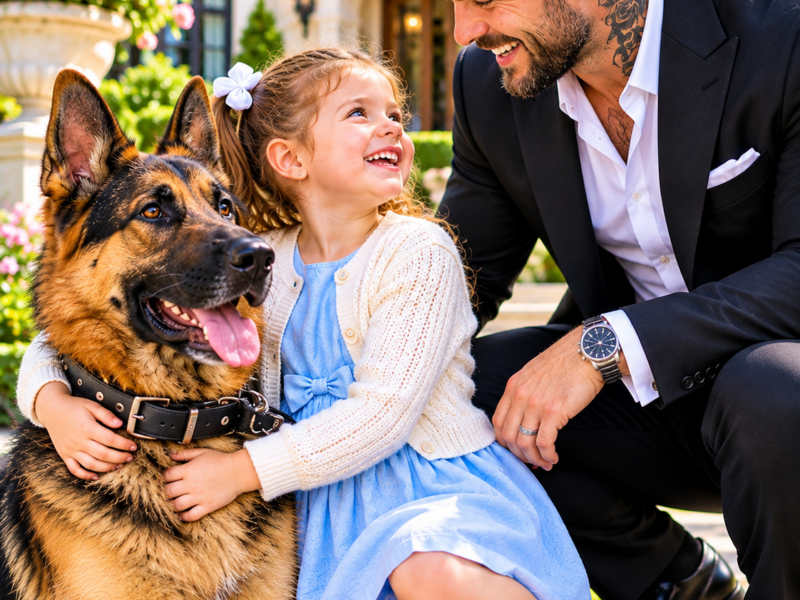
“I’m taking your dog for a ride.” I was six years old when I said those words to one of the most feared men in the city.
The rain had not stopped when Alessandro Romano walked out of the apartment building.
I was six years old, and I didn’t understand why everyone was suddenly moving so quickly. I didn’t understand why Bruno had lifted me into his arms, why my mother was crying, or why Marco kept looking back toward the staircase.
I only understood one thing.
Alessandro was staying behind.
And he had promised to come find me.
I clutched the little silver chain he had placed in my palm. The tiny saint hanging from it was smooth from years of being touched. Alessandro had told me it belonged to his wife, Alina.
I didn’t know what that meant yet.
I only knew it was important to him.
“Keep it safe,” Bruno told me as he carried me down the last flight of stairs.
“I will.”
“And look after Marco.”
“I am.”
Marco walked ahead of us, his ears flattened against his head. He was usually a confident dog, the sort who could sleep through a thunderstorm without lifting his head. But that afternoon, he moved differently.
He stayed close to us.
Very close.
We escaped through the back of a bakery. The baker, a large woman with flour on her arms, stared at us as we hurried through her kitchen.
Bruno didn’t stop to explain.
Outside, the wind coming off the river cut through our clothes. A small wooden boat waited beside the water.
Paulo helped my mother climb aboard while Bruno placed me carefully beside her.
Marco jumped in after us.
“Where is Alessandro?” I asked.
Neither man answered immediately.
“He’s taking care of something,” Bruno finally said.
“Then why isn’t he coming?”
Bruno looked at Paulo.
I remember that look because it was the first time I realized adults could be frightened without saying they were frightened.
“Your father will come,” Bruno said.
I didn’t correct him.
I didn’t know whether Alessandro was my father. I hadn’t yet learned what the photograph meant or why my mother had been crying.
But I liked the sound of those words.
Your father.
The boat pulled away from the riverbank.
I watched the city disappear behind the rain.
A few minutes later, a distant sound crossed the water.
It was sharp and unfamiliar.
My mother closed her eyes.
Bruno’s hands tightened around the oar.
Marco stood in the bow, staring toward the city.
“Was that a gun?” I whispered.
Bruno didn’t answer.
And that was when I began to cry.
1. The Man Who Stayed Behind
What happened outside our apartment building became one of the stories I would hear many times over the years.
But I didn’t learn the details until I was old enough to understand what Alessandro had risked.
He had walked through the front entrance alone.
Three black cars waited across the street. Eight men stood beneath the buildings, their coats darkened by rain.
The man in charge was Carlo Benedetti.
He was an old rival of the Romano family, a man who had spent more than a decade believing Alessandro’s daughter was dead.
Now he knew the truth.
Carlo stepped out of his car, adjusted his coat, and greeted Alessandro with the politeness of someone arriving for dinner.
“Alessandro. It’s been a long time.”
“Not long enough.”
Carlo smiled.
“Where is the child?”
Alessandro didn’t answer.
He stood in the middle of the wet street with his hands visible. His charcoal overcoat was soaked, and rain ran down his face.
He looked nothing like the man I remembered from the café.
There was no laughter in his eyes.
Only determination.
Carlo took a step closer.
“You’ve made things difficult for yourself.”
“I know.”
“You should have left the child where she was.”
Alessandro’s jaw tightened.
“She has a name.”
“Does she?”
“Sophia.”
For eleven years, Alessandro had lived with the belief that his daughter had been taken from him and killed.
Now he knew she was alive.
He also knew that acknowledging her publicly could put her life in danger.
Carlo wanted to use that knowledge against him.
Alessandro understood something else.
The only way to protect me might be to give up everything that made him powerful.
So he made an offer.
The villa. The businesses. The accounts. The territories. Everything he had spent twenty years building.
He would disappear from the city and never challenge Carlo again.
In exchange, Carlo would leave the child and her family alone.
Carlo laughed.
“You expect me to believe you would surrender an empire for one little girl?”
Alessandro looked at him without blinking.
“I expect you to understand that I have nothing else left that I want.”
Carlo’s smile faded slightly.
Then a third man appeared.
Vittorio Gallo.
He had followed Alessandro from the apartment, and he was now standing between the two men.
His face was pale.
His expensive suit was soaked.
“Carlo,” he said quietly. “I can tell you where the child is.”
Alessandro turned toward him.
For a moment, he looked almost unable to understand what he had heard.
Vittorio had been his closest friend for decades.
They had built their lives together. They had survived enemies, betrayals, and years of violence.
Vittorio had also been the man who helped destroy Alessandro’s family.
Carlo smiled again.
“That would be helpful.”
But Vittorio didn’t turn toward Carlo.
He faced Alessandro.
“Forgive me,” he whispered. “I was always going to give her back.”
Then he stepped in front of his oldest friend.
The street erupted.
Vittorio took the bullets intended for Alessandro.
He fell onto the wet cobblestones, his hand opening against the pavement.
Carlo’s men scattered as Alessandro’s remaining guards emerged from nearby buildings.
But the damage had been done.
Vittorio was dying.
Alessandro dropped beside him.
For several seconds, neither man spoke.
Then Vittorio reached inside his coat and pulled out a folded sheet of paper.
It was a confession.
Eleven years of secrets had been written in neat handwriting.
Names. Dates. Meetings. Payments. The identities of the men who had arranged the kidnapping and the murder of Alina.
“I should have told you,” Vittorio whispered.
Alessandro held the paper.
“Yes.”
“I thought I was protecting her.”
“You were protecting yourself.”
Vittorio closed his eyes.
“I know.”
Those were his last words.
Alessandro remained beside him until Bruno arrived.
He did not forgive Vittorio that afternoon.
But he did not leave him alone either.
2. Two Years by the Sea
The town where we went was small enough that everyone knew when someone bought a new pair of shoes.
It had a little harbor, a church with a cracked bell, and houses painted in faded shades of yellow and blue.
My mother rented a modest house near the water.
There was a garden behind it, a narrow kitchen, and a bedroom where Marco slept across the doorway every night.
Bruno stayed with us for the first few weeks.
Paulo visited whenever he could.
Then, gradually, the men who had spent years working for Alessandro disappeared from our daily lives.
We were told not to give our address to strangers.
We were told not to mention the Romano family.
We were told to avoid the old neighborhood.
My mother became Lucia Ferrante again.
I became Giulia Ferrante.
And Alessandro Romano became a man I wasn’t sure I would ever see again.
The first month was difficult.
I asked about him every morning.
“Is he coming today?”
My mother always answered carefully.
“He said he would find us.”
“Then why doesn’t he?”
“Sometimes grown-up things take longer than children expect.”
I hated that answer.
I was six.
I believed promises should be simple.
If someone said they would come, they should come.
I didn’t understand courtrooms, police investigations, criminal organizations, or the danger of having a famous surname.
I understood waiting.
And I waited.
Every time a car slowed outside the house, I ran to the window.
Every time footsteps approached the gate, I looked toward the door.
Most of the time, it was nothing.
Sometimes it was the postman.
Sometimes it was a neighbor.
Sometimes it was Bruno bringing groceries.
But never Alessandro.
At night, I wore the silver chain beneath my pajamas.
I kept touching the little saint whenever I felt frightened.
One evening, my mother found me sitting on the floor beside Marco.
“Are you missing him?”
I nodded.
She sat beside me.
“So am I.”
I looked up.
“Are you angry with him?”
She thought about it.
“I’m angry about many things.”
“Does that mean you don’t like him?”
My mother smiled sadly.
“No, sweetheart. Sometimes people can be angry with someone and still want them to come home.”
I considered that for a while.
Then I rested my head against her shoulder.
“I think Marco misses him too.”
My mother looked at the dog.
Marco was sleeping with one ear turned toward the front door.
“Yes,” she whispered. “I think he does.”
The town gradually became our home.
I started school.
My mother found work at a small restaurant.
Marco became famous among the neighborhood children, who initially approached him cautiously before discovering that the enormous German Shepherd enjoyed being scratched behind the ears.
He never stopped sleeping outside my bedroom.
Sometimes I wondered whether he was protecting me.
Other times, I thought he was waiting for Alessandro.
Perhaps he was doing both.
Meanwhile, the events in the city continued to unfold.
I learned the details years later.
Vittorio’s confession had been more important than anyone expected.
The document identified the men who had paid for Alina’s death and Sophia’s disappearance. It also contained information about the network that had helped Carlo Benedetti maintain his influence.
Once the authorities received the evidence, the investigation expanded.
Carlo and several of his associates were arrested.
The Romano organization began to collapse from within.
Some men disappeared.
Others turned against one another.
Businesses that had looked legitimate for years suddenly became the subject of investigations.
Alessandro could have used the confusion to take control of everything again.
Instead, he made a decision nobody around him expected.
He began dismantling his empire.
It was not immediate.
There were years of legal proceedings, negotiations, financial investigations, and difficult decisions.
He closed businesses connected to criminal activity.
He sold properties.
He worked with lawyers to separate legitimate assets from the rest.
Some of the men who had served him left.
Others stayed long enough to help him finish what he had started.
Bruno eventually discovered that he enjoyed cooking.
This surprised everyone, including Bruno.
Paulo returned to school.
The young man who had once carried a weapon beneath his jacket began studying business administration.
Alessandro never returned to the villa as a place of power.
He sold it.
He kept only a few personal belongings, including the photograph of Alina holding their baby.
And he kept looking for us.
3. The Truth About My Name
I was eight when my mother finally sat me down and told me everything.
It was a warm afternoon.
Marco was lying beneath the kitchen table, and my mother was preparing vegetables for dinner.
She had been unusually quiet all day.
After washing her hands, she sat opposite me.
“Giulia, there’s something important we need to talk about.”
I put down my pencil.
“Did I do something wrong?”
“No.”
“Is Marco sick?”
“No, sweetheart.”
She took a breath.
“It’s about your name.”
I looked at her.
“You gave it to me.”
“Yes. But before you came to live with us, your name was Sophia.”
I didn’t speak.
She continued.
“Your birth mother was a woman named Alina. She died when you were very young. Your father is Alessandro Romano.”
I knew that name.
I knew the photograph.
I knew the silver chain.
But hearing the words spoken together made everything different.
“Then why did you tell everyone I was Giulia?”
My mother reached across the table.
“Because I loved you. And because I wanted you to have a safe home.”
“But you aren’t my real mother?”
Her eyes filled with tears.
“I didn’t give birth to you. That’s true. But I raised you. I held you when you were sick. I sat beside your bed when you had nightmares. I taught you to tie your shoes and helped you learn to read.”
She paused.
“None of that was pretend.”
I looked down at my hands.
I had never considered that my mother might not be my mother.
To me, she was simply Lucia.
The woman who packed my lunch.
The woman who knew when I was lying about brushing my teeth.
The woman who sang old songs while washing dishes.
The woman who had held me when I was frightened.
I didn’t want to lose any of that.
“Will I have to leave you?”
My mother stood up immediately and came around the table.
“No.”
“Will Alessandro take me?”
“No one is going to take you away from me.”
She held my face between her hands.
“You have a father who has spent years trying to make sure you are safe. And you have me. Those things don’t have to cancel each other out.”
I started crying.
She pulled me into her arms.
“I was afraid,” she whispered. “I was so young when you came to us. I didn’t know what would happen if I told the truth. I thought someone might come looking for you. I thought I might lose you.”
“Did you know he was my father?”
“Not at first.”
“Then why did you let him see me?”
My mother looked toward the window.
“Because when I saw him with you, I understood that you deserved to know where you came from.”
I rested my head against her.
“Can I still call you Mama?”
She began crying.
“Oh, sweetheart. You can call me that for the rest of your life.”
That night, I looked at the silver chain for a long time.
I had two names.
Two histories.
And two people who loved me.
I didn’t know what to do with all of it.
But I knew I didn’t want to choose between them.
4. The Return
Alessandro came to find us on the first warm day of spring.
I remember because I was sitting on the garden wall with Marco.
The old dog had grown heavier and slower. His muzzle was beginning to turn gray, and he no longer ran across the garden as quickly as he once had.
But he still watched the gate.
He always watched the gate.
I was drawing in the dirt with a stick when I heard the latch move.
A man stood outside.
He wore a plain gray sweater and dark trousers.
He looked thinner than I remembered.
There was a scar near his hairline, and his hair had more gray than before.
He held nothing in his hands.
No expensive coat.
No guards.
No black cars.
Just a man standing at the gate, looking toward the little girl he had promised to find.
Marco saw him first.
The dog stood up slowly.
For one moment, he seemed uncertain.
Then his ears lifted.
He crossed the garden with his tail swinging.
Alessandro dropped to his knees.
Marco pressed his enormous head against his chest, and the man wrapped both arms around him.
He began to cry.
Not quietly.
Not with the restraint I remembered from the villa.
He cried like someone who had spent two years holding his breath.
I stood up.
I touched the silver chain around my neck.
Then I walked toward him.
“You came.”
Alessandro looked up.
His eyes were wet.
“I did.”
“You took a long time.”
“I know.”
“Marco waited.”
He looked at the dog and ran his hand over his head.
“He did.”
I held out the chain.
“You gave this to me.”
Alessandro stared at it.
For a moment, he couldn’t speak.
Then he gently closed my fingers around it.
“Keep it.”
“But it belongs to your wife.”
His expression softened.
“It belonged to Alina. She would have wanted you to have it.”
I looked at the tiny saint.
“She was my mother?”
“Yes.”
“Did she love me?”
Alessandro’s face changed.
I had never seen so much sadness in one expression.
“More than anything in the world.”
“Then why isn’t she here?”
He lowered his head.
“Because someone took her from us.”
I waited.
He didn’t offer a complicated explanation.
He didn’t tell me stories about enemies or business or the dangerous life he had once lived.
He simply said:
“She should have had the chance to watch you grow up.”
I looked at his face.
Then I asked the question that had been sitting inside me for two years.
“Are you going to leave again?”
Alessandro shook his head.
“Not if I can help it.”
I thought about that.
Then I stepped forward and hugged him.
His arms closed around me carefully, as though he was afraid I might disappear.
From the kitchen doorway, my mother watched.
She had one hand over her mouth.
Alessandro looked at her over my shoulder.
For several seconds, neither spoke.
Then he stood, still holding me, and walked toward the house.
My mother met him halfway.
“Lucia,” he said.
“Alessandro.”
There was so much history between those two names.
He looked down.
“I don’t know how to thank you.”
“You don’t have to.”
“You kept her safe.”
“She’s my daughter.”
He nodded.
“Yes. She is.”
My mother seemed surprised.
Perhaps she had expected him to correct her.
Perhaps she had prepared herself for a conversation about blood and names and legal rights.
Instead, Alessandro said something she would remember for the rest of her life.
“I won’t ask you to give her up. I only hope you’ll allow me to be part of her life.”
My mother looked at me.
I was still holding his hand.
She took a breath.
“Then we will have to learn how to do this together.”
Alessandro nodded.
“Together.”
It wasn’t a perfect reunion.
There were questions that couldn’t be answered in one afternoon.
There were legal documents to sign, family histories to understand, and years of lost time that could never be recovered.
But that day, we ate dinner together.
My mother cooked pasta.
Alessandro sat at our small kitchen table.
Marco slept beneath it.
And for the first time in eleven years, the Romano family had a home that didn’t feel empty.
5. Learning to Be a Father
Alessandro had no idea how to raise a six-year-old.
He knew how to negotiate with dangerous men.
He knew how to read a room.
He knew how to make people nervous simply by entering a building.
But he had never learned how to help a little girl with her homework.
The first time he visited after returning, I asked him to help me with a school assignment.
We had to write five sentences about our family.
I sat at the kitchen table with my notebook.
Alessandro sat beside me.
“How do you spell family?” I asked.
He told me.
I wrote the word carefully.
Then I stopped.
“Can I write two mothers?”
He looked at me.
“Of course.”
“Will the teacher think that’s strange?”
“Perhaps.”
“Then what should I do?”
He considered it.
“Write what is true.”
So I wrote about Lucia, who raised me, and Alina, who gave birth to me.
Then I wrote about Alessandro.
I described him as a man who used to have a very big house and a very scary dog.
Alessandro read the page.
“A scary dog?”
I nodded.
“Marco was scary.”
“Marco?”
“He was enormous.”
Alessandro looked beneath the table.
Marco was asleep with his paws twitching.
“He was always gentle with you.”
“That’s because he liked me.”
“Yes,” Alessandro said softly. “He did.”
It was the first time I saw him smile without sadness following immediately afterward.
He began visiting regularly.
Sometimes he came for dinner.
Sometimes he took me to the beach with Marco.
Sometimes he sat with my mother while I played in the garden.
He never tried to replace her.
He didn’t ask me to call him Papa.
He didn’t demand that I use Sophia instead of Giulia.
He allowed me to decide what felt comfortable.
For a while, I called him Alessandro.
Then one afternoon, I fell while running across the garden.
I scraped my palm and started crying.
My mother was inside.
Alessandro reached me first.
He lifted me carefully and carried me to the kitchen.
He washed the dirt from my hand and searched the cabinet for a bandage.
I was still crying when he knelt in front of me.
“You’re all right.”
“It hurts.”
“I know.”
“Can you stay?”
He looked at me.
“Of course.”
I reached for his sleeve.
“Daddy?”
His hand stopped.
For a moment, I thought I had said something wrong.
Then he lowered his head.
“Yes, sweetheart?”
“Don’t go yet.”
He took my hand.
“I won’t.”
Later that evening, I heard him speaking quietly with my mother.
“I never thought I’d hear that word again,” he said.
My mother answered gently.
“Then don’t waste it.”
He didn’t.
6. The Life He Chose
It took Alessandro years to leave his former life behind completely.
People sometimes imagine that a man who has spent decades building an empire can simply walk away from it.
He cannot.
There were properties to sell, investigations to answer, old associates to distance himself from, and responsibilities that did not disappear just because he had changed his mind.
Some men accused him of becoming weak.
Others believed he had lost his judgment.
A few tried to convince him to rebuild the organization under a different name.
He refused.
Bruno told me that one evening, an old associate visited him at his office.
The man had once been among Alessandro’s closest business partners.
He wanted to know why Alessandro was throwing away everything.
“You could still have control,” the man argued. “You know how the world works. You know what people respect.”
Alessandro looked at him.
“I know exactly what people fear.”
“Then use it.”
Alessandro stood and walked to the window.
Outside, the city was beginning to darken.
“Do you know what I remember most about my daughter?” he asked.
The man didn’t answer.
“She once looked at a dog everyone was afraid of and decided he needed a friend.”
He turned.
“She was six years old. She had more courage in her little finger than I had in twenty years of power.”
The associate shook his head.
“You’ve changed.”
“Yes.”
“And you think the world will let you?”
Alessandro gave him a tired smile.
“The world can do what it wants. I am finished doing what it wants.”
The man left.
Alessandro never saw him again.
He continued the difficult work of dismantling the businesses that had supported his former organization.
He cooperated with the authorities where necessary.
He made restitution where possible.
He sold the villa and moved into a modest house closer to the sea.
He never returned to the position he had once held.
But he gained something he had not possessed for many years.
Peace.
Not the kind that comes from controlling everything around you.
The kind that comes from no longer needing to.
7. The Photograph on the Wall
When I was ten, Alessandro gave me a small wooden box.
Inside were several photographs.
One showed him as a young man standing beside Alina.
Another showed Alina holding me as a baby.
The last was a photograph I had never seen before.
It showed Alina sitting in a garden, laughing.
Her dark curls fell across her face.
She looked happy.
I held the photograph for a long time.
“Was she always smiling?”
Alessandro sat beside me.
“Not always.”
“Was she funny?”
“Very.”
“Was she brave?”
He smiled.
“More than anyone I knew.”
I traced the edge of the photograph.
“Did she like dogs?”
He laughed quietly.
“She loved them.”
“Then she would have liked Marco.”
“She would have adored him.”
I looked at the picture again.
“Do you miss her?”
Alessandro didn’t answer immediately.
“Every day.”
“Does it get better?”
He thought carefully before responding.
“You learn to carry it differently.”
I leaned against his arm.
“Sometimes I miss things I never had.”
He turned toward me.
“Like what?”
“Having a mother who was there when I was a baby.”
His eyes softened.
“I miss that too.”
He didn’t try to make me feel better with promises that everything happened for a reason.
He didn’t tell me that the past didn’t matter.
He simply sat beside me.
After a while, I asked whether I could put the photograph on my bedroom wall.
He nodded.
“She belongs somewhere people can see her.”
So we placed it above my bed.
For the first time, the walls in Alessandro’s home began to fill with photographs.
There were pictures of Alina.
Pictures of me.
Pictures of Lucia.
And, eventually, pictures of Marco sleeping in increasingly ridiculous positions.
The house stopped looking like a museum.
It began looking like a home.
8. The Last Ride
Marco lived to be thirteen.
For a German Shepherd of his size, that was a long life.
By the end, his hips were stiff, and he struggled to climb the stairs.
He still insisted on following me everywhere.
If I went into the garden, he came.
If I sat on the sofa, he placed his head on my feet.
If I left the room, he lifted his head and watched the door.
Alessandro worried about him more than he admitted.
One afternoon, I found him sitting beside Marco’s bed.
He was gently brushing the dog’s fur.
“Is he sick?” I asked.
Alessandro looked up.
“He’s getting old.”
“Can he get better?”
He paused.
“I don’t think so, sweetheart.”
I sat beside him.
Marco lifted his head and nudged my hand.
I scratched behind his ear.
“Can we take him for a ride?”
Alessandro looked at me.
“What kind of ride?”
“The red wagon.”
He smiled sadly.
“The wagon is much too small now.”
“We can get a bigger one.”
He laughed.
For the next few days, he worked with a local carpenter to build a small wooden cart with wide wheels and a padded bed.
It wasn’t meant to carry Marco far.
It was simply a way to make him comfortable.
On a bright afternoon, we took the cart into the garden.
Marco lay inside, his enormous head resting on the edge.
I held the handle.
Alessandro walked beside us.
My mother followed with a blanket and a bottle of water.
We moved slowly along the garden path.
Marco’s ears lifted whenever he heard a bird.
For a little while, he seemed like the same young dog who had once walked beside Alessandro through the streets of the city.
Then he rested his head again.
I looked at my father.
“Do you remember the first time I met him?”
“I remember every second.”
“You thought I was strange.”
“I thought you were going to give me a heart attack.”
I laughed.
“Because I wanted to borrow your dog?”
“Because you approached four armed men without the slightest hesitation.”
I thought about that.
“Was I brave?”
Alessandro looked at Marco.
“No,” he said. “You were six.”
I frowned.
“That’s not an answer.”
He smiled.
“All right. You were brave.”
We continued walking.
When we reached the end of the path, Marco lifted his head and looked at Alessandro.
My father stopped.
He placed one hand on the dog’s forehead.
“Thank you,” he whispered.
I didn’t know what he meant at the time.
Years later, I understood.
Marco had been the first creature to accept me without asking who I was.
He had brought a little girl and a lonely man together.
And he had stayed beside us through every difficult year that followed.
When Marco died, Alessandro buried him beneath the old olive tree in the garden.
We placed his favorite blanket beside him.
I cried for days.
My father cried too.
But we didn’t hide our sadness from each other.
We spoke about Marco often.
We remembered the red wagon.
We remembered the café.
And we remembered the enormous dog who had somehow known that two lonely people needed each other.
9. The Family We Became
I grew up.
I finished school, went to university, and eventually began working with children.
My mother remained an important part of my life.
She was the person I called when I needed practical advice, when I was worried, or when I wanted someone to remind me not to take everything so seriously.
Alessandro became the person who taught me patience.
He never told me to become like him.
In fact, he often reminded me not to repeat his mistakes.
When I was seventeen, I asked him whether he regretted the life he had lived.
We were sitting on the terrace.
The sea was visible beyond the garden wall.
He was holding a cup of coffee.
“Regret is a strange thing,” he said. “You cannot change the past, but you can decide what you do with the time you have left.”
“That sounds like something from a book.”
He smiled.
“Perhaps I should write one.”
“You’d be terrible at it.”
He laughed.
Then his expression became serious.
“I regret what my choices cost other people. I regret the years I lost with you. And I regret that your mother had to be afraid for so long.”
I looked at him.
“Do you regret meeting me?”
He turned toward me immediately.
“Never.”
I believed him.
When I was twenty-three, I married a kind man who loved books, hated loud restaurants, and had absolutely no interest in the criminal history of my family.
Alessandro walked me down the aisle.
My mother sat in the front row.
There was a photograph of Alina on a small table near the entrance.
I wanted her there.
I wanted the woman who had given me life to have a place in the celebration.
And I wanted the woman who had raised me to know that nothing could ever diminish what she had done.
Before the ceremony, my mother adjusted my veil.
“You look beautiful,” she whispered.
I hugged her.
“Thank you, Mama.”
Then Alessandro appeared in the doorway.
He looked at me for a long moment.
“Your mother would be proud.”
I smiled.
“Which one?”
He laughed softly.
“Both.”
10. The Girl in the Park
Years passed.
Alessandro grew older.
His hair turned almost completely silver, and the scar near his hairline became harder to notice.
He no longer wore expensive coats.
He preferred simple sweaters, comfortable shoes, and long walks near the sea.
He became a grandfather.
My daughter, Elena, inherited my curiosity and apparently my complete lack of fear around large dogs.
When she was six, I took her to a park on a Saturday afternoon.
A man nearby was walking a huge mastiff.
The dog was broad, heavy, and rather intimidating.
Most children kept their distance.
Elena walked straight toward him.
I was about to call her back when I heard her speak.
“I’m taking your dog for a ride.”
I froze.
The owner looked surprised.
I stared at my daughter.
For a second, I was six years old again, standing outside a café on a rainy street.
I began laughing.
Not a polite laugh.
Not a small smile.
I laughed until tears came to my eyes.
The dog wagged his tail.
His owner looked at me as if I had lost my mind.
Then I saw Alessandro sitting on a nearby bench.
He had come with us that afternoon.
He was watching Elena with a gentle expression.
His eyes were wet.
He didn’t laugh.
He only smiled.
Elena turned toward him.
“Grandpa, why are you smiling?”
Alessandro leaned forward.
“You remind me of someone I once knew.”
“Who?”
“A little girl.”
“What was her name?”
He looked at me.
I smiled back.
“Her name was Giulia.”
Elena considered this.
“Was she your friend?”
Alessandro nodded.
“She was.”
“Was she nice?”
“Very.”
“Did she like dogs?”
He laughed softly.
“More than anyone.”
Elena pointed toward the mastiff.
“Then she would have liked him.”
“I think she would.”
My daughter looked at the dog again.
“Can I borrow him?”
The owner laughed and agreed to let her walk him around the park for a few minutes.
I watched her take the leash.
She held it with both hands, concentrating very seriously as the enormous dog walked beside her.
Then I turned toward Alessandro.
“Do you ever think about that day?”
He knew exactly which day I meant.
“The café?”
I nodded.
“All the time.”
“Would you have believed me if someone had told you what would happen?”
He looked toward Elena.
“No.”
“Neither would I.”
He sat quietly for a moment.
Then he said something I would remember for the rest of my life.
“I thought I had built an empire because I was afraid of losing control. I thought if I had enough money, enough men, and enough power, no one could ever hurt me again.”
He looked down at his hands.
“Then a six-year-old girl walked up to my table and asked to borrow my dog.”
I smiled.
“And?”
“And she reminded me that the things worth protecting cannot be controlled.”
I leaned my head against his shoulder.
For a while, we watched Elena walk the mastiff around the park.
The afternoon sun was warm.
Children were laughing.
A bicycle passed along the path.
And the man who had once made an entire street fall silent sat peacefully beside his daughter.
11. The Promise
Alessandro died several years later.
He was old, surrounded by family, and no longer carrying the burdens that had once defined his life.
My mother was beside him.
I held his hand.
He had become thinner in his final months, and his voice was quieter, but his eyes were still the same pale gray I remembered from the café.
Shortly before he died, he asked to see the silver chain.
I had worn it for most of my life.
I removed it from my neck and placed it in his palm.
He looked at the tiny saint.
“Your mother gave me this,” he whispered.
“Alina?”
He nodded.
“She used to say that people should carry something that reminds them where they belong.”
I closed my hand over his.
“Where do you belong?”
He smiled.
“Here.”
He looked at me.
“With you.”
I started crying.
He lifted his hand and touched my cheek.
“Don’t spend your life being afraid of losing people, Sophia.”
He rarely called me that.
Most of my life, I had been Giulia.
But when he said Sophia, I heard the little girl in the yellow blanket.
The daughter he had lost.
The daughter he had found.
The daughter who had grown up with two mothers and a father who had learned, too late to recover his lost years but early enough to change his remaining ones, what love really meant.
“Promise me something,” he whispered.
“Anything.”
“Keep telling Elena about the dog.”
I laughed through my tears.
“I will.”
“And tell her about the little red wagon.”
“I promise.”
He closed his eyes.
His breathing became quieter.
My mother held his other hand.
And when he was gone, the room remained silent for a long time.
There was grief, of course.
There were memories.
There were questions we would never be able to ask him.
But there was also something else.
Peace.
For the first time in his life, Alessandro Romano had left nothing unfinished that he could still put right.
He had found his daughter.
He had protected the family that loved her.
And he had learned to live without the empire that once seemed more important than anything else.
Epilogue: The Red Wagon
My daughter is six now.
She has a pink backpack with a broken zipper.
She has a scraped knee.
And she has inherited the same unreasonable confidence I had at her age.
Last weekend, she found an old red wagon in the storage room.
It had belonged to me.
The paint was chipped, one wheel squeaked, and the handle was worn smooth.
She dragged it into the garden.
“Mom, can we take the dog for a ride?”
We don’t have a German Shepherd anymore.
But our neighbor sometimes brings his elderly golden retriever over when he visits.
Elena looked at the dog.
Then she looked at the wagon.
The owner laughed.
“He’s a little too big for that.”
Elena folded her arms.
“Have you asked him?”
I stood there, unable to speak.
Because I remembered a rainy Saturday in late October.
A little girl.
A lonely dog.
A man in an expensive charcoal coat.
And four bodyguards who had no idea what to do when a child approached their boss.
I laughed until I cried.
Then I looked toward the garden bench.
For a moment, I could almost see Alessandro sitting there, watching us with his hands folded over his knees.
I could almost hear his laughter.
And I remembered the last thing he had told Elena when she asked him what happened to the little girl who wanted to borrow his dog.
“She came home.”
That was the truth.
Not because she had returned to a particular house.
Not because she had inherited a name or a fortune.
She came home because, after years of secrets, fear, and separation, she finally found the people who loved her.
My mother, who had raised me.
Alina, whose love had survived through a photograph and a silver chain.
And Alessandro, who had once been feared by an entire city but eventually became the gentlest father I could have asked for.
I still wear the chain.
Sometimes, when Elena asks about it, I tell her it belonged to her grandmother.
Then I tell her about the dog.
I tell her about the red wagon.
I tell her about the man who laughed so hard that his bodyguards thought he had lost his mind.
And I tell her that the bravest thing I ever did wasn’t facing a dangerous man or walking into a room full of armed bodyguards.
It was walking toward a lonely dog and deciding he needed a friend.
Because sometimes, the smallest acts of kindness find their way into places that power could never reach.
And sometimes, a little girl who simply wants to take a dog for a ride ends up bringing an entire family home.
The end.









