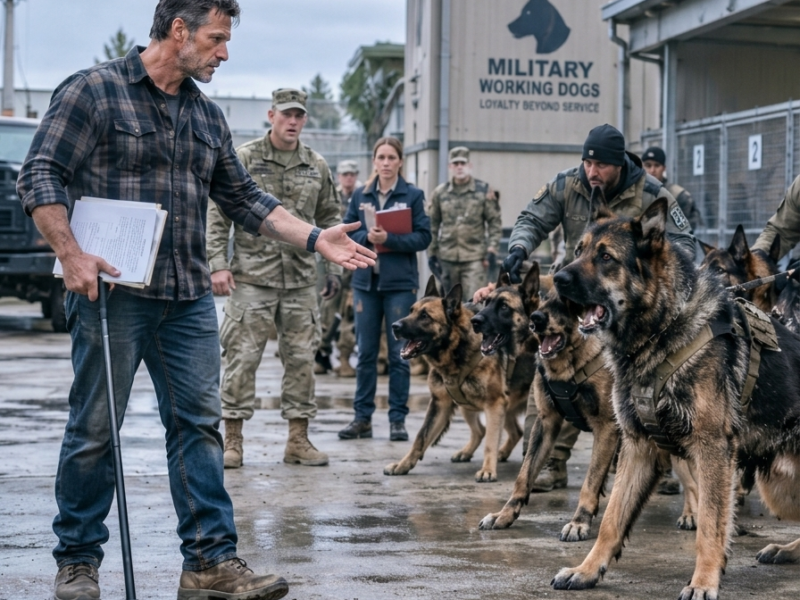
“I’m taking all these retired K9 dogs,” I said inside the county shelter in Virginia, while the director stared at me like I had lost my mind
The persistent hum of fluorescent lights inside the Henrico County shelter felt like a slow, drilling pain behind my eyes. The scent was always the same in these places—a heavy mixture of industrial bleach, wet fur, and the metallic tang of unspoken fear.
The shelter director, a thick-set man named Arthur Vance whose skin had been weathered by thirty years of county bureaucracy, stared at me as if I had just asked him to sign over the keys to the county treasury. His jaw was slack, his pen hovering an inch above a stack of beige folders.
“I’m taking all of them,” I said, my voice steady, though my heart was hammering against my ribs like a trapped bird.
Vance lowered the pen and let out a dry, breathy laugh. “Son, I don’t think you heard me correctly when you walked in here. These aren’t golden retrievers from a backyard breeder. These are twelve retired tactical and military working dogs. Four Belgian Malinois, five German Shepherds, two Dutch Shepherds, and a Labrador that looks like he’s survived an explosion. They were dropped off by a private defense contractor three days ago because their contracts expired. They are broken goods.”
“They aren’t broken,” I replied, keeping my hands jammed deep into the pockets of my canvas jacket so he wouldn’t see the slight tremor in my left wrist—a permanent reminder of a mortar blast outside Kandahar seven years ago. “They’re tired. There’s a difference.”
“They’re unpredictable, Jack,” Vance insisted, leaning across the counter. “They’ve got joint issues, PTSD, bite histories, and anxiety that makes them tear through chain-link fences. Half of them limp. One of the Dutchies—Buster—won’t even let a handler put a leash on him without turning his head to snap. You have a three-acre plot outside city limits and a mortgage. You take twelve apex predators with behavioral trauma, and you’ll be bankrupt in six months, if they don’t tear each other apart first.”
I didn’t answer him with words. Instead, I walked past the counter, pushing through the swinging double doors that led into the high-security quarantine corridor. Vance cursed under his breath and hurried behind me, his heavy boots squeaking on the polished linoleum.
The moment the doors opened, the corridor went deathly silent.
In standard shelters, the arrival of a human triggers a chorus of chaotic barking, jumping, and tail-wagging. Not here. The twelve dogs stood in their respective kennels, rigid as iron statues. Their graying muzzles were pressed tightly against the cold steel bars. They didn’t bark. They evaluated.
Some bore deep, hairless scars across their shoulders and muzzles. A German Shepherd in the third stall dragged his hind left leg slightly as he shifted his weight. In the far corner kennel, a dark Dutch Shepherd sat entirely motionless, his dark brown eyes fixed on the blank concrete wall, completely refusing to acknowledge the world around him.
I stopped in front of Kennel 07. Inside stood a Belgian Malinois. His coat was faded, his left ear was notched from an old tear, and a thick scar ran from his tear duct down to his upper lip. His tag read Ranger.
As I approached, Vance put a hand up. “Careful with that one. He tried to take a chunk out of the intake vet yesterday.”
I ignored Vance and dropped slowly down to one knee. I didn’t reach out a hand—reaching out to an untrained or traumatized war dog is an invitation for a bite. Instead, I kept my shoulders soft and lowered my gaze, letting him see my profile rather than confronting him face-to-face.
Ranger didn’t growl. He stepped closer, his chest low to the ground, his nose working frantically. He pressed his wet snout against the bottom bar of the cage door. The scent of motor oil, old leather, and stale tobacco clung to my jacket. But beneath that was something else—a lingering smell that only those who had spent years in dusty, sun-baked compounds in the Helmand Province would ever recognize.
Ranger let out a long, shuddering exhale through his nose. His ears softened slightly.
“They’re not aggressive,” I whispered softly, keeping my voice low so only the dog could hear me. “They’re terrified. They think they’re still in the box.”
I stood up and turned back to Vance. “Where are the papers?”
It took two hours, three separate waiver forms releasing the county from all legal liability, and every dollar remaining in my savings account to clear the administrative fees. Vance watched me with a mixture of pity and annoyance as I arranged for three borrowed horse trailers and a pair of transport vans owned by an old friend from my private security days.
When we loaded them, there was no chaotic wrestling match. I walked from cage to cage, opened the doors, and gave a simple, low-volume hand signal—the old NATO K9 standard for load up. One by one, without a single growl or fight among themselves, the twelve old veterans walked out of their stalls and climbed into the crates. They moved with a strange, eerie synchronicity, like a military unit moving on an established patrol route.
By the time the sun began to dip below the horizon, painting the Virginia sky in shades of bruised purple and fiery orange, the convoy was pulled up outside my modest ranch house. The property sat on three acres surrounded by dense oak and pine woods, insulated from the rest of the county by a long gravel driveway.
Unloading them took another hour. I had prepared the barn adjacent to the house, lining it with clean straw, heavy-duty orthopedic beds, and separate feeding stations. But as night fell, the dogs refused to stay in the barn. When I tried to shut the sliding door, Ranger stood in the gap, his heavy body blocking the frame, looking at me with an unwavering, unblinking intensity.
“Fine,” I muttered, rubbing the back of my neck. “Inside.”
They trotted into the house without a sound. They didn’t explore the furniture or search for food scraps. They positioned themselves strategically throughout the living room and hallway. Two took positions by the back door; three settled near the front windows; the rest laid down in a perimeter around the hallway leading to my bedroom. It wasn’t the behavior of pets adjusting to a new home. It was the defensive posture of a squad setting up a firm base of operations in hostile territory.
Exhausted, I fell onto my bed around 11:00 PM, fully clothed, leaving the bedroom door slightly ajar.
Sleep was always a dangerous proposition for me. My brain rarely settled into deep rest; it floated in a shallow, restless state where every creak of the floorboards translated into a potential threat.
At 2:14 AM, the quiet was broken not by a loud noise, but by a sound so low it vibrated through the mattress—a rhythmic, guttural hum from deep inside Ranger’s throat.
My eyes snapped open. I was awake instantly, my heart pounding against my ribs.
I sat up and swung my legs off the bed. Ranger was standing in the doorway, his silhouette illuminated by the pale moonlight filtering through the hallway window. His ears were pinned forward, his tail held rigid and straight behind him. He wasn’t looking at me. He was staring down the dark corridor toward the utility room that connected the kitchen to the attached garage.
As I stepped into the hall, I realized Ranger wasn’t alone.
All twelve dogs were standing. They had formed a silent, tight line behind Ranger. None of them were barking. There was no whining, no nervous pacing. They moved as a single organism, their eyes fixed on the metal door leading to the garage.
“Ranger,” I whispered. “Hold.”
He didn’t move an inch. His body was taut as a piano wire.
I reached for the tactical flashlight resting on the hall table, flicked it on, and unlatched the garage door. The cold draft from the concrete floor hit my legs immediately. I swept the beam of light across the room—past my old workbench, the lawnmower, and stacks of plastic storage bins.
Nothing was out of place. The side door was locked. The garage door was fully down.
Yet, the dogs marched into the cold space in lockstep. They didn’t sniff the tires or the trash cans. They gathered in a precise circle around an old, battered wooden footlocker resting in the far corner under a dust cover.
It was my deployment chest. It had belonged to me during my final tour in Afghanistan with the 75th Ranger Regiment’s K9 handler element. I hadn’t opened it since the military hospital in Landstuhl shipped my belongings back to the States seven years ago. Seeing it felt like opening a grave.
“What is it, boy?” I asked, my voice barely audible over the hum of the freezer in the corner.
Ranger stepped forward and pressed his nose firmly against the iron latch of the trunk. Beside him, the dark Dutch Shepherd—Buster—dropped his front paws onto the wood, letting out a single, sharp exhale.
My fingers were trembling as I stepped forward and pulled off the faded canvas cover. The brass padlock was missing, cut off years ago by quartermasters. I lifted the heavy wooden lid.
The smell of old oil, dust, and dried sweat drifted up into the air. Inside lay my old combat uniforms, a pair of worn-out boots, radio harnesses, and a stack of classified field manuals with their covers torn off.
Ranger shoved his muzzle deep into the left side of the trunk, nudging aside a rolled-up poncho. He clamped his teeth gently around a thick, moisture-sealed plastic envelope and pulled it out, dropping it onto the concrete floor at my feet.
The envelope was stamped with heavy red ink: PROPERTY OF THE DEFENSE INTELLIGENCE AGENCY – CLASSIFIED – DO NOT DISTRIBUTE.
I sat down hard on the cold garage floor, my flashlight resting on my knee, illuminating the dark plastic. I had never seen this envelope before. It had been slipped into my gear during the chaotic evacuation from the field hospital after the mortar strike.
With numb fingers, I tore open the plastic seal and pulled out a stack of heavily redacted documents.
The top document was a tactical unit roster from Operation Silent Horizon—a covert joint-task-force mission executed in the mountains of Kunar Province in late 2018.
I scanned the page, my eyes darting across the blacked-out names. But the secondary section—the K9 Asset Manifest—was fully legible. Twelve dogs were listed by their military tattoo numbers and call signs.
Asset 4419 – Belgian Malinois – “Ranger”
Asset 3302 – Dutch Shepherd – “Buster”
Asset 8812 – German Shepherd – “Guns”
I looked up. The twelve dogs were sitting in a neat semicircle around me in the dark garage, their dark eyes reflecting the yellow beam of the flashlight.
Every single dog in my house had belonged to that exact same covert unit.
I turned the page. Attached to the back was a casualty report and a mission summary. The ink on the final paragraph was bold and unredacted:
Target area compromised by unauthorized mercenary contractors. All K9 handlers terminated in action. Handler Sergeant Jack Miller (Witness) – Presumed Dead.
The air left my lungs in a sharp, painful gasp.
I wasn’t reported injured. I wasn’t reported honorably discharged. According to the official intelligence record sitting in my hands, I had died seven years ago in a trench in Kunar Province. And these twelve dogs hadn’t been scattered across different bases—they had been kept together, hidden away in contractor kennels, waiting for their lifespans to run out.
A sudden, sharp glare of light slashed through the garage’s high windows, cutting across the darkness.
Outside, gravel crunched slowly under heavy tires.
I dropped the papers, grabbed my flashlight, and moved toward the small window beside the garage door. The dogs followed me instantly, moving without a sound, their bodies low to the ground.
A jet-black SUV with dark tinted windows and no license plates had pulled up to the edge of my driveway. The engine was left idling, a low, rumbling growl in the quiet Virginia night.
The driver’s side door opened slowly. A man stepped out into the chill night air. He wore a heavy black tactical coat, his posture erect, his face shadowed under the brim of a low cap. He didn’t walk toward the front door. He didn’t pull a weapon.
Instead, he stood under the yellow glow of the driveway light and looked directly through the glass window where I was standing in the dark.
Slowly, deliberately, the man raised his right hand to his chin. He tapped his thumb against his palm three times—an old military signaling gesture for Eyes On Target.
Then, looking straight into my eyes, his lips moved slowly, mouthing four words into the silence of the night:
“They remember everything, Jack.”
He turned, climbed back into the SUV, and accelerated down the driveway, the red taillights disappearing into the thick pine forest like two burning coals.
I stood in the cold garage, my heart hammering against my ribs, the classified folder clutched in my hand. Behind me, Ranger stepped up, resting his heavy, scarred head against my leg. He didn’t look at the road. He looked at the papers in my hand, his dark eyes filled with an ancient, terrifying intelligence.
The night air had turned freezing by the time the taillights of the black SUV vanished completely into the darkness of the pines. My mind was racing, a chaotic storm of military codes, forgotten names, and memories I had spent seven years trying to drown with alcohol and isolation.
I backed away from the window, pulling the heavy blinds down over the glass.
“Inside,” I commanded, keeping my voice clipped and flat.
The twelve dogs didn’t hesitate. They filed out of the garage and back into the living room, taking up position around the perimeter as if executing an order they had rehearsed a thousand times.
I dumped the contents of the sealed envelope onto the heavy oak dining table. Under the harsh yellow overhead light, the documents looked even more sinister.
There were field maps marked with red grid coordinates, communications logs, and medical records detailing biological enhancements and specialized nerve-stimulant protocols administered to the K9 assets during the winter of 2018.
I picked up the mission report for Operation Silent Horizon.
I remembered the operation, or at least what they had allowed me to remember. We were supposed to be tracking a high-value Taliban insurgent network operating out of a mountain complex near the Afghan-Pakistan border. My unit had been attached to a private defense firm called Aegis Tactical Solutions—a high-end contractor outfit operating under a black-budget Department of Defense contract.
The official story I was told in the military hospital after I woke up from my coma was simple: our patrol had hit an IED. My team was wiped out. I had suffered severe shrapnel wounds and brain trauma, resulting in partial amnesia. They gave me a Purple Heart, a medical discharge, and a modest pension, sending me back to Virginia to live out a quiet, broken life.
I looked at the document in front of me.
False. Entire scenario fabricated.
The report detailed what actually happened. We hadn’t hit an IED. Aegis Tactical had uncovered an illicit stash of raw, weapons-grade lithium and rare earth minerals inside the cave network—worth hundreds of millions of dollars. Instead of reporting the cache to command, the contractor unit tried to secure the site for themselves.
When my handler team discovered what they were doing, the contractors opened fire on us.
I stared at the page, my eyes tracing the names of my dead comrades. Corporal David Vance. Specialist Marcus Reed. Sergeant Sarah Jenkins. All dead. Shot in the back by men wearing the same uniform.
And the dogs? The dogs had witnessed the entire execution.
Military working dogs trained for high-level tactical operations don’t just sniff out explosives; they are trained to track specific human scents, follow detailed behavioral cues, and recognize unit commanders. They were living, breathing memory drives. They couldn’t be interrogated by a military court, but they could identify the killers if they ever saw them again.
That was why Aegis Tactical had locked them away in private contractor kennels for seven years, waiting until the heat died down before sending them to a rural shelter to be quietly euthanized. They weren’t broken dogs. They were loose ends.
A low growl from the hallway shattered my concentration.
I looked up. Buster, the dark Dutch Shepherd, was standing at the front window, his ears flat against his head, the fur along his spine standing straight up.
I crept toward the window and peeked through the slit in the blinds.
A second vehicle had turned onto my road. It wasn’t the black SUV. It was a white, unmarked utility van moving slowly, its headlights turned off, relying only on the faint illumination of the moonlight. It stopped at the edge of my property line, about two hundred yards down the gravel path.
Four men stepped out of the vehicle. They were wearing dark tactical gear, night-vision goggles mounted on their helmets, and carrying suppressed carbines.
Cleaning crew.
They thought they were dealing with a broken veteran and twelve old, dying dogs. They thought this would be a simple sweep-and-clear operation.
“Ranger,” I whispered, stepping back into the center of the room.
The Belgian Malinois was at my side in an instant, his dark eyes locked onto mine. The rest of the dogs stood up in unison, moving without making a sound on the hardwood floor.
Seven years of passive living vanished in a single heart-beat. The tactical conditioning that had been drilled into my bones during three combat deployments flooded back with violent clarity. I didn’t have weapons—not real ones. I had an old 12-gauge Remington shotgun in my closet with a box of birdshot, a hunting knife, and three acres of dark, familiar terrain.
But I had something else. I had twelve trained combat veterans who knew how to hunt in the dark.
“Ranger, Buster, Guns,” I whispered, using the low hand signals for Flank Left. The three dogs immediately slunk toward the back door, moving through the shadows like liquid smoke.
“Duke, Bear, Chief,” I pointed toward the front entry. Flank Right.
“Rest of you, on me.”
I grabbed the shotgun from the closet, loaded three shells into the tube, and cracked the back door open just enough for the first element to slip out into the freezing darkness. They didn’t bark. They didn’t make a sound. They vanished into the tall grass and brush surrounding the ranch house.
I moved to the side window of the living room, watching the four contractors advance up the driveway. They were moving in a standard wedge formation, weapons raised, sweeping the dark windows of the house with infrared lasers that were invisible to the naked eye.
They were professional, fast, and silent. But they were looking for a man with a gun. They weren’t looking at the ground.
The lead contractor reached the porch steps. He raised a hand, signaling his team to stack up against the front wall.
That was when the dark jumped out of the bushes.
A low, bone-chilling roar echoed from the left side of the porch as Buster—the Dutch Shepherd who supposedly couldn’t be handled—launched himself through the air. He hit the lead contractor squarely in the chest, all eighty pounds of muscle and rage slamming the man backward off the wooden steps. The suppressed carbine clattered against the stone pavers.
Before the second contractor could react, Ranger hit him from the shadow of the woodpile, locking his jaws onto the man’s forearm with a sickening crunch of plastic and body armor. The contractor let out a muffled scream, dropping to one knee as Ranger dragged him down into the dirt.
“Contact! Ambush!” one of the men yelled, his professional composure shattering into panic.
He raised his carbine to fire at Ranger, but Chief—a massive German Shepherd with half an ear missing—leapt from the shadows under the porch, ripping the weapon out of his hands before he could pull the trigger.
The third and fourth contractors tried to fall back toward the driveway, panic taking over, but the remaining six dogs emerged from the dark pine trees behind them, forming an impenetrable wall of bared teeth and low, guttural growls. They didn’t attack immediately; they held their ground, cutting off every escape route, herding the men back toward the house like wolves managing a herd of sheep.
Within forty-five seconds, the four heavily armed contractors were disarmed, pinned to the frozen earth, and surrounded by twelve gray-muzzled dogs whose eyes reflected the pale moonlight.
I stepped out onto the porch, the shotgun resting casually across my shoulder.
“You’re on private property,” I said, my voice ice-cold.
The lead contractor, pinned under Buster’s massive front paws, looked up at me, his face pale, sweat breaking out on his forehead despite the freezing air. His arm was bleeding through his tactical jacket where Ranger had pinned him.
“You… you don’t know what you’re getting into, Miller,” the man gasped, his breath hitching as Buster let out a low, vibrating growl right next to his ear. “This goes way above Aegis. This is Department-level.”
“I know exactly what this is,” I said, stepping down the stairs and kneeling beside him. I reached down, pulled off his tactical helmet, and stripped his belt radio. “Who ordered the sweep?”
The man gritted his teeth, refusing to speak.
I looked at Ranger. “Ranger… speak.”
Ranger barked once—a deafening, sharp sound six inches from the man’s face. The contractor flinched so hard his head struck the ground.
“Colonel Vance!” the man yelled, his courage completely breaking. “Retired Colonel Arthur Vance! He runs the logistics division for Aegis now! He’s the one who tracked the dogs when you picked them up at the shelter!”
My blood went cold.
Arthur Vance. The shelter director.
He hadn’t been a tired county bureaucrat disgusted by broken dogs. He was the overseer. He had been placed at that shelter specifically to monitor the disposal of retired military assets from Aegis contractor networks. When I walked in and demanded all twelve, I had thrown a wrench directly into their clean-up operation.
I stood up, my mind turning the pieces over. Vance had let me take them because he thought it would be easier to liquidate the dogs and me together in one remote location, far away from county records.
“Get them up,” I ordered.
Using zip-ties from their own tactical vests, I bound the four contractors to the wooden posts of my back porch. I took their communications gear, their weapons, and the encrypted tablet they were using for GPS tracking.
I walked back into the house. The twelve dogs followed me, their tails held low, their breathing heavy but calm. They looked at me, waiting for the next command.
I pulled up the tablet’s interface. The screen flickered to life, displaying a digital satellite map of Virginia. In the center of the screen was a blinking red dot located four miles away, at an abandoned industrial gravel pit owned by a subsidiary of Aegis Tactical.
Beneath the red dot was a single line of text: COMMAND UNIT – VANCE.
I looked down at Ranger. The old Belgian Malinois walked up to me, pressing his head firmly against my thigh.
“They thought we were broken,” I whispered, racking a shell into the chamber of the shotgun. “Let’s go show them we’re still on active duty.”
The night was at its darkest just before 4:00 AM. A light frost had begun to settle over the Virginia countryside, turning the pine needles crisp underfoot and painting the windshield of the stolen white contractor van in a thin layer of ice.
I drove without headlights, navigating the narrow back roads using the night-vision goggles I had taken from the cleaning crew.
In the back of the van, the atmosphere was thick with quiet tension. The twelve dogs sat in two neat rows along the metal floorboards. There was no whining, no shifting, no anxiety. They understood movement. They understood target insertion. They had done this in the craggy valleys of the Hindu Kush and the dusty outskirts of Fallujah.
To the rest of the world, they were old, diseased, and disposable. But in this van, they were a specialized assault element operating with absolute tactical cohesion.
The gravel pit appeared through the tree line—a massive, scarred gouge in the earth surrounded by chain-link fencing, rust-eaten machinery, and three large corrugated metal warehouses.
A single light illuminated the central structure. Outside sat two black SUVs and a mobile command trailer equipped with satellite dishes.
I pulled the van into a dense thicket of trees three hundred yards upwind from the main gate. I turned off the engine and pulled the night-vision goggles up onto my forehead.
“Listen up,” I said softly, turning around to face the back of the van.
Twelve pairs of ears pivoted forward. Twelve pairs of eyes locked onto mine.
“We aren’t here for revenge,” I said, my voice low and dark. “We’re here for the drive. We get the hard evidence of what happened in Kunar, we expose Vance, and we end this tonight. No man, no dog left behind.”
I reached over and cracked open the rear doors.
The cold night air rushed in. The dogs slipped out into the shadows like grey ghosts, instantly spreading out into a perimeter security screen around the vehicle.
I grabbed a captured suppressed carbine, three spare magazines, and the encrypted tablet.
We moved through the forest toward the perimeter fence. Buster, running point, found a gap where the chain-link had rotted away near a drainage culvert. He slid through effortlessly, followed by Ranger and the rest of the unit. I squeezed through last, staying low against the muddy embankment.
The gravel pit was patrolled by six armed guards wearing contractor uniforms. They were walking lax perimeter loops, clearly not expecting an attack from a force they believed had been eliminated hours ago at my ranch house.
I signaled Chief and Bear—the two heavy German Shepherds—toward the outer guard post near the entry gate. They moved with silent, devastating efficiency. Two shadows emerged from the dark behind the guard post; two low thuds followed as the guards were swept off their feet, their weapons pinned under eighty pounds of muscle before they could scream into their radios.
“Gate cleared,” I muttered to myself, advancing toward the central warehouse.
Through the high windows of the warehouse, I could see Arthur Vance.
He was no longer wearing his faded shelter jacket. He wore a crisp, dark tactical uniform with no rank insignia. He was pacing back and forth in front of a folding table covered in laptop screens and radio equipment. Standing around him were four heavily armed private security operatives.
Vance was shouting into a satellite phone, his face red with anger.
“What do you mean they haven’t checked in?” Vance yelled into the receiver, his voice echoing faintly through the corrugated walls. “It was one broken vet and twelve old dogs! How hard is it to clear a house and set a fire?”
He slammed the phone onto the table, rubbing his temples in frustration.
“Send a secondary team to the ranch,” Vance ordered the chief of his security detail. “If Miller cleared out, find him. He can’t have gone far with twelve limping hounds. If those dogs hit the press or an independent vet, their microchips will flag the DIA audit team.”
“They aren’t at the ranch, Arthur,” I said, stepping through the small side access door of the warehouse.
The sound of my voice cut through the room like a razor blade.
Vance froze. The four contractors spun around, raising their weapons toward the doorway.
Before they could acquire their targets, I gave the signal.
“TAKE THEM!” I roared.
The high glass windows along the upper wall of the warehouse shattered simultaneously as four dogs—led by Ranger and Buster—leapt through the frames from the exterior scaffolding, rain of glass showering the concrete floor.
At the same time, the remaining eight dogs burst through the double doors at the front of the warehouse, creating a terrifying crossfire of noise, speed, and muscle.
The warehouse erupted into chaos.
The security operatives tried to form a firing line, but the sheer speed of the assault overwhelmed them. A contractor raised his rifle toward me, but Guns—the limping German Shepherd—tackled him from the side, knocking the weapon free and pinning his arm to the concrete floor.
Another operative fired a burst into the ceiling before Chief hit him in the waist, driving him back into a stack of wooden crates that collapsed in a shower of splinters and dust.
Vance stumbled backward, terror distorting his features. He reached into his jacket, pulling a nickel-plated pistol from an shoulder holster.
He aimed it straight at my chest.
“You should have stayed dead, Miller!” Vance screamed, his finger tightening on the trigger.
A brown flash blurred across my peripheral vision.
Ranger launched himself off the top of a metal storage locker, flying through the air with unbelievable power for a dog his age. He slammed into Vance’s chest just as the gun went off.
The shot went wild, striking a steel girder overhead with a deafening PING.
Vance hit the floor hard, the pistol skittering across the smooth concrete toward my boots. Ranger stood over him, his forepaws planted firmly on Vance’s shoulders, his bared teeth inches from the man’s throat. A low, terrifying vibration rattled from Ranger’s chest—a sound that promised immediate death if the man so much as twitched.
I stepped forward, kicked the pistol away, and looked down at Arthur Vance.
The shelter director was shaking violently, his hands raised in surrender, his eyes wide with absolute horror as he looked into the face of the dog he had branded “broken” just twelve hours earlier.
“Call them off! Call them off, Miller!” Vance sobbed, his voice cracking. “Please! They’re wild animals!”
“They aren’t wild,” I said calmly, kneeling beside him and pulling a flash drive from the central computer console on his table—the drive containing the master logs of Aegis Tactical’s illegal operations. “They’re soldiers. And unlike you, they never broke their oath.”
I stood up, holding the drive in my hand.
Outside, the distant wail of police sirens began to echo through the night air. I had placed an anonymous call to the state police and the FBI’s field office three miles back, tipping them off to an active illegal weapons facility operating at the gravel pit.
Vance looked at me, a desperate, pathetic smear of fear on his face. “You think this ends here? Aegis has board members in Washington! They’ll cover this up! You won’t make it to morning!”
“They can try,” I said, looking around the room.
The twelve dogs had gathered around me. None of them were mortally wounded. Guns had a small scratch on his muzzle, and Buster was breathing heavily, but they were all standing tall, their heads held high, their eyes clear and focused.
For seven years, they had been hidden in the dark, forgotten by the country they served, waiting for someone to give them back their purpose.
And for seven years, I had been hiding in my own dark house, waiting for a reason to live.
I didn’t need a army. I didn’t need a black budget.
I had twelve brothers standing beside me.
“Let’s go home, boys,” I said quietly.
Ranger let out a short, soft bark, stepped off Vance’s chest, and turned to follow me into the cool night air as the flashing red and blue lights of the arriving federal task force began to paint the dark pine trees in the distance.
The morning sun broke over the Virginia hills not in a burst of gold, but in a soft, pale gray that bled through the heavy morning fog.
By 9:00 AM, my quiet three-acre ranch looked like a staging ground for a military invasion.
Federal vehicles—black SUVs, mobile command centers, and armored vans bearing the insignia of the Department of Justice and the Defense Criminal Investigative Service—lined my gravel driveway for a quarter of a mile. State troopers blocked the main road, keeping the swarm of news helicopters and local reporters at a safe distance.
I sat on the wooden steps of my front porch, a thick wool blanket draped over my shoulders, holding a hot mug of black coffee in both hands.
Beside me, Ranger lay with his head resting on his paws, his tail occasionally thumping against the wooden deck as I scratched him gently behind his left ear. The other eleven dogs were scattered across the front yard, lying in the grass under the watchful eyes of three federal K9 veterinarians who had been flown in from Fort Belvoir.
The vets weren’t treating them like aggressive strays anymore. They were treating them like war heroes.
A tall, sharp-featured woman wearing a tailored charcoal suit and carrying a leather briefcase walked up the porch steps. Special Agent Sarah Mercer of the Department of Justice Inspector General’s Office looked exhausted. Her eyes were bloodshot, her dark hair pulled back into a tight, non-nonsense bun.
She stopped at the top of the stairs, looking down at Ranger, then at me.
“He bit three federal contractors last night, Sergeant Miller,” Mercer said, her voice dry, though there was a slight twitch of a smile at the corner of her mouth.
“He was executing a legal citizen’s arrest on unauthorized armed combatants,” I replied without looking up from my coffee. “And technically, he only bit two. Buster took care of the third.”
Mercer let out a long breath, pulling a thick paper file from her briefcase and sitting down on the wooden bench opposite me.
“The flash drive you retrieved from the gravel pit was a goldmine, Jack,” she said, her tone turning serious. “It contained unredacted operational logs, offshore financial transactions, and recorded communications between Arthur Vance and senior executives at Aegis Tactical.”
She paused, opening the folder.
“Operation Silent Horizon has been officially reopened by the Department of Defense. The story about the IED attack in Kunar Province has been struck from the record. The families of Sergeant Jenkins, Corporal Vance, and Specialist Reed were notified three hours ago that their loved ones died in action while defending their post against rogue contractors.”
My heart gave a heavy, painful thud. I looked out over the yard, watching Chief chase a fallen leaf across the frost-covered grass.
“And the men who pulled the trigger?” I asked softly.
“Arthur Vance is currently in federal custody without bail,” Mercer said. “He’s facing charges of treason, conspiracy to commit murder, and armed extortion. The CEO of Aegis Tactical and three board members were arrested at their homes in Northern Virginia at 6:00 AM this morning. The company’s assets have been frozen, and their defense contracts are being permanently terminated.”
She closed the file with a soft clack.
“You brought down a multi-billion-dollar defense syndicate in six hours, Sergeant. With a shotgun and twelve dogs that were slated to be put down.”
“They weren’t strays, Agent Mercer,” I said, turning my eyes to meet hers. “They were witnesses. Vance and his people thought if they hid them long enough, everyone would forget what happened in those mountains. But a dog doesn’t forget who his enemies are. And he never forgets who his friends are.”
Mercer looked at the dogs in the yard, her expression softening.
“The Pentagon wants to take them back,” she said quietly.
I froze, my grip tightening on the coffee mug until my knuckles turned white. Ranger instantly sat up beside me, his ears pinned back, sensing the sudden shift in my posture.
“No,” I said, my voice dropping an octave. “They aren’t going back into a system that let Vance lock them away in a shelter.”
“Jack, hear me out,” Mercer urged, leaning forward. “The Army wants to retire them with full military honors. Pensions, medical coverage for life, specialized care facilities at Lackland Air Force Base—”
“No,” I interrupted again, firmer this time. “They’ve spent their entire lives living in cages, riding in transport crates, and executing orders for men in uniforms who saw them as equipment. They earned a home. A real one. Right here.”
Mercer stared at me for a long moment. She looked from me to Ranger, who was now standing, his heavy shoulder pressed against my knee, staring directly into her eyes with an unblinking, protective stare.
She let out a soft sigh, reached into her briefcase, and pulled out a second, smaller document.
“I figured you’d say that,” she muttered, a genuine smile breaking through her stern demeanor.
She handed me the paper. It was an official release form from the Department of the Army, signed by the Undersecretary of Defense. It granted full, permanent legal guardianship of all twelve working dogs to Sergeant Jack Miller, along with a monthly federal stipend to cover their medical care, food, and handler expenses for the rest of their natural lives.
At the bottom of the page was an additional authorization grant: funding for the establishment of the Silent Horizon K9 Sanctuary—a permanent rehabilitation center for retired, traumatized combat working dogs, located on my three acres.
I held the paper in my hands, my eyes growing hot as the words blurred slightly on the page.
“You’re going to need a bigger barn, Jack,” Mercer said softly, standing up and buttoning her suit jacket. “There are a lot of broken veterans out there—both two-legged and four-legged. Looks like you just became their commanding officer.”
She turned and walked down the steps toward the waiting federal vehicles.
I sat on the porch for a long time, holding the document in my lap, listening to the hum of the morning wind through the oak trees.
One by one, the dogs walked up the porch steps. Buster sat on my left; Chief lay down at my feet; Guns nudged his scarred nose under my hand. The twelve forgotten veterans gathered around me under the warm Virginia sun, no longer ghosts, no longer loose ends, no longer waiting to be discarded.
We had survived the war. Now, finally, we were home.
Two years later.
The morning sun washed over the rolling green hills of the Henrico countryside, burning away the low valley mist and lighting up the wide timber-frame structure that now stood where my old tumble-down barn used to be.
A large carved wooden sign hung above the main entrance: SILENT HORIZON SANCTUARY & REHABILITATION CENTER.
Below the main title were four smaller words carved into the polished cedar: None Left Behind.
The three acres had grown to fifty, purchased through donations and federal grants that had poured in after the story of the “Twelve Veterans” made national headlines. What had started as a desperate attempt to save twelve disposable K9s had turned into one of the country’s premier sanctuary facilities for retired military and law enforcement dogs suffering from severe trauma and physical injuries.
I stood on the back porch of the main house, holding a fresh cup of coffee, watching the morning routine unfold across the lower pasture.
A young man—a former Marine lance corporal who had lost his right leg below the knee in Helmand—was walking across the grass with a golden-retriever mix named Barnaby, who had been rescued from an explosive ordnance disposal unit in Kuwait. They moved at the same slow, deliberate pace, helping each other find their rhythm in a world that often moved too fast for broken soldiers.
Beside them, six new arrivals were running through a wide agility course, guided by volunteer handlers who were all military veterans working through their own recovery programs.
And watching over the entire operation, sitting like old generals on a hill overseeing their troops, were the Twelve.
They weren’t limping as much anymore. Specialized aquatic therapy, high-grade nutrition, and the complete absence of stress had added years back to their lives.
Ranger sat right beside my left boot, his gray muzzle held high, his notched ear twitching slightly at the sound of a distant songbird. His coat was thick and shiny; the deep scar along his lip was still there, but the hyper-vigilant panic that used to burn behind his dark eyes had been replaced by a deep, unwavering calm.
Buster lay on the top step, his head resting comfortably on the warm wood, watching the young handlers with a protective, grandfatherly gaze. Guns, Chief, and the rest of the original unit were scattered across the lawn, basking in the sun, surrounded by green grass and clear blue sky.
A dark blue sedan pulled up the gravel driveway, stopping near the visitor’s center.
A family stepped out—a mother, a father in a wheelchair wearing an Army veteran hat, and a little girl around six years old with bright blonde pigtails. They were visiting to meet their new companion—an older Dutch Shepherd who had been cleared for adoption after six months of trauma rehabilitation at the center.
The little girl ran ahead, her laughter echoing across the open field.
Ranger stood up slowly, stepped down off the porch, and walked toward her. Two years ago, a stranger running toward him would have triggered a immediate defensive response. Now, he simply trotted over, lowered his massive head, and let the little girl wrap her small arms around his scarred neck.
He let out a long, happy sigh, his tail wagging slowly back and forth against the tall grass.
I walked down the steps to join them, the morning sun warm against my back.
My phone vibrated in my pocket. It was a text message from Special Agent Mercer, who still checked in on us every month from Washington.
New transfer coming in from Ramstein tomorrow night, the message read. Belgian Malinois, age nine. Two tours in Syria. Severe anxiety, refusal to handle. They said he’s unfixable.
I looked down at Ranger, who was currently leaning his heavy body against the little girl while her father reached down from his wheelchair to scratch the dog’s ears.
I typed a quick reply:
Send him home. We’ve got room.
I put the phone back in my pocket and looked out over the fields of the sanctuary.
For eleven years, I had thought my life’s purpose was tied to a tactical uniform, a rifle, and a mission objective in some far-off desert. I had thought when the military broke my body and sent me home, my story was over.
I was wrong.
The war hadn’t broken us; it had simply prepared us for the real mission.
The twelve dogs who had walked out of that shelter two years ago hadn’t just saved my life from Arthur Vance and Aegis Tactical. They had saved me from the silence. They had reminded me that no matter how deep the scars run, no matter how forgotten you feel in the dark, you are never truly alone if you have a pack to stand with.
Ranger looked up from the little girl, walked over to my side, and nudged my hand with his cold nose.
I reached down and gripped his collar, pulling him close.
“Good boy,” I whispered into the morning breeze.
The old war dog let out a quiet, satisfied huff, turned his gaze toward the open horizon, and stood guard over the land where none of us would ever be left behind again.
The end









