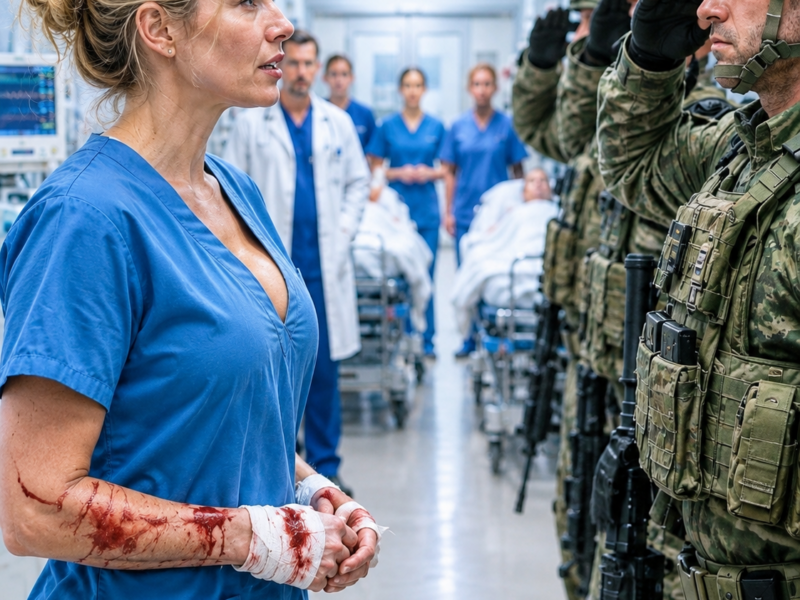
““I’m just a nurse,” I whispered when six Navy SEALs suddenly stood at attention in the middle of the emergency department
My fingers rested against the sealed edge of the envelope.
For four years, I had imagined what Nathan Brooks might have said if he’d survived that night.
Sometimes I imagined him angry.
Sometimes disappointed.
On the worst nights, I imagined him asking why I had left him behind.
Now I was holding something he had actually written.
“Rebecca,” Mark said quietly.
I looked at him.
“Who was Nathan?”
I couldn’t answer immediately.
David Hayes stepped closer.
“Commander, we should move somewhere private.”
I nodded toward the small consultation room beside the nurses’ station.
“Give me five minutes. My patients come first.”
David glanced toward Trauma One.
“Of course.”
I turned to the other nurses.
“Angela, take over the charge desk. Make sure Dr. Harris gets the latest blood results on both SEALs.”
Angela looked at the envelope.
Then at me.
“Are you okay?”
“I will be.”
I wasn’t sure I believed myself.
Mark followed me into the consultation room.
The six SEALs remained outside.
When I closed the door, I finally looked at the envelope properly.
My name was written in Nathan’s handwriting.
Beneath it was a date.
October 18.
The date of the operation that had ended my military career.
I sat down.
Mark pulled a chair beside me.
“Rebecca, I think you owe me an explanation.”
“I know.”
“Not a military explanation. Not something you’re required to keep classified. Just the truth about why six men walked into this hospital and treated you like their commanding officer.”
I looked at the envelope.
“I was their medical commander. I led a special operations medical team attached to a SEAL unit. I wasn’t a SEAL, but I was responsible for the medical plan, evacuation decisions, and sometimes the lives of everyone on the ground.”
Mark stared at me.
“Why didn’t you ever tell me?”
“Because I didn’t know how to explain the person I used to be.”
He leaned back.
“Fourteen years, Rebecca. We were married for eleven of them.”
“I know.”
“Did you think I wouldn’t understand?”
I looked at him.
“No. I thought if I told you everything, I’d have to remember everything.”
He went quiet.
That was the first time he’d heard me admit it.
I broke the seal.
Inside was a folded sheet of paper and a small photograph.
The photograph showed Nathan standing beside three men.
I recognized the location immediately.
A dusty operations compound in Afghanistan.
Nathan was smiling.
He had one arm around Ethan, who looked impossibly young.
The other two men were members of my medical team.
On the back, Nathan had written:
“Some orders are meant to protect the mission. Others protect the people who gave them.”
I unfolded the letter.
The first line made my eyes burn.
“Rebecca, if you’re reading this, it means I didn’t get the chance to tell you the truth myself.”
I stopped.
For a moment, I couldn’t continue.
Mark placed his hand beside mine.
“Take your time.”
I read the next paragraph.
“That night, you were ordered to withdraw because someone reported that the extraction zone had been compromised. You followed the medical command protocol. You did not abandon us.”
My throat tightened.
I kept reading.
“The information was false. The enemy had not discovered our position. Someone on our side deliberately changed the coordinates and transmitted a false threat assessment.”
I looked up.
“Someone changed the coordinates?”
David’s voice came through the door.
“Commander? May we come in?”
I folded the letter.
“Come in.”
David entered with Ethan.
The other four SEALs remained outside.
David looked at the photograph.
“That’s the team.”
I nodded.
“Who gave you this envelope?”
“An intelligence officer who was assigned to the recovery operation. He found it in a sealed equipment container that had been held in military storage.”
“Why wasn’t it delivered four years ago?”
“Because the container was classified as destroyed.”
I looked at him.
“That’s not an answer.”
“No, ma’am. It’s not.”
Ethan stepped forward.
“Commander, Nathan made me promise something before the mission.”
“What?”
“That if the truth ever came out, I would find you.”
I stared at him.
“You knew?”
“Not everything. I knew the withdrawal order didn’t match what happened on the ground.”
He lowered his eyes.
“I was the youngest man on the team. I didn’t have access to the command communications. I tried asking questions afterward, but I was told the matter had been reviewed.”
“And you believed them?”
“No.”
His answer was immediate.
“Then why didn’t you come to me?”
He looked genuinely ashamed.
“Because I was afraid.”
I wanted to be angry.
Part of me was.
But I remembered being twenty-three and watching a senior commander tell a young sailor that asking questions could end his career.
Fear had a way of making silence seem reasonable.
I looked back at the letter.
There was another paragraph.
“Do not trust the first report you receive. Find the original transmission log. The person who changed our coordinates had access to the command channel.”
Below that, Nathan had written a name.
Colonel Richard Whitmore.
I read it twice.
Whitmore had been the senior operations officer overseeing our mission.
He had personally approved the withdrawal.
He had also testified during the review board that my medical team had failed to maintain communication with the extraction unit.
That testimony had effectively ended my career.
I had spent four years believing I had made a mistake.
Now I was looking at evidence that the mistake might never have been mine.
“Where is Whitmore now?” I asked.
David exchanged a glance with Ethan.
“Retired. He works as a security consultant for a private defense company.”
“Which company?”
“Northstar Strategic.”
I remembered the name.
Northstar had recently received a major government contract involving military medical evacuation systems.
I looked at the six SEALs outside the glass.
“Why were you on tonight’s operation?”
David answered carefully.
“We were assigned to recover a communications archive from a remote training facility. The archive contained original mission transmissions from several operations, including yours.”
“Why?”
“Because a whistleblower sent information to our intelligence unit suggesting that someone had manipulated military extraction records.”
My hands tightened around the letter.
“And the two injured men?”
“James and Thomas were hurt during the recovery. We were ambushed while leaving the facility.”
“By whom?”
“We don’t know yet.”
I looked toward the envelope.
“Did you find the archive?”
David nodded.
“Part of it.”
“Where is it?”
“With the federal investigators.”
I studied his expression.
He was holding something back.
“What aren’t you telling me?”
David hesitated.
Then Ethan spoke.
“Commander, the archive contained your name.”
I looked at him.
“Explain.”
“Your withdrawal order was transmitted from an account assigned to Colonel Whitmore. But the digital signature attached to the order was yours.”
I felt the room tilt slightly.
“What?”
David continued.
“The record shows that the withdrawal was authorized by Commander Rebecca Morgan.”
I stared at him.
“That’s impossible.”
“We believe someone copied your credentials.”
“I never authorized that withdrawal.”
“We know.”
“Then why would the record show my signature?”
“That’s what we’re trying to establish.”
I stood.
For four years, I had lived with the belief that I had failed my team because I had followed an order too quickly.
Now I was being told someone might have used my identity to make that order appear legitimate.
“Who else knew my access credentials?”
David shook his head.
“We’re still reviewing that.”
I turned toward the door.
“I need to see the original transmission.”
“That’s not possible tonight.”
“Then find a way.”
“Rebecca,” Mark said.
I looked at him.
He was watching me with an expression I hadn’t seen in years.
Not fear.
Recognition.
He remembered the woman I had been before I came home.
But he also seemed to understand that I wasn’t simply trying to return to that life.
I was trying to stop it from deciding the rest of mine.
“I need to finish this,” I said.
Mark nodded slowly.
“Then don’t disappear into it again.”
His words landed harder than he intended.
I looked down at the letter.
“I won’t.”
At that moment, Angela knocked.
“Rebecca, Dr. Harris needs you in Trauma One.”
I immediately folded the letter.
“What’s happened?”
“Thomas Walker is awake. He’s asking for you.”
I hurried out.
Thomas was sitting slightly upright.
His right arm was immobilized, and a bandage covered the side of his head.
When he saw me, he tried to smile.
“Commander.”
I shook my head.
“You’re in a hospital. I’m Rebecca.”
He gave a tired laugh.
“Right. Sorry.”
I checked his pulse and oxygen saturation.
“How are you feeling?”
“Like someone used me as a punching bag.”
“That’s a fair description.”
His smile faded.
“Commander, I need to tell you something.”
I glanced at David.
Thomas looked toward the closed curtain.
“During the operation, we found a file labeled Iron Harbor.”
My fingers stopped on the blood pressure cuff.
“Where?”
“In the communications archive.”
“What was inside?”
“An audio recording. From the night Nathan died.”
I felt the room become very still.
“Did you hear it?”
Thomas nodded.
“Only part of it.”
“Who was speaking?”
He swallowed.
“Colonel Whitmore.”
I leaned closer.
“What did he say?”
Thomas looked at David before answering.
“He said, ‘Morgan has accepted the withdrawal. Make sure nobody returns for Brooks.'”
I closed my eyes.
For four years, that sentence had existed in my mind in a different form.
I had imagined myself making the decision.
I had imagined Nathan hearing my order.
But if Thomas was telling the truth, someone had deliberately made it sound as though I had accepted the withdrawal.
“Was there anything else?”
Thomas nodded.
“Another voice. Someone asked whether you knew the coordinates had been changed.”
My pulse quickened.
“What was the answer?”
Thomas looked directly at me.
“Whitmore said, ‘She doesn’t need to know. By the time she finds out, the report will be signed.'”
I stepped back.
For a moment, I couldn’t speak.
Then Dr. Harris called for me.
I had a patient to care for.
And whatever had happened four years earlier would have to wait until I was sure Thomas was stable.
That was the difference between my old life and my new one.
I couldn’t let the past take priority over the people in front of me.
I finished the assessment, updated the physician, and made sure Thomas had everything he needed.
Only then did I return to the consultation room.
David was waiting.
“Agent Mitchell is on her way,” he said.
“Who is Agent Mitchell?”
“An investigator from Naval Criminal Investigative Service. She’s been reviewing the original mission records.”
“Does she know about the recording?”
“Not yet. We wanted to confirm the source first.”
I looked at him.
“Why did you come here instead of contacting her?”
He hesitated.
“Because we didn’t know whether the recording had been compromised.”
That answer bothered me.
“You’re telling me six SEALs walked into a civilian hospital because you didn’t know who you could trust?”
David nodded.
“Yes, ma’am.”
I looked toward the injured men.
They were exhausted.
One was asleep in a chair.
Another was quietly talking to a nurse.
They had come here with two injured teammates and a secret that had followed them for years.
I couldn’t help wondering how much longer they had been carrying it.
Agent Laura Mitchell arrived twenty minutes later.
She was in her early forties, with short brown hair and a calm manner that made people speak more carefully.
After reviewing the letter and hearing Thomas’s account, she requested that the original archive be transferred directly to a secure federal evidence facility.
She also confirmed that an investigation into Colonel Whitmore had already been opened.
“Commander Morgan,” she said, “I need to ask you something.”
“Go ahead.”
“Did you ever receive a direct withdrawal order that night?”
I thought carefully.
“I received a radio transmission stating that the extraction zone had been compromised. The voice identified itself as command.”
“Did you recognize the speaker?”
“No. The transmission was distorted.”
“Did you personally authorize the withdrawal?”
“I followed the order I believed had come from command.”
She nodded.
“That’s important.”
“Why?”
“Because the official report says you personally approved it using your command credentials. But the radio log shows the transmission originated from a secondary terminal.”
I stared at her.
“Could someone have used my credentials?”
“Yes.”
“Who had access?”
“That’s what we’re investigating.”
She opened a folder.
“There is another problem. The original report was amended three hours after the operation. The amendment removed a reference to a second extraction request.”
I remembered that night.
Nathan’s team had been waiting for medical evacuation.
I had received one transmission.
Then another.
The second one had been cut off.
I had assumed it was interference.
“Who sent the second request?”
Mitchell looked at the file.
“Commander Nathan Brooks.”
My throat tightened.
“Was it received?”
“Yes.”
“By whom?”
She looked up.
“Colonel Whitmore.”
I sat down.
For four years, I had believed Nathan’s final transmission had been lost.
But it hadn’t been.
Someone had heard it.
Someone had chosen not to respond.
Mitchell closed the folder.
“We have enough to justify further investigation, but we need the original recording and the full transmission archive before making accusations.”
I nodded.
“Then get them.”
“We are.”
She paused.
“There’s something else. Whitmore knows we’ve reopened the case.”
“How?”
“Someone contacted him after the archive was recovered.”
I looked at David.
He was already watching me.
“Who?”
“We’re tracing the call.”
Before Mitchell could say more, my phone vibrated.
A message appeared from an unknown number.
I opened it.
There were only two lines.
“Some graves should stay closed, Rebecca.”
Below the message was a photograph.
It showed my house.
My daughter Lily was standing on the front porch, holding her school backpack.
The photograph had been taken less than an hour earlier.
My blood turned cold.
I immediately called Mark.
He answered on the second ring.
“Rebecca?”
“Where’s Lily?”
“At my place. Why?”
“Is she safe?”
“Yes. She’s doing homework.”
I let out a breath.
“Don’t take her anywhere. Lock the doors. Call the police.”
Mark’s voice changed.
“What’s happening?”
“Someone took a picture of her outside our house.”
He went quiet.
Then I heard him moving.
“Rebecca, I’m calling the police now.”
Agent Mitchell took the phone from my hand after I showed her the message.
“We’ll arrange protection.”
I shook my head.
“I want to go home.”
“That’s not safe.”
“My daughter is there.”
“We’ll send agents to her location. You stay here.”
I looked at her.
“You don’t get to tell me to sit in a hospital while someone threatens my child.”
She held my gaze.
“I understand. But if Whitmore wants to draw you out, walking into the open is exactly what he wants.”
I hated that she was right.
I hated even more that Lily was now part of something she had never asked to be part of.
David stepped forward.
“Commander, we’ll stay with you.”
I turned toward him.
“You’re injured.”
“Not all of us.”
Ethan nodded.
“We’re not leaving.”
I looked at the six men.
They were no longer the frightened young sailors I remembered.
They were experienced operators.
But they were also patients.
And I was still responsible for their care.
“You’re not going anywhere until your doctors clear you.”
Ethan smiled slightly.
“Some things don’t change.”
I almost smiled back.
Almost.
Within forty minutes, federal agents confirmed that Lily and Mark were safe.
A patrol car was stationed outside Mark’s house.
Two investigators were assigned to watch my home.
The photograph had been taken from across the street.
The person responsible had disappeared before officers arrived.
But the threat changed the investigation.
Mitchell no longer treated Whitmore as a former officer whose name had surfaced in an old case.
He was now a potential threat to a witness and her family.
The next morning, she received confirmation that the original archive had been recovered intact.
There were seventeen files.
Sixteen contained routine operational communications.
The seventeenth was an audio recording marked:
IRON HARBOR — COMMAND REVIEW.
Mitchell played it in a secure conference room at the hospital.
I sat beside David and Ethan.
The recording began with radio static.
Then I heard my own voice.
“Medical command requesting extraction confirmation.”
A second voice answered.
“Stand by.”
It was followed by several seconds of silence.
Then a man’s voice.
Colonel Whitmore.
“Commander Morgan, withdraw your team immediately. Extraction zone compromised.”
My voice came again.
“Confirm the status of Brooks’s unit.”
“Brooks’s unit is no longer recoverable.”
I leaned forward.
“That’s not what I was told.”
The recording continued.
“Commander, you have wounded personnel. Withdraw now. That’s a direct order.”
Then my voice.
“Understood. Medical team withdrawing.”
I closed my eyes.
It sounded exactly like the memory I had carried for four years.
But Mitchell paused the recording.
“Listen carefully.”
She replayed the final exchange.
This time, I noticed something.
The background noise.
The transmission delay.
The slight distortion in the second voice.
Mitchell enlarged the audio waveform.
“Your response was recorded on one channel. The order came through another.”
David leaned forward.
“Someone spliced the transmission.”
Mitchell nodded.
“That’s our preliminary assessment.”
She played the recording again.
Then another voice appeared beneath the static.
A man shouting.
“Rebecca, don’t pull out! We have survivors!”
Nathan.
I knew his voice.
I would have recognized it anywhere.
My hand covered my mouth.
The recording continued.
Whitmore spoke again.
“Cut the channel.”
Then another voice answered.
“Sir, Brooks is still transmitting.”
“Then make sure he stops.”
The room fell silent.
I stared at the screen.
I could hear Nathan breathing.
Then his voice came through one last time.
“Rebecca, if you hear this, it wasn’t your fault.”
The recording ended.
Nobody spoke.
I couldn’t move.
For four years, I had replayed the moment I left that compound.
I had blamed myself for obeying an order.
I had convinced myself that if I had waited another five minutes, Nathan might have survived.
Now I knew he had tried to tell me the truth.
He had known someone was manipulating the mission.
And even as he was dying, he had wanted me to understand.
I stood and walked out of the room.
David followed but didn’t approach.
He waited near the hallway.
I placed both hands against the wall and tried to breathe.
I didn’t cry immediately.
The tears came later, when I was alone in the small staff bathroom.
I sat on the closed toilet lid, holding the letter against my chest.
Nathan had not blamed me.
He had known I had been lied to.
And somehow, that hurt almost as much as losing him.
Because it meant I had spent four years punishing myself for something another man had done.
When I returned, Agent Mitchell was waiting.
“Commander, we have enough evidence to move forward.”
“Then do it.”
“We need your formal statement.”
“You’ll have it.”
She nodded.
“Whitmore is being located now.”
I looked at the recording equipment.
“Make sure you preserve every copy.”
“We will.”
I returned to my shift later that afternoon.
My colleagues noticed I was quieter than usual.
Angela asked whether I needed the rest of the day off.
I told her I could manage.
She didn’t argue.
She simply left a cup of tea beside my charting station.
I appreciated that more than she knew.
The following morning, Colonel Whitmore was arrested.
He was taken into federal custody while attempting to leave his residence.
Investigators recovered encrypted files, payment records, and communications showing that he had falsified operational reports in exchange for money from a private defense contractor.
The company had been seeking to eliminate evidence of illegal procurement practices.
The original operation had threatened to expose those activities.
Nathan had discovered the falsified records.
He had intended to report them.
Whitmore had ordered the withdrawal to leave Nathan and his team isolated.
He had then altered the communications record to make it appear that I had personally authorized the decision.
The operation had been designed to destroy evidence and protect the people responsible.
It had also destroyed several lives.
But there was one more detail I hadn’t expected.
When investigators reviewed the full archive, they found an additional transmission sent by Nathan shortly before the final attack.
It contained a list of names.
One of them was Ethan Cole.
I looked at him when Mitchell told us.
Ethan frowned.
“Why would Nathan list me?”
Mitchell explained that Ethan had been assigned to copy the original transmission records before the mission.
He had been the only junior member with access to the equipment.
“Someone believed you had retained a backup,” she said.
Ethan looked down.
“I did.”
I turned toward him.
“You had the original files?”
He nodded slowly.
“Not all of them. I saved the audio because something about the order didn’t feel right.”
“Where?”
“In a personal archive. I kept it on an encrypted drive.”
“Why didn’t you tell anyone?”
He looked at me.
“Because the last time I asked questions, I was told I was imagining things.”
I understood.
But I also understood what his silence had cost.
“Did you give it to Nathan?”
“No. He knew I had it, but he told me to keep it safe until he could find a way to expose Whitmore.”
“Why didn’t you bring it to me?”
His eyes filled.
“Because I thought you’d already been destroyed by the report.”
I stared at him.
He continued.
“I thought if I came forward, I’d only make it worse.”
For a moment, I saw the frightened twenty-three-year-old sailor again.
I wanted to tell him he should have been braver.
But I remembered how often I had hidden behind the same kind of fear.
Instead, I said, “You should have trusted me enough to let me decide what to do with the truth.”
He nodded.
“Yes, ma’am.”
I placed a hand on his shoulder.
“You don’t have to call me commander anymore.”
He gave a small smile.
“I know.”
But he still did.
The investigation continued for months.
Whitmore was charged with conspiracy, evidence tampering, fraud, and obstruction-related offenses.
The defense contractor involved lost its government contracts.
The military reopened the review of my discharge.
Nathan’s family received the full investigation report.
I attended the memorial ceremony when the official record was corrected.
It was held on a clear morning at Fort Rosecrans National Cemetery.
The Pacific Ocean stretched beyond the rows of white headstones.
I stood beside Nathan’s parents.
His mother held a folded photograph.
It was the same one from the envelope.
“Did he write to you?” she asked.
I nodded.
She reached for my hand.
“He always said you were the strongest person on his team.”
I looked down.
“I wasn’t strong enough to bring him home.”
She shook her head.
“Rebecca, he never blamed you.”
I looked at her.
“How do you know?”
She smiled sadly.
“Because he wrote to us too.”
She handed me a letter.
Nathan had written it several weeks before the operation.
It was addressed to his parents.
Inside, he described the people he trusted most.
He mentioned Ethan.
He mentioned David.
And he mentioned me.
“Rebecca has the hardest job of anyone on this team. She carries every life she can save, and sometimes the ones she can’t. I hope she learns one day that she isn’t responsible for every bad thing that happens in the world.”
I read the sentence twice.
Then I folded the letter carefully.
For the first time in four years, I didn’t feel the need to defend myself against his memory.
I simply missed him.
And that was enough.
Three months later, the Navy formally corrected my record.
The false withdrawal authorization was removed.
My service was restored to the record without the damaging findings.
I was offered the opportunity to return to active duty.
I declined.
I had a daughter who needed me.
I had a job I loved.
And I had finally begun building a life that wasn’t defined by the worst night of my military career.
David Hayes visited Harbor Point with the six men after they were medically cleared.
James had recovered from his injuries.
Thomas was back to training, although he had been advised to take things slowly.
They came to the emergency department wearing civilian clothes.
No uniforms.
No military equipment.
David carried a small wooden box.
“We wanted to thank you properly,” he said.
I looked at the box.
“What is it?”
“Something Nathan left with us.”
He opened it.
Inside was a silver compass.
The same one I had been asked about on the night they arrived.
I recognized the scratches along the side.
My compass.
The one I thought I’d lost during my final deployment.
I picked it up.
On the back was a small engraving I had never noticed.
“Find your way home.”
I looked at Ethan.
“How did Nathan get this?”
“He found it in the medical evacuation vehicle after the operation. He kept it with him.”
My fingers traced the engraving.
“He carried this for four years?”
David nodded.
“He asked us to return it if we ever found you.”
I couldn’t speak.
For years, I had thought the compass was just another thing I’d lost in Afghanistan.
Now I understood why Nathan had written about it.
It was never about the object.
It was about finding a way back from the places that kept pulling us away from the people we loved.
Mark was waiting outside the hospital that afternoon.
He had brought Lily to pick me up.
She saw the compass in my hand.
“What’s that?”
“Something from an old friend.”
“Was he a good friend?”
I looked at the silver surface.
“One of the best.”
She studied my face.
“Are you sad?”
I knelt beside her.
“A little.”
“Because you miss him?”
I nodded.
She wrapped her arms around my neck.
“That’s okay, Mom.”
I held her for a moment longer than usual.
Mark stood nearby, waiting.
When Lily ran ahead toward the parking lot, he approached.
“Are you all right?”
I looked at him.
For years, he had known the version of me who avoided talking about the past.
He had seen the exhausted nurse, the mother who forgot to buy milk, the woman who sometimes woke from nightmares and pretended she hadn’t.
He was finally beginning to understand the person underneath all of that.
“I’m getting there,” I said.
He nodded.
“Good.”
Then he held out his hand.
“Come on. Lily wants pizza.”
I laughed.
“Of course she does.”
We walked toward the parking lot together.
That night, I placed the compass on my bedside table.
I didn’t put it away in a drawer.
I didn’t hide it.
I left it where I could see it.
The next morning, I returned to Harbor Point for another twelve-hour shift.
A young nurse approached me before the evening rush.
“Rebecca, can I ask you something?”
“Sure.”
“Those SEALs who came in last week… were you really their commander?”
I smiled.
“Once.”
She looked at the compass clipped to my bag.
“Why did you leave?”
I considered giving her the usual answer.
Instead, I told her the truth.
“Because I needed to find a different way to help people.”
She nodded slowly.
Then she asked, “Do you miss it?”
I thought about the men who had saluted me.
The mission.
Nathan’s voice on the recording.
The years I had spent believing I had failed.
“Sometimes,” I said. “But I don’t need to go back to prove that part of my life mattered.”
The emergency department doors opened.
A paramedic rushed in with a frightened young woman on a stretcher.
The nurse beside me straightened.
I put down my coffee and stepped forward.
“Let’s get her into Trauma Two.”
And as I moved toward the patient, I felt the silver compass resting against my chest.
For the first time in four years, I knew exactly where I was supposed to be.
Not because six SEALs had saluted me.
Not because the military had corrected my record.
And not because the truth had finally been exposed.
But because I had stopped measuring my worth by the people I couldn’t save and started honoring it through the people I still could.
The end.









