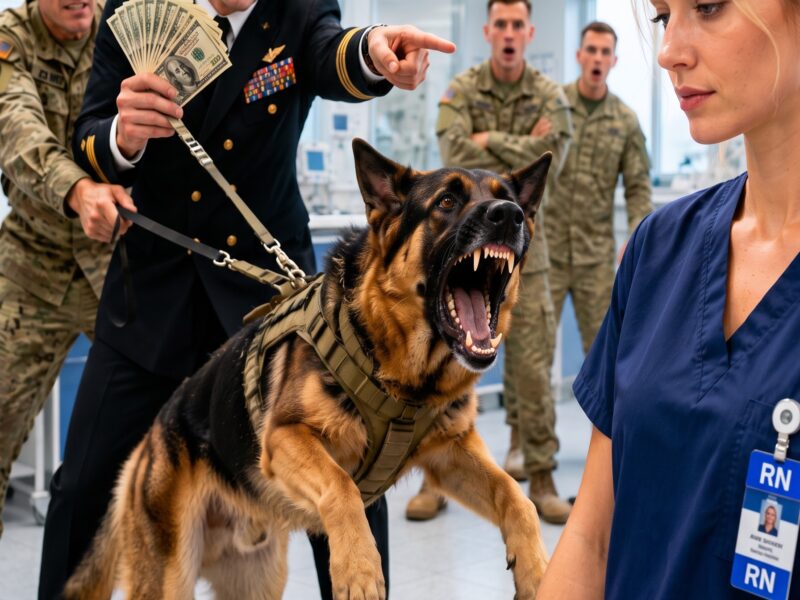
“I’ll pay you $1 million if you can calm him,” the captain mocked in the crowded emergency room as his violent K9 lunged against the leash
The trauma ward at Walter Reed National Military Medical Center hummed with the relentless, sterile rhythm of midnight operations. Overhead fluorescent panels buzzed a dull, exhausting white, casting harsh glares over pale linoleum floors that were perpetually scuffed by rubber boots, rolling gurneys, and the frantic footsteps of overworked staff. The air tasted of aerosolized disinfectants, dry skin, stale coffee from the basement breakroom, and the lingering, coppery ghost of fresh trauma.
I stood behind the central nursing station, my fingers flying across the terminal keyboard to finish a batch of post-op narcotic logs. At thirty-four, with deep violet shadows etched permanently beneath my eyes, I was just another sleep-deprived civilian ER nurse doing double shifts to keep my apartment in Silver Spring. Or at least, that was the identity printed on my badge and locked inside the human resources filing cabinet.
The heavy double doors at the primary ambulance bay suddenly blew open with a violent crash.
“Out of the way! Clear the corridor!”
A squad of military police forced their way into the triage hall, their boots striking the floor in synchronized, thunderous rhythm. At the center of their wedge was a massive, ninety-pound Belgian Malinois. The animal was a coiled engine of raw muscle and panic, his coat matted with dried mud, gray tactical dust, and dark, crusty stains that looked uncomfortably like old blood.
The Malinois was fighting his lead with terrifying strength. He wasn’t just pulling; he was lunging vertically, his front paws scrambling against the air, his jaws snapping inches from empty space while a deep, vibrating snarl tore from his chest.
“Get everyone back against the walls!” a sergeant shouted, waving a heavy lead strap.
Patients in wheelchairs were shoved into alcoves. A nervous junior nurse dropped a metal instrument tray, the sharp clatter echoing down the hallway like a gunshot. The chaos was absolute, a sudden eruption of raw tactical violence inside a sanctuary of healing.
Then I looked up from my terminal.
Holding the other end of the heavy tactical leash was Captain Marcus Vance. He wasn’t wearing his service cap, and his combat tunic was torn at the shoulder, sweat plastering his dark hair to his skull. He looked exhausted, his eyes bloodshot and darting around the room with manic vigilance.
He caught sight of me standing behind the low glass partition of the nursing station, my hands resting flat on the counter beside the medication cart.
“You,” Vance said, his voice cutting through the barking dog and the shouting MPs like a serrated blade.
I blinked, pointing a single finger at my own chest. “Me?”
He offered a bitter, humorless smile that didn’t reach his eyes. “I’ll pay you a million dollars if you can calm him.”
A few nurses near the supply closet chuckled nervously, treating it as gallows humor from a stressed officer.
I didn’t laugh.
I didn’t blink. I locked my eyes directly onto the animal’s face, looking past the snapping jaws, past the foam dripping from his black muzzle, and straight into his amber eyes.
He wasn’t aggressive. Not really. His pupils were blown wide with unadulterated panic. His breath came in shallow, ragged hitches. He was trapped in a feedback loop of terror, fighting a ghost only he could see.
“Take off his tactical vest,” I said. My voice was low, flat, and completely devoid of the panic that filled the room.
Vance frowned, tightening his grip on the lead. “What? Why? He’s an active K9 combat asset; this vest is standard-issue reinforced Kevlar.”
“Because he’s choking himself,” I said, taking two slow steps around the end of the partition. “Look at the front thoracic buckle. It’s jammed against his windpipe. He can’t draw a full breath, and the pressure is triggering a hyper-arousal panic response.”
Vance hesitated. His military instincts told him to maintain operational control, to force submission through strength. But the dog gave a particularly violent wrench, letting out a high-pitched, choking wheeze that sounded distinctly human.
Cursing under his breath, Vance dropped to one knee. He fumbled with the heavy plastic quick-release buckles along the dog’s flanks.
With a sharp snap, the reinforced Kevlar harness fell away, hitting the linoleum with a heavy thud.
The transformation was instantaneous.
The wild, frantic thrashing stopped dead. The dog’s body went completely rigid for a single heartbeat, his ribcage expanding as he pulled in his first unhindered lungful of air. He gave a massive, body-shaking shudder, letting out a long, ragged exhale that sounded like a sigh of profound exhaustion.
I didn’t wait for Vance to give an order. I slowly dropped down, sinking onto my heels until I was eye-level with the animal, keeping my hands open, palms upward, resting on my knees.
“Easy, buddy,” I whispered.
The dog’s ears, pinned flat against his skull like combat blades, slowly swiveled forward. He turned his heavy head. His amber eyes locked onto my face.
He didn’t charge. He didn’t growl.
He began to walk—slowly, almost hesitantly, his claws clicking softly against the polished floor. He crossed the ten-foot gap between Vance and me as if moving through deep water.
When he reached my knees, he didn’t stop. He pressed his entire seventy-pound frame directly against my thighs, sliding downward until his massive head rested heavily across my lap. He let out a low, vibrating groan, his eyes fluttering shut as my hands automatically moved to trace the strong, warm muscles along the back of his neck.
The entire hallway went dead silent.
The heart monitors from the adjacent trauma bays beeped in a slow, metronomic cadence. The MPs stared in open disbelief, their weapons still holstered, their mouths slightly open.
Vance slowly rose to his feet, his hands hanging empty at his sides. He stared at me with an expression that shifted from shock to deep, unsettling suspicion.
“What did you do?” Vance demanded, his voice dropping into a dangerous, controlled register.
“Nothing,” I murmured, my fingers gently massaging the thick fur behind the dog’s left ear.
Then my thumb brushed against a familiar, hairless patch of skin just beneath the earlobe—a jagged, triangular three-quarter-inch scar tissue pattern left behind by a rough-stitched field debridement.
My stomach plummeted. The breath vanished from my lungs as if I’d been kicked in the ribs by a horse.
I knew that scar.
Three years earlier, during a clandestine humanitarian rotation in a forward stabilization post near the Hindu Kush, I had spent forty-eight hours operating on a military working dog that had been dragged out of a bombed-out communications bunker. His handler—a silent, haunted special operations medic who refused to give his last name—had sat beside the surgical table the entire night, holding the animal’s paw until the stitches were tied.
The handler had promised to return the next morning to pick up his dog.
He never showed up. By dawn, the entire camp had been locked down under a classified emergency directive, and the dog had vanished from the recovery crate before I could check his serial numbers.
Vance noticed the sudden, violent draining of color from my face. He took a step closer, his boots squeaking on the floor.
“You’ve seen him before,” Vance stated. It wasn’t a question.
I swallowed hard, forcing my voice to remain steady despite the roaring in my ears. “Yes.”
“Where?”
“Afghanistan,” I whispered. “Fall of twenty-three. Forward Operating Base Viper.”
Vance’s face hardened into stone. His hand drifted instinctively toward his sidearm holster. “That operation was classified at top-secret compartmentalized levels. Civilians don’t have clearance to know the designation of Viper, let alone the canine manifests.”
“I was a military contract nurse before I took the hospital placement here,” I said, keeping my hands steady on the dog’s head, refusing to pull away. “And that dog was registered under a Black-Ops inventory code that didn’t exist on paper.”
Before Vance could interrogate me further, the Malinois suddenly lifted his head. His nostrils flared wide, working the air currents drifting from the open doorway of the central trauma supply room.
He pulled his body back from my lap, stood up, and turned toward the supply room door.
He raised his right paw and scratched sharply against the metal threshold.
Scratch.
Scratch.
Scratch.
Three distinct, deliberate blows.
“What is he doing?” Vance muttered, stepping past me to yank the heavy fire door open.
The supply room was dark, filled with towering metal racks of saline bags, boxes of sterile gauze, and surgical kits. Nothing looked out of place.
Then my eyes caught a glint of dull metal resting on the bottom shelf behind a crate of intravenous tubing.
It was an old, heavily battered canvas medical kit—the kind issued exclusively to long-range reconnaissance patrols. The fabric was stained with dark, oxidized rings of old blood. Protruding from the unzipped main pouch were a pair of black-handled trauma shears.
My heart hammered against my ribs like a trapped bird. Those shears had custom-molded orange grips wrapped in tactical grip tape. I had handed them to the anonymous handler three years ago to cut away a tourniquet in the dust of the Hindu Kush.
Vance followed my gaze. He stepped into the dark room, knelt down, and pulled the canvas kit out into the light of the hallway.
He unzipped the pouch completely.
Inside, resting on top of a pack of sterile dressings, was a small, sealed military evidence bag containing a thumb drive, a folded sheet of grid coordinates, and a heavy, engraved silver dog tag bearing a name that had been officially struck from the Pentagon rosters.
Vance’s face turned the color of wet ash. He looked up at me, his eyes wide with a terrifying realization.
“Where did you get those?” Vance whispered, his hand hovering over the canvas bag as if it were rigged with a tripwire.
I looked down at the dog, who was now sitting patiently beside my boots, watching Vance with cold, steady intelligence.
“I didn’t put them there,” I said. “He did.”
“That’s impossible,” Vance growled, standing up abruptly. “Those items were secured in a Level-Four evidence locker at Fort Meade after the extraction failure. The handler… the handler died before extraction. His body was never recovered from the blast zone.”
I stood up slowly, facing the captain with a sudden, cold fury that pushed all fear aside.
“No,” I said, my voice dropping into a harsh, uncompromising register. “He didn’t die.”
Vance stared at me, his jaw working as if he wanted to shout an order, but the words caught in his throat. “Prove it.”
“Ask the dog,” I said.
Vance looked down at the Malinois.
The dog let out a low, sharp bark, turned on his heel, and trotted directly toward the locked hazardous-waste incinerator alcove at the end of the corridor, where an old, heavy steel-reinforced transit trunk sat half-hidden beneath a blue tarp.
The game was over. The past had finally caught up.
The transit trunk was sealed with a heavy brass combination padlock that looked like it had survived a war zone. The green paint was chipped away in jagged flakes, exposing rusted iron beneath, and the corners were dented from rough handling in cargo holds.
“Stand back,” Vance ordered, drawing his sidearm just an inch from the retention holster as he approached the trunk. He looked over his shoulder at the two MPs who had flanked him through the doors. “Secure the perimeter of this hallway. No staff, no patients, no medical directors. If anyone approaches within thirty feet, you redirect them.”
“Captain, this is a functioning hospital ward,” I said, stepping between him and the trunk. “We have critical patients fifty yards away in ICU. You cannot conduct an armed interrogation in the middle of a trauma corridor.”
“Move, nurse,” Vance said, his voice flat, carrying the absolute, chilling authority of a man backed by invisible intelligence agencies. “You have no idea what is inside that container. And based on the fact that you recognize a dog from an off-the-books operation in Central Asia, you are already knee-deep in a security breach that carries a federal treason charge.”
I didn’t move. I crossed my arms over my scrubs, my eyes locked on his. “Try charging me, Captain. Let’s see how fast the inspector general’s office asks why a classified military K9 that was officially reported KIA three years ago is roaming the halls of Walter Reed looking for a dead man’s gear.”
Vance’s eyes narrowed into dangerous slits. He weighed his options—silencing a civilian nurse in a public hospital versus containing a catastrophic intelligence leak. Before he could make a decision, the Malinois solved the problem for him.
The dog walked up to the heavy steel trunk, planted his front paws firmly against the lid, and let out a sharp, rhythmic double-bark.
Then he pressed his nose directly against the brass padlock and sneezed.
“He’s not barking at the lock,” I realized, stepping closer. “Look at the scratch marks on the side panel.”
Vance knelt down, switching on the tactical flashlight mounted to his belt. In the narrow beam of white light, a series of shallow, rhythmic indentations were gouged into the olive-drab paint—morse code. Three short, two long, one short.
S-T-A-S-H.
“That’s not random dog behavior,” Vance muttered, his hand reaching out to touch the scratched metal. “That’s conditioning. High-tier operative imprint. Who trained this animal?”
“His original handler,” I said softly, kneeling down beside the dog. My hand brushed against the animal’s thick shoulder, and he leaned into my touch, seeking grounding. “The man you said died in the blast.”
Vance didn’t answer immediately. He reached into his tactical vest, pulled out a heavy-duty wire cutter, and hooked the jaws around the shackle of the brass padlock. With a sudden, brutal squeeze of his forearms, the hardened steel sheared through with a loud, ringing snap.
The padlock fell to the floor, rolling away across the linoleum.
Vance slowly reached out and lifted the heavy steel lid of the transit trunk.
A puff of stale, dry air escaped the interior—smelling faintly of gun oil, aged leather, and bitter-tasting battery acid.
Inside, sitting neatly on a bed of custom-cut black foam, was a collection of items that made the blood run cold in my veins. There were no weapons, no explosives, no illicit cash.
Instead, the trunk held an orderly archive of survival gear: three encrypted satellite phones with their batteries removed, a stack of blank civilian passports bearing different names and photographs, an old, water-damaged paperback novel with pages hollowed out to conceal micro-SD cards, and a leather-bound military journal.
Resting right on top of the journal was a standard Department of Defense casualty notification envelope, its paper yellowed with age, addressed to an address in Knoxville, Tennessee—my mother’s house.
I reached out with a trembling hand, lifting the envelope. Across the front, written in bold red ink by an administrative clerk, was a single stamped word: DECEASED.
“Open the journal,” Vance said, his voice dropping an octave.
I flipped the leather cover open. The pages were filled with tight, angular handwriting—the same handwriting that had scrawled the warning on the back of the photograph three years ago.
Operation Cerberus was never about retrieval, the first visible entry read, dated four days before the reported ambush. The command knew the site was hot. They sent us in as a sacrifice to sanitize the digital footprint before the drone strike wiped the valley. If I don’t make it out, the dog knows where the backup ledger is buried. Trust the animal. Never trust the brass.
Vance read the page over my shoulder, his breathing turning shallow and uneven.
“That’s impossible,” Vance whispered, shaking his head. “I sat in the command briefing at MacDill AFB when we reviewed the drone strike footage. There was nothing left of that bunker. The thermobaric warhead vaporized everything within a half-mile radius.”
“Except the men who weren’t in the bunker when the bomb dropped,” a voice echoed from the end of the hallway.
Both Vance and I snapped our heads toward the sound.
Standing fifty feet away, half-shadowed by the flickering fluorescent light of the nurses’ station, was a man wearing a dark civilian trench coat with the collar turned up high against his neck. A wide-brimmed hat shadowed the upper half of his face, but even in the dim light, I could see the thick, jagged white scar running from the corner of his jaw down into the collar of his shirt.
The Malinois didn’t bark. He didn’t growl.
His ears shot straight up. He let out a low, ecstatic whimper, broke away from my side, and sprinted down the corridor like a bullet fired from a gun.
He slammed his front paws into the man’s chest, nearly knocking him off balance, and began frantically licking the stranger’s face, whining with a heartbreaking, desperate joy.
The man caught the massive dog around the neck, burying his face in the thick fur of the animal’s shoulders.
Vance drew his pistol, leveling the barrel squarely at the stranger’s chest.
“Freeze! Do not move a muscle! Identify yourself or I will put a round through your center mass!” Vance roared, his finger tightening on the trigger.
The man slowly raised his head from the dog’s neck. He pushed the brim of his hat back, revealing a pair of pale, piercing blue eyes that looked identical to the ones staring out from the photograph in my memory.
He looked directly at Vance, then past him, straight into my eyes.
“Hello, Captain,” Marcus Vance said quietly, his voice raspy and scarred by years of smoke and silence. “It’s been a long time since you tried to bury me.”
The hospital corridor seemed to shrink, the bright fluorescent lights blurring into a harsh, vibrating hum as the reality of the moment slammed into us.
Marcus Vance—my older brother, the man whose flag-draped coffin I had watched lowered into the red clay of a military cemetery in Tennessee—was standing twenty feet away from me, breathing, bleeding slightly from a fresh cut on his cheek, and holding the dog that had supposedly vaporized in a thermo-baric blast.
“Marcus…” I breathed, the word catching in my throat like shards of glass.
Captain Vance—our uncle, the regional commander of special operations logistics—froze with his sidearm leveled dead center at my brother’s chest. The color completely drained from the captain’s face, leaving him looking like a corpse carved from stone.
“You’re dead,” Captain Vance whispered, his voice trembling for the first time since he had burst through the ER doors. “I signed the casualty warrant. I watched the telemetry data from the Predator feed. The bunker took a direct Hellfire strike followed by a secondary fuel-air explosion. Nothing human could have survived that temperature.”
Marcus didn’t raise his hands. He kept one hand firmly buried in the Malinois’s thick neck ruff, his blue eyes locked onto our uncle with a quiet, lethal intensity that made the air in the hallway feel thin and cold.
“I wasn’t in the bunker, Thomas,” Marcus said, taking a slow step forward. The dog moved in perfect synchronization with him, a living shield pressing against his left thigh. “Your intelligence assets forgot to check the drainage culverts running beneath the ridge. Or maybe you knew they were there, and you just didn’t care enough to check before you called in the strike to cover up your little supply chain discrepancies.”
“That’s a court-martial offense,” Captain Vance snarled, though his weapon hand dipped an inch. “You are officially listed as a deserter operating under a false identity. Everything you say is classified under national security statutes. I can drop you right here in this hallway and write it up as an active-threat neutralization.”
“Try it,” Marcus said softly, stopping ten feet away. He unbuttoned the top button of his trench coat, revealing a heavy leather cord around his neck with a small, encrypted micro-cassette recorder dangling from it. “Before I walked through those hospital doors, I transmitted a full cryptographic backup of the Operation Cerberus logistics manifests to three independent journalistic servers and the inspector general’s secure drop box. If my heart stops beating in the next ten minutes, the entire architecture of your black-budget supply ring goes public across every major news network on earth.”
Captain Vance stared at the recorder, his chest heaving with violent, shallow breaths. The calculation in his mind was visible—weighing the value of killing a ghost against the absolute destruction of his career, his pension, and his freedom.
Slowly, with deliberate reluctance, the captain thumbed the safety back onto his Glock and lowered the weapon back into his holster.
“You’re a fool, Marcus,” the captain hissed, stepping past him toward the transit trunk. “You think you can fight the apparatus? You think a handful of encrypted files will protect you from people who write the laws you swore to uphold?”
“I don’t need files to protect me,” Marcus said, turning his head to look directly at me for the first time. “I have something better. I have family you forgot could still ask questions.”
Marcus took another step toward the nursing station, his boots clicking softly against the floor. He stopped right in front of me.
Up close, the years of survival in the shadows were etched deep into his skin. There were new lines around his eyes, a faint tic in his left cheek, and an aura of absolute, hyper-vigilant readiness that never turned off.
“Maya,” he whispered, his voice cracking slightly. “I told you to stay out of D.C. I told you to take the hospital placement in Seattle.”
“You left me an empty box, Marcus,” I said, my voice shaking as hot tears finally spilled over my eyelashes and carved clean paths through the dust on my cheeks. “You let me mourn you for three years. You let Mom die thinking her only son was blown to pieces in a ditch half a world away.”
“If Mom had known I was alive, they would have used her to find me,” Marcus said fiercely, reaching out to gently touch my cheek with his thumb. His hand was rough, calloused, and freezing cold. “It was the only way to keep you both off the radar. The moment Vance’s team realized I slipped the net, they started hunting anyone with my bloodline. That’s why you were transferred to Walter Reed three months ago. You thought it was a routine civil-service promotion, didn’t you?”
I froze. The cold realization hit me like a physical blow. “Vance arranged my transfer?”
“Of course he did,” Marcus said, glaring over his shoulder at our uncle. “He needed a tether. He knew sooner or later I’d come back for the dog, and he knew the dog would come looking for the only person who ever showed him kindness in that forward base.”
Captain Vance didn’t deny it. He slammed the heavy steel lid of the transit trunk shut, locking the remaining contents away from prying eyes.
“You’re both fools,” Captain Vance said coldly, turning on his heel and walking down the corridor toward the exit doors, his boots echoing sharply in the empty hallway. “Enjoy your reunion while it lasts. By morning, this entire hospital will be cordoned off by federal marshals, and neither of you will exist on any registry in the civilized world.”
The heavy doors swung shut behind him, leaving us standing in the dim, humming quiet of the trauma ward.
Marcus let out a long, shuddering breath, pulling me into a tight, fierce embrace that drove the remaining air from my lungs. I buried my face in his damp coat, clinging to him as if letting go would turn him back into a ghost.
Beside us, the Malinois let out a soft, contented grunt, flopping down onto the floor with a heavy thud, his chin resting across both of our shoes.
“We don’t have much time, Maya,” Marcus whispered against my hair, pulling back to look into my eyes with grim urgency. “Vance won’t use official channels next time. He’s going to send cleaners. We need to move right now.”
“Move where?” I asked, wiping my eyes with the back of my sleeve. “Every highway out of D.C. is monitored by federal traffic cameras.”
Marcus reached into his trench coat pocket and pulled out a set of heavy iron keys attached to a yellow plastic tag stamped with a maintenance locker number.
“Not the highways,” Marcus said, a faint, grim smile touching his lips. “The old steam tunnels beneath the hospital. Built during the Civil War, expanded during the Cold War, and completely forgotten by everyone except the night-shift engineers.”
He looked down at the dog, who was already back on his feet, ears pricked, waiting for the command.
“Are you ready to walk away from your badge, your apartment, and your entire life?” Marcus asked softly.
I looked back down the dark hallway toward the empty trauma bays, then up at my brother, and finally at the dog who had kept our secrets safe in the dirt of Afghanistan.
“My badge was expired anyway,” I said. “Let’s go.”
The basement level of Walter Reed beneath the modern clinical wings smelled like a century of damp brick, forgotten coal dust, and the warm, metallic tang of active high-pressure steam pipes.
Marcus led the way down a steep, narrow flight of cast-iron spiral stairs that descended into the dark beneath the surgical basement. His tactical flashlight cut through the heavy, humid air in a narrow, amber beam, illuminating thick clusters of asbestos-wrapped pipes and cobweb-laced brick arches that curved overhead like the ribs of an ancient leviathan.
Rex trotted silently directly behind Marcus’s left heel, his claws clicking rhythmically against the worn concrete floor. I brought up the rear, carrying a heavy canvas duffel bag filled with medical supplies, two encrypted satellite phones Marcus had salvaged from the transit trunk, and a handful of emergency rations.
“Keep your head down,” Marcus murmured over his shoulder, his voice echoing off the curved masonry. “Some of these low-clearance junctions were part of the old evacuation network. If we trip the seismic sensors near the main administrative junction, base security will seal the iron grates within sixty seconds.”
“How do you know this layout so well?” I asked, ducking beneath a low-hanging steam valve that radiated intense heat against my face.
“Before I joined the reconnaissance cadre, I spent two years as a civilian contractor mapping the utility corridors for the Department of Defense’s emergency continuity-of-government program,” Marcus replied without slowing his pace. “I spent six months crawling through these exact tunnels with a clipboard and a laser measure. Turns out, knowing how to break out of a hospital is a lot easier when you’re the one who designed its escape routes.”
We rounded a sharp ninety-degree corner, entering a wider junction where four brick tunnels converged beneath the old Walter Reed historic quadrangle.
Marcus stopped beside a heavy, rusted steel door marked with a faded yellow radiation trefoil and a stenciled number: VA-04.
He pulled the heavy iron keys from his pocket, selected a long, brass skeleton key with a notched tip, and slid it into the archaic keyhole. With a deep, groaning mechanical clack, the internal deadbolts retracted.
He shoved the heavy door open, revealing a dry, surprisingly clean concrete room fitted with a camp cot, a battery-powered radio rig, a small chemical toilet, and crates of bottled water stacked neatly against the back wall.
“A safe house,” I breathed, stepping inside and shining my flashlight around the space.
“A waypoint,” Marcus corrected, tossing his trench coat onto the cot. “We can’t stay here long. Vance knows I know these tunnels. The moment he realizes we didn’t exit through the parking garage, he’ll send tracking teams down through the intake vents.”
Rex trotted into the room, circled twice, and collapsed onto a folded wool blanket in the corner with a heavy, contented sigh. He rested his chin on his paws, his dark eyes following our every movement.
I set the duffel bag down on a wooden crate and pulled out a roll of sterile gauze and antiseptic ointment. I walked over to Marcus, who was standing over a small metal table examining a folded topographical map of the District of Columbia.
“Sit down,” I ordered, gesturing to the edge of the cot.
Marcus blinked, surprised by the sudden shift in tone. “Maya, I’m fine—”
“You’re bleeding through your sleeve,” I interrupted, pointing to the dark stain spreading across the dark fabric of his flannel shirt near his left elbow. “Sit down before you develop an infection that septicemic shock turns into a permanent discharge.”
Marcus gave a tired, soft chuckle, lowered himself onto the edge of the cot, and rolled his sleeve up.
A ragged, three-inch gash ran along his forearm, the edges of the skin angry, swollen, and crusted with dried blood. It looked like knife work—or the jagged tear of a shrapnel fragment from an uncleaned wound.
“How did you get this?” I asked, my hands moving with practiced, clinical precision as I swabbed the wound with antiseptic.
“A welcome gift from one of your uncle’s private contractors outside a safe house in Arlington three nights ago,” Marcus said, gritting his teeth slightly as the alcohol hit the raw tissue. “He didn’t want to talk; he just wanted to verify my dental records with a combat knife.”
“And the contractor?”
“He’s currently sleeping very soundly beneath a pile of old tires behind an abandoned auto body shop near the Anacostia River,” Marcus said evenly.
I finished applying the antibiotic cream and wrapped a clean white bandage securely around his forearm, securing it with medical tape.
“You’ve really adapted to this lifestyle, haven’t you?” I murmured, packing the remaining supplies back into the duffel.
“It’s not a lifestyle, Maya. It’s a perimeter,” Marcus said, staring down at his boots. “When you spend three years living in caves and drainage ditches, waiting for people with badges to put a bullet in your back, the world shrinks down to very simple things: you trust the dog, you watch your flanks, and you never look back at the life you left behind.”
“You could have reached out,” I said, my voice catching on a sudden wave of old grief. “Even a coded message. Even a single line on an encrypted server to let me know you weren’t burning in that helicopter.”
Marcus looked up, his blue eyes meeting mine with a depth of sorrow that made my chest ache.
“If I had sent a message, the intelligence algorithms would have triangulated my digital fingerprint within forty-eight hours,” he said quietly. “Vance would have used you to draw me out into the open just like he did tonight. The only way to keep you safe was to make sure you believed I was genuinely, irrevocably dead. Grief is survivable, Maya. A federal manhunt isn’t.”
Before I could answer, a low, ominous rumble vibrated through the floorboards beneath our feet.
It wasn’t a subway train, and it wasn’t a passing truck overhead.
It was the distinct, high-frequency whir of heavy electric motors turning over in the ventilation shafts above us—followed immediately by the heavy, metallic slam of a pneumatic security gate locking down somewhere down the tunnel network.
Rex was instantly on his feet. His ears were pinned forward, his hackles raised in a stiff line along his spine, emitting a low, vibrating growl from deep within his chest.
Marcus stood up so fast his camp cot rattled against the concrete wall. He reached down and clicked off our flashlights, plunging the safe room into absolute, pitch-black darkness.
“They found the secondary access hatch,” Marcus whispered, his hand sliding the heavy suppressor onto his pistol with a soft, practiced click. “They didn’t send tracking teams. They sent gas.”
The sweet, sickly scent of almonds and burnt plastic drifted beneath the heavy steel door before we could even hear the hissing of the canisters.
“Cyanide-based aerosol,” Marcus muttered, his voice cold and flat in the absolute darkness. He yanked a pair of specialized tactical respirators from his trench coat pocket, forcing one over my face and tightening the straps with ruthless efficiency. He slipped the second one over his own mouth and nose, his eyes darting toward the ceiling ventilation grate.
Rex let out a sharp, anxious bark, pawing at the base of the steel door as white tendrils of chemical vapor began to snake their way across the concrete floor like crawling fingers.
“Marcus, there’s no other exit from this room,” I said through the rubber filter of my respirator, my voice sounding muffled and distant in my own ears. “This is a dead end.”
“Not a dead end,” Marcus corrected, his hands moving rapidly along the lower masonry joints of the back wall. “A maintenance shaft. The original steam-return line before they rerouted the utilities in the nineteen-sixties.”
He jammed the butt of his suppressed pistol into a loose mortar joint, using it as a lever. With a loud, grinding crunch, a three-foot square section of rotting wooden paneling gave way, revealing a dark, yawning aperture that smelled of fresh earth, rushing water, and cold night air.
“Get through,” Marcus ordered, shoving the canvas duffel bag into the opening. “Rex, hinein!”
The Malinois didn’t hesitate. He dived headfirst into the dark opening like an arrow leaving a bow.
“Marcus, come on!” I yelled, grabbing the edge of the wooden frame.
“Go! I’ll cover the threshold!” Marcus shouted, drawing another magazine from his belt and locking it into his pistol receiver.
I scrambled through the opening, scraping my knees against the rough brick edge, dropping into a narrow, mud-slicked drainage pipe that sloped sharply downward toward the sound of rushing water.
A heavy series of muffled concussions echoed from the safe room behind me—followed by the rapid, stuttering pop of suppressed gunfire.
Pop-pop-pop.
Then silence. A heavy, suffocating silence that felt heavier than the earth above us.
“Marcus!” I screamed, turning back toward the opening.
A dark, heavy shape came flying backward through the aperture, crashing into the mud beside me with a grunt of pure exertion.
Marcus scrambled to his feet, slamming a heavy iron maintenance hatch shut from the inside and throwing three separate security bolts across the plate just as a muffled explosion rattled the masonry on the other side.
“They’re using breaching charges,” Marcus panted, his chest heaving beneath his tactical vest. He grabbed my arm, yanking me forward into the drainage pipe. “Move! If that door blows, this entire tunnel becomes a gas chamber!”
We scrambled through the slick, winding pipe for fifty yards, the sound of rushing water growing louder with every step until we burst out into the open night air through a crumbling stone culvert.
The cold, crisp air of a D.C. autumn hit our faces like a physical slap.
We tumbled down a muddy embankment, landing hard in the shallow, rock-strewn bed of Rock Creek Park, hidden beneath a canopy of massive, ancient oak trees whose leaves rattled in the midnight wind.
Above us, towering half a mile away through the dark branches, the illuminated dome of the Walter Reed administrative complex stood against the starry sky like a monument to an empire that had forgotten its own secrets.
Marcus rolled onto his back, pulling his respirator down around his neck, coughing weakly as he spat a mouthful of foul-tasting water into the weeds.
Rex stood guard at the edge of the creek bed, his ears swiveling toward the park road above us, tail wagging in slow, steady sweeps against his thighs.
I scrambled over to my brother, my hands trembling as I checked his pulse, his arms, his chest. “Are you hit? Marcus, did they get you?”
Marcus caught my wrists, stopping my frantic hands. He looked up at me, a genuine, unburdened smile finally breaking through the hard lines of his scarred face.
“I’m clean, Maya,” he said softly. “Just a few more bruises to add to the collection.”
He sat up slowly, looking around the quiet, secluded park as the distant wail of base security sirens began to fade into the night, swallowed by the vastness of the capital city.
“What now?” I asked, my voice barely audible over the murmur of the creek. “We can’t go back to our apartments. We can’t use our credit cards. Vance still has the entire federal apparatus looking for us.”
Marcus reached into his breast pocket and pulled out the encrypted thumb drive he had recovered from the transit trunk—the one containing the complete, unedited operational records of Operation Cerberus.
He held it out, resting it in the palm of my hand.
“We don’t need to hide anymore,” Marcus said, his eyes bright with a fierce, quiet resolution. “We send this directly to the Senate Select Committee on Intelligence through an independent legal proxy at dawn. Vance and his contractors are going to have to explain to a public congressional hearing why they faked a terrorist bombing to cover up an illegal bioweapons ring.”
He looked down at the Malinois, who had trotted back over to us and was now sitting squarely between our feet, keeping a vigilant watch over the tree line.
“And the dog?” I asked, scratching the animal behind his scarred ear.
Marcus reached out, unclipped the heavy tactical collar with its encrypted military serial numbers, and tossed it into the swirling waters of Rock Creek. The metal sank instantly out of sight.
“He’s not a military asset anymore,” Marcus said, wrapping his arm around my shoulders and pulling me close against his side as we started walking northward along the creek bed toward the mountain trails. “He’s just a good dog going home.”
Behind us, the city lights of Washington twinkled across the horizon, indifferent and vast, while the three of us stepped out of the shadows and walked straight into the dawn.
The end.









