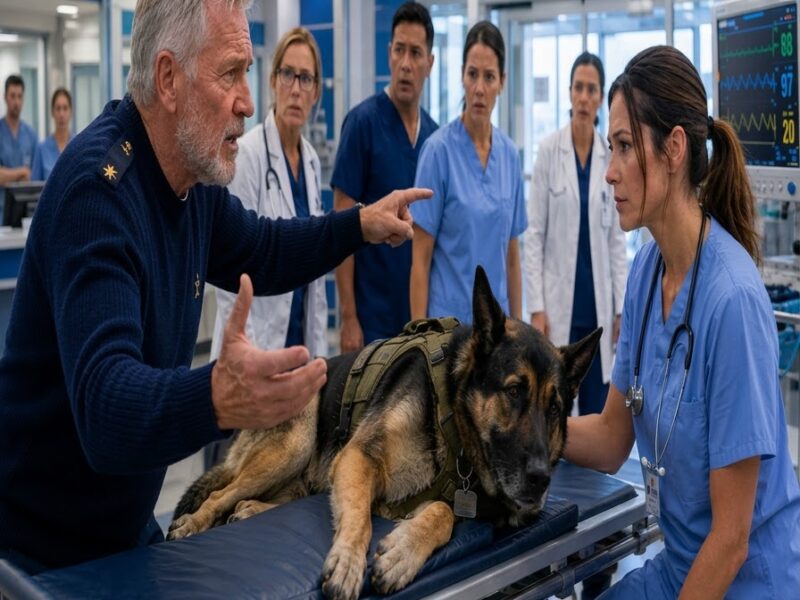
“I’LL GIVE YOU ANYTHING YOU WANT—JUST SAVE MY K9!” A Navy SEAL admiral fell to his knees inside the emergency room
“I’LL GIVE YOU ANYTHING YOU WANT—JUST SAVE MY K9!”
Admiral Thomas Reed fell to his knees inside the emergency room, his knees striking the cold linoleum with a heavy, sickening thud. A decorated Navy SEAL officer whose chest was decorated with a dozen rows of campaign ribbons, he looked utterly destroyed, his calloused hands clutching the edge of the stainless-steel operating table. He was begging a trauma nurse whom everyone in the military hospital had dismissed as inexperienced—a temporary transfer working late-night shifts in the trauma bay. The admiral was completely unaware that the dying dog lying before him recognized her scent from a classified mission the military had spent twelve years erasing from existence.
The K9 lay motionless on the central operating table, his thick black fur soaked with dark, clotting blood, and his breathing growing weaker by the second. His name was Shadow, a nine-year-old Belgian Malinois who had served alongside Admiral Reed through countless dangerous black-ops missions across three continents. Now, three chief medical officers stood around the table, their arms folded, shaking their heads in unison as the heart monitor emitted a agonizingly slow, shallow beep.
“There’s nothing more we can do, Admiral,” Dr. Harris, the chief surgeon, finally said, his voice flat and detached as he stepped back to strip off his latex gloves. “The shrapnel severed the femoral artery, and he’s lost too much blood. His brain activity is plummeting. If we keep pushing fluids, we’re just delaying the inevitable. It’s time to call it.”
The admiral gripped the metallic edge of the table so hard his knuckles turned ghostly white. “Please,” his voice cracked, breaking with a raw, desperate grief that shattered the rigid authority he usually carried. “He’s not just a dog. He saved my life in Mosul. He brought three men out of a burning compound in Kabul. He’s family.”
I had been organizing surgical trays and restacking sterile gauze near the doorway when I noticed a minute, almost imperceptible detail. Beneath the matted, crimson-stained fur of Shadow’s flank, his left paw gave a sharp, frantic twitch. His shallow ribcage fluttered—not with the rhythm of death, but with the violent, erratic spasm of a body fighting a hidden hemorrhage.
“Wait,” I said, my voice cutting through the heavy silence of the room.
Dr. Harris and the two assisting physicians turned toward me, their expressions instantly hardening into condescending scowls. I stepped closer, dropping my clipboards onto the counter, and pressed three fingers deep into the hollow space beneath Shadow’s torn tactical vest. The dog’s skin was ice-cold, but beneath the thick muscle layer, I felt a localized, surging heat.
“He’s bleeding internally,” I asserted, looking up into Dr. Harris’s eyes. “It’s not just the leg wound. You’ve sealed the primary laceration, but there’s a secondary rupture in the retroperitoneal space. He’s pooling blood near his kidney.”
Dr. Harris sighed, rolling his eyes as he gestured to the flatlining vitals on the wall-mounted screen. “We already checked the abdominal cavity with ultrasound, Nurse Miller. There’s no free fluid in the main peritoneum. He’s in irreversible neurogenic shock. Step back and let the staff clear the room.”
“Then check again,” I snapped, refusing to budge an inch. “You ran a standard FAST scan that only looks at the anterior upper quadrants. You missed the posterior lining because his tactical harness is compressing his back. Take off the vest and check the retroperitoneum.”
Nobody moved. The two attending doctors stared at me as if I had spoken in a foreign language.
I didn’t wait for their permission. I reached directly for the tray, grabbing a pair of heavy-duty trauma shears and a scalpel.
The admiral lifted his head, his tear-streaked eyes searching my face with a sudden, desperate intensity. “Can you save him?” he rasped.
“I can try,” I said softly, slicing through the reinforced nylon straps of the dog’s armor.
“Name your price,” Reed said, his voice dropping to a harsh whisper. “Money, transfers, security clearances—anything. Just bring him back.”
I shook my head, keeping my eyes locked on the dark blood welling beneath the dog’s skin. “Just let me work.”
For the next twenty minutes, the small operating room filled with the chaotic symphony of medical trauma: the erratic, squealing tones of heart monitors, the rhythmic clatter of metal tools hitting trays, my own hurried footsteps, and my trembling, focused breath. The attending doctors stood back, murmuring in disbelief as I clamped the hidden arterial tear deep near the canine’s spine, pouring units of universal canine plasma directly into his neck line.
Shadow’s pulse disappeared twice. The line went completely flat, filling the room with a long, continuous tone that screamed death. Both times, Dr. Harris reached out to stop me, and both times, I shoved his hand away, performing rhythmic, hard chest compressions until my shoulders burned with fatigue.
“Come on, Shadow,” I whispered, pressing my mouth near his torn ear. “Fight it.”
On the twenty-third minute, the monitor blipped. Then again. Thump-thump. Thump-thump. Shadow’s heart began beating again, steadying into a strong, resonant rhythm.
The admiral covered his mouth with a trembling hand, tears gathering in his gray eyes as he slumped back against the wall, overwhelmed.
I took a deep breath, wiping sweat from my forehead with the sleeve of my scrubs. I turned back to the dog to clean the remaining incisions. But as I peeled away the final layer of the reinforced tactical vest, I noticed something strange hidden beneath the inner lining. A small, tarnished metal plate had been hand-stitched into the thick ballistic Kevlar, completely hidden from standard military inspection.
It carried a stamped mission serial number: OP-RED-FALL-0412.
My hands went completely cold. The scalpel nearly slipped from my fingers. I knew that exact number sequence. I had memorized every single digit of it twelve years ago, staring at a government rejection letter under the dim light of my bedroom lamp.
Twelve years earlier, my older brother, Corporal Marcus Miller, had disappeared during a covert Navy SEAL rescue operation in the mountains of Eastern Europe. The official Department of Defense report claimed his entire five-man team had been ambushed and killed, their bodies incinerated in an ammo depot explosion. But one detail had never made sense to me—a detail the military liaison had brushed off as administrative error: the mission’s specialized K9 unit had also been listed as missing in action, with no remains recovered.
I looked down at Shadow’s graying face. A thin, jagged silver scar crossed his right eye, splitting the eyebrow ridge in two.
My heart hammered against my ribs like a trapped bird. I remembered that exact scar. I had seen it in an old, crumpled polaroid photograph my brother had sent home in a secret letter just weeks before he vanished.
“Where did you get him?” I asked, my voice barely more than a whisper.
The admiral stared at me, his eyes narrowing slightly as he took in my pale face. “Why?”
“Answer me,” I demanded, stepping away from the table, my voice trembling with a mixture of rage and terror. “Where did this dog come from, Admiral?”
He stepped closer, his boots heavy against the tile. “Shadow was recovered from an abandoned safehouse twelve years ago. He was wounded, starving, and guarding a sealed door in the basement. We brought him back, rehabilitated him, and he’s been by my side ever since.”
My chest tightened until I couldn’t breathe. “Who was his original handler?”
The admiral didn’t speak. His jaw tightened, a shadow of heavy, dangerous secrets passing over his face.
Then, behind us, Shadow slowly opened his eyes. The cloudy haze of anesthesia was still there, but his dark eyes moved past the admiral, turning slowly until they settled entirely on me. The dog’s ears twitched forward. He tried to lift his heavy, bandaged head from the pillow.
I leaned closer, resting my trembling hand against his side. The dog sniffed my skin, and a faint, desperate whimper escaped his throat—a sound of profound recognition.
The admiral reached deep into his inner dress uniform pocket and pulled out a worn, leather-bound wallet. From inside, he extracted a folded, yellowed photograph wrapped in protective plastic.
“I’ve carried this for twelve years,” he whispered, holding it out to me. “Waiting for someone who recognized that code.”
I opened it with shaking fingers. My brother, Marcus, stood beside a young, energetic Shadow, both of them kneeling in the snow outside a dark pine forest. Marcus was younger, smiling broadly at the camera, with one heavy hand resting affectionately on the dog’s head.
I flipped the photo over. On the back, written in my brother’s jagged, familiar handwriting, were six simple words:
“If I vanish, find my sister.”
I looked up, tears blurring my vision. The admiral’s face had turned completely pale, his eyes darting toward the frosted glass doors of the emergency room corridor.
“Your brother didn’t die that night,” Reed said, his voice dropping to a terrifying whisper. “He was taken. And the men who took him have been hunting this dog for a decade.”
Behind him, Shadow suddenly lifted his head, his nostrils flaring as his upper lip curled back over his teeth. A deep, menacing growl began to vibrate deep in his chest, aimed directly at the double doors of the hospital entrance.
Through the frosted glass, a shadow blocked the light. And someone outside softly whispered my full name.
The air in the trauma bay suddenly felt thirty degrees colder. The rhythmic beep-beep-beep of Shadow’s heart monitor seemed to slow down, swallowed whole by the ominous, guttural growl vibrating from the dog’s chest. The shadow standing on the other side of the frosted glass door remained motionless for two agonizing seconds, its silhouette tall, broad-shouldered, and draped in a long tactical coat.
“Get behind me,” Admiral Reed commanded, his entire demeanor shifting instantly from a grieving dog owner back to a lethal combat commander. He reached instinctively toward his hip, but his hand met empty air—regulations prohibited sidearms inside the civilian ward of the naval hospital.
The handle of the double doors slowly turned.
“Clara…” the voice hissed again through the narrow rubber gap between the doors. It was a raspy, dry whisper, like boots scraping over gravel. “Clara Miller…”
Shadow didn’t just growl—he attempted to launch himself off the surgical table, his bandaged paws tearing at the sterile sheets as he snarled with a feral intensity. I lunged forward, throwing my arms around the dog’s chest to keep him from ripping open his newly stitched abdominal wall.
“Shadow, down! Stay!” I commanded, my tears burning against his rough black fur. The dog quivered under my grip, his eyes locked onto the door, his teeth dripping with saliva.
The double doors swung open with a slow, metallic creak.
A man stepped into the bright fluorescent glare of the room. He wasn’t wearing a military uniform or a hospital gown. He wore dark, grease-stained tactical pants, a frayed collar shirt, and a heavy jacket. His face was covered in a maze of old, silver burn scars that destroyed the left side of his jawline, pulling his skin tight over his cheekbone. But despite the disfigurement, I recognized his eyes instantly.
They were the same storm-gray eyes that had stared back at me across our family dinner table in Ohio twelve years ago.
“Marcus?” I gasped, the world spinning around me.
“Clara,” my brother said, his voice raw and broken. He didn’t step any closer. He kept his hands raised slightly at his waist, his eyes darting nervously toward Admiral Reed. “You shouldn’t have saved him, Clara. As long as Shadow is alive… as long as his pulse is beating… the signal is active.”
“Marcus!” I cried out, taking a step toward him, but Admiral Reed instantly extended a heavy arm, blocking my path.
“Stand down, Nurse,” Reed snapped, his eyes fixed on my brother with an expression of intense distrust and cold fury. “Corporal Miller was declared MIA twelve years ago. He is an unregistered combatant in a secure military facility.”
“Shut up, Thomas!” Marcus barked, his eyes flashing with sudden rage as he glared at the admiral. “You brought him here! You brought Shadow to a public grid! Do you have any idea what you’ve done? The moment his vitals spiked on your base bio-monitor, the satellite flagged his location!”
“What signal?” I demanded, my mind racing as I looked between my dead brother and the Navy admiral standing in my operating room. “What are you talking about?”
Marcus reached into his jacket, and Reed instantly tensed, preparing to rush him. But Marcus didn’t pull a weapon. Instead, he pulled out a heavily modified hand-held radio, its red LED screen flashing with a countdown timer: 03:42… 03:41… 03:40.
“Twelve years ago,” Marcus said, his voice shaking with urgency as he looked directly at me, “our unit wasn’t wiped out by an enemy ambush. We were set up by a rogue division inside JSOC—a group called the Aegis Initiative. They were testing illegal cybernetic tracking micro-chips in military K9s—chips linked directly to encrypted sub-dermal drives carried in the dog’s thoracic tissue.”
Marcus pointed a trembling finger at Shadow, who had calmed down slightly at the sound of my brother’s voice, his tail giving a single, feeble thump against the surgical mattress.
“Shadow isn’t just a dog, Clara,” Marcus continued, tears welling in his ruined, scarred face. “He is the vault. The metal plate sewn into his vest has the serial number, but the actual evidence—the names of the corrupt generals, the offshore bank accounts, the records of the men they executed to keep it quiet—is stored on a micro-drive housed inside a titanium capsule beneath his left shoulder blade. As long as his heart is beating above forty beats per minute, the capsule emits a low-frequency encrypted ping to the Aegis network.”
“And they just found us,” Reed realized, his jaw dropping as he turned toward the curtained windows overlooking the hospital parking lot.
Outside, the quiet night was shattered by the sharp, metallic whirring of heavy rotor blades. Two unlit, blacked-out helicopters descended from the low clouds over the naval hospital, their searchlights remaining dark as they hovered directly above the roof of the medical wing.
“They’re not here to arrest anyone,” Marcus said, pulling a silenced sidearm from his belt and tossing a secondary pistol to Admiral Reed. “They’re here to sanitize the site. They’re going to destroy this entire floor to make sure that drive never reaches the Department of Justice.”
Dr. Harris and the two attending physicians let out terrified screams, backing away toward the rear supply closet.
“Get them out of here!” I shouted at Harris. “Take the back stairwell!”
The doctors didn’t need to be told twice. They sprinted out the side exit, leaving me, my returned brother, the admiral, and a dying black K9 alone in the central trauma bay.
BANG-BANG-BANG!
The heavy glass of the exterior windows shattered inward as heavy black ropes dropped down from the ceiling rafters outside. Four armed men dressed in unmarked, dark grey tactical gear crashed through the glass, their weapons raised as they landed on the slick floorboards.
“Shadow! Cover!” Reed roared.
Despite his gaping surgical wound, the brave Belgian Malinois threw himself off the table, using his heavy body to knock me flat onto the floor behind the stainless-steel supply cart just as a hail of automatic gunfire tore through the trauma bay.
The air in the trauma bay turned into a swirling vortex of shattered glass, pulverized drywall, and hot lead. Bullets slammed into the stainless-steel supply cart above my head, ringing like church bells as plastic IV bags exploded, showering us in cold saline solution.
Admiral Reed fired twice from behind a concrete pillar, his shots sharp and precise, taking down the first mercenary who tried to breach the window frame. Marcus rolled across the slick tile floor, returning suppressive fire with his silenced pistol, his movements fluid despite his scarred left leg.
“Clara! The rear elevator!” Marcus screamed over the deafening roar of automatic weapons. “Take Shadow! Get him to the sub-basement under the old boiler room! The walls down there are lead-lined—it’ll block the micro-chip’s transmission ping!”
“I am not leaving you!” I yelled back, pressing my hands against Shadow’s chest. The dog was panting heavily, his tongue hanging out, dark spots of blood beginning to seep through his fresh bandages from the physical exertion of saving me.
“You have to!” Marcus shouted, dropping his empty magazine and slapping a fresh one into his sidearm. “They don’t know who you are yet! If they capture the dog here, everybody dies! Move!”
Admiral Reed stepped into the open hallway, firing three rapid shots to suppress the remaining mercenaries coming down the corridor. “Go, Nurse Miller! I’ll cover your brother! That’s an order!”
I didn’t argue any longer. I grabbed the heavy leather harness around Shadow’s shoulders, hauling the seventy-pound dog onto a low, wheeled transport gurney. Shadow let out a soft whine, but he understood the urgency; he kept his head flat against the vinyl pad, his good eye locked on mine as I unlocked the gurney’s wheels and shoved it through the rear service door into the dimly lit hospital hallway.
The sounds of gunfire faded behind us, replaced by the deep, terrifying alarm sirens blaring across the medical complex. Red emergency strobe lights flashed along the ceiling, casting long, bloody shadows across the white floorboards.
I pushed the gurney as fast as my legs could carry me, turning down a maze of narrow corridors until I reached the rusted iron doors of the old freight elevator used for laundry and toxic waste disposal. I slammed my hand against the call button, my heart hammering against my ribs.
Click… clack… hummmmm.
The heavy steel doors slid open with a screech of ungreased metal. I shoved the gurney inside, slapped the button for LEVEL B3, and pulled the manual iron gate shut.
As the elevator began its slow, clanking descent into the depths of the hospital, the floor indicator lights flickered violently. Shadow reached out with his snout, gently resting his cold, wet nose against my trembling hand.
“We’re going to make it, boy,” I whispered, kneeling beside him in the dim yellow light of the elevator cage. I pulled my emergency trauma kit from my pocket, quickly applying fresh pressure dressings to his bleeding side. “Marcus is back. He’s alive. We just have to hold on.”
DING.
The elevator jolted to a sudden halt. The iron doors screeched open, revealing the cold, dark world of Level B3.
This wasn’t the clean, sterile environment of the upper medical bays. The sub-basement was a cavernous labyrinth of exposed concrete walls, rusted iron steam pipes, and forgotten storage lockers from the 1950s. The air smelled thick with damp rot, hot oil, and ozone. Steam hissed from hairline fractures in the overhead pipes, filling the narrow walkways with a thick, hanging white fog.
Shadow lifted his head, his ears twitching as he sniffed the heavy air. He let out a low, subtle huff—a warning.
We weren’t alone down here.
I pulled a heavy iron wrench from a maintenance tray hanging near the elevator shaft, holding it tight in my right hand as I carefully pushed the gurney forward through the knee-deep fog.
“Shadow,” I whispered softly. “Which way?”
The dog shifted his weight, pointing his nose toward a heavy steel door marked BOILER ROOM 4 – AUTHORIZED PERSONNEL ONLY.
I pushed the gurney toward the door, my rubber-soled shoes splashing through shallow puddles of dirty water on the concrete floor. But before I could touch the iron handle, a cold, smooth voice echoed out from the thick white steam behind us.
“Remarkable work, Nurse Miller. Truly remarkable.”
I froze, turning slowly around, raising the iron wrench in front of me like a club.
A tall, middle-aged man walked out of the fog. He wore an immaculate blue military uniform with gold braid on the shoulders, completely unbothered by the damp soot of the basement. He had short gray hair, thin rimless spectacles, and a calm, polite smile that didn’t reach his cold blue eyes.
Behind him stood two heavily armed private security contractors, their laser sights tracing bright red dots across my chest and Shadow’s head.
“Allow me to introduce myself,” the man said, stepping closer with his hands folded neatly behind his back. “I am General Arthur Vance, Director of Logistics for JSOC. And you, Clara, have spent the last half-hour complicating a quiet, twelve-year administrative cleanup.”
General Vance stepped closer, his polished leather shoes clicking against the wet concrete floor with terrifying composure. The red laser sights from his two mercenaries remained fixed on my forehead and Shadow’s trembling chest.
“Put the wrench down, Clara,” Vance said softly, as if he were addressing a child in a classroom. “You are an emergency room nurse, not a combatant. You’ve done a commendable job saving this animal’s life, but his journey ends here.”
“You set up my brother,” I rasped, my knuckles white as I gripped the iron wrench, refusing to lower it. “You tried to murder Marcus’s entire team twelve years ago because they found out about your illegal contracts.”
Vance let out a dry, disappointed chuckle, shaking his head slightly. “Your brother was a fine soldier, but he lacked vision. He stumbled upon a logistics framework that was keeping five shadow operations funded across three continents. He thought he was being heroic by stealing that data. He didn’t understand that in our world, heroism is just another word for liability.”
Vance gestured slightly with his hand to the contractor on his left. “Extract the dog’s shoulder blade. Take the drive and burn the rest of the room.”
The contractor stepped forward, pulling a heavy combat knife from his chest rig.
Shadow let out a menacing snarl, his front paws sliding off the gurney as he attempted to stand, protecting me with his body even as his surgical stitches groaned under the strain.
“Don’t touch him!” I screamed.
Before the contractor could take another step, a sharp, deafening BANG echoed through the steam-filled boiler room.
The contractor’s eyes went wide with shock. A small, neat hole appeared in the center of his tactical helmet, and he collapsed forward onto the wet concrete like a sack of stones.
Vance gasped, ducking down behind a row of rusted iron steam pipes as a second shot rang out through the darkness, striking the second mercenary square in the chest.
“CLARA! DOWN!” Admiral Reed’s voice roared through the fog.
I threw myself over Shadow, covering his head with my body as Admiral Reed and Marcus burst out from a side ventilation shaft. Marcus was firing his sidearm with deadly, rhythmic precision, while Reed charged forward like a freight train, slamming his massive frame directly into General Vance.
The two high-ranking military officers crashed against the concrete wall, rolling into the shallow puddle of water. Reed disarmed Vance with a violent twist of his wrist, slamming the general’s arm behind his back and pinning him face-down onto the cold, wet floor.
“It’s over, Vance!” Reed roared, his chest heaving as he pressed his knee firmly into the small of the general’s back. “The base communications grid is back online! I’ve personally transmitted an emergency flash-override to the Department of the Navy! Federal marshals are surrounding the perimeter as we speak!”
Vance spat blood onto the concrete, a bitter, twisted smile spreading across his face despite his capture. “You think… you think a federal marshal cares about a twelve-year-old ghost story, Reed? You have no hard evidence. You have a deserter corporal, an unauthorized nurse, and a dying dog!”
Marcus stepped forward, his boots splashing in the water as he approached General Vance. He didn’t look angry; his face was a mask of cold, absolute certainty.
“We have the evidence, Arthur,” Marcus said quietly.
Marcus knelt beside Shadow, his hands moving gently to the dog’s left shoulder blade. Shadow whined softly, leaning his head against Marcus’s knee as my brother touched a deep, thick scar hidden beneath the black fur—a scar that didn’t come from a bullet or shrapnel, but from a precise surgical incision made twelve years ago.
“The micro-drive inside Shadow’s shoulder wasn’t just a passive storage unit,” Marcus explained, looking at Reed and me. “It was encrypted using a dual-biometric latch. It requires two specific physical keys to unlock the public encryption key and broadcast the raw files to an unredacted server.”
Marcus looked up at me, his storm-gray eyes shining with tears. “The first key was the dog’s live heart rhythm—which you restored, Clara, when you saved his life on that table.”
“And the second key?” Admiral Reed asked, pressing Vance harder against the floor.
Marcus reached into his collar and pulled out a silver dog tag hanging from a steel chain around his neck. He handed it to me. On the back of the tag was a small, micro-magnetic strip.
“The second key is the handler’s tag,” Marcus said softly. “Brought back from the dead.”
Marcus took the tag, leaned over the Belgian Malinois, and swiped the magnetic strip directly across the small metallic plate sewn inside Shadow’s tactical vest.
BEEP.
A sharp, high-pitched tone emitted from the dog’s vest. A tiny blue LED light, hidden within the leather seams, turned from flashing red to a solid, vibrant blue.
Across the room, Marcus’s handheld receiver began to chime frantically as thousands of encrypted files, financial ledgers, video logs, and signed execution orders began uploading directly to the Department of Justice’s secure cloud server via the hospital’s high-frequency satellite link.
General Vance’s face went completely grey. The bitter smile vanished, replaced by the sheer, unadulterated terror of a man watching his entire empire collapse in real-time.
“No…” Vance whimpered into the dirt. “No, please…”
Above us, the blaring sirens of the hospital shifted from the high-pitched intrusion alarm to the deep, steady air-horn sequence of arriving federal law enforcement vehicles.
Shadow let out a long, shuddering sigh, his body relaxing completely as the weight of a twelve-year war finally lifted from his shoulders. He reached out with his tongue, gently licking my brother’s scarred cheek, before turning his head to rest his snout back in my lap.
Part 5: The Final Watch
Six months later, the morning sun rose bright and clear over the rolling green hills of a quiet farm in rural Virginia, just two hours outside of Washington D.C.
The air was fresh, sweet with the scent of wild clover and damp earth, entirely free of the harsh antiseptic smell of emergency rooms and the cold soot of subterranean boiler rooms.
Sitting on the wide, wooden porch of the farmhouse was my brother, Marcus. His disfiguring scars remained, but his face had lost the hollow, haunted look of a ghost who had spent a decade hiding in the shadows. His name had been fully cleared by a military tribunal; General Vance and fourteen high-ranking conspirators inside the Aegis Initiative were currently serving life sentences in federal penitentiaries for treason, murder, and corruption.
Beside Marcus sat Admiral Thomas Reed, dressed in casual civilian clothes, sipping a warm cup of black coffee as he looked out over the sunlit pasture.
“The Department of Defense wanted to award him a Distinguished Service Medal today,” Reed said softly, looking down toward the green lawn. “Official ceremony at the Pentagon. Full press coverage. I told them to shove it. I told them Shadow had earned his retirement away from cameras.”
I stepped out onto the porch, carrying a tray of fresh iced tea, smiling as I looked down at the yard.
Running through the tall grass—with a noticeable, stubborn limp in his hind leg, but with absolute joy in his movement—was Shadow. The nine-year-old Belgian Malinois was chasing a bright red rubber ball, his black coat shining under the warm summer sun, his torn ear bouncing with every stride.
He caught the ball in mid-air, brought it proudly to the base of the porch steps, and dropped it at my feet with a happy, raspy bark.
“He’s never going to let you stop throwing that, Clara,” Marcus laughed, leaning back in his rocking chair, his hands clasped behind his head.
I knelt down on the wooden steps, running my fingers through Shadow’s thick fur, feeling the solid, steady, powerful beat of his heart against my palm. The scar over his right eye remained, a permanent reminder of the darkness he had lived through, but his eyes were clear, bright, and filled with an unconditional trust that no war could ever break.
“He earned every single throw,” I said, picking up the ball and raising my arm.
Shadow tensed, his hind legs coiled like springs, his cloudy right eye locked on my hand, completely ready for the game.
I threw the ball far out into the open field, watching the brave old war dog sprint out into the sun, free at last from the mission he had carried for twelve long years.
The end.









