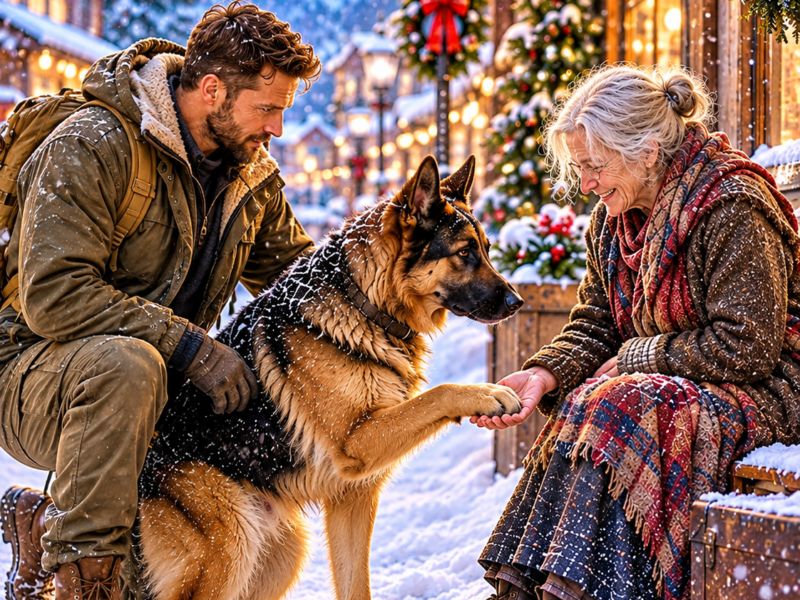
“I watched two wealthy strangers recognize a seventy-two-year-old woman begging for leftover food outside a Montana roadside store
I took the newspaper clipping from Eleanor’s trembling hand.
The paper was yellowed at the edges, folded into quarters, and worn along the creases as though she had carried it for years.
The headline read: WHITAKER MEDICAL SYSTEMS FOUNDER ANNOUNCES RETIREMENT FROM PUBLIC LIFE.
Beneath it was a photograph of Eleanor.
Not the woman standing beside me in a faded charcoal coat, but a woman with silver hair neatly arranged, wearing a tailored black suit and standing behind a podium.
Her expression was composed.
Her eyes were unmistakable.
I looked from the photograph to the woman beside Daniel’s grave.
“You’re Eleanor Whitaker.”
She gave a small nod.
“Yes.”
I knew the company.
Whitaker Medical Systems supplied emergency medical equipment, trauma-care technology, and rehabilitation systems to hospitals across the country.
I’d seen its name on equipment in military medical facilities.
I’d never imagined its founder would be asking a convenience store clerk for leftover soup.
“You own the company?”
“I founded it. I still control the voting shares, although I haven’t been involved in its daily operations for years.”
I looked at the newspaper again.
The article described a businesswoman whose company had grown from a small medical equipment supplier into a major national organization.
It mentioned her charitable foundation, her late husband, and her son, Captain Daniel Whitaker.
Then I remembered the silver-haired man at the market.
“Those people knew who you were.”
“Yes.”
“And they left you there.”
Eleanor lowered her eyes toward the headstone.
“That’s what they did.”
I wanted to ask a dozen questions, but something in her expression stopped me.
She wasn’t looking at the newspaper anymore.
She was looking at Daniel.
“May I ask you something?” I said.
“Of course.”
“Why didn’t you tell me?”
She brushed a little snow from the edge of the stone.
“Because I wanted to know what it felt like to be Eleanor Whitaker without being Eleanor Whitaker.”
I didn’t understand.
She noticed.
“For most of my adult life, people have approached me with an expectation. They want a donation, a signature, an introduction, a decision, or an answer. Even people who genuinely care about me sometimes speak as though I’m a position they have to manage.”
She paused.
“When Daniel died, I threw myself into the company and the foundation. I told myself I was honoring him. Perhaps I was. But I also became very good at staying busy enough not to miss him every minute.”
The wind moved through the pine trees.
“My husband died six years later. After that, work became the only place where I knew what was expected of me.”
She looked down at her hands.
“Then one morning, I woke up in my own house and realized I couldn’t remember the last time someone had asked whether I was happy without wanting something in return.”
I glanced at the headstone.
“That’s why you left?”
“Partly.”
She explained that she had planned to spend a week traveling quietly through Montana.
She had left a message with Richard Hale, her longtime attorney and closest professional adviser, explaining that she was safe and needed some time alone.
She packed an old suitcase, wore inexpensive clothes, and left her phone behind.
She hadn’t intended to become homeless.
She had simply wanted to visit ordinary places where nobody knew her name.
For the first few days, it had worked.
She drank coffee in small diners, walked through unfamiliar towns, and listened to conversations that had nothing to do with business.
Then she lost her wallet at a bus station.
It contained most of her cash and the bank card she had brought for emergencies.
She still had identification in a separate compartment of her suitcase.
She could have called Richard.
She could have walked into a police station.
But every time she considered doing so, she imagined the same conversations waiting for her.
Meetings. Questions. Apologies. People telling her what she needed to do.
So she kept moving.
“At first, I thought I was being brave,” she admitted. “After a while, I realized I was simply becoming stubborn.”
I leaned against the nearby bench.
“Those aren’t always different things.”
She gave me a faint smile.
“No. I suppose they aren’t.”
I remembered her at the market.
The wet boots.
The carefully folded bread.
The way she had moved aside whenever someone approached.
“What about the man and woman who recognized you?”
Eleanor’s expression changed.
“The man was Martin Caldwell. He used to be a senior regional executive at Whitaker Medical Systems. The woman was his wife, Patricia.”
“What happened between you?”
She took a long breath.
“Several years ago, Martin proposed a restructuring plan that would have shifted some of our medical supply operations toward cheaper contractors. I objected because the proposed savings depended on quality controls I didn’t believe were adequate.”
She explained that the disagreement had become bitter.
Martin eventually left the company after the board rejected his proposal.
He believed she had humiliated him.
“I never thought he would like me,” she said. “But I thought he might still remember that I was a human being.”
She looked toward the road.
“When he saw me outside that store, I think he enjoyed discovering that I had become someone he no longer needed to respect.”
I didn’t respond.
I had seen people become cruel when they believed another person had lost the power to challenge them.
But something about Eleanor’s story bothered me.
“Did Martin know where you were going?”
“No.”
“Did anyone else?”
“Not that I knew of.”
She folded the newspaper clipping and returned it to her pocket.
Then she looked at Daniel’s grave again.
“There’s another reason I came here.”
I waited.
“Daniel died fourteen years ago. I visit him every year, but lately I’ve been coming less often.”
She touched the engraved letters of his name.
“After his funeral, I promised myself that his death would mean something. I built the foundation. We funded rehabilitation programs, helped military families, and supported veterans who needed medical equipment they couldn’t afford.”
Her voice softened.
“But somewhere along the way, I started measuring the work by the size of the checks and the number of programs.”
She looked at me.
“I stopped asking whether the people receiving help felt welcome.”
I thought about the church warming center and Henry Doyle.
I remembered the way Eleanor had divided her bread with him.
“You still seem to know how to help people,” I said.
“Only because I know what it feels like to need help and be afraid to ask.”
Knox approached her and rested his shoulder against her leg.
She ran her hand over his head.
“Your dog understood something before either of us did.”
I smiled.
“He’s always been smarter than me.”
For the first time that morning, Eleanor laughed.
It was brief, but genuine.
Then the sound of approaching engines interrupted us.
Knox raised his head.
I turned toward the cemetery entrance.
Two black SUVs had entered the grounds.
My shoulders tightened automatically.
I stepped slightly in front of Eleanor.
The first vehicle stopped about fifty yards away.
A man in a dark overcoat stepped out.
He was in his early sixties, tall and thin, with silver-gray hair and rectangular glasses.
He looked exhausted.
“Eleanor!”
She closed her eyes for a moment.
“Richard.”
The man walked toward us, stopping several feet away.
He looked at her face, her coat, and her suitcase.
Then he let out a breath.
“You look terrible.”
Eleanor gave him a tired smile.
“That’s a lovely way to greet someone you’ve been searching for.”
“I’ve been searching for you for nearly three weeks.”
“Richard, I told you I was safe.”
“You also told me you’d call after a few days.”
“I know.”
He took off his glasses and rubbed his eyes.
“Do you have any idea how many hospitals I’ve contacted?”
Eleanor looked down.
“I’m sorry.”
His expression softened.
“Don’t apologize for needing time. Apologize for making me wonder whether you were lying in a ditch somewhere.”
She almost smiled.
“I suppose that’s fair.”
Richard turned toward me.
“Staff Sergeant Barrett?”
“Yes, sir.”
“Richard Hale.”
We shook hands.
His grip was firm, but his hand was cold.
He looked at Knox.
“And this must be the dog who found her.”
“Knox,” I said.
Richard nodded.
“I’ve heard about him.”
Eleanor looked surprised.
“From whom?”
“Henry Doyle.”
She glanced at me.
I shrugged.
“Henry mentioned you had disappeared.”
Richard looked back at Eleanor.
“I should explain something.”
His tone changed.
He told us that he had initially respected her request for privacy.
When her promised call never came, he waited.
Then he began contacting people who might have seen her.
He had eventually hired a small private security team to help locate her.
They had discovered that a Marine and his German Shepherd had taken an elderly woman home during the storm.
They had checked the road near my father’s farmhouse, but hadn’t approached because Richard didn’t want to frighten her.
“Why didn’t you come sooner?” Eleanor asked.
“Because you told me not to follow you.”
He glanced at the vehicles.
“I was trying to respect your wishes while making sure you were alive.”
For a moment, nobody spoke.
Then Richard looked at Eleanor.
“There’s something else.”
Her expression tightened.
“What happened?”
“Whitaker Medical Systems is functioning. The executive team has kept operations moving. But your absence has created an opportunity for people who have been waiting a long time to change the company’s direction.”
“Who?”
“Martin Caldwell is no longer an employee, but he’s been advising a group of shareholders. Several current directors are supporting proposals that would change the company’s governance structure.”
Eleanor stared at him.
“Which proposals?”
Richard opened a leather folder.
“Some are reasonable. Others are not. One would weaken the independent oversight of the Daniel Whitaker Military Family Foundation.”
Eleanor’s face went still.
“How?”
“They’re proposing changes to the foundation’s board appointments and long-term funding arrangements. Nothing has been transferred illegally. But if the amendments pass, the foundation could gradually lose the independence you’ve spent years protecting.”
She looked toward Daniel’s grave.
“How much time do we have?”
“The board meets in six days.”
Eleanor closed her eyes.
I could see the conflict in her face.
She had spent weeks trying to escape a life in which everyone expected something from her.
Now the very responsibility she had tried to put down was waiting for her again.
Richard lowered his voice.
“You don’t have to decide today.”
She looked at him.
“Yes, I do. If I let them change the foundation’s purpose, I may never be able to restore it.”
I stepped away slightly.
“This is your decision, ma’am.”
She turned toward me.
“You don’t think I should stay?”
“I think you’ve earned the right to decide where you go.”
She studied my face.
Then she looked down at Knox.
“Do you know what surprised me most about meeting you?”
I shook my head.
“You never asked what I could do for you.”
I didn’t have an answer.
She smiled faintly.
“You gave me a room without knowing my name. You bought me food without asking for my history. And your dog decided I was worth sitting beside before either of us knew anything about the other.”
I looked at Knox.
“He’s got good judgment.”
Richard cleared his throat.
“Perhaps we should let her decide whether she wants to return.”
Eleanor nodded.
Then she picked up her suitcase.
“Take me back, Richard.”
Before getting into the SUV, she turned toward Knox.
She lowered herself carefully onto one knee and placed both hands around his face.
“Thank you for seeing me.”
Knox rested his muzzle against her knee.
She held him there for several seconds.
Then she stood and looked at me.
“Staff Sergeant Barrett, I hope I’ll see you again.”
“Montana isn’t going anywhere.”
She laughed softly.
“No. I suppose it isn’t.”
The vehicles pulled away.
I watched until their taillights disappeared.
For a long time, Knox stood beside me.
Then he turned toward the truck.
“Come on, buddy.”
He climbed into the back seat.
I drove home.
But something about Eleanor’s story stayed with me.
I had spent weeks thinking I was helping an old woman survive a snowstorm.
I hadn’t realized that she was also reminding me of something I had forgotten about myself.
I had become so accustomed to carrying my own grief that I had stopped making room for anyone else’s.
My father’s farmhouse had been quiet for almost a year.
For the first time, I wondered whether that silence had been a choice.
The following six days passed without much news.
I cleared snow from the driveway, repaired a broken gate, and returned to the routines I had built around my leave.
Richard called twice.
The first time, he simply thanked me for helping Eleanor.
The second time, he told me the board meeting had been moved forward by a day.
I didn’t ask for details.
It wasn’t my company.
It wasn’t my decision.
But I thought about Eleanor every time I passed the kitchen table where she had left her note.
Then, on a Tuesday morning, my phone rang.
It was an unfamiliar number.
“Staff Sergeant Barrett?”
“Speaking.”
“This is Eleanor Whitaker.”
I sat down.
“Good morning, ma’am.”
She laughed.
“You really do insist on that.”
“Would you prefer Eleanor?”
“Yes. I think I would.”
Her voice sounded different.
Not necessarily happier, but steadier.
“The board meeting is over,” she said.
“And?”
“We stopped the proposed amendments.”
I leaned back.
“Good.”
“Martin Caldwell’s group failed to obtain enough support. The independent foundation oversight will remain in place, and we’re bringing in additional independent directors to protect its mission.”
I listened.
She explained that she had not returned to running the company.
She had never wanted to be its daily chief executive.
Instead, she had exercised her authority as founder and controlling chairwoman to block the changes she believed were dangerous.
She had also asked Richard to review the company’s governance arrangements.
The foundation would receive independent financial oversight, clearer protections for its charitable purpose, and a stronger voice for the veterans and military families it served.
“That sounds like a lot of work,” I said.
“It was.”
“Are you all right?”
There was a pause.
Then she answered honestly.
“I’m tired.”
I smiled.
“That’s allowed.”
“I know. I’m learning.”
She went quiet again.
“There’s something else I wanted to tell you.”
I waited.
“I’ve been thinking about that roadside store.”
“What about it?”
“I used to read reports about people experiencing homelessness. I funded shelters and food programs. I thought I understood what those services meant.”
She paused.
“But I had never stood in a doorway with wet shoes, asking a stranger whether there was anything left to eat.”
I remembered the bread in her coat pocket.
“I don’t think I ever understood how much courage it took to ask.”
She took a breath.
“Your kindness didn’t solve my problems, Cole. But it gave me enough dignity to face them.”
I looked out the kitchen window.
Snow was melting from the fence posts.
“You did the hard part yourself.”
“Perhaps. But nobody should have to do every hard thing alone.”
We talked for another few minutes.
Before ending the call, she asked whether I would be willing to meet her for coffee sometime.
I told her I would.
Three weeks later, she returned to the farmhouse.
This time, she arrived in an ordinary dark sedan.
No security team.
No expensive SUV.
No driver.
She wore a navy winter coat, practical boots, and the same knitted hat she had worn outside the market.
Knox heard the engine before I did.
He was beside the door before I could put down my coffee.
When I opened it, he ran across the yard.
Eleanor had barely stepped away from the car when he reached her.
He slowed, pressed against her, and rested his head on her knee.
She laughed.
“Well, hello again.”
Knox’s tail swept across the snow.
I stood on the porch.
“You’ve got a better welcome than I usually get.”
“That’s because I bring treats.”
She reached into her coat pocket.
Knox looked at me as though he had just confirmed that retirement was treating him exceptionally well.
Inside, Eleanor sat at the kitchen table.
She looked around the room.
“The house feels warmer.”
“Radiator’s been repaired.”
“That’s not what I meant.”
I understood.
For the first time in a long while, someone else was sitting at the table.
I poured coffee.
She took a sip and glanced toward the window.
“Daniel would have liked this place.”
“Your son?”
She nodded.
“He liked old houses. Said they had better stories than new ones.”
I smiled.
“Your son sounds like my father.”
“Maybe they would have gotten along.”
For a while, we talked about ordinary things.
The weather.
The roads.
A section of fence I still needed to repair.
Then Eleanor reached into her bag and placed a folder on the table.
I looked at it.
“What is that?”
“An idea.”
I opened it.
Inside were photographs of an old ranch outside Bozeman.
There were several buildings, open fields, a large barn, and a modest house surrounded by trees.
“What am I looking at?”
“A property I’m considering purchasing.”
“Why?”
She folded her hands.
“I want to build a recovery center.”
I looked through the photographs.
She explained that she wanted a place for veterans returning from service, military families dealing with difficult transitions, and retired service animals that needed rehabilitation or a peaceful place to adjust to civilian life.
It would include licensed mental health professionals, medical support, veterinary specialists, and practical reintegration programs.
Not another building where people came, received a service, and were sent away.
A place where they could stay connected while rebuilding their lives.
“I’ve funded programs before,” she said. “I’ve built facilities. I’ve approved budgets. But I want this one to be different.”
“Different how?”
“I want to ask the people using it what they actually need.”
I turned another page.
There were notes about accessible housing, quiet outdoor spaces, family rooms, canine rehabilitation areas, and long-term support.
At the bottom of one page, she had written a question.
What happens after the crisis ends?
I looked up.
“That’s a good question.”
“I thought so.”
She smiled.
“There’s something I’d like to ask you.”
I already suspected what was coming.
“I want you to advise us on the veteran and canine portions of the project.”
I shook my head.
“Eleanor, I’m a Marine. I’m not a therapist or a veterinarian.”
“I know.”
“I’m not qualified to design a recovery program.”
“That’s why we’ll hire qualified people.”
She leaned forward.
“I don’t need you to pretend to know things you don’t. I need someone who understands what returning home can feel like. Someone who knows what happens when a working dog loses the routine that once gave his life structure.”
I glanced toward Knox.
He was asleep near the wood stove.
After his retirement, I had struggled to help him adjust.
For months, he had searched for tasks that no longer existed.
He would sit beside the truck, waiting for a command.
Sometimes he paced at night.
I had thought giving him more exercise and repeating his old training would make everything better.
Eventually, I understood that he didn’t need another mission.
He needed a life that no longer required him to be on alert.
“Sometimes,” I said, “the hardest part of coming home is realizing nobody has taught you what to do once the danger is over.”
Eleanor wrote that down.
Then she looked at me.
“That’s exactly why I asked.”
I closed the folder.
“I can’t promise a full-time position.”
“I’m not asking you to leave the Marines.”
“I may be deployed again.”
“Then we’ll work around your schedule.”
I looked at her for a long moment.
“All right. When my duties allow.”
Her smile was small but unmistakably relieved.
“That’s all I wanted.”
The ranch project took months to become real.
Eleanor purchased the property through the foundation’s approved structure.
Richard handled the legal work.
Independent directors reviewed the funding and oversight arrangements.
Medical professionals, counselors, veterinary specialists, and experienced program administrators were hired to develop the services.
I visited whenever my military duties permitted.
At first, I thought my role would mostly involve reviewing floor plans and pointing out practical problems.
It turned out there were more than a few.
One proposed kennel building placed the retired dogs too close to the main entrance.
I explained that some animals leaving service were sensitive to noise and unfamiliar movement.
A dog that had spent years learning to remain alert didn’t necessarily need a busy lobby full of people.
The veterinary team agreed and redesigned the area.
We created quiet transition rooms with access to outdoor walking paths.
There were spaces where former handlers could spend time with their dogs without feeling they had to explain their entire military history.
The human recovery facilities were designed with the same care.
Private rooms.
Family areas.
Accessible outdoor spaces.
A kitchen where residents could prepare meals together.
A workshop where people could learn practical skills without being treated as patients every minute of the day.
Henry Doyle became involved, too.
I had met him at the warming center, where he had been helping volunteers carry food and arrange chairs.
Eleanor offered him a paid position coordinating supplies and grounds maintenance after the center’s leadership reviewed his experience.
He initially refused.
“I don’t want a charity job,” he told her.
She looked directly at him.
“Then don’t take one. Take a job. We’ll pay you for the work you do.”
Henry studied her for several seconds.
“You’re a stubborn woman.”
“I’ve been told.”
He accepted.
Over time, Henry became one of the most reliable people on the property.
He knew which contractors arrived late, which pipes froze first, and how to repair a fence without spending money on materials that weren’t needed.
He also made sure the coffee was always ready.
Eleanor insisted on that.
“Daniel would have asked about the coffee,” she explained.
Nearly a year after the roadside market, the center was ready to open.
A wooden sign stood near the entrance.
THE DANIEL WHITAKER VETERANS AND CANINE RECOVERY CENTER.
Eleanor refused to put her own name beside her son’s.
“This was never about making people remember me,” she said.
On opening morning, veterans, military families, staff members, and community volunteers gathered outside the main building.
Henry stood beside Eleanor, wearing a clean work jacket and a look of quiet pride.
“Think your boy would approve?” he asked.
She looked at the sign.
“He’d ask whether we had enough coffee.”
Henry laughed.
“Then we’d better get it right.”
I stood a few feet away with Knox.
The German Shepherd had become something of a favorite among the staff.
He was older now, his muzzle showing more gray, but he still carried himself with the quiet confidence of a dog who had spent years doing a difficult job.
Eleanor approached him with a small packet of approved treats.
“Good morning, handsome.”
Knox sat.
She offered him one.
Then she looked at me.
“Do you remember what I said outside the market?”
I nodded.
“At least you still see me.”
She looked toward the people gathering near the entrance.
“I thought I had to disappear to find out whether I still mattered.”
I waited.
“But I think I was asking the wrong question.”
“What was the right one?”
She smiled.
“Whether I could still make room for other people in my life without losing myself.”
I looked across the grounds.
A young veteran was helping Henry carry a box of supplies.
A woman stood near the entrance holding the hand of her husband.
Two retired service dogs were walking with their handlers along the snowy path.
Nobody was rushing.
Nobody was being asked to prove they deserved to be there.
The center wasn’t perfect.
It couldn’t erase trauma, bring back lost family members, or make difficult memories disappear.
But it offered something many people needed after years of being told to stay strong.
A place where they could stop pretending they were fine.
A few months later, I visited again during a winter afternoon.
Snow was falling lightly outside the main lodge.
I found Eleanor sitting beside a broad window with a mug of coffee in her hands.
Knox was asleep at her feet.
Across the room, a recently retired military working dog was resting beside his former handler.
The man had been speaking with one of the canine specialists for nearly an hour.
I noticed that he was no longer watching the door every few seconds.
He was simply sitting.
Eleanor followed my gaze.
“Do you think he’ll be all right?”
I looked at the man.
“I think he’s starting to believe he might be.”
She nodded.
Then Knox woke.
He stood, stretched his legs, and crossed the room toward Eleanor.
Without being called, he lowered his muzzle onto her knee.
She placed her hand between his ears.
The small notch in his right ear was still there.
I remembered the first time he had done that outside the roadside market.
Back then, I had thought he was comforting a lonely woman.
Now I understood that something had happened to all three of us in that moment.
Eleanor had discovered that her worth had never depended on her company, her fortune, or the people who recognized her name.
I had discovered that helping someone didn’t require knowing how their story would end.
And Knox, who had spent years following orders and protecting people, had reminded us both that sometimes the most important thing a person can do is simply stay.
Eleanor looked down at him.
“You know, I once thought I had lost everything that made me important.”
She glanced at me.
“Now I think I was looking in the wrong place.”
I sat across from her.
Outside, the snow continued falling over the ranch.
Inside, people were talking quietly, coffee was brewing, and somewhere down the hallway, Henry was arguing with a contractor about a stubborn door hinge.
Eleanor laughed at something he said.
It was the kind of ordinary sound that had once been missing from her life.
She no longer needed to disappear to find out who she was.
She was Eleanor Whitaker.
She was a mother who still missed her son.
She was a woman who had made mistakes, learned from them, and found a way to begin again.
And she had finally found a place where she could be all those things without having to prove her worth.
I looked down at Knox.
He had closed his eyes again, his head resting comfortably against Eleanor’s knee.
For a dog who had spent much of his life standing watch, he had learned something important, too.
Not every good thing needs to be guarded.
Some things simply need to be allowed to stay.
And as I watched the snow gather outside the window, I thought about that roadside market, the two strangers who had walked away, and the elderly woman who had asked for nothing more than food that would otherwise have been thrown out.
I had driven there looking for coffee.
I had left with a story that changed the way I understood kindness.
Because the night Knox refused to leave Eleanor Whitaker alone in the snow, neither of us knew her fortune, her company, or her history.
We only knew she was cold.
And sometimes, that is all we need to know before opening the door.
The end.









