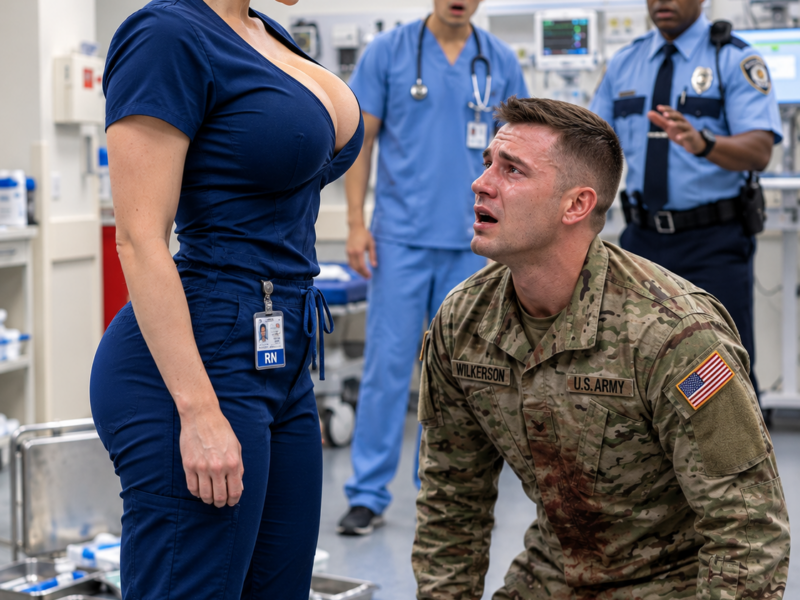
“I watched two men in unmarked military uniforms enter the emergency room, and when one reached beneath his jacket
The older veteran held the photograph tightly between his remaining fingers.
“Before you let them take you, there’s something you need to know about the man who signed Raven Echo’s final orders.”
I stared at the picture.
It showed six soldiers standing beside a military helicopter.
They were younger, thinner, and covered in dust.
I recognized three immediately.
One was Mason.
Another was Daniel Cross, our communications specialist, who had died during the extraction.
The third was me.
I looked barely twenty years old, with my hair tucked beneath a helmet and a smile I hadn’t seen in a long time.
But the man standing in the middle was the one who made my stomach tighten.
Colonel Richard Voss.
He had been our commanding officer.
He was also the man who had personally told us that our mission had been classified beyond the reach of ordinary military review.
“Where did you get this?” I asked.
The veteran looked toward the two men in uniform.
“From someone who died trying to make sure it survived.”
The taller man stepped forward.
“Sir, put the photograph down.”
The veteran didn’t move.
“Funny. Twenty years ago, another man wearing your kind of uniform told me the same thing.”
The second man finally removed his hand from beneath his jacket.
He held a folded document.
“Ma’am, we’re here under federal authority. Sergeant Hale is being transferred for security reasons. You’re coming with us for questioning.”
I glanced at Mason.
He was pale, sweating, and struggling to remain conscious.
His blood pressure was dropping.
“He’s not going anywhere until his doctors clear him.”
The taller man frowned.
“You don’t understand the situation.”
“I understand that he’s bleeding internally.”
The attending physician stepped between us.
“She’s right. This patient is not stable enough for transport.”
The man looked at him with open irritation.
“Doctor, this is a national security matter.”
The physician didn’t back down.
“This is a hospital. And right now, he’s my patient.”
For the first time that night, I felt grateful for someone else’s stubbornness.
The older veteran placed the photograph on a nearby counter.
“My name is Frank Mercer,” he said. “I served with the Army for thirty-two years. I was attached to the operation that was supposed to extract Raven Echo.”
I stared at him.
“You were the extraction coordinator?”
He nodded.
“I was supposed to bring six people home.”
His voice weakened.
“I brought nobody home.”
Mason turned his head.
“Wait. You were the voice on the radio?”
Frank looked at him.
“Yes, Sergeant.”
Mason’s eyes filled with confusion.
“I heard you say the landing zone was compromised.”
“It was.”
“You told us the helicopter couldn’t come back.”
Frank closed his eyes.
“I did.”
Mason looked away.
For twenty years, he had carried the memory of that moment.
So had I.
But the photograph suggested there was more to it.
I pointed toward the two men.
“Who sent you?”
The taller one answered without hesitation.
“Colonel Voss.”
The name seemed to drain the remaining warmth from the room.
Frank slowly shook his head.
“Then he’s still cleaning up.”
The second man looked at him sharply.
“That’s enough.”
“No,” Frank replied. “It isn’t.”
He turned toward me.
“Hannah, I need you to listen carefully. Raven Echo wasn’t erased because the operation failed.”
I waited.
“It was erased because your team found something you weren’t supposed to find.”
For a moment, the sounds of the emergency department seemed to fade.
I remembered the desert.
The burning buildings.
The dust that had covered everything.
And the radio message that had changed the course of our lives.
Twenty years earlier, I had been a combat medic attached to a small special operations team.
We had been sent into a remote compound to recover a captured intelligence officer.
The briefing described a simple extraction.
Enter quietly.
Locate the prisoner.
Recover the files.
Leave before sunrise.
But when we reached the compound, we discovered something different.
The intelligence officer wasn’t being held there.
He was dead.
And the files weren’t ordinary intelligence reports.
They contained records of weapons shipments being redirected through unofficial military channels.
Some shipments had disappeared.
Others had ended up in the hands of people who were supposed to be our enemies.
Our team photographed the documents and copied everything we could.
Then Daniel Cross discovered a second folder.
It contained names.
Military officers.
Private contractors.
Government officials.
And at the top of several pages was the signature of Colonel Richard Voss.
We didn’t have time to understand what we had found.
The compound came under attack.
Our radio communications failed.
And when we finally reached the extraction point, our helicopter never arrived.
I remembered Mason shouting into the radio.
I remembered Daniel trying to repair the communications equipment.
I remembered blood soaking through my uniform as I dragged an injured teammate behind a concrete wall.
And I remembered Frank’s voice.
“Raven Echo, extraction is denied. Repeat, extraction is denied.”
After that, everything became a blur.
The last thing I remembered clearly was a helicopter disappearing into the darkness.
I had believed it carried the wounded soldiers who had managed to reach the second landing zone.
I had also believed I was being left behind.
Frank’s voice brought me back to the hospital.
“Three days after the mission, I was told your unit had been killed in action.”
“All of us?” I asked.
He nodded.
“Every name. Every record. Every photograph.”
Mason shifted on the bed.
“That’s impossible. I survived.”
“Your survival was never supposed to become public knowledge,” Frank said.
Mason stared at him.
“Who made that decision?”
Frank looked at the two men.
“Voss.”
The taller man took another step.
“You’re making serious accusations.”
Frank laughed bitterly.
“I’ve had twenty years to make them.”
Then he reached into the inside pocket of his old jacket.
He pulled out a small plastic envelope.
Inside was a memory card.
“I kept this because I couldn’t live with what happened.”
I stared at it.
“What is it?”
“An audio recording from the night of the extraction.”
My mouth went dry.
“Why didn’t you release it?”
Frank looked at the floor.
“Because the recording didn’t just implicate Voss.”
He paused.
“It implicated me, too.”
The silence that followed was heavier than anything I had heard that night.
Mason slowly lifted his head.
“Play it.”
The taller man immediately stepped forward.
“That evidence is classified.”
Frank turned toward him.
“Then you should have protected the people who collected it.”
The attending physician glanced at the security officer near the door.
“Can we get hospital administration and law enforcement down here?”
The officer nodded and reached for his radio.
The two men exchanged a look.
It was brief.
But I saw it.
The second man moved toward the counter.
I stepped between him and the memory card.
“Don’t.”
He stopped.
“You’re making a mistake.”
I looked directly into his eyes.
“No. I made one twenty years ago when I believed the people giving the orders had earned my trust.”
For several seconds, nobody spoke.
Then the attending physician returned with two hospital security officers.
He positioned himself beside Mason’s bed.
“Nobody is removing this patient without proper authorization.”
The taller man reluctantly stepped back.
Frank looked at me.
“There’s something else.”
He took a slow breath.
“Your team didn’t all die.”
I felt my fingers tighten around the edge of the counter.
“What are you saying?”
“One person survived the original extraction.”
Mason tried to sit up.
“Who?”
Frank looked at him.
“Daniel.”
The name hit me harder than I expected.
Daniel Cross.
Our communications specialist.
The youngest member of the team.
He used to hum old country songs while repairing equipment, even when gunfire was close enough to shake the walls.
I had seen him fall.
I had watched him stop moving.
I had held his wrist and felt no pulse.
I had spent years remembering that moment.
“That’s not possible,” I whispered.
Frank nodded.
“I know what you saw. But he wasn’t dead.”
Mason’s face had gone completely still.
“Where is he?”
Frank looked down at the memory card.
“That’s what this recording explains.”
The taller man suddenly reached for his phone.
Before he could make a call, the hospital security officer stepped forward.
“Sir, put the phone away.”
The man glared at him.
“You have no idea who you’re interfering with.”
The officer didn’t move.
“Then you can explain it to the police.”
For the first time, the two men looked uncertain.
A few minutes later, the attending physician returned to Mason’s bedside.
“We’re taking him for imaging. He needs surgery.”
I nodded.
“His blood pressure?”
“Improving, but not enough for us to wait.”
I turned toward Frank.
“Keep that card safe.”
He placed it inside his jacket.
“I’ve kept it safe for twenty years.”
Then he looked at me with tired eyes.
“I won’t fail you again.”
Mason reached for my wrist.
His grip was weak, but his eyes were clear.
“Hannah, don’t disappear this time.”
I looked at him.
“I won’t.”
The medical team wheeled him away.
The two men remained under the watch of hospital security.
And Frank and I were left standing beside the counter, staring at the photograph of six soldiers who were never supposed to exist.
For the first time in twenty years, I wanted to know the whole story.
Not the version in the official report.
Not the version I had told myself to survive.
The truth.
The next morning, I sat in a small conference room at the hospital.
I hadn’t slept.
My uniform had been replaced, but I could still smell Mason’s blood on my hands whenever I closed my eyes.
Frank sat across from me.
Between us lay the memory card and the photograph.
The hospital had contacted federal authorities.
An investigator named Special Agent Laura Bennett arrived shortly after eight.
She was in her forties, wore a dark blue suit, and carried a notebook with a worn leather cover.
She listened without interrupting as Frank explained the operation.
When he finished, she examined the photograph.
Then she looked at me.
“Miss Reed, do you understand what you’re telling me?”
“Yes.”
“You’re claiming a military operation was deliberately abandoned, its survivors declared dead, and evidence connected to an illegal weapons network was concealed.”
“I’m telling you what happened to my team.”
She nodded slowly.
“Those are serious claims. I need evidence.”
Frank pushed the memory card across the table.
“Then listen.”
The recording was old.
There was static, wind, and the distant sound of gunfire.
At first, all I could hear were clipped radio transmissions.
Then Mason’s younger voice came through.
“Raven Echo to command. We have the files. Requesting immediate extraction.”
A second voice answered.
“Stand by.”
Then another transmission.
“Command, this is Cross. We have additional names. Repeat, we have evidence of internal involvement.”
There was a long pause.
Then a voice I recognized immediately.
Colonel Voss.
“All units, abandon the recovery. No extraction will be authorized.”
Mason’s voice grew louder.
“Sir, we have wounded personnel.”
“Mission parameters have changed.”
“Sir, we need medical evacuation.”
“That’s an order, Sergeant.”
Then Daniel’s voice.
“Colonel, if we don’t get out of here, the files disappear with us.”
Voss answered coldly.
“Then perhaps they should.”
A burst of static followed.
Then Frank’s voice.
“Raven Echo, I have a secondary landing zone. Can you reach the eastern ridge?”
Mason replied.
“We can try.”
Frank’s next words were barely audible.
“Listen carefully. The helicopter is not coming for you.”
The recording ended.
Nobody moved.
I stared at the device.
“Why did you tell us that?”
Frank’s face crumpled.
“Because I was ordered to.”
Agent Bennett leaned forward.
“Who gave you the order?”
Frank looked directly at her.
“Colonel Voss.”
“Did you know the team would be declared dead?”
“Not then.”
He swallowed.
“But I knew I was leaving people behind.”
I looked at him.
“Why didn’t you come back?”
His eyes filled.
“Because when I returned to headquarters, Voss told me that if I spoke about the operation, the surviving soldiers would be hunted.”
He paused.
“He showed me photographs of their families.”
I looked away.
My mother had been alive then.
She had called every military office she could find after being told I was missing.
I remembered the letters.
The unanswered calls.
The folded flag that arrived months later.
“Did he threaten our families?”
Frank nodded.
“He told me he could make their lives disappear as easily as he had made your unit disappear.”
Agent Bennett wrote something in her notebook.
Then she asked a question that changed the direction of the entire investigation.
“Mr. Mercer, do you know where Daniel Cross is now?”
Frank hesitated.
“I received one letter from him eleven years ago.”
“Where?”
“Virginia.”
“Do you still have it?”
Frank nodded.
“I’ve carried it ever since.”
He reached into his jacket and removed a folded envelope.
The paper had yellowed along the edges.
Agent Bennett opened it carefully.
Inside was a handwritten note.
There were only three sentences.
Frank,
If anyone ever asks about Raven Echo, tell them I kept the original files.
Tell Hannah she was right about the radio.
And tell Mason I didn’t leave him.
Daniel.
I read the note twice.
Then a third time.
I looked up.
“What did he mean about the radio?”
Frank didn’t answer.
He stared at the final sentence.
Mason had always believed the helicopter had left without him.
But Daniel had written that he hadn’t abandoned him.
There was something we still didn’t understand.
Agent Bennett looked at the envelope.
“Do you have a return address?”
Frank nodded.
“An old post office box in Virginia.”
She photographed the letter.
Then she closed her notebook.
“I’ll see what I can find.”
Before leaving, she turned toward me.
“Miss Reed, I need you to understand something. If these claims are true, this investigation could take months. There may be people who will try to discredit you.”
I thought about the two men who had entered the emergency room.
I thought about the patients who depended on me.
Then I looked at the photograph.
“I spent twenty years being afraid of what would happen if I spoke.”
I met her eyes.
“I’m not doing that anymore.”
Mason survived surgery.
The surgeons repaired the damage to his shoulder and removed the bullets from his left side.
He spent three days in intensive care.
On the fourth morning, I walked into his room with a cup of coffee and found him sitting upright.
He looked exhausted.
But he was awake.
“You’re still here,” he said.
I placed the coffee on the table.
“I work nights. Remember?”
He managed a small smile.
Then his expression became serious.
“Did Frank tell you about Daniel?”
I nodded.
“Yes.”
Mason looked through the window.
“I thought I watched him die.”
“I know.”
“I heard him stop breathing.”
He rubbed his face.
“Sometimes I still hear that night.”
I pulled a chair closer.
“Trauma doesn’t always leave us with memories in the right order.”
He looked at me.
“Do you think he’s alive?”
“I don’t know.”
Mason stared at the blanket.
“I need him to be.”
I understood.
Not because I knew what had happened to Daniel.
Because I knew what it meant to carry a death that might not have been real.
We sat quietly for a while.
Then Mason asked the question I had been avoiding.
“Why did you leave?”
I looked down at my hands.
There were no gloves now.
No blood.
Just the small scar across my right thumb from a kitchen knife accident years earlier.
“I didn’t exactly choose to leave.”
He waited.
“After the mission, I was found by a local medical team. I had a fractured rib, a damaged shoulder, and an infection that nearly killed me.”
Mason listened without interrupting.
“When I woke up in a military hospital, I was told the others had died. I asked for the official report. They refused.”
I swallowed.
“Then Voss came to see me.”
Mason’s expression tightened.
“What did he say?”
“He told me the operation had failed because our team had disobeyed orders. He said the evidence was compromised, and if I spoke publicly, I could face charges.”
“That’s not all, is it?”
I shook my head.
“He showed me photographs of my mother leaving her house.”
Mason went still.
“He said she would be questioned. He said her medical benefits could be reviewed. He never directly threatened her, but he made sure I understood.”
Mason stared at the wall.
“So you disappeared.”
“I was discharged. I changed my address. I moved away from the military community and started again.”
“Why nursing?”
I smiled faintly.
“Because I knew what it felt like to need someone to stay when everyone else was shouting.”
For a moment, neither of us spoke.
Then Mason reached toward the coffee.
“Well, you’re still terrible at making it.”
I laughed.
It was the first real laugh I had heard from myself in years.
Two days later, Agent Bennett called.
She had located Daniel Cross.
He was living in a small town in Virginia.
He had changed his name legally and worked as an independent communications technician.
He had also been receiving anonymous threats for years.
Agent Bennett arranged a secure meeting.
Mason was still recovering, so he couldn’t travel.
Frank and I went with the investigators.
The drive took almost six hours.
I spent most of it watching the landscape pass through the window.
Every mile brought back something I had tried to forget.
When we arrived, Daniel was waiting outside a modest brick house.
He was thinner than I remembered.
His hair had gone gray at the temples.
But the moment he saw me, he smiled.
“Hannah Reed.”
My throat tightened.
“Daniel.”
He looked past me.
“Where’s Mason?”
“Recovering.”
Daniel lowered his eyes.
“Good.”
For several seconds, none of us moved.
Then he stepped forward and hugged me.
He was warm.
Solid.
Alive.
I held on longer than I intended.
When we finally separated, he looked at Frank.
“You’re late, Mercer.”
Frank shook his head.
“I know.”
Daniel’s expression softened.
“Come inside.”
His house smelled of coffee and old books.
There were boxes stacked along one wall.
A computer sat on a small desk.
Daniel led us into the living room.
“I’ve been waiting a long time for this conversation.”
I looked at him.
“Why didn’t you contact us?”
He took a breath.
“Because I thought you were all dead.”
I frowned.
“What?”
Daniel nodded.
“After the ambush, I was hit by shrapnel. I lost consciousness. When I woke up, I was in a field hospital. A local medic had found me.”
He rubbed his left forearm.
“I had a broken arm and a head injury. They told me the other survivors had been evacuated through a separate route.”
I stared at him.
“Who told you?”
“A military liaison. I never saw his face clearly.”
Frank leaned forward.
“Voss?”
Daniel nodded.
“He told me Mason had died. He told me you had died. He said the rest of the team was gone.”
I sat down slowly.
“We were told the same thing about you.”
Daniel looked at the floor.
“That’s how he kept us apart.”
The room became quiet.
Daniel walked to his desk and opened a locked drawer.
He removed a small external drive.
“This is why he wanted us separated.”
He connected it to his computer.
A folder appeared on the screen.
Inside were scanned documents, photographs, shipment records, and audio files.
I recognized the original documents from the compound.
But there was something else.
A spreadsheet listing the dates and destinations of weapons shipments.
Several entries were marked with initials.
R.V.
Daniel pointed to them.
“Richard Voss.”
Agent Bennett leaned closer.
“Are these authentic?”
“I kept copies from the original files. I also recovered financial records from the contractor that handled the shipments.”
He opened another document.
“This company received payments from accounts connected to senior officers. The money was moved through shell companies.”
Frank studied the screen.
“How much?”
Daniel gave a tired smile.
“Enough to buy silence.”
I looked at the dates.
Some shipments had taken place months before our mission.
Others continued for years afterward.
Then I noticed something.
One entry was dated three weeks after Raven Echo.
The destination was a private storage facility in Virginia.
“Why is this one highlighted?” I asked.
Daniel looked at me.
“Because that shipment contained the original mission archive.”
My stomach tightened.
“You mean the files we found?”
He nodded.
“They were never destroyed. They were moved.”
Agent Bennett leaned forward.
“Do you know where?”
Daniel opened another file.
A scanned inventory sheet appeared.
At the bottom was a handwritten authorization.
Colonel Richard Voss.
Below it was another signature.
Frank Mercer.
Everyone turned toward the veteran.
Frank stared at the screen.
His face had gone pale.
“I didn’t sign that.”
Daniel enlarged the image.
The signature looked convincing.
But Frank shook his head.
“I never authorized the transfer.”
Agent Bennett photographed the document.
“Someone forged your name.”
Frank sat back.
For the first time since I had met him, he looked genuinely frightened.
Daniel closed the file.
“There’s more.”
He opened a recording.
A man’s voice filled the room.
It was Voss.
Older, but unmistakable.
“Move the archive before the inquiry begins. The team is already contained. Nobody will believe a dead unit.”
Then another voice answered.
“What about the medic?”
Voss replied.
“She’ll stay quiet. She has a family.”
The recording ended.
I felt sick.
Not because I was surprised.
Because I recognized the fear in my younger self.
For twenty years, I had wondered whether leaving had been cowardice.
Now I understood that someone had deliberately made survival feel like betrayal.
Agent Bennett copied the files.
“This is enough to open a formal investigation. But we still need to locate the original archive.”
Daniel pointed to the inventory sheet.
“The storage facility is still operating.”
“Who owns it?”
Daniel zoomed in.
A private defense contractor.
One that had recently received several government contracts.
Agent Bennett closed her notebook.
“Then we have somewhere to start.”
The following weeks were difficult.
Mason returned to Atlanta and began physical therapy.
He hated being told to rest.
He hated needing help with ordinary tasks.
And he hated that the shoulder injury would keep him away from active duty for months.
I visited him whenever my schedule allowed.
Sometimes we talked about Raven Echo.
Sometimes we discussed nothing important.
One afternoon, I found him struggling to button his shirt with his injured arm.
“Let me help.”
“I can do it.”
“I know.”
He tried again.
The button slipped from his fingers.
He stared at it.
Then he pushed the shirt away.
“I’m supposed to be able to do this.”
I sat beside him.
“You’re recovering from surgery.”
“I’ve spent my whole adult life being the person who doesn’t need help.”
I picked up the shirt.
“Then maybe it’s time you learned how to receive it.”
He looked at me for a long moment.
Finally, he let me help.
It was a small moment.
But it meant more than either of us said.
Meanwhile, Agent Bennett’s investigation uncovered a network of forged records and unauthorized shipments.
The original archive was still in the Virginia storage facility.
A federal judge approved a search warrant.
The operation took place early on a Tuesday morning.
Voss was not present.
But his name appeared on several documents.
Investigators found boxes of financial records, classified correspondence, and original files from Raven Echo.
They also found a sealed envelope with my name on it.
I was in the hospital break room when Agent Bennett called.
“Miss Reed, we found something you should see.”
I met her that afternoon.
She placed the envelope on a table.
The paper was old.
My name was written across the front in handwriting I recognized immediately.
Daniel’s.
I looked at Agent Bennett.
“Did he know about this?”
“Apparently not. It was stored with the original archive.”
I opened it carefully.
Inside was a short letter.
Hannah,
If you’re reading this, it means someone finally found the files.
I need you to know that I never believed you abandoned us.
I heard your voice over the radio after the extraction was denied.
You were telling Mason to keep pressure on the wound.
You were telling me to stay awake.
I heard everything.
I also heard Voss order the communications channel closed.
You didn’t leave us.
They made sure you believed you had.
I’m sorry I couldn’t find you.
Daniel.
I read the letter twice.
Then I placed it on the table.
For twenty years, I had carried the belief that I had failed to save my team.
Daniel had been carrying the knowledge that I had never abandoned them.
Neither of us had known the other was alive.
Agent Bennett waited quietly.
Finally, I wiped my eyes.
“Thank you.”
She nodded.
“There was one more thing in the envelope.”
She handed me a smaller photograph.
It showed the six of us at the compound.
On the back was a handwritten sentence.
“Six went in. Six deserved to come home.”
I held it against my chest.
The investigation eventually reached Colonel Voss.
He was arrested several weeks later on charges connected to fraud, conspiracy, obstruction, and the illegal diversion of military equipment.
His lawyers denied everything.
His former colleagues claimed he had been acting under complicated operational orders.
But the documents told a different story.
So did the recordings.
And so did the people he had spent twenty years trying to silence.
Frank testified.
Daniel testified.
Mason gave a recorded statement once his doctors cleared him.
I testified last.
The courtroom was smaller than I expected.
Voss sat at the defense table wearing a dark suit.
His hair had turned completely white.
He looked older, but his eyes were the same.
For a moment, I was twenty years old again.
Standing in a dusty compound.
Waiting for a helicopter that never came.
Then the attorney asked me to describe what happened after the extraction was denied.
I looked toward Voss.
“I was told my team had died.”
I paused.
“Then I was told to forget them.”
The attorney asked whether I had believed the official report.
“At first, yes.”
“Why?”
“Because I trusted the people who gave it to me.”
“Did you later discover that the report was false?”
“Yes.”
“What did that discovery mean to you?”
I looked at Mason, who was sitting in the gallery.
Then I looked at Frank and Daniel.
“It meant I had spent twenty years grieving people who were still alive. It meant I had blamed myself for something someone else had deliberately done.”
My voice trembled.
“But mostly, it meant that the people we were supposed to trust had treated our lives like paperwork they could erase.”
The courtroom was silent.
Voss looked down.
For the first time, I didn’t feel afraid of him.
I felt sorry for the person I had been when I believed his lies.
The legal process took months.
Some charges were eventually proven.
Others remained under separate investigation.
Voss was convicted on multiple federal counts and sentenced to prison.
The weapons network was dismantled.
Several officials lost their positions.
The government formally corrected the records of Raven Echo.
But no court ruling could give us back the twenty years we had lost.
No official apology could return the birthdays, funerals, friendships, and ordinary days we had missed.
Still, the truth was finally written somewhere people could read it.
Raven Echo had existed.
Its members had served.
And they had not abandoned one another.
Six months after Mason arrived at St. Mary’s, the hospital held a small ceremony in its courtyard.
It wasn’t a military event.
There were no marching bands or speeches about glory.
Just a few folding chairs, a table with photographs, and a handful of people who had spent too long believing they were alone.
Mason arrived wearing a clean shirt with his injured shoulder still stiff.
Daniel stood beside him.
Frank sat in the front row.
I almost didn’t attend.
I had spent so many years avoiding attention that the idea of standing in front of a crowd made my palms sweat.
But Mason had called me the night before.
“You don’t have to say anything,” he told me.
“Then why do you want me there?”
“Because you were part of the team.”
I had no answer.
So I went.
The ceremony began with the reading of the corrected military record.
One by one, the names were spoken.
Daniel Cross.
Mason Hale.
Hannah Reed.
And the others who had died that night.
When my name was called, I stood.
For years, I had imagined what it would feel like to hear my name connected to Raven Echo again.
I thought I might cry.
Instead, I felt something settle inside me.
Not happiness.
Not exactly.
Something closer to being allowed to breathe.
After the ceremony, Frank approached me.
He was holding the old photograph.
“I owe you an apology,” he said.
I looked at him.
“You’ve already apologized.”
“Not properly.”
He took a breath.
“I was afraid. I told myself that staying quiet would keep the survivors safe. I thought I was protecting you.”
I nodded.
“I know.”
“But I should have fought harder.”
I looked at his remaining hand.
It was trembling slightly.
“You were human, Frank. You made a decision you have to live with. So do I.”
He lowered his eyes.
“Can you forgive me?”
I thought about it.
Forgiveness had always sounded like something people demanded from the injured because they wanted the discomfort to end.
But Frank wasn’t demanding anything.
He was simply asking.
“I can forgive you for being afraid,” I said. “I can’t pretend that what happened didn’t hurt.”
He nodded.
“That’s fair.”
We stood together for a moment.
Then he handed me the photograph.
“You should keep this.”
I looked at the six young faces.
The person I had been seemed both familiar and impossibly distant.
I carefully placed the photograph in my bag.
Across the courtyard, Mason was talking to Daniel.
He caught my eye and raised his coffee cup.
I smiled.
A week later, I returned to work.
The emergency department was just as loud as before.
Phones rang.
Monitors beeped.
Patients complained about waiting.
Doctors hurried between rooms.
Nobody treated me differently.
And I was grateful for that.
One night, a young soldier arrived with a broken wrist and a panic attack.
He kept insisting he didn’t want anyone near him.
The resident looked toward me.
“Can you talk to him?”
I approached the bed.
I didn’t use a code.
I didn’t tell him I understood everything.
I simply sat where he could see me.
“My name is Hannah,” I said. “I’m going to stay right here. You don’t have to tell me anything you’re not ready to tell me.”
He looked at me suspiciously.
“Are you going to call security?”
“Not unless someone is in immediate danger.”
He studied my face.
Then his shoulders dropped slightly.
“Okay.”
I stayed.
That was enough for the moment.
Later, after my shift ended, I walked outside into the cool Atlanta night.
My phone buzzed.
It was a message from Mason.
Physical therapy was brutal today. The therapist says I’m making progress. I told her I already knew that.
I smiled and typed back.
Try listening to the people helping you for once.
His reply came almost immediately.
I learned that lesson from the best.
I stood beneath the hospital lights and looked at the photograph in my bag.
For twenty years, I had believed my past was something I needed to bury.
I thought the only way to survive was to become someone nobody could connect to the girl who had worn that uniform.
But I had been wrong about one thing.
I didn’t need to become that young medic again.
I didn’t need to return to the desert or prove that I had been brave.
I only needed to stop being ashamed of the fact that I had survived.
The next morning, I placed the photograph in a simple frame on my apartment bookshelf.
Six soldiers.
One team.
A mission that had nearly erased us.
And a truth that had finally brought us back together.
I no longer left the room when helicopters appeared on television.
Sometimes I still felt my chest tighten.
Sometimes the old memories returned without warning.
But now, when they did, I allowed myself to remember more than the fear.
I remembered Daniel humming while repairing the radio.
I remembered Mason sharing his last bottle of water.
I remembered Frank’s voice calling us by our unit name.
And I remembered that even after everything, we had found our way back to one another.
I had spent twenty years thinking Raven Echo was the worst thing that had ever happened to me.
It took twenty years to understand that it was also the reason I knew exactly what to do when a frightened soldier looked at me and begged everyone to stay away.
I couldn’t save the past.
But I could make sure someone else didn’t have to face their darkest moment alone.
THe End.









