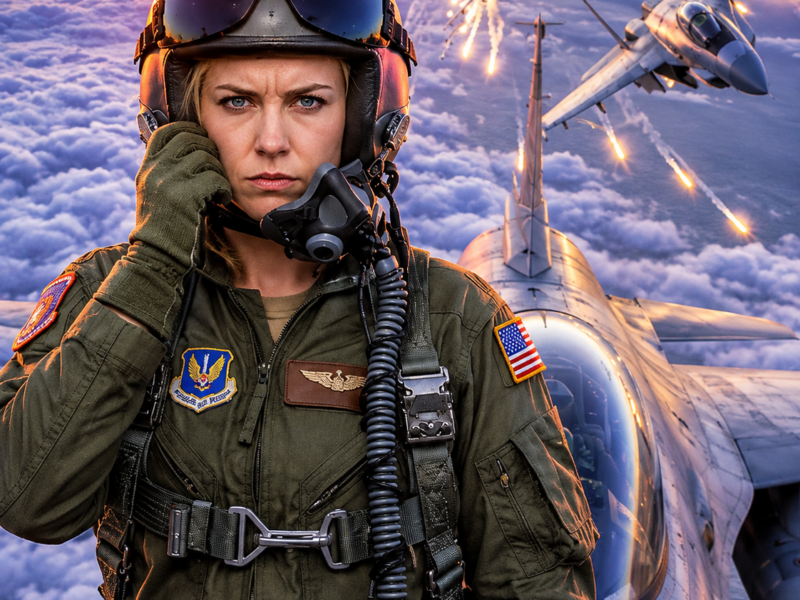
“I watched three Russian Su-35 fighters lock their missiles onto my F-16 over the Bering Sea while their commander calmly ordered me to surrender
The first Russian fighter rolled sharply to the left.
The second dropped toward the ocean.
The third, the one flying closest to my tail, pulled up so violently that I watched its nose disappear above my canopy.
For a few seconds, I couldn’t understand what I was seeing.
They had been seconds away from killing me.
Now they were running.
“Watchtower, Ren Two, do you copy?”
Static answered.
I tried again.
“Watchtower, this is Valkyrie Actual. Do you copy?”
A long pause followed.
Then Master Sergeant Curtis Mahone spoke.
“Say again your call sign.”
I could hear people talking in the background.
Someone was shouting.
Another voice asked for confirmation of my transponder signal.
“Watchtower, I said Valkyrie Actual. I have three hostile aircraft breaking contact. One confirmed destroyed. Request immediate tanker support.”
Mahone exhaled.
“Copy, Valkyrie. Stand by.”
I glanced at my fuel gauge.
The red warning light was no longer blinking.
It was simply on.
“Watchtower, I need that tanker now.”
“We’re working it, Major.”
His voice had changed.
I had spent months listening to Mahone treat every patrol like a routine delivery of paperwork.
Now he sounded as though he were speaking to someone who had returned from the dead.
I didn’t have time to explain.
My engine gave a small shudder.
The fuel flow indicator dropped.
I was still alive, but the aircraft was running out of time.
“Watchtower, my fuel is critical.”
“Understood. Tanker is inbound. Five minutes.”
“Five minutes?”
“That’s the best we’ve got.”
I looked at the black water beneath me.
Five minutes was a lifetime.
It was also probably more time than I had.
I eased the throttle back and began climbing.
Every thousand feet of altitude might give me another mile of gliding distance if the engine failed.
My hands were beginning to shake.
I told myself it was the cold.
It wasn’t.
Three years of silence had just ended in less than ten seconds.
And somewhere across the Bering Sea, people who had spent years believing I was dead now knew exactly where to find me.
“Valkyrie,” Mahone said.
“Go ahead.”
“That was really you?”
I looked at the laminated card lying beside my knee.
“Apparently.”
He didn’t laugh.
“Welcome back, ma’am.”
At 29,000 feet, the engine quit.
There was no dramatic explosion.
Just one heavy shudder through the airframe, followed by a terrible winding-down sound.
The familiar roar disappeared.
My cockpit became strangely quiet.
The warning panel illuminated.
My main displays flickered and went dark.
The emergency power unit activated with a sharp mechanical hiss.
I was flying a thirty-thousand-pound glider over the coldest water I had ever seen.
“Watchtower, Valkyrie. Flameout. I have lost the engine.”
Mahone responded immediately.
“Copy. Tanker is five miles ahead, Angels 20. Can you see him?”
I looked through the canopy.
At first, I saw nothing.
Then a cluster of lights appeared against the darkness.
A KC-135 tanker was banking toward me.
“Tally, tanker.”
“Good. That’s Pit Stop Eleven. Captain Wade Kimbro is flying. Boom operator is standing by.”
A new voice came over the radio.
“Valkyrie, this is Pit Stop Eleven. We have you on visual. Bring her in, Major.”
Captain Kimbro sounded remarkably calm.
I appreciated that.
“Pit Stop, I’m dead stick. Zero thrust. I get one attempt at this.”
“Understood.”
“If we miss, I’m going swimming.”
“Then let’s not miss.”
I almost smiled.
The tanker adjusted its position.
I followed, fighting the heavy controls as the F-16 began losing altitude.
Without engine power, even small corrections became difficult.
The tanker was moving through turbulent air.
I needed to match its speed, position, and altitude while keeping enough airspeed to prevent a stall.
“Valkyrie, this is Fitch,” the boom operator said.
His voice sounded young.
“Staff Sergeant Lonnie Fitch. I’ve got eyes on you.”
“Good to meet you, Fitch.”
“Same here. Just keep her steady. I’ll bring the boom to you.”
The tanker grew larger in my canopy.
“Twenty feet,” Fitch called.
“Ten.”
I made a small correction.
The nose drifted.
“Forward and up, Major.”
My arms burned.
“Five feet.”
The boom hovered above my aircraft.
For one awful second, it seemed to slide past.
Then came a metallic clang.
“Contact!”
Fitch shouted.
“Contact! We have contact!”
A green light appeared on my instrument panel.
Fuel was flowing.
But I wasn’t safe yet.
The dead F-16 was hanging behind the tanker, and the drag was putting enormous strain on the refueling boom.
“Pit Stop, push over slightly,” I said. “I need airflow for a restart.”
“Copy. Taking her down.”
The tanker began a shallow descent.
My airspeed increased.
I pressed the starter switch.
Nothing.
I tried again.
The turbine began turning.
Then stopped.
“Come on,” I whispered.
I could hear Fitch breathing over the radio.
“Major?”
“Give me a second.”
I pressed the starter again.
A low rumble came through the floor.
The engine gauge moved.
Then the turbine caught.
Fresh fuel ignited.
The engine roared back to life.
I had never heard a more beautiful sound.
“Engine online!”
I laughed once, more from disbelief than happiness.
“Hydraulics are coming back.”
“That’s what we like to hear,” Fitch said.
The boom disconnected.
I eased away from the tanker and watched my displays slowly reboot.
For the first time that afternoon, I allowed myself to breathe.
“Pit Stop Eleven, Valkyrie. I owe you both a very expensive bottle of Scotch.”
Captain Kimbro chuckled.
“We’re bourbon people, Major.”
I looked at the fuel gauge.
“Then I’ll owe you bourbon.”
“Welcome back to the living.”
The flight home was almost silent.
I didn’t speak unless I needed to.
My mind kept returning to one question.
Who had known my aircraft’s fuel state?
Who had told Berkut my rank?
And why had the Russians been so certain that I would be flying that particular patrol?
When the lights of Joint Base Elmendorf-Richardson appeared beneath me, I felt something I hadn’t expected.
I didn’t feel victorious.
I felt exposed.
The runway crew had already been alerted.
Fire trucks followed my aircraft as I taxied toward the hardened shelter.
My F-16 was damaged, its warning panel still flashing, but it was intact.
I shut down the engine.
The silence returned.
When I climbed out, the Alaskan wind struck my face.
Colonel Glenn Barstow stood beside the ladder.
He wasn’t smiling.
He didn’t congratulate me.
He simply looked up.
“My office, Major. Now.”
I climbed down.
Danny Pruitt was standing near the hangar entrance, wrapped in a flight jacket.
His aircraft had made it home.
His face was pale.
The moment he saw me, he walked forward.
“Ma’am.”
I stopped.
“Your aircraft?”
“Grounded. They’re checking the engine and hydraulics.”
“Good.”
He glanced at the F-16 behind me.
Then he looked back at my face.
“I heard the radio.”
I didn’t answer.
“Valkyrie?”
I lowered my eyes.
“Not here, Juice.”
He nodded slowly.
For once, he didn’t have a joke.
“I thought you were just some desk officer who got stuck flying with me.”
“I know.”
“Guess I was wrong.”
I placed a hand on his shoulder.
“You got your aircraft home. That’s what matters.”
He looked as though he wanted to ask another question.
Before he could, Barstow called my name.
I followed him inside.
The debriefing room was buried beneath the headquarters building.
Its steel door closed with a heavy click.
A long metal table occupied the center.
Across from me sat Colonel Barstow and a civilian in an expensive charcoal suit.
The man’s identification badge read Department of Defense Intelligence Liaison.
His name was Sutter.
He opened a folder.
“Let’s discuss your actions today, Major Holloway.”
I sat down.
“All right.”
“You were assigned a routine deterrence patrol.”
“Correct.”
“Instead, you destroyed two Russian aircraft, killed their commanding pilot, and transmitted a classified call sign over an international emergency frequency.”
“They fired first.”
Sutter looked at the photographs in front of him.
“That isn’t the point.”
“It is exactly the point.”
Colonel Barstow struck the table with his palm.
“Enough, Erin.”
I looked at him.
He rarely used my first name during official proceedings.
“Do you understand what you’ve done?” he asked.
“I brought my wingman home.”
“You exposed an identity that was supposed to remain buried.”
Sutter leaned forward.
“Do you have any idea what your call sign means to their military?”
“I have a general idea.”
“Then you should understand why this is a diplomatic disaster.”
I looked at the satellite photographs.
One showed the burning wreckage of a Su-35.
Another showed the approximate location of the engagement.
“They launched missiles without warning,” I said. “They attempted to capture an American pilot. What exactly would you have preferred I do?”
“Follow established evasion procedures.”
“With no missiles, no fuel, and three fighters behind me?”
Sutter closed the folder.
“Your previous service record is classified. Your actions today may require a review of that record.”
I stared at him.
“My previous service record was classified because people in this building asked me to keep it classified.”
Barstow looked away.
That was when I noticed something.
Sutter hadn’t asked about Danny.
He hadn’t asked whether I had been injured.
He hadn’t even asked how I had managed to survive after losing my engine.
He was interested in one thing.
The call sign.
“There’s something else,” I said.
Sutter waited.
“Berkut knew my rank.”
Barstow frowned.
“What?”
“He called me Major before I identified myself.”
“Your rank may have been available through intercepted communications,” Sutter said.
“No.”
I leaned forward.
“My aircraft was flying under the call sign Ren Two. My rank wasn’t transmitted. The emergency channel doesn’t display it. And the Russian fighters had no visual identification of me.”
Sutter’s expression barely changed.
I continued.
“He also knew I was nearly out of fuel. He knew I had no missiles. He timed his demand for surrender almost perfectly.”
“That’s what a capable intelligence service does,” Sutter replied.
“Not without information.”
I looked directly at him.
“Somebody knew my mission details.”
The room became quiet.
“Somebody knew I was flying that patrol,” I continued. “Somebody knew my aircraft’s status. And somebody knew exactly who I was.”
Barstow slowly turned toward Sutter.
For the first time, the civilian looked uncomfortable.
He closed his folder.
“Those are serious accusations, Major.”
“So was the ambush.”
A voice came from the far side of the room.
“She’s right.”
I turned.
A man had been standing beside the steel door.
He stepped into the fluorescent light.
Two silver stars shone on his collar.
Major General Raymond Kessler.
I recognized him immediately.
He had commanded the classified aviation unit where I had once served.
He had given me my original call sign.
He had also been the last person to tell me that the world would be safer if I disappeared.
“General.”
“Sit down, Erin.”
He walked to the table and placed a hand on the satellite photograph.
“We’ve suspected a leak in the upper command structure for six months.”
Barstow straightened.
“Six months?”
“Classified deployment schedules have been appearing in foreign intelligence reports. We thought it was limited to logistics and routine operations.”
He looked at me.
“Apparently, it wasn’t.”
I felt a chill move through my shoulders.
“Did they have my file?”
Kessler nodded.
“At least part of it.”
“How much?”
“We don’t know yet.”
I looked at Sutter.
He had gone very still.
Kessler noticed.
“Mr. Sutter, this debriefing is now under Special Operations Command authority. You can leave.”
Sutter gathered his folder.
“General, I strongly recommend that we consider the diplomatic consequences before taking further action.”
Kessler didn’t raise his voice.
“I’ve been considering them for six months.”
Sutter left.
The door locked behind him.
Kessler pulled out a chair.
For several seconds, he simply studied me.
Then he spoke quietly.
“I put you in Alaska to protect you.”
I looked down at my hands.
“That worked wonderfully.”
He almost smiled.
“After the Iron Crown operation, there were people in Washington who wanted you court-martialed.”
I knew.
I had never forgotten the hearings.
Four enemy fighters destroyed.
One American pilot lost.
An operation that had never officially happened.
Some people called my actions heroic.
Others called them reckless.
The politicians had been less interested in either description than in the diplomatic consequences.
“You were becoming a liability,” Kessler said. “So we buried your record, changed your assignment, and gave you a life where nobody would think to look.”
“And now they found me.”
“Yes.”
He reached into his uniform pocket.
A small black patch appeared in his hand.
It had a silver-winged helmet embroidered in the center.
My old squadron insignia.
I hadn’t seen one in three years.
Kessler placed it on the table.
“The people responsible for selling our deployment information are operating through a fortified intelligence site on the Kamchatka Peninsula.”
I studied the patch.
“Who?”
“We’re still identifying the individuals involved.”
“How many?”
“Enough to compromise several operations.”
He slid a photograph across the table.
It showed a concrete facility surrounded by forest, fencing, and radar installations.
“Your old squadron members may be in danger. Their identities have appeared in the same intelligence package.”
I looked at the photograph again.
My former flight leader had been killed over a mountain range three years earlier.
His name was Captain Michael Reeves.
He had been the best pilot I had ever known.
And the last thing he had said to me was, “Don’t let them turn you into somebody you’re not.”
I had spent three years trying to forget that sentence.
“Do they know I’m alive?” I asked.
Kessler nodded.
“After today’s transmission, they almost certainly do.”
I leaned back.
“Then we move them.”
“That’s one option.”
“What’s the other?”
Kessler looked toward Barstow.
Glenn didn’t speak.
The general turned back to me.
“There’s a modified F-35 at Eielson. No tail number, no active transponder, and no official record of its existence.”
I stared at him.
“You’re asking me to fly another classified mission.”
“I’m asking you to help us identify the people who sold our pilots.”
“With what support?”
“Limited support.”
“How limited?”
Kessler didn’t answer immediately.
“Enough to get you in. Not enough to guarantee a way out.”
I looked at the patch.
The old silver helmet seemed almost unfamiliar.
“Why me?”
“Because they know your name. Because you understand their tactics. And because you’ve survived something nobody else in this room has.”
I picked up the patch.
The rough stitching caught against my thumb.
For three years, I had been Erin Holloway.
I had filed paperwork, attended briefings, and listened to young pilots make jokes about my age.
I had convinced myself that the quiet life was enough.
But now somebody had tried to kill Danny.
Somebody had known exactly where to find me.
And somewhere on the other side of the Bering Sea, men were preparing to hunt my former squadron.
I looked at Kessler.
“Valkyrie Actual, sir.”
I stood.
“Standing by.”
He nodded once.
“Then we have work to do.”
The next morning, I entered the hangar at Eielson.
The modified F-35 stood beneath the overhead lights.
Its surface was dark gray, with no identifying markings.
A crew chief was checking the landing gear.
Another was working beneath the open weapons bay.
I approached slowly.
For the first time in three years, I felt the familiar anticipation that came before a mission.
Not excitement.
Not fear.
Something quieter.
A sense that I was finally standing in the right place.
“Major Holloway?”
I turned.
Danny Pruitt stood near the hangar entrance.
His arm was in a sling.
He had driven over despite being ordered to rest.
“What are you doing here, Juice?”
“Checking on my favorite mother.”
I shook my head.
“You’re supposed to be recovering.”
“I am recovering.”
He looked at the aircraft.
“Is that yours?”
“Apparently.”
He walked closer.
“I heard they’re sending you somewhere.”
I didn’t answer.
Danny lowered his voice.
“Are you going to tell me what Valkyrie actually means?”
I looked at the F-35.
“Three years ago, I had a flight leader named Michael Reeves.”
Danny listened.
“He taught me how to fly. Not how to operate an aircraft. How to fly when everything went wrong.”
I paused.
“During our last mission, he was killed. I was left alone. I made decisions that brought me home, but not everyone agreed with them.”
Danny glanced at my face.
“That’s why they buried you?”
“Partly.”
“What about the rest?”
I looked at him.
“The rest is classified.”
He nodded.
Then he reached into his flight jacket and handed me something.
It was a small laminated card.
I recognized it immediately.
My old transponder code.
The one I had torn from my kneeboard.
“You left this in the debriefing room,” he said.
I took it.
“How did you get it?”
“Colonel Barstow’s secretary found it. I figured you might want it back.”
I turned the card over.
On the back, someone had written a short sentence in black ink.
I recognized the handwriting.
Michael Reeves.
My fingers tightened around the plastic.
Danny noticed.
“Something wrong?”
I shook my head.
“Not yet.”
I slipped the card into my pocket.
That afternoon, General Kessler summoned me to a secure briefing room.
Three intelligence officers were waiting.
A large screen displayed the Kamchatka facility.
The first officer introduced himself as Major Thomas Reed.
He explained that the site had been used to collect and analyze American military communications.
The facility had access to classified flight schedules, aircraft readiness reports, and operational identities.
“Someone inside our command structure has been supplying them information,” Reed said.
“Do we have a name?” I asked.
“Not yet.”
He changed the screen.
A list of personnel appeared.
Most were unfamiliar.
Then I saw one name.
Sutter.
I looked at Kessler.
He didn’t react.
“How long has he been under investigation?”
“Three months,” Reed answered.
“Why was he in my debriefing?”
“Because he was assigned to monitor the incident.”
I stared at the screen.
“Convenient.”
Kessler folded his arms.
“We didn’t have enough evidence to remove him.”
“Now?”
“Now we have a reason to watch him closely.”
Reed brought up another image.
It showed a satellite photograph of the Kamchatka facility taken the previous evening.
A small aircraft sat on the northern side of the compound.
“That aircraft arrived twelve hours after your engagement,” he said.
I leaned forward.
“What’s its tail number?”
“It doesn’t have one.”
I studied the photograph.
Something about the aircraft’s shape bothered me.
Then I noticed the wing configuration.
It was an older American design.
My stomach tightened.
“That’s not Russian equipment.”
“No,” Reed said.
“Where did it come from?”
“We’re trying to establish that.”
I looked at Kessler.
“How much of our technology is inside that facility?”
“Enough to make this a national security problem.”
I returned my attention to the screen.
There was a small building beside the runway.
A separate structure with its own security perimeter.
“What’s in there?”
“Communications and interrogation rooms, according to our intelligence.”
I studied the building.
Then I noticed something else.
A vehicle parked outside.
A white utility truck.
On its door was a familiar symbol.
A black circle with a silver line through it.
My old squadron had used that symbol on equipment cases.
I stepped closer to the screen.
“Enlarge that vehicle.”
Reed adjusted the image.
The symbol became clearer.
I felt the air leave my lungs.
It was the insignia of the Iron Crown operation.
The same unit that had disappeared three years earlier.
“Who put that there?” I asked.
Nobody answered.
I looked at Kessler.
“General, you told me our squadron’s identities were compromised.”
“They were.”
“Then why is our insignia sitting outside that building?”
His expression darkened.
“We don’t know.”
I stared at the screen.
The building wasn’t merely collecting information.
It was connected to the operation that had destroyed my old squadron.
And now I understood why the Russian pilots had recognized my call sign so quickly.
They hadn’t simply heard stories about Valkyrie.
They had access to something much more personal.
My hands moved toward the photograph of the vehicle.
“General, I want the full Iron Crown mission file.”
Kessler hesitated.
“That file is restricted.”
“I know.”
“Some of it is still under diplomatic protection.”
I met his eyes.
“Then remove the protection.”
He looked at me for a long moment.
Finally, he nodded to Reed.
“Get her the file.”
Two hours later, I was alone in a secure room with a digital copy of the mission records.
The official version contained the usual gaps.
Redacted names.
Missing communications.
Unexplained time stamps.
But the original flight data had survived in fragments.
I began with the final thirty minutes of the operation.
My flight leader’s aircraft had disappeared from radar at 14:32.
The official report said he had been destroyed by enemy fire.
But the radar data showed something strange.
His aircraft had changed course eleven seconds before the first missile launch.
Eleven seconds.
That was enough time for a warning.
Enough time to avoid the attack.
I checked the communications transcript.
There was a message from Reeves to command.
“Valkyrie, hold position. I have a new heading.”
Then another transmission.
“Valkyrie, do not engage.”
I remembered that moment.
I had been ordered to remain outside the engagement zone.
But I had seen two enemy fighters closing on his position.
I had disobeyed.
I had accelerated toward them.
And then his aircraft disappeared.
I scrolled farther.
A previously redacted message appeared.
It had been sent from a command terminal in the United States.
“Target acquisition confirmed. Package compromised. Proceed with extraction.”
I read it twice.
Target acquisition.
Package compromised.
Those weren’t the words of a normal mission report.
They sounded like someone had deliberately exposed us.
I checked the sender identification.
The name was missing.
But the terminal number was still visible.
I searched the mission database.
The terminal belonged to a command facility at Fort Meade.
And the access credentials had been issued to one civilian intelligence liaison.
Daniel Sutter.
I leaned back.
For several seconds, I couldn’t move.
The man who had sat across from me in the debriefing room wasn’t merely monitoring the incident.
He had been connected to the mission that had killed Michael Reeves.
I called Kessler.
“General, I found something.”
“Go ahead.”
“Sutter’s credentials appear in the Iron Crown mission log.”
Silence.
Then Kessler said, “Are you certain?”
“Yes.”
“Don’t access anything else. I’ll send a team.”
I looked at the screen.
There was another file attached to the message.
A recording.
Its timestamp was two minutes before Reeves disappeared.
I clicked play.
Static filled the speakers.
Then I heard my flight leader’s voice.
“Command, this is Iron Crown One. We’ve been compromised. Repeat, we’ve been compromised.”
A second voice answered.
“Maintain course.”
Reeves sounded angry.
“Negative. We have enemy aircraft approaching from the east. We need immediate extraction.”
The second voice replied.
“Continue mission. Your position is secure.”
I recognized the voice.
Not Sutter.
Someone else.
A military officer.
Then Reeves said something that made my throat tighten.
“That’s impossible. You gave them our coordinates.”
The recording ended.
I sat in the silence.
Michael Reeves had known.
He had known someone had betrayed us.
And he had tried to warn command.
I replayed the last thirty seconds.
Then I heard something I hadn’t noticed the first time.
A faint sound behind Reeves’s voice.
Three short electronic beeps.
I opened the technical metadata.
The recording had been processed through an aircraft communications system.
The beeps were a transponder identification sequence.
I checked the code.
It was the same code on my laminated card.
The code that had caused the Russian fighters to break formation over the Bering Sea.
I stared at the screen.
The code wasn’t just a personal identification signal.
It was a warning.
Michael had used it to identify the presence of a compromised command channel.
The Russian pilots recognized it because they had been given the same warning years earlier.
They knew what it meant.
Someone inside their own command structure had been working with the same people who betrayed us.
I stood and walked toward the door.
Before I could reach it, my phone rang.
Unknown number.
I answered.
A man’s voice spoke quietly.
“Major Holloway.”
I recognized him immediately.
Berkut.
“How did you get this number?”
“Your government is not as secure as you believe.”
I glanced at the room’s security camera.
“What do you want?”
“To tell you something about your commander.”
I tightened my grip on the phone.
“Which commander?”
“Michael Reeves.”
The room seemed to shrink.
“He’s dead.”
“That is what your government told you.”
I didn’t speak.
Berkut continued.
“Three years ago, he was captured after your aircraft escaped. He was not killed in the engagement.”
I closed my eyes.
“You’re lying.”
“I saw the transport.”
“Where is he?”
“Kamchatka.”
I stared at the wall.
“Why tell me?”
“Because the man who sold your squadron also sold mine. My brother was flying the lead aircraft over the Bering Sea today.”
I remembered the burning Su-35.
The first one I had destroyed.
I said nothing.
Berkut’s voice became quieter.
“He was twenty-nine. He believed he was protecting his country. He was given information that told him you were an ordinary American pilot.”
I swallowed.
“Your brother tried to kill my wingman.”
“Yes.”
“And you tried to capture me.”
“Yes.”
For a moment, neither of us spoke.
Then he said, “I do not ask you to forgive me.”
“What do you want?”
“Find the man who sold us both.”
The call ended.
I stood there holding the phone.
Michael Reeves might still be alive.
For three years, I had mourned him.
I had carried the weight of leaving him behind.
And now a Russian commander was telling me that the man I had watched disappear from radar had been taken prisoner.
I called Kessler again.
“General, we have a problem.”
His response came immediately.
“Where are you?”
“In the intelligence room.”
“Stay there. We’re coming.”
I looked back at the screen.
The photograph of the Kamchatka facility remained open.
The white truck stood outside the small building.
For the first time, I understood the real purpose of the operation.
The facility wasn’t simply holding classified documents.
It was holding people.
People who knew the truth.
And one of them might be the man who had taught me how to fly.
The next forty-eight hours were a blur of briefings, intelligence exchanges, and arguments.
Kessler wanted confirmation before authorizing an operation.
I wanted to leave immediately.
“You’re not thinking clearly,” he told me.
“Michael is alive.”
“We have one unverified phone call.”
“Then verify it.”
“We’re trying.”
I leaned across his desk.
“General, you sent me home three years ago believing my flight leader was dead. I accepted that because you told me the evidence was conclusive.”
Kessler looked tired.
“I know.”
“Was it?”
He didn’t answer.
That was enough.
I stepped back.
“How long have you known?”
“Erin…”
“How long?”
He lowered his eyes.
“Six months.”
I felt something break inside me.
“You knew there was a possibility.”
“We had fragments. No confirmed identity. No proof he was alive.”
“And you didn’t tell me?”
“We were trying to protect you.”
I laughed once.
It wasn’t a pleasant sound.
“Everyone keeps saying that.”
Kessler stood.
“I made a decision. I believed it was the right one.”
“You made it for me.”
“Yes.”
I looked at him.
“Then don’t make another one without me.”
He stared at me for a long time.
Finally, he reached for the secure telephone.
“Bring Reed in.”
The rescue operation was approved the following evening.
It would be small.
No bombers.
No public announcement.
No official mission record.
A handful of intelligence specialists would coordinate with an extraction team operating near the facility.
My role was to provide air support and identify the compound’s defensive systems.
The modified F-35 would fly without a transponder.
A second aircraft would remain outside the immediate area.
If things went wrong, there would be no reinforcements.
I understood.
I had lived through worse.
Before leaving, I visited Danny.
He was sitting in the squadron lounge with his injured arm resting on a pillow.
He looked up when I entered.
“You’re going somewhere.”
“Yes.”
“How dangerous?”
I took a chair opposite him.
“Potentially.”
He looked at my face.
“You’re not going to tell me where.”
“No.”
He nodded.
Then he reached into his pocket and handed me a folded piece of paper.
“What is this?”
“Something I wrote after the engagement.”
I opened it.
It was a short note.
Thank you for coming back.
I looked at him.
He shrugged.
“I know you told me to head home. I know you were trying to pull them away from me. I just wanted you to know I understood.”
I folded the paper carefully.
“You’re welcome, Juice.”
He looked down.
“Bring yourself back this time.”
I stood.
“That’s the plan.”
The flight to the Kamchatka Peninsula began shortly before midnight.
The sky was black.
The sea below reflected almost no light.
I flew low enough to remain difficult to detect, following the route provided by intelligence.
The F-35’s cockpit was quieter than my old F-16.
Its systems were more advanced.
But the feeling was the same.
One pilot.
One aircraft.
A great deal of ocean.
I approached the target area without speaking.
The facility appeared on my display.
Several radar sites.
Two runways.
A communications tower.
And the small building from the satellite photograph.
I scanned the compound.
“Valkyrie, this is Watchtower.”
Kessler’s voice came through.
“Go ahead.”
“Extraction team is in position. We need confirmation of the prisoner location.”
I checked the infrared image.
A group of vehicles was moving near the northern perimeter.
Then I saw a light inside the small building.
It flashed three times.
Paused.
Flashed twice.
I leaned closer.
Three.
Two.
The same pattern from the recording.
My throat tightened.
“Watchtower, I have a possible signal.”
“Describe.”
“Three flashes. Pause. Two flashes.”
Kessler was silent.
Then he said, “That’s Reeves.”
I watched the building.
A second later, the light flashed again.
Three.
Two.
I knew the pattern.
Michael had used it during training to signal that a communications channel was compromised.
He was alive.
“Watchtower, confirm prisoner location.”
“Confirmed. We have visual intelligence indicating one high-value detainee in that structure.”
I took a breath.
“Then let’s bring him home.”
The extraction team moved.
The first alarm sounded less than a minute later.
Searchlights swept across the northern perimeter.
Two armored vehicles turned toward the small building.
“Valkyrie, we’ve been detected,” Kessler said.
“I see them.”
“Abort if necessary.”
I looked at the infrared display.
A group of armed personnel was moving toward the building.
Then the lights inside went dark.
“Negative,” I said. “They’re moving the prisoner.”
I pushed the aircraft forward.
The radar warning receiver began chirping.
A surface-to-air radar had found me.
I rolled away from the facility and dropped lower.
The warning intensified.
“Watchtower, I have a radar lock.”
“Break south. Do not engage.”
I turned.
The lock followed.
Then a second radar appeared.
They had anticipated an aircraft approaching from the sea.
I climbed sharply and released countermeasures.
A missile launched from the ground.
Its white trail rose behind me.
I pushed the F-35 into a hard turn.
The missile overshot.
But the maneuver had cost me altitude and time.
“Valkyrie, extraction team is under fire,” Reed reported.
I checked the display.
The team had reached the northern building.
A vehicle blocked their exit.
Another group was approaching from the main compound.
I looked at the weapons display.
I had two precision-guided weapons available.
Not enough to destroy the entire facility.
Enough to open a route.
“Watchtower, requesting permission to strike the vehicle blocking the northern road.”
Kessler responded immediately.
“Approved. Keep the building clear.”
I selected the target.
The weapon released.
A few seconds later, the vehicle disappeared in a flash of fire.
The extraction team moved.
“Road is open,” Reed said.
“Copy.”
Then a new voice came through my headset.
It was not Kessler.
It was Berkut.
“Valkyrie.”
I checked my radar.
A Su-35 was approaching from the east.
“You’re far from home, American.”
I recognized the voice.
“Not as far as you think.”
He laughed without humor.
“I was told you would come.”
“By whom?”
“Your friend.”
My jaw tightened.
“Sutter?”
A pause.
“Yes.”
I looked at the compound.
The Russians had known we were coming.
Sutter had leaked the operation.
“Where is he?”
“Not here. He is already leaving.”
I checked the northern road.
The extraction team was still moving.
“Then he can wait.”
Berkut’s aircraft closed.
I had no interest in fighting him.
Not tonight.
“Your brother died over the Bering Sea,” I said.
His voice became cold.
“I know.”
“He was given false information.”
“I know that too.”
“Then help me stop this.”
For several seconds, he said nothing.
Then his aircraft turned away.
“I will not fire on you tonight.”
It wasn’t an alliance.
It wasn’t forgiveness.
It was enough.
The extraction team reached the waiting vehicle.
A small convoy moved toward the coastline, where a transport aircraft was waiting beyond the facility’s immediate security zone.
I watched the thermal display.
One person was moving more slowly than the others.
An older figure.
His right leg appeared injured.
“Watchtower, I have visual confirmation of the detainee.”
“Can you identify?”
I zoomed in.
A familiar posture.
A slight limp.
A way of holding the left shoulder.
My voice almost failed.
“That’s Reeves.”
The convoy reached the extraction point.
The transport aircraft lifted into the darkness.
For several minutes, nobody spoke.
Then Reed came over the radio.
“Valkyrie, extraction complete.”
I closed my eyes.
“Copy.”
“One high-value detainee recovered.”
I opened them.
“Name?”
A pause.
Then Reed answered.
“Captain Michael Reeves.”
I sat back.
Three years.
Three years of believing I had left him behind.
And now he was coming home.
The return flight took hours.
I landed at Eielson shortly before dawn.
Kessler was waiting in the hangar.
He didn’t say anything at first.
He simply approached and placed a hand on my shoulder.
“He’s alive.”
I nodded.
“I know.”
“He asked for you.”
I looked toward the medical transport parked near the hangar entrance.
The rear doors opened.
Two medical personnel stepped out.
Then a man appeared between them.
He was thinner than I remembered.
His hair had turned almost completely gray.
His face carried scars I didn’t recognize.
But his eyes were the same.
Michael Reeves.
I walked toward him.
He stopped when he saw me.
For a moment, neither of us spoke.
Then he smiled faintly.
“You’re late, Valkyrie.”
My eyes filled.
“Traffic.”
He laughed.
It was a weak sound, but it was his.
I reached him and held his shoulders.
I didn’t know whether to hug him or hit him for making me wait three years.
So I did both.
He winced.
“Easy. I’m still in one piece.”
I stepped back.
“You were supposed to be dead.”
“I know.”
“Why didn’t you contact us?”
His smile disappeared.
“They were listening.”
He glanced at Kessler.
“General.”
Kessler nodded.
“Captain.”
Reeves looked at me again.
“They told me you were dead too.”
I shook my head.
“Apparently, neither of us was very good at following instructions.”
He smiled.
Then his expression became serious.
“Erin, we need to talk about Sutter.”
I looked toward Kessler.
“We know.”
Reeves shook his head.
“No. You don’t.”
He reached into his medical jacket and produced a small sealed envelope.
It was old.
The paper had been folded and unfolded so many times that the edges were soft.
“I kept this because I knew someone would eventually come looking.”
I took it.
The handwriting on the front was familiar.
Michael Reeves had written my name.
Inside was a list of personnel, dates, and transfer records.
At the bottom was a single signature.
Raymond Kessler.
I looked up.
The general’s face had gone pale.
Reeves spoke quietly.
“Your general knew the operation was compromised before we launched.”
The hangar seemed to become very still.
Kessler stared at the envelope.
“Michael…”
“I heard the command channel,” Reeves said. “I heard you approve the revised route. I heard you say the mission had to continue.”
I looked between them.
“General?”
Kessler lowered his head.
For a long time, he said nothing.
Then he spoke.
“I knew there was a possibility of compromise.”
My fingers tightened around the paper.
“You knew?”
“We had intelligence indicating that the route might have been exposed. We believed the source was unreliable.”
“And you sent us anyway?”
“I was under orders.”
Reeves looked at him.
“So was I.”
Kessler’s face changed.
“I made a decision that I thought would protect the operation.”
“You protected the operation,” I said. “You didn’t protect us.”
He closed his eyes.
I had imagined confronting the man who had buried my identity many times.
I had imagined anger.
Arguments.
Explanations.
I had never imagined this.
“Why?” I asked.
Kessler looked at me.
“Because the operation was connected to a larger intelligence exchange. If we withdrew, we risked exposing sources who were working inside the enemy’s command structure.”
“So you sacrificed our squadron?”
“No.”
Reeves spoke before he could continue.
“You didn’t have to order the mission to continue. You could have warned us.”
Kessler looked at the floor.
“Yes.”
It was the first honest answer he had given.
I wanted to hate him.
Part of me did.
But I also remembered the years he had spent trying to keep me alive.
The quiet assignment.
The sealed records.
The protection he had arranged.
None of it erased what had happened.
“Who gave the final authorization?” I asked.
Kessler handed me a second document.
The signature belonged to a senior civilian official.
Not Sutter.
A man whose name appeared in the same intelligence records.
Deputy Director Malcolm Voss.
He had overseen the operation and approved the intelligence exchange.
Sutter had been the intermediary.
Voss had been the man who made the decision.
Reeves looked at me.
“He’s still in Washington.”
I folded the paper.
“Then we’re going to Washington.”
The investigation lasted four months.
Sutter was arrested while attempting to leave the country.
Voss resigned before the charges were made public, but the evidence eventually connected him to the unauthorized transfer of classified mission data.
Several military officers were removed from command.
The official investigation confirmed that Iron Crown had been deliberately exposed.
The Russians had received our flight routes, aircraft identities, and mission timing.
They had been told which pilots were most likely to survive an engagement.
They had even been given information about my aircraft’s weapons configuration.
The purpose had been to capture American personnel and exchange them for intelligence assets.
Reeves had been taken alive because the Russians believed he could identify the source of the American operation.
They had kept him isolated.
They had threatened him.
But he had refused to cooperate.
And for three years, he had kept the evidence that eventually brought the entire arrangement down.
The government never publicly acknowledged the full story.
The official statement described a successful recovery operation involving a previously missing service member.
There was no mention of Valkyrie.
No mention of the secret squadron.
No mention of the men who had sold our names.
But inside the military, people knew.
Danny knew.
Mahone knew.
The tanker crew knew.
And the pilots who had once flown beside Michael Reeves knew.
Six months after the rescue, I visited the memorial at Elmendorf.
The names were engraved on a black stone wall.
I found Michael’s name.
Then I found the names of the others.
Pilots who had never made it home.
I stood there for a long time.
Reeves walked up beside me.
He was still using a cane.
His recovery was slow.
Some days were better than others.
He placed a small flower beneath the memorial.
“You still think about that day?” he asked.
“Every day.”
“So do I.”
I looked at him.
“I thought I had failed you.”
He studied the names.
“You came back.”
“I left you.”
“You were ordered to survive.”
I shook my head.
“I disobeyed almost every order that day.”
He smiled faintly.
“That’s why you’re still here.”
We stood quietly.
Then he turned toward me.
“Are you going back to the cockpit?”
I looked across the airfield.
A pair of F-16s were climbing into the morning sky.
Their engines left a deep vibration in the air.
“Yes.”
“Good.”
He started walking.
I followed.
Danny was waiting near the hangar.
His arm was finally out of the sling.
He had been cleared for limited flight training.
When he saw me, he raised his coffee cup.
“Morning, Mom.”
I shook my head.
“Still calling me that?”
“Tradition.”
Michael laughed behind me.
Danny glanced at him.
“Sir, is it true?”
“Is what true?”
“That she once shot down four fighters with nothing but a cannon?”
Michael looked at me.
I shrugged.
“Stories get exaggerated.”
He smiled.
“Not that one.”
Danny’s mouth fell open.
I walked toward the aircraft.
“Come on, Juice. Briefing starts in ten minutes.”
He hurried after me.
“Wait. You’re actually flying today?”
“That’s generally what happens when you put on a flight suit.”
He laughed.
For the first time in years, I didn’t mind being teased.
The old laminated card was still in my pocket.
I had thought it was a reminder of the life I had lost.
Now I understood it was something else.
A promise that the people who had disappeared from my records had not disappeared from my memory.
And a reminder that a call sign was never just a name.
It belonged to the people who had earned it, the people who had carried it, and the people who had refused to let it die.
When I climbed into the cockpit, I placed the card beneath my kneeboard.
I didn’t seal it with gray tape this time.
I left it where I could see it.
The ground crew gave me the signal.
I started the engine.
The familiar vibration moved through the seat and into my chest.
“Ren flight, radio check.”
Danny answered.
“Juice Two, loud and clear.”
I glanced at the sky beyond the hangar.
The Bering Sea was hundreds of miles away.
But I could still remember the warning tone, the cold darkness, and the voice that had called me by a name I thought I would never hear again.
I keyed the microphone.
“Valkyrie Actual, ready for departure.”
And this time, when I looked toward the sky, I wasn’t running from the past.
I was finally flying with it.
The End









