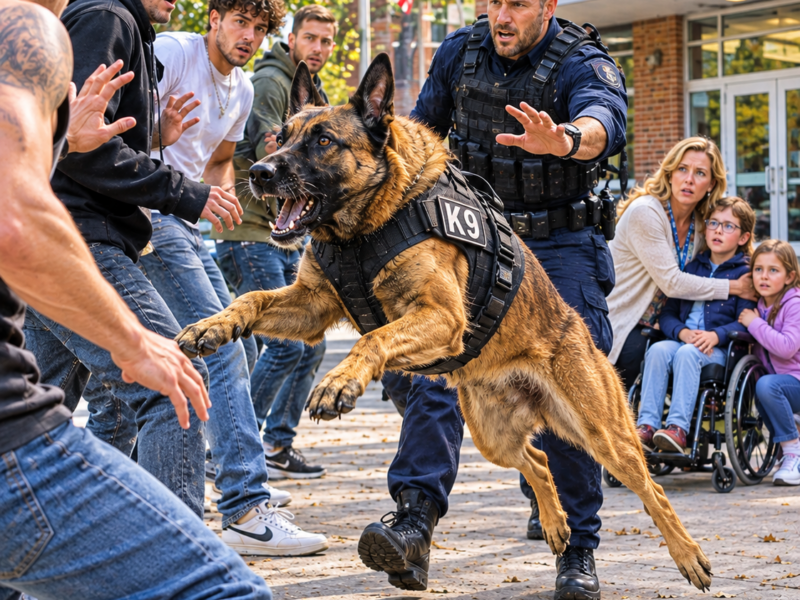
“I watched three men shove my wheelchair-bound student into a muddy puddle outside our school while one of them laughed and filmed it
Daniel didn’t move toward the envelope immediately.
For several seconds, he stood beside Ranger, staring at the white paper tucked beneath the windshield wiper.
The police sirens grew louder.
Behind me, Tyler was crying quietly while I tried to keep him warm with my jacket.
“Ms. Emily?”
I turned.
He was looking at Daniel.
“Is that man in trouble because he helped us?”
The question hurt more than anything Kyle had said.
I knelt beside Tyler.
“No, sweetheart. Sometimes good people get pulled into difficult situations. That doesn’t mean they’ve done anything wrong.”
Tyler nodded, but he kept watching the man in the Navy cap.
Daniel finally approached the truck.
He removed the envelope carefully, checking both sides before opening it.
His eyes moved across the page.
Then his hand tightened.
“Daniel?” I called.
He folded the paper.
“Emily, I need to ask you something.”
“What?”
“Has anyone been asking about you recently? Anyone you don’t recognize? Anyone calling the school?”
I shook my head.
“Not that I know of.”
He looked at the envelope again.
“Are you sure?”
Before I could answer, two police cruisers pulled into the parking lot.
The officers stepped out, and Kyle immediately began talking.
“Officer, this guy threatened us! He brought a trained attack dog onto school property!”
One officer glanced at Ranger.
“Sir, keep your dog under control.”
Daniel gave a small nod.
“He’s under control, Officer.”
The other officer approached me.
“Ma’am, can you explain what happened?”
I told him everything.
I described the harassment, the shove, the damaged tablet, and the phone Travis had knocked from my hand.
Tyler and Mia’s injuries were documented.
A school employee brought Mia inside, where another teacher checked her for scrapes.
The officers collected the broken phone and spoke with the students who had witnessed the incident.
Kyle kept insisting it had all been a joke.
Then the officer looked at the mud on Tyler’s clothes.
“Does pushing a child to the ground usually count as a joke where you come from?”
Kyle said nothing.
Travis was less cooperative.
He kept glancing at Daniel.
Finally, one of the officers asked Daniel to identify himself.
“Daniel Brooks. Former Navy. I live two houses down.”
“Did you witness the assault?”
“I witnessed the aftermath and the three men threatening the teacher.”
The officer wrote something down.
“Are you carrying any weapons?”
“No.”
“Is the dog a service animal?”
“He’s a retired military working dog. He lives with me now.”
The officer nodded.
“All right. We’ll take statements.”
While the officers separated the men, I walked toward Daniel.
“What’s in the envelope?”
He looked at me for a long moment.
“Something I hoped had ended.”
“That doesn’t answer my question.”
He glanced toward the school entrance.
“Not here. Not in front of the children.”
I wanted to insist.
But there was something in his face that stopped me.
It wasn’t arrogance.
It was fear carefully hidden beneath years of discipline.
And I was beginning to understand that the envelope wasn’t just a random threat.
It was connected to something he had been running from.
An hour later, the students had gone home.
The police had taken statements, and Kyle, Travis, and Mason had been escorted away for further questioning.
I was in my classroom, wiping mud from the floor, when Daniel appeared at the open doorway.
Ranger sat beside him.
“Can I come in?”
I nodded.
He looked around at the colorful posters, the children’s drawings, and the small collection of donated toys.
A paper airplane made by Tyler was taped to the wall.
Daniel studied it.
“Your students made these?”
“Yes. Tyler designed that one. He wants to become an aerospace engineer.”
Daniel smiled faintly.
“Good choice.”
I put the cleaning cloth down.
“Now will you tell me what’s happening?”
He pulled the folded letter from his pocket.
“Read it.”
I unfolded the paper.
There were only two sentences.
The children are still here. Stop asking questions about the Harbor Project.
Beneath them was a date.
Three days earlier.
My stomach tightened.
“What is the Harbor Project?”
Daniel sat down slowly.
“Six years ago, I was assigned to a classified military support operation overseas. My unit worked with a private contractor that provided security and logistical support.”
He paused.
“The contractor was called Harbor Strategic Solutions.”
I had heard the name somewhere, but I couldn’t remember where.
“After I left the Navy, I discovered that some of the contractor’s records didn’t match what actually happened during the operation.”
“What kind of records?”
“Personnel lists. Medical reports. Transportation logs. There were people who had been moved without proper documentation. Some reports described injuries that never appeared in the official files.”
He rubbed his thumb along the edge of the envelope.
“I reported the discrepancies through the proper channels.”
“And?”
“Someone leaked my identity to the people involved. I was told to stop.”
I looked at the letter again.
“Why would they write my name on it?”
“That’s what I’m trying to understand.”
He stood and walked toward the window.
“When I moved here, I thought I was choosing a quiet place. I didn’t know anyone connected to Harbor lived nearby.”
“Do Kyle and his friends work for them?”
“I don’t know.”
“Then why did Kyle recognize you?”
Daniel looked at me.
“Because my face was in the news after the investigation started.”
I searched his expression.
“What happened?”
He took a breath.
“One of the men who served with me disappeared. His name was Marcus Reed. He was the best medic in our unit, and he had a daughter who needed ongoing medical care.”
Daniel’s voice softened.
“Marcus discovered that Harbor had been falsifying transportation records involving vulnerable people. He believed some of the people listed as receiving medical transfers had never arrived at their destinations.”
I stared at him.
“You’re saying people were disappearing?”
“I’m saying the records suggested something terrible. But I never had enough evidence to prove what happened.”
“And Marcus?”
“He vanished before he could testify.”
For a moment, the only sound in the room was the hum of the heating system.
I thought about the envelope.
Then about the phrase written inside.
The children are still here.
“Daniel, I don’t understand what this has to do with my school.”
He hesitated.
“That’s what worries me.”
I walked to my desk and opened my computer.
“I’ve never heard of Harbor Strategic Solutions.”
Daniel watched as I searched the name.
The first results were old articles about government contracting.
Then I found a local news report.
The headline mentioned a charitable foundation that had recently donated money to several special education programs in Virginia.
The foundation was called Harbor Children’s Initiative.
I clicked the article.
A photograph appeared.
A smiling man in an expensive suit stood beside a banner, shaking hands with a school administrator.
I recognized him.
Not personally.
But I had seen his face.
His name was Richard Hale.
He was the founder of Harbor Children’s Initiative and a prominent local philanthropist.
For the past four months, his foundation had been offering grants to schools like ours.
Our principal had submitted an application.
I scrolled farther down.
There was a photograph of a new accessible playground funded by the foundation.
Then I saw another image.
A group of children standing in front of a school bus.
One of them was Tyler.
I leaned closer to the screen.
“Why is Tyler in this photograph?”
Daniel stepped beside me.
“Maybe the foundation visited your school.”
“They haven’t funded anything here yet.”
I opened the photograph’s details.
It had been taken six months earlier.
That was impossible.
Six months earlier, the school had never contacted Harbor Children’s Initiative.
I clicked the article’s embedded link.
It led to a page describing the foundation’s scholarship and transportation programs.
One phrase caught my attention.
Specialized placement and relocation support for medically vulnerable children.
I read it twice.
“Relocation?”
Daniel leaned closer.
“Show me.”
I pointed to the paragraph.
He read it without speaking.
Then he pulled out his phone and photographed the screen.
“Emily, don’t contact this foundation.”
“Why?”
“Because I don’t know whether it’s legitimate.”
I turned toward him.
“Those are pictures of my students. How did they get them?”
“I don’t know.”
“They’ve been to our school?”
“Possibly.”
I felt a wave of anger.
“They don’t get to photograph children without permission.”
Daniel nodded.
“You’re right.”
For the first time since he had arrived, his expression softened.
“Whatever is happening, we need to protect them without frightening them.”
I thought of Mia’s damaged tablet.
Tyler’s soaked jacket.
Ben’s baseball cap.
These weren’t names in a file.
They were children who trusted me to keep them safe.
And somebody had been watching them.
The next morning, I went to the principal’s office.
Dr. Susan Miller had been running our school for eleven years.
She was in her late fifties, wore reading glasses on a chain, and kept a photograph of her late husband beside her computer.
She listened without interrupting while I explained what had happened.
When I showed her the article, she looked uncomfortable.
“Richard Hale contacted us last spring.”
“Why didn’t you tell the staff?”
“Because we were considering a grant.”
“Did anyone photograph the children?”
She took off her glasses.
“They sent a photographer during an introductory visit.”
“Did the parents sign consent forms?”
“Yes. We requested permission for promotional photographs.”
I sat back.
“Then why is Tyler in a photograph dated six months before the visit?”
She looked at the screen.
Her face changed.
“That can’t be right.”
“That’s what I said.”
She picked up the phone and called the foundation.
No one answered.
She tried again.
Then she opened a folder in her desk.
“Emily, I need to show you something.”
Inside was a printed application.
It included our school’s financial information, student enrollment numbers, and details about our transportation needs.
A section near the bottom listed students who might qualify for additional assistance.
I read the names.
Tyler.
Mia.
Ben.
Three more students.
My mouth went dry.
“Why are their names here?”
Susan looked genuinely confused.
“The foundation requested anonymized eligibility information. I thought this was a preliminary list.”
“These aren’t anonymized.”
She stared at the page.
Then she whispered, “Oh, my God.”
We immediately contacted the school district’s legal department.
They advised us not to share any further records until the grant had been reviewed.
By lunchtime, Daniel was waiting outside the school.
He had Ranger on a leash.
“Have you heard anything?” he asked.
I handed him a copy of the application.
He read the names.
His expression hardened.
“Who else has seen this?”
“Only Dr. Miller and the district attorney’s office.”
“Good.”
He studied the paper again.
“There’s something I want to check.”
“What?”
“Whether Harbor is using the same methods it used before.”
He explained that the old contractor had often gathered information through legitimate-looking charities and transportation programs.
They offered assistance to families, collected medical and travel information, and used private contractors to manage placements.
At least, that was what the investigation had suggested.
“But you don’t know for sure?” I asked.
“No. That’s why we need evidence.”
I folded my arms.
“Then we get evidence.”
He gave me a careful look.
“Emily, this could become dangerous.”
I looked through the classroom window.
Ben was trying to teach Mia how to balance a plastic basketball on her head.
She was laughing so hard she could barely keep it there.
“Those children are already involved,” I said. “They didn’t ask for any of this.”
Daniel didn’t argue.
That afternoon, we began contacting parents.
We didn’t tell them our suspicions were proven facts.
We told them the school had discovered an unauthorized disclosure of student information and that we were investigating.
Some were angry.
Some were frightened.
One father cried when he learned that his daughter’s medical details might have been shared.
By the end of the day, every family had been notified.
Then something happened that made the situation much more personal.
A woman came to my classroom carrying a photograph.
She was in her early forties, with tired eyes and a silver ring on her right hand.
“Are you Emily Carter?”
“Yes.”
“My name is Rachel Reed.”
The name meant nothing to me at first.
Then Daniel, who had been standing near the entrance, turned sharply.
“Rachel?”
She looked at him.
For a moment, neither spoke.
Then she walked toward him.
“You look older.”
Daniel swallowed.
“So do you.”
Rachel placed the photograph on my desk.
It showed a man in military fatigues holding a little girl.
The man was smiling.
Daniel stared at the photograph.
“Marcus.”
Rachel nodded.
“My father disappeared six years ago. I’ve spent most of my adult life trying to find out why.”
I looked between them.
“You’re Marcus’s daughter?”
“Yes.”
Rachel turned to me.
“I work with families who have children with disabilities. I heard about the incident yesterday, and someone told me you were asking questions about Harbor.”
Daniel took a step closer.
“How did you find out?”
“Because I received the same envelope.”
She reached into her bag and removed another white envelope.
My name wasn’t on this one.
Daniel’s was.
Inside was a printed photograph.
It showed our school parking lot.
My classroom window was visible in the background.
The photograph had been taken that morning.
On the back, someone had written:
Stop looking for the people who were never supposed to come home.
Rachel’s hands trembled.
“Daniel, I think I know what happened to my father.”
Daniel looked at her.
“Tell me.”
She sat down.
“Three weeks ago, I received a message from an unknown number. It said my father might still be alive.”
I felt the room become very quiet.
“Did you respond?”
“Yes. They sent me a location and told me to meet someone.”
Daniel’s face tightened.
“Where?”
“An old storage facility outside Chesapeake.”
“Did you go?”
“I did.”
Rachel looked down at her hands.
“There was a man waiting inside. He knew my father’s name. He had a photograph of him from six years ago.”
“Who was it?”
“I don’t know. He wore a baseball cap and kept his face turned away.”
She paused.
“But he gave me something.”
She opened her bag and removed a small flash drive.
“He said my father left it for me.”
Daniel took the drive carefully.
“Did you open it?”
“Not yet.”
“Why?”
“Because the man told me that if I opened it on my own computer, the people watching me would know.”
Daniel looked at me.
“She’s right to be cautious.”
Rachel’s eyes filled.
“I don’t know who to trust anymore.”
Daniel pulled out a chair and sat across from her.
“Then we’ll start with what we know.”
For the next two days, we worked with the police and the school district’s legal team.
The flash drive was transferred to investigators, who examined it using an isolated system.
It contained photographs, spreadsheets, and scanned documents.
Some were military transportation records.
Others were files from Harbor Children’s Initiative.
The files showed that the foundation had been paying private transportation companies to move children between facilities.
Some transfers were legitimate.
Others had no corresponding authorization from parents or guardians.
A spreadsheet contained a column labeled destination verified.
Several entries were marked no.
There were also payments to companies that had no visible offices and appeared to exist only on paper.
Daniel studied the files with an investigator.
I wasn’t allowed to see all of them.
But one page was shown to me because it included our school.
It listed student names, transportation needs, and family contact information.
Beside several names was a note:
Priority placement candidates.
I recognized Tyler’s name.
My hands began to shake.
“Why would they select him?”
The investigator closed the folder.
“We’re still determining that.”
Daniel stood beside the table.
“These records are enough to reopen the old investigation.”
“Possibly,” the investigator replied. “But we need to establish who authorized the transfers and whether any children were actually moved without consent.”
Rachel sat quietly.
Then she said something none of us expected.
“My father wouldn’t have kept these records unless he believed someone was in danger.”
Daniel turned toward her.
“Marcus was careful. He didn’t take risks without a reason.”
“Then why did he disappear?”
Daniel didn’t answer immediately.
“I wish I knew.”
That evening, I went home and found a voicemail from an unknown number.
The caller sounded like a woman.
“Ms. Carter, I think you should stop asking questions. The children are not in danger if you leave things alone.”
I played it three times.
Then I forwarded it to the investigator.
At 8:15 the next morning, Dr. Miller called.
“Emily, someone is here asking to see you.”
“Who?”
“Richard Hale.”
I drove to school immediately.
When I entered the principal’s office, I saw him sitting comfortably in a leather chair.
He was in his early sixties, silver-haired, and dressed in a navy suit.
He stood when I entered.
“Ms. Carter. I’ve heard about the unfortunate incident.”
I didn’t offer my hand.
“Why do you have photographs of my students from before your foundation visited?”
His smile barely changed.
“Our organization has worked with many schools over the years.”
“That doesn’t answer my question.”
He turned toward Dr. Miller.
“I understand there has been some confusion regarding our application process.”
“Those children never gave you permission to collect their personal information,” I said.
Hale folded his hands.
“We have always acted in the best interests of vulnerable families.”
“Then why did your foundation’s files list them as placement candidates?”
For the first time, his expression changed.
Only slightly.
But I noticed.
“Where did you see that?”
I looked directly at him.
“That’s not your concern.”
He stood.
“Ms. Carter, I understand your emotions are running high. But these programs provide essential services. Without organizations like ours, many families would have nowhere to turn.”
“Then why are you sending people to threaten us?”
His eyes narrowed.
“I have no idea what you’re talking about.”
Daniel entered the room.
Hale turned.
Recognition crossed his face.
“Mr. Brooks.”
Daniel didn’t respond.
Hale adjusted his jacket.
“I thought you had finally moved on.”
Daniel’s voice was calm.
“People don’t move on from things that never got resolved.”
Hale gave a small laugh.
“Still carrying ghosts around, are we?”
Daniel took a step forward.
“Where is Marcus Reed?”
Hale’s smile disappeared.
“I don’t know anyone by that name.”
Rachel appeared in the doorway.
“You know exactly who he is.”
Hale looked at her.
Then his expression became something I couldn’t quite read.
“Rachel. You’ve grown up.”
She stared at him.
“You told my mother my father abandoned us.”
Hale said nothing.
“You sent us letters. You said he had chosen his work over his family.”
Hale sighed.
“Your father made decisions that affected many people.”
Rachel’s voice broke.
“He never stopped looking for me.”
For the first time, Hale seemed uncomfortable.
He reached for his briefcase.
“These accusations are serious. I suggest you speak with my attorney.”
He left without another word.
The moment the door closed, Rachel sat down.
Her shoulders shook.
Daniel stood beside her but didn’t touch her.
I placed a glass of water on the desk.
“How did he know your name?”
Rachel wiped her cheek.
“Because he knew my father.”
Daniel looked toward the window.
“And because he knows we’re getting close.”
The next morning, federal investigators arrived at the school.
They informed us that Harbor Children’s Initiative was under investigation for possible fraud, unlawful disclosure of protected information, and unauthorized transportation arrangements involving minors.
Richard Hale was not arrested that day.
The investigators explained that they were still building the case.
But they had enough evidence to suspend the foundation’s access to school records and freeze certain payments through a court order.
I thought that would bring some relief.
It didn’t.
Because Tyler still couldn’t sleep.
Mia refused to use the replacement tablet her parents had purchased.
And Ben began asking whether the men would come back.
I realized that uncovering the truth wasn’t the same as repairing the damage.
So I returned to what I knew.
I taught.
I helped Tyler rebuild his model airplane.
I sat beside Mia while she learned to use her new communication device.
I let Ben wear his backward cap during reading time, even though the school handbook technically required hats to be removed indoors.
One afternoon, Tyler approached me with a drawing.
It showed a dark pickup truck, a German Shepherd, and three stick figures standing beside a school building.
Above the truck, he had written:
THE GOOD GUYS CAME.
I smiled.
“That’s a wonderful picture.”
He pointed at Daniel.
“Is he going to be our friend?”
I looked across the courtyard.
Daniel was helping a maintenance worker repair a loose handrail.
“Yes,” I said. “I think he already is.”
Then Rachel called.
Her voice was barely audible.
“Emily, they found something.”
I stepped into the hallway.
“What?”
“There’s a location in the files. A place where the transportation records stopped.”
“Where?”
“An old residential care facility outside Richmond. It closed six years ago.”
I looked toward Daniel.
He was already walking toward me.
Rachel continued.
“Investigators went there this morning. They found boxes of medical records and photographs.”
“Did they find your father?”
There was a long silence.
“No.”
My shoulders dropped.
“But they found a name.”
“What name?”
“Marcus Reed.”
Daniel took the phone from my hand.
“Rachel, what do the records say?”
She swallowed.
“They say he was transferred to a private medical facility under a different identity.”
Daniel closed his eyes.
“Is there an address?”
“Yes.”
“Send it to the investigators. Don’t go there yourself.”
Rachel hesitated.
“Daniel…”
“What?”
“There’s something else.”
“What is it?”
“The file says he was transferred alive.”
Daniel gripped the phone.
“When?”
“Six years ago.”
The call ended.
For several seconds, Daniel stood motionless.
Then Ranger pressed his head against Daniel’s knee.
Daniel looked down at him.
“Looks like we’re not finished, buddy.”
Three days later, the investigators located the private facility.
It was a small rehabilitation center in western Virginia that had recently changed ownership.
The records were incomplete, and the staff claimed they had no knowledge of Marcus Reed.
But an elderly nurse remembered a patient who had arrived under an assumed name.
She remembered him because he always asked for paper and a pencil.
He wrote letters to a little girl.
He never mailed them.
The nurse had kept several of those letters in a box because she believed someone might eventually come looking.
Rachel was allowed to see them with investigators present.
I went with her.
Daniel came too.
The facility smelled of disinfectant and old carpet.
An investigator placed a cardboard box on a table.
Rachel opened it carefully.
Inside were dozens of folded sheets of paper.
Some had dates.
Some had only a few words.
She unfolded the first one.
Dear Rachel,
I don’t know if you remember the sound of my voice. I hope you do.
I am trying to come home.
Rachel pressed the paper against her mouth.
Daniel looked away.
She opened another.
I did not leave you. I need you to know that.
The nurse stood nearby.
“He was very sick when he arrived. He had a head injury and couldn’t remember everything at first. But he always remembered his daughter.”
Rachel looked up.
“Where is he now?”
The nurse hesitated.
“He was transferred again last year.”
“To where?”
“Another facility. I don’t have the paperwork anymore.”
The investigator stepped closer.
“Can you describe the transfer?”
The nurse closed her eyes, trying to remember.
“There was a man who came to collect him. He said he was a family representative.”
“Do you remember his name?”
“Richard.”
The room went silent.
Rachel’s face drained of color.
“Richard Hale?”
The nurse nodded slowly.
“I believe so.”
Daniel’s hands curled into fists.
The investigator immediately made a note.
This time, they had something that could connect Hale directly to Marcus’s disappearance.
But there was still one question.
Where was Marcus now?
The answer came from a place none of us expected.
Two weeks later, the school held its annual family picnic.
We had decided not to cancel it.
The children deserved one ordinary afternoon without worrying about people watching them.
There were folding tables, paper plates, hot dogs, and a small inflatable obstacle course.
Daniel arrived with Ranger.
Tyler ran toward him as fast as his wheelchair allowed.
“Mr. Daniel! Look!”
He held up a model airplane.
Daniel crouched beside him.
“That’s impressive. What kind is it?”
“F-18.”
“Good eye.”
Mia pressed a button on her tablet.
A synthetic voice announced, “Ranger is my favorite.”
Daniel laughed.
“I think you’ve made his day.”
For the first time in weeks, I saw my students laughing without looking over their shoulders.
Then a black sedan pulled into the parking lot.
Two investigators stepped out.
One approached Daniel.
“We found him.”
Daniel stared at the man.
“Who?”
“Marcus Reed.”
Rachel, standing nearby, dropped the paper plate in her hand.
“Where?”
“He’s alive. He’s receiving treatment at a facility near Roanoke.”
Rachel covered her mouth.
The investigator continued.
“We’ve confirmed his identity. He’s been living under a different name. His condition is stable, but his memory is incomplete.”
Daniel looked at Rachel.
“Do you want to go?”
She nodded before he finished asking.
We left the picnic in the care of the other teachers.
Daniel drove.
Rachel sat in the passenger seat.
I rode in the back with Ranger.
For most of the trip, nobody spoke.
The mountains rolled past the windows.
The sky was pale blue, and the late afternoon sun lit the trees.
When we arrived, a nurse led us to a quiet room.
A man sat beside the window.
He was thinner than in the photograph.
His hair was gray.
A scar ran along his temple.
But when Rachel stepped inside, he looked up.
For a moment, he simply stared.
Then his eyes narrowed.
“Rachel?”
She made a small sound.
“Dad?”
Marcus slowly stood.
His hands trembled.
“I know that voice.”
Rachel crossed the room.
He reached for her face as if he needed to make sure she was real.
Then he pulled her into his arms.
“I’m sorry,” he whispered.
Rachel shook her head against his shoulder.
“Don’t. Please don’t.”
“I tried to come home.”
“I know.”
“I wrote to you.”
“I know.”
They held each other for a long time.
Daniel stood near the doorway, his face turned away.
When Marcus finally noticed him, he took a step forward.
“Daniel.”
Daniel nodded.
“Hey, brother.”
Marcus tried to smile.
“You look terrible.”
Daniel laughed softly.
“So do you.”
They embraced.
I had never seen two grown men hold on to each other like that.
Not because they were afraid of letting go.
But because they had spent six years believing there might never be another chance.
The investigation continued for months.
Richard Hale was eventually arrested after investigators connected him to fraudulent records, unauthorized transfers, witness intimidation, and the concealment of Marcus’s identity.
Several former employees cooperated.
The three men who had bullied my students were also identified as having received money through a company linked to the foundation.
They had been hired to intimidate people who asked questions and discourage complaints around certain locations.
Kyle, Travis, and Mason were charged in connection with the assault and harassment.
The video Travis had recorded, which he originally thought would humiliate Tyler, became evidence against them.
The court ordered restitution for Mia’s damaged tablet and Tyler’s medical expenses.
But the most important change happened at our school.
We received new security procedures.
Student records were moved to a protected district system.
Parents gained greater control over the release of photographs and personal information.
And the school board created a permanent family advisory committee to review outside partnerships.
Dr. Miller asked me to lead it.
I accepted.
Not because I wanted another responsibility.
Because I wanted to make sure nobody could use our children’s trust as a business opportunity again.
Daniel became a regular visitor.
He never acted like a hero.
He didn’t tell stories about his military service unless someone asked.
He mostly helped with practical things.
He fixed a broken gate.
He repaired the wheelchair ramp.
He taught the children how to recognize different aircraft.
And Ranger became the school’s unofficial favorite visitor.
The dog was gentle with the children.
He knew when to sit quietly beside someone who was upset.
He also knew when to move away if a child needed space.
Mia eventually started calling him her “big furry bodyguard.”
Tyler insisted that Ranger should receive an honorary school certificate.
So we made one.
It was printed on bright yellow paper and decorated with paw prints.
Daniel framed it and hung it in his living room.
A few months later, I visited Rachel and Marcus at their new apartment.
Marcus was still receiving rehabilitation.
Some days were difficult.
He sometimes forgot recent conversations.
Other times, a sound or smell brought back a memory he hadn’t expected.
But he was home.
Rachel had placed his old photograph beside the front door.
The same photograph she had carried into my classroom.
Marcus looked at it for a long time.
“I thought I’d never see that picture again.”
Rachel sat beside him.
“You don’t have to look at it alone anymore.”
He took her hand.
I watched them from the kitchen.
For years, Rachel had believed her father had abandoned her.
For years, Marcus had believed his daughter might have stopped waiting.
Neither had known the truth.
And all those years had been stolen by people who thought vulnerable families could be managed like paperwork.
Before I left, Marcus asked me about the children.
I told him about Tyler’s airplane, Mia’s new tablet, and Ben’s determination to become a professional baseball player.
Marcus smiled.
“Sounds like you’ve got a good group.”
“The best.”
He looked toward the window.
“People like us sometimes spend so much time trying to protect everyone that we forget what we’re protecting them for.”
I didn’t know what to say.
He smiled again.
“Don’t let them lose their childhood.”
I carried those words back to school.
The following spring, we held another picnic.
This time, the weather was warm, the sky was clear, and the parking lot was filled with families.
Tyler was showing Marcus his newest model airplane.
Mia was using her tablet to tell Ranger that he was a very handsome dog.
Ben was arguing with Daniel about whether the Navy had better aircraft than the Air Force.
I stood near the playground and watched them.
Daniel walked over.
“Quite a difference from that rainy Thursday.”
I nodded.
“Do you ever think about what would have happened if you hadn’t driven past that day?”
He looked at Ranger.
“I wasn’t supposed to be there.”
“What do you mean?”
“I had planned to take a different route. Ranger started acting restless, so I stopped at the store. Then I heard the shouting.”
He paused.
“Sometimes you don’t know why a small decision matters until much later.”
I looked at the children.
“Tyler still tells everyone you saved him.”
Daniel shook his head.
“I didn’t save him, Emily. I just stood there long enough for him to know someone was on his side.”
Across the courtyard, Tyler lifted his airplane.
“Mr. Daniel! Watch this!”
Daniel turned immediately.
Tyler pushed his model along the table, making a soft engine noise.
Mia laughed.
Ben cheered.
Ranger wagged his tail.
And for a moment, the entire courtyard seemed to belong to the children.
I thought about that first afternoon.
The mud.
The broken tablet.
The men laughing while I begged them to stop.
I remembered Kyle saying nobody cared about children like ours.
He had been wrong.
Not because a former Navy SEAL had arrived in a pickup truck.
Not because a military dog had sat beside him.
Not even because the people responsible eventually faced justice.
He had been wrong because those children had never needed to earn anyone’s respect.
They deserved it from the beginning.
And the best thing we could do for them wasn’t to teach them that the world was full of dangerous people.
It was to make sure they never forgot that there were good people willing to stand beside them.
That afternoon, Tyler asked me to help him hang his newest drawing in the classroom.
It showed a school, a dark pickup truck, a German Shepherd, and a group of children standing together.
This time, he had written something different above the picture.
WE ARE NOT ALONE.
I found a place for it beside the old paper airplane.
And I left it there.
The end.









