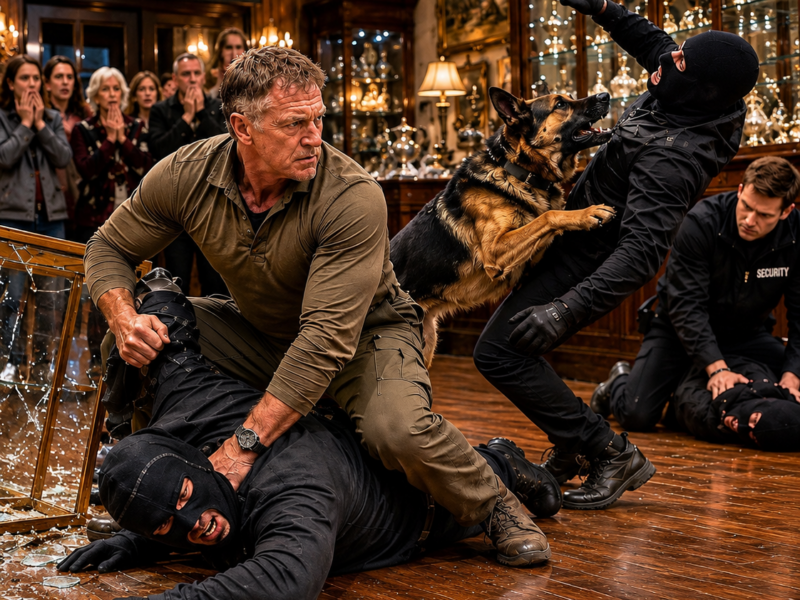
“I watched three masked men walk into Calder Hall during Sawyer’s biggest winter auction, and when the oldest one grabbed my longtime friend by the collar
The masked man tightened his grip on Emmett’s arm.
I could see the old man’s fingers trembling, but he wasn’t looking at the weapon. He was staring at the man’s eyes.
“Who are you?” Emmett whispered.
The intruder gave a quiet laugh.
“You really don’t recognize me?”
Emmett swallowed.
“I recognize the voice.”
For the first time, the masked man’s confidence seemed to falter.
I remained crouched beside Kepler, one hand resting against his collar. Around us, people were slowly being pushed toward the center of Calder Hall.
The younger intruder demanded their phones.
The second man moved toward the control equipment and disconnected the microphone.
Nolan Reeve stood near the kitchen entrance, watching everything with a frightened but determined expression.
I caught his eye.
He looked at me for half a second.
Then he looked toward the old fire alarm mounted beside the kitchen doorway.
Good.
He understood.
“Everyone to the center,” the younger intruder ordered.
A woman began crying.
An elderly man tried to stand, but his wife pulled him back down.
Mara Voss stood near the display cases, holding her leather folder against her chest.
She looked at me.
I gave her the smallest shake of my head.
Not yet.
The tallest intruder dragged Emmett toward the rear corridor.
“Where is the ledger?”
“I told you. I don’t have it.”
“Don’t lie to me.”
“I’m not lying.”
The man leaned close.
“Your father knew what would happen if those records ever came out.”
Emmett’s face changed.
I saw it immediately.
This was no longer a simple question about an old book.
Something in those words had reached a place Emmett had spent decades trying to avoid.
“Leave my father out of this,” he said.
The intruder laughed.
“Your father? He was the reason this happened.”
I looked at Kepler.
The dog had become completely still.
His amber eyes followed the tall man’s movements.
I lowered two fingers toward the floor.
Wait.
Kepler obeyed.
I had spent years teaching him that courage wasn’t the same as charging forward.
Tonight, that lesson mattered more than ever.
Then the old fire alarm began ringing.
The intruders turned toward the kitchen.
Nolan had pulled the lever.
The bell was loud, metallic, and impossible to ignore.
For a moment, the entire room seemed to vibrate.
The younger man cursed and moved toward the kitchen entrance.
The second intruder turned toward the control panel.
The tall one tightened his grip on Emmett.
“Who pulled that?”
Nobody answered.
Outside, snow continued falling over Sawyer’s Reach.
Two blocks away, Sheriff Dana Lockwood heard the alarm report come through her dispatch radio.
She stood immediately.
“Get the units to Calder Hall. Now.”
Back inside, the alarm had created something the intruders hadn’t planned for.
Uncertainty.
People were no longer simply waiting for instructions.
They were beginning to understand that help might be coming.
I looked at Nolan again.
He had guided several guests through the kitchen doorway.
An elderly woman with a cane.
A retired schoolteacher.
A teenage boy who had been working as a server.
He was getting them away without drawing attention.
The young guard was frightened.
But he was doing his job.
I was proud of him.
Then I noticed Lydia.
Emmett’s granddaughter was standing near the refreshment table.
Her small hands were pressed against the edge.
Her eyes were fixed on her grandfather.
She was twelve years old.
And she was trying very hard not to cry.
I wanted to get her away from there.
But the youngest intruder was standing between her and the kitchen.
I couldn’t move carelessly.
The tall man dragged Emmett another step.
“Last chance. Where’s the book?”
Emmett looked toward me.
For a brief moment, our eyes met.
Then he said something I hadn’t expected.
“I kept my promise, Tom.”
My father’s name.
Not mine.
My father’s.
The intruder noticed the change in his expression.
“What’s that supposed to mean?”
Emmett didn’t answer.
I felt the old brass lighter in my jacket pocket.
I’d brought it without thinking, the same lighter Kepler had taken from my storage chest that morning.
My father’s initials were engraved on the side.
T.B.
I looked at Emmett.
He had recognized that lighter when he visited my cabin.
And now he was looking at me as if it meant something.
The second intruder suddenly shouted.
“Forget the guests. We need the ledger!”
The tall man turned toward him.
“Then tell me where it is!”
The second man hesitated.
That hesitation told me something.
They weren’t working from the same information.
One knew more than the others.
Perhaps much more.
Then, from the front display table, a small sound interrupted the room.
The captain’s antique pocket watch had begun chiming.
One deep note.
Then another.
Everyone looked toward it.
The tall intruder’s attention shifted for a fraction of a second.
That was enough.
I moved.
Kepler came out from beneath the edge of the tablecloth.
He caught the hanging fabric in his teeth and pulled sideways.
A row of empty glasses toppled.
The youngest intruder stepped backward, struck the cocktail table, and lost his balance.
His weapon arm swung away from the crowd.
Nolan immediately moved a wooden chair between the man and the guests.
I reached him before he could recover.
There was a brief struggle.
His weapon skidded across the polished floor.
Nolan pinned the chair against him, keeping him away from the nearest row of people.
“Stay down!” Nolan shouted.
The second intruder turned.
He saw his partner on the floor and raised his arm.
Kepler moved between him and the guests.
He didn’t attack.
He simply stood there.
His golden chest faced the intruder, his black saddle bristling, his amber eyes fixed on the man’s movements.
The intruder hesitated.
I used the moment to move toward the control table.
A short collision followed.
The equipment cart overturned, cables pulled loose, and the second man stumbled against the wall.
His weapon fell away.
Two men were down.
But the third still had Emmett.
And that was the only thing I cared about.
The tall intruder dragged my friend toward the storage corridor.
“Stop!”
I stopped.
He had brought the weapon close to Emmett.
“One more step and he pays for it.”
Kepler stood beside me, breathing heavily.
I could feel the tension in his body.
But I didn’t give the command.
The room was silent except for the old alarm.
Then Emmett looked at me.
His face was pale.
His bow tie had come loose.
Yet somehow, he managed a faint smile.
“Harlen,” he said, “if this goes badly, tell your father I still owe him five dollars.”
I almost laughed.
Even now, the old fool was making jokes.
The intruder shoved him.
“Shut up!”
But Emmett didn’t.
“I stayed quiet for forty years,” he said. “Not tonight.”
The masked man tightened his grip.
“Where is the ledger?”
Emmett looked directly at him.
“Somewhere you should have looked a long time ago.”
The intruder’s eyes narrowed.
Then Lydia moved.
She reached for a metal serving tray beside the tea urn.
Her hands were shaking.
She looked at her grandfather, then at me.
I shook my head.
I didn’t want her anywhere near the danger.
But the girl had already made her decision.
She tipped the tray.
It crashed onto the floor with a tremendous metallic sound.
The intruder turned.
For one second, his attention left Emmett.
I whispered a single word.
“Home.”
Kepler moved.
He caught the edge of the long tablecloth near the intruder’s boots and pulled hard.
The fabric tightened around his legs.
The man lost his balance.
Emmett twisted away.
I crossed the remaining distance and forced the weapon away from my friend.
The struggle lasted only seconds.
Then the weapon hit the floor.
Kepler planted his front paws on the fallen cloth.
Nolan rushed over.
Mara followed him, along with two men from the front row.
Together, we kept the intruder down.
No gunshot.
No one in the crowd had been struck.
For several seconds, nobody moved.
Then the front doors opened.
Sheriff Dana Lockwood entered with Deputy Miles and two other officers.
“Everyone stay where you are!”
Her eyes swept across the room.
Three masked men.
Two weapons on the floor.
An overturned display table.
An old auctioneer leaning against a chair.
And a German Shepherd standing beside me.
Dana lowered her weapon when she saw the situation was under control.
“Briggs?”
“Evening, Sheriff.”
She glanced at Kepler.
“Your dog seems to have had a busy night.”
“He’ll expect overtime.”
Dana almost smiled.
Then her attention returned to the three men.
“Get them secured. Nobody leaves until we’ve taken statements.”
Nolan finally sat down.
His hands were shaking so badly that he couldn’t get his radio back into its holder.
I crouched beside him.
“You did well.”
He looked at me.
“I thought I was going to freeze.”
“You didn’t.”
“I was scared.”
“That’s not a crime, Nolan.”
He lowered his head and breathed out slowly.
Across the room, Lydia had reached her grandfather.
Emmett wrapped both arms around her.
“I’m okay,” he whispered.
She buried her face in his coat.
“You said nothing bad would happen tonight.”
“I know.”
“You promised.”
“I know, sweetheart.”
He held her tighter.
I turned away.
Some things deserved privacy.
But the questions hadn’t ended.
Not even close.
The three men were taken into separate rooms at the sheriff’s office.
Their masks were removed during booking.
The youngest was identified as Travis Bell, a 24-year-old from Green Bay.
The second man was Martin Kessler, 41, a former security contractor with a history of theft and fraud.
The tallest was identified as Grant Holloway, 51.
When Dana told me his name, I looked at her.
“Holloway?”
She nodded.
“Ever heard of him?”
I shook my head.
“Not personally.”
“That’s interesting.”
“Why?”
She opened a folder.
“Because Emmett has.”
I looked through the glass toward the interview room.
Grant Holloway sat with his hands cuffed in front of him.
His expression had changed completely.
Without the mask, he looked like an ordinary middle-aged man.
Dark hair turning gray.
A narrow scar beneath his left cheekbone.
Tired eyes.
There was nothing extraordinary about him.
But when Emmett saw his photograph, he had gone white.
I returned to the old auction hall, where Dana had asked Emmett to wait until the first round of interviews was finished.
Mara sat nearby with a blanket over her shoulders.
Lydia was beside her grandfather.
Kepler lay at my feet.
“Do you know that man?” I asked Emmett.
He looked down at his hands.
“His name was Daniel Holloway.”
Dana frowned.
“The suspect’s name is Grant.”
“Grant was his middle name. Everyone called him Daniel when we were young.”
“How far back do you go?”
Emmett took a long breath.
“Back to when this town was barely a town.”
He looked at me.
“His father owned half the land north of Sawyer’s Reach.”
I waited.
Emmett continued.
“Back in the late seventies, several families lived on property that had been passed down through generations. They had homes, small farms, and timber rights. Most of them had no lawyers and very little money.”
“What happened?”
“Someone began buying the land.”
“Legally?”
Emmett’s eyes lowered.
“That’s what the paperwork said.”
He explained that his father, Arthur Calder, had worked at the county land office before opening Calder Hall.
Arthur had discovered that several property deeds had been altered.
Some signatures were forged.
Some payments had been recorded twice.
Others had disappeared completely.
A number of families had lost their homes without understanding why.
One of those families was the Holloways.
“Daniel’s father lost everything,” Emmett said.
I leaned forward.
“Because of the forged deeds?”
“Yes.”
“Then why would Daniel be trying to steal the ledger?”
Emmett looked toward the window.
“Because the ledger proves who did it.”
I waited for him to continue.
But he seemed to struggle with the next words.
Finally, he looked at me.
“And because my father was involved.”
The room became very quiet.
Mara slowly lowered her blanket.
Lydia looked from her grandfather to me.
“What do you mean?” I asked.
Emmett pressed his hands together.
“My father discovered the fraud. But he didn’t expose it immediately.”
“Why?”
“Because he was afraid.”
Arthur had been threatened.
He had a wife, a young son, and a business that could be destroyed.
The people responsible were wealthy and well connected.
At first, he told himself he needed more evidence.
Then weeks became months.
Months became years.
And by the time he was ready to speak, the families had already lost their land.
“Did he keep the evidence?”
Emmett nodded.
“Everything. Names, dates, payments, copies of documents. He wrote it all in a brown ledger.”
“Why didn’t he take it to the police?”
“He tried.”
Emmett’s voice cracked.
“The original sheriff at the time was friends with the men involved. My father was warned that if he pushed the matter, he would lose everything.”
I glanced at Dana.
She had been listening without interrupting.
“Who was involved?” she asked.
Emmett hesitated.
“Three businessmen. One county official. And Daniel’s father.”
I frowned.
“Daniel’s father was part of the fraud that took his own family’s property?”
“That’s what the records suggested.”
Emmett rubbed his face.
“His father had debts. He signed agreements he shouldn’t have signed. Then he helped the others hide the truth.”
That explained the anger.
It didn’t explain the robbery.
“Why did Daniel want the ledger now?”
Emmett looked at the floor.
“Because he believes the ledger contains proof that his father was innocent.”
“Does it?”
“I don’t know.”
“Emmett.”
He closed his eyes.
“That’s why I kept it hidden.”
Dana leaned forward.
“Where is it?”
Emmett didn’t answer immediately.
Then he reached inside his blazer and removed a small brass key.
“I didn’t bring the ledger to the auction.”
He looked at me.
“I brought the key.”
We drove to Emmett’s house shortly before midnight.
The snow had become heavier.
Dana followed in her cruiser.
Mara stayed at Calder Hall with Lydia and Nolan, who had finally agreed to have his hands checked after a glass cut on his palm.
Emmett’s house stood behind the old library, a two-story brick building with white shutters and a narrow porch.
Inside, everything was neat.
Photographs lined the hallway.
There was one of Arthur Calder standing beside my father, both men smiling in front of a wooden fishing boat.
I stopped.
“Where was this taken?”
“Lake Superior,” Emmett said.
“Summer of 1988.”
My father was younger in the photograph.
His hair was still mostly brown.
He had one arm around Arthur’s shoulder and was laughing at something outside the frame.
I hadn’t seen that expression on his face in years.
Emmett noticed me looking.
“Your father helped Arthur after the whole land business.”
“How?”
“He drove him to meetings. Helped him make copies of documents. Even paid for a lawyer once.”
I looked at him.
“My father never told me.”
“Tom didn’t like talking about other people’s troubles.”
Emmett led us into his study.
There was a large wooden desk against the far wall.
Behind it stood a bookcase filled with old local histories.
He moved several books aside, revealing a small metal lockbox.
The brass key fitted perfectly.
Inside were photographs, envelopes, a bundle of letters, and a worn brown ledger.
Its leather cover was cracked.
A brass clasp held it shut.
I stared at it.
This was the object three men had risked prison to retrieve.
Emmett placed both hands on the desk.
“My father gave it to me shortly before he died.”
“Why?”
“He told me to wait until the right person came looking for it.”
Dana frowned.
“That’s a dangerous instruction.”
“I know.”
Emmett opened the clasp.
The pages were filled with names, dates, financial figures, and handwritten notes.
Some pages contained photocopied documents.
Others had small slips of paper tucked between them.
I began turning the pages carefully.
Then I found a familiar name.
Thomas Briggs.
My father.
Beside his name was a date from 1989 and a short handwritten note.
I read it twice.
“Original transfer records secured. Copies delivered to Thomas Briggs for safekeeping.”
I looked at Emmett.
“What does this mean?”
His face tightened.
“Your father had the original documents.”
I stared at the page.
“Where are they?”
Emmett shook his head.
“I don’t know.”
Dana leaned closer.
“Could Daniel have known?”
“Possibly.”
I turned another page.
A small envelope had been attached to the paper with an old piece of tape.
My father’s initials were written across it.
T.B.
I recognized the handwriting immediately.
The letters leaned slightly to the right.
He had written that way on every birthday card he’d ever sent me.
My hands became unsteady.
“Did you know this was here?”
Emmett shook his head.
“I never opened that envelope.”
I carefully lifted it.
Inside was a single folded sheet of paper.
The handwriting was unmistakably my father’s.
I unfolded it.
The first line read:
“Emmett, if Daniel Holloway ever comes looking for this book, don’t assume he is the enemy.”
I looked up.
Nobody spoke.
I continued reading.
“His father made terrible choices, but Daniel was a child when those decisions were made. He deserves to know what happened to his family. The original documents prove more than one man was responsible.”
I turned the page.
There was another paragraph.
“Arthur knows the truth. So do I. We both failed those families by waiting too long. If we cannot repair the damage ourselves, at least we must leave the truth where someone brave enough can find it.”
I lowered the letter.
For years, I had believed my father spent his final years helping Emmett with ordinary town business.
I had never known he was carrying something this important.
But the last paragraph made my throat tighten.
“Tom Briggs wasn’t a hero,” Emmett said quietly. “Neither was my father. We were frightened men who made mistakes.”
He looked at me.
“Your father spent the rest of his life trying to make that right.”
I folded the letter carefully.
“Where are the original documents?”
Emmett shook his head.
“That’s the part I’ve never understood.”
I looked at the old ledger again.
Then something caught my attention.
On the inside cover, beneath a faded library stamp, was a small handwritten phrase.
Northstar.
I looked at Emmett.
“The map?”
He nodded slowly.
“Arthur used to say the Northstar Atlas was more than an antique. He said it was the only map in town that could still lead someone to the truth.”
I thought about the auction.
The display case.
The three intruders.
The crate with Emmett’s name.
Suddenly, the map seemed far more important than its appraised value.
The next morning, Dana called a meeting at the sheriff’s office.
Daniel Holloway had asked to speak with Emmett.
He refused to speak with anyone else.
I went with Emmett.
Dana sat across from us in the interview room.
Daniel entered wearing a gray county-issued sweatshirt.
Without his mask and winter clothing, he looked older than I expected.
He sat down and stared at Emmett.
“You finally opened it.”
Emmett didn’t answer.
Daniel smiled bitterly.
“Forty years. That’s how long my family waited.”
“Your father was involved,” Emmett said.
Daniel’s face tightened.
“You believe that because your father’s handwriting told you so?”
“No. Because I read the records.”
“Then you know he was framed.”
Emmett looked at him.
“I know he signed the agreements.”
“He was threatened.”
“So were the other families.”
Daniel leaned forward.
“My father was forced to sign away his property. He spent the rest of his life being called a thief.”
“And the other families?”
Daniel said nothing.
“My father knew about their losses,” Emmett continued. “He knew the deeds were false. He helped bury the evidence.”
Daniel’s jaw tightened.
“You don’t know what he went through.”
“No,” Emmett said. “But I know what the other families went through.”
Daniel looked away.
For several seconds, nobody spoke.
Then I placed my father’s letter on the table.
Daniel looked at the initials.
His expression changed.
“Thomas Briggs.”
“You knew my father?”
Daniel nodded.
“He visited our house once.”
“When?”
“1990. I was fifteen.”
He stared at the letter.
“My father was sick. We were living in a rented trailer outside town. Mr. Briggs brought groceries and a box of old photographs.”
I waited.
“He told my mother that my father had been used by men who were much more powerful than him. He said he was going to prove it.”
Daniel’s voice became quieter.
“He promised her.”
“Did he?”
Daniel laughed without humor.
“No.”
He looked at me.
“Your father disappeared from our lives. My mother died believing everyone had forgotten us.”
I felt the words settle heavily.
“My father died too,” I said. “He wasn’t able to finish everything.”
Daniel’s eyes narrowed.
“Convenient.”
“No. Just true.”
He leaned back.
For the first time, he looked less angry than exhausted.
“Do you know what it’s like to grow up hearing that your father was a criminal?”
I didn’t answer.
He continued.
“People wouldn’t hire him. Neighbors stopped speaking to us. My mother sold her wedding ring to pay for heating oil. And every year, someone in this town would tell us we should be grateful we still had a roof.”
Emmett’s eyes filled.
“I’m sorry.”
Daniel shook his head.
“Don’t.”
Then he looked directly at me.
“I wasn’t trying to steal the ledger because I wanted money.”
“Then why bring three men into Calder Hall?”
His face hardened.
“Because I wanted to destroy the records.”
Emmett stared at him.
“What?”
Daniel looked down at his hands.
“I thought the ledger was the only thing keeping my father’s name dirty.”
He admitted that he had hired Martin Kessler and Travis Bell to help him retrieve the book.
He had learned about the auction through someone who worked with the estate appraisers.
He knew the brown ledger was not listed publicly.
He also knew Emmett planned to speak about it.
But he hadn’t expected the letter.
Or my father’s involvement.
“Who told you about the ledger?” Dana asked.
Daniel hesitated.
Then he gave a name.
“Frank Mercer.”
Emmett went completely still.
I looked at him.
“Who is Frank Mercer?”
Emmett swallowed.
“Former county treasurer.”
Daniel nodded.
“He contacted me six months ago. Said he had proof my father was innocent.”
Dana opened another folder.
“Frank Mercer died two weeks ago.”
Daniel looked up.
“What?”
“Car accident on County Road 8.”
His expression changed.
“That can’t be.”
Dana slid a photograph across the table.
Daniel stared at it.
Then he covered his mouth.
“He promised me he’d show me the documents.”
Dana said nothing.
Daniel lowered his head.
I realized then that he hadn’t simply been following an old family grievance.
Someone had been feeding his anger.
Someone had convinced him that destroying the ledger would restore his father’s name.
And that someone was now dead.
The Northstar Atlas was brought to the sheriff’s office that afternoon.
Mara Voss had supervised the transfer herself.
She had spent the morning examining the auction’s inventory records and discovered that the map’s frame had been repaired several times over the years.
One repair had never been documented.
When she removed the backing under Dana’s supervision, she found a narrow paper envelope tucked between the wooden frame and its protective board.
Inside were three original land-transfer documents.
There was also a letter from Arthur Calder.
Emmett read it standing beside the evidence table.
His hands trembled.
The letter was dated 1991.
It explained that Arthur had discovered a coordinated land fraud involving several local businessmen and county officials.
One of the men had been Frank Mercer’s father.
Another had been Daniel’s father.
But the person who organized the scheme was a businessman named Walter Voss.
Mara looked up sharply.
“My grandfather.”
Nobody spoke.
She read the letter again.
Walter Voss had used false debt agreements and forged signatures to acquire property from struggling families.
He had then transferred the land through several companies, making the original ownership difficult to trace.
Daniel’s father had signed some of the documents, but the evidence showed he had also been threatened after attempting to withdraw.
The documents proved that he had not organized the fraud.
They also proved that he had helped conceal it.
It wasn’t innocence.
But it wasn’t the story Daniel had been told.
Mara sat down.
“My grandfather built his company on those properties.”
Emmett nodded.
“Yes.”
She stared at the documents.
“Then my family profited from stolen land.”
“Yes.”
Her hands began to shake.
“My father always said those acquisitions were legal.”
“Maybe he believed that.”
“Or maybe he didn’t want to know.”
Nobody answered.
Mara closed the folder.
For years, she had treated risk as something that could be measured and insured against.
Now she was looking at the cost of a family fortune.
And there was no policy that could make it disappear.
Dana took custody of the documents.
She explained that the case would need to be reopened with the district attorney.
The records would be examined by forensic specialists.
The forged deeds would be compared with county archives.
The families who had lost their land would be contacted.
It wouldn’t happen overnight.
But the evidence was finally in the right hands.
Emmett looked at me.
“Your father would have wanted this.”
I thought about the letter.
Then I looked at the brass lighter in my palm.
“Yes,” I said. “He would.”
Three days later, I visited Daniel at the county detention center.
I hadn’t planned to go.
But something about his story stayed with me.
He was sitting at a small table when I entered.
He looked surprised.
“Briggs.”
I sat opposite him.
“Daniel.”
For a while, neither of us spoke.
Then he looked at my hands.
“Do you still have the letter?”
“Yes.”
“Can I see it?”
I took the folded page from my jacket pocket.
He read it slowly.
When he reached the final paragraph, he stopped.
His eyes moved over the handwriting several times.
“Your father remembered us.”
“Yes.”
Daniel looked down.
“My mother would have wanted to know.”
I nodded.
He folded the paper carefully and handed it back.
“I thought if I destroyed the ledger, people would stop calling my father a thief.”
“They wouldn’t.”
He looked up.
“Why not?”
“Because destroying evidence doesn’t change what happened. It only makes sure nobody can prove it.”
He rubbed his face.
“I know that now.”
I didn’t tell him everything would be fine.
It wouldn’t.
He would face charges for the robbery.
Travis and Martin would face their own consequences.
And Daniel would have to live with the fact that his attempt to repair his family’s reputation had nearly endangered an entire room of innocent people.
But I did tell him something.
“The truth about your father is bigger than what you were told.”
He nodded slowly.
“I wish I’d known that before.”
“So do I.”
Before I left, he asked one final question.
“Did your father ever forgive people?”
I thought about Jonah Pierce.
About the mission.
About the years I had spent blaming myself for coming home.
“Sometimes,” I said. “But forgiveness wasn’t always the same as pretending nothing happened.”
Daniel looked at the table.
I left him with that.
The following weeks changed Sawyer’s Reach.
The district attorney reopened the land fraud investigation.
Several retired county employees were interviewed.
Old property records were retrieved from storage.
Three families who had lost land decades earlier received notice that their cases were being reviewed.
Some of the original owners were no longer alive.
Their children and grandchildren were.
For them, the documents represented more than money.
They represented the chance to know that their parents hadn’t simply been careless or foolish.
They had been wronged.
Mara resigned from her position with the auction’s insurance company.
She later helped organize a public review of the Wickham estate’s property records and offered to cooperate with investigators regarding her grandfather’s business holdings.
It was not an easy decision.
Her family was furious.
But she didn’t change her mind.
Nolan received a commendation from Sheriff Lockwood for helping protect the guests.
He tried to act embarrassed when people congratulated him.
But I saw him smiling when Lydia presented him with a homemade card.
It read:
“Thank you for being brave even though you were scared.”
He kept it inside his locker.
As for Emmett, he did something I never expected.
He reopened the old railway station’s unused waiting room and turned it into a small community archive.
The brown ledger was placed in secure custody, but copies of the verified historical records were made available to families whose names appeared in it.
The Northstar Atlas remained on display.
Not as an expensive antique.
As a reminder of what had been hidden.
One afternoon, I visited Calder Hall with Kepler.
Emmett was standing beside the display case, looking at the map.
“You know,” he said, “I used to think the worst thing that could happen was that people would discover what our fathers did.”
I looked at him.
“And now?”
“Now I think the worst thing would have been if nobody ever knew.”
I nodded.
He smiled faintly.
“Your father was right about one thing.”
“Only one?”
Emmett laughed.
“Don’t push your luck.”
We stood quietly for a while.
Then he looked at Kepler.
“That dog saved my life.”
“He’s going to expect a larger biscuit budget.”
“He deserves it.”
Kepler sat down and looked between us.
Emmett reached into his pocket and produced a small dog biscuit.
I watched him give it to Kepler.
“Don’t tell him I spoil him,” he said.
“I think he already knows.”
A month after the auction, the first official announcement came from the district attorney’s office.
The original records had been authenticated.
Several land transfers were confirmed to have involved forged signatures and fraudulent agreements.
The investigation was continuing into the people who had organized and concealed the scheme.
Daniel Holloway remained in custody while his criminal case proceeded.
His cooperation helped investigators locate additional records connected to Frank Mercer.
The district attorney also confirmed that Daniel’s father had not been the architect of the fraud.
His role had been more complicated.
He had signed documents under pressure, but he had also participated in hiding the transactions.
The truth was not as clean as Daniel had hoped.
It wasn’t as simple as Emmett had feared.
But it was finally the truth.
Daniel eventually pleaded guilty to his role in the attempted robbery.
He received a prison sentence, followed by supervised release.
Travis and Martin were convicted as well.
The land investigation continued separately.
Several families eventually received financial settlements and legal recognition of their original claims.
Mara’s family surrendered property connected to the fraudulent transfers.
She did not try to excuse her grandfather’s actions.
She simply cooperated and accepted the consequences.
And Emmett?
He wrote letters to every family whose name appeared in the ledger.
Some answered.
Some didn’t.
A few came to see him in person.
He listened to their stories without interrupting.
He never asked them to forgive his father.
He never asked them to forgive him.
He had finally learned that an apology wasn’t a debt someone else was obligated to repay.
By the time spring arrived, the snow had begun retreating from the forest.
The road outside my cabin was wet and dark, and the first small patches of grass appeared beneath the cedar trees.
My mornings returned to their old rhythm.
Coffee.
Firewood.
Kepler’s breakfast.
A walk along the forest road.
But something inside me had shifted.
I still thought about Jonah.
I probably always would.
For years, I had believed that returning to a quiet life meant I had to leave every part of my old life behind.
I had avoided people because I was afraid that getting close to them meant eventually losing them.
I had mistaken isolation for peace.
Then a twelve-year-old girl had stood in a room full of armed men and found the courage to make a small noise with a serving tray.
A young security guard had pulled an old fire alarm even though his hands were shaking.
A woman who had spent her life protecting her family’s reputation had chosen to help expose its darkest history.
And an old friend had finally decided that silence was no longer protecting anyone.
I began visiting town more often.
Sometimes I helped Nolan with security training.
Sometimes I stopped by Calder Hall to see Emmett.
And sometimes I simply sat with Kepler outside the bakery while Lydia shared the occasional pastry with him.
One Saturday morning, Emmett came to my cabin.
He wasn’t carrying pie this time.
He had a small wooden box.
“I found something while cleaning out my father’s desk,” he said.
He placed it on the kitchen table.
Inside was an old photograph.
It showed my father, Arthur Calder, and Daniel’s father standing beside a fishing boat.
All three men were smiling.
On the back, someone had written:
“Three families, one promise. Never let the truth disappear.”
I turned the photograph over again.
“Do you remember when this was taken?” I asked.
“Summer of 1988.”
Emmett sat down.
“They were friends once. Before everything fell apart.”
I looked at the faces.
My father was laughing.
Arthur had one arm around Daniel’s father.
For a moment, I could almost hear them talking.
Then I placed the photograph back in the box.
“Maybe that’s what we should remember,” Emmett said.
“Not only what they did wrong.”
I looked at him.
“Remembering the good doesn’t erase the bad.”
“No,” he said. “But it reminds us they were people. Not just the worst thing they ever did.”
Kepler rested his head on my knee.
I rubbed the golden fur behind his notched ear.
Outside, sunlight moved across the snow-covered edge of the forest.
For the first time in a long while, I didn’t feel the need to hurry back into the cabin.
I took my father’s brass lighter from the shelf and placed it beside the photograph.
Two small pieces of the past.
One had belonged to a man who taught me to help people without asking what it would cost.
The other reminded me that even good men could make mistakes, and that silence could sometimes hurt more than the truth.
I had spent years believing my duty ended when I left the military.
I was beginning to understand that service had never really been about uniforms, medals, or the places where I had once stood.
Sometimes it was about showing up when an old friend knocked.
Sometimes it was about trusting a dog who noticed what everyone else overlooked.
And sometimes it was simply about refusing to let the truth remain buried because digging it up might hurt.
Emmett stood to leave.
At the door, he turned back.
“Your father would be proud of you, Harlon.”
I looked down at Kepler.
The dog was already watching the road, waiting for our next walk.
“I hope so,” I said.
After Emmett drove away, I stepped onto the porch.
The spring air was cold, but no longer cruel.
Kepler walked beside me toward the tree line.
I slipped my hand into my jacket pocket and felt the familiar shape of the old lighter.
For years, I had carried it as a reminder of everything I’d lost.
Now I carried it as a reminder of what I still had the chance to do.
And as Kepler pressed his shoulder against my leg, I finally understood that coming home had never meant the end of my duty.
It had simply given me a different place to begin.
The End.









