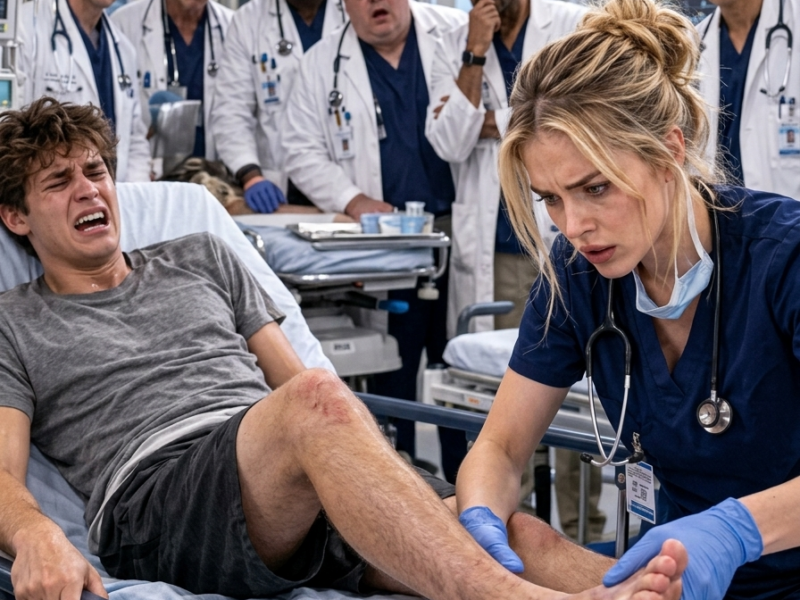
I watched the surgeon prepare to amputate my husband’s leg in a crowded Chicago trauma room while everyone dismissed the shaking janitor in the corner
The sharp, metallic smell of disinfectant could not hide the iron thick stench of raw blood. I leaned against the cold tiles of Trauma Bay 4 in Chicago General, my palms pressed flat against the wall just to keep my body upright. My hands were stained crimson—Daniel’s blood, drying dark and sticky in the creases of my knuckles.
Three hours earlier, my life had been split into a clear before and after. In the before, Daniel was laughing in our kitchen, kissing my cheek as he grabbed his jacket to run a quick errand. In the after, a three-ton delivery truck had run a red light on Michigan Avenue, violently pinning Daniel against a concrete barrier.
“Get two more units of O-negative in here!” a voice shouted.
The trauma room was an arena of controlled chaos. Nurses darted back and forth, tearing open sterile packaging with their teeth. Machines beeped in erratic, high-pitched shrieks. At the center of the storm lay my husband. His face was ash-gray, his lips tinged with blue, his chest heaving under a clear plastic oxygen mask. His left leg below the knee was barely recognizable—a jagged, mangled twisted mess of torn denim, shattered bone, and dark, pooling blood.
“Can he keep his leg?” I whispered. My voice was so weak, so entirely stripped of authority, that it didn’t even bounce off the walls. I tried again, louder, stepping forward into the frantic orbit of doctors. “Please… Dr. Miller… can you save his leg?”
Dr. Aris Miller, the chief trauma surgeon on shift, did not look at me. His gloved hands were buried knee-deep in gauze, trying to pack a massive hemorrhage. His brow was slick with sweat, his eyes cold and singularly focused.
“We’re running out of time, Mrs. Vance,” he said, his tone blunt, carrying the icy pragmatic weight of a man who dealt in survival odds rather than hope. “The tissue is pale. The limb is hypoxic. If we don’t amputate immediately, toxin buildup from the dying muscle will hit his kidneys the moment we restore systemic pressure. He’ll go into cardiac arrest on the table.”
“No… please, there has to be another way,” I begged, tears blinding me. Daniel was a master woodworker. His legs, his balance, his hands—they were his livelihood, his identity.
“Wheel in the portable Doppler and prepare a guillotine amputation set,” Miller commanded the room, ignoring my pleas entirely.
A nurse rolled a heavy grey monitor to the side of the bed. She greased a ultrasound wand and pressed it against the top of Daniel’s foot, then his ankle. Silence. The machine gave off no rhythmic whoosh-whoosh of arterial blood flow. Just dead, flat static.
The nurse shook her head, looking up at Miller. “There’s no pulse. The foot is icy cold. Total ischemia.”
My knees nearly gave out beneath me. I grabbed the edge of a stainless steel tray, rattling the scalpels. “Daniel…” I sobbed, watching his chest rise and fall in shallow, desperate gasps. He was slipping away, bit by bit, right before my eyes.
The surgical team moved with mechanical precision. Miller pulled on a fresh pair of heavy-duty gloves, reaching for a thick, curved bone saw sitting on the tray. “Sedate him further. Let’s get him to OR 3 before he goes into DIC.”
Amidst the screaming alarms, the heavy footfalls of medical staff, and my own ragged sobbing, there was a quiet, rhythmic sound near the doorway.
Squeak. Swish. Squeak. Swish.
It was the sound of a heavy yarn mop being dragged across wet linoleum.
I turned my head slightly, wiping my tears with the back of my bloody sleeve. Standing near the swinging double doors was a woman in dark green janitorial scrubs. She was in her late fifties, with deep, weathered lines etched into her bronze skin, and graying hair pulled back into a tight, severe bun. Her yellow rubber gloves gripped the stainless steel handle of her mop bucket so tightly her knuckles were white.
She had stopped mopping entirely. Her eyes weren’t on the blood on the floor. She was staring intently, unnaturally, at Daniel’s crushed leg.
“Excuse me,” she said.
Her voice was low, carrying a thick, unmistakable Eastern European accent. It was barely a murmur, completely drowned out by a nurse shouting out vital signs.
Nobody answered her. To the surgical team, she was invisible—a piece of background furniture whose only job was to erase the messes they left behind.
She stepped closer, leaving a wet trail of soapy water in her wake. She pushed her mop cart directly into the threshold of the trauma bay, blocking the pathway to the operating room.
“Check behind his knee,” she said. This time, her voice cut through the noise with a cold, terrifying clarity.
A young surgical resident snapped his head around, his face reddening with instant annoyance. “Ma’am, you need to clear the doorway! We have a critical patient!”
“Check behind his knee,” she repeated, not shifting her gaze from the wound.
“We already did a distal check!” the resident snapped back, waving a hand dismissively. “There’s no popliteal or pedal pulse. Step back, now!”
“No,” she said softly, taking another step forward until she was right beside the Doppler machine. “You checked the wrong place. Look at the angle of the tibia. Look at the monitor.”
Dr. Miller froze, his hand suspended inches over the saw. He glared at the janitor, his eyes blazing with the quiet fury of an elite surgeon whose authority had just been breached by an unqualified intruder. “Ma’am, if you don’t step out of this room this instant, I will have security escort you off hospital property permanently.”
The woman didn’t flinch. She pointed a yellow-gloved finger directly at the bedside telemetry screen, ignoring Miller’s threat completely. “His systemic blood pressure is resting at 110 over 70. His pulse rate is 88. If his main femoral or popliteal artery were completely severed or thrombosed in a high-energy crushing impact, his pressure would be dropping like a stone. It isn’t. He isn’t bleeding out internally anymore.”
The room suddenly went dead silent. The nurses stopped moving. The resident blinked, looking rapidly between the janitor and the cardiac monitor.
Miller’s jaw tightened. He turned his head slowly, looking at the vitals display. 110 over 70. Stable. Unnaturally stable for a man with a supposedly dead limb and a completely severed major vessel.
Slowly, without a word, Miller dropped the saw. He leaned over Daniel’s leg, his thick fingers moving past the shattered bone fragments, probing deeper into the bloody tissue behind the posterior knee joint. He pressed firmly, feeling along the path of the popliteal artery.
His expression changed instantly. The arrogant irritation melted away, replaced by a sudden, sharp look of intense shock.
“Get vascular surgery down here!” Miller roared, his voice cracking with urgent adrenaline. “Now! Get Dr. Chen in here right this second!”
“What is it?!” I cried out, stepping closer. “What’s wrong?!”
“Someone cut open this temporary splint!” Miller yelled at the resident, ignoring my question as he dove back into the wound. “Get me a retractor and a sterile flashlight! Hurry!”
The resident frantically sliced through the fiberglass wrap. Miller reached deep into the lacerated flesh with a pair of long medical forceps. The room held its breath.
Clink.
The metal instrument made a sharp, distinct clicking sound against something hard inside Daniel’s leg. Miller carefully withdrew the forceps. Clamped between the steel tips was a jagged, inch-long shrapnel fragment of pulverized steel from the truck’s bumper.
“It was acting as a valve,” Miller whispered, his voice trembling slightly. “The metal fragment didn’t sever the artery. It drove itself straight into the arterial sheath, pinching it entirely flat against the bone spur. It cut off circulation to the lower foot completely, creating a false ischemic reading, but the vessel itself is intact. The tissue below isn’t dead—it’s just starved of blood!”
He looked up at the wall, his eyes wide. “If I had cut that leg off, I would have sliced right through a viable, repairable popliteal artery. He didn’t lose the leg.” He turned his eyes slowly toward the monitor. “Not yet.”
Miller turned around, his chest heaving, his eyes searching the room frantically. “Where is she? How did she…”
He stared at the doorway.
The surgeon, the residents, and I all looked toward the threshold. The yellow mop bucket was still there, a small puddle of suds slowly spreading across the gray floor. But the woman was gone.
The next four hours passed in a blurred fog of agony and exhaustion. I sat on a hard vinyl chair in the waiting room, staring at the clock on the wall. Every second felt like a drop of acid falling onto my nerves.
Around 3:00 AM, the heavy double doors finally swung open. Dr. Miller walked out, pulling off his surgical cap. His surgical scrubs were soaked in sweat, and his eyes carried a deep, humbled fatigue.
He walked directly toward me. I stood up so fast my head spun. “Is he…?”
“He’s stable, Mrs. Vance,” Miller said softly. The cold, distant authority he had carried in the trauma bay was completely gone. He reached out and gently took my hand. “The vascular team successfully removed the metal fragment and performed a bypass repair on the damaged section of his artery. Blood flow was restored to his lower leg within twenty minutes of our conversation.”
I let out a ragged, sob-choked breath, collapsing back onto the chair. “So… he keeps it?”
“He keeps his leg,” Miller confirmed, taking a seat beside me. He rubbed his face with both hands, staring down at the floor. “I’ve been a trauma surgeon for nineteen years, Elena. I was seconds away from taking that saw to your husband’s limb. I would have maimed him for life based on a false reading. If that woman hadn’t spoken up…”
He trailed off, shaking his head in disbelief. “I asked the nursing supervisor about her. Her name is Marya. She’s worked night shifts here for six months through a third-party janitorial contractor. Nobody really talks to her. She just does her work and leaves.”
“I need to see him,” I whispered.
“He’s in the ICU, post-op,” Miller said. “He’s still heavily sedated, but you can go in.”
When I walked into Daniel’s room, the steady, rhythmic beep-beep-beep of the heart monitor was the most beautiful sound I had ever heard. He was swimming in narcotics, his face pale, but he was breathing smoothly. Beneath the thick white blankets, I could clearly see two long shapes—two legs. I pulled back the sheet gently and laid my hand against his left foot.
It was warm.
I buried my face in his bedsheets and cried until my ribs throbbed, letting out all the terror, grief, and sheer relief that had been tearing me apart since the phone call came.
I didn’t sleep that night. I sat by Daniel’s bed, holding his limp fingers, watching the monitor, waiting for the morning light to breach the hospital blinds. I couldn’t stop thinking about the woman. Who was she? How could a janitor spot an obscure arterial occlusion that a chief of trauma surgery had completely overlooked?
At 7:00 AM, as the nursing shifts were changing, I left Daniel’s room to search for her. I walked down the sterile, endless corridors of the hospital’s basement levels, asking every staff member I passed. Finally, a laundry worker pointed me toward the long, quiet hallway leading to the morgue and administrative storage.
Down at the end of the corridor, I saw the familiar yellow bucket.
Marya was pushing her mop back and forth across the white tiles, her posture hunched, her movements methodical and robotic. She didn’t look up as my footsteps echoed down the hall.
“Marya?” I called out softly.
She paused, her shoulders stiffening under her green uniform. Slowly, she turned around. Up close, in the harsh fluorescent lighting of the hallway, she looked even more fragile than she had in the trauma bay. Deep, dark circles carved into the skin beneath her hollow eyes.
“I’m sorry,” she said quietly, her accent heavy. “I am not supposed to talk to family members. I go now.”
“No, please! Wait!” I rushed forward, stopping a few feet away from her. “Please don’t leave. I… I just wanted to say thank you.”
She stared at me, her brown eyes completely devoid of warmth or triumph. They were cold, flat, and filled with a crushing, infinite sadness.
“Your husband,” she said flatly. “Is he…?”
“He’s alive. And he kept his leg,” I said, tears brimming in my eyes again. “The surgeon said if you hadn’t forced them to look, they would have amputated it within minutes. You saved his life, Marya. You saved our entire family.”
I reached out, impulsively trying to take her hand to squeeze it, but she pulled her hands back quickly, clutching the wooden handle of her mop like a barrier between us.
“I did nothing,” she whispered, turning her head away. “The doctors did the work.”
“That’s not true,” I insisted. “You knew exactly what to look for. You understood the vitals, the vascular pressure, the angle of the tibia. You aren’t just a janitor, are you?”
Marya stood frozen for a long moment. Her chest rose and fell in a slow, heavy sigh. She looked down at the soapy water in her bucket, watching the bubbles pop one by one.
“I was a trauma physician in Kyiv for twenty-two years,” she said quietly, her voice barely audible. “Before the war. Before everything was destroyed.”
I gasped softly. “A doctor…”
“My degrees mean nothing here,” she said, her voice dropping an octave, filled with an ancient bitterness. “No license in America. No money to take the equivalency exams. So… I clean blood off the floor instead of stopping it.”
“Why did you risk your job to speak up?” I asked. “Dr. Miller almost had you fired.”
Marya looked up at me then. For a brief fraction of a second, something raw and agonizing flickered deep within her dark eyes.
“My son,” she said, her voice trembling slightly. “He had the exact same crush injury. Five years ago. A military transport truck crushed his lower body.”
“Did… did someone save him?” I asked gently.
Marya’s face hardened. She gripped the mop handle until her knuckles clicked. “No,” she whispered. “The surgeons were in a rush. They didn’t check the pressure. They panicked. They took his leg… and he died of shock on the table two hours later.”
Her words hung in the quiet hallway like heavy stones.
“I just didn’t want another woman to hear what I heard that night,” she whispered. “I did not save your husband for him. I saved him for you.”
Before I could say another word, before I could offer her help, money, or even a proper hug, Marya grabbed the handles of her cart. She turned her back on me and pushed her cleaning equipment down the corridor, her worn sneakers squeaking rhythmically against the floor until she vanished around the corner.
Three weeks passed.
Daniel’s recovery was nothing short of a miracle. The vascular bypass had taken beautifully, and the shattered tibia had been set with titanium rods and pins. The doctors at Chicago General were astonished by his progress. After sixteen days in the inpatient ward, he was cleared to return home to begin an intensive, months-long physical therapy regimen.
Our house felt different now. The ambient anxiety of daily life had been stripped away, replaced by a profound, trembling gratitude. Every step Daniel took with his walker, every grimace of pain as he flexed his left foot, was a reminder of what we had almost lost.
Yet, I couldn’t get Marya out of my head.
Twice, during Daniel’s final week in the hospital, I had gone down to the basement to look for her. The first time, her supervisor told me she was off shift. The second time, the supervisor pulled a clipboard out and frowned.
“Marya? She put in her two weeks’ notice last Friday,” the man had told me, popping a piece of gum. “Didn’t give a reason. Just turned in her badge and walked out.”
I had felt a sharp pang of guilt. Had my constant probing made her uncomfortable? Had she gotten into trouble with hospital management for her outburst in Trauma Bay 4? I had no address for her, no phone number. She had simply vanished back into the vast, indifferent expanse of the city.
It was a chilly Tuesday afternoon in late October when the mail arrived.
Daniel was resting on the living room sofa, his elevated leg resting on a stack of plush pillows, a physical therapy guide open on his lap. I walked down to the edge of our driveway and pulled open the metal mailbox.
Inside were two utility bills, a local grocery circular, and a thick, square Manila envelope.
I paused on the porch, examining the envelope. There was no postage stamp. No return address. On the front, my name—Elena Vance—was written in crisp, dark black ink, using a precise, almost calligraphic style of handwriting.
“What is it, honey?” Daniel called out through the open screen door, hearing my lingering footsteps.
“Just mail,” I answered, tearing open the top flap of the envelope as I stepped inside.
I pulled out the contents. Inside was a single, heavy piece of cardstock, and a matte black-and-white photograph.
I looked at the photograph first. It was a high-contrast portrait taken outdoors, seemingly in a Eastern European square. In the frame stood Marya. She was younger—perhaps ten years younger—wearing a crisp white lab coat over a floral dress. Her hair was down, blowing softly in the wind, and she was smiling—a rare, radiant smile that completely transformed her face.
Standing beside her, with his arm wrapped tightly around her shoulder, was a tall, broad-shouldered young man in his early twenties. He was wearing a dark military fatigue jacket. He had thick, dark hair, a strong jawline, and a brilliant, infectious grin that crinkled the corners of his eyes.
My heart hammered against my ribs. Her son.
I stared at the young man’s face. There was something strangely familiar about him—the high cheekbones, the slight cleft in his chin. He looked like an actor, vibrant and full of unfulfilled life.
I turned the photograph over to check for a date.
On the back of the heavy photo paper, written in the same sharp, precise black ink, were two sentences.
My eyes scanned the lines. Once. Twice. A third time.
The room seemed to tilt beneath my feet. The sound of the ticking wall clock vanished, replaced by a roaring rushing noise in my ears.
The handwriting read:
She did not save your husband because she saw her son in him. She saved your husband because she recognized the man who killed her son.
My hands began to shake violently. The photograph slipped through my fingers, fluttering downward and landing face-up on the hardwood floor right beside Daniel’s crutches.
“Elena?” Daniel’s voice cut through the fog in my mind. He was looking at me from the couch, his brow furrowed in deep concern. “Elena, what’s wrong? You look like you’ve seen a ghost.”
I couldn’t breathe. I couldn’t speak. I stood frozen in the hallway, looking from the photograph on the floor to the man sitting on my sofa—my kind, gentle husband, whose past was suddenly opening up like a dark, yawning abyss beneath us.
“Elena, talk to me!” Daniel demanded, his voice laced with sudden fear as he pushed himself up into a sitting position, struggling to negotiate his heavily cast leg.
I slowly dropped to my knees and picked up the photograph. My mind was spinning into total madness. Killed her son? It made no sense. Daniel was born and raised in Naperville, Illinois. He was an architect turned custom furniture builder. He had never been in the military. He had never fought in a war. He had never even been to Ukraine or Eastern Europe in his entire life!
I walked over to the couch, my legs feeling like hollow blocks of wood. I handed him the photo and the envelope, my hand trembling so badly the paper rattled.
Daniel grabbed the photo, frowning. “Who is this? Is this… is this the woman from the hospital?”
“Turn it over,” I choked out.
Daniel flipped the photograph. As his eyes read the sharp black writing on the back, the color drained instantly from his face. His mouth fell slightly open. The color in his cheeks vanished, leaving him looking just as pale as he had on the trauma table three weeks ago.
“This… this is sick,” Daniel spat out, his voice shaking with sudden, defensive anger. “Who sent this to us?! Who wrote this vile lie?!”
“Daniel…” I whispered, sitting on the far edge of the coffee table, searching his face for any micro-expression of guilt or terror. “Do you know who that young man is? Have you ever seen him before?”
“No! Of course not!” Daniel yelled, throwing the photo down onto the table. “Elena, look at me! I build dining tables! I draw blue prints! I’ve never pulled a trigger in my life! I’ve never met this woman before she walked into Trauma Bay 4! Why would someone write this?!”
“Then why did she look at you like that?” I asked, my voice cracking as tears finally spilled over my eyelashes. “I saw her eyes, Daniel. When she looked at you on that bed… she wasn’t looking at a random patient. She was looking at you with a look that was so terrifying, so deep… it looked like hatred wrapped in grief.”
Daniel rubbed his face frantically. “I don’t know! Maybe she’s crazy! Maybe the trauma of losing her son broke her mind! People make false connections all the time when they’re suffering from severe PTSD!”
It was a logical explanation. It was the only explanation that protected the foundation of my life. But deep in my chest, a dark, cold instinct told me that a former chief trauma physician did not hallucinate identity mistakes with such cold, calculated accuracy.
I picked up the Manila envelope again. I looked deep inside the dark cardboard pocket.
There was a second piece of paper pushed flat against the very bottom of the envelope.
I reached inside and pulled it out. It was a printed printout of an official news article from a regional news outlet dated four years prior—November 12th, 2022.
The headline read: TRAGIC COLLISION ON ROUTE 14 CLAIM UNIDENTIFIED FOREIGN WORKER; INVESTIGATION CLOSED.
My eyes devoured the text.
A tragic multi-vehicle collision occurred late Tuesday night during a heavy blizzard on Route 14 near Barrington. A heavy Ford F-350 pickup truck crossed the center line on black ice, striking a compact sedan head-on. The driver of the sedan, identified as 23-year-old Ukrainian refugee and delivery contractor Viktor Kozlov, died at the scene from severe crush injuries and delayed medical assistance…
The driver of the F-350 fled the scene on foot before state troopers arrived…
My blood turned to pure ice.
Four years ago. November 2022.
I remembered that night with terrifying, crystal clarity.
It was the night of the first major blizzard of the winter. Daniel had gone out late to drop off a custom oak mantelpiece for a client in Barrington. He hadn’t returned home until 3:00 AM.
When he finally walked through our front door that night, he had been trembling violently. His clothes were soaked with melting snow. He had told me he had lost control of his truck, slid into a ditch on an isolated back road, and had to walk two miles in the freezing cold to find a tow truck. His truck had been totaled—the entire front end smashed to splinters. He had claimed he hit an oak tree.
I had believed him. I had made him warm tea, wrapped him in blankets, and helped him file the insurance claim the next morning for a single-vehicle accident.
I slowly raised my head. The living room felt utterly, suffocatingly quiet.
Daniel was staring at the news printout in my hands. The defensive anger in his eyes was gone. In its place was a naked, catastrophic, suffocating terror.
“Daniel…” I whispered, my voice barely a draft of air. “You didn’t hit a tree four years ago… did you?”
The silence stretched between us like an agonizing physical weight. I could hear the slow, rhythmic hum of the refrigerator in the kitchen, the distant rustle of autumn leaves blowing across the driveway outside. Every second of silence was a hammer blow to my heart, shattering nine years of marriage into dust.
Daniel covered his face with both hands. His shoulders began to heave. He didn’t yell. He didn’t deny it. He just started to weep—a terrible, ragged, gut-wrenching sound that tore straight out of his chest.
“It was black ice…” he sobbed, his voice muffled behind his trembling palms. “Elena, I swear to God, it was black ice! I was going thirty miles an hour… the truck just drifted. I tried to steer out of it, but the back wheels locked…”
“You hit him,” I gasped, pulling back from him as if he were a total stranger. “You hit a car… and you left him!”
“I didn’t know!” Daniel cried out, dropping his hands, his eyes wild with tears and deep, ancient guilt. “The impact… it was so violent. The air bags deployed, my horn was stuck screaming. I stumbled out of the cab into the blinding snow. His car was upside down in the ditch. I ran over to it… I tried to pull his door open, but it was smashed flat!”
He squeezed his eyes shut, shaking his head violently as if trying to erase the memory from his brain. “I screamed into the window… there was no answer. I couldn’t see anything through the smashed glass. My phone was dead… crushed in the dash console. I panicked, Elena! I was terrified! I thought… I thought if I stayed there, if I was arrested… my life was over! I ran. I walked through the blizzard until I hit a gas station…”
“He bled to death in that ditch, Daniel!” I screamed, the horror consuming me. “He was twenty-three years old! He had escaped a war zone to come here, and you left him to freeze in the dark!”
“I know!” Daniel howled, pressing his forehead against his knees. “I’ve lived in hell every single day for four years! Every time I close my eyes, I hear the sound of that metal crushing! I read the paper two days later… I saw his name, Viktor Kozlov. I tried to go to the police a hundred times, but I was a coward! I was a weak, pathetic coward!”
I backed away until my spine hit the living room wall. I looked at the man I loved, the man I had built a life with, and felt a chilling sickness in the pit of my stomach.
And then, like a lightning strike in the dark, the horrific, beautiful truth of what had happened in Trauma Bay 4 crashed over me.
Marya hadn’t been a lucky coincidence.
She had recognized the truck’s registration records during the police report four years ago. Or perhaps she had seen Daniel’s face in the news, or tracked his civil records. No—when Daniel was brought into Chicago General three weeks ago, his name and driver’s license were logged into the emergency admissions portal instantly.
Marya worked the night shift in that very department. She had seen his name on the board. She had walked into Trauma Bay 4 to look at the man who had left her only son to die on a frozen Illinois roadside four years earlier.
She had stood in the corner of that room, holding her mop, watching the blood pour out of Daniel’s shattered leg.
She had held his life entirely in her hands.
Dr. Miller had been holding the bone saw. The entire surgical team was convinced the leg was dead. All Marya had to do was stand there. All she had to do was remain silent. All she had to do was keep mopping the floor, and the man who had ruined her life would have been maimed forever—his leg cut off, his life broken, poetic justice delivered without her ever lifting a finger.
It would have been so easy. It would have been so justified.
Instead, she had pushed her mop bucket into the doorway. She had raised her voice against elite doctors. She had forced them to find the metal fragment. She had fought to save the leg of the monster who had left her boy in the snow.
“She knew,” I whispered, sliding down the wall until I sat on the floor, my hands over my mouth. “Daniel… she knew who you were the entire time.”
Daniel looked up, his tears freezing on his face. “What… what do you mean?”
“The janitor…” I sobbed, pointing a shaking finger at the photo on the table. “That woman… Marya… she is Viktor Kozlov’s mother.”
Daniel went completely rigid. His eyes dilated in absolute, unadulterated shock. “What…?”
“She recognized you,” I wept. “She knew exactly who was lying on that table. She had the power to let them cut your leg off. She could have let you suffer… and she saved you instead.”
Daniel stared at the photograph of the young man smiling in the sunlight. A heavy, agonizing sob ripped through his chest, bigger and deeper than before. He dragged himself off the sofa, collapsing onto his knees on the carpet, reaching out with a trembling hand to touch the image of the boy he had left behind.
“Why…?” Daniel wept, clutching the photo to his heart, his body trembling with the weight of a grace he did not deserve. “Why would she do that for me…?”
I remembered what Marya had whispered to me in that quiet basement corridor beside the morgue: I just didn’t want another mother to hear what I heard.
She hadn’t saved Daniel out of forgiveness. She hadn’t saved him out of love for a stranger. She had saved him because she refused to let her own soul be dragged down into the same darkness that had consumed the world. She had chosen mercy over vengeance, returning life for death, leaving us both with a debt that could never, ever be repaid.
Two days later, Daniel walked into the Cook County Police Department on his crutches and surrendered himself to the authorities, confessing in full to the hit-and-run of November 2022.
As he was led away in handcuffs, awaiting trial, I stood on the steps of the courthouse, looking up at the cold grey Chicago sky. I knew our old life was over. I knew the years ahead would be filled with prison visits, legal battles, and lingering shame.
But as I pulled my coat tightly around myself, I reached into my pocket and touched the small, square photograph of Marya and her son.
She had given my husband his leg back. But far more than that, she had given him the chance to finally pay his debt—and in doing so, she had saved whatever was left of his soul.
The end.









