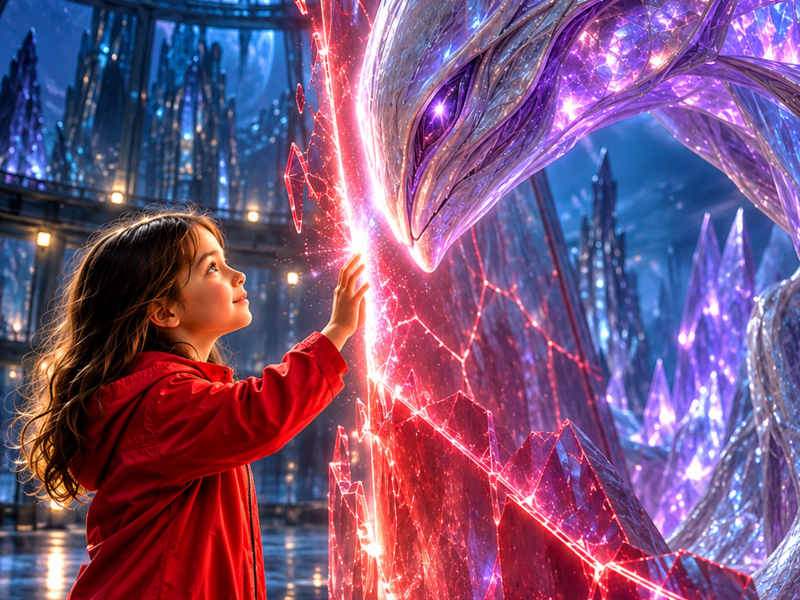
“I watched the station director order my eight-year-old daughter locked in medical quarantine after she touched a mysterious crystal creature
Icaros’s hand stopped inches from the emergency override.
“Director,” I whispered, “if you lower that barrier, you may not be able to raise it again.”
He didn’t look at me.
His gray quills stood rigid along the back of his head, and every muscle in his long frame seemed locked in place.
“Your daughter is asking me to expose four thousand people to something we do not understand.”
“No,” Ada said.
Her small voice cut through the Lumari’s rising song.
“They’re asking you to listen.”
The station shook again.
A shower of sparks burst from the ceiling above us, and the emergency lights flickered red.
Somewhere beyond the habitat, an alarm announced that the reactor core had reached its final safety threshold.
We had minutes. Perhaps less.
I looked at my daughter.
Her yellow jumper was too large at the sleeves, her dark curls stuck to her forehead, and her brown eyes were fixed on the creatures beyond the barrier.
She looked frightened.
But she wasn’t looking away.
“Director,” I said, “every adult who touched a Lumari before Ada fell into a trance because they were overwhelmed by what they received. Maybe we misunderstood what happened.”
Icaros finally turned toward me.
“And you believe an eight-year-old understands them better than our entire research division?”
“I believe she understands something we refused to hear.”
The Lumari pulsed brighter.
The little one Ada had touched floated forward, its crystalline body glowing a soft lilac.
It tilted toward her, just as it had the first time.
Ada lifted her hand.
“They’re scared, Mama.”
My throat tightened.
“Of us?”
She shook her head.
“Of what is happening to the station.”
Then she pressed her palm against the barrier.
The lilac creature answered with three bright flashes.
Up three notes.
Down two.
Then the long, wobbling note.
The melody I had heard through the habitat walls for weeks.
Ada closed her eyes.
“It’s Bell,” she whispered.
Icaros frowned.
“Bell?”
“That’s its name.”
The little Lumari spun once, scattering tiny sparks of light.
For the first time, I saw something that looked almost like joy in a being made of crystal.
Then every Lumari began to sing.
The sound rolled through the habitat like a thousand voices speaking at once.
My knees weakened.
Images flooded my mind.
A dark corridor.
A trembling metal pipe.
A glowing red line.
A circle surrounded by smaller circles.
I staggered backward, grabbing the railing.
Icaros dropped to one knee.
His four-fingered hands covered his ears.
“Stop it!” he shouted. “Make them stop!”
Ada didn’t move.
“They aren’t trying to hurt us.”
She opened her eyes and looked directly at him.
“They’re showing me where the station is broken.”
The director stared at her.
“Can you understand what they’re saying?”
Ada nodded slowly.
“Not with words.”
She pointed toward the reactor section of the station.
“They’re showing me a picture.”
I knelt beside her.
“What picture, sweetheart?”
“A long metal tunnel with a crack in it. Something is leaking out. There’s a bright circle at the end, and it’s shaking.”
My heart sank.
The coolant line.
“Can you show us where?”
Ada looked back at Bell.
The little Lumari flashed twice, then drifted toward the far side of the habitat.
It moved in a slow circle.
The others followed, arranging themselves into a pattern.
One by one, their bodies lit up.
A map formed in the air.
Not a map of the habitat.
A map of the reactor.
I recognized the main coolant channel, the magnetic bearing chamber, and the emergency containment coils.
But there was something else.
A section of the coolant line had turned bright red.
A tiny point of light blinked beside it.
“Junction fourteen,” I whispered.
Icaros stared at the floating pattern.
“That junction is inaccessible.”
“Why?” I asked.
“Because the coolant pressure is too high. Anyone entering that maintenance passage would be killed within seconds.”
Ada watched the Lumari.
“They say it isn’t the pipe.”
“What do they mean?”
She swallowed.
“They say the pipe is only where the hurt is showing.”
The station lurched so violently that I fell against the railing.
A warning appeared across the habitat display.
REACTOR STABILITY: 9%
TIME TO CRITICAL FAILURE: 04:12
Icaros rose.
“We need to evacuate.”
“The escape pods are jammed,” I reminded him.
“Then we seal the habitat and attempt a manual shutdown.”
Ada shook her head.
“No.”
“Child, this is not a discussion.”
“They’re saying if you shut it down now, the station will break apart.”
Icaros’s expression hardened.
“And if we do nothing, the reactor will explode.”
Ada looked at me.
“Mama, they know how to fix it.”
I held her small hand.
“Then ask them to show us.”
She turned toward Bell.
The little Lumari drifted closer.
Its lilac light spread across Ada’s fingers, and a new pattern appeared.
Three coils.
One after another.
A circle.
Then another circle.
Then the final one.
I understood the shape, but not the meaning.
“Are they telling us to activate the containment coils?”
Ada nodded.
“Not all at once.”
She pointed to the first coil.
“First this one.”
Then the second.
“Then this one.”
Finally, she touched the third.
“And this one last.”
Icaros shook his head.
“That sequence is impossible. The coils are designed to activate simultaneously.”
“Maybe that’s why they keep failing,” I said.
He looked at me sharply.
I forced myself to continue.
“The magnetic bearings are unstable. If all three coils engage together, they may create an uneven field. Sequential activation could stabilize the rotation.”
“Could,” he repeated.
The director glanced at the countdown.
“Or it could destroy the reactor immediately.”
Ada’s fingers tightened around mine.
Bell pulsed again.
The other Lumari answered.
This time, the pattern changed.
A bright circle appeared.
Then three smaller lights.
Then a line connecting them.
Ada frowned.
“They say they tried to tell the others before.”
“Who?” I asked.
“The people who touched them.”
My stomach twisted.
The adults who had fallen into those trances hadn’t been attacked.
They had been shown something.
Something too vast for their minds to hold.
“They weren’t trying to take over their thoughts,” I whispered.
“They were trying to share what they knew.”
Ada nodded.
“They have been waiting for someone who could hear all of it without getting lost.”
I looked at Icaros.
He stood completely still.
For a moment, the alarms seemed distant.
Then he reached for his communicator.
“Engineering control, this is Director Icaros. Prepare to override the containment coils manually.”
A voice crackled through the speaker.
“Director, the control system is offline. We have no access to the coil sequence.”
“Then restore manual access.”
“Sir, the maintenance bridge is already losing pressure.”
Icaros closed his eyes.
“How long?”
“Two minutes before the reactor reaches critical failure.”
The countdown changed.
02:07.
I looked at the Lumari.
Their lights were fading.
Bell drifted backward, its lilac glow trembling.
“They’re getting tired,” Ada whispered.
I understood then.
The creatures had been sending their knowledge into the station’s systems for weeks.
They had been trying to help us.
And we had locked them behind a wall.
“Can they do it?” I asked Ada.
She listened.
Her face changed.
“They can hold the reactor steady for a little while.”
“How long?”
She closed her eyes.
“Not long.”
Icaros moved toward the barrier controls.
“Open the screen.”
A technician’s voice burst through his communicator.
“Director, you cannot be serious.”
“Open it now.”
“The containment protocol—”
“Has failed us!” Icaros thundered.
“Open the screen!”
The pale blue barrier flickered.
For one terrible second, I thought it would hold.
Then it vanished.
The Lumari poured into the habitat.
Thousands of crystalline bodies drifted through the air, their lights reflecting across the walls like stars.
I stepped in front of Ada instinctively.
But Bell floated straight toward her.
It touched her forehead.
A wave of warmth passed through me.
Not a voice.
Not a command.
A feeling.
A deep, overwhelming sense of being welcomed.
Then the Lumari moved.
They formed a bright path toward the reactor access corridor.
Ada took my hand.
“They want us to follow.”
Icaros hesitated.
“Taking her into the reactor section is out of the question.”
“Then stay here,” I said.
He stared at me.
I had never spoken to him that way before.
But I was done asking permission to protect my daughter.
“We have four minutes to save this station. The Lumari are offering us a way. We either follow it, or we die behind our procedures.”
Icaros looked at Ada.
Then he lowered his head.
“Proceed.”
We ran.
The corridor outside the habitat was filled with drifting smoke.
Emergency lights flashed against the walls, and the air smelled of overheated metal.
Lumari moved ahead of us, illuminating the safest route.
Every few meters, one would stop and pulse brightly.
Ada watched them carefully.
“Left,” she said.
We turned.
“Now right.”
A pressure door began closing ahead of us.
Icaros threw himself against the manual control.
“Go!”
I pushed Ada through the narrowing gap.
He followed just before the door slammed shut.
We reached the reactor control chamber with less than ninety seconds remaining.
The room was enormous.
Three containment coils surrounded the reactor core, each suspended inside a magnetic frame.
The core itself pulsed red, its light beating like a dying heart.
A cracked coolant pipe ran along the far wall.
White vapor poured from the fracture.
The entire structure trembled.
The engineering team stood around the control console, helpless.
A technician turned toward us.
“Director! The reactor is past the safe threshold!”
Icaros pointed to the coils.
“Can you activate them manually?”
“Not in sequence. The system only accepts simultaneous activation.”
Ada stepped forward.
“That’s wrong.”
The technician stared at her.
“Who brought a child into the reactor chamber?”
I ignored him.
“Show us the manual controls.”
The engineer pointed to three separate panels.
“One for each coil. But the timing has to be exact.”
Ada looked at Bell.
The small Lumari hovered above her shoulder.
Its lilac light pulsed three times.
She watched the other creatures gather around the reactor.
“They’ll show us when.”
I knelt in front of her.
“Listen carefully. Are you sure?”
Her eyes filled with tears.
“No.”
The answer broke my heart.
She was eight years old.
She should have been thinking about school, stories, and what to eat for dinner.
Not the precise timing of a reactor that could destroy four thousand lives.
I touched her cheeks.
“You don’t have to do this alone.”
She nodded.
“I know.”
Then she turned toward the Lumari.
The song began again.
This time, I could hear more than sound.
A sense of rhythm moved through my chest.
Three pulses.
A pause.
Three pulses.
A longer pause.
The first coil glowed.
“Now!” Ada shouted.
The technician slammed his hand onto the first control.
The magnetic frame flashed blue.
The reactor shuddered.
“Second!” Ada cried.
A second Lumari moved into position.
Its body turned bright white.
The second coil activated.
The red glow inside the reactor dimmed.
For one hopeful second, I thought it had worked.
Then a violent explosion rocked the chamber.
A support beam snapped overhead.
Metal crashed down between Ada and me.
“Ada!”
I lunged forward.
She was on the other side, crouched beside Bell.
The little Lumari’s light had turned almost completely dark.
A shard of metal had struck its crystalline body.
A thin crack ran across its surface.
Ada reached for it.
“Don’t touch it!” I screamed.
But she already had.
The entire chamber filled with light.
Not the harsh white of the reactor.
A soft lilac glow.
The Lumari song changed.
The third coil began to vibrate.
Ada looked at me through the smoke.
“Mama, they’re scared.”
“Tell them we’re here!”
“They say the last one needs us.”
“What does that mean?”
She looked toward the control panel.
“The third coil can’t turn on until the reactor stops fighting it.”
Icaros rushed to the console.
“How do we stop it?”
Ada pointed at the cracked coolant pipe.
“They say the pressure has to be released first.”
The engineer shook his head.
“That’s impossible. The release valve is inside the maintenance tunnel. The temperature is lethal.”
I looked at the reactor.
Then at the engineer.
“Is there another way?”
He hesitated.
“There’s an emergency purge lever outside the tunnel. But it hasn’t been tested since the station was built.”
“Where?”
He pointed to a small red handle behind the reactor support column.
Icaros ran toward it.
The moment he touched the handle, the floor buckled.
He fell hard against the column.
“Director!”
He tried to stand, but one leg gave way.
The countdown flashed.
00:38.
The engineer shouted, “We need someone to pull that lever!”
I looked at the handle.
It was only a few meters away.
But a wall of superheated vapor separated us from it.
The Lumari moved closer.
Their lights flickered in a pattern I couldn’t understand.
Ada stared at them.
Then she looked at me.
“They can make a path.”
My blood ran cold.
“What kind of path?”
She pointed to the vapor.
“They can cool it.”
The Lumari gathered in front of the broken pipe.
Their bodies began to glow brighter and brighter.
The vapor slowed.
A narrow corridor opened through the heat.
“Ada, no,” I said.
She was already moving.
I caught her arm.
“Stay behind me.”
She shook her head.
“They need me to tell them when.”
I wanted to refuse.
I wanted to carry her out of there and lock every door between her and danger.
But the reactor was dying.
And for the first time, I understood that protecting her did not mean preventing her from being brave.
It meant standing beside her when she was.
We ran together.
The heat pressed against my skin.
The Lumari formed a shimmering tunnel around us, their bodies absorbing the energy pouring from the broken line.
Bell drifted beside Ada.
Its cracked surface glowed faintly.
“Now!” Ada shouted.
I reached the emergency lever.
It wouldn’t move.
I pulled with both hands.
Nothing.
“It’s stuck!”
Behind us, Icaros struggled to his feet.
“Use the release latch beneath it!”
I dropped to my knees.
There was a small metal catch under the handle.
I pulled it.
The lever moved.
A deafening roar filled the chamber.
The coolant pressure dropped.
The red glow inside the reactor faded to orange.
“Third coil!” Ada shouted.
The final Lumari surged toward the magnetic frame.
Bell moved with them.
Its lilac light flashed once.
Then again.
Then the long, wobbling note.
The third coil activated.
For a heartbeat, everything went silent.
The reactor core stopped shaking.
The magnetic frames aligned.
The red warning lights disappeared one by one.
Then the entire station gave a deep, steady hum.
The countdown vanished.
A new message appeared across the control display.
REACTOR STABLE.
COOLANT PRESSURE NORMAL.
MAGNETIC BEARINGS ALIGNED.
Nobody moved.
Nobody spoke.
The engineer slowly lowered his hands.
Icaros stared at the screen as if he no longer trusted his own eyes.
“We’re alive,” someone whispered.
Then the chamber erupted.
People shouted.
Some cried.
Others dropped to their knees.
I didn’t hear any of it.
I was looking at Ada.
She stood in the middle of the reactor chamber, her hands resting against Bell’s cracked body.
“Is it okay?” I asked.
She didn’t answer immediately.
Her eyes were closed.
The Lumari gathered around her.
Their lights softened.
After a moment, she opened her eyes.
“Bell says it’s tired.”
I knelt beside her.
“Is it hurt?”
She nodded.
“But not forever.”
I gently touched Bell with one finger.
A faint lilac light spread across its surface.
For the first time, I felt something like a thought.
A small, simple feeling.
Thank you.
I pulled my hand back, tears filling my eyes.
“You’re welcome,” I whispered.
Icaros approached us.
His usual commanding posture was gone.
He looked smaller somehow.
More uncertain.
“Dr. Mensah.”
I turned.
He lowered his head.
“I owe you and your daughter an apology.”
I looked at the Lumari surrounding us.
“For what?”
“For treating them as a threat because we could not understand them. For keeping them behind a barrier. And for ignoring every warning they tried to give us.”
His gaze moved to Ada.
“I owe you the greatest apology, young one.”
Ada studied him.
“Are you going to put them back in the cage?”
“No.”
“Promise?”
Icaros looked at the Lumari.
Then he turned toward the engineering team.
“Effective immediately, all containment barriers around the Lumari are to remain disabled. No experiments, no contact restrictions, and no attempts to separate them from the habitat.”
He paused.
“They are not specimens. They are our neighbors.”
Ada smiled.
It was the smallest smile.
But it changed the room.
The next few days passed in a blur.
The reactor required repairs.
The damaged coolant line was replaced, and the magnetic bearings were recalibrated.
Every department on Vellum Ring began reviewing its records of previous Lumari encounters.
We discovered that the adults who had fallen into trances had not been harmed.
They had received enormous amounts of information all at once.
Their minds had simply needed time to process it.
One by one, those people woke from their long sleep.
And one by one, they remembered fragments.
A warning about a failing air recycler.
A pattern showing a dangerous pressure buildup.
A message about a structural weakness in the outer ring.
The Lumari had been trying to help us for years.
We had mistaken their kindness for an attack.
A week after the reactor crisis, the central habitat held its first open gathering.
There were humans, Thesari, and representatives from all eleven species who lived aboard the station.
No security barriers divided us.
The Lumari floated freely among the crowd.
Some children laughed as tiny crystals danced above their heads.
Others sat quietly, listening to the melodies.
Ada stood beside me in her yellow jumper.
Bell hovered near her shoulder.
Its crack had almost disappeared.
“Are you going to give a speech?” I asked.
She shook her head.
“I don’t know what to say.”
“You don’t need to say anything.”
She looked up at me.
“Can I ask them something?”
“Of course.”
She turned toward the Lumari.
“Can you sing so everyone can hear you?”
The creatures began to glow.
Their song filled the habitat.
This time, nobody collapsed.
Nobody screamed.
The sound was gentle.
A melody of three rising notes, two falling notes, and one long, wobbling note.
The entire crowd fell silent.
Then the station’s translation system flickered.
A voice emerged from the speakers.
It was not human.
It was not mechanical.
It sounded like sunlight passing through glass.
“We hear you.”
A woman near the back began to cry.
A Thesari engineer lowered his head.
Even Icaros stood motionless, his gray quills slowly relaxing.
Ada looked at Bell.
“Did you say that?”
Bell flashed lilac.
Ada laughed.
“That’s not what I asked.”
The little Lumari spun happily.
For the first time in its existence, it seemed to understand a joke.
Months later, the central habitat looked different.
The pale blue screens were gone.
In their place were gardens, pools of warm light, and crystal formations that grew naturally along the walls.
The Lumari had become part of our daily lives.
They helped us understand the station’s systems, while we helped them explore the world beyond their habitat.
Our scientists no longer tried to force communication.
They learned to wait.
They learned to listen.
And they learned that understanding another life-form sometimes began with accepting that it might think in ways we could never fully comprehend.
Icaros created a new position on the station’s council.
It was called the Office of Interstellar Understanding.
Ada was named its first honorary envoy.
She was still eight years old.
She still forgot to put her shoes away.
She still asked a thousand questions before breakfast.
But now, when she walked through the central habitat, the Lumari followed her like a constellation.
One evening, I found her sitting beneath the observation dome.
The dead star hung outside, surrounded by a faint ring of silver dust.
Bell floated beside her.
“What are you doing?” I asked.
“Listening.”
“To what?”
She smiled.
“The station.”
I sat beside her.
For a while, neither of us spoke.
Then Ada leaned against my shoulder.
“Mama?”
“Yes?”
“Do you think they were lonely before we met them?”
I looked at the Lumari drifting through the gardens.
“I think they were.”
She considered that.
“I’m glad we can hear them now.”
I kissed the top of her head.
“So am I.”
Bell drifted closer.
Its lilac light pulsed three times.
Up three notes.
Down two.
Then the long, wobbling note.
I smiled.
The sound no longer frightened me.
It felt like a greeting.
Like a promise.
Like the beginning of a friendship that had been waiting a very long time.
And as I watched my daughter laugh with a creature made of living crystal, I finally understood what the Lumari had been trying to teach us all along.
The universe was not silent.
We had simply been listening for the wrong kind of voice.
THe end.









