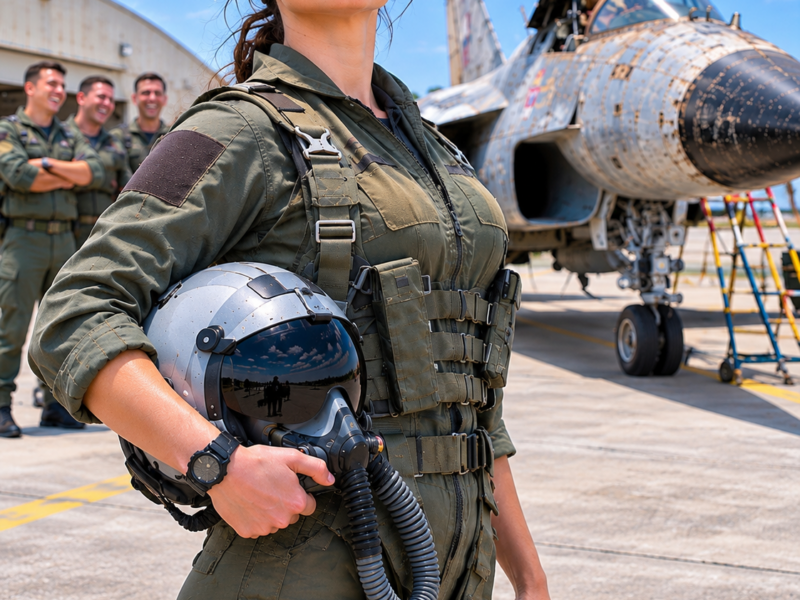
“I watched the squadron’s most arrogant pilot laugh as Colonel Hayes handed me the keys to a thirty-year-old fighter jet that everyone considered scrap metal
“Captain Bennett, are you still with me?”
Kane’s voice came through my headset again.
I forced myself to breathe slowly.
“Viper Two, I’m here.”
My eyes moved between the radar display and the aircraft’s position outside my canopy.
Something wasn’t right.
Kane had changed his approach deliberately.
He wasn’t simply trying to gain a firing position. He was pushing me toward the same kind of high-pressure maneuver that had preceded Sarah Mitchell’s crash three years earlier.
I knew that maneuver.
I’d studied it hundreds of times.
I’d also spent three years wishing I could forget it.
“Major Kane, what exactly are you trying to prove?”
His answer came almost immediately.
“That some pilots shouldn’t be in the air, Captain.”
I tightened my grip on the controls.
There it was.
The same judgment he’d carried since the investigation.
But this time, I wasn’t going to let his opinion decide how I flew.
“Then watch closely, Major.”
I adjusted my position and focused on the engagement.
The old F-15 responded with a familiar vibration through the control stick.
I knew that vibration.
I knew the slight delay in the left engine.
I knew exactly how much the aircraft could give me.
Kane had a newer fighter.
I had three years of experience studying every weakness and every strength of the aircraft beneath me.
And I was finally beginning to trust myself again.
I didn’t answer him.
Kane pushed his aircraft into another turn, forcing me to make a decision.
For a few seconds, the mountain peaks seemed to rise toward my canopy.
I remembered the Pacific.
I remembered Sarah.
Then I heard a familiar voice in my headset.
“Captain Bennett, Falcon Ridge Control. Your altitude is stable. Continue the evaluation.”
It was Colonel Hayes.
His voice brought me back to the present.
I checked my instruments again.
Kane was trying to make me react emotionally.
He wanted me to repeat the mistake he believed I had made three years earlier.
But there had been no mistake.
I knew that now.
I adjusted my position and refused to chase his aircraft into a maneuver that would favor its superior technology.
Instead, I waited.
Kane came around again.
His aircraft was faster, but speed alone didn’t guarantee a victory.
I knew the old Eagle’s response better than I knew my own morning routine.
I anticipated his next movement and repositioned.
For a brief moment, our aircraft crossed at an angle that gave me a clear simulated firing opportunity.
“Fox Two. Simulated.”
The judges marked the pass.
Kane immediately responded.
“Not confirmed.”
He wasn’t ready to concede.
He pulled into a climb, using the superior thrust of his F-15EX.
I watched him disappear above my field of view.
The old aircraft vibrated as I followed within the approved training parameters.
I didn’t try to match his aircraft’s performance.
I didn’t need to.
I watched the direction of his turn, anticipated where he would return, and positioned myself accordingly.
When he came back into view, I had the advantage.
“Fox Two. Simulated.”
There was silence.
Then Kane’s voice came through.
“Kill confirmed.”
I exhaled.
The engagement was over.
We returned to Falcon Ridge and landed separately.
When I climbed down from Jet 084, my knees were shaking.
Dee was waiting beside the ladder.
She looked at my face.
“Well?”
I removed my helmet.
“She did it.”
Dee smiled.
“No, Captain. You did.”
Across the flight line, Kane was walking toward us.
He stopped several feet away.
For a moment, he looked at the old aircraft rather than me.
“I underestimated that jet,” he said.
I wiped the sweat from my forehead.
“You underestimated its pilot.”
He nodded slowly.
Then he extended his hand.
“Good flying, Captain.”
I shook it.
“Thank you, Major.”
I thought that would be the end of it.
But Kane didn’t walk away.
Instead, he looked toward the command building.
“There’s something we need to discuss.”
I frowned.
“What?”
“The Mitchell incident.”
My fingers tightened around my helmet.
“What about it?”
He glanced at Dee, then back at me.
“Not here.”
Before I could respond, Colonel Hayes approached.
“Major, my office. Now.”
Kane nodded.
Then Hayes looked at me.
“Captain Bennett, I want you there too.”
I followed them inside.
The colonel closed his office door and placed a folder on the desk.
It was an old folder.
I recognized the date immediately.
Three years earlier.
The Mitchell incident.
My stomach tightened.
Hayes opened it.
“Major Kane has requested that the original safety review be reopened.”
I looked at Kane.
“Why?”
He stood with his hands behind his back.
“Because there was information that wasn’t properly included in the original board discussion.”
I stared at him.
“What information?”
Hayes turned a page.
“A maintenance discrepancy was recorded on Lieutenant Mitchell’s aircraft before the training exercise.”
I felt the blood drain from my face.
“What?”
The colonel continued.
“The aircraft had experienced intermittent hydraulic pressure fluctuations during an earlier ground test. The maintenance team recommended additional inspection before the next training flight.”
I remembered Sarah mentioning a warning light before we took off.
She had said it was probably nothing.
I had asked whether maintenance had cleared the aircraft.
She told me the crew chief had signed the paperwork.
At the time, I hadn’t known anything else.
“Why wasn’t that in the final report?” I asked.
Hayes looked toward Kane.
The major lowered his eyes.
“I was the operations officer responsible for reviewing the training schedule that morning.”
I said nothing.
Kane continued.
“The aircraft had been inspected, and the discrepancy was marked as resolved. I accepted that assessment.”
“You knew about the warning?”
“Yes.”
“And you never told the board?”
He looked directly at me.
“I should have.”
The room seemed smaller.
I had spent three years believing that I had somehow failed Sarah.
Now I was learning that the aircraft had already shown signs of trouble before we entered the sky.
Hayes placed another document on the desk.
“This isn’t a conclusion, Captain. We still need to establish exactly what happened.”
I looked at Kane.
“Why are you telling me now?”
He took a long breath.
“Because watching you fly today made me realize how much damage my assumptions caused.”
I shook my head.
“Your assumptions?”
He nodded.
“I believed you had hesitated during the emergency. I believed that hesitation had contributed to the crash.”
“Sarah was losing control of her aircraft. I was trying to guide her.”
“I know.”
“No, Major. You don’t know.”
My voice was louder than I intended.
“You weren’t on that radio. You didn’t hear her asking whether she was going to make it.”
Kane didn’t interrupt.
I continued.
“I stayed with her until the rescue team reached her. I followed every instruction. I did everything I could.”
“I know that now.”
“Then why did you keep questioning me?”
He looked at the folder.
“Because admitting the maintenance warning had been ignored would have meant admitting that I had approved a training schedule without demanding a proper review.”
I stared at him.
There it was.
Not a confession that he had caused the mechanical failure.
Not proof that he had deliberately put Sarah in danger.
Something more ordinary, and in its own way, more difficult to forgive.
He had protected his judgment by questioning mine.
And I had spent three years carrying the weight of it.
Hayes closed the folder.
“We’ll conduct a formal review. The maintenance records, radio recordings, and original flight data will all be examined.”
I nodded.
“Thank you, sir.”
As I reached for the door, Kane spoke again.
“Captain.”
I turned.
“I’m sorry.”
I looked at him for a long moment.
“I hope you understand that saying that doesn’t give me back three years.”
He nodded.
“I do.”
I left the office without another word.
The following morning, I went to the back hangar earlier than usual.
Dee was already there.
She was sitting on a small toolbox, drinking coffee and reading a maintenance report.
She looked up when I entered.
“You look like you didn’t sleep.”
“I didn’t.”
“Bad flight?”
I shook my head.
“Something happened in Colonel Hayes’s office.”
I told her about the maintenance discrepancy, Kane’s admission, and the possibility that the original investigation had missed something important.
Dee listened without interrupting.
When I finished, she put down her coffee.
“Did you know about the hydraulic warning?”
“No.”
“Did Sarah?”
“I don’t know.”
Dee stood and walked toward Jet 084.
“Captain, can I tell you something?”
“Of course.”
“Machines don’t care about rank. They don’t care about schedules, evaluations, or how important someone thinks they are. If something is wrong, it’s wrong.”
She rested a hand on the aircraft.
“People sometimes have a harder time admitting that.”
I looked at the old fighter.
For three years, I had believed I was the problem.
Now I wondered how many other people had known there was more to the story.
My phone rang.
It was an unfamiliar number.
I answered.
“Captain Bennett?”
“Yes.”
A woman’s voice came through.
“Emily? It’s Sarah.”
For a second, I couldn’t speak.
Sarah Mitchell.
I hadn’t heard her voice in months.
“Sarah?”
“Hey, Ashley.”
I sat down on a nearby equipment case.
“How are you?”
“I’m doing okay. How about you?”
I looked at Jet 084.
“I’m flying again.”
There was a pause.
“I heard.”
“How?”
“Someone sent me the evaluation results. Apparently, you made quite an impression.”
I laughed.
“I had a little help from an old jet.”
Sarah chuckled.
“Of course you did.”
Then her voice became quieter.
“Ashley, I heard they’re reviewing the incident again.”
I closed my eyes.
“Yes.”
“Good.”
I hesitated.
“Sarah, did you know about the hydraulic problem before our flight?”
She didn’t answer immediately.
“I remember a technician mentioning a pressure fluctuation. He said they were checking it.”
“Did you report it?”
“I mentioned it to the crew before we took off. They told me the aircraft had been cleared.”
I looked at Dee.
She was watching me now.
“Did you tell the original investigation?”
“Yes. I told them about the warning light, and I told them you did everything right.”
My throat tightened.
“Why didn’t I know?”
“I thought you knew. I assumed they’d told you everything.”
I stared at the concrete floor.
Sarah continued.
“Ashley, I need you to listen to me.”
I held the phone closer.
“You did not cause that crash.”
I felt something inside me give way.
For three years, I had wanted to hear those words.
But hearing them from Sarah was different.
She had been there.
She had lived through the same terrible minutes.
And she had never blamed me.
“I should have called you,” I whispered.
“I should have called you too.”
“I thought you hated me.”
Sarah let out a sad little laugh.
“Why would I hate the person who stayed on the radio with me when my aircraft was falling apart?”
I covered my eyes with my hand.
“I couldn’t get you out of my head.”
“I know.”
“I kept thinking there was something else I could have done.”
Sarah’s voice softened.
“Ashley, I lost my flying career. That’s true. I still have pain in my leg when the weather changes. Some days I get angry about what happened. But none of that is your fault.”
I took a shaky breath.
“Are you happy now?”
“Most days.”
“What do you do?”
“I work with a rehabilitation program for injured service members. I help them figure out what comes after the uniform.”
I smiled through my tears.
“That sounds like you.”
“It took me a while to find my way there.”
We spoke for nearly an hour.
We talked about the old squadron, the people who had transferred, and the ridiculous coffee machine that never worked properly.
For the first time in three years, I didn’t feel like I was talking to a ghost.
Before we hung up, Sarah said something I would remember for the rest of my life.
“When you get back in the air, don’t fly to prove something to me.”
I looked through the hangar doors at the gray fighter.
“Then what should I fly for?”
“For yourself.”
I didn’t answer.
I didn’t need to.
That afternoon, Colonel Hayes announced that the original investigation would undergo an independent review.
The review included maintenance records, radio transcripts, aircraft data, and testimony from everyone involved in the training exercise.
I was interviewed twice.
Kane was interviewed several times.
The maintenance crew from that morning was also contacted.
Over the next two weeks, the facts became clearer.
The hydraulic pressure issue had been recorded before Sarah’s aircraft was cleared for the training flight.
The inspection documentation had been incomplete.
The aircraft had experienced a mechanical failure during the exercise consistent with the earlier warning.
The review found no evidence that my decisions had contributed to the crash.
It also found that the earlier fitness review had continued long after there was sufficient evidence to clear me.
Colonel Hayes called me into his office when the final findings arrived.
He stood beside his desk with the report in his hand.
“Captain Bennett, the independent review is complete.”
I sat down.
He opened the folder.
“The mechanical failure was consistent with the earlier hydraulic discrepancy. The aircraft should not have been released without further inspection.”
I listened carefully.
“The review also confirms that you followed the required emergency procedures and remained with Lieutenant Mitchell until rescue personnel reached her.”
My eyes moved to the last page.
“Does that mean the review is officially closed?”
Hayes nodded.
“Effective immediately. Your flight status is fully restored.”
I looked at him.
For three years, I had imagined this moment.
I thought I would feel angry.
I thought I would demand explanations.
Instead, I felt strangely quiet.
“Thank you, sir.”
He sat down.
“Captain, I owe you an apology as well.”
I looked up.
“When I first received the report, I believed the board would resolve the matter quickly. When it didn’t, I allowed the uncertainty to become an excuse for inaction.”
He folded his hands.
“You should never have spent three years proving something the evidence already supported.”
I didn’t know what to say.
He continued.
“When I assigned you Jet 084, I thought I was giving you an aircraft that would keep you occupied without creating much attention.”
I almost smiled.
“I noticed, sir.”
He allowed himself a brief smile.
“I underestimated you.”
“That makes two of us.”
He laughed quietly.
Then he handed me another document.
“This is your new assignment.”
I read it.
The title was simple.
Wing Flight Training Instructor.
I looked up.
“Sir?”
“We’re establishing a training program focused on fundamental aircraft handling, visual awareness, and decision-making without relying entirely on digital assistance.”
“You want me to lead it?”
“I do.”
I looked at the document again.
“Why me?”
Hayes leaned back.
“Because you learned something the rest of the squadron needs to understand. Technology is useful, but it doesn’t replace judgment. And experience isn’t measured by the age of the aircraft someone flies.”
I nodded.
“When do I start?”
“Monday.”
I stood and saluted.
“Yes, sir.”
As I reached the door, he added one more thing.
“Jet 084 stays in service, by the way.”
I turned.
“Really?”
“Master Sergeant O’Keeffe has already submitted the maintenance proposal.”
I smiled.
“She’ll be pleased.”
“I suspect she’s already celebrating.”
For the first time, I walked out of his office without feeling that I needed to look over my shoulder.
But there was one more conversation I needed to have.
I found Kane near the flight line that afternoon.
He was standing beside his F-15EX, looking at a maintenance technician’s notes.
“Major?”
He turned.
“Captain.”
“The review is complete.”
“I heard.”
“They confirmed the mechanical failure. They also confirmed that I followed procedure.”
He nodded.
“Good.”
I studied his face.
“Why did you keep pushing to have me grounded?”
He was quiet for a moment.
Then he answered honestly.
“I thought I was protecting the squadron.”
“From me?”
“From another accident.”
I crossed my arms.
“You knew the investigation had cleared me.”
“I did.”
“Then why?”
He looked toward the runway.
“Because I had watched what happened to Sarah. I watched her leave the hospital with a cane. I saw how hard it was for her to accept that she’d never fly again.”
He paused.
“I convinced myself that if I kept you grounded, I was preventing another tragedy.”
I shook my head.
“You weren’t protecting me, Major. You were making a decision about my life because you were afraid.”
He didn’t argue.
“You’re right.”
I hadn’t expected him to say that.
He continued.
“And I was afraid of admitting that the maintenance decision had been wrong. It was easier to question your judgment than to question the system I had trusted.”
I looked at him.
“Do you understand what that cost me?”
He nodded.
“I do.”
“Three years, Major.”
“I know.”
I waited.
Then he extended his hand.
“I can’t give you those years back. But I can stop pretending I was right.”
I shook his hand.
It wasn’t forgiveness.
Not yet.
But it was the beginning of something better than another argument.
Monday morning arrived with clear skies and a temperature cold enough to make the hangar doors creak.
Twelve young pilots sat in the briefing room.
They were confident, talented, and accustomed to flying aircraft equipped with some of the most advanced systems in the world.
I stood at the front of the room.
“Good morning.”
“Good morning, Captain,” they answered.
I placed a photograph of Jet 084 on the screen.
A few pilots exchanged amused looks.
One of them raised his hand.
“Ma’am, is that the aircraft we’re using?”
“Yes.”
“Isn’t that one scheduled for retirement?”
I smiled.
“Not today.”
A few people laughed.
I walked toward the front row.
“Tell me something. What happens if your digital systems fail during a mission?”
A young lieutenant answered immediately.
“We switch to backup systems.”
“And if those fail?”
“We use the remaining instruments.”
“And if you don’t know how to operate them?”
Nobody answered.
I nodded.
“That’s why we’re here.”
I explained that the program would focus on understanding aircraft behavior, recognizing changes in performance, making sound decisions, and maintaining situational awareness.
I wasn’t teaching them to distrust technology.
I was teaching them not to depend on it blindly.
“Your aircraft can give you information,” I said. “But it cannot take responsibility for your decisions. That’s still your job.”
The room became quiet.
I looked around at the twelve faces.
“Some of you will find this frustrating. Some of you will think it’s unnecessary. That’s fine. I thought the same thing when I first climbed into Jet 084.”
I paused.
“Then that old aircraft reminded me of something I’d forgotten.”
A lieutenant leaned forward.
“What was that, Captain?”
I looked toward the hangar.
“That a good pilot doesn’t simply operate a machine. A good pilot understands it.”
After the briefing, we walked toward the back hangar.
Dee was waiting beside Jet 084.
She had spent the weekend inspecting the aircraft and preparing it for the training program.
The mismatched panel on the left wing was still there.
The faded paint was still there.
But the hydraulic leak had been repaired, and the engines were running smoothly.
Dee looked at the group.
“Well, look at all these shiny new pilots.”
One of the lieutenants smiled.
“Master Sergeant, is this really safe to fly?”
Dee raised an eyebrow.
“Safer than asking me that question before you’ve read the maintenance records.”
The group laughed.
I approached the aircraft and placed my hand against its nose.
The metal was cold.
Familiar.
For three years, I had watched other people take off from this runway.
Now I was standing beside the aircraft that had helped me find my way back.
Dee came over.
“Ready, Captain?”
I nodded.
“Ready.”
I climbed the ladder and settled into the cockpit.
I checked the instruments, adjusted my seat, and secured my harness.
The young pilots stood below, watching.
The engines started with that familiar deep roar.
The old fighter trembled, then settled.
I requested taxi clearance.
The tower responded.
“Jet 084, cleared to taxi.”
I moved toward the runway.
At the threshold, I paused for the final checks.
Then I pushed the throttles forward.
The aircraft accelerated.
The runway rushed beneath me.
The nose lifted.
And once again, Alaska opened beneath my wings.
Behind me, twelve young pilots watched the oldest fighter on the base climb into the morning sky.
I made a gentle turn toward the mountains.
The sunlight broke through the clouds, illuminating the snow-covered peaks.
For a moment, I thought about Sarah.
I thought about the three years I had spent blaming myself.
I thought about Kane, the investigation, and the people who had decided that my career was over before I had been given the chance to prove otherwise.
Then I looked at the horizon.
I didn’t feel the need to prove anything anymore.
I was simply flying.
When I returned to the hangar, Dee was waiting beside the ladder.
“How was she?”
I removed my helmet.
“Beautiful.”
Dee smiled.
“Told you.”
I climbed down and looked at the aircraft.
“Thank you for keeping her alive.”
Dee shrugged.
“Someone had to.”
Then she looked at me.
“Besides, I had a feeling she wasn’t finished yet.”
A few days later, I received a message from Sarah.
It contained a photograph of her standing beside a group of injured veterans at the rehabilitation center.
Beneath it, she had written:
“Looks like we’re both finding new ways to serve.”
I read it twice.
Then I sent her a photograph of Jet 084.
“Some of us are still flying.”
She replied almost immediately.
“Some of us never really stopped.”
I smiled.
That evening, I walked through the back hangar one last time before heading home.
Jet 084 stood beneath the lights.
Its gray paint was faded.
Its wing panel didn’t match.
Its age was obvious.
But it was still there.
I thought about something Dee had told me on my first morning.
Everybody looks at old things and sees what they have lost.
I looked at the aircraft again.
It had lost none of the things that made it an Eagle.
It had simply learned to fly with the years it carried.
I realized I had been doing the same thing.
Three years earlier, I had believed one terrible accident had taken away the person I used to be.
I thought returning to the cockpit meant proving I could become that person again.
But I wasn’t the same pilot who had taken off three years before.
I had changed.
I had learned to live with uncertainty.
I had learned that guilt could feel like responsibility even when it wasn’t yours to carry.
And I had learned that being grounded didn’t mean being defeated.
The following month, the first group of trainees completed their initial program.
One of the youngest pilots approached me after the final briefing.
“Captain, can I ask you something?”
“Of course.”
“Why did you choose to fly that old aircraft when you could have requested something newer?”
I glanced through the hangar doors.
Jet 084 was parked in its usual place.
“Because nobody else wanted it.”
He looked confused.
I smiled.
“And because I wanted one chance to show myself that being overlooked isn’t the same as being finished.”
He nodded slowly.
Then he asked, “Do you think I’ll ever be as good a pilot as you?”
I laughed.
“I hope you become better.”
He smiled.
“Yes, ma’am.”
I watched him walk toward the flight line.
Then I turned back to Jet 084.
Some aircraft are remembered for their speed.
Some are remembered for their technology.
And some are remembered because they kept flying when everyone expected them to stop.
I had once believed my career ended the day Sarah’s aircraft went down.
Now I understood that the accident had been one chapter of my life, not the final page.
The old Eagle hadn’t given me my wings back.
They had never really been gone.
It had simply reminded me how to trust them again.
The End.









