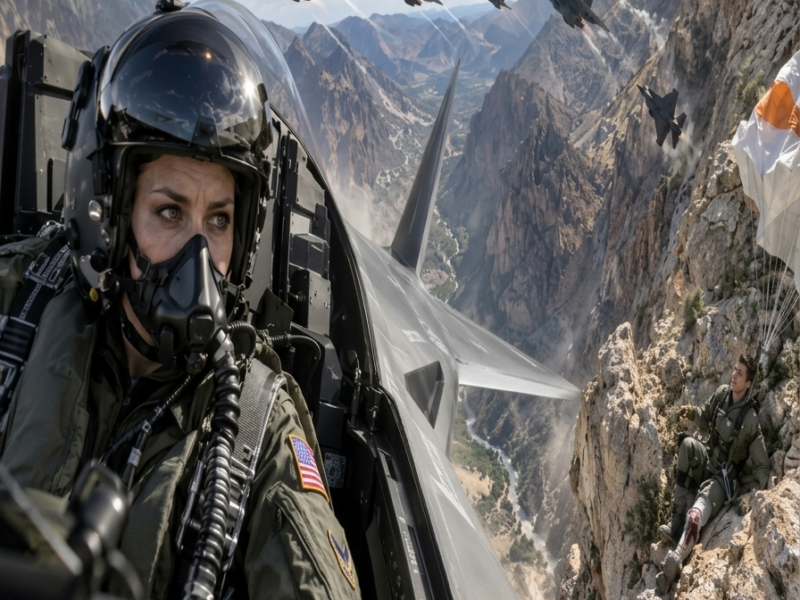
I watched the enemy fighters close in over the Pacific as my wingman screamed through the radio, “Leave him, Lieutenant,” but I broke formation anyway, diving toward the burning jet below us
I watched the enemy fighters close in over the Pacific. The sky had been deceptively beautiful just moments before, a vast expanse of bruised purple and deep gray clouds reflecting the early morning sunlight across the sleek, silver wings of our F-16s. It started like every other routine patrol. The hum of the engine was a comforting vibration through my flight suit. The air was calm. We were a mile above the ocean, untouchable, kings of the sky.
Then the radar screamed.
The digital display on my dashboard lit up with a terrifying cluster of red dots. They appeared out of nowhere, rising from beneath the cloud cover like a swarm of angry hornets. My heart hammered violently against my ribs. I blinked sweat from my eyes, my hands tightening instinctively around the flight stick.
“Fourteen hostiles, two o’clock,” Captain Mason warned, his voice cutting through the radio static with razor-sharp urgency. “Break formation and engage. Watch your six, people. We are heavily outnumbered.”
We scattered, pushing our thrusters to the absolute limit. The G-force slammed me back into my seat as I banked hard to the left, narrowly dodging a streak of blinding white light that tore through the space my jet had occupied a split second before. The sky became an instant battlefield, a chaotic whirlwind of contrails, warning alarms, and the deafening roar of jet engines pushing the sound barrier.
Seconds later, I saw it. A burst of brilliant, horrific orange fire blossomed in the distance. One of our jets had taken a direct hit to the right wing. The explosion sent a shockwave that rattled my canopy. I watched, helpless, as the burning fuselage began a violent, spiraling tumble toward the endless expanse of the Pacific Ocean below.
“He’s going down!” I yelled into the comms, my eyes locked on the trail of thick black smoke. “We need to cover him! He’s a sitting duck!”
“Forget him, Lieutenant!” Mason ordered, his tone devoid of any emotion. “Hold your vector! We engage the remaining bogeys. Do not break off!”
I knew exactly what that order meant. In the ruthless arithmetic of war, we were outgunned. Stopping to protect a single downed pilot meant sacrificing our speed and maneuvering advantage. It meant suicide for the rest of the squadron. Protocol dictated that we leave him to the rescue choppers, assuming he even survived the ejection.
But then, a burst of broken, heavily distorted static bled through my earpiece.
“Mayday… I’m hit… controls are dead…”
Something inside my chest turned to absolute ice. My breath caught in my throat. I stopped blinking. I had heard that voice before. It was impossible. It defied every law of reality, every piece of logic my military brain possessed.
Three years earlier, my older brother, Michael, had disappeared during a highly classified, deep-black mission over this exact stretch of the Pacific. The military brass had visited my home. They handed me a folded flag and called it a tragic, unavoidable accident. A catastrophic engine failure. They told me he went down in deep water. They had never recovered his body. I had spent three years mourning a ghost.
“Mayday… falling…”
I broke formation. I didn’t think; I just reacted. I threw the flight stick forward and pushed the throttle to maximum, plunging my F-16 into a steep, terrifying dive straight toward the burning wreckage.
“Lieutenant, get back in line!” Mason roared over the radio. “That is a direct order! You are compromising the entire squad! Pull up!”
I ignored him. I silenced the comms channel. Missiles streaked past my canopy, leaving trails of white smoke that violently rocked my jet. Anti-aircraft fire painted the sky around me, but I kept my eyes locked on the falling pilot. He ejected late. The canopy blew off the burning jet, and a small figure shot into the air.
His parachute opened badly, the silk lines tangled and twisting in the violent air currents, dragging him mercilessly toward the cresting whitecap waves. I circled low, dropping my speed to dangerously slow levels, putting myself directly between him and the pursuing enemy fighters. I dared them to shoot me. I waited for the lock-on alarms.
But as I banked closely past the descending pilot, I looked through my canopy. The distance was short enough, and the angle was perfect. Even through his cracked, smoke-stained visor, I saw his eyes. I saw the sharp line of his jaw.
My hands went completely numb around the controls.
It was my brother.
He was older, his face etched with exhaustion and scars that hadn’t been there three years ago, but it was him. Michael. The brother I had buried an empty casket for.
“Michael?” I whispered into the open channel, my voice trembling so hard I barely recognized it.
Static hissed back. Then, a heavy, ragged breath.
“Emily…” his voice crackled through the speakers, weak but unmistakably his. “You shouldn’t… you shouldn’t have come.”
Before I could process the impossibility of his words, my threat receiver went completely silent. The shrill alarms that had been screaming about missile locks abruptly stopped. I looked at my radar. The enemy fighters—all fourteen of them—had suddenly stopped firing. They weren’t turning to engage me. They weren’t swooping in for the kill.
One by one, in perfect, eerie synchronization, they pulled up. They banked hard to the north, reforming their tight V-formation, and simply flew away, disappearing into the thick cloud cover as if they had never been there.
I stared at the empty radar screen, my lungs burning because I had forgotten how to breathe. I switched the comms back to Mason’s channel.
“Mason…” I stammered. “Mason, why are they retreating? I’m a sitting duck here. Why did they break off?”
There was a long, agonizing silence on the other end of the line. When Mason finally spoke, his voice was tight, carrying a chilling realization.
“Because, Lieutenant… they weren’t trying to shoot you down.”
I felt cold sweat trace a line down my spine. “What were they trying to do?”
Mason hesitated. The silence stretched until it felt like it would snap.
“They were trying to make sure you found him.”
The rescue helicopter was deafening, the relentless thumping of the rotors vibrating deep within my teeth. Below us, the Pacific Ocean churned violently, a dark abyss that had kept my brother hidden for three agonizing years. I sat near the open door, the freezing wind whipping across my face, watching the rescue divers pull Michael’s limp body from the turbulent waters.
He was barely conscious. His flight suit—an unrecognizable, unbranded black fabric with no insignias—was torn and soaked in a mixture of seawater and thick, dark blood. As they hoisted him onto the metal floor of the chopper, I threw off my harness and dropped to my knees beside him.
“Michael,” I choked out, grabbing his face. His skin was ice-cold. “Michael, stay with me. Look at me.”
His eyelids fluttered, revealing eyes that were wild, bloodshot, and filled with a terror I had never seen in him before. This was a man who had flown through anti-aircraft fire with a smile on his face. Now, he looked like a hunted animal. The medic shoved me aside, frantically pressing gauze against a deep laceration on Michael’s ribs, shouting vital signs into his headset.
I sat back, my mind spinning violently. How was this possible? How had he survived for three years? Why was he flying an unmarked jet in enemy airspace? And why had an entire squadron of hostile fighters intentionally spared me just so I could pull him out of the ocean?
As the helicopter banked sharply toward the aircraft carrier, Michael suddenly lunged forward, pushing past the medic. His bloodstained hand shot out and clamped around my wrist with desperate, bruising force.
“Emily, listen to me,” he gasped, his voice a raw, rattling wheeze.
“Don’t speak. Save your strength. We’re almost to the carrier. You’re safe now.”
“No!” He squeezed my wrist harder, pulling me down until his lips were inches from my ear. The roar of the wind and the rotors drowned his voice out to everyone but me. “I am not safe. You are not safe. The crash… three years ago. It wasn’t an accident.”
I froze, staring into his panicked eyes. “What are you talking about? They said your engine failed. They said you went down in a storm.”
A bitter, blood-flecked smile crossed his pale face. “My engine didn’t fail. I was shot down. But not by the enemy.”
The bottom dropped out of my stomach. “Who did it?” I whispered, afraid of the answer.
Michael’s eyes darted past my shoulder. He looked toward the front of the helicopter, where the cockpit door was slightly ajar. Then he looked toward the horizon, where the massive, gray hull of our aircraft carrier was coming into view. Standing on the flight deck, waiting for our arrival, were a dozen medical personnel. But standing slightly behind them, separated from the regular crew, were two men in dark, unadorned military dress uniforms. No name tags. No rank insignias.
“Who did it, Michael?” I demanded again, shaking his arm.
He pulled me closer, his breath hot against my cheek. “The people who ordered your rescue today. They wanted you to bring me in. Because they knew I would never surrender to them.”
Before I could ask another question, the helicopter touched down on the deck with a heavy jolt. Immediately, the doors were thrown open. The medical team flooded in, shouting orders, lifting Michael onto a gurney. I tried to follow, but a heavy hand clamped down on my shoulder.
I spun around to face one of the officers in the dark uniforms. He had cold, dead eyes and a perfectly neutral expression.
“Stand down, Lieutenant,” the man said. His voice was smooth, devoid of any inflection. “Your brother requires immediate, classified medical attention. You need to report to debriefing.”
“I’m staying with him,” I snarled, pushing his hand away. “I’ve thought he was dead for three years. I’m not leaving his side.”
The second officer stepped forward, blocking my path to the medical bay doors. “That wasn’t a request, Lieutenant. Report to Captain Mason for debriefing. Now.”
I watched in helpless fury as the heavy steel doors of the medical wing slammed shut, swallowing my brother. A sense of profound dread settled over me. Michael’s words echoed in my mind like a death knell. The people who ordered your rescue.
I spent the next four hours in a suffocating interrogation room. They didn’t ask me about the dogfight. They didn’t ask about the enemy tactics. They only asked what Michael had said to me in the helicopter. I lied. I told them he was delirious, that he only cried and asked for our mother. I saw the skepticism in their eyes, but I held my ground. I played the traumatized sister perfectly.
When they finally let me go, the ship was under night protocols. The corridors were bathed in dim red light. I moved quickly, silently, bypassing my quarters and heading straight for the lower deck medical wing. I knew the patrol routes of the military police on this ship. I slipped past a pair of guards, using the maintenance access hatches to drop directly into the hallway outside Michael’s room.
I peered through the small, reinforced glass window of room 4B.
The lights were off. I carefully turned the handle and slipped inside, keeping my back to the wall.
“Michael?” I whispered into the darkness.
There was no answer. No steady beep of a heart monitor. No sound of breathing.
I rushed to the bed and threw back the heavy wool blanket. The bed was empty. I placed my hand flat against the mattress. It was still warm. He had been here minutes ago. Panic flared in my chest. I looked wildly around the sterile room, searching for any sign of a struggle.
Then I saw it.
Resting perfectly in the center of the white pillow, catching the faint red glow from the hallway lights, was a silver chain. I picked it up, my hands trembling uncontrollably.
They were his dog tags. The exact same dog tags the military had handed me three years ago. The ones I had buried in an empty grave in Arlington.
I stared at the cold metal tags resting in my palm, the embossed letters of Michael’s name burning into my vision. The implications crashed over me in suffocating waves. He hadn’t escaped. Someone who had just been pulled half-dead from the ocean with shattered ribs didn’t just walk out of a secure, guarded medical ward on a military vessel. He had been taken.
I slipped the dog tags over my head, feeling the cold metal settle against my collarbone, and backed out of the room. The red emergency lights in the corridor suddenly felt less like protocol and more like a warning. The ship was a floating fortress, and right now, it was a prison. If the people who took Michael knew I was looking for him, I would be the next one to vanish.
I needed answers, and I couldn’t trust anyone wearing a uniform. Not even Captain Mason.
I sprinted down the narrow metal corridors, avoiding the main junctions and utilizing the engineering access shafts. My destination was the ship’s primary server hub, located three decks down. As a pilot, I didn’t have clearance for the central archives, but I didn’t need it. During a deployment two years ago, a comms engineer had shown me a blind spot in the network where the security cameras rebooted for exactly twelve seconds every hour.
I crouched in the shadows outside the server room door, checking my watch. Five, four, three… The red light on the camera above the door blinked out. I swiped a stolen maintenance keycard, stepped inside, and let the heavy door lock behind me just as the camera’s light flickered back on.
The room was freezing, filled with the deafening hum of cooling fans and rows of towering black server racks. I moved to an auxiliary terminal in the back corner and began typing furiously. I bypassed the standard encrypted gateways, using an old backdoor exploit to access the ship’s deep-storage logs.
“Come on, come on,” I muttered, watching lines of code cascade across the screen.
I searched for the flight logs from today’s mission. The file was already flagged with a glaring red banner: CLASSIFIED – LEVEL 5 CLEARANCE REQUIRED. I ran a brute-force decryption script. While it chewed through the lock, I searched for the files from three years ago—the day Michael disappeared.
The decryption finished with a soft chime. I opened the file.
What I saw made my blood run cold.
The radar data from my flight today was a complete fabrication. The official log stated that we engaged fourteen hostile bogeys and sustained one casualty before driving the enemy away. But the raw, unedited sensor data showed something entirely different.
The enemy jets hadn’t locked onto us. They had locked onto a transponder signal. And that signal hadn’t come from Michael’s unmarked jet.
It had come from our own aircraft carrier.
The ship had broadcasted a beacon, guiding the enemy fighters directly to our patrol sector. It was an ambush, but we weren’t the targets. We were the bait. They orchestrated the entire dogfight just to force Michael out of hiding, knowing that if I was in danger, he would break cover to save me. They used me to catch him.
I quickly pulled up the files from three years ago. The report claimed Michael’s engine exploded due to mechanical failure. But buried in a sub-folder labeled Project Icarus was a heavily redacted after-action report. I managed to decode a single paragraph:
Subject [REDACTED] successfully acquired unauthorized intel regarding the Icarus payload. Neutralization authorized. Target engaged by friendly elements over Sector 4. Target presumed destroyed.
He wasn’t shot down by the enemy. He was shot down by his own wingman. By our own government.
“You’re digging where you shouldn’t be, Lieutenant.”
The voice came from the dark shadows at the end of the server aisle. I froze, my hand slowly reaching down to the heavy iron wrench I had grabbed from the maintenance hatch earlier.
Footsteps echoed softly against the grated metal floor. One of the men in the dark dress uniforms stepped into the pale blue light of the servers. He held a silenced pistol by his side, his face an emotionless mask.
“We had hoped you would just accept the narrative, Emily,” he said calmly, taking another step forward. “We told you to go to your quarters. You should have listened.”
“Where is he?” I demanded, my grip tightening on the wrench. “Where is my brother?”
“He’s being transported to a secure location where he can no longer be a threat to national security. And unfortunately for you, you’ve just proven that you are a liability as well.” He raised the pistol, aiming it squarely at my chest. “It’s a tragedy, really. Two siblings, both lost to the sea in tragic, unrelated accidents.”
I didn’t hesitate. As his finger tightened on the trigger, I grabbed the heavy fire extinguisher mounted to the rack beside me and hurled it directly at his head.
The gun fired with a soft pfft, the bullet sparking against the metal server rack inches from my face. The extinguisher slammed into the man’s shoulder, throwing off his aim and knocking him to the floor. I didn’t wait to see if he was getting up. I bolted down the aisle, vaulted over a row of cooling pipes, and slammed my fist onto the emergency door release.
The alarm klaxons instantly began wailing, drowning out the hum of the servers. Red strobe lights flashed violently across the entire ship. I was no longer a pilot in the United States military. I was a fugitive on my own carrier, trapped in the middle of the ocean, with the very people I trusted hunting me down.
I ran.
The wail of the ship-wide alarm was deafening, a relentless, shrieking pulse that matched the frantic hammering of my heart. “Security breach in Sector 4,” a mechanized voice blared over the intercom. “Lockdown initiated. All personnel stand to.”
I sprinted up the narrow stairwell, taking the metal steps three at a time. The heavy blast doors at the top of the deck were slowly grinding shut. I dove, sliding on my stomach across the cold steel grating, barely clearing the threshold before the doors locked with a resounding boom behind me. I was on the flight deck level now. The smell of jet fuel, salt, and ozone hit me instantly.
I ducked behind a stack of munitions crates as a squad of heavily armed Marines ran past, their rifles raised, heading toward the lower decks to find me.
I pressed my back against the cold metal crate, trying to control my ragged breathing. I pulled the dog tags out from under my shirt. While the decryption program was running in the server room, I had noticed something odd about the physical tags. I ran my thumb over the back of the second piece of metal. It wasn’t smooth. Someone had meticulously scratched a sequence of numbers into the steel using a pin or a knife.
34.05 N, 118.24 W.
Coordinates. Michael had left me coordinates.
He knew they were going to take him. He knew he wouldn’t be able to escape the ship, but he left me a trail. If I wanted to save him, or at least expose whatever Project Icarus was, I had to get to those coordinates.
But to do that, I needed a plane.
I peered around the crates. The flight deck was bathed in the harsh glare of floodlights. Amidst the chaos of the alarms, the deck crew was scrambling, securing munitions and locking down the aircraft. About fifty yards away, sitting on catapult two, was an F-18 Super Hornet. It was fully fueled, armed, and going through its pre-flight diagnostic checks. The canopy was open, the boarding ladder still attached. The pilot was standing at the base of the ladder, distracted by the flashing alarms, talking frantically into his radio.
It was a suicide run. I would be dead before I even reached the ladder. But I had no other choice.
I grabbed a heavy metal chock block from the deck, took a deep breath, and threw it as hard as I could toward a stack of empty fuel barrels on the opposite side of the runway. The heavy block smashed into the metal with a deafening crash that echoed over the alarms.
The pilot and the deck crew whipped their heads toward the sound, their hands reaching for their sidearms.
I ran.
I abandoned all stealth, sprinting across the open tarmac with everything I had. The wind whipped my hair into my eyes. Every second felt like an hour. I expected to feel the burning impact of a bullet tearing through my back, but the confusion gave me exactly three seconds of cover.
I hit the ladder and scrambled up like a feral animal. The pilot turned back just as I reached the cockpit.
“Hey! What the hell do you think you’re doing?!” he yelled, lunging for the ladder.
I kicked the ladder release lever. It detached and clattered to the deck, taking the pilot down with it. I threw myself into the pilot’s seat, slapping the canopy close button. The thick glass lowered, sealing me inside and cutting out the roar of the deck. I didn’t have time to put on a G-suit. I barely had time to strap the harness across my chest.
I jammed the throttle forward. The jet lurched violently.
Through the canopy, I saw armed guards sprinting onto the flight deck, raising their rifles. I saw Captain Mason bursting through the command tower doors, his face purple with rage, shouting into his headset. My own radio cracked to life.
“Lieutenant Emily Vance! Power down that aircraft immediately! You are committing treason! We will shoot you down!”
I flipped the radio switch to transmit. “I’m sorry, Captain. But I’m finishing the mission you started three years ago.”
I didn’t wait for clearance. I didn’t wait for the catapult. I pushed the twin engines to full afterburner. The F-18 screamed, the sheer force pinning me against the seat as the jet accelerated down the short runway. It wasn’t enough distance. The edge of the carrier approached terrifyingly fast.
The nose wheel left the deck. The jet dropped heavily, plummeting toward the black waves below. I pulled back on the stick with all my strength. The engines roared, fighting gravity, kicking up a massive spray of seawater. Slowly, agonizingly, the nose pitched up, and the jet tore into the night sky, leaving the carrier behind.
“Vance, you are entering hostile airspace unauthorized!” Mason’s voice screamed in my ear. “I have two interceptors launching now. Turn around, or they are authorized to use lethal force!”
“Let them try,” I whispered.
I punched the coordinates into the navigation computer. The display lit up, drawing a line toward a remote, uninhabited atoll hundreds of miles off the coast. I pushed the throttle to the firewall, watching the airspeed indicator climb past Mach 1.
Thirty minutes later, my radar pinged. Two fast-moving bogeys were closing in on my six o’clock. Mason’s interceptors. I had to shake them, but I couldn’t shoot them down—they were my friends, my squadmates. They were just following orders.
I killed my lights, dropped my altitude to thirty feet above the cresting waves to avoid radar detection, and began weaving through a treacherous storm system that was brewing on the horizon. Lightning flashed around my canopy. The turbulence tossed the jet like a toy.
I held my breath, watching the radar. After ten agonizing minutes, the two green dots vanished. I had lost them in the storm.
As the storm broke, the first light of dawn began to bleed across the horizon, painting the sky in pale pinks and grays. And there, rising from the mist in the middle of the ocean, was the coordinate destination.
It wasn’t a military base. It wasn’t an island.
It was a massive, rusted offshore oil rig. But it wasn’t abandoned. Heavily armed patrol boats circled the perimeter, and anti-aircraft batteries tracked my approach from the helipad. This was the black site.
“I’m here, Michael,” I said to the empty cockpit.
As I banked to assess my landing options, a violent explosion rocked my left wing. The alarms I had disabled suddenly shrieked back to life. Smoke poured into the cockpit. I was hit.
The jet began to spin, plummeting toward the churning water below the rig. I reached up and pulled the ejection handle.
The ejection seat blasted me through the canopy with bone-crushing force. The world became a blur of spinning sky, gray ocean, and burning debris. My parachute deployed with a violent snap, wrenching my shoulders, and seconds later, I plunged into the freezing Pacific.
I cut the tangled parachute lines instantly, kicking desperately toward the surface. I broke through the water, gasping for air, the taste of salt and aviation fuel burning my throat. Above me, the rusted steel pillars of the offshore rig towered like the legs of a mechanical monster. Warning sirens wailed from the platform above. They knew I was here.
I swam toward the nearest pillar, clinging to the barnacle-encrusted metal to hide from the searchlights sweeping the water. My muscles screamed in protest, but I forced myself to climb the maintenance ladder, hand over hand, until I reached the lower catwalks of the rig. I was soaked, freezing, and armed with absolutely nothing.
I crept through the damp, shadow-filled corridors of the lower decks. The facility didn’t look like an oil rig on the inside. It was entirely hollowed out, retrofitted into a high-tech staging ground. Massive crates labeled with foreign military insignias—the same insignias of the enemy fighters we had encountered earlier—were stacked alongside United States military hardware.
My stomach plummeted. This wasn’t just a black site. This was a trafficking hub. A shadow operation where corrupt factions of my own military were arming the enemy, orchestrating a controlled, perpetual war for profit and power. Project Icarus.
I slipped past a pair of armed mercenaries, moving silently toward the central command hub. Through a thick glass observation window, I finally saw him.
Michael was strapped to a steel chair in the center of a brightly lit interrogation room. He looked worse than he had on the helicopter. His face was bruised, and his flight suit was stripped down to a gray t-shirt. Standing in front of him were the two officers from the aircraft carrier, calmly wiping blood from a steel baton.
“You’re going to tell us where you hid the data drive, Michael,” one of the officers said smoothly, his voice feeding through the intercom speakers into the hallway. “You’ve been a ghost for three years. You managed to steal our buyer logs and bury yourself in the enemy’s ranks. Impressive. But your little sister’s stunt today cost us a very lucrative shipment.”
“Go to hell,” Michael spat, a bloody smile crossing his face. “The drive is already in the hands of a journalist in D.C. The moment I stop transmitting a dead-man’s switch, your entire operation gets broadcasted to the world.”
The officer sighed. “A bluff. You wouldn’t have risked exposing yourself today if the data was secure.” He raised the baton again.
I couldn’t wait. I looked around the catwalk and spotted the facility’s main breaker box. I ripped the cover off, grabbed a heavy fire axe from the wall, and smashed it directly into the high-voltage relays.
A shower of blinding blue sparks erupted. The entire rig plunged into absolute, pitch-black darkness.
Shouts echoed through the facility. Emergency red lights flickered on, casting long, nightmarish shadows. I kicked the interrogation room door open. The two officers spun around, drawing their weapons, but I was already moving. I swung the heavy fire axe, burying the blunt side of the ax head into the first officer’s chest. He collapsed with a wheeze.
The second officer fired blindly. The bullet grazed my shoulder, a hot streak of agonizing pain. I ignored it, tackling him to the floor. We rolled across the cold steel, grappling for the gun. He was stronger, his hands closing around my throat, cutting off my air.
Suddenly, a heavy steel chair leg smashed into the side of the officer’s head. He crumpled, unconscious.
I gasped for air, looking up. Michael was standing over us, holding the broken chair leg. He had managed to slip his restraints in the darkness.
“I told you not to come, Emily,” he breathed, offering me a bruised, blood-slicked hand.
I grabbed it and pulled myself up. “You know I never listen to you.”
“We need to move,” he said, grabbing the fallen officer’s pistol and checking the magazine. “They’ll have the backup generators on in less than two minutes. The helipad is two levels up. They have a transport chopper fueled and ready. It’s how they brought me here.”
“Can you fly it?” I asked, gripping my bleeding shoulder.
He offered a grim, exhausted smirk. “I was the best pilot in the academy before you showed up.”
We sprinted out of the interrogation room, navigating the maze of corridors as the sound of heavy boots echoed all around us. The mercenaries were swarming the lower levels. We reached the stairwell, taking fire from a catwalk above. Bullets pinged against the metal railing, showering us with sparks. Michael returned fire, dropping one of the guards, while I pushed open the heavy blast doors to the roof.
The wind hit us like a physical wall. The storm I had flown through was finally breaking over the rig, rain lashing against the metal deck. Sitting in the center of the helipad was a sleek, black transport chopper.
“Get in!” Michael yelled over the roar of the wind.
I scrambled into the co-pilot seat while Michael threw himself into the pilot’s chair, rapidly flipping the ignition switches. The engines whined to life, the rotors slowly beginning to turn. But we were out of time. A squad of mercenaries burst through the roof access doors, raising automatic rifles.
“Hold on!” Michael roared.
He didn’t wait for the rotors to reach full speed. He wrenched the collective up. The chopper tore off the helipad just as a hail of gunfire shattered the reinforced glass of the cockpit. I ducked, shielding my face from the flying shards.
The helicopter pitched forward, dropping terrifyingly close to the dark, churning waves before Michael caught the momentum and pulled us up into the stormy sky. We flew in complete silence for ten minutes, the only sound the rhythmic thumping of the rotors and the heavy rain beating against the broken windshield.
I slumped back in my seat, the adrenaline finally fading, replaced by a deep, throbbing ache in my shoulder. I looked over at my brother. He was alive. We were both alive.
“So,” I said quietly, staring out at the endless black horizon. “What happens now? We can’t go back to the carrier. We can’t go home. We’re fugitives.”
Michael kept his eyes on the instruments, but the tension in his jaw slowly relaxed. He reached into the pocket of his torn flight suit and pulled out a small, encrypted USB drive. He placed it on the console between us.
“We don’t hide anymore, Emily,” he said, his voice steady and filled with a quiet, dangerous resolve. “We fly this bird until we hit the mainland. We find a secure terminal. And we burn their entire world down.”
I looked at the drive, then up at the breaking dawn. The sun was rising, casting a brilliant, golden light over the Pacific. I smiled, the pain in my shoulder suddenly feeling very distant.
“Alright then,” I said, reaching for the navigation controls. “Let’s light the match.”
The end









