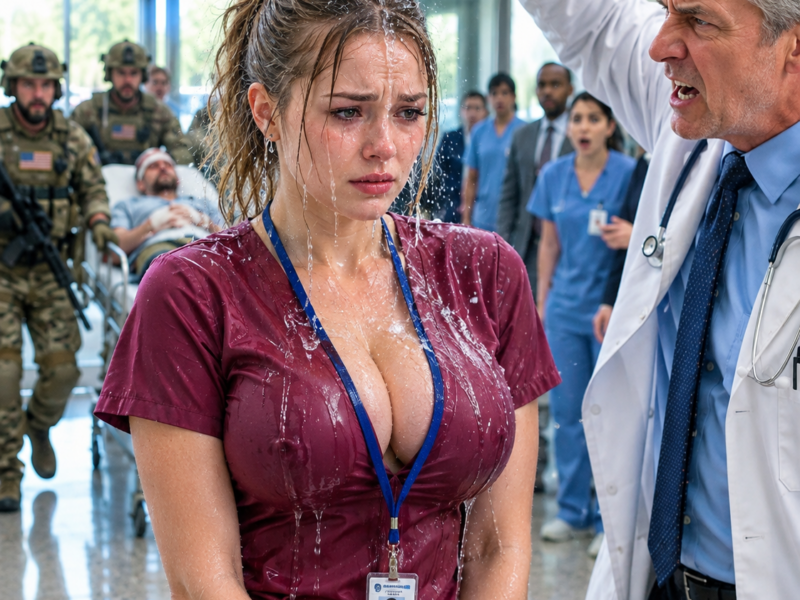
“I watched the chief surgeon shove a rookie nurse’s trauma kit off the operating table and laugh, ‘This isn’t a battlefield, sweetheart,’
The detective had barely finished locking the hospital room door when Michael opened his eyes.
“Blue door,” he whispered again.
I stepped closer to his bed. “Michael, what does that mean?”
His gaze shifted toward the detective.
“Not here.”
The detective glanced at the hallway camera, then lowered his voice. “We need to know whether you’re talking about a location, a person, or something else.”
Michael swallowed painfully.
“It’s where Daniel kept the names.”
My stomach tightened.
“Daniel Cross?”
Michael nodded.
I felt the room tilt around me.
Three years earlier, I had stood beside a folded American flag at Daniel’s memorial. I remembered the chaplain’s words, the photographs, the empty space where his body should have been. I remembered the notification officer telling me there had been no survivors from the convoy.
And I remembered the last message Daniel had sent me.
Keep your head down, Parker. Get your people home.
I had spent three years believing I was one of the people he hadn’t managed to bring home.
“Where is he?” I asked.
Michael tried to sit up, but pain stopped him. “I don’t know where he is now.”
“Then how do you know he’s alive?”
“Because I saw him.”
“When?”
“Six weeks ago.”
The detective moved closer. “You told federal investigators you had never met Daniel Cross.”
“I told them what I was told to say.”
“By whom?”
Michael looked at me.
“By the people who were supposed to protect me.”
The detective’s expression hardened.
“I’m Detective Lena Brooks,” she said. “And I need you to understand that if you’re withholding information from a federal investigation, it could put more people in danger.”
Michael gave a bitter laugh that turned into a cough.
“Detective, the federal investigation is why I’m in this bed.”
Before she could answer, the monitor beside him began to beep faster.
I checked his pulse and oxygen saturation. His breathing had become shallow again.
“Everyone back,” I said. “He’s struggling.”
Hayes entered with two nurses behind him. He took one look at the monitor and moved to the bedside.
“What happened?”
“His breathing changed. I think the bleeding may be progressing.”
Hayes examined Michael, then looked at the monitor.
“Get respiratory therapy. Repeat imaging. Now.”
He didn’t challenge me. He didn’t ask why I had noticed it first.
For the first time since I’d met him, he simply listened.
As the team worked, Michael caught my wrist.
“Don’t let them move me.”
“Michael, we need to make sure you’re stable.”
“Not to another hospital.”
His fingers tightened.
“Blue door. Find the blue door before they do.”
Then his eyes closed.
I stayed beside him until his breathing settled.
When the team finally stepped away, Hayes pulled me into the corridor.
“Parker.”
I braced myself for another lecture.
Instead, he said, “You were right about the second injury.”
It wasn’t an apology, but it was the first crack in his certainty.
“Thank you,” I replied.
He looked toward Michael’s room.
“I’ve been doing trauma surgery for twenty-two years. I’ve seen people miss things because they’re tired, frightened, or convinced they already know the answer.”
He paused.
“I missed it because I thought I knew who you were.”
I didn’t know what to say.
“Don’t let what happened tonight distract you from your patient,” he added. “Whatever your history with this man is, you’re his nurse first.”
“I know.”
But the moment he walked away, I realized my history with Michael was no longer the most frightening part.
My history with Daniel was.
Detective Brooks was waiting near the nurses’ station.
“Federal agents are on their way,” she said. “Until they arrive, I want you to stay where I can find you.”
“Why?”
“Because the person who attacked Michael knew his identity, his location, and his schedule. They also knew he was being transported here.”
“You think someone inside the hospital is involved?”
“I think someone has access to information they shouldn’t have.”
Her phone vibrated.
She read the message, and her expression changed.
“What is it?”
“An agent just confirmed something. Michael’s apartment was searched tonight.”
“By police?”
“No.”
She showed me a photograph.
It was a small room with overturned furniture, drawers pulled open, and papers scattered across the floor.
On the wall was a faded photograph of a military convoy.
I recognized the vehicles immediately.
I had been in one of them.
Daniel stood near the front, wearing his dusty uniform and the crooked smile he used whenever he knew I was worried.
Someone had drawn a red circle around his face.
Underneath, in black marker, were three words.
SHE KNOWS NOTHING.
My mouth went dry.
“Who took that photograph?”
“Federal agents at the apartment.”
“Why would someone leave it there?”
Brooks lowered her phone.
“Maybe they wanted us to find it.”
I stared at Daniel’s face.
For three years, I had tried not to look at photographs of him.
Now I couldn’t look away.
“Tell me everything Michael said about him,” I whispered.
Brooks shook her head.
“I can’t disclose the entire investigation.”
“Then tell me why a man who supposedly died overseas is connected to a witness being hunted in Denver.”
She studied me for several seconds.
“Because Daniel Cross may have been involved in a classified operation that never officially existed.”
The words seemed to drain the air from the corridor.
“What operation?”
“An investigation into the theft and sale of sensitive military intelligence. It began before your convoy was attacked.”
I shook my head.
“Daniel wasn’t a criminal.”
“I didn’t say he was.”
“He saved people. He protected his team.”
“Then maybe you should consider that someone wanted him out of the way for exactly those reasons.”
A sound came from Michael’s room.
We both turned.
A nurse hurried into the doorway.
“Detective, there’s someone asking for the patient.”
Brooks reached for her badge.
“Who?”
The nurse glanced back.
“He says he’s from hospital security.”
I looked through the glass.
A man in a dark jacket stood beside Michael’s bed, holding a clipboard.
Something about his posture felt wrong.
He wasn’t looking at the patient.
He was watching the doorway.
Then he looked directly at me.
His face didn’t change.
But his right hand moved toward his jacket.
I recognized the motion.
“Detective,” I said quietly. “That’s not hospital security.”
Brooks drew her weapon.
“Step away from the bed!”
The man bolted.
A crash sounded as he shoved a supply cart into the hallway. Brooks chased him, shouting for backup.
I rushed into Michael’s room.
His eyes were open.
He was trying to pull himself upright, panic spreading across his face.
“Stay down!” I ordered.
“He found me,” Michael gasped.
“Who?”
“The man who took Daniel.”
My blood went cold.
Before I could ask another question, the hospital’s overhead announcement interrupted us.
“Security alert. All staff remain in designated areas.”
The door slammed.
Someone had triggered an emergency lockdown.
I reached for the call button.
Then my phone vibrated.
A message from the same unknown number.
YOU WERE NEVER SUPPOSED TO SEE HIM AGAIN.
A second message followed.
ASK YOURSELF WHY YOUR MEMORIAL HAD NO BODY.
I stared at the screen.
The question I’d avoided for three years was suddenly standing in front of me.
Why had Daniel been declared dead without a body?
I had been told the convoy had been destroyed by an explosion. The remains were unrecoverable. The official report had been sealed because of the operation’s sensitive nature.
At the time, I had accepted it.
I had been injured myself, evacuated before the investigation was complete, and overwhelmed by the loss of the people I’d served with.
But I remembered something.
The night before the convoy left, Daniel had taken me aside.
He’d been unusually serious.
“If anything happens out there,” he had said, “don’t believe the first report.”
I’d laughed, thinking he was trying to frighten me into checking my equipment twice.
He hadn’t laughed back.
“Promise me, Parker.”
I had promised.
Then the convoy had vanished, and the first report had become the only story anyone was allowed to hear.
I looked at Michael.
“What happened to Daniel after the convoy was attacked?”
Michael’s eyes filled with fear.
“He got the others out.”
“Which others?”
“The men who were supposed to die with him.”
I felt a chill move through me.
“Was the explosion staged?”
Michael closed his eyes.
“Not exactly.”
He took a shallow breath.
“Somebody changed the route. The convoy was sent through a road that wasn’t on the approved plan. Daniel realized it too late.”
“Who changed it?”
“An officer named Colonel Voss.”
I knew the name.
Colonel Andrew Voss had been the operations liaison for our unit. He had signed the movement orders and approved our route.
After the convoy incident, he had been promoted.
I remembered seeing his name in a news article months later.
He had spoken about sacrifice, leadership, and the cost of serving our country.
I had wanted to believe him.
“Daniel survived?” I asked.
“Barely. He was pulled from the wreckage by people who weren’t on the rescue team.”
“Who?”
“Private contractors. They weren’t there to save anyone. They were there to recover a storage device.”
“What device?”
Michael looked at me.
“The one Daniel took before they reached him.”
My hands began to shake.
“The blue door?”
He nodded.
“Not a real door. It’s the name of an encrypted archive. Daniel hid the access information somewhere nobody would think to look.”
“Where?”
Michael opened his mouth.
A sudden pounding sounded against the room’s door.
“Hospital security! Open up!”
I stepped between Michael and the entrance.
“Who are you?”
“Security. We need to move the patient.”
“Detective Brooks has to authorize that.”
A pause.
Then a voice I recognized.
“Emily, it’s Dr. Hayes. Open the door.”
I hesitated.
Hayes had been in the hospital all night. He had no reason to be involved.
But something in Michael’s face stopped me.
He was staring at the door as if he had seen a ghost.
“Don’t,” he whispered.
“Michael?”
He shook his head.
“That’s not Hayes.”
I moved toward the desk and hit the emergency call button.
The voice outside changed.
“Emily, you don’t understand. There are people coming. You need to open this door.”
Then came a metallic scrape.
Someone was trying to force the lock.
I grabbed the portable monitor stand and positioned it against the door.
“Michael, can you move?”
“Not far.”
“Then stay low.”
The door shook.
A voice shouted from the hallway.
“Stand clear!”
A second later, the door flew inward.
Detective Brooks entered first, weapon raised, followed by two uniformed officers.
Behind them stood Dr. Hayes, breathing hard.
“Are you both okay?” Brooks asked.
I nodded.
Hayes looked at the damaged door.
“Whoever impersonated me used my staff credentials.”
“Can you identify the person?” Brooks asked.
“I’ve never seen him before.”
Brooks spoke into her radio, then turned to me.
“The suspect escaped through the service corridor. We have officers searching the building.”
I looked at Hayes.
“Someone used your credentials.”
His face tightened.
“I’ll have every access record pulled.”
“Don’t do it alone,” Brooks said. “Those records are evidence now.”
Hayes nodded.
For once, nobody argued.
An hour later, two federal agents arrived.
Special Agent Naomi Reed introduced herself and asked to speak with Michael. She also asked me to remain in the room.
“Your name appears in several documents connected to the original convoy investigation,” she explained.
“Why?”
“Because you were listed as the final surviving member of Daniel Cross’s medical team.”
I stared at her.
“I’m not the final surviving member.”
“According to the official record, you are.”
“What about the others?”
She hesitated.
“That is part of what we’re investigating.”
Michael shifted painfully.
“Tell her about the archive.”
Agent Reed opened a secure tablet.
“Before we discuss that, I need to know exactly what you saw.”
Michael looked at me.
“Daniel told me he had copied the original movement orders, communications logs, and payment records. He believed someone was selling patrol routes to private contractors.”
“Colonel Voss?” I asked.
“Voss was involved, but he wasn’t working alone.”
“Who else?”
Michael’s expression darkened.
“Someone inside the investigation.”
Agent Reed leaned forward.
“Who?”
Michael closed his eyes.
“Deputy Director Paul Harlan.”
The room went silent.
I didn’t know the man personally, but I’d seen his name in the news. He was a senior official in the agency overseeing the investigation into the stolen intelligence.
“If Harlan was involved,” Reed said carefully, “then the original inquiry may have been compromised.”
“That’s why Daniel hid the archive,” Michael replied. “He couldn’t trust anyone with access to the official channels.”
“Why did you wait six weeks to come forward?”
“Because I thought Daniel was dead again.”
His voice cracked.
“He found me in a parking garage. He said he had one chance to get the evidence out. Then he disappeared.”
“Did he give you anything?”
Michael looked toward his bedside table.
A hospital property bag sat beside a stack of paperwork.
“His dog tags,” he whispered.
I hadn’t noticed them before.
Agent Reed opened the bag.
Inside was a worn chain with a pair of military identification tags.
I recognized the scratches across the metal.
Daniel had once used the edge of a field knife to carve a tiny blue line into the back of one tag.
It was our private joke.
When we were deployed, he’d told me the blue line meant that if everything went wrong, we should look for the door nobody else could see.
I reached for the tags.
My fingers trembled.
On the back of one was a short sequence of numbers.
0417.
I stared at it.
“That’s not a serial number.”
Agent Reed looked up.
“What is it?”
“A date. April seventeenth.”
Michael shook his head.
“It’s not a date.”
I looked at him.
“Then what?”
“The room number.”
I frowned.
“Where?”
Michael’s eyes moved toward the window.
“Forward Operating Base Redstone. Old medical storage wing. There was a blue door at the end of the corridor.”
The memory came back so suddenly I almost lost my balance.
A narrow hallway.
A door painted blue.
Daniel standing beside it, holding a paper cup of coffee.
He’d told me it was the only room in the building nobody ever checked because it had been sealed after a water leak.
I’d forgotten it completely.
“Room 417,” I whispered.
Michael nodded.
“That’s where he hid the access key.”
Agent Reed closed the property bag.
“We can’t send you to an overseas facility based on an unverified statement.”
“I don’t care about the facility,” I said. “I care about finding Daniel.”
“You may not be able to separate those two things.”
I looked at her.
“Then don’t ask me to.”
For the next several hours, I stayed with Michael while the agents coordinated with military investigators.
The hospital remained under heightened security.
The man who had impersonated Hayes was still missing.
Detective Brooks told me that someone had attempted to access Michael’s medical records from an internal terminal shortly before the attack.
The account belonged to a staff member who had been off duty for two days.
Every new detail made the hospital feel less like a place of safety and more like a building with too many unlocked doors.
Near dawn, Hayes returned to the room.
He had changed out of his surgical gown and looked exhausted.
“Parker,” he said, “I need to tell you something.”
I stepped into the corridor.
He lowered his voice.
“I pulled the access logs with the federal agents present. The credentials used to request Michael’s records belonged to an administrator named Scott Bell.”
“Was he involved?”
“He’s been missing since yesterday.”
“Did you know him?”
“Only professionally.”
He looked down at his hands.
“I also found something else. Someone accessed the hospital’s security camera system using a remote login.”
“When?”
“Eleven minutes before the man entered Michael’s room.”
My stomach tightened.
“Can they trace it?”
“The agents are working on that.”
He paused.
“I owe you an apology, Emily.”
I looked at him.
“For what?”
“For treating your experience as a threat to my authority. You saw a patient in danger, and I dismissed you because I assumed a new nurse couldn’t know more than I did.”
He swallowed.
“I was wrong.”
I nodded.
“Thank you for saying that.”
“I don’t expect you to forget it.”
“Good. Because I won’t.”
For the first time, he almost smiled.
“Fair enough.”
Then his expression became serious again.
“If you’re going overseas, make sure you understand what you’re walking into.”
“I’ve been there before.”
“Not as a nurse.”
I glanced toward Michael’s room.
“Maybe that’s why I have to go.”
Agent Reed approached before he could answer.
“We’ve received authorization to send a small joint team to the former base.”
My heart began pounding.
“When?”
“Within twelve hours.”
“I’m coming.”
“No.”
The answer came too quickly.
“I know the medical wing. I know the layout.”
“You haven’t been there in three years.”
“I know the room.”
“Emily, you’re a witness, not an investigator.”
“Then let me be a witness.”
Reed considered me.
“Your knowledge could help us locate the archive, but you’re not entering a potentially hostile site without protection.”
“I understand.”
“And if Daniel is there, you will follow the team’s instructions.”
I nodded.
I wasn’t sure I could promise that.
Before we left, I returned to Michael’s room.
He was awake, staring at the ceiling.
“Are you going to find him?” he asked.
“I’ll try.”
“Tell him I’m sorry.”
“For what?”
“For giving them his name. I thought if I cooperated, they’d stop hunting me.”
I pulled a chair beside his bed.
“Michael, you were trying to survive.”
“He saved my life once. I thought I could save his.”
I placed Daniel’s dog tags in his hand.
“Then help us finish what he started.”
Michael closed his fingers around the chain.
“Don’t let them take you, too.”
I gave him a small smile.
“I’ve been difficult to get rid of since I was nineteen.”
He managed a weak laugh.
Then I left.
The flight overseas felt longer than the deployment I remembered.
I sat beside Agent Reed, studying the old base maps on her tablet.
Redstone had changed since I’d last seen it. Some buildings had been demolished, others converted, and the medical storage wing was marked for decommissioning.
“Room 417,” Reed said. “If it exists, we’ll find it.”
I stared at the map.
“It exists.”
“How can you be sure?”
“Because Daniel hated throwing things away. He said every building deserved one place where the truth could hide.”
Reed looked at me.
“You really trusted him.”
“More than I trusted myself.”
The base came into view beneath the aircraft.
For a moment, I couldn’t breathe.
The familiar rows of buildings looked smaller than they had in my memories.
But the road leading toward the medical wing was exactly the same.
The joint team met us at the landing area.
A military investigator named Captain Lewis briefed us.
“We’ve secured the outer perimeter. No confirmed hostile presence. We’ll move through the medical wing in pairs.”
I followed Reed and Lewis through the old compound.
My boots struck the concrete.
Every step brought back something I had tried to forget.
The smell of dust.
The distant engine noise.
The echo of radios.
The hallway where Daniel had once taught me how to keep my hands steady while someone screamed.
We reached the old medical storage wing.
The entrance was chained.
Lewis cut the lock.
Inside, the air smelled of damp plaster and rust.
“Room 417 should be down here,” I said.
We moved slowly.
The first doors were empty.
The second corridor was partially collapsed.
Then I saw it.
A faded blue door at the end of the hall.
My chest tightened.
“That’s it.”
Lewis raised one hand.
“Hold.”
He checked the frame and hinges.
No obvious wires.
No movement.
Reed nodded to the team.
They entered first.
The room was almost empty.
A metal cabinet stood against one wall. A broken chair lay beneath a dusty window.
There was no computer, no safe, no obvious archive.
I stepped inside.
“Daniel?”
My voice sounded absurd in the silence.
No answer.
I looked at the door.
On its inner frame, just below the paint, was a small scratch.
Two lines crossing.
Then one short blue mark.
The same symbol Daniel had carved into his dog tag.
I ran my fingers over it.
“It’s here.”
Lewis examined the cabinet.
“Nothing.”
I crouched near the doorframe.
The scratch was not decoration. It was a mark pointing toward the lower hinge.
I pressed the metal plate.
A small panel shifted.
Behind it was a narrow compartment.
Inside sat a weatherproof envelope and a tiny encrypted drive.
Agent Reed carefully removed both.
“Is this the archive?”
“I don’t know.”
She opened the envelope.
Inside was a handwritten note.
The handwriting was unmistakable.
Emily,
If you’re reading this, then the first story they told you was a lie.
Don’t trust the records.
Don’t trust the people who say I died.
And don’t trust anyone who tells you I came back alone.
I read the last sentence twice.
“What does that mean?”
Reed turned the paper over.
There was another line.
THE DOOR IS ONLY THE FIRST KEY.
I looked at the drive.
“Where’s the second?”
Lewis checked the compartment again.
“Nothing else.”
Then a voice came from the hallway.
“You found it.”
Every weapon in the room turned toward the entrance.
A man stood in the doorway.
His face was thinner than I remembered.
His hair had gone gray at the temples.
There was a scar running from his jaw toward his ear.
But his eyes were the same.
“Daniel,” I whispered.
He didn’t move.
For a long moment, neither did I.
Then he said, “Emily Parker.”
I took one step forward.
“You’re alive.”
His expression tightened.
“Not the way you think.”
I wanted to run to him.
I wanted to hit him.
I wanted to ask why he had let me mourn him for three years.
Instead, I stood still.
“Why didn’t you come home?”
Daniel glanced at Agent Reed.
“Because the people who declared me dead were still looking for me.”
“Then why come back now?”
“Because Michael was running out of time.”
I swallowed.
“You could have contacted me.”
“I tried.”
“When?”
“Two years ago. I sent a message through the only channel I thought was safe.”
“I never received anything.”
“I know.”
His eyes dropped.
“Someone intercepted it.”
Reed stepped forward.
“Sergeant Cross, we need you to explain the archive and identify everyone involved.”
Daniel looked at the drive.
“That isn’t the archive.”
“Then what is it?”
“The key to it.”
He pointed toward the door.
“The real archive is somewhere the people who killed my team could never reach.”
“Where?” Reed asked.
Daniel looked at me.
“Where the first report was written.”
I felt a cold weight settle in my chest.
“The convoy command center?”
He nodded.
“Colonel Voss changed the route there. The original communications log was stored on a separate system before the official report was rewritten.”
Reed’s radio crackled.
A voice reported movement near the outer perimeter.
Lewis moved to the door.
“Possible vehicles approaching.”
Daniel’s face changed.
“How many?”
“Two.”
“Then we don’t have much time.”
Reed secured the drive.
“We’re leaving.”
Daniel shook his head.
“Not until I know what they found.”
“You can tell us during extraction.”
“No. You don’t understand. They know we’re here because someone activated the old system.”
He looked at me.
“Emily, did you bring the dog tags?”
I nodded.
He held out his hand.
I placed them in his palm.
He turned them over and pressed the tiny blue line.
A small compartment opened inside the metal casing.
I stared.
There was a second microchip.
“Why didn’t Michael tell us?”
“Because he didn’t know it was there.”
Daniel connected it to the encrypted drive.
A series of files appeared on Reed’s secure tablet.
Names.
Dates.
Payment records.
Movement orders.
And one file marked REDSTONE FINAL.
Reed opened it.
The first document showed the original convoy route.
The second showed the altered route.
The third was a list of payments made to a private security company.
At the bottom of the page was Colonel Andrew Voss’s signature.
But there was another name beside it.
Paul Harlan.
Then a fourth document appeared.
It was a personnel transfer order dated three years earlier.
Daniel Cross was listed as deceased.
The order had been signed two days before the convoy attack.
I stared at the screen.
“They had already declared you dead.”
Daniel nodded.
“They needed a body count that matched the story.”
“And the memorial?”
“Part of it.”
I felt sick.
“You let me bury you.”
“I didn’t have a choice.”
“You always had a choice to tell me the truth.”
He looked at me, pain breaking through his guarded expression.
“If I had contacted you, they would have used you to get to me.”
“You don’t get to decide what I can survive.”
He said nothing.
The sound of engines grew louder outside.
Reed shut down the tablet.
“We need to move. Now.”
We left the medical wing through a rear passage.
Lewis led us toward the perimeter, but before we reached the exit, gunfire cracked from somewhere beyond the compound.
The team dropped behind a concrete barrier.
“Contact, east side!” Lewis shouted.
Daniel pulled me down beside him.
“Stay low.”
“I know how to stay low.”
“I know.”
His hand trembled against my shoulder.
It was the first time I realized he was afraid.
Not of being captured.
Of losing me again.
Reed called for extraction.
Lewis returned fire only long enough to create a path toward the transport vehicle.
We moved together.
A shot struck the wall beside us.
I stumbled.
Daniel caught my arm.
“Keep moving!”
We reached the vehicle.
The driver pulled away as another burst of gunfire hit the ground behind us.
Inside, nobody spoke for several minutes.
Then Reed looked at the recovered files.
“We have enough to reopen the case.”
Daniel shook his head.
“Not yet.”
“Why not?”
“Because the files prove who signed the orders. They don’t prove who gave the command to erase the evidence.”
Reed frowned.
“Harlan?”
Daniel looked out the window.
“Harlan was the one who arranged it. But he was taking orders from someone higher.”
I felt my stomach tighten.
“Who?”
Daniel turned toward me.
“Someone who attended your memorial.”
The words struck harder than the gunfire.
“Who?”
He didn’t answer immediately.
Instead, he opened another file.
A photograph appeared.
It showed a small group of officers standing beside a flag-draped table.
I recognized the location.
The memorial ceremony at Fort Carson.
I recognized the chaplain.
I recognized Colonel Voss.
And beside him stood a man in a dark suit.
I had seen that man before.
Not overseas.
Not in the hospital.
At the memorial, he had approached me after the ceremony and told me how proud Daniel would have been of me.
He had placed a hand on my shoulder.
He had told me to let the past go.
His name was General Thomas Mercer.
I stared at the screen.
“He was there.”
Daniel nodded.
“He was the one who approved the operation.”
Reed’s expression hardened.
“General Mercer is retired.”
“Retired doesn’t mean powerless,” Daniel said. “He’s been protecting the network from the beginning.”
The vehicle turned onto a service road.
I looked at Daniel.
“Why didn’t you tell me?”
“Because I thought I could finish this without bringing you into it.”
“You failed.”
“I know.”
His answer was quiet.
I wanted to be angry.
I was angry.
But beneath it was something I couldn’t ignore.
He had survived three years of hiding, knowing that every person who got close to him might become a target.
And I had spent those same three years believing I had failed him.
The vehicle reached the airfield.
Agent Reed immediately contacted federal authorities in the United States.
She requested protection for Michael and emergency warrants for Voss and Harlan.
But before the call ended, her secure tablet rang.
She listened.
Then her face changed.
“What happened?” I asked.
“Michael’s hospital room has been evacuated.”
My blood ran cold.
“Is he alive?”
“We don’t know.”
Daniel grabbed the tablet.
“Who ordered the evacuation?”
Reed listened again.
“An emergency transfer authorization came from the hospital administration.”
“That’s impossible,” I said. “He was stable.”
Reed’s jaw tightened.
“Someone signed the order using a federal medical transport credential.”
Daniel looked at me.
“They’re moving him.”
“Where?”
Reed checked the record.
“Unknown destination.”
For a moment, the whole world seemed to narrow to those words.
Michael had trusted us.
He had given us the clue.
And now someone was taking him again.
Daniel stepped toward the aircraft.
“We go back.”
Reed caught his arm.
“You can’t just disappear from a federal operation.”
“Then make it official.”
She stared at him.
“Sergeant Cross, you’re still listed as deceased.”
Daniel looked at me.
“Not for much longer.”
We returned to Denver under federal protection.
The moment we landed, Agent Reed received confirmation that Michael’s transfer vehicle had been tracked to a private medical facility outside the city.
The facility was owned by a company connected to Colonel Voss.
Reed obtained an emergency warrant.
Detective Brooks joined the operation.
Hayes also volunteered to review Michael’s medical records and provide evidence that the transfer had been medically unnecessary.
“I know what stable looks like,” he told the agents. “And that patient was stable.”
We reached the facility shortly after midnight.
The building was quiet.
Too quiet.
The front entrance was locked, but a side door had been left open.
Reed signaled the team to move.
Daniel walked beside me.
“Stay behind me.”
“No.”
He looked at me.
“Emily.”
“I am not spending another three years waiting for someone to tell me you’re dead.”
His expression softened.
“Then stay beside me.”
We entered.
The corridor smelled of disinfectant.
A nurse stood at the far end, frozen when she saw the armed agents.
“Where is Michael Turner?” Reed demanded.
The nurse pointed toward a locked room.
The agents opened it.
Michael lay on a narrow bed, his hands secured to the rails.
He was awake.
When he saw Daniel, his face crumpled.
“You came.”
Daniel crossed the room and freed his hands.
“You did your part.”
Michael looked at me.
“I thought they were taking me somewhere I wouldn’t come back from.”
“Not tonight,” I said.
Reed ordered medical staff to check him immediately.
I stayed beside Michael, monitoring his breathing and pulse while Hayes’s remote medical team prepared to receive him.
Then a voice echoed from the corridor.
“You’re making a terrible mistake.”
General Thomas Mercer stood at the entrance.
Two private security guards flanked him.
He wore a dark coat and carried no visible weapon.
His face held the same calm expression I remembered from the memorial.
“General,” Reed said, raising her weapon. “Step away from the doorway.”
Mercer ignored her.
He looked directly at Daniel.
“You should have stayed dead.”
Daniel stepped forward.
“You should have told the truth.”
Mercer gave a faint smile.
“You have no idea how many lives I protected by keeping this contained.”
“You sold patrol routes.”
“I prevented a larger conflict.”
“You sent my team into an ambush.”
“I sent a convoy through an approved route.”
“You changed the route after the final briefing.”
Mercer’s smile disappeared.
“Orders change.”
“And bodies disappear?”
For the first time, the general looked uncertain.
Reed raised her voice.
“General Thomas Mercer, you’re under arrest for conspiracy, obstruction of justice, and evidence tampering. Put your hands where I can see them.”
One of the guards reached inside his jacket.
A federal agent shouted.
The guard froze.
The second guard immediately stepped away from Mercer.
He understood what the general had not.
The evidence was no longer hidden.
Mercer looked at me.
“Emily, you don’t understand what you’re involved in.”
I held his gaze.
“I understand exactly what you did.”
“You were a junior medic. You weren’t supposed to know any of this.”
“I knew enough to recognize when someone was dying.”
His eyes narrowed.
“And now?”
“Now I know the difference between a man who protects his team and one who uses them.”
Reed moved forward and placed handcuffs around his wrists.
Mercer didn’t resist.
As he was escorted away, Daniel stood motionless.
I reached for his hand.
It was cold.
“It’s over,” I whispered.
He shook his head.
“Not yet.”
“What do you mean?”
“The trial. The investigation. The people who followed orders without asking why.”
He looked at Michael.
“And the families who were told their loved ones died because of an accident.”
I understood.
The arrest was only the beginning of justice.
But it was the first honest beginning we’d had in three years.
The months that followed were difficult.
The files recovered from Room 417 led investigators to the original communications archive.
They confirmed that Colonel Voss had altered the convoy route, Harlan had arranged the false casualty reports, and General Mercer had authorized the cover-up.
Several contractors were arrested.
Two former officers agreed to testify.
The official record of the convoy attack was corrected.
Daniel’s death certificate was withdrawn.
The families of the soldiers who had been listed as unrecoverable finally received the truth.
Some had survived.
Others had not.
But none of them had died for the reasons their families had been told.
Michael recovered slowly.
He gave a formal statement and testified before a federal grand jury.
He never pretended he had been brave every day.
He told investigators about the nights he had considered running, the fear that made him lie, and the guilt of giving up Daniel’s name.
Daniel never blamed him.
“You were trying to stay alive,” he told him. “That’s not a crime.”
As for Hayes, he changed in ways I hadn’t expected.
He still demanded excellence.
He still challenged his staff.
But he stopped confusing authority with being right.
One afternoon, he asked me to help train the new emergency department nurses.
“Your field experience could save someone,” he said.
I looked at him.
“You mean my combat medic experience?”
He nodded.
“I mean all of it.”
For the first time, I didn’t feel the need to hide that part of myself.
I accepted.
Daniel and I had a harder road.
The truth didn’t erase the years between us.
It didn’t undo the memorial, the grief, or the mornings I had woken up convinced I should have done something differently.
Some nights, I still heard the radio static from that convoy.
Some nights, Daniel woke from dreams he couldn’t explain.
We learned not to force each other to heal on a schedule.
One evening, several weeks after the arrests, he came to the hospital with two coffees.
He placed one on my desk.
“You still take it with too much sugar,” he said.
I smiled.
“You still think black coffee makes you look tougher.”
He laughed.
For a moment, we were back at Redstone.
Not in the hallway where everything had fallen apart.
Not beside the blue door.
Just two people sharing a quiet moment after a long shift.
Daniel reached into his pocket and placed his dog tags on the desk.
The blue line was still there.
“I kept these because I thought I might get one chance to come back,” he said.
I touched the metal.
“You got your chance.”
“I know.”
He hesitated.
“I don’t expect things to go back to how they were.”
“They can’t.”
“I don’t expect you to forgive me just because I survived.”
I looked at him.
“I’m still angry.”
“I know.”
“But I’m glad you’re here.”
His eyes softened.
“That’s enough for now.”
I picked up the tags and placed them back in his hand.
“Keep them.”
He frowned.
“Why?”
“Because the blue door did what it was supposed to do. It brought the truth out.”
He looked down at the tiny mark.
Then he smiled.
A year after the convoy attack was officially corrected, the surviving members of our unit gathered for a small ceremony.
There were no speeches about glory.
No polished stories about perfect heroes.
There were photographs, names, and honest accounts of what had happened.
I stood beside Daniel as the names of the fallen were read.
This time, nobody pretended an empty chair was a body.
Nobody asked the families to accept a convenient lie.
When the ceremony ended, Daniel walked with me toward the parking lot.
“Do you ever wish you hadn’t followed the clue?” he asked.
I thought about the hospital room, the messages, the blue door, and the moment I’d seen his face again.
“I wish you hadn’t needed to hide.”
He nodded.
“Fair.”
“But I don’t regret finding the truth.”
He took my hand.
For three years, I had believed my job was to save people who were still breathing.
I had never understood how much damage a lie could do to the living.
I couldn’t bring back the soldiers we had lost.
I couldn’t return the years Daniel had spent in hiding.
And I couldn’t erase the guilt I’d carried since the convoy disappeared.
But I could stop letting someone else’s false report decide what those years meant.
I was still a nurse.
I was still a medic.
And I was no longer ashamed of either part of myself.
As Daniel and I reached the car, I glanced at the dog tags hanging from his hand.
The tiny blue line caught the afternoon light.
It reminded me that sometimes the most important thing isn’t finding the door.
It’s refusing to believe the wall is the end.
THE END.









