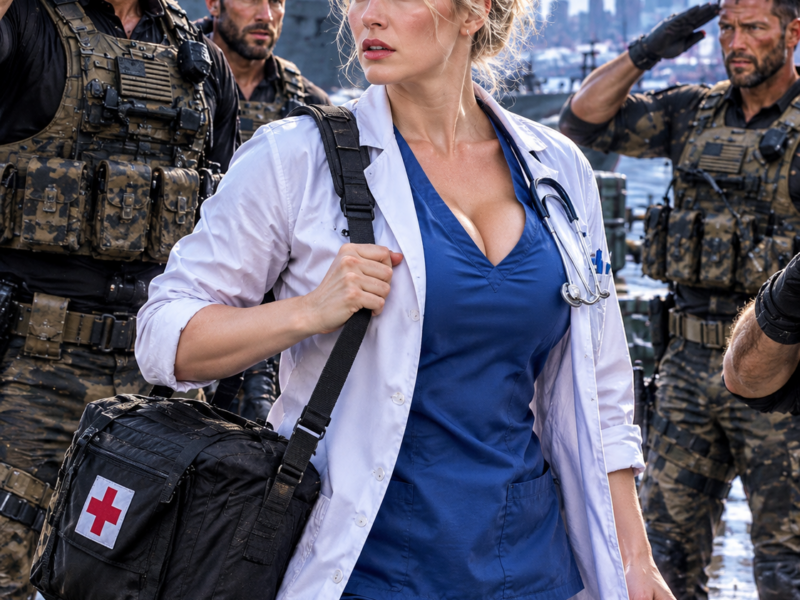
“I watched six battle-hardened Navy SEALs walk straight past hospital security, ignore a furious trauma doctor, and raise their hands in a military salute to me
“Whose name?” I asked.
Thomas Reed stood in the middle of West View Memorial Hospital’s emergency department, holding the mahogany box against his chest.
For the first time since I had known him, the man looked afraid.
Not afraid of gunfire.
Not afraid of dying.
Afraid of what he was about to tell me.
He glanced at the six men behind him. David Hayes shifted his weight onto his good leg. Jacob Miller, the youngest of them, stared at the floor. The others stood unusually still.
Then Thomas said, “Captain Daniel Whitmore.”
The name struck harder than I expected.
I hadn’t heard it in three years, but I remembered it immediately.
Whitmore had been our commanding officer during the Kor(e)al Valley operation. He had been the one who ordered our helicopter to remain outside the extraction zone. He had been the one who called our position unrecoverable.
And he had been the man who told headquarters that no rescue aircraft could safely reach us.
I looked at Thomas.
“Why is his name in the report?”
“Because the declassified files show he changed the original mission record.”
The emergency department seemed to grow quieter.
“He reported that your aircraft never received our distress signal,” Thomas continued. “But the radio logs show you received it. You requested permission to divert. He denied it.”
“I remember.”
“He also recorded your landing as an unauthorized medical evacuation.”
“That part is true.”
Thomas swallowed.
“What he left out was that he ordered the extraction team to stand down before you ever reached us.”
I felt the old scar on my left forearm tighten as my fingers curled.
Behind us, a monitor beeped.
Somewhere down the hall, a child was crying.
I had spent three years trying not to remember that night. I had not expected to find it waiting for me in a hospital hallway.
Dr. Harrison Cole stepped forward.
“I’m sorry, but this is a hospital. Whatever military dispute you’re discussing, it needs to happen somewhere else.”
Thomas turned toward him.
“Doctor, with respect, the woman you’re asking to leave this conversation once flew into a hostile landing zone to save six men your military had already written off.”
Cole’s face changed.
I raised one hand.
“Thomas. Not here.”
He nodded immediately.
That simple obedience seemed to unsettle Cole more than anything else.
A radio crackled at the emergency desk.
“Multiple-vehicle collision on Interstate 5. Incoming patients. Estimated arrival four minutes. Two pediatric patients critical. Several adults with significant injuries.”
The announcement snapped the room back into focus.
I looked toward the trauma bays.
“Sarah, get me the latest staffing count.”
She was already moving.
“Two trauma teams available, one surgical team on standby. Pediatric emergency is preparing a room.”
“Good. I want the pediatric team at the ambulance entrance. Have respiratory bring two pediatric airway kits. Tell radiology to keep the portable units ready.”
Cole stepped closer.
“I’ll coordinate the trauma bays.”
I looked him in the eye.
“Then coordinate. Don’t crowd the entrance. We need room for the stretchers.”
He nodded.
No argument.
No sarcastic remark.
Just a nod.
I turned toward Thomas.
“Your men can stay out of the treatment area. If you want to help, keep the entrance clear and follow the security team’s instructions.”
“Understood, Commander.”
I almost corrected him.
Then I decided there were more important things to do.
The first ambulance arrived before the second radio update.
Its rear doors opened, and paramedics rolled out a little girl strapped to a stretcher. She couldn’t have been more than seven. Her dark hair was tangled against the collar of her jacket, and a small stuffed rabbit was tucked beneath one arm.
“Female, seven years old,” the paramedic called. “Passenger in the rear seat. Significant chest trauma, decreased breath sounds on the right, oxygen saturation falling.”
“Bay one. Now.”
Sarah moved beside me.
The little girl’s eyes opened for half a second.
“Where’s my mom?”
Her voice was so small I almost missed it.
“Your mom is being brought in,” I told her. “You’re not alone, sweetheart.”
I checked her breathing while the team transferred her.
The signs were worrying.
“Get respiratory in here. Prepare for immediate intervention.”
Cole was already at the bedside.
“Pressure’s dropping.”
“I see it.”
He looked at the monitor, then at the girl’s chest.
“I hear diminished breath sounds on the right.”
“Good. Keep watching her oxygen and pressure.”
He looked up at me.
“Could be a tension pneumothorax.”
“Yes.”
His hands moved quickly as he prepared to assist.
Three years earlier, I had learned how quickly a chest injury could turn a survivable wound into a death sentence. In the valley, I had performed emergency procedures in a trench while rounds struck the dirt above us.
Here, there were bright lights, clean instruments, and a team that knew its roles.
But the urgency was the same.
The intervention was performed, and the little girl’s breathing began to improve. Her oxygen level climbed gradually.
Sarah exhaled.
“She’s responding.”
“Keep monitoring. Don’t relax yet.”
The next stretcher arrived.
Then another.
A man with a deep laceration to his scalp. A woman with a fractured arm. A teenage boy who had been thrown against the passenger door. A driver with abdominal tenderness and dangerously low blood pressure.
The department filled with movement.
I moved from bed to bed, making decisions, assigning tasks, and checking that no one was lost in the noise.
Cole worked beside me without trying to take over.
At one point, I noticed him pause before giving an instruction.
He glanced at me.
I gave him a brief nod.
He continued.
It was the first time that morning I saw him look like the doctor he had worked so hard to become.
Not the chief resident defending his authority.
A physician focused on the people in front of him.
The final ambulance brought in the second critical child, a boy of perhaps nine. His father followed behind the stretcher, one hand pressed against his own bleeding forehead.
“Please,” the man kept saying. “Help my son first.”
“We are,” I assured him. “A team is with him. Someone will take care of you, too.”
The boy was pale and barely responsive.
The pediatric team moved quickly. Cole joined them, and I stayed long enough to make sure the right specialists were in place before returning to the adult trauma bays.
By the time the last patient had been assessed, my shoulders were aching and the front of my scrub top was stained with blood.
But both children were alive.
One was stable enough for further imaging. The other had been taken for emergency surgery.
I stood outside the pediatric bay, watching the doors close behind the surgical team.
Sarah came up beside me.
“You knew what to do before anyone else even understood what was happening.”
“I knew what needed to happen next.”
She looked toward the trauma area.
“Dr. Cole listened to you.”
I gave her a tired smile.
“He was busy doing his job.”
“That’s not what I meant.”
I looked at her.
She lowered her voice.
“I heard what he said to you earlier. About your license. About being just a nurse.”
I didn’t answer immediately.
“Sarah, your job is to learn, ask questions, and protect your patients. Don’t waste energy trying to prove your worth to someone who hasn’t figured out how to recognize it.”
She nodded slowly.
Then she looked at my left forearm.
“Is that scar from the military?”
I pulled my sleeve down.
“Yes.”
“Were you a nurse there?”
“I was a flight surgeon.”
Her eyebrows lifted.
“That’s why you knew what to do with the motorcycle patient.”
“Experience helps. But experience doesn’t replace a team.”
She seemed to consider that.
Then a voice behind us said, “She’s right.”
Dr. Cole stood a few feet away.
His coat was unbuttoned, and his hair had fallen out of place. He looked exhausted.
“I owe you an apology,” he said.
I waited.
He glanced toward the trauma bays.
“I saw your uniform. I saw your position. I decided what you were capable of before I had any reason to make that judgment.”
“I was wearing scrubs, Harrison.”
He gave a short, embarrassed laugh.
“That’s fair.”
“You also threatened my license.”
His expression tightened.
“I know.”
“That’s not something you get to take back with one apology.”
“I understand.”
For a moment, he looked as if he wanted to say more.
Then he did.
“I was wrong to dismiss your assessment on the motorcycle patient. I was wrong to threaten you for speaking up. And I was wrong to let my title matter more than what was happening in front of me.”
I studied him.
“Then make sure you don’t do it again.”
“I won’t.”
He extended his hand.
I looked at it for a moment before shaking it.
Not because everything was suddenly fine.
Because accountability had to start somewhere.
When I returned to the nurses’ station, Thomas was waiting near the wall. The mahogany box was still in his hands.
The six men had remained outside the treatment area, exactly as I had asked.
“You’re still here,” I said.
“Didn’t think you’d want us disappearing halfway through the conversation.”
“I have patients to check on.”
“We know.”
He looked down at the box.
“Can we talk somewhere private?”
I glanced toward the clock.
“I have ten minutes.”
We moved into a small consultation room. Sarah stayed outside to cover the desk.
Thomas placed the box on the table.
For a moment, neither of us spoke.
Then he opened it.
Inside was a Navy Cross.
The medal rested on dark blue velvet, its silver surface catching the fluorescent light.
I stared at it.
I had seen the paperwork before. I knew the recommendation had been submitted. I knew the mission had been classified. I had also been told the award could not be processed while the operational record remained under review.
But seeing it there made the whole thing real in a way a letter never could.
Thomas took a folded document from beneath the medal.
“The Pentagon completed its review last month,” he said. “The operation was declassified in stages. The official record now recognizes what happened.”
I looked at the document.
“And Whitmore?”
“An inquiry is underway. The report shows that he altered the mission timeline and withheld the original communications log. The review board has referred the matter for further investigation.”
“Is he still in command?”
“No.”
I nodded.
I didn’t feel victorious.
I felt tired.
Thomas continued.
“The report also includes something else. The name of the officer who approved the flight plan that allowed you to divert.”
I looked up.
“I thought the diversion was denied.”
“It was. But before that, someone had quietly prepared a contingency route. It was never supposed to be used without authorization.”
He turned the document toward me.
The name was printed near the bottom.
Commander Elena Marquez.
My former operations officer.
I felt my breath catch.
“Elena?”
“She was the one who built the route. She knew you might ignore the stand-down order if you believed we were still alive.”
I remembered Elena standing beside the flight operations board, her dark hair tied back, arguing that the valley had not been fully assessed.
She had been reassigned not long after the mission.
I’d assumed it was unrelated.
Thomas tapped the page.
“She also preserved the radio logs. Without them, the truth might never have come out.”
I sat down.
For three years, I had carried the memory of that night as something I had done alone.
But I hadn’t been alone.
Someone had believed there was still a way to reach those men. Someone had quietly made sure that if I chose to go, I would have a chance.
“Where is she now?” I asked.
“Retired. Lives in Virginia. She was asked to provide a statement during the review.”
I stared at the name.
“Did she know about the award?”
“She knew the recommendation had been reopened. She didn’t know the final decision.”
Thomas paused.
“She asked us to tell you something.”
“What?”
He took a small envelope from his jacket and placed it beside the box.
I opened it.
The handwriting was unmistakable.
Margaret,
You once told me that the hardest part of being responsible for people was knowing when to disobey an order that had become more dangerous than the situation itself.
I never forgot that.
I made the route because I believed you would go.
I saved the radio logs because I believed someone would eventually ask why.
I am sorry it took three years.
You were never alone in that valley.
Elena.
I read it twice.
Then a third time.
My eyes burned, and I pressed the paper flat against the table.
Thomas looked away, giving me a moment.
I had spent three years telling myself that the mission was over.
That the men had survived, the paperwork had been filed, and the rest belonged to history.
But the past wasn’t finished with me.
Not because it wanted to hurt me.
Because there were still pieces of the truth I hadn’t known.
I closed the envelope.
“Thank you for bringing this.”
Thomas nodded.
Then he lifted the medal carefully from its velvet lining.
“There’s one more thing.”
I looked at him.
“We didn’t come here just to deliver paperwork.”
He glanced toward the door.
“Jacob has been talking about this since we landed in San Diego.”
A faint smile crossed my face.
“Jacob still talks too much?”
“More than ever.”
He opened the door.
Jacob stood outside with the others.
The young man stepped forward, his eyes bright.
“Commander, I know this probably isn’t the right time.”
“Then make it quick, Miller.”
He smiled.
“Three years ago, when we were in that trench, I thought I was going to die.”
His voice faltered.
“I was nineteen. I kept asking you whether my mother knew where I was. You told me she knew I was doing something important, and that she’d be proud of me.”
I remembered him.
A boy with a broken shoulder, blood on his uniform, and a stubborn refusal to close his eyes.
“I remember,” I said.
“You promised me I’d get to tell her the story myself.”
I nodded.
“You did.”
He swallowed.
“Yeah. And I did. But I never told you what happened after.”
He reached into his pocket and pulled out his phone.
“My mother came to visit the base a few months later. I showed her the picture of you from the mission report. She wanted to thank you. We couldn’t contact you because the whole thing was classified.”
He held the phone toward me.
On the screen was a photograph of a woman standing beside a young man in uniform. She was smiling, one hand resting on his shoulder.
“That’s my mom,” he said. “She wanted you to know she still has the letter you sent when I was recovering.”
I frowned.
“I don’t remember sending a letter.”
“You didn’t. It was the note you wrote on the back of my medical evacuation form. The one that said I was going to be a pain in the neck for another sixty years.”
I laughed before I could stop myself.
“I stand by that assessment.”
Jacob grinned.
“She framed it.”
The others laughed softly.
For the first time that morning, the room felt less like a place where old wounds had been reopened and more like a place where something had finally been allowed to heal.
Thomas set the Navy Cross back in its box.
“You should take it.”
I shook my head.
“I don’t need a medal to remember what happened.”
“No,” he said. “But the truth deserves to be recorded. Those men deserve to have their lives acknowledged. And you deserve to have your name attached to what you did.”
I looked at the medal again.
For years, I had avoided speaking about the mission because I didn’t want to be remembered as the woman who broke an order.
I wanted to be remembered as the person who showed up when someone needed help.
Maybe those two things were not as different as I had once believed.
I closed the box.
“I’ll accept it.”
Thomas’s shoulders relaxed.
“Good.”
“But not here. Not in front of the nurses’ station. Not as a performance.”
“Of course.”
“And I want the official record to include the whole team. The pilots who flew us in. The medic who kept the radio working. Elena. Everyone who made it possible.”
Thomas nodded.
“I’ll make sure that request is included.”
The six men stood in a loose line.
Then, one by one, they raised their hands in salute.
I stood still.
I didn’t return the salute immediately.
I looked at Thomas, at David, at Jacob, and at the three men whose faces had been in my nightmares and my prayers for three years.
Then I raised my hand.
“I’m glad you’re all here,” I said.
Thomas lowered his arm.
“So are we, Commander.”
A nurse called my name from the hallway.
I turned toward the door.
“That’s my cue.”
Jacob smiled.
“Still saving people?”
“Still trying.”
I left the room with the medal box in Thomas’s hands and returned to the emergency department.
The shift was far from over.
There were still patients waiting for scans, families waiting for news, and nurses who needed a few minutes to breathe.
I checked on the little girl from the collision. Her mother had arrived and was sitting beside her bed, holding the stuffed rabbit while the child slept.
The boy was out of surgery and stable.
I stood in the doorway for a moment, watching his father bend over him.
Then I returned to the nurses’ station.
Sarah was reviewing the patient list.
“Everything accounted for,” she said.
“Good work.”
She looked up.
“Are you going to tell us what the medal was about?”
“Eventually.”
“Eventually?”
“When I can explain it without turning it into a history lesson.”
She smiled.
“I’d listen.”
I glanced down the hall.
Dr. Cole was speaking with a paramedic, listening carefully as the man explained a detail about one of the crash victims. He didn’t interrupt. He didn’t look at his watch. He simply listened.
It was a small thing.
But sometimes the smallest changes were the ones that mattered.
I returned to the medication chart.
My hands were steady.
The scar on my arm was still there. The memories were still there. Nothing about a medal or a declassified report could erase the night in the valley.
But I no longer felt the need to hide every part of it.
I had been a flight surgeon.
I was a nurse.
I was a woman who had made mistakes, followed instincts, broken an order, and lived long enough to understand that courage wasn’t always loud.
Sometimes it was a decision made in the dark.
Sometimes it was a hand reaching for another person’s wrist.
And sometimes it was the humility to step aside when someone else knew what needed to be done.
That afternoon, when my shift finally ended, I walked outside into the San Diego sunlight.
Thomas and the others were waiting near the hospital entrance.
The mahogany box was tucked under his arm.
He held it out to me.
I took it.
“Thank you,” I said.
He nodded.
“Thank you for coming back for us.”
I looked at the six men.
Three years ago, I had believed I was flying into a valley to save six lives.
I hadn’t understood that those six lives would keep reaching back toward mine long after the mission ended.
I held the box carefully.
Then I turned toward the parking lot.
Tomorrow, I would come back to West View Memorial.
I would put on my scrubs.
I would check my patients.
I would answer the call lights and help whoever came through those doors.
And if someone asked whether I had ever been anything more than a nurse, I would tell them the truth.
I had been many things.
But the title I was proudest of was still the simplest one.
Someone people could count on.
The End.









