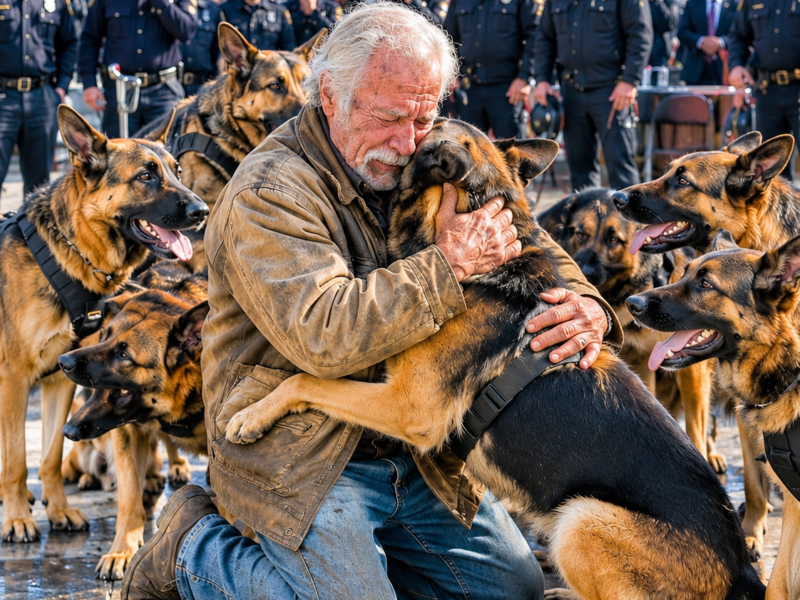
“I watched seven highly trained police dogs break formation in front of hundreds of people, drag their handlers across a memorial courtyard
Kenneth placed both hands on the edge of the conference table and looked at Chief Peterson.
For several seconds, nobody spoke.
Ranger remained pressed against his leg, his head resting on Kenneth’s worn boot.
Tank had settled beneath the table, but his eyes never left the old man’s face.
Chief Peterson carefully untied the piece of baling twine.
The leather notebook opened with a faint cracking sound.
Its pages were yellowed, some stained with grease, others marked with handwritten dates and small photographs.
The first page contained twenty names.
Not twenty dog names.
Twenty descriptions, each accompanied by a date, a weight, medical notes, and a photograph.
I leaned closer.
The first photograph showed a young German Shepherd with a dark saddle and a narrow scar above his left eye.
Ranger.
Underneath it, Kenneth had written:
“Rusty. Found in an unheated wire crate. Fifty-one pounds. Afraid of men, especially anyone wearing a uniform. Responds to patience and quiet voices.”
I felt something tighten in my throat.
That was my dog.
Or at least, that was the dog I had known for three years without knowing his first name.
Chief Peterson turned the page.
There was Tank.
Then Juno.
Sable.
Axel.
Kodiak.
Nova.
Each had a photograph, a medical history, and a description of the little habits that only someone who had spent countless hours caring for them would know.
Kenneth pointed to Tank’s photograph.
“Biscuit used to sleep with his back against my kitchen door. He wouldn’t let anybody touch his left hip for almost six months after the operation.”
Justin lowered his eyes.
“Tank still does that.”
Kenneth smiled faintly.
“Some things don’t change.”
I looked at the photographs again.
There was something else.
Every dog had a small handwritten note beneath its medical record.
Not training notes.
Personal notes.
“Likes apples.”
“Afraid of thunder.”
“Carries blankets around when nervous.”
“Will sit beside anyone who cries.”
I recognized several of those habits immediately.
Ranger always brought me his blanket when I came home after a difficult shift.
I had thought it was something his trainers had taught him.
Apparently, it had been something he’d learned long before he met me.
Chief Peterson closed the notebook halfway.
“Mr. Weaver, you said twenty dogs were taken. Why were only seven sold to us?”
Kenneth looked down.
“That’s what I’ve been trying to find out for three years.”
He turned to another section.
There were photocopies of official-looking documents, veterinary invoices, photographs of trucks, and a folded letter.
The letter was dated October 17th, three years earlier.
Kenneth unfolded it carefully.
“I kept this because I didn’t know what else to do with it.”
He passed it to the chief.
I watched Peterson read the first few lines.
His jaw tightened.
Then he read them again.
“What is it?” I asked.
He didn’t answer immediately.
Finally, he placed the letter on the table.
It was from Craig Price.
The letter claimed that Fieldstone Second Chance had violated provincial animal welfare regulations and that twenty dogs had been removed under emergency authority.
But there was a problem.
The document carried the signature of an inspector who had retired six months before the date printed on it.
Kenneth tapped the paper.
“That man wasn’t there. He’d never even been to my farm.”
Peterson reached for his phone.
“Get me the procurement office. Now.”
While he made the call, I sat beside Ranger.
I ran my fingers over the scar above his eyebrow.
“Rusty,” I whispered.
His ears moved.
He looked at me briefly, then turned back toward Kenneth.
I didn’t know whether to feel jealous, grateful, or simply ashamed that I had never known the beginning of his story.
Kenneth noticed my expression.
“Don’t take it personally, miss.”
I looked up.
“Those dogs didn’t forget you.”
He gently scratched Ranger behind the ear.
“Animals can love more than one person. They don’t have to erase somebody to make room for somebody else.”
I looked down at Ranger.
His tail moved once against the floor.
For the first time that morning, I felt able to breathe.
Chief Peterson returned to the table.
“The original procurement file is missing.”
Kenneth looked at him.
“Missing?”
“According to our records, the purchase was approved through a provincial vendor called Stevens Consulting. The company supplied seven dogs at forty-eight thousand dollars each.”
Justin let out a low whistle.
“Three hundred and thirty-six thousand dollars?”
“That’s correct.”
Kenneth stared at him.
“Those dogs were never worth that kind of money to me.”
Peterson shook his head.
“That’s not the point. The question is where the money went.”
He pulled out a chair and sat.
“Stevens Consulting was incorporated shortly before the purchase. Its registered address is a mailbox in Mississauga. The company had no permanent employees, no training facility, and no documented breeding operation.”
Kenneth’s fingers tightened around the edge of the notebook.
“So somebody stole my dogs and sold them to you?”
“That’s what it looks like.”
I looked at the chief.
“Then why did nobody check?”
He didn’t become defensive.
He simply looked tired.
“Because the paperwork appeared legitimate, the dogs passed their initial evaluations, and Craig Price had a reputation for handling procurement efficiently. We trusted a process we should have examined.”
It was the first time I had heard a senior officer admit something like that.
Peterson called the provincial anti-rackets unit.
Within an hour, two detectives arrived.
They photographed the notebook, copied every document, and asked Kenneth to explain the circumstances surrounding the seizure.
One detective, a woman named Detective Laura Mitchell, spent nearly forty minutes examining the veterinary records.
When she reached the page about Ranger, she stopped.
“Mr. Weaver, do you have any proof that these dogs were actually on your property before they were transferred?”
Kenneth nodded.
He reached into the notebook’s back cover and removed a small envelope.
Inside were photographs.
Some showed the dogs playing in a field.
Others showed them sleeping in the barn or standing beside Kenneth near an old wooden fence.
There were also veterinary bills, vaccination records, and handwritten adoption documents.
Detective Mitchell examined them carefully.
“These are useful.”
Kenneth gave a tired smile.
“I kept everything because I was afraid somebody would say I hadn’t.”
She looked at him.
“Who told you that?”
He didn’t answer.
He didn’t need to.
By late afternoon, the police had secured the procurement files, frozen the remaining accounts associated with Stevens Consulting, and begun tracing the payments.
Kenneth was asked to remain available for further interviews.
Before he left the building, he stopped beside Ranger.
The dog stood immediately.
Kenneth rested his forehead against his.
“Be good, Rusty.”
Ranger gave a soft whine.
“Don’t forget to eat your dinner. You always were a slow eater.”
I smiled despite myself.
Kenneth turned toward me.
“He’s got a good partner.”
I nodded.
“I hope I can live up to that.”
He gave my shoulder a gentle squeeze.
“You already have.”
Then he walked toward the exit.
Ranger watched him until the door closed.
That evening, I took Ranger home.
He ate his dinner, drank water, and settled beside the couch.
But every few minutes, he lifted his head toward the front door.
I understood.
He was waiting for someone.
I sat on the floor beside him.
“You can miss him,” I whispered.
Ranger placed his head on my knee.
I stayed there until midnight.
The investigation continued for weeks.
Craig Price was not arrested immediately.
His lawyers insisted that the animal transfers had been lawful and that all transactions had been conducted according to established procedures.
For a while, it looked as though he might escape responsibility.
Then Detective Mitchell found something that changed the entire investigation.
A second company.
It was registered under a different name, but its financial records connected directly to Stevens Consulting.
The company had operated a boarding and breeding facility near Hawkesbury.
The facility had received thirteen of the dogs Kenneth had lost.
Seven had been transferred to our police department.
The remaining six had been sold or moved elsewhere.
There was no reliable record of the other seven.
Kenneth sat quietly when Detective Mitchell told him.
“Are you certain?” he asked.
“We’re still verifying everything, but the records strongly suggest it.”
He looked toward the window.
For several seconds, his hands remained folded in his lap.
“Some of them might still be alive.”
Detective Mitchell nodded.
“That’s what we’re hoping.”
Kenneth stood slowly.
“Then I want to go with you.”
She hesitated.
“Mr. Weaver, it may not be a pleasant place.”
“I’ve seen worse.”
There was no anger in his voice.
Just certainty.
In January, I drove Kenneth to the facility.
The road was wet, the sky low and gray, and the old truck made a rattling sound whenever we passed over a pothole.
He carried his notebook on his lap.
He had brought a small bag of dog treats in his coat pocket.
When we arrived, two provincial cruisers were already parked outside.
The facility looked abandoned.
A rusted metal sign hung crookedly above the entrance.
Several windows were covered with plywood.
A detective met us near the gate.
“We’ve secured the property,” she said. “There are twelve dogs inside.”
Kenneth looked at her.
“Twelve?”
“That’s what we’ve confirmed so far.”
He closed his eyes briefly.
Then he stepped through the gate.
The smell hit us first.
Wet straw, old disinfectant, and something sour that I couldn’t identify.
There were steel pens along both sides of the building.
Several dogs were lying on thin bedding.
Some looked toward us.
Others barely lifted their heads.
Kenneth moved slowly.
He didn’t call out.
He simply walked along the pens, holding the back of his hand near the openings.
Then he stopped.
An old gray-muzzled female shepherd was lying in the corner of the last pen.
She had a white patch beneath her chin and a small tear in her right ear.
Kenneth stared at her.
The dog lifted her head.
For a moment, neither moved.
Then Kenneth whispered, “Mabel?”
The dog’s ears rose.
She stood on unsteady legs.
A thin sound escaped her throat.
Kenneth knelt.
“Oh, sweetheart.”
Mabel pressed her face against the wire.
Kenneth put his hand through the opening.
She pushed against it as though she were trying to climb into his palm.
I turned away.
I didn’t want him to see me crying.
The detectives opened the pen after a veterinarian checked the animal.
Mabel came out slowly.
She walked straight to Kenneth and rested her head against his chest.
He held her as carefully as if she were made of glass.
“I thought I’d lost you, girl.”
She licked his chin.
“I know. I know.”
The remaining dogs were taken for veterinary assessment.
Two needed surgery.
Three were severely underweight.
Several had untreated skin conditions.
But all twelve were alive.
Over the next month, investigators traced the remaining dogs.
Two had been sold to a private security company in Ottawa.
They were located and recovered.
One was living with a family who had purchased him without knowing his history.
The family voluntarily surrendered him after learning the truth.
Within four weeks, all twelve surviving dogs had been reunited with Kenneth or placed under his care.
The other seven from the original twenty were never located.
One, an old male named Duke, had died from an untreated infection before the authorities discovered the facility.
Kenneth kept Duke’s photograph in the front of his notebook.
He never spoke about it much.
But one evening, I found him sitting on the cottage steps, holding that photograph in both hands.
I sat beside him.
“I’m sorry,” I said.
He looked at the picture.
“He used to steal my socks.”
I smiled.
“Seriously?”
“Every morning. I’d find them in his bed.”
He rubbed his thumb across the photograph.
“Some mornings, I still put out two pairs without thinking.”
I didn’t know what to say.
So I sat beside him until the sun disappeared behind the training grounds.
By then, Kenneth had become a familiar presence at the police headquarters.
Chief Peterson had arranged temporary housing for him in an unused cottage on the K9 training property.
It wasn’t much, but it had a small kitchen, a bedroom, and a fenced yard.
Kenneth had brought Mabel there.
She slept beside the wood stove.
The seven police dogs visited whenever their schedules allowed.
Ranger was usually the first to arrive.
He would walk into the cottage, check on Kenneth, and then lie beside the stove with Mabel.
I began to notice something else.
Ranger had become calmer.
Not less alert or less capable.
Just more comfortable.
When thunderstorms rolled through, he no longer paced the hallway.
When a uniformed stranger entered the training building, he no longer stiffened.
One afternoon, I asked Kenneth how he had managed to rehabilitate so many difficult dogs.
He shrugged.
“Most people think a frightened dog needs to be reminded who’s in charge.”
He poured coffee into two chipped mugs.
“Usually, what they need is somebody who doesn’t make them afraid in the first place.”
I looked at him.
“And the training?”
“That comes later.”
He sat down.
“First, they need to learn that tomorrow is coming, that dinner will be served, and that the person who promised to return actually will.”
I thought about all the times I had worked with Ranger.
All the commands.
All the drills.
All the hours spent measuring performance.
I had never thought about how much of a dog’s confidence came from simply knowing someone would be there.
In March, Chief Peterson made Kenneth an official offer.
The police service had a vacant civilian position for a canine behavioral consultant.
The salary was seventy-eight thousand dollars a year, with benefits.
He would work three days a week at the training facility, helping with rehabilitation and overseeing the mental wellness of the working dogs.
The service would also provide housing on the grounds.
Kenneth read the offer twice.
Then he looked up.
“I haven’t got a degree.”
Peterson leaned back in his chair.
“You’ve got fourteen years of experience and more than three hundred dogs whose lives you’ve changed.”
Kenneth looked uncomfortable.
“I don’t know anything about office work.”
“Good. I have enough people who know about office work.”
Peterson smiled.
“I need someone who knows dogs.”
Kenneth folded the paper.
“I’ll think about it.”
He didn’t give an answer that day.
But the following Monday, he arrived at the training facility before seven in the morning.
He wore his old barn coat.
He carried a thermos of coffee.
And he had Mabel walking beside him.
Justin Carpenter was waiting near the training yard.
“Morning, Kenneth.”
“Morning.”
Justin held up Tank’s leash.
“There’s something I need help with.”
Kenneth looked at the dog.
“What’s that?”
“His nails.”
Tank immediately backed away.
Kenneth laughed.
“Still doesn’t like that, does he?”
“He’s nearly ninety pounds. I can’t get him to hold still.”
Kenneth knelt beside Tank.
“Come here, Biscuit.”
The dog approached.
Kenneth scratched his chest and examined his paws.
“You’re trying to hold him still before he trusts what you’re doing.”
Justin frowned.
“What should I do instead?”
“Let him see the clippers. Let him sniff them. Give him time.”
Kenneth glanced at him.
“You don’t have to win every argument with a dog, son.”
Justin smiled.
“That sounds like something my mother would say.”
“Your mother sounds like a smart woman.”
For the first time in months, the training yard was filled with laughter rather than shouted commands.
But the legal investigation was far from finished.
In early December, provincial investigators had arrested Craig Price at his lake house outside Gravenhurst.
He was wearing slippers and holding a cup of tea when detectives arrived.
Two other men involved in the false seizure had also been charged.
Price’s lawyers initially denied any wrongdoing.
Then the financial records began to tell a different story.
Investigators discovered that Stevens Consulting had received the police department’s payment and transferred much of it through several accounts.
A portion had gone toward purchasing a property.
Another portion had been used to pay the men who had carried out the illegal seizure.
The documents showed that Price had personally authorized the transactions.
He had also arranged for the false animal welfare reports.
The provincial investigators found that he had deliberately selected rescue operations with limited financial resources and complicated licensing records.
He believed their owners would be unable to afford lengthy legal battles.
Kenneth had lost his farm partly because he couldn’t pay a lawyer to challenge the seizure.
Price had counted on that.
In June, the sentencing hearing took place in a courtroom in Napanee.
I attended with Justin.
Kenneth sat in the second row wearing a borrowed jacket and a dark tie.
He had asked Justin to help him with the knot that morning.
Mabel stayed at the cottage.
Ranger accompanied me.
He lay quietly beneath my chair throughout the proceedings.
Craig Price stood at the defense table.
He looked older than I remembered from the few photographs I’d seen.
The judge read the charges.
Fraud over five thousand dollars.
Theft.
Forgery.
Conspiracy.
Animal cruelty.
She also reviewed the financial evidence.
Three hundred and thirty-six thousand dollars taken from the public purse.
Twenty dogs unlawfully seized.
Thirteen recovered from a neglectful facility.
One dead.
The judge looked directly at Price.
“Mr. Price, you took the life’s work of a decent man and turned it into a financial opportunity.”
Price stared at the table.
“You sold animals that had been rescued through years of work to the very institution entrusted with protecting the public.”
She paused.
“You did so using forged documents and without any lawful authority.”
Kenneth’s hands were folded tightly in his lap.
The judge sentenced Price to seven years in federal prison, ordered restitution, and imposed a lifetime prohibition on owning or keeping animals.
The two men who had helped carry out the seizure received four years each.
When the judge asked whether Price had anything to say, he stood.
He looked toward the gallery.
For a moment, I thought he might apologize.
Instead, he said, “They were dogs. Surplus animals from a failing operation. Nobody was meant to be hurt.”
The judge’s expression didn’t change.
“Sit down, Mr. Price.”
He sat.
The deputies approached.
As they escorted him toward the side door, Price turned toward Kenneth.
“Weaver.”
Kenneth slowly stood.
“Tell them I never touched your dogs myself.”
The courtroom fell silent.
Kenneth held the back of the bench in front of him.
“No,” he said quietly. “You never did.”
Price looked at him.
Kenneth continued.
“That was always the trouble with you. You found other people to do the hurting.”
Price opened his mouth.
Nothing came out.
The deputies led him away.
Kenneth remained standing until the door closed.
Then he sat down.
I reached over and placed my hand on his shoulder.
He covered it with his own.
Neither of us spoke.
Outside the courthouse, Chief Peterson approached with a folded document.
“The court has ordered restitution,” he said.
“The sale of Price’s property will cover the service’s losses, and a separate civil settlement has been approved for you.”
Kenneth looked at the paper.
“How much?”
“Just over three hundred thousand dollars, subject to the final accounting.”
Kenneth read the amount twice.
He looked confused rather than happy.
“I haven’t seen that kind of money in years.”
Peterson nodded.
“Your old farm is still available. The bank has agreed to delay the sale while you decide what you want to do.”
Kenneth looked toward the parking lot.
For a long time, he said nothing.
Then he smiled faintly.
“One hundred acres is a lot of grass to mow at my age.”
Peterson laughed.
“I suspect you’ll find someone to help.”
Kenneth looked down at Ranger.
The dog was sitting beside me, watching him.
“Maybe.”
He folded the paper and slipped it into his coat.
“But I think I know what I want to do.”
Three months later, Kenneth bought back the old property in Grey County.
The barn needed repairs.
The fencing had to be replaced.
The farmhouse required a new roof, and the old water pump no longer worked.
But the land was still there.
The same maple trees stood along the driveway.
The same small pond reflected the sky.
And the old gate still leaned slightly to the left.
Kenneth stood beside it on the first morning after the purchase.
He rested both hands on his hickory cane.
For a moment, he simply looked across the field.
Then Mabel stepped forward.
She sniffed the grass.
Her tail moved.
Kenneth smiled.
“Well, girl. We’re home.”
The new sign above the gate read:
FIELDSTONE SECOND CHANCE.
It was painted by hand.
The letters weren’t perfectly straight, but Kenneth refused to replace it.
He said the old sign had never been straight either.
The police service continued employing him as a canine behavioral consultant.
Three days a week, he worked at the training grounds.
The other days, he spent at the farm.
The department also established a formal rehabilitation partnership with Fieldstone.
Dogs that had been abandoned, injured, or deemed unsuitable for ordinary training could now receive specialized care.
Kenneth insisted that the program include one rule.
“No dog gets written off because it takes longer to trust us.”
Chief Peterson approved it without argument.
Over the next year, more than forty dogs passed through the program.
Some were eventually adopted.
Others became working dogs.
A few simply stayed at the farm because they needed a place where nobody expected anything from them.
I continued working with Ranger.
He remained one of the finest police dogs in the region.
But our partnership changed.
I learned to recognize when he needed a break.
I learned that a command delivered quietly could be more effective than one shouted across a field.
And I stopped measuring every good day by the number of successful exercises.
Sometimes, success was simply a dog lying peacefully in the grass.
One afternoon in October, I drove Ranger out to Fieldstone after a long shift.
Kenneth was repairing a section of fence.
His cane leaned against a post.
Mabel was sleeping near the barn.
Several rescued dogs were scattered across the field.
Ranger spotted Kenneth and started running.
I unclipped his leash.
He crossed the grass and stopped directly in front of the old man.
Kenneth bent carefully.
“There’s my Rusty.”
Ranger pressed his head into Kenneth’s chest.
Then he turned and looked back at me.
Kenneth noticed.
“He’s checking that you’re coming.”
I walked closer.
“He’s always done that.”
Kenneth nodded.
“That’s because you’re his person, too.”
I looked at the dog.
Three years earlier, I had believed that being Ranger’s handler meant earning his obedience.
I had learned that it meant something much larger.
It meant being the person he could trust when everything else became unfamiliar.
Kenneth reached down and rubbed the dog’s neck.
“You know, Taylor, I used to worry that I’d never get them back.”
I smiled.
“You did get them back.”
He shook his head.
“Not exactly.”
He looked across the field.
“I got to see them again. I got to know they were safe. That’s different from getting back what you lost.”
I thought about the farm, the years he had spent grieving, and the dogs who had finally found their way home.
“Do you ever wish things had happened differently?”
Kenneth considered the question.
“Every day.”
He looked at Ranger.
“But I don’t wish I’d never loved them.”
The wind moved through the trees.
Ranger stood between us, his ears lifted, his tail resting gently against my leg.
Kenneth had once believed that twenty dogs had disappeared from his life forever.
Instead, seven of them had found their way into the hands of people who needed them, twelve had survived to return to him, and the rest of his work had begun again in a place that had once seemed lost.
He never became wealthy.
He never became famous.
But every Wednesday, Friday, and Sunday, he walked onto the training field with his old cane and a pocket full of dog treats.
And every time he arrived, the dogs knew.
They didn’t need a whistle.
They didn’t need a command.
They simply came running.
On the anniversary of that November memorial, the department held another ceremony in the same courtyard.
This time, Kenneth stood in the front row.
He wore his old barn coat, freshly mended at the cuff.
Seven German Shepherds sat beside their handlers.
Ranger was beside me.
When the bugler began playing, he lifted his head.
The wind moved through the courtyard again.
For a brief moment, I wondered whether he would break formation.
Then he looked toward Kenneth.
Kenneth smiled.
Ranger looked back at me.
And instead of running away from either of us, he rested his shoulder against my leg.
I placed my hand on his head.
The chief began speaking about loyalty, courage, and service.
But I wasn’t listening anymore.
I was watching an old man in a worn coat, surrounded by the animals he had once saved and the people who had learned from him.
I finally understood something I hadn’t understood when I first met Kenneth Weaver.
Those seven dogs hadn’t broken their training that morning.
They had remembered the person who taught them that the world could be safe.
And somehow, they had found a way to bring him home.
The End.









