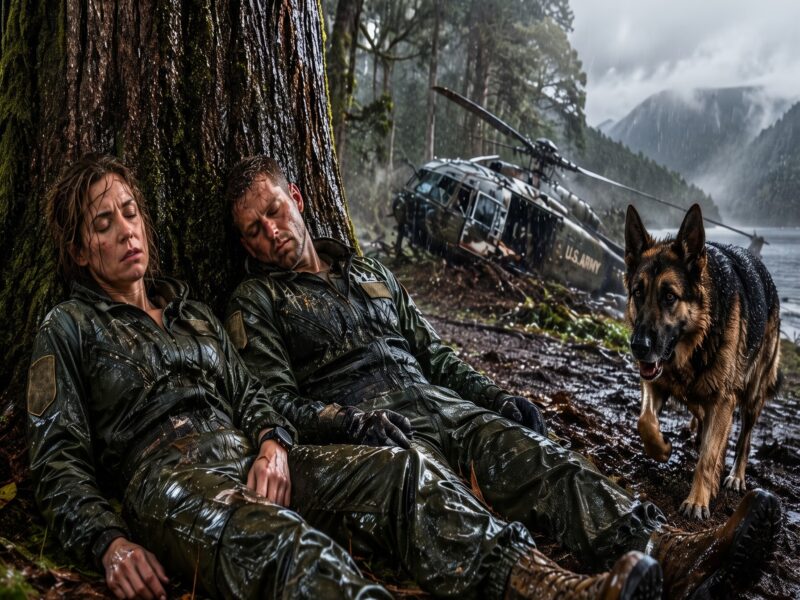
I watched our helicopter burn on a deserted Pacific island while my commander walked away without looking back, leaving me and another Army pilot to die
The fire reflected across the black water as I dragged myself away from the wreckage. Every movement sent a violent surge of pain up my right thigh, a sharp, white-hot agony that made my vision blur into static. I could smell the sickening mixture of scorched aviation fuel, burning rubber, and melted wiring. Behind me, the crushed hull of the UH-60 Black Hawk groaned under the intense heat, its metal ribs buckling and popping like gunshots in the damp night air.
“Stay with me, Marcus! Keep moving!”
Captain Ryan Cole’s voice was hoarse, choked with soot and adrenaline. He was pulling me by the shoulder straps of my tactical vest, his boots skidding in the wet sand. Blood streamed from a deep gash above his left eyebrow, cutting a clean red line through the black ash smeared across his face.
We collapsed together onto the wet sand, thirty yards from the inferno, just past the reach of the tide. I rolled onto my back, gasping for air that tasted like sulfur and salt. My hands were shaking so violently I couldn’t unbuckle my thigh rig. Ryan dropped beside me, coughing violently before pressing his palm hard against the gash on his head.
“Can you walk?” Ryan panted, his chest heaving under his torn flight suit.
“I can try,” I gritted out, forcing myself to sit up. The world tilted dangerously. I gripped my knee, feeling the warm stickiness of blood soaking through my trousers. The bone wasn’t exposed, but the shrapnel from the instrument panel had bitten deep.
Behind us, the helicopter burned until the metal began collapsing inward with a long, agonizing hiss. The main rotor was snapped in two, jabbed into the sand like a broken cross. We sat in silence for a moment, bathed in the orange glare of our destroyed life line.
Slowly, the reality of our situation began to settle in like a cold weight in my chest. Our emergency radio was gone, destroyed in the initial impact when the cockpit collapsed. Our survival kits, packed in the rear cabin, were currently incinerating in a twelve-hundred-degree firestorm. And our long-range rescue beacon—the one piece of gear designed to broadcast our coordinates across the entire Pacific basin—had completely disappeared from the dashboard prior to our emergency descent.
Ryan turned his head, his sharp blue eyes scanning the dark treeline where the white sand gave way to dense, tangled jungle.
“Where’s Commander Hayes?” Ryan whispered. His voice lacked the panic I expected; instead, it held a cold, sharp edge of confusion.
I looked back down the beach, tracing the ragged path our airframe had carved through the shoreline before spinning out. Fifty yards south, half-buried in the surf, lay the orange silk of a emergency parachute. Beside it, sitting neatly on a dry patch of drift logs, was Hayes’s personal survival pack.
But Hayes was gone.
“Commander!” Ryan shouted, pushing himself up despite his staggering gait. “Hayes!”
The only response was the crackle of burning aluminum and the rhythm of the waves breaking against the reef. I looked closer at the dry sand around Hayes’s pack. Footprints. Deep, deliberate boots prints leading straight out of the surf and directly into the dark wall of palms. He hadn’t been thrown. He hadn’t been dragged. He had unbuckled his harness, dropped his chute, taken the secondary long-range comms kit from his vest, and walked into the dark.
He didn’t check for survivors. He didn’t fire a flare. He had abandoned us before the smoke even cleared.
“He took the satellite radio,” Ryan said, his voice barely audible over the roaring fire. He walked over to Hayes’s abandoned harness and knelt down, touching the empty nylon pouch where the AN/PRC-117G radio should have been stored. “It was in his vest harness. He had it strapped in before we even lost engine power in the storm.”
“Why the hell would he hit the jungle?” I spat, trying to wrap a piece of torn fire-retardant cloth around my bleeding leg. “We’re on a dead-zone rock in the middle of the Marianas. If he has the radio, he should be on the shore calling in the CSAR team.”
Ryan didn’t answer right away. He stood up, looking into the pitch-black abyss of the forest. “Unless he isn’t trying to be saved, Marcus.”
For two days, we survived on sheer instinct and anger. We drank lukewarm rainwater collected from palm leaves and smashed open green coconuts with Ryan’s tactical knife. The tropical heat was suffocating, wrapping around us like a wet blanket, making my leg infection pulse with a steady, sickening heat. We built a crude shelter beneath the overhang of a coral outcrop, keeping our eyes glued to the horizon for the glint of a searching C-130 or the thrum of a naval rotor.
Nothing came. The sky remained an empty, cloudless blue. The ocean was a vast mirror of absolute isolation.
By the third morning, my fever had spiked. My vision swam with grey spots, and Ryan had used the last of his energy to drag me into the shade of a banyan tree at the edge of the treeline. We were out of water. Our strength was depleted. The fire on the beach had long since died down to a mound of blackened, unrecognizable scrap metal.
Then, through the fog of my fever, I heard it.
A low, raspy bark snapped through the ambient hum of the ocean.
Ryan’s hand immediately moved to his hip, drawing his M9 sidearm—the only weapon we had managed to salvage from the cockpit floor. His arm was shaking from exhaustion as he brought the barrel up. “Stay down,” he muttered.
The bushes parted thirty feet in front of us.
A German Shepherd stepped out from between the thick leaves. He was thin—his ribs visible beneath a coat coated in dried mud and burrs—but his posture was alert, ears pinned forward, intelligence shining in his dark eyes. Around his chest was an old, faded tactical harness, the webbing frayed and bleached by years of harsh sunlight.
Ryan froze, his finger resting lightly on the trigger guard. “Easy…”
The dog didn’t growl. He didn’t bare his teeth or assume an aggressive stance. He stood on the edge of the clearing, his tail held low and neutral. He stared directly into my eyes, then shifted his gaze to Ryan. He raised his head, let out a short, soft chuff, and turned his body ninety degrees, looking back over his shoulder toward the thickest part of the jungle.
He took three steps into the brush, stopped, and turned his head back toward us.
It wasn’t wild behavior. It was military training. It felt like an unmistakable invitation.
“Look at his harness, Ryan,” I rasped, my throat raw.
Ryan lowered the pistol slightly, squinting through the dappled sunlight. Stitched along the side of the dog’s chest rig was a faded brown name patch, the Velcro peeling at the corners.
“He’s not a wild animal,” Ryan said, his eyes widening. “That’s issue gear.”
The dog gave one more urgent bark, moved another five paces into the dark foliage, and waited again.
“We don’t have a choice,” I said, leaning against the banyan tree as I tried to force my dead weight onto my good leg. “We stay here on this beach, we die of infection or dehydration. He wants us to follow him.”
Ryan tucked his pistol into his waistband, stepped under my shoulder, and took my weight. Together, sweating and bleeding, we followed the ghost in the military harness deeper into the green shadows of the island.
The dog moved with practiced, mechanical precision. He never strayed more than twenty feet ahead of us, constantly dropping back to check our pace, his ears twitching at every snap of a twig or cry of a tropical bird. He guided us off the flat terrain of the coast, leading us up a steep, muddy ridge where the humidity hung so thick it felt like breathing water.
My leg was a fire of agony. Every time my right foot touched the slick loam, a white flash erupted behind my eyes. Ryan grunted under my weight, his breathing heavy and ragged, but he kept moving forward, his eyes locked on the moving brown back of the Shepherd.
“He knows where he’s going,” Ryan panted, wiping sweat and old blood from his eyes. “This isn’t random. He’s running a search and guide protocol.”
After nearly forty minutes of climbing, the dense jungle abruptly gave way. The dog stopped beside a massive wall of volcanic rock completely draped in thick hanging vines. He turned to us, sat down on his haunches, and let out a single, definitive bark.
Ryan let me slide gently against a mossy boulder before stepping forward. He reached out and yanked on a handful of heavy vines. With a shower of dry dirt and dead leaves, the green curtain pulled back, revealing a heavy, reinforced steel door set directly into the side of the mountain. It was covered in deep red rust, the lock mechanism corroded, but the heavy hatch was propped open a few inches by a rotting wooden beam.
“A WWII bunker?” I whispered, leaning my head back against the rock as my chest heaved.
“No,” Ryan said, rubbing his thumb over the metal frame. “Look at the rivets. Look at the stenciling. This is cold-war era. US Navy construction.”
He pushed the heavy steel door open. The hinges screamed with a metallic screech that echoed down the valley, making us both wince. Darkness yawned inside, smelling of damp earth, copper, and old paper.
The dog didn’t hesitate. He trotted straight into the pitch blackness.
Ryan pulled his small tactical penlight from his sleeve—one of the few tools still in his pocket when we crashed—and clicked it on. The narrow white beam sliced through the dust-mote filled air. I limped in behind him, using a sturdy stick I’d picked up along the trail to keep my balance.
Inside, the bunker opened into a medium-sized command room. Old, dead radio consoles sat along the walls, their vacuum tubes smashed and wires stripped. Rusting ammunition crates were stacked in the corner, alongside rotting canvas cots and shattered glass bottles.
Ryan swept the light across a wooden desk in the center of the room. Sitting on top of a heap of moisture-ruined maps was a framed photograph, its glass cracked in a spiderweb pattern.
Ryan picked it up, shaking off a layer of grey dust. He shone the penlight directly onto the photo.
My breath hitched in my throat.
The photo showed four soldiers in woodland camouflage standing in front of this very bunker. On the far left stood a younger man, his face clean-shaved, wearing an officer’s cap. But it was the dog in the center of the photo that made my skin crawl. Standing proudly beside his handler was the same German Shepherd currently sitting on the concrete floor beside us.
“This can’t be,” Ryan breathed, his fingers tightening on the frame.
He pointed the light at the bottom of the canvas harness resting on the dog in the picture. The unit patch was clear: 13th Special Operations K9 Division. And embroidered beneath it was the name: RANGER.
Ryan turned the flashlight onto the dog sitting at our feet. He knelt down, his fingers gently brushing away the dry mud on the dog’s chest patch. The faded black lettering matched the photo exactly.
“Ranger,” Ryan whispered.
The dog’s ears perked up at the sound of his name. He let out a low, soft whine, leaning his head against Ryan’s knee for a brief second before pulling away.
“Marcus,” Ryan said, his voice dropping an octave, turning flat and terrified. “Look at the date on the photo.”
I leaned over his shoulder, reading the faded blue ink in the corner of the print: October 14, 2020.
“He was listed as missing six years ago,” Ryan said, his eyes darting around the dark room. “His entire unit—Detachment 4—was reported lost at sea during a routine transport flight in heavy weather. I remember the briefing in flight school. They said the aircraft sank in deep water with no survivors.”
“If the plane sank in deep water,” I said, looking at the solid floor, “how is this dog alive on an unmapped island?”
Before Ryan could answer, Ranger suddenly snapped his head toward the back of the bunker. A sharp, guttural growl vibrated deep within his chest. He trotted over to the corner of the room, near a stack of collapsed wooden pallets, and began frantically scratching at the concrete floor with his front paws.
“What is it, boy?” Ryan asked, stepping over with the light.
The concrete floor in that corner was uneven. Ranger was digging at a seam where two large wooden floorboards had been laid down to cover a recessed drainage pit.
Ryan set the photo down and used the blade of his knife to pry up the rot-weakened boards. They cracked and splintered, revealing a shallow, dry pit lined with heavy plastic sheeting.
Lying at the bottom of the pit was a heavy, Pelican brand waterproof hard-case, locked with two heavy metal latches.
Ryan reached down and hauled the case out. It was covered in dust, but the rubber seal was intact. He popped the latches with a loud metallic snap and swung the lid open.
Inside, resting on clean grey foam, was an array of equipment that had no place on a forgotten island. A fully charged satellite phone with an auxiliary solar pack, four dark-grey encrypted military memory cards, and a thick, hand-written operational logbook bound in black leather.
I reached out with a trembling hand and pulled the logbook from the foam. I flipped open the cover. The first page contained a hand-drawn map of our current flight corridor, marked with red X’s over specific coordinates in the Mariana Trench.
Below the map was a tight, precise handwriting detailing an operation that made my blood run cold despite the muggy air of the shelter.
It was a log of systematic sabotage. The entries detailed the illegal interception of high-grade military hardware, the deliberate misrouting of supply flights, and the execution of “unrecoverable force purges”—a polite term for murder—to cover up the theft of black-budget military assets.
I scrolled down to the bottom of the first page. The final signature authorizing the abandonment of the unit six years ago was written in clear, dark ink.
Commander Victor Hayes.
Ryan leaned over, reading the signature over my shoulder. His hand went dead limp, the penlight slipping slightly before he caught it.
“He didn’t leave us because he thought we were dead,” Ryan whispered, his eyes wide with absolute horror as he looked toward the jungle outside.
“He left us because we knew too much.”
The air inside the bunker instantly felt ten degrees colder. The pieces of the puzzle, disjointed and terrifying, snapped together in my mind with brutal clarity.
Our flight wasn’t a routine transport run. The sudden electronic failure over the trench, the complete loss of our backup telemetry, the missing emergency beacon—it hadn’t been an act of god or bad weather. Hayes had set us up. He had brought us out into this blind sector of the Pacific specifically to dump the airframe, eliminate us, and clean up the final loose ends of an operation he had been running out of this shadow site for over six years.
“Look at the dates in the log,” I said, my fingers shaking as I turned the brittle pages. “He’s been using this abandoned installation as a staging ground. The K9 unit six years ago—they found out about his smuggler network. He crashed their transport, left them to die, and reported it as an accident.”
“Except Ranger survived,” Ryan said, staring down at the dog. “Ranger survived, stayed with the stash, and lived off the land.”
“And Hayes came back,” I said, pointing to the last entry in the book, dated just three weeks ago. “He was clearing out the inventory. We were his last ride out before he shut the whole thing down for good.”
Ranger suddenly stopped sniffing the crate. His ears went flat against his skull. A low, terrifying vibration started in his throat, deeper and more aggressive than before. He backed up against my good leg, his body trembling violently.
“Ryan,” I whispered. “Listen.”
Through the rusted steel door of the bunker, over the sound of the wind whipping through the trees, came the distinct sound of snapping branches and the rhythmic crunch of boots on dry leaves.
Someone was coming up the ridge.
Ryan instantly grabbed the satellite phone from the Pelican case, shoving it inside his flight suit, while I lunged forward, grabbing Ranger by his harness handle and pulling him back behind the thick concrete corner of the shelter wall.
Ryan clicked off the penlight. Darkness fell over us like a lead vault.
We froze in the pitch black. The only sounds were the ragged, shallow breathing of three living creatures crammed into a dark alcove and the slow, heavy thud of my own heart hammering against my ribs.
Through a narrow two-inch crack where the wall met the doorframe, a sliver of bright sunlight cut through the room.
Shadows crossed the light.
Step. Step. Step.
Four men walked into the clearing directly outside the bunker.
Through the crack, I saw him. Commander Hayes was wearing his olive-drab flight suit, but he had stripped off his officer insignias. Holstered across his chest was a heavy, tactical carbine that had never been issued to our squadron.
Behind him stood three men dressed in unmarked grey contractor uniforms, carrying short-barreled automatic rifles. They didn’t move like regular soldiers; they moved with the loose, dangerous precision of mercenaries.
“Search the perimeter,” Hayes ordered, his voice cold, calm, and utterly devoid of emotion. “The crash site was completely burnt out, but there were only two sets of boot prints leaving the surf. They didn’t die in the impact.”
One of the mercenaries pointed toward the rusted steel door. “The hatch is open, Commander.”
Hayes stopped directly outside our shelter. He raised his rifle, resting his finger lightly against the receiver. He didn’t look worried. He looked like a man executing a tedious chore.
“I know you’re alive, Cole,” Hayes called out, his voice echoing off the concrete walls of the shelter. “I know you dragged Miller up the beach. You always were too noble for your own good, Captain.”
Inside the alcove, Ryan reached down and pulled his M9 pistol from his belt. He racked the slide as silently as possible, but the tiny metallic click sounded like a thunderclap in the tiny space.
Ranger pressed harder against my thigh. I wrapped both arms around the old dog’s chest, burying my face in his scruff, praying to God he wouldn’t bark. The dog was rigid, every muscle in his body strained like a coiled spring, but he remained dead silent. He knew the enemy’s voice.
Hayes took two steps closer to the entrance. He was standing less than ten feet from where we were crouching in the dark.
“You don’t understand the scope of what’s happening here, Ryan,” Hayes said, his tone conversational, almost pleasant. “You think this is treason? You think this is about money? It’s about survival. The world is changing, and the men I work for are building the future. You and Miller… you were just flight line collateral. Unfortunate losses in a routine training accident.”
He paused, stepping into the threshold of the bunker. The beam of a high-powered weapon light cut through the darkness, washing over the empty wooden desk, the cracked photo frame, and the open floorboards where the Pelican case had been buried.
Hayes stopped. The light fixed on the open pit.
His posture stiffened instantly.
“They found it,” one of the mercenaries barked, bringing his rifle up to his shoulder.
Hayes didn’t panic. He slowly swept his weapon light across the room, the bright beam passing within six inches of the concrete corner hiding us.
“Come out, Ryan,” Hayes said softly, his voice dropping all pretense of friendliness. “Come out, and maybe you’ll get off this island alive. Give me the drive, and I’ll put you on a transport to the mainland. You have my word as your commander.”
Ryan looked at me in the dim reflected light. He didn’t say a word. He didn’t need to. We both knew what a promise from Hayes was worth.
Then, Hayes took one more step forward, his boot resting directly on the wooden boards covering the pit.
“Search the back room,” Hayes commanded his men. “Kill anything that moves.”
The two mercenaries moved into the bunker, their boots clicking against the hard floor. The light beams swept wildly across the ceiling and walls.
We were seconds away from being discovered. There was nowhere left to run, no second exit, and only nine rounds of 9mm ammunition against four men with automatic rifles.
Ryan looked down at the Pelican case sitting open between his knees.
Beside the satellite phone and the logbook lay one final item—a small, heavy-duty metallic flash drive that had slipped into the dark foam padding at the bottom of the box. It was a ruggedized, military-grade drive, coded in yellow paint.
While I kept my arm locked around Ranger’s neck, Ryan reached down with agonising slowness and pulled the satellite phone from his suit. It was a modern tactical unit, equipped with a small, high-resolution LCD display and an integrated media reader slot on the side.
Ryan slid the yellow memory card into the side port of the phone. The small screen flickered to life, throwing a pale blue glow over Ryan’s blood-stained face.
A file directory opened automatically. There was only one file on the drive: an encrypted, time-stamped video recording from six years ago.
Ryan hit play, keeping the volume completely muted.
The video was shot from a fixed security camera inside what appeared to be an underground armory. In the frame, crate after crate of advanced anti-aircraft weaponry was being loaded onto shipping pallets.
Standing in the center of the frame was a younger Commander Hayes, saluting a man in a dark civilian suit whose back was turned to the camera.
Then, the man in the suit turned around to sign a transfer document.
When the screen illuminated his face, Ryan’s breath hitched in a sharp, audible gasp. He clamped his hand over his own mouth, his eyes wide with absolute, horrifying disbelief.
I leaned my head forward, looking down at the screen.
The man in the video—the person orchestrating the illegal weapons transfers, the man who had authorized the destruction of the K9 unit, the man who was paying Hayes to turn our helicopter into a burning tomb on the beach—wasn’t a rogue foreign agent or a faceless warlord.
It was General Thomas Vance.
The Vice Chief of Staff of the Army. The man who had personally pinned the wings on my chest at graduation. The man who had sent our squadron to this sector of the Pacific.
We hadn’t been sent here on a routine patrol. We had been sent here by the highest level of our own command chain to be executed because General Vance was scrubbing his past before his upcoming nomination to the Joint Chiefs.
And Ranger—the dog sitting quietly under my arm—had been guarding the one piece of evidence that could pull down the entire leadership structure of the regional command.
Outside our alcove, the footsteps stopped.
“Commander,” one of the mercenaries shouted from the center of the bunker. “They’re not in the main room!”
“Then they’re behind the wall partition,” Hayes’s voice rang out, cold and close. “Flush them out with a grenade.”
Ryan looked at me. The blue light from the phone reflected in his eyes. There was no fear left in his face—only a raw, burning fury.
He tapped the screen of the satellite phone, hitting the emergency broadcast sequence. The phone began to ping—a high-frequency, encrypted signal blasting directly to the military satellite network, uploading the video file, the logbook, and our live GPS coordinates straight to the Department of Defense Inspector General’s secure server.
UPLOAD COMPLETE, the screen flashed in bright green letters.
“Now!” Ryan whispered.
Before the mercenary could pull the pin on the grenade, Ryan leaned around the concrete corner and fired three rapid shots into the darkness.
The deafening roar of the 9mm rounds exploded inside the cramped concrete bunker.
The lead mercenary crumpled to the floor as the bullets tore into his chest. The second contractor yelled out, spraying a wild burst of automatic fire that shattered the concrete edge right above our heads, filling the air with biting dust and flying stone chips.
“Ranger, ATTACK!” Ryan roared.
The old German Shepherd didn’t need to be told twice. Six years of pent-up rage, six years of waiting in the dark, exploded out of his chest in a terrifying, animalistic roar. He leaped past the corner, a blur of fur and teeth, lunging straight for the neck of the second shooter.
The mercenary screamed as Ranger knocked him backward onto the concrete, the heavy rifle spinning out of his hands and clattering across the floor toward me.
I ignored the screaming agony in my leg, threw my weight forward, and scooped up the fallen automatic rifle. I rolled onto my back and opened fire on the doorway, forcing Hayes and the third mercenary to dive back into the daylight outside.
“Move! Out! Out!” I screamed, using the wall to haul myself to my feet.
Ryan grabbed the satellite phone and the leather logbook, throwing them into his suit jacket. He hauled me up under my arm, and together, with Ranger trotting fiercely at our side, we burst out of the bunker’s entrance into the blinding tropical sunlight.
The third mercenary was waiting on the ridge. He raised his rifle, but Ryan was faster. He pulled his M9 and fired twice, hitting the contractor in the shoulder, sending him tumbling down the steep, muddy embankment into the jungle below.
Then, there was silence.
The wind rustled through the palm trees. The salt air hit my face.
Fifty feet away, standing on the crest of the narrow ridge overlooking the open ocean, stood Commander Hayes.
His rifle was gone—lost or dropped in the chaos inside the shelter. He stood with his hands raised slightly, his eyes locked on the automatic weapon trembling in my hands.
“Marcus… Ryan…” Hayes said, his voice smooth, trying to regain his composure. “Think about what you’re doing. You think anyone back home is going to believe two shell-shocked pilots over a decorated commander? You bring that evidence back, and Vance will destroy you before you ever hit a courtroom.”
“It’s already gone, Hayes,” Ryan said, stepping forward, holding up the satellite phone. The screen was still glowing green. “The entire package—the logs, the video, General Vance’s signature—it was uploaded three minutes ago. It’s on the Pentagon servers right now.”
Hayes’s face drained of color. The smug, untouchable confidence that he had worn like armor suddenly shattered. He staggered back a step, looking at the glowing screen, then at the rifle in my hands, and finally down at the dog standing beside us.
Ranger stood tall, his head held high, his ears forward, his low growl echoing across the ridge.
“It’s over, Commander,” I said, my finger tight on the trigger. “Six years ago, you thought you left everyone dead on this island. You forgot that some things don’t stay buried.”
In the far distance, across the vast blue expanse of the Pacific Ocean, a low, rhythmic thumping sound began to echo through the sky.
Thump. Thump. Thump. Thump.
It wasn’t one aircraft. It was two. Heavy, twin-engine search-and-rescue MH-60 Jayhawks, responding to the automated emergency distress beacon Ryan had triggered from the satellite phone. They were banking hard over the reef, heading straight toward our coordinates.
Hayes looked up at the sky, watching his final escape route disappear as the massive rescue helicopters swept over the island, their spotlights cutting through the canopy.
He dropped to his knees in the mud, his hands hovering behind his head, completely defeated.
Ryan looked down at Ranger. The old dog walked slowly over to the edge of the ridge, sitting down in the soft grass, watching the rescue helicopters hover over the beach below. His duty was done. The mission was finally over.
Ryan knelt beside the dog, wrapping his arm around Ranger’s broad shoulders, pulling the old soldier close.
“Good boy, Ranger,” Ryan whispered, his voice finally breaking with emotion. “You brought us home.”
The end.









