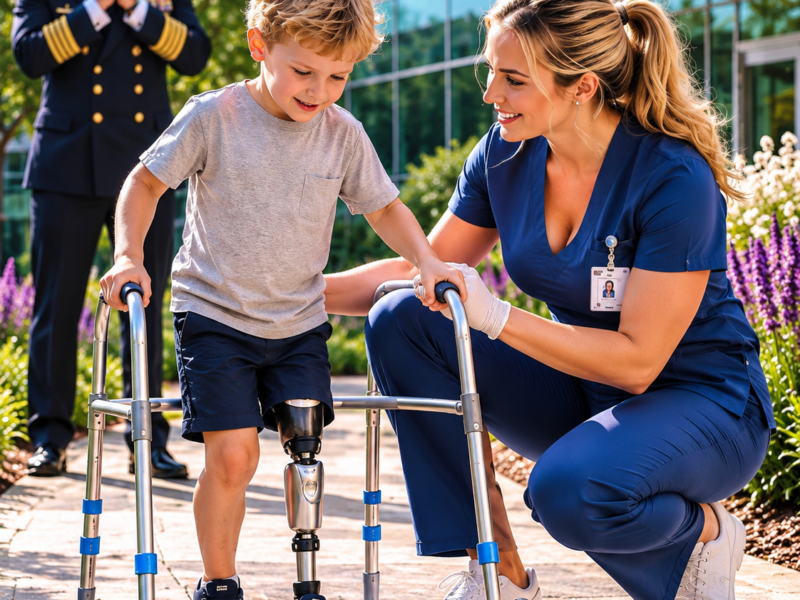
“I watched my seven-year-old son collapse on the garden path outside Bethesda Naval Medical Center while a hospital coordinator shouted for emergency medication
The call ended, but the warning stayed with me.
“Her departure from service was not straightforward.”
I stood in my office long after the screen went dark, listening to the quiet hum of Bethesda Naval Medical Center outside my door. Six years earlier, I had watched a young combat medic disappear into smoke with one of my wounded sailors over her shoulder. I had never learned her name. The mission report had been sealed, the personnel records restricted, and every attempt I made to identify her had led to the same answer: no accessible information.
Now I knew where to find her.
Reagan Cole was three floors below me, probably checking on my son.
And someone had just told me to leave her alone.
I had spent thirty years in the Navy. I understood classified information, operational security, and the difference between a legitimate warning and an attempt to bury something. I also understood that a father had no business turning his child’s nurse into an intelligence investigation.
So I made a decision.
I would not confront Reagan with what I knew. Not yet.
First, I would find out why someone was so determined to keep her past hidden.
The next morning, I arrived at the pediatric rehabilitation unit before visiting hours. Sam was sitting in his wheelchair beside the window, carefully arranging a collection of toy ships on the table. Reagan stood nearby, helping him adjust the blanket over his legs.
“Dad!” Sam called.
I smiled and approached him. “How’s my favorite sailor?”
“I’m going to walk outside again today.”
His confidence had returned in small pieces. A few weeks earlier, he had refused to look at the empty space beneath his left knee. Now he talked about the garden path as if it were a destination he had every right to reach.
“That sounds like a good plan,” I said.
Reagan looked up. “We’ll see how his pain is this morning before deciding.”
There was no false reassurance in her voice. She never promised Sam that something would be easy. She promised that she would help him through it.
I had begun to understand how rare that was.
“Can I speak with you for a moment?” I asked her.
Her expression remained professional. “Of course, Admiral.”
We stepped into the corridor, where I lowered my voice.
“Thank you for what you did yesterday.”
“You don’t need to thank me. Sam needed help.”
“I know. But I want you to understand that I noticed.”
She studied me for a second. “You were there. Anyone would have noticed.”
“Not everyone would have known what to do.”
Something changed in her face. It was brief, almost invisible, but I saw it. Her shoulders tightened. Her eyes moved toward the nurses’ station.
“Admiral, I followed the protocols.”
“I didn’t say you hadn’t.”
“Then I think we should leave it there.”
She returned to Sam before I could answer.
It was the first time I had seen her deliberately close a conversation.
Later that morning, I contacted a retired intelligence officer who had worked with my command during the operation six years earlier. I did not ask him to violate a classification. I asked him a simple question.
“Was the medic from that mission ever formally identified?”
There was a long silence.
“James, why are you asking?”
“Because I believe I met her again.”
“Then you should forget you ever asked.”
“That’s not an answer.”
“It’s the only one I can give you.”
He disconnected.
By noon, I had received another call. This time, it came from the hospital’s administrative director.
Denise Marsh, the physical therapy coordinator, had filed a formal concern about Reagan’s treatment decisions. The report questioned her judgment during Sam’s outdoor rehabilitation and alleged that she had acted outside the established treatment plan.
I read it twice.
The report described Reagan’s breathing technique as an unapproved intervention. It characterized her decision to take Sam outdoors as an unnecessary risk. It even suggested that the previous day’s pain episode demonstrated why her approach was inappropriate.
I knew what I had witnessed.
Sam had been frightened, hurting, and convinced that his body had betrayed him. Reagan had not dismissed his pain or forced him to continue. She had stopped, assessed him, helped him regulate his breathing, and made sure he was safe.
The report made those actions sound reckless.
I requested a meeting with the director and the rehabilitation team.
When I entered the conference room, Denise was already seated with a folder in front of her. Reagan sat at the opposite end of the table. Her posture was straight, her hands folded, her expression controlled.
“Admiral,” Denise began, “I’m glad you’re here. I think we all agree that Sam’s safety must come first.”
“I certainly agree.”
“Then you’ll understand why we need consistency. Individual nurses cannot create their own rehabilitation methods.”
“Did Ms. Cole create a new treatment method?”
Denise glanced at the report. “She used techniques that are not part of our standard pediatric protocol.”
“Were they harmful?”
“That isn’t the point.”
“It seems like a fairly important point.”
The director raised a hand. “Let’s keep this constructive.”
I looked at Reagan. “Would you explain what happened?”
She spoke calmly. She described Sam’s pain, his physical response, and the steps she took to stabilize him. She explained that she had monitored his breathing and responsiveness, and that she had not resumed the walk until he was ready.
She did not mention the classified operation.
She did not mention her military experience.
She did not defend herself with credentials she could not disclose.
She simply described what she had done for a frightened seven-year-old boy.
Denise interrupted twice. Reagan waited both times and continued without raising her voice.
When she finished, the director turned to me.
“Admiral, we understand your concern as a parent, but personnel decisions must remain clinical.”
“I agree,” I said. “And I expect them to be based on clinical evidence rather than discomfort with an employee who exercises sound judgment.”
Denise’s mouth tightened.
I continued. “My son is not a demonstration project. He is a child who has experienced a traumatic injury. I will not ask anyone to ignore protocol. But I will not support a system that mistakes compassion for insubordination.”
The director requested additional documentation and postponed any disciplinary decision.
It was not a victory.
But it was a chance for the truth to be heard.
After the meeting, Reagan caught up with me near the elevators.
“You shouldn’t have done that.”
“Supported a fair review?”
“Used your position to influence a personnel matter.”
“I asked them to examine the facts.”
“You’re Sam’s father. That makes your involvement complicated.”
She was right. I disliked that she was right, but she was.
“I won’t interfere with the clinical process,” I said. “But I won’t stay silent if I see something unfair.”
She looked at me for a long moment.
“Thank you,” she said finally.
Then she walked away.
That afternoon, I received a secure message from my retired contact. It contained no personnel file, no name, and no operational details. Just a single sentence.
The medic was removed from active duty following an internal inquiry. The inquiry was never made public.
I read it several times.
Removed from active duty.
Not transferred. Not retired. Not reassigned.
Removed.
I called him immediately.
“What inquiry?”
“I can’t discuss it.”
“Was she accused of something?”
Another silence.
“James, you need to understand that people made decisions under circumstances you weren’t cleared to know.”
“I was the commanding officer on that operation.”
“You were the operational commander. That doesn’t mean you were read into every personnel matter afterward.”
“Did she save my sailor?”
“Yes.”
“Did she save anyone else?”
“I can’t answer that.”
I leaned back in my chair.
“Then tell me one thing. Was she punished for doing what she was trained to do?”
My contact exhaled slowly.
“Sometimes the people who come home are not the people who get thanked.”
The line went dead.
I looked out at the hospital courtyard. Children and families moved along the paths, some in wheelchairs, some holding hands, some walking slowly with the help of therapists.
I thought about Reagan.
I thought about the way she had watched Sam’s face before deciding whether to take another step.
And I wondered how many times she had done the same thing in places where there had been no hospital, no handrails, and no one to help her afterward.
The next morning, Sam asked if Reagan could take him outside.
“Only if she’s available,” he added. “I don’t want to make her busy.”
I knelt beside his chair.
“You don’t have to worry about being a burden.”
He looked down at his hands. “Sometimes I think she gets in trouble because of me.”
That sentence hurt more than anything I had heard since the accident.
“Why would you think that?”
“Because people talk when they think I can’t hear. They say she does things differently.”
I sat beside him.
“Sam, listen to me. Adults are responsible for their own decisions. You are not responsible for someone else’s disagreement.”
He nodded, but I could tell he wasn’t convinced.
A few minutes later, Reagan entered the room.
“Ready for our morning check?”
Sam looked at me before answering.
“Are you still allowed to help me?”
Reagan stopped.
For the first time since I had met her, I saw her struggle to find the right words.
“I’m here today,” she said gently. “And we’ll talk with your care team about what’s best for you.”
Sam nodded, but his smile had disappeared.
I wanted to tell him that no one could take away the comfort she had given him. But I knew that would not be true. Adults could make decisions that changed a child’s world without ever asking what the child needed.
So I promised him something else.
“We’ll make sure the people taking care of you listen to you.”
That afternoon, I requested a meeting with the hospital director without Reagan present. I explained that I wanted an independent clinical review of Sam’s rehabilitation plan, including input from pediatric pain specialists and trauma-informed care professionals.
I also asked whether the hospital had any program designed specifically for children whose physical injuries were connected to frightening or life-changing events.
The answer was disappointing.
There were pediatric rehabilitation services. There were pain-management specialists. There were psychologists who worked with children after traumatic injuries.
But there was no coordinated program that brought those disciplines together around the child’s sense of safety, control, and confidence.
I left the meeting with a new question.
What if Reagan’s approach was not an exception that needed to be controlled?
What if it was a model worth understanding?
I did not ask her to build anything. I did not mention my idea.
Instead, I watched.
Over the following week, I saw Reagan make small changes in the way Sam approached rehabilitation. She let him choose which path to take in the garden. She gave him time to describe his pain instead of immediately asking him to rate it. When he became anxious, she reminded him that stopping was not failure.
She also made sure his physical therapist remained involved. She never told Sam to ignore medical advice or push through pain. She encouraged him to ask questions, understand his limits, and recognize his progress.
Her work was not dramatic.
It was patient.
And it was changing my son.
On Friday, Sam stood beside his walker in the rehabilitation room. His left prosthetic leg had been fitted and adjusted, but he still struggled to trust it. He had managed a few steps indoors. The garden path remained his greatest challenge.
“Today,” Reagan said, “you get to decide how far we go.”
Sam looked at the door.
“What if I only make it to the corner?”
“Then we celebrate reaching the corner.”
“What if I don’t make it?”
“Then we learn what your body needs today.”
He considered that.
Then he placed both hands on the walker.
I watched from the doorway as he took one step.
Then another.
His movements were uneven. His shoulders tightened. His right foot moved forward before the prosthetic followed.
Reagan walked beside him without pulling or pushing.
“Take your time,” she said.
Sam reached the end of the parallel bars and stopped.
“I did it.”
“You did,” Reagan answered.
He looked toward me.
“Dad, did you see?”
“I saw every step.”
He smiled so widely that I had to turn away for a moment.
I had watched sailors return from missions that had tested every part of them. I had stood beside men and women who had survived things most people could not imagine.
But I had never seen a victory quite like that one.
Sam had taken six steps.
And for the first time in months, he was not looking at what he had lost.
He was looking at what he could do next.
That evening, I found Reagan in the small staff lounge, sitting alone with a cup of coffee that had gone cold.
“May I sit?”
She nodded.
I remained quiet for a moment.
“Sam made six steps today.”
“I know. He told everyone.”
“He thinks you’re the reason.”
“I’m not. He did the work.”
“You helped him believe he could.”
She looked down at her cup.
“Sometimes that’s all anyone needs. Someone who doesn’t decide their limits for them.”
I thought about the warning I had received.
“Reagan, can I ask you something?”
Her eyes lifted.
“Six years ago, during a joint operation, a combat medic saved one of my sailors. I never learned her name. The official record was sealed. But I’ve seen certain things since you started working with Sam that remind me of that day.”
Her expression did not change, but the room seemed to grow quieter.
“I don’t need you to confirm anything,” I continued. “I won’t ask you to reveal information you’re not allowed to share. I only want to know whether something happened that made you leave the service.”
For a long time, she said nothing.
Then she set down her cup.
“I served for eleven years.”
I waited.
“Most of those years were in special operations medicine. I worked with teams that went into places where conventional medical support couldn’t reach. I treated people in conditions where there wasn’t time to be afraid.”
Her voice was steady, but her fingers had tightened around the cup.
“Six years ago, there was an operation that went wrong. People were injured. We had conflicting orders, incomplete information, and a very short window to get everyone out.”
“Was my sailor there?”
“Yes.”
I felt the old memory return with uncomfortable clarity.
“He was losing blood,” she continued. “We had to move him through a corridor that was taking fire. I stayed with him until the evacuation team reached us.”
“You saved his life.”
“I did what I was trained to do.”
“Why was there an inquiry?”
She looked toward the window.
“Because the mission didn’t end the way certain people expected. There were decisions made in the field that were later judged by people who hadn’t been there. Some of us were blamed for things we couldn’t control.”
“Were you accused of misconduct?”
“I was told that my judgment had become a concern. I was offered a way out. The details were complicated, and the records were restricted.”
“Did you agree to leave?”
“I signed the papers.”
“That isn’t the same thing as choosing freely.”
“No,” she said. “It isn’t.”
I wanted to ask who had made the decision, who had written the report, and why a medic who had saved lives had been pushed out of the service.
But the expression in her eyes stopped me.
There was more to the story than I had a right to demand.
“I’m sorry,” I said.
She gave a small, tired smile.
“Most people don’t know what to say when they hear it.”
“I don’t think an apology can repair what happened.”
“No. It can’t.”
We sat in silence.
Then she spoke again.
“Admiral, I need you to understand something. I didn’t come here to be recognized. I didn’t want anyone looking into my past. I wanted a job where I could help children, go home at the end of the day, and not have to explain who I used to be.”
“I understand.”
“I don’t think you do.”
She was not being unkind. She was telling me the truth.
“I spent years being introduced by what I had done in uniform. Then I spent years trying to make sure nobody knew. I thought if I could leave all of it behind, I could finally be ordinary.”
I looked at her.
“And are you?”
She gave a quiet laugh without humor.
“I’m still figuring that out.”
I nodded.
“Then I won’t make that decision for you.”
She studied my face, perhaps looking for the familiar signs of someone who wanted a confession, a headline, or a heroic story.
She found none.
“I won’t share what you’ve told me,” I said. “And I won’t use my position to force you to discuss it.”
“Thank you.”
“But I would like to ask you something else.”
“What?”
“Would you consider helping us develop a better approach to pediatric trauma rehabilitation? Not as a decorated veteran. Not as someone whose history needs to be exposed. As a nurse who understands what fear does to a person’s ability to heal.”
She looked uncertain.
“I don’t know if the hospital would accept that.”
“Then we’ll ask them to consider it.”
“And if they say no?”
“Then we’ll find out why.”
For the first time that evening, she smiled.
It was small, but it was real.
The following Monday, I met with the hospital director again. This time, I brought a proposal.
I requested a multidisciplinary pilot program combining pediatric rehabilitation, pain management, psychological support, and trauma-informed nursing care. The program would give children more control over their rehabilitation goals while maintaining clinical safeguards and measurable treatment standards.
I did not include Reagan’s military history.
I did not mention the operation.
I described the results I had witnessed with Sam and requested that Reagan be invited to advise the team based on her nursing experience.
The director was cautious.
“We can’t build a program around one employee’s personal philosophy.”
“I agree,” I replied. “That’s why I’m asking for a team, clear standards, documented outcomes, and independent review.”
Denise Marsh attended the meeting as well. She was less enthusiastic.
“We already have established rehabilitation procedures,” she said. “Introducing a separate model could create confusion.”
“Then let’s evaluate it properly,” I answered. “If it doesn’t improve care, we stop. If it does, the children benefit.”
The director agreed to a limited trial.
Denise did not object again, but her expression made it clear that she remained unconvinced.
Reagan accepted the invitation with one condition.
“The program has to be about the children,” she told the team. “Not about me.”
That became the first principle written on the proposal.
Over the next several weeks, the team met regularly. Reagan helped develop practical guidance for responding to panic, pain, and emotional distress during physical rehabilitation. The psychologists contributed age-appropriate coping strategies. The physical therapists established safe movement goals. The physicians reviewed pain-management protocols.
Denise challenged several parts of the plan.
At first, I expected another confrontation.
Instead, Reagan listened.
She asked Denise to explain her concerns and adjusted the proposal where the evidence supported it. When Denise worried that children might stop when they felt discomfort, Reagan clarified the difference between respecting pain and avoiding every difficult movement.
“We’re not teaching them that discomfort means danger,” she explained. “We’re teaching them that they can recognize what their bodies are telling them and respond safely.”
Denise looked at the revised document.
“And how do we measure whether this works?”
“By documenting pain, participation, distress, functional progress, and the child’s confidence in setting goals,” Reagan answered. “Not by assuming that one number tells the whole story.”
It was the first time I saw Denise consider Reagan’s approach without immediately dismissing it.
The pilot program began with three children.
One was Sam.
His progress was not a straight line. Some mornings, he walked confidently. Other days, phantom pain made him afraid to put weight on his prosthetic leg. There were moments when he became frustrated and threw his walker aside.
Reagan never pretended those moments did not matter.
She helped him name what he was feeling. She reminded him of the tools he had practiced. She involved his physical therapist and made sure his treatment plan remained safe.
And slowly, Sam began to trust himself.
One afternoon, he asked to walk from the rehabilitation room to the garden without using his wheelchair.
The physical therapist checked his readiness and approved a short, supervised attempt.
Reagan stood beside him.
I waited near the doorway.
Sam took one step.
Then another.
At the corridor’s halfway point, he stopped and looked down at his prosthetic leg.
“It’s strange,” he said.
“Tell me what feels strange,” Reagan replied.
“It feels like it’s mine, but I still have to think about every step.”
“That makes sense. You’re learning a new way to move.”
He took a breath.
“Can I keep going?”
“That’s your decision, as long as your therapist says it’s safe.”
Sam glanced at the therapist, who nodded.
Then he continued.
When he reached the garden doors, he turned toward me.
“Dad, can we go outside?”
I looked at Reagan.
She smiled.
“Let’s take it slowly.”
The air outside was cool. Sunlight fell across the path, and the trees moved gently in the breeze. Sam held his walker and moved forward, one careful step at a time.
At the point where he had experienced the worst pain weeks earlier, he stopped.
His breathing changed.
I felt my body tense.
Reagan did not rush toward him. She stayed close enough to help, but gave him room to use what he had learned.
“What do you notice?” she asked.
“My leg feels weird.”
“Okay. Let’s pause.”
“I’m scared it’s going to hurt again.”
“You remember what happened last time. But this is a new moment. We can check how you’re feeling and decide what to do.”
Sam closed his eyes.
He breathed in slowly.
Then he breathed out.
He opened his eyes and looked at the path.
“I think I can take one more step.”
He did.
Then another.
And another.
He reached the small wooden bench near the flower beds and sat down.
“I made it,” he whispered.
I crouched in front of him.
“You made it.”
He looked at his prosthetic leg, then at the path behind him.
“I didn’t forget what happened,” he said.
“No,” I replied. “You didn’t.”
“But it didn’t stop me.”
I put my hand on his shoulder.
“No, son. It didn’t.”
Behind us, Reagan stood quietly, giving us the moment.
I realized then that she had given Sam something more important than the ability to walk farther.
She had helped him understand that being afraid did not mean he was powerless.
The pilot program continued for three months. The team documented improvements in participation and confidence among the children, though not every outcome changed at the same rate. Some needed more time. Some needed different approaches. The program was adjusted as the evidence came in.
Denise eventually became one of its strongest advocates.
During a review meeting, she presented the results herself.
“I was concerned that this approach would weaken the structure of rehabilitation,” she said. “I was wrong about that. The structure is still there. What changed is how we involve the child in it.”
She turned toward Reagan.
“I should have listened before filing my report.”
Reagan looked surprised.
“Thank you for saying that.”
“I can’t undo what happened.”
“No,” Reagan said. “But we can do better going forward.”
There was no dramatic reconciliation. No applause. Just two professionals acknowledging a mistake and choosing to work differently.
For me, that was enough.
A month later, Sam took his first independent steps without the walker. They were short, uneven, and followed by a long rest. But they were his.
He still needed support. He still had pain. He still had days when he wished the accident had never happened.
But he no longer saw every difficult day as proof that he was failing.
One evening, as I tucked him into bed, he asked me a question.
“Dad, do you think Ms. Cole misses being in the Navy?”
I considered it.
“I think she misses some parts of it.”
“Does she miss being brave?”
I sat on the edge of his bed.
“Being brave isn’t something you leave behind when you take off a uniform.”
Sam thought about that.
“Then she’s still brave.”
“Yes,” I said. “She is.”
The next day, I found Reagan in the garden.
She was watching another child practice with a walker. The child’s mother stood nearby, holding a hand over her mouth as her daughter took a few hesitant steps.
Reagan was not directing the moment. She was simply making sure the child had space to try.
I approached her.
“Sam asked about you last night.”
She smiled. “Should I be worried?”
“He wanted to know whether you missed the Navy.”
Her smile faded slightly.
“What did you tell him?”
“That bravery doesn’t disappear when someone leaves the service.”
She looked back toward the child.
“That’s a generous answer.”
“It’s also true.”
We stood together for a moment.
Then she said, “I used to think leaving meant I had to erase everything. The uniform. The missions. The people. Even the parts of myself that I was proud of.”
“And now?”
“Now I think I can keep what mattered without carrying everything that hurt me.”
I nodded.
“That’s a good place to start.”
She looked at me.
“I’ve been thinking about speaking with someone from my old unit. Not to reopen the inquiry. Just to find out whether the people I served with are doing well.”
“You should.”
“I don’t know if I’m ready.”
“Then wait until you are.”
She smiled faintly.
“You’re getting better at not giving orders.”
“I’ve had a good teacher.”
For the first time, she laughed openly.
A few weeks later, the hospital held a small meeting to recognize the completion of the pilot program’s first phase. There were no medals, no speeches about heroism, and no attempt to turn Reagan’s history into a public story.
The director spoke about the children.
The therapists discussed the clinical results.
Denise described how the team had learned to combine structure with flexibility.
Then Reagan stood.
She looked uncomfortable in front of the room, but she spoke clearly.
“Every child who comes through this hospital has a different story. We can’t assume that healing will look the same for everyone. We have to listen, give them choices when we can, and help them find the courage to take the next safe step.”
She paused.
“Sometimes that step is across a room. Sometimes it’s asking for help. Sometimes it’s simply believing that tomorrow might be different.”
I watched Sam sitting beside his mother in the front row. He was standing with his prosthetic leg, one hand resting lightly on the chair for balance.
When Reagan finished, he began to clap.
The rest of the room followed.
Afterward, I found her near the exit.
“Are you all right?” I asked.
She nodded.
“I think so.”
“You did well.”
“I wasn’t sure I could talk about any of that without feeling like I had to explain myself.”
“You didn’t explain yourself. You spoke about the children.”
She looked toward Sam, who was showing his mother how far he could walk without assistance.
“I think that’s what I want to keep doing.”
“You can.”
She turned back to me.
“Admiral, there’s something I want you to know. I don’t regret saving those sailors. I don’t regret serving. I regret that I let what happened afterward convince me that the best parts of my life were something I had to hide.”
I felt the weight of her words.
“You don’t owe anyone an explanation for surviving a difficult chapter.”
“I know that now.”
She took a breath.
“I’ve decided to contact someone from my old unit. I want to hear the truth about what happened. I may never get the full story, but I don’t want fear making that choice for me anymore.”
I extended my hand.
“I hope you find what you’re looking for.”
She shook it.
“Thank you, Admiral.”
That evening, Sam asked if we could walk in the garden one more time before dinner.
We went slowly. He carried no walker, though I stayed close enough to catch him if he stumbled.
At the far end of the path, he stopped beside the bench where he had first managed to continue after the pain episode.
“Dad?”
“Yes?”
“Do you remember when I thought I would never walk again?”
“I remember.”
“I was wrong.”
I swallowed.
“You were scared. That’s not the same as being wrong.”
He looked down at his prosthetic leg.
“I still wish I had my old one.”
“I know.”
“But I like this one too.”
I smiled.
“Both things can be true.”
He leaned against me for a moment.
Then he looked toward the hospital doors.
“Do you think Ms. Cole will keep working here?”
“I hope so.”
“Because she understands.”
I looked at him.
“Understands what?”
“What it feels like when something happens and everyone thinks you’re supposed to be okay just because you’re still here.”
I had no answer.
Sam took my hand, and we walked back toward the hospital.
A few days later, I received a final message from my retired intelligence contact. It contained no new operational details, only confirmation that the old inquiry had been closed and that the people involved had moved on with their lives.
There would be no public correction. No official recognition. No satisfying explanation for every decision made six years earlier.
I deleted the message after reading it.
Not because the truth no longer mattered, but because I had finally understood that Reagan’s life did not belong to my investigation.
She had already told me what she wanted me to know.
And that was enough.
On Sam’s last scheduled day in the pediatric rehabilitation unit, he walked from the therapy room to the garden entrance without assistance. His steps were still careful, but he no longer watched his feet every second.
The staff gathered near the doors.
Reagan stood beside him.
“Ready?” she asked.
Sam nodded.
He took a step.
Then another.
When he reached the doorway, he turned toward the people watching.
“I did it,” he said.
His mother began to cry.
I felt my own eyes burn.
Reagan crouched to his level.
“You did.”
Sam wrapped his arms around her.
“Thank you for helping me not be scared.”
She held him gently.
“You were brave before I ever met you.”
He pulled back.
“I know.”
Then he looked at me.
“Can we go outside now?”
I opened the door.
Sunlight spilled across the floor, and the garden path stretched ahead of us.
Sam stepped forward.
Not because he had forgotten the accident.
Not because he would never feel pain again.
But because he had learned that his future was bigger than the worst thing that had happened to him.
Reagan watched from the doorway.
I turned back toward her.
“Thank you,” I said.
She shook her head.
“Take care of him, Admiral.”
“I will.”
She smiled and stepped aside.
As I followed my son into the sunlight, I thought about the young medic I had never been able to identify, the nurse who had helped my child stand again, and the truth that had taken six years to reach me.
I had spent much of my career believing that courage was measured by what a person could endure.
Sam had taught me something different.
Reagan had taught me something better.
Sometimes courage was simply allowing someone to help you take the next step.
And sometimes the strongest people were not the ones who never fell.
They were the ones who found a way to stand again without pretending they had never been hurt.
The end.









