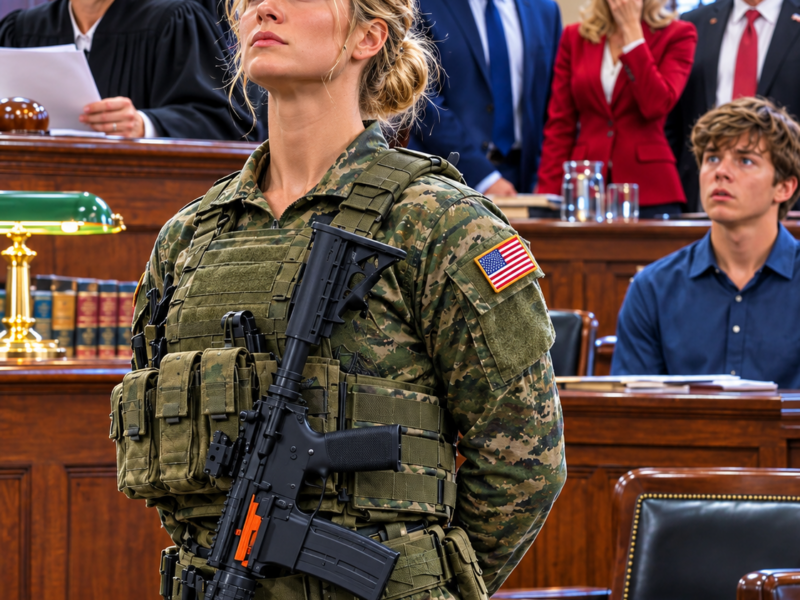
“I watched my parents laugh as I walked into the family courtroom wearing my combat uniform, body armor, and a secured rifle
Judge Reynolds rested one hand on the envelope.
“Mr. Brooks, before I open this, I want to know whether either party objects to its authenticity.”
Bradley Collins was already standing.
“Your Honor, we object to its admission. We have no way of knowing whether that letter was actually written by the deceased, and its contents may be entirely unrelated to the child’s welfare.”
Daniel remained calm.
“My client can establish the chain of custody. The envelope was sealed by Mr. Carter himself and remained in my office until this morning.”
“Convenient timing,” Bradley muttered.
Judge Reynolds looked at him.
“Mr. Collins, if you interrupt me again, you will spend the rest of this hearing explaining your conduct.”
Bradley sat down.
I glanced at Ethan.
He was twisting the cuff of his sweater so tightly that his fingers had turned pale.
I wanted to cross the room and put my arms around him.
But I knew that if I did, my parents would use it against me.
So I stayed where I was.
The judge examined the seal.
Then she carefully opened the envelope.
Inside were three sheets of paper, a small flash drive, and a photograph.
She read the first page silently.
Her expression didn’t change, but her eyes moved back to the beginning.
Then she read it again.
“Mr. Brooks,” she said, “does this letter have an accompanying affidavit?”
“Yes, Your Honor. It’s attached to the second page.”
My father shifted in his chair.
My mother reached for his hand.
He pulled it away.
That tiny movement told me more than any argument they had made that morning.
Something was happening between them that I had never seen before.
The judge placed the papers on the bench.
“Mr. and Mrs. Carter, I am going to ask you a question. I expect a direct answer.”
My father straightened his tie.
“Of course, Your Honor.”
“Did your late father ever tell you that he intended to appoint an independent trustee to oversee Ethan’s inheritance?”
My father hesitated.
“Not that I recall.”
The judge looked at the document.
“Interesting.”
Bradley stood again.
“Your Honor, I must point out that the financial arrangements of an estate are separate from the question of custody.”
“That is true in some circumstances,” she replied. “However, if the financial arrangements are being used to influence a custody decision, they become relevant.”
Daniel opened his briefcase.
“Your Honor, may I present the original trust agreement?”
The judge nodded.
He handed over a thick document with my grandfather’s signature on the final page.
I recognized the blue ink.
I had watched him sign that document at his kitchen table two years earlier.
At the time, he had explained only that he wanted Ethan protected.
He had made me promise not to interfere unless Ethan needed me.
Now I understood why.
Judge Reynolds turned several pages.
Then she stopped.
“Mr. Carter, according to this agreement, you were never appointed trustee.”
My father frowned.
“That’s not correct.”
“Would you like to examine the document?”
He looked toward Bradley.
Bradley took the agreement and began reading.
For the first time that morning, his confidence seemed to leave him.
The trust named an independent financial institution as trustee.
My parents had been granted limited authority to pay for Ethan’s education, medical care, and living expenses.
They could not withdraw principal.
They could not transfer ownership.
And they could not use the inheritance as collateral.
My grandfather had made that very clear.
But the judge was not finished.
She lifted the second page of the letter.
“Mr. Carter also states that he became concerned about unauthorized withdrawals from the trust before his death.”
My mouth went dry.
Unauthorized withdrawals?
I looked at my father.
He stared at the table.
My mother began shaking her head.
“That’s impossible.”
Judge Reynolds continued.
“He specifically requests an independent accounting if either of his children attempts to obtain guardianship over Ethan.”
Bradley cleared his throat.
“Your Honor, this is an allegation made by a deceased individual. It has not been independently verified.”
Daniel nodded.
“Which is why we requested an accounting six weeks ago. The financial institution has since provided preliminary records.”
He placed another folder on the bench.
My father finally looked up.
“What is that?”
“Bank statements, transfer records, and correspondence concerning the trust.”
My mother stood abruptly.
“Richard, we should leave.”
Judge Reynolds raised her voice.
“Mrs. Carter, sit down.”
She remained standing for another second before slowly lowering herself into her chair.
I looked at Daniel.
He had not told me any of this.
I felt betrayed for a moment, then remembered that he had probably been waiting for the proper opportunity to introduce evidence.
Still, my grandfather’s letter had opened a door I hadn’t known existed.
The judge asked for a recess so she could review the documents.
As people began moving around the courtroom, I finally approached Ethan.
He didn’t stand.
I crouched beside his chair.
“Hey, buddy.”
His eyes filled immediately.
I kept my voice low.
“Did you write those letters?”
He shook his head.
“Did Mom make you sign them?”
He looked toward the hallway.
Then he whispered, “Not exactly.”
I waited.
“She said they were just for school.”
“What were they?”
“Statements. She told me they were practice for talking to the judge.”
I looked at him carefully.
“Did you understand what they said?”
He shook his head.
“She said I could go back and fix them if I didn’t like them. But she never let me see the final copies.”
My jaw tightened.
“Why didn’t you tell me?”
His eyes dropped.
“Because Dad said if I told you anything, you’d lose your job.”
I sat back on my heels.
There it was.
The reason behind every missed call.
Every awkward visit.
Every time he had told me he was fine.
My father had used my military service to make Ethan afraid of losing me.
“Listen to me,” I said. “You haven’t done anything wrong.”
He wiped his face with his sleeve.
“Are you mad?”
“Not at you. Never at you.”
He leaned forward and whispered something that made the room seem suddenly smaller.
“There’s something else, Maddie.”
I moved closer.
“What?”
“They made me record a video.”
I looked at him.
“What kind of video?”
“One where I said I didn’t want to live with you.”
“Did you say that?”
He nodded.
“Mom told me to read it. She said Grandpa wanted me to stay with them.”
I felt a cold pressure behind my ribs.
“Do you still have the video?”
Ethan looked toward my parents.
“On Dad’s computer.”
Before I could ask anything else, the bailiff announced that the hearing would resume.
I stood.
“Tell the judge what you told me. Only what you remember. Nobody gets to put words in your mouth.”
Ethan nodded.
For the first time that morning, he looked directly at me.
And I saw a little of the boy from the photograph.
When we returned to our seats, Judge Reynolds had finished reviewing the documents.
She looked at my parents.
“I am concerned about the apparent discrepancy between the trust agreement and the financial authority exercised by the respondents.”
Bradley stood.
“Your Honor, my clients have acted under the advice of financial professionals.”
“Then those professionals should have no difficulty explaining the transactions.”
She turned to Daniel.
“How much money is currently unaccounted for?”
Daniel glanced at his notes.
“Approximately eight hundred and forty thousand dollars, Your Honor.”
A murmur passed through the room.
My father shook his head.
“That’s ridiculous.”
My mother stared at Bradley.
He didn’t look back at her.
Judge Reynolds asked for the dates.
Daniel explained that the money had been transferred in several transactions over fourteen months.
Some payments were described as property expenses.
Others were listed as investment-related disbursements.
One transfer had been made to a company registered under a name I recognized.
Carter Family Holdings.
My father’s private investment company.
I had heard him mention it at family dinners.
He always described it as a harmless business structure for managing family assets.
Now I wondered how much of Ethan’s inheritance had passed through it.
The judge turned to my father.
“Mr. Carter, can you explain why trust funds intended for your son’s education and care were transferred to your private company?”
My father leaned toward Bradley.
The attorney whispered something.
Then my father said, “Those funds were being temporarily invested.”
“With whose authorization?”
My father didn’t answer.
My mother began crying quietly.
I had seen her cry at funerals, at weddings, and whenever something threatened her carefully maintained social image.
This was different.
She looked frightened.
Bradley requested another recess.
The judge refused.
“We are not going to turn this hearing into a revolving door. The child has been sitting here for hours.”
Then she looked at Ethan.
“Young man, I understand that some documents submitted to this court may contain statements attributed to you. I would like to hear directly from you, but only if you are comfortable speaking.”
Ethan looked at me.
I nodded.
He stood slowly.
His voice was barely audible at first.
“My parents told me Madison didn’t want me.”
My mother covered her mouth.
Ethan continued.
“They said she was always too busy. That she would leave again. They said she didn’t have a real home for me.”
I swallowed.
I had heard some of those words before, but hearing them spoken aloud made them hurt in a different way.
“Did you believe them?” the judge asked.
“Sometimes.”
My brother looked down at his shoes.
“Because she was gone a lot. And when she came home, she was always tired.”
I didn’t interrupt.
He was telling the truth.
I had missed birthdays, school concerts, and ordinary Sunday afternoons.
There were things military service had taken from me that money could never replace.
Then Ethan looked up.
“But she always called. Even when Mom said I couldn’t answer.”
My mother started crying harder.
“And she remembered things,” he continued. “Like my science project and the name of my dog at school. She remembered everything.”
Judge Reynolds nodded.
“What about the letters you supposedly wrote?”
“I didn’t write them like that.”
“Can you explain?”
“Mom gave me papers and told me to read them. She said if I didn’t, Dad would get angry.”
My father shook his head.
“That’s not what happened.”
Ethan flinched.
The judge noticed immediately.
“Mr. Carter, do not address the child.”
Ethan took a breath.
“There’s a video, too.”
Bradley turned sharply toward him.
“What video?”
Ethan looked at the judge.
“They made me record something on Dad’s computer. I said I didn’t want to live with Madison. But I didn’t mean it.”
The courtroom fell silent.
Judge Reynolds asked Daniel whether the video had been submitted as evidence.
“It has not, Your Honor. We were not aware of its existence until today.”
Bradley immediately objected to any attempt to access the computer without proper authorization.
The judge agreed that the court could not simply order an unrestricted search of private devices.
But she instructed the parties to preserve any potentially relevant recordings and directed that the matter be referred for appropriate investigation.
My father looked at Ethan.
There was no shouting.
No dramatic threat.
Just a long, disappointed stare.
It was the look he had used when I was sixteen and told him I wanted to attend a military academy instead of joining his business.
Ethan lowered his head.
I wanted to shield him from that look.
But I knew he needed to see that he could tell the truth and survive the consequences.
Then Daniel made another request.
“Your Honor, there’s one additional item in Mr. Carter’s letter.”
The judge picked up the final sheet.
She read it silently.
Then she looked at me.
“Ms. Carter, are you aware that your grandfather named you as the successor guardian in his estate planning documents?”
I stared at her.
“No, Your Honor.”
My mother stopped crying.
My father slowly turned toward me.
Daniel spoke.
“Your grandfather did not want you to be forced into that responsibility. He wanted you to have the option. He also specified that any appointment would require an independent assessment of your ability and willingness to care for Ethan.”
I looked at my brother.
He was watching me with an expression I couldn’t quite read.
I understood then that my grandfather had never intended to use money to make me responsible for Ethan.
He had intended to make sure money couldn’t prevent me from protecting him.
Judge Reynolds ordered an expedited independent review of the guardianship arrangement.
She also suspended my parents’ authority to make extraordinary financial decisions involving the trust until the accounting could be completed.
But she did not immediately transfer custody.
Instead, she requested a private conversation with Ethan and appointed an independent child advocate to evaluate his wishes and living situation.
The hearing ended without a final custody decision.
My parents left through a side hallway.
My mother didn’t look at me.
My father paused near the door.
“You have no idea what you’ve done,” he said.
I met his eyes.
“Neither did Ethan.”
He walked away.
Outside the courtroom, Daniel handed me the photograph from my grandfather’s envelope.
It was the old picture of Ethan and me on the truck.
On the back, my grandfather had written one sentence.
“Children should never have to earn the right to feel safe.”
I read it twice.
Then I folded the photograph carefully and placed it inside my uniform pocket.
Ethan came out a few minutes later with his court-appointed advocate.
He looked tired.
I approached slowly.
“How are you doing?”
He shrugged.
“Can I stay with you tonight?”
I glanced at the advocate.
“We have to follow the court’s temporary arrangements, buddy.”
He nodded.
Then he looked at me.
“I thought you weren’t coming.”
I knelt in front of him.
“I told you I’d always come when you needed me.”
“You were late.”
The words landed harder than I expected.
He wasn’t being cruel.
He was telling me what it had felt like to wait.
I lowered my eyes.
“You’re right. I was late.”
He rubbed his sleeve.
“But you came.”
I smiled faintly.
“I’m here now.”
The advocate explained that Ethan would remain with my parents temporarily while the court completed its review.
However, she would arrange regular supervised contact with me and ensure he had access to an independent counselor.
I agreed.
I wasn’t happy about the arrangement.
But I knew that forcing the process would only give my parents another opportunity to portray me as reckless.
For the next three weeks, I did something I had never expected to do.
I waited.
I attended every scheduled meeting.
I provided my housing records, employment information, references, and proof that my military duties allowed for a stable care arrangement.
My commanding officer helped arrange a predictable schedule, and I began working with a family counselor to prepare for the possibility of becoming Ethan’s guardian.
I also learned to stop treating every problem like an operation with a clear objective.
A fourteen-year-old boy needed more than someone willing to fight for him.
He needed someone willing to sit quietly beside him when he didn’t feel like talking.
During our supervised visits, we played cards.
Sometimes we talked about school.
Sometimes he barely spoke.
On the third visit, he brought a folded sheet of paper.
“Can you help me with this?”
It was a science assignment about renewable energy.
I looked at the diagrams.
“Since when are you interested in solar panels?”
He shrugged.
“Since my teacher said they were boring.”
I laughed.
For the first time in months, he laughed with me.
It wasn’t a big moment.
Nobody in the room applauded.
But I remembered it.
Meanwhile, the financial investigation moved forward.
The preliminary accounting showed that the missing money had not been invested in the way my father claimed.
Some of it had been used to cover expenses connected to a property development project.
Other funds had paid off a loan secured by Carter Family Holdings.
The independent trustee confirmed that none of those transfers had been authorized under the trust agreement.
Then came another discovery.
One of the transfers had been made just two days after my grandfather entered hospice.
My father had signed the instruction.
My mother had countersigned it.
That detail changed the investigation.
It suggested that the transfers were not merely a misunderstanding about investment authority.
They had continued even when my grandfather was no longer able to supervise his financial affairs.
The investigator requested additional records.
Bradley withdrew from representing my parents, citing a conflict that he did not publicly explain.
My parents hired another attorney.
And Ethan finally told his counselor about the video.
He remembered recording it in my father’s home office.
He remembered his mother standing behind the camera.
He remembered being told to repeat the sentence whenever he looked uncomfortable.
The recording was eventually located and preserved through the proper legal process.
It showed Ethan reading a prepared statement.
At the end, the voice behind the camera said, “Now say it like you mean it.”
Ethan looked toward the person filming.
Then he asked, “Will Madison still be allowed to visit me?”
The recording ended.
That question became one of the most important pieces of evidence in the custody proceedings.
Because it showed that even while he was being pressured to reject me, Ethan’s greatest concern was whether he would lose me.
The final hearing took place seven weeks after the first.
This time, I wore a simple navy dress.
No body armor.
No military equipment.
No uniform.
Just me.
Ethan sat beside his advocate.
He looked healthier.
He had started sleeping better, according to his counselor, and his grades had improved.
My parents sat across the aisle.
My mother looked older.
My father looked angry.
The judge reviewed the independent assessment.
It found that Ethan had a strong emotional bond with me, that my home was suitable, and that I had made reasonable arrangements to accommodate my service obligations.
It also found that Ethan’s statements had been influenced by pressure from my parents.
Judge Reynolds turned to Ethan.
“Do you understand that if you live with your sister, you may need to adjust to a different home and schedule?”
“Yes.”
“Do you understand that she may sometimes have military obligations?”
“Yes.”
“Do you want to live with her?”
Ethan glanced at me.
Then he looked at the judge.
“I want to live somewhere I don’t have to practice what I’m supposed to say.”
My mother lowered her head.
The judge gave him a moment.
“Is that somewhere with your sister?”
“Yes.”
My father leaned forward.
“Your Honor, he’s a child. He doesn’t understand the financial consequences of this decision.”
Judge Reynolds looked at him.
“This is a custody hearing, Mr. Carter. Not a shareholder meeting.”
For the first time, I saw my father unable to find an answer.
The judge issued her decision.
I was granted permanent guardianship of Ethan, subject to the ordinary requirements and ongoing oversight appropriate to the case.
My parents’ guardianship was terminated.
The trust would remain under independent management.
Any disputed transfers would be addressed through separate civil and, if warranted, criminal proceedings.
The judge also ordered that Ethan’s contact with our parents could continue under a structured arrangement if he wanted it and if his counselor considered it appropriate.
My mother began crying.
My father stood abruptly.
“This is a mistake.”
Judge Reynolds closed the file.
“Then you may pursue whatever legal remedies are available to you. But this court will not return a child to an environment where his words have been treated as property.”
I looked at Ethan.
He was staring at the table.
I reached for his hand.
This time, he took mine.
Outside the courthouse, the afternoon sun was bright enough to make us squint.
Ethan carried a small backpack.
That was all he had brought from my parents’ house.
“Is that everything?” I asked.
He nodded.
“Most of my stuff is still there.”
“We can get it later. You don’t have to worry about that today.”
He looked at me.
“Can we get pizza?”
I laughed.
“That’s your first request?”
“And maybe ice cream.”
“You’re pushing your luck.”
He smiled.
We drove to my apartment.
It wasn’t a mansion.
It didn’t have a swimming pool, a guesthouse, or a view of the ocean.
It was a modest two-bedroom place with a small kitchen and a balcony that overlooked a parking lot.
But I had prepared his room carefully.
There were fresh sheets, a new desk, a bookshelf, and a lamp shaped like a basketball.
I had also put a framed copy of the photograph of us on our grandfather’s truck on the nightstand.
Ethan stood in the doorway for a long time.
“You remembered this picture.”
“Of course.”
He picked it up.
For a moment, he didn’t say anything.
Then he asked, “Do you think Grandpa knew?”
I sat on the edge of the bed.
“I think he knew people could make bad decisions when money was involved.”
“Did he know Mom and Dad would do this?”
I considered the question.
“I don’t know. Maybe he worried they might.”
Ethan ran his thumb over the frame.
“Do you hate them?”
I looked toward the window.
There were plenty of things I could have said.
I was angry about the money.
I was angry about the letters.
I was angry that my parents had made my brother afraid to call me.
But hatred was a heavy thing to hand a fourteen-year-old.
“No,” I said finally. “I’m hurt by what they did. And I don’t trust them right now. But you don’t have to decide how you feel about them today.”
He nodded.
“Good.”
“Why?”
“Because sometimes I miss them.”
I reached for his hand.
“You’re allowed to.”
He sat beside me.
We stayed there for a while without talking.
The financial investigation continued for months.
The independent accounting eventually established that a substantial portion of the trust had been improperly diverted.
My father agreed to repay a significant amount through a court-supervised settlement, although he denied intentionally stealing from Ethan.
The remaining disputed transactions were referred to the appropriate authorities.
My mother later admitted that she had signed the documents because my father told her the transfers were temporary and necessary to protect the family’s business.
That didn’t excuse her involvement.
But it helped explain why she had looked so frightened when my grandfather’s envelope appeared.
She had known enough to be afraid.
Not enough, perhaps, to understand how far things had gone.
Several months later, she requested to see Ethan.
He discussed it with his counselor first.
Then he agreed to meet her for lunch in a public place.
I drove him there but stayed outside.
When he came back, his eyes were red.
“How was it?”
He looked at the restaurant window.
“She said she missed me.”
I waited.
“Did you believe her?”
He shrugged.
“I think she does.”
“How do you feel about that?”
He thought for a moment.
“I don’t know yet.”
I nodded.
“That’s okay.”
He opened the car door.
Then he stopped.
“She asked if I could come home for Christmas.”
“What did you tell her?”
“I said I already had plans.”
I smiled.
“What plans?”
He looked at me as though the answer should have been obvious.
“Pizza. Christmas movies. And that ugly tree you bought.”
I laughed.
“The tree is not ugly.”
“It looks like a green feather duster.”
“You have no appreciation for holiday decorations.”
He grinned and climbed into the passenger seat.
That evening, we decorated the apartment.
Our Christmas tree leaned slightly to the left.
The lights were tangled.
One ornament kept falling off.
Ethan complained about every part of it.
And I had never been happier to hear someone complain.
Later, while I was putting away the decorations, he came into the kitchen carrying the photograph from our grandfather’s truck.
“Can we put this somewhere else?” he asked.
“Where?”
“Somewhere we both see it.”
We found a place on the living room wall.
He held the frame while I adjusted the nail.
When I stepped back, the photograph hung slightly crooked.
I reached up to straighten it.
Ethan stopped me.
“Leave it.”
“Why?”
He smiled.
“Grandpa always said things didn’t have to be perfect to be good.”
I looked at the picture again.
Two children sitting on an old truck.
One laughing with missing teeth.
The other with an arm wrapped around his shoulders.
I thought about the courtroom, the money, the lies, and the letter that had changed everything.
I had entered that courthouse believing I needed to prove I was strong enough to protect my brother.
What I learned was that strength wasn’t always about standing between someone and danger.
Sometimes it was about listening when they finally found the courage to tell you they were afraid.
And sometimes it was about giving them a home where they never had to rehearse the truth again.
That night, I walked past Ethan’s bedroom and saw the light still on.
He was sitting at his desk, working on his science project.
A few minutes later, he appeared in the hallway.
“Maddie?”
“Yeah?”
“Can I ask you something?”
“Anything.”
“Are you going to leave again?”
I put down the laundry basket.
I couldn’t promise him that military life would never take me away.
That would have been another lie, and he had heard enough of those.
“I may have to travel sometimes,” I told him. “But you’ll always know where I am, when I’m coming back, and how to reach me. And we’ll make every decision together.”
He studied my face.
Then he nodded.
“Okay.”
He turned toward his room, but before he disappeared, he came back and hugged me.
It wasn’t the desperate hug of a frightened child.
It was the ordinary hug of a boy who finally felt safe enough to stop holding everything inside.
After he went to bed, I stood in the living room for a moment.
The photograph was still crooked.
I left it that way.
Because for the first time in a long time, neither of us needed a perfect family.
We just needed a place where the truth could live without making anyone afraid.
The end.









