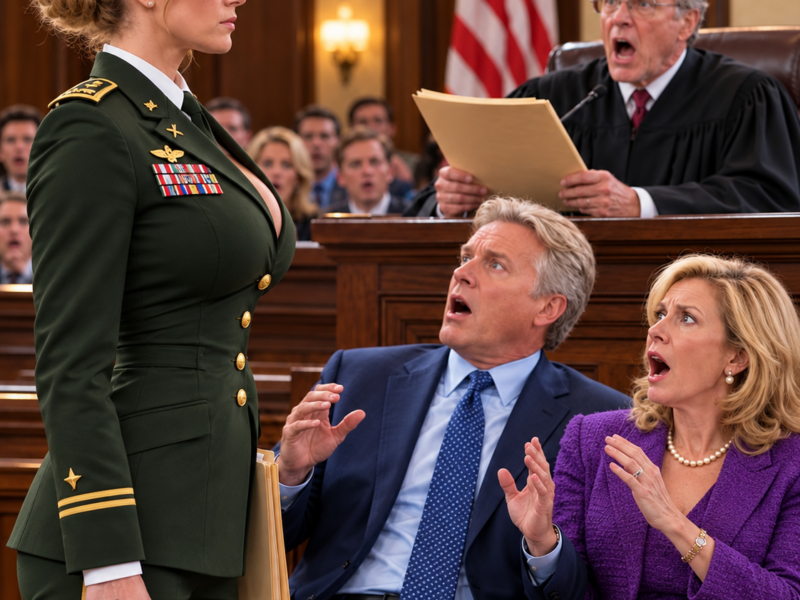
“I watched my mother publicly call me an unfit daughter in a Georgia courtroom while demanding the $4.7 million my grandmother had left me
Judge Whitmore held the document in both hands, studying the official seal before looking back at me.
“Miss Bennett, is this your current military appointment record?”
“Yes, Your Honor.”
Richard Collins shifted in his chair.
My mother leaned toward him and whispered something I couldn’t hear.
The judge continued.
“And you currently serve as an officer in the United States Army Judge Advocate General’s Corps?”
“Yes, sir.”
There was a pause.
“How long have you served?”
“Fourteen years, Your Honor.”
Judge Whitmore glanced at the papers again.
“Mr. Collins, I believe you should examine this before making any further statements about your client’s allegations.”
He passed a copy across the bench.
Collins accepted it with an expression that had changed considerably since the hearing began.
My father leaned over to see what was written.
“What is it?” he whispered.
Their attorney didn’t answer immediately.
The document contained a summary of my professional credentials, my current military status, and a statement confirming that I was an attorney in good standing.
But that wasn’t the part that had caught the judge’s attention.
Behind it was a letter from the attorney who had prepared Grandma’s estate plan.
It explained that Evelyn Bennett had independently requested a review of her estate documents after becoming concerned that certain family members might challenge her capacity or claim that someone had influenced her decisions.
The letter also referenced a series of recorded meetings, medical evaluations, and independent legal consultations.
My grandmother had anticipated this courtroom.
And she had prepared for it.
Judge Whitmore turned another page.
“Mr. Collins, your complaint states that the beneficiary lacks the intellectual and emotional capacity to manage this inheritance. Is that correct?”
Collins cleared his throat.
“That is one of the concerns raised by my clients, Your Honor.”
“On what medical evidence?”
He glanced down.
“We have concerns based on family observations.”
“Family observations?”
“Yes, Your Honor.”
The judge looked toward my parents.
“Are either of you qualified medical professionals?”
My father shook his head.
My mother remained silent.
“Then I would suggest we distinguish between a medical finding and a family disagreement.”
Nobody moved.
I kept my hands folded in front of me.
For years, I had imagined confronting my parents about the way they treated me.
I had imagined shouting, crying, and finally explaining how much damage their indifference had caused.
Instead, I sat in a courtroom while a stranger asked them questions they had never bothered to answer honestly.
And somehow, that felt more painful.
Judge Whitmore returned his attention to the file.
“There’s another matter I want clarified. The estate records indicate that the decedent received independent legal advice throughout the relevant period. Mr. Hayes, are you present?”
Robert Hayes stood from the second row.
“Yes, Your Honor.”
“Please approach.”
Robert walked toward the bench carrying a slim folder.
He looked older than he had during our meeting, but his posture remained straight.
“Mr. Hayes, did you prepare Mrs. Bennett’s final will?”
“I did.”
“Did you meet with her privately?”
“On multiple occasions.”
“Was the beneficiary present during those meetings?”
“No, Your Honor.”
“Did Miss Bennett request any changes to the will?”
“No.”
“Did she instruct you to exclude her children?”
Robert paused.
“She did.”
My mother made a small sound.
Robert continued.
“Mrs. Bennett was very clear that the decisions were hers. She explained them in detail, and she asked me to document her reasons.”
Collins stood.
“Objection. We haven’t established that the decedent’s decisions were free from influence.”
Judge Whitmore looked at him.
“That’s precisely what we’re here to establish, counsel.”
Robert opened his folder.
“Mrs. Bennett also completed an independent cognitive assessment. She was evaluated by a physician who had no financial relationship with her or the beneficiary.”
He handed over the report.
The judge read it carefully.
Then he looked at Collins.
“Do you have any contrary medical evidence?”
Collins hesitated.
“Not at this time, Your Honor.”
My father leaned toward my mother.
I heard him whisper, “This isn’t what we were told.”
For the first time that morning, I looked directly at them.
I wondered who had told them what.
And whether they had ever bothered to find out the truth.
Judge Whitmore called for a short recess.
I gathered my folders and stepped into the hallway.
The courthouse smelled of old paper, floor polish, and burnt coffee.
I was standing near a window when I heard my mother’s heels approaching.
“Claire.”
I turned.
She looked irritated, but there was something else beneath it.
Anxiety.
“What exactly did you tell that judge?”
I stared at her.
“Nothing that wasn’t true.”
She folded her arms.
“Don’t play games with me. Your father and I didn’t know you were involved in all these legal things.”
I almost laughed.
“I’m an attorney, Mom. I’ve been one for years.”
“That’s not what I mean.”
“What do you mean?”
She glanced toward the courtroom door.
“Your grandmother made it sound like you were just working in some military office.”
“I told her what I did. She listened.”
My mother looked away.
Then she said something I hadn’t expected.
“She never told us any of this.”
I felt my jaw tighten.
“Did you ever ask?”
She didn’t answer.
For a moment, I could see the young mother she must once have been.
The woman who had carried me home from the hospital.
The woman who had probably held me when I cried.
I couldn’t remember the last time I had thought of her that way.
Then she spoke again.
“Claire, whatever happened between us, we’re still your family.”
I looked at her carefully.
“You hired a lawyer to tell a judge I was mentally unfit because Grandma left me money.”
“We were trying to protect what she built.”
“No. You were trying to take what she left.”
Her lips tightened.
“That’s an ugly way to describe it.”
“Then find a more accurate one.”
My mother stared at me as if she couldn’t recognize the person standing in front of her.
Perhaps she couldn’t.
For years, she had mistaken my silence for weakness.
She had never considered that I might simply have learned not to waste words on people who weren’t listening.
Before she could respond, Robert Hayes appeared at the end of the hallway.
“Claire, Judge Whitmore is ready.”
My mother stepped aside.
As I passed her, she whispered, “You don’t know everything that happened with your grandmother.”
I stopped.
“What does that mean?”
But she had already turned away.
I returned to the courtroom with those words following me.
You don’t know everything.
I sat down and opened my folder.
When the hearing resumed, Collins requested permission to introduce additional evidence.
Judge Whitmore allowed him to explain the basis for the request.
Collins approached the bench.
“Your Honor, my clients believe there may have been financial irregularities involving Mrs. Bennett’s estate shortly before her death.”
I looked at Robert.
He seemed equally surprised.
Collins continued.
“We have reason to believe that substantial funds may have been transferred without the knowledge or consent of the decedent’s family.”
Judge Whitmore frowned.
“Her family was not automatically entitled to receive information about her finances during her lifetime.”
“Of course, Your Honor. However, we believe the transfers may be relevant to the question of undue influence.”
My father sat straighter.
My mother looked at me.
I could almost hear her thinking that this was finally the evidence they needed.
Then Collins produced a bank statement.
It showed a transfer of $250,000 from one of Grandma’s investment accounts to a separate account approximately eight months before her death.
I recognized the date.
I also recognized the account number.
It wasn’t mine.
It belonged to a charitable foundation Grandma had established years earlier.
Robert leaned toward me.
“That’s the Evelyn Bennett Veterans Education Fund.”
I nodded.
Grandma had created it to provide scholarships for children of deceased or disabled service members.
She had told me about it during one of my visits.
At the time, I had suggested that she speak with a financial adviser to make sure the foundation was properly structured.
She had laughed.
“Darling, I have more paperwork than a small government agency. I’ll manage.”
Collins held up the statement.
“Mrs. Bennett transferred a quarter of a million dollars while the beneficiary was in frequent contact with her.”
“Objection,” Robert said. “The transfer was made to a registered charitable organization.”
Collins ignored him.
“We believe the beneficiary may have been involved.”
Judge Whitmore turned toward me.
“Miss Bennett, did you have any involvement in this transaction?”
“No, Your Honor.”
“Did you receive any of the funds?”
“No.”
“Did you hold any position in the foundation?”
“No.”
Robert opened another folder.
“Your Honor, I have the foundation’s incorporation records, its independent financial statements, and the board resolutions authorizing the transfer.”
He handed them forward.
The judge reviewed the documents.
Then he looked at Collins.
“Mr. Collins, this transfer appears to have been properly authorized by the foundation’s board.”
Collins studied the papers.
“That may be so, Your Honor.”
“Then why did you present it as evidence of financial misconduct?”
“We were attempting to establish a pattern.”
“A pattern of what?”
Collins didn’t answer.
Judge Whitmore removed his glasses.
“Counsel, allegations of this seriousness should be supported by more than speculation.”
My father began shaking his head.
My mother whispered, “This is ridiculous.”
But the judge wasn’t finished.
He looked at Robert.
“Mr. Hayes, you mentioned that Mrs. Bennett anticipated a challenge to her estate plan. Did she leave any additional instructions?”
Robert nodded.
“She did, Your Honor. She asked that a sealed letter be delivered to the court if her will was challenged on grounds of undue influence or incapacity.”
My stomach tightened.
I hadn’t known about that.
Robert opened his briefcase and removed a large envelope.
The flap was sealed with red wax.
On the front, in Grandma’s unmistakable handwriting, were the words:
“To be opened only if my family challenges my final wishes.”
For several seconds, nobody spoke.
Judge Whitmore examined the seal.
“Mr. Hayes, do you have any reason to believe this envelope has been tampered with?”
“None whatsoever.”
The judge nodded.
“Very well. Let’s hear what Mrs. Bennett had to say.”
Robert carefully broke the seal.
He unfolded a handwritten letter and began reading.
“My name is Evelyn Rose Bennett. I am writing this because I know my family, and I know what happens when money becomes more important than the people who earned it.”
My throat tightened.
Robert continued.
“I have spent many years hoping my children would learn to treat one another with kindness. I have also spent many years pretending that the way they treated Claire was simply a family disagreement.”
My mother looked down.
My father shifted in his chair.
“I was wrong to pretend.”
Robert paused, adjusting the paper.
“My granddaughter never asked me for money. She never asked me to change my will. In fact, she repeatedly told me that whatever I decided was entirely my business.”
He continued reading.
“I chose Claire because she has shown me something I have not always found in my own children: the ability to do what is right even when nobody is watching.”
I pressed my lips together.
I could almost hear Grandma’s voice.
She used to say that doing the right thing was easiest when someone was applauding.
The difficult part was doing it when the room was empty.
Robert reached the next paragraph.
“I am leaving Claire my estate because I trust her judgment. I want her to have the freedom to use what I have spent my life building. I do not want my other grandchildren or children to feel that they are owed a share simply because of their last name.”
My mother began crying quietly.
I didn’t look at her.
Then Robert read the final section.
“However, there is one thing Claire does not know, and I have chosen not to tell her until I am gone.”
My hands became cold.
Robert stopped.
He looked at Judge Whitmore.
The judge nodded for him to continue.
“Twenty-nine years ago, I discovered that someone in this family had been taking money from my personal accounts. At the time, I chose to handle the matter privately because I believed exposing the truth would destroy my family.”
The room became completely still.
Robert lowered the letter slightly.
My father stared at the paper.
My mother stopped crying.
I looked from one parent to the other.
Grandma’s letter continued.
“I kept the records. I kept the correspondence. I kept the original bank documents. I never forgot what happened, even after everyone else pretended it had never occurred.”
Robert looked at me.
Then he read the final sentence.
“If my children challenge my will, I ask the court to examine the records I have preserved, because the reason they want my money may be connected to something they have spent nearly three decades hiding.”
I felt the air leave my lungs.
Twenty-nine years.
I had been seven years old.
Judge Whitmore placed the letter on his desk.
“Mr. Hayes, what records are you referring to?”
Robert opened the briefcase again.
“There is another envelope, Your Honor.”
This one was smaller.
It contained photocopies of old bank statements, handwritten notes, and a document bearing my father’s signature.
My father suddenly stood.
“That’s enough.”
Judge Whitmore looked up.
“Sit down, Mr. Bennett.”
“You can’t just start dragging up things from thirty years ago.”
“Your attorney may address the admissibility of the documents. You will remain seated.”
My father slowly lowered himself into his chair.
I stared at his signature.
I recognized it immediately.
He had signed birthday cards, school forms, and the mortgage documents for the house where I grew up.
But I didn’t understand why his name was attached to a bank account Grandma had opened.
Robert leaned toward the judge.
“Your Honor, these documents concern a custodial savings account established for Miss Bennett when she was a child.”
I looked at him.
“A savings account?”
He nodded.
“Your grandmother opened it shortly after your birth.”
I shook my head.
“I never knew about that.”
“I understand.”
Judge Whitmore studied the records.
“How much money was in the account?”
Robert checked the statement.
“Approximately $86,000, including accrued interest, before the withdrawals began.”
I looked at my father.
He wasn’t looking at me.
He was staring at the table.
Robert explained that Grandma had deposited money into the account over several years.
She had intended it to help pay for my education and provide a financial foundation when I became an adult.
But when I was seven, a series of withdrawals had emptied it.
The person authorized to manage the account was my father.
The documents showed that the money had been transferred into an account connected to his business.
My mother whispered, “Michael.”
He didn’t respond.
I felt something strange move through me.
It wasn’t anger yet.
It was the sensation of an old memory suddenly acquiring a completely different meaning.
When I was seventeen, I had asked my parents whether Grandma had ever contributed to my college fund.
My mother had told me there was no money.
She said Grandma had probably spent it years earlier.
I remembered accepting that explanation.
I had worked part-time, applied for scholarships, and taken out student loans.
My brother Daniel had attended a private college with substantial help from our parents.
My sister Rebecca had received money for her first apartment.
I had never questioned the difference.
I had simply assumed I wasn’t the kind of daughter people invested in.
Now I was looking at the reason.
Judge Whitmore addressed my father.
“Mr. Bennett, do you recognize this signature?”
My father swallowed.
“It’s mine.”
“Do you dispute the account records?”
“I’d have to review them.”
“Do you dispute the transfers?”
My father looked toward Collins.
His attorney stood.
“Your Honor, my client would like an opportunity to review these documents before responding.”
“That is your right.”
Judge Whitmore turned toward Robert.
“Do we know the purpose of the transfers?”
Robert opened another document.
“Mrs. Bennett’s notes indicate that she confronted her son after discovering the withdrawals. She states that he told her the money had been used to prevent his business from failing.”
My mother covered her mouth.
My father rubbed his forehead.
Robert continued.
“Mrs. Bennett also documented that she was promised repayment.”
Judge Whitmore examined the final page.
“Was repayment ever made?”
Robert shook his head.
“Not according to the records.”
I turned toward my father.
“Did you take my money?”
He looked at me.
For the first time that morning, I saw something in his face that wasn’t contempt.
It was fear.
“Claire, you don’t understand what was happening back then.”
“Then explain it.”
He opened his mouth.
Nothing came out.
My mother began speaking instead.
“Your father was having problems with the business. We were going to lose everything.”
I looked at her.
“So you used my college savings?”
“It wasn’t like that.”
“How was it?”
She looked toward my father.
“We thought we could replace it.”
I glanced at the documents.
“Did you?”
Neither answered.
I felt my fingers curl against the edge of the table.
“Did you ever tell me?”
My mother began crying again.
“Claire, we were young. We made mistakes.”
I stared at her.
“You let me believe Grandma had forgotten about me.”
She shook her head.
“We didn’t know how to explain it.”
“You had ten years to explain it.”
My voice wasn’t loud.
That seemed to make the words harder for her to hear.
Judge Whitmore called for another recess so the attorneys could review the newly produced documents.
During the break, I walked into the hallway alone.
I stood beside the same window where my mother had approached me earlier.
The sunlight had shifted across the courthouse floor.
I could see people walking along the street outside, carrying coffee and talking on their phones.
The world hadn’t stopped.
But the story I had told myself about my childhood had just fallen apart.
Robert came to stand beside me.
“Claire, I’m sorry.”
I looked at him.
“Did Grandma know?”
He nodded slowly.
“She discovered the withdrawals when you were still a child. She confronted your father, and he promised to repay every dollar.”
“Why didn’t she tell me?”
Robert considered his answer.
“She believed you were too young to carry that burden. Later, when you became an adult, she worried that telling you would create a permanent separation between you and your parents.”
I laughed once, without humor.
“So she protected them.”
“She tried to protect you.”
I looked down at the courthouse floor.
“Those aren’t always the same thing.”
“No,” he said quietly. “They aren’t.”
After a moment, he continued.
“Your grandmother kept the records because she wanted the truth preserved. She didn’t want you growing up believing that you had somehow been less deserving than your siblings.”
That sentence hurt more than anything else.
Because it was exactly what I had believed.
For years, I had wondered why my parents celebrated Daniel’s accomplishments and barely acknowledged mine.
Why Rebecca received help while I was told to figure things out.
Why I had to work twice as hard to receive half as much attention.
Grandma had known something was wrong.
She had tried to correct it.
And when she couldn’t, she had at least made sure the truth would survive her.
The hearing resumed later that afternoon.
Collins looked considerably less confident.
He informed the judge that his clients wished to withdraw their allegation concerning my mental capacity.
Judge Whitmore raised an eyebrow.
“Do they also wish to withdraw their claim of undue influence?”
Collins spoke quietly with my parents.
Then he stood.
“My clients would like to request a continuance to investigate the newly presented financial records.”
Robert objected to delaying the probate proceedings unnecessarily.
Judge Whitmore considered both arguments.
“Given the seriousness of the allegations and the newly introduced documentation, I will allow a limited continuance for the parties to review the material.”
He looked directly at my parents.
“However, I want something understood. A challenge to a person’s estate plan is not a license to make unsupported allegations about the beneficiary.”
He paused.
“Mrs. Bennett appears to have taken considerable steps to ensure that her wishes were voluntary and legally documented.”
Then he turned toward Collins.
“If your clients continue this case, they will need actual evidence, not assumptions based on family resentment.”
The hearing ended without a final ruling.
But something important had changed.
My parents had entered the courthouse convinced they were going to take my inheritance.
They left knowing that their own history was now under scrutiny.
Outside, I saw my father standing beside the courthouse steps.
My mother was speaking to Collins.
When she noticed me, she walked over.
“Claire, can we talk?”
I was exhausted.
But I stopped.
She looked at my briefcase, then at my face.
“I know you have every reason to hate us.”
“I don’t hate you.”
She seemed surprised.
I continued.
“I’m disappointed that you thought this was something you could do to me and still expect me to pretend we’re a happy family afterward.”
Her eyes filled.
“We were scared.”
“Of losing the money?”
“Of losing everything.”
I waited.
She looked over her shoulder at my father.
“Your father’s business was failing. We had debts. The house was almost gone. He thought he could borrow the money and replace it before anyone noticed.”
“Grandma noticed.”
“Yes.”
“And then?”
My mother lowered her voice.
“She told him to pay it back. He said he would. But the business never recovered.”
I stared at her.
“What did you do with the money?”
She shook her head.
“I didn’t take it, Claire.”
“But you knew.”
She didn’t deny it.
That was enough.
I wanted to ask why she had never defended me when my father dismissed my accomplishments.
Why she had allowed Daniel and Rebecca to believe I was difficult.
Why she had watched me struggle through college while knowing there had once been money set aside for me.
But I already knew the answers would not change anything.
She had made choices.
So had I.
“I need you to understand something,” I said.
“The inheritance is not compensation for a childhood you can’t give back. It’s Grandma’s decision, and I intend to respect it.”
My mother nodded.
Then she asked the question I had been expecting.
“Could you give us some time to work things out?”
I looked at her.
“We’ve had thirty-six years.”
I walked away.
Over the next several weeks, the legal proceedings became more complicated.
The old bank records were authenticated.
A financial examiner reviewed the transactions and confirmed that the money from my childhood account had been used to cover debts associated with my father’s business.
There was no evidence that I had ever received any benefit from those funds.
The records also showed that my father had signed a repayment agreement with Grandma.
He had made two small payments and then stopped.
The total amount had never been restored.
My parents’ attorney eventually advised them to abandon the claim that I had manipulated Grandma.
They did.
The allegation concerning my mental capacity was formally withdrawn as well.
The court then returned its attention to the will.
Robert presented the original documents, the independent medical evaluation, and testimony concerning Grandma’s private meetings with him.
He explained that she had reviewed every provision and had repeatedly confirmed that the estate distribution reflected her wishes.
The judge listened carefully.
When he finally issued his decision, he upheld the will.
My grandmother’s $4.7 million estate remained mine.
But the ruling didn’t erase the old account.
Nor did it answer the questions that had been sitting inside me since the hearing.
A few days after the decision, my father called.
I almost let it go to voicemail.
Something made me answer.
“Claire.”
His voice sounded older.
“Dad.”
“I know you’re angry.”
I didn’t respond.
“I wanted to explain about the money.”
“All right.”
He took a breath.
“Back then, I had a business partner who left me with enormous debts. I was trying to keep the company alive. Your grandmother had helped us before, and I thought I could borrow from the account temporarily.”
“You didn’t ask me.”
“You were seven.”
“You didn’t ask Grandma either.”
He went quiet.
Then he said, “I thought I could fix it.”
I leaned against my kitchen counter.
“Why did you let me believe she hadn’t saved anything for me?”
He sighed.
“Your mother thought it would be easier if we didn’t tell you.”
“Easier for whom?”
He didn’t answer.
I closed my eyes.
For years, I had imagined that some terrible misunderstanding had separated me from my parents.
I had hoped there was an explanation that would make all those forgotten birthdays and dismissed accomplishments feel less personal.
But the truth was simpler.
They had made decisions that benefited them.
Then they had allowed me to carry the consequences.
“Claire, I want to make this right.”
“How?”
“I can repay the money.”
I looked out my apartment window.
A neighbor was walking a golden retriever along the sidewalk.
“Can you?”
“I’ll sell the house if I have to.”
I was quiet for a moment.
“Don’t do that because you think it will make me forgive you.”
“I’m not asking you to forgive me.”
“Then why are you offering?”
He took a long breath.
“Because your grandmother was right. I owe you.”
It was the first honest thing I remembered hearing from him in years.
I told him I would have the records reviewed and that any repayment would need to be handled properly.
Then I ended the call.
I didn’t feel victorious.
I felt tired.
Several months later, my father’s attorney contacted Robert.
My father had agreed to repay the original $86,000, plus a reasonable amount of interest calculated from the account’s final balance and the date the money should have been restored.
He sold a small investment property to make the first payment.
The remaining balance was arranged through a formal repayment agreement.
I accepted the repayment.
Not because I needed it.
Because the seven-year-old girl who had once wondered why nobody had saved anything for her deserved to have the truth acknowledged in a way that couldn’t be dismissed.
My mother sent me a letter.
It was four pages long.
She wrote about the financial pressure they had experienced, the fear of losing their home, and how she had convinced herself that keeping the secret was better than admitting what they had done.
She also wrote that she had been jealous of my relationship with Grandma.
That surprised me.
She said Evelyn had always listened to me, and sometimes my mother felt that her own mother understood me better than she understood her.
It wasn’t an excuse.
But it was the first time she had acknowledged that the distance between us had been partly of her making.
I kept the letter in a drawer.
I didn’t respond immediately.
My brother Daniel called once to ask whether I was planning to share any of the inheritance.
I told him no.
He said I was being selfish.
I reminded him that Grandma had made her wishes clear.
We haven’t spoken since.
Rebecca sent a message saying she hoped we could eventually have a relationship that wasn’t defined by money.
I appreciated that she hadn’t demanded anything.
I told her I hoped so too.
As for my military career, I returned to work.
There were courtrooms, meetings, long days, and responsibilities that didn’t care what had happened in my family.
I didn’t discuss the inheritance with colleagues.
I didn’t need to.
The money wasn’t going to change the person I was.
But it did give me choices.
I paid off my student loans.
I set aside enough to ensure that I would never have to make career decisions based solely on financial pressure.
And then I contacted the board of the Evelyn Bennett Veterans Education Fund.
The foundation had continued operating after Grandma’s death.
I reviewed its financial statements and met with its trustees.
We agreed to expand the scholarship program using a portion of the inheritance.
The first new scholarship would be named after Grandma.
The Evelyn Bennett Opportunity Scholarship.
It would support students from military families who needed help paying for college.
At the first award ceremony, I stood at the back of a community hall in Savannah.
A young woman named Hannah was receiving the scholarship.
Her father had died while serving overseas, and she had been working two jobs to pay for school.
When she came to thank me, she was holding her acceptance letter with both hands.
“I don’t know how I’ll ever repay this,” she said.
I smiled.
“You don’t have to repay me. Just use the opportunity.”
She nodded, trying not to cry.
And suddenly, I understood something about Grandma’s final decision.
She hadn’t left me $4.7 million because she thought money could heal everything.
She had left it to me because she trusted me to decide what to do with it.
That trust meant more than the number.
About a year after the court hearing, I drove to Savannah alone.
The magnolia tree outside Grandma’s house was in bloom.
I had kept the house.
I hadn’t been able to bring myself to sell the place where she had made me feel like I belonged.
The front door still creaked.
The kitchen still smelled faintly of lemon oil and old wood.
Her favorite teacup sat in the cabinet where she had always kept it.
I made myself a glass of sweet tea and sat at the kitchen table.
For a long time, I looked at the empty chair across from me.
Then I took the handwritten letter Robert had given me and read it again.
“Claire, you’ve spent too much of your life trying to earn affection from people who should have given it freely.”
I traced the words with my finger.
There had been a time when I would have given almost anything to hear my mother say she was proud of me.
I would have worked harder, called more often, explained myself more carefully, and forgiven more than I should have.
I thought being a good daughter meant making it impossible for anyone to reject me.
I didn’t believe that anymore.
My parents and I eventually began speaking occasionally.
There were no dramatic family dinners.
No sudden apologies that erased decades.
My father continued making payments according to the agreement.
My mother and I had a few careful conversations.
Sometimes they were pleasant.
Sometimes they ended early.
I didn’t pretend everything was repaired simply because we were related.
I also didn’t spend the rest of my life waiting for them to become different people.
The money had been the reason we ended up in court.
But the truth was the reason I finally stopped blaming myself.
I had spent years believing I was the daughter who wasn’t worth celebrating.
Now I understood that my parents’ inability to recognize my worth had never been proof that I lacked it.
I stood, carried my empty glass to the sink, and walked toward the front door.
Outside, the magnolia petals moved gently in the afternoon breeze.
I remembered something Grandma used to tell me whenever I left her house.
“Don’t make yourself smaller just to keep other people comfortable, sweetheart.”
For most of my life, I had misunderstood that advice.
I thought she meant I should be louder.
Stronger.
More successful.
But standing there in the quiet house, I finally understood.
She meant I didn’t have to spend my life asking permission to take up space.
I locked the front door and walked down the steps.
The inheritance had given me financial freedom.
The courtroom had given me the truth.
But my grandmother had given me something long before either of those things.
She had given me a place where I never had to prove I deserved to be loved.
THE END.









