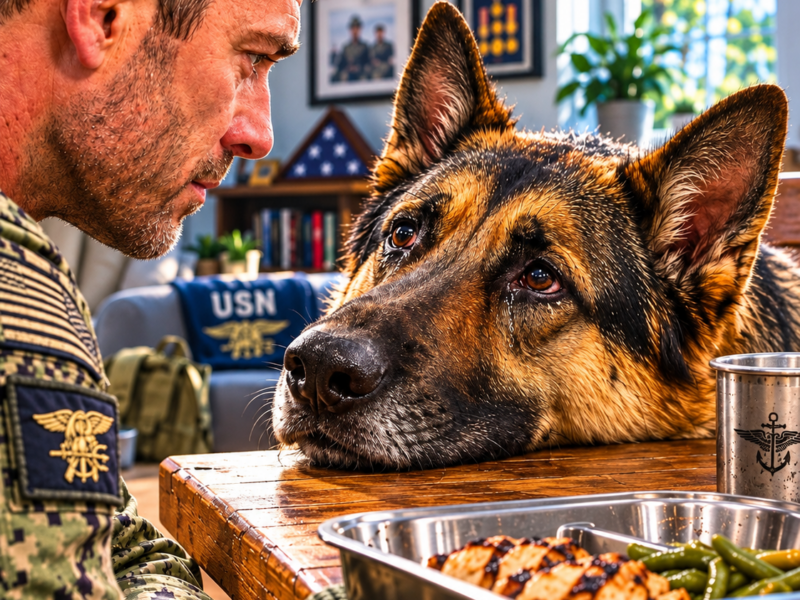
“I watched my German Shepherd disappear through our backyard gate, only to discover her sitting outside the Tennessee animal shelter where she’d spent 847
The first thing I did the next morning was call Rachel.
She answered before the second ring.
“Matt? Is everything okay?”
“I need Sadi’s complete history,” I said. “Everything you have. Previous placements, returns, notes from the people who worked with her. All of it.”
There was a pause.
“Did something happen last night?”
“Emily thinks we need to understand what happened to Sadi before she came to us.”
Rachel exhaled softly.
“Then I think you should come in. There are a few things in her file that are easier to explain in person.”
I looked toward the kitchen.
Emily sat at the table, still wearing her pajamas. Sadi lay beside her chair, her chin resting on her front paws. The dog hadn’t eaten much the night before, but she had accepted a small piece of chicken from Emily’s hand.
Neither of them looked particularly happy.
“Give us an hour,” I told Rachel.
After I hung up, Emily glanced at me.
“Are we taking Sadi back?”
“No.”
I said it too quickly.
Emily’s fingers stopped moving over the edge of her cereal bowl.
“I mean, we’re going to talk to Rachel. We’re going to learn what we can. But we’re not taking her back just because she got scared.”
Emily looked down.
“What if she doesn’t want to stay?”
That question landed harder than I expected.
I pulled out the chair across from her.
“Then we’ll have to listen to what she’s telling us. But we won’t decide what she wants based on one frightening afternoon.”
Emily nodded, although she didn’t seem convinced.
Sadi lifted her head when I stood.
“Come on, girl,” I said gently.
She didn’t move until Emily rose.
Then she followed.
At the shelter, Rachel met us near the front desk. Daniel Price, the behavior coordinator, stood beside her with a thick folder tucked under one arm.
“I’ve been looking through her records,” Rachel said. “Some of the older notes were handwritten, so it took a while to put everything together.”
She led us into a small office.
Sadi settled near Emily’s feet.
Daniel opened the folder.
“Before we get into the history, I want to make one thing clear,” he said. “A dog returning to a familiar place doesn’t necessarily mean she rejected a new home. We can’t know exactly what she was thinking.”
Emily nodded.
“But we can look at the patterns,” he continued. “And Sadi has a few.”
He turned the first page.
Sadi had arrived at the shelter two years and four months earlier.
She had been found wandering near a grocery store outside Knoxville. No microchip. No collar. No owner came forward.
At first, the shelter had assumed she was a stray.
Then a volunteer noticed something unusual.
Sadi would sit beside an empty chair in the visiting room for hours.
Not beside the door.
Not near the food.
Beside the chair.
“She did that almost every day,” Rachel explained. “We tried moving the chair, but she’d find the new spot and settle beside it.”
Emily looked down at Sadi.
“Was somebody sitting there before?”
“Possibly,” Rachel said. “We don’t know for certain.”
Daniel turned another page.
A few months after her arrival, Sadi had been placed with a family outside the city. They had a fenced yard and two adults who worked from home.
The placement lasted eleven days.
The family reported that Sadi was gentle but unusually watchful. She followed one household member from room to room and became distressed when that person left.
They returned her because they felt she needed more attention than they could provide.
The second placement lasted three weeks.
The third lasted less than a week.
The reasons were different, but the notes shared a pattern.
Sadi struggled with sudden changes, unfamiliar visitors, and people reaching toward her when she was resting.
“She wasn’t aggressive,” Daniel said. “But she communicated discomfort. Some people didn’t recognize the signals until she growled.”
I remembered the napkin.
The way Sadi’s body had gone stiff.
The warning sound that had made me pull my hand away.
I had thought she was being difficult.
Now I understood how little I had known.
“What happened with the last family?” Emily asked.
Rachel looked at Daniel.
He hesitated before answering.
“That placement is the reason I wanted you both to come in.”
He opened a thinner section of the file.
The family had included a woman named Lily and her teenage daughter.
Sadi had bonded with the girl.
The notes described a dog who slept outside her bedroom, waited beside her desk while she studied, and followed her down the stairs each morning.
Emily’s eyes moved toward Sadi.
“Like she does with me.”
“Very similar,” Daniel said.
The placement had lasted nearly four months.
Then Lily’s daughter became seriously ill and had to stay with relatives while receiving treatment.
The adults were dealing with a sudden medical crisis. They couldn’t keep Sadi, and they returned her to the shelter with the explanation that their family situation had changed.
There was no accusation in the file. No cruelty. Just a family overwhelmed by circumstances.
Sadi had gone back to the same shelter where she had started.
“She waited by the visiting-room chair again,” Rachel said quietly. “For weeks.”
Emily’s eyes filled.
“Did the girl ever come back?”
Rachel shook her head.
“We don’t know. The family didn’t leave updated contact information, and we couldn’t share their details.”
I looked at the page.
Four months.
A teenage girl.
A chair.
A bedroom door.
And then another goodbye.
It wasn’t proof that Sadi had been thinking about that girl when she followed Emily around our house.
It wasn’t proof that she had run back to the shelter because she expected us to abandon her.
But it gave us a picture of a dog who had experienced a sudden change after becoming attached to someone.
And it gave us a reason to be patient.
Emily reached down and touched Sadi’s shoulder.
“Maybe she thought it was happening again,” she whispered.
“Maybe,” Daniel said. “But we shouldn’t decide her feelings for her. What we can do is make her environment predictable and let her build trust at her own pace.”
He explained that Sadi needed a consistent routine, a quiet place where nobody disturbed her, and people who respected her warnings.
He also recommended working with a canine behavior consultant.
“Clare Morgan has helped us with several dogs who struggle after multiple placements,” he said. “She can visit your home and help you set up a plan.”
I agreed before he finished.
On the drive home, Emily was quiet.
Sadi lay in the back seat, her head resting on the blanket we’d brought from home.
At a red light, Emily finally spoke.
“Dad?”
“Yeah?”
“Do you think she was waiting for that girl every day?”
“I don’t know.”
“Do you think she missed her?”
I glanced at the rearview mirror.
Sadi’s eyes were half closed.
“I think dogs can miss people,” I said. “And I think they can be confused when their lives change. But I don’t want to pretend I know exactly what she’s thinking.”
Emily nodded.
Then she said something I hadn’t expected.
“I think I understand that.”
I looked at her.
She was staring out the window.
“Understand what?”
“What it’s like to get used to somebody and then not know if they’re going to stay.”
I gripped the steering wheel.
Her mother had moved to Atlanta eight months earlier.
The separation had been difficult, but I had convinced myself that Emily was adjusting. She still had her room, her school, her friends—or at least the friends I assumed she had.
I had been so focused on keeping our lives organized that I hadn’t noticed how much she was holding inside.
“Emily,” I said, “is that how you’ve been feeling?”
She shrugged.
“I don’t know. Mom says she’ll call, and sometimes she does. Sometimes she gets busy. You say we’re okay, but then you work late, and I don’t want to bother you.”
“You never bother me.”
“I know you say that.”
The light turned green.
I drove forward, but her words stayed with me.
That afternoon, Clare came to the house.
She was in her fifties, with silver hair tied back and a calm way of moving that seemed to make the whole room quieter.
She didn’t approach Sadi immediately.
Instead, she sat on the floor near the kitchen doorway and talked to us while Sadi watched from beside Emily.
“Tell me about the napkin incident,” she said.
I explained how I’d reached for the napkin, how Sadi had growled, and how I had reacted.
Clare listened without interrupting.
“Did she freeze before growling?”
“Yes.”
“Did she turn her head away?”
“I think so.”
“Did you notice her body becoming stiff?”
I remembered it clearly now.
“Yes.”
“Those were warnings. She was asking for space. The growl was another warning, not a challenge.”
I nodded.
“I should have recognized it.”
“Now you do. That’s what matters.”
She showed us how to watch for tension around Sadi’s eyes, mouth, ears, and shoulders.
She explained that we shouldn’t grab her collar, disturb her when she was sleeping, or take objects directly from her mouth.
If Sadi had something unsafe, we should use a calm trade rather than force.
Then Clare turned to Emily.
“What do you do when Sadi follows you upstairs?”
“I let her.”
“And when she waits outside your bedroom?”
“I usually leave the door open.”
“Does that feel comfortable to you?”
Emily considered the question.
“Yeah. I like having her there.”
“Good. Just remember she needs choices, too. You don’t have to be responsible for making her happy every minute.”
Emily looked relieved.
Clare helped us create a routine.
Morning walks at the same time.
Meals in a quiet corner.
A bed where Sadi could retreat without anyone approaching her.
Short training sessions built around rewards.
And a rule that mattered more than all the others:
Nobody would force affection.
Sadi could approach us.
She could walk away.
She could rest without being touched.
We would let her decide when she was ready.
Before Clare left, she inspected the backyard gate.
The latch was loose.
A slight push from the wrong angle could make it swing open.
My stomach tightened.
“I’ll replace it tomorrow,” I said.
“Replace it today,” Clare replied. “Until then, don’t leave her outside unattended.”
I didn’t argue.
That evening, I went to the hardware store and bought a new latch, a locking clip, and a small metal gate alarm.
I installed all three before dinner.
Then I tested the gate six times.
Emily watched from the porch.
“Dad?”
“Yeah?”
“You know it’s okay if you don’t fix everything in one day, right?”
I looked at the tools in my hands.
For years, I’d believed that being a good father meant having an answer ready before my daughter finished asking a question.
But Emily didn’t need another plan.
She needed me to hear her.
I set the screwdriver down.
“Come sit with me.”
We sat on the porch steps while Sadi rested inside.
“I’ve been thinking about what you said in the car,” I began. “About not knowing if people are going to stay.”
Emily pulled her sleeves over her hands.
“I didn’t want to make you feel bad.”
“You don’t have to protect me from your feelings.”
She looked at me.
“I know things have been strange since Mom moved.”
“Strange isn’t a strong enough word.”
For a moment, neither of us spoke.
Then I asked, “Do you feel like this is your home?”
Her eyes moved toward the front window.
“My room is.”
“That wasn’t what I asked.”
She swallowed.
“Sometimes I feel like I’m visiting.”
I felt something inside me break quietly.
“Why?”
“Because everything changed so fast. Mom moved. I changed schools. Then I got that picture sent around.”
I knew about the picture, but I hadn’t understood how much it had hurt her.
She explained that someone had taken an embarrassing photograph of her during lunch and shared it in a group chat. Other students had made jokes. When she tried to defend herself, the messages spread.
She had stopped going to yearbook club because she couldn’t stand sitting in the room with people who had laughed.
I’d told her that teenagers could be cruel.
I’d offered to speak to the school.
I’d suggested she find new friends.
I had done everything except sit still and let her tell me how lonely she felt.
“Why didn’t you tell me it was that bad?” I asked.
“I tried.”
The answer was so quiet I almost missed it.
I looked down at my hands.
“You’re right.”
Emily blinked.
“What?”
“You tried. I didn’t listen carefully enough.”
Her face crumpled for a second before she looked away.
I moved my hand toward hers, then stopped.
“Can I?”
She nodded.
I held her hand.
“I can’t make Mom move back. I can’t erase what happened at school. And I can’t promise nothing else will ever change.”
She squeezed my fingers.
“But I can promise you won’t have to wonder whether you belong here,” I continued. “This is your home. Not because your bedroom is here. Not because I pay the bills. Because you’re my daughter, and there’s nowhere else I want you to be.”
Emily started crying.
I pulled her into my arms.
She cried against my shoulder for a long time.
I didn’t tell her to calm down.
I didn’t offer a solution.
I just stayed.
When we went inside, Sadi was waiting near the hallway.
Emily crouched.
“Hi, girl.”
Sadi approached slowly and rested her head against Emily’s chest.
Emily wrapped her arms around the dog’s neck, but she didn’t hold on tightly.
Sadi stayed.
That night, Emily opened her navy duffel.
She took out a sweatshirt, two books, a framed photograph, and a small ceramic bowl she’d kept from her grandmother.
She placed the bowl on her dresser.
Then she hung the sweatshirt in her closet.
I stood in the doorway.
“That’s a nice start,” I said.
Emily glanced at the bag.
“I don’t think I want to unpack everything tonight.”
“You don’t have to.”
She smiled faintly.
“Maybe tomorrow.”
“Tomorrow works.”
Sadi lay on the rug, watching without staring.
When Emily climbed into bed, the dog settled outside her door.
The next few weeks weren’t perfect.
Sadi still startled when someone dropped a pan.
She still preferred to eat when the house was quiet.
Some nights she paced the hallway, checking each room before settling.
And sometimes, when Emily left for school, Sadi waited beside the front window.
But we learned her rhythms.
We stopped interpreting every hesitation as rejection.
We learned that trust wasn’t a single decision made on adoption day.
It was a hundred small decisions repeated until they became familiar.
Clare visited twice more.
The second time, she helped us practice calling Sadi away from the gate and rewarding her for returning to us.
The third time, she watched Emily teach Sadi a simple touch command.
Emily held out her palm.
Sadi sniffed it.
Then she gently touched her nose against Emily’s hand.
Emily grinned.
“Did you see that?”
“I saw it.”
“She’s so smart.”
“She is.”
Clare smiled.
“She’s also learning that she has choices. That’s important.”
We kept the backyard routine supervised.
The new latch stayed locked.
The alarm stayed in place.
I added a second barrier near the driveway, not because I expected Sadi to run again, but because loving a dog with a history of instability meant taking reasonable precautions.
One Saturday morning, Emily asked if we could go back to the shelter.
I looked at her.
“Why?”
“I want to thank Rachel and Daniel. And I think Sadi might like seeing them.”
I wasn’t sure about that last part.
But we called first.
Rachel said it was fine.
When we arrived, Sadi stepped out of the car cautiously.
She sniffed the familiar air.
For a moment, her body went still.
Then Rachel came through the front door.
“There’s my girl.”
Sadi approached her slowly, tail moving in a low, gentle rhythm.
Rachel knelt and let Sadi sniff her hands.
“Look at you,” she whispered. “You’ve got a family.”
Emily stood beside them.
“She does,” she said.
Rachel looked up.
“And how are you doing?”
Emily smiled.
“Better.”
Inside, Daniel showed us the old visiting room.
The empty chair was still there, though it had been moved closer to the window.
Sadi walked toward it.
My chest tightened.
She sniffed the legs, circled once, and looked toward the door.
Then she turned away.
Emily watched her.
“Do you think she remembers?”
“Maybe,” I said.
Daniel joined us.
“She may recognize the room and the smells. But what matters is what she’s doing now.”
Sadi walked back to Emily.
She sat beside her.
Not beside the chair.
Beside Emily.
I couldn’t help looking at the old seat one more time.
For months, maybe longer, Sadi had waited beside something familiar.
Perhaps she had been waiting for someone.
Perhaps she had simply found a place where the world felt predictable.
We would never know for certain.
But she wasn’t sitting there anymore.
Before we left, Rachel handed Emily a small envelope.
“It’s a copy of the photo we keep for our adoption stories,” she said. “Only if you’d like it.”
Inside was a picture of Sadi from her first week at the shelter.
She looked thinner.
Her ears were alert, and her eyes seemed to be watching something just outside the frame.
Emily held it carefully.
“Can we put this in the hallway?”
“Of course,” I said.
“Not because I want everyone to feel sorry for her,” Emily added. “I just want her to know we remember where she came from.”
I nodded.
“Then we’ll put it somewhere she can see us when she walks by.”
On the way home, Emily asked if she could try yearbook club again.
“Are you sure?”
“Not because I think everyone will suddenly be nice. I just miss taking pictures.”
“Then go for the pictures,” I said. “You don’t owe anybody a performance.”
She smiled.
“I know.”
She went back the following Thursday.
I didn’t ask a dozen questions when she came home.
I waited until she was ready.
She told me she had spent most of the meeting working on photographs for the fall sports pages. A couple of students had barely looked at her. One girl had apologized for sharing the picture.
Emily wasn’t ready to forgive her.
And I didn’t tell her she should.
“Maybe someday,” she said. “But not today.”
“That sounds fair.”
At dinner, she talked about camera settings and a photo she’d taken of the football field just before sunset.
I listened.
Really listened.
Sadi lay near her chair, her body relaxed.
When Emily finished, she placed a small piece of chicken in Sadi’s bowl.
Then she sat back.
Sadi looked at the food.
She looked at Emily.
And finally, she began to eat.
Nobody cheered.
Nobody moved too quickly.
We just let the moment happen.
A few nights later, I found Emily standing in her bedroom doorway with the navy duffel in her hands.
It was empty.
She looked at me.
“I think I’m ready to put it away.”
I nodded.
“Where do you want it?”
“Up in the closet. I don’t need it beside my bed anymore.”
She folded it and placed it on the top shelf.
Then she closed the closet door.
Sadi was stretched across the rug.
Emily sat beside her and leaned against the wall.
“Dad?”
“Yeah?”
“Do you think Sadi knows she’s staying?”
I looked at the dog.
Her eyes were closed, but one ear moved toward Emily’s voice.
“I think she knows what we’re showing her.”
Emily rested her hand on Sadi’s back.
“And what are we showing her?”
“That tomorrow morning, we’ll still be here.”
Emily thought about that.
Then she smiled.
“Good.”
The next morning, I woke before sunrise.
I found Sadi waiting beside Emily’s bedroom door, just as she often did.
But this time, she wasn’t standing rigidly.
Her head rested on her paws.
Her breathing was slow.
When Emily opened the door, Sadi rose and stretched.
“Morning, best friend,” Emily whispered.
Sadi followed her downstairs.
I made coffee.
Emily poured cereal.
The dog went to her bed and settled while the kitchen filled with the ordinary sounds of a family beginning another day.
Nothing dramatic happened.
No miracle.
No sudden transformation.
Just a girl who no longer kept a bag packed.
A dog who no longer had to wait beside an empty chair.
And a father who finally understood that home wasn’t something you proved by keeping every problem away.
It was something you built by staying when things got difficult.
Before school, Emily stopped at the front door and turned back.
“Dad?”
“Yeah?”
“Can we take Sadi to the park after dinner?”
“Absolutely.”
She opened the door.
Sadi watched her go, then looked at me.
I clipped on her leash.
Outside, the morning was cool, and the neighborhood was quiet.
As we walked, Sadi stayed close to my side.
At the corner, she paused and looked back toward our house.
For one brief second, I wondered whether she was remembering the shelter.
Then she turned toward me.
I held the leash loosely.
“Come on, girl,” I said.
And she came.
Not because I pulled.
Not because she had nowhere else to go.
But because, little by little, she was learning that she could choose to stay.
The end









