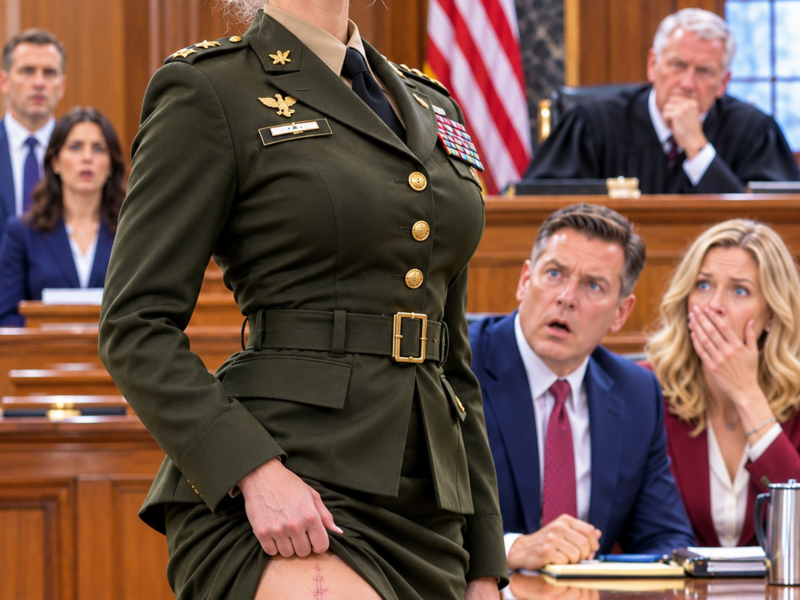
“I watched my father laugh at my Navy dress uniform in a Virginia courtroom, convinced he was about to take my grandfather’s farmhouse away from me
Judge Simmons adjusted his glasses and looked directly at my father.
“Mr. Carter, I’m going to ask you one more time. Have you entered the farmhouse during the past twelve months?”
My father shifted in his chair.
“I own property in Virginia, Your Honor. I have every right to visit my father’s house.”
“That wasn’t my question.”
My mother reached for his arm.
Robert pulled away.
“Yes,” he finally said. “I’ve been there a few times.”
“With your daughter’s permission?”
He hesitated.
“We’re family. I didn’t think permission was necessary.”
Judge Simmons glanced down at the document.
“Then perhaps you can explain why the deed contains an explicit provision restricting unauthorized transfers and access to certain personal property belonging to the former owner.”
My father looked at Bradley Collins, the attorney representing him.
Bradley opened his briefcase.
“Your Honor, we would appreciate an opportunity to review that document before answering questions about its interpretation.”
“Certainly,” Judge Simmons replied. “But I suggest you read the entire document, not just the portions that support your client’s position.”
The judge handed a copy to the clerk.
I watched the pages pass across the courtroom.
My grandfather’s signature appeared at the bottom of every relevant section.
I knew that handwriting better than I knew my father’s.
It was the same handwriting he had used on birthday cards, grocery lists, and the little notes he used to leave beside my breakfast plate.
Judge Simmons turned toward me.
“Commander Carter, do you have evidence showing that you paid the property’s expenses?”
“Yes, Your Honor.”
I opened my leather folder.
I had organized everything chronologically, beginning with the year my grandfather transferred the property.
There were twelve years of property tax receipts.
Insurance statements.
Roof repairs.
Plumbing invoices.
Electrical work.
Even receipts for the annual inspection of the farmhouse’s septic system.
I placed them on the clerk’s table.
“These payments came from my personal account. I can provide certified bank statements showing the transfers.”
The judge examined the first few documents.
“Did your parents contribute to any of these expenses?”
“Not to my knowledge.”
My father gave a dismissive laugh.
“Those are just a few receipts. They don’t prove she maintained the entire property.”
I turned toward him.
“Then perhaps you can show the court your receipts.”
He looked at me.
For several seconds, nobody spoke.
Bradley Collins leaned toward his client and whispered something.
My father finally said, “We didn’t keep every receipt.”
Judge Simmons raised an eyebrow.
“You’re claiming reimbursement for years of expenses but have no complete accounting?”
“We paid cash for some of the repairs.”
“To whom?”
My father didn’t answer.
I looked down at my folder.
There was something satisfying about seeing the evidence arranged so neatly.
For years, I had made those payments quietly.
I had never imagined I would need to prove to my own parents that I had been responsible for my grandfather’s home.
But the receipts weren’t the only things I had brought.
I had also printed photographs taken during my visits.
Some showed the new roof.
Others showed the repaired porch, freshly painted shutters, and the restored kitchen floor.
The pictures included dates and location information.
Judge Simmons reviewed them carefully.
“These photographs appear to contradict the claim that the property has been neglected.”
My father leaned forward.
“The outside looks fine. The inside is another matter.”
I looked at him.
“Then why did you change the locks?”
He didn’t answer.
My mother finally spoke.
“We were only trying to protect the house.”
I turned toward her.
“From whom?”
She looked away.
Judge Simmons placed the photographs down.
“Mrs. Carter, I would like you to explain exactly what you mean.”
My mother adjusted her pearls.
“Your grandfather kept valuable personal items inside that house. We were concerned they might be stolen.”
“Which items?” the judge asked.
She hesitated.
“Furniture. Antiques. Family papers.”
“Did you remove any of them?”
“No.”
The answer came too quickly.
I glanced at the judge.
He noticed.
“Mrs. Carter, I will ask you again. Did you or your husband remove anything from the farmhouse?”
My mother lowered her eyes.
“We moved a few things for safekeeping.”
My father interrupted.
“Margaret, that’s enough.”
The courtroom went quiet.
Judge Simmons leaned back.
“Mr. Carter, you don’t get to decide when your wife answers a question.”
I felt a familiar tension in my shoulders.
My parents had spent years speaking for one another, correcting each other’s sentences, and presenting a united front.
Now the cracks were becoming visible.
The judge turned toward the clerk.
“Please mark the deed as a preliminary exhibit. I want both parties to have an opportunity to review it.”
Then he looked at my father’s attorney.
“Mr. Collins, I also want to know whether your clients have conducted any transactions involving this property.”
Bradley cleared his throat.
“I believe the property has been discussed with a potential purchaser, but no final agreement has been executed.”
My stomach tightened.
“A purchaser?” I asked.
The judge looked at me.
“Commander Carter, did you know your parents had discussed selling the farmhouse?”
“No, Your Honor.”
I turned toward my father.
“You were trying to sell Grandpa’s house?”
He stared at the table.
“We were trying to protect the family’s financial interests.”
“What financial interests?”
He finally looked at me.
“That property is worth considerably more than you seem to understand.”
I almost laughed.
The house had never been about money to Grandpa.
It had been about keeping something alive.
Judge Simmons asked Bradley to explain the proposed transaction.
The attorney reluctantly admitted that a local development company had expressed interest in purchasing the land.
The offer was substantial.
The property sat near an area that had recently attracted commercial investment.
The company wanted the farmhouse demolished and the land incorporated into a larger development.
I looked at my father.
“You were going to tear it down?”
He shrugged.
“It has served its purpose.”
That sentence hurt more than I expected.
I thought about the old workbench in the garage.
The pencil marks on the kitchen door where Grandpa had measured my height.
The small wooden swing he had built for me when I was seven.
My father had never understood those things.
He saw a deteriorating structure on valuable land.
I saw the last place where my grandfather had been truly happy.
Judge Simmons called a brief recess.
I gathered my papers and walked into the hallway.
My knee was beginning to ache.
I sat on a wooden bench and rubbed the area above the surgical scar.
A few minutes later, Thomas Reed appeared.
He was carrying a dark leather briefcase and moving slowly with a cane.
“You’re doing fine,” he said.
I looked at him.
“You could have mentioned that my parents were trying to sell the property.”
“I didn’t know about the sale until yesterday.”
“How?”
He sat beside me.
“The development company contacted my office. They wanted to know whether the title was clear.”
I stared at him.
“And you told them?”
“I told them the property belonged to you.”
He opened his briefcase.
“That’s when I started looking more closely at your grandfather’s records.”
He removed a thick envelope.
“Evelyn, your grandfather left more than a deed.”
I looked at him.
“What else?”
“A separate agreement concerning the farmhouse.”
He handed me a copy.
I read the first paragraph.
Then I looked at him again.
“What is this?”
“Your grandfather established a preservation agreement with a local historical trust.”
I read the document more carefully.
The agreement required that certain parts of the farmhouse be preserved because of its historical significance to the community.
The property could still be sold under specific conditions, but the farmhouse and surrounding grounds could not simply be demolished or altered without approval.
I looked at Thomas.
“Why didn’t Grandpa tell me?”
“He wanted you to have the freedom to decide what to do with the property. He didn’t want you to feel trapped by an obligation.”
I looked back at the document.
There was another section.
It named me as the person responsible for maintaining the agreement.
I felt my throat tighten.
“He trusted me with this?”
Thomas nodded.
“He told me you understood what the house meant.”
I folded the document carefully.
Then I asked the question that had been bothering me since I saw the new lock.
“Why were my parents so interested in getting inside?”
Thomas hesitated.
“Because your grandfather kept an original copy of the preservation agreement in the farmhouse. He also kept the records concerning the land.”
I looked toward the courtroom doors.
“Did they take them?”
Thomas lowered his voice.
“I believe they did.”
I felt the anger rising again.
“Can you prove that?”
He nodded.
“Your grandfather had a habit of photographing important documents before storing them. I have copies of everything.”
I let out a slow breath.
“Then why did they change the locks?”
Thomas closed his briefcase.
“I think they wanted to find something before you did.”
The recess ended before I could ask more.
We returned to the courtroom.
Judge Simmons had already resumed his seat.
“Mr. Reed,” he said, “thank you for joining us. I understand you have additional documents concerning the property.”
“Yes, Your Honor.”
Thomas approached the bench.
He submitted the preservation agreement, a certified copy of the original deed, and several pages of correspondence between my grandfather and the historical trust.
My father immediately objected.
“Your Honor, this is becoming a completely different case.”
Judge Simmons looked at him.
“Mr. Carter, your complaint asks the court to award you financial compensation and control over this property. The ownership and legal restrictions attached to that property are directly relevant.”
Bradley stood.
“We would request time to review these additional materials.”
“That is reasonable,” the judge replied. “However, I also want an explanation for why the original records appear to have been removed from the house.”
Thomas handed over another document.
It was a letter dated six months before my grandfather died.
I recognized the handwriting.
This one was addressed to my father.
Judge Simmons read it.
Then he looked at Robert Carter.
“Mr. Carter, did your father ever tell you that the farmhouse was not to be sold or demolished?”
My father said nothing.
The judge read a passage aloud.
“Robert, I know you see the land as an opportunity. I have heard your proposals. But this house is not an investment for you to liquidate. Evelyn understands why it matters, and I have made arrangements accordingly.”
My father shifted in his chair.
Judge Simmons continued.
“Did you receive this letter?”
“Yes.”
“Did you understand its contents?”
My father looked at Bradley.
“I understood that my father had certain wishes.”
“Wishes?”
The judge held up the letter.
“This is not a birthday card, Mr. Carter. It is a written statement explaining his intentions concerning a property he legally transferred.”
My father finally raised his voice.
“He was old. He didn’t understand the value of the land.”
Thomas responded calmly.
“Your grandfather had the property independently appraised before signing the transfer.”
My father turned toward him.
“Nobody asked you.”
Thomas didn’t flinch.
“Your father did.”
The judge called for another recess.
During that break, I stepped outside the courthouse.
The air smelled of wet pavement.
It had rained while we were inside.
I stood beneath the covered entrance and looked at my phone.
There was a message from an unfamiliar number.
“Stop making this worse. We can settle this privately.”
I stared at the screen.
A second message arrived.
“Your father is willing to pay you for the property. Take the money and move on.”
I showed the messages to Thomas.
He read them twice.
“Don’t respond.”
“Do you know who sent them?”
He examined the number.
“Not yet.”
I took a screenshot and saved it.
Then I put my phone away.
For the first time, I began to suspect that my parents’ lawsuit was only one part of something larger.
When we returned to the courtroom, Judge Simmons announced that he had reviewed the preservation agreement.
He also stated that the court would not resolve the historical trust’s separate legal rights in a family property hearing.
However, the agreement was relevant to determining whether my parents had made accurate claims about the farmhouse.
Then he asked my father a question I hadn’t expected.
“Mr. Carter, have you received any money from the development company?”
My father stared at him.
“No.”
Bradley turned toward his client.
It was a small movement.
Almost invisible.
But I noticed it.
Judge Simmons noticed it too.
“Mr. Collins, do you know something your client has not disclosed?”
The attorney stood.
“Your Honor, I need to speak with my client.”
“Do so briefly.”
They leaned together.
My father spoke in a low voice.
Bradley shook his head.
Then the attorney straightened.
“Your Honor, I have learned that my clients received an option payment from the development company.”
My mother’s hand flew to her mouth.
My father turned toward him.
“Bradley!”
The attorney continued.
“The payment was made under a preliminary agreement, subject to verification of title and the authority to sell.”
The judge’s expression hardened.
“How much?”
Bradley looked at the documents.
“Thirty-five thousand dollars.”
My father sat back.
I felt my face grow warm.
They had already accepted money for a property that wasn’t theirs.
Judge Simmons asked for a copy of the agreement.
Bradley provided it.
The document showed that my father and mother had represented themselves as having authority to negotiate the sale.
They had also represented that there were no preservation restrictions preventing development.
Both statements were questionable.
The judge looked at my parents.
“Did either of you disclose your daughter’s ownership interest to the development company?”
My mother began crying.
My father answered.
“We believed the matter would be resolved.”
“By taking her to court?”
“By establishing our rightful interest.”
Judge Simmons looked at the deed again.
“Your names do not appear as owners.”
My father leaned forward.
“We were his children.”
“And she was his granddaughter. That does not change the recorded ownership.”
Bradley asked for a short adjournment so he could advise his clients.
Judge Simmons granted it.
He also ordered the parties to preserve all records relating to the property and instructed my parents not to enter, transfer, encumber, or alter the farmhouse while the dispute remained before the court.
The judge made it clear that any claim involving the option payment or potential misrepresentations to the development company would need to be addressed through the appropriate legal proceedings.
Then he turned toward me.
“Commander Carter, I want to be clear about something. Your military service is not the basis of this decision. Your father’s allegations must be evaluated against the evidence, and the evidence is what matters.”
I nodded.
“Yes, Your Honor.”
He paused.
“But I also want to acknowledge the amount of documentation you have provided. It appears you have taken your responsibility for this property seriously.”
For the first time that day, I felt my shoulders relax.
The hearing did not end with my parents being arrested or escorted out of the courtroom.
Real life rarely worked that way.
Instead, the judge dismissed their immediate request for control of the property and denied their reimbursement claim because they had failed to establish that they had paid the expenses they alleged.
He reserved other issues for further proceedings.
The option payment would have to be addressed separately.
And the title records would be reviewed to ensure that the development company understood the actual ownership and preservation restrictions.
My father looked furious.
My mother looked exhausted.
As I gathered my documents, she approached me.
“Evelyn.”
I stopped.
“What?”
She glanced toward the hallway.
“Can we talk?”
I looked at her pearls.
The same necklace she had worn at my high school graduation.
The same necklace she had worn when she told me I was embarrassing the family by joining the Navy.
I wanted to ask why she had signed the complaint.
Why she had allowed my father to use her name.
Why she had watched him laugh at me.
Instead, I said, “About what?”
She looked down.
“Your father thinks this can still be worked out.”
I almost smiled.
“Your father?”
She looked up.
“Robert.”
“Mom, I know who Dad is.”
She swallowed.
“I mean the property.”
I held my folder against my side.
“It’s not for sale.”
“Your father has debts.”
There it was.
Not an apology.
Not an explanation.
A reason.
I waited for her to say more.
“He made some investments that didn’t work out,” she continued. “The development company offered enough money to clear everything.”
“Then he should have used his own property.”
She looked hurt.
“You know how much that land is worth.”
“I know how much Grandpa’s house meant to him.”
My mother wiped her cheek.
“Your grandfather was difficult. He never understood the pressure your father was under.”
I looked at her for a long moment.
“Did Grandpa understand the pressure I was under when I was recovering from surgery?”
She didn’t answer.
“Did he understand that I was paying the taxes while I was learning how to walk again?”
Her eyes filled.
“I didn’t know it was that bad.”
I almost laughed.
“You never asked.”
She looked away.
Then she said something I hadn’t expected.
“Your father told me you had agreed to sell.”
I stared at her.
“What?”
“He said you had called him.”
“I haven’t spoken to Dad in almost a year.”
She shook her head.
“He showed me a message.”
“What message?”
She reached into her handbag and took out her phone.
Her fingers trembled as she searched through it.
Then she showed me a screenshot.
It appeared to be a message from my number.
It said that I was willing to sell the farmhouse and had authorized Robert to negotiate.
I read it carefully.
The wording was strange.
I would never have used that language.
Then I noticed the date.
It was a day when I had been attending a medical appointment in Richmond.
I had not sent the message.
I looked at my mother.
“Did you ever verify this with me?”
She shook her head.
“Your father said you didn’t want to talk to us.”
I returned the phone.
“Mom, someone used my name to make you believe I had agreed to sell Grandpa’s house.”
She looked frightened.
“Are you saying your father made it up?”
“I’m saying I didn’t send it.”
For a moment, neither of us spoke.
Then she whispered, “I don’t know what to believe anymore.”
I looked at her.
“That’s a question you should have asked yourself before signing a lawsuit.”
I walked away.
Thomas was waiting near the courthouse entrance.
He handed me a bottle of water.
“How are you?”
“Tired.”
“That makes two of us.”
We stood outside for a few moments.
Then I showed him the screenshot.
He examined the date and wording.
“This needs to be preserved.”
“Could it have been fabricated?”
“Possibly. We would need the original device records and appropriate technical analysis.”
I nodded.
He slipped the phone number and date into his notes.
“There’s another issue we need to investigate.”
“What?”
“Your grandfather’s personal papers.”
He explained that the farmhouse had contained a small metal filing cabinet in the back room.
My grandfather kept old correspondence, photographs, land surveys, and records relating to the historical trust inside it.
When Thomas had visited shortly after my grandfather died, the cabinet had been locked.
The key was in the envelope with the deed.
But the cabinet itself was no longer mentioned in the inventory of household items.
I looked at him.
“Do you think my parents took it?”
“I don’t know. But we need to find out.”
That evening, I drove to the farmhouse.
I had permission to inspect the exterior and document its condition, but I didn’t enter because the locks had been changed and the court had ordered that nothing be disturbed.
I parked beneath the old oak tree.
The house looked smaller than it had when I was a child.
I took photographs of the porch, the windows, the roof, and the side entrance.
Then I noticed a piece of paper tucked beneath the mailbox.
It was folded twice.
I opened it.
Inside was a handwritten note.
“Your grandfather left something for you in the place where the house remembers the rain.”
I read it again.
There was no signature.
No date.
I looked toward the roof.
The old rain barrel still stood beside the back porch.
Grandpa had used it to collect water for the garden.
I walked toward it slowly.
The metal barrel was empty.
Its paint had almost completely disappeared.
I crouched and looked behind it.
There was a loose wooden board near the foundation.
I recognized it immediately.
When I was ten, Grandpa had shown me how to lift it to retrieve a small tin box where he kept spare keys.
I pulled the board away.
The box was still there.
Inside was a key, a folded photograph, and a small note in Grandpa’s handwriting.
“Evelyn, if you’re reading this, someone has probably tried to take what doesn’t belong to them. Don’t be angry before you understand.”
I sat back on my heels.
My knee hurt, but I barely noticed.
The photograph showed Grandpa standing beside the farmhouse with a man I didn’t recognize.
On the back was a date from 1998.
Below it, Grandpa had written:
“First meeting with Lewis Carter Historical Preservation Committee.”
I turned the photograph over again.
Lewis.
The name made me pause.
My closest friend in the Navy had been named Lewis.
But this was someone else.
The note continued.
“Ask Thomas about the original survey. The house is only part of what I wanted you to protect.”
I called Thomas.
He answered on the second ring.
“Have you found something?”
I read him the note.
There was a long silence.
Then he said, “Evelyn, I think we need to meet tomorrow.”
“What is it?”
“Your grandfather’s original survey included more land than the deed your parents have been discussing.”
I looked at the farmhouse.
“How much more?”
“I’ll explain when I see you. But there’s something else. The historical trust has been trying to locate a missing document for years.”
“What document?”
“The agreement that established the preservation fund.”
I glanced down at the key in my palm.
“Could it be in the filing cabinet?”
“Possibly.”
“Then we need to get inside.”
“We’ll do it legally. The court’s order means we need to be careful.”
I put the key back into the tin box.
For the first time, I began to understand why my grandfather had been so determined to keep the farmhouse in my hands.
The house itself wasn’t the whole story.
The next morning, Thomas and I met with the historical trust’s director, a woman named Helen Parker.
She was in her sixties, with silver hair and a calm manner.
She brought an old map.
When she unfolded it across the conference table, I saw the farmhouse, the oak tree, the creek, and a large section of surrounding land.
The original property was nearly twice the size of the parcel my parents had described in their complaint.
I looked at the map.
“Why is the other half missing from the current deed?”
Helen explained that Grandpa had transferred the farmhouse and a portion of the land to me, but the remaining acreage had been placed in a preservation trust.
The trust had been established to protect a small stretch of wetlands and an old community trail that ran along the creek.
My grandfather had purchased the land decades earlier when a developer threatened to drain the wetlands.
He had spent years working with local volunteers to preserve it.
The farmhouse was the center of that effort.
“Your grandfather wanted the land protected, but he also wanted someone he trusted to keep the house connected to the community,” Helen said.
I looked at Thomas.
“Why didn’t anyone tell me?”
“Your grandfather wanted to explain everything himself,” Thomas replied. “He planned to do it when you returned from deployment.”
I lowered my eyes.
He had died before I came home.
Helen placed another document on the table.
“This is the missing preservation agreement. We believe your grandfather kept the original in the farmhouse.”
I examined the signature.
Samuel Carter.
Then I saw the clause near the bottom.
The trust could not be dissolved or sold without approval from its board and the local preservation authority.
The land could not be developed for commercial purposes.
I looked at Helen.
“So my father couldn’t sell the entire property even if he owned the farmhouse?”
“Correct.”
“Then why did the development company offer him money?”
Helen exchanged a glance with Thomas.
“Because the company believed he had authority to negotiate the sale of the entire parcel.”
I leaned back.
“Did they know about the trust?”
“We informed them as soon as we learned of the negotiations.”
Helen explained that the company had since paused its discussions.
It had not yet decided whether to pursue the matter further.
Thomas looked at me.
“There is one more thing.”
He opened a folder.
Inside was a letter from the development company’s legal department.
It stated that Robert Carter had represented himself as acting on behalf of the property’s owner.
He had also provided a copy of a document that appeared to authorize him to negotiate.
I looked at the signature.
It resembled mine.
But it wasn’t mine.
The letter was dated four months earlier.
My father had apparently used a document bearing my name to convince the company that he had authority.
I stared at it.
“Where did he get this?”
Thomas shook his head.
“We don’t know.”
I thought about the screenshot my mother had shown me.
The strange message.
The date.
The changed locks.
The missing filing cabinet.
Suddenly, the pieces were beginning to fit together.
My father hadn’t simply believed he could sell the farmhouse.
He had been preparing to sell it for months.
And he had been using my name to make the transaction appear legitimate.
I felt sick.
Not because of the money.
Because he had been willing to turn my grandfather’s final wishes into a false document.
Helen placed a hand on the table.
“Evelyn, there’s something you should know about the preservation agreement.”
I looked up.
“The trust isn’t just a legal restriction. It includes a maintenance fund. Your grandfather deposited money into it over several years.”
“How much?”
“Approximately two hundred and seventy thousand dollars.”
I stared at her.
“Where is it?”
“That is what we’ve been trying to determine.”
Thomas looked at the document again.
“According to the original agreement, the fund was supposed to be managed separately from the property.”
I slowly understood.
My father had been looking for the missing agreement because it would reveal the existence of the preservation fund.
If he could make the property appear free of restrictions, he could negotiate the sale.
And if he could convince everyone that I had abandoned the farmhouse, he might have been able to take control before anyone discovered the missing money.
I looked at Thomas.
“Do you think he knew about the fund?”
Thomas didn’t answer immediately.
Then he said, “Your grandfather warned me that Robert had asked several questions about it.”
I closed my eyes.
My father had not been trying to rescue a neglected property.
He had been trying to gain access to money that was never his.
The following week, the court authorized an independent inspection of the farmhouse.
A locksmith changed the side entrance lock under supervision.
The historical trust sent a representative.
Thomas attended.
And I entered the house for the first time in months.
The smell of old wood and dust filled the hallway.
The kitchen still had the same yellow curtains.
Grandpa’s old coffee mug remained on the shelf.
I touched the counter.
For a moment, I could almost hear him moving around the kitchen.
Then I walked toward the back room.
The filing cabinet was gone.
The desk was still there.
The shelves were empty.
And on the floor, near the wall, I noticed a rectangular outline where something heavy had once rested.
I crouched.
There were small scratches in the wood.
Thomas examined them.
“Something was dragged across here.”
Helen opened a notebook.
“The inventory from the year your grandfather died lists a metal filing cabinet, three boxes of records, and a locked wooden chest.”
“Where are they now?”
Nobody answered.
We searched the house carefully.
The wooden chest was still in the attic.
It contained photographs, old letters, and several notebooks.
But the filing cabinet and the three boxes were missing.
Thomas photographed the empty area and documented everything.
Then Helen noticed a loose panel behind the desk.
She pressed against it.
A small wooden compartment opened.
Inside was a folded piece of paper.
I recognized Grandpa’s handwriting.
This one contained a short list of names.
At the top was my father’s.
Beside it were several dates.
Below them was the name of a local accountant.
And at the bottom was a sentence:
“Ask why the maintenance fund was transferred.”
I looked at Thomas.
“Transferred where?”
He shook his head.
“We need the financial records.”
The historical trust began a formal review.
The investigation eventually revealed that part of the maintenance fund had been moved into an account controlled by a company associated with my father.
The transfers had occurred over several years.
The total was smaller than the original fund but still substantial.
The trust’s attorney contacted the bank and requested the transaction records.
My father was asked to explain the transfers.
His response was that the money had been used to pay for improvements to the farmhouse.
But the receipts he provided did not match the amount.
Some were for work that had never been completed.
Others appeared to be duplicate invoices.
And one payment had gone to a contractor who later told investigators he had never worked on the property.
I was sitting in Thomas’s office when he received that call.
He put the phone down slowly.
“Evelyn, this is no longer just a property dispute.”
I looked at him.
“What does that mean?”
“It means the historical trust may have grounds to pursue a separate financial claim.”
I stared at the documents.
I felt no satisfaction.
Only exhaustion.
I had wanted my parents to leave the farmhouse alone.
I had not wanted to discover that my father had been using it to cover financial problems.
The next few months were difficult.
My father stopped communicating directly with me.
My mother sent several messages, but none contained an apology.
They were mostly requests to meet, statements about family loyalty, and reminders that my father had worked hard to provide for us.
I didn’t respond.
I was beginning to understand that I could not keep explaining my boundaries to people who treated them as invitations to negotiate.
Eventually, the development company withdrew its offer.
The historical trust confirmed the preservation restrictions.
My father was required to repay part of the maintenance fund under a settlement agreement.
The remaining financial allegations were referred for further review.
He also faced a separate civil claim concerning the unauthorized documents presented to the company.
There was no dramatic courtroom confession.
No sudden realization that he had been wrong.
He continued insisting that he had acted in the family’s best interests.
But the records told a different story.
And for the first time, the people who had always believed him without question began asking for proof.
Six months after the original hearing, I returned to Portsmouth Family Court.
This time, the hearing concerned the final ownership and access arrangements.
I wore ordinary clothes.
A navy sweater, dark trousers, and comfortable shoes that didn’t aggravate my knee.
My parents were there.
My father looked thinner.
My mother sat beside him, holding a tissue.
Judge Simmons reviewed the updated records.
The court confirmed my ownership of the farmhouse under the recorded deed.
The preservation agreement remained in force.
My parents had no authority to sell, transfer, or encumber the property.
Their reimbursement claim was dismissed.
The judge also directed that any remaining dispute over the maintenance fund be handled through the separate proceedings.
Before closing the matter, he looked toward me.
“Commander Carter, is there anything further you wish to say?”
I stood.
I had prepared a statement, but as I looked across the room, I realized I didn’t need most of it.
“Your Honor, I only want to make clear that I never abandoned the property. I paid every bill because I promised my grandfather I would. I didn’t do it because I expected recognition or repayment.”
I paused.
“I did it because that house mattered to someone who mattered to me.”
The judge nodded.
“Thank you.”
I sat down.
My father stared at the table.
When the hearing ended, my mother approached me in the hallway.
“Evelyn, please.”
I stopped.
She looked tired.
Not the carefully arranged, polished woman I remembered from childhood.
Just an older woman who didn’t know what to say.
“I should have asked you about the messages,” she said.
I waited.
“I should have called you. I should have asked whether you had really agreed to sell.”
“Yes.”
She wiped her eyes.
“Your father said he was trying to save the family.”
I looked at her.
“And you believed him.”
She nodded.
“I wanted to believe him.”
That was the first honest thing she had said to me in years.
I took a breath.
“Mom, I don’t know whether I can trust you again.”
“I understand.”
“I don’t want you contacting the development company or anyone else about the property. If you need to discuss something, speak to Thomas.”
She nodded.
Then she asked, “Can I see the farmhouse?”
I looked at her for a long moment.
“Not yet.”
Her face fell.
“But maybe someday,” I added. “If you can come without trying to change anything.”
She nodded again.
I walked away.
Outside, the sky was bright.
Thomas was waiting beside his car.
“How does it feel?”
I considered the question.
“Like something heavy has finally been put down.”
He smiled.
“Your grandfather would be pleased.”
I looked toward the road.
“I hope so.”
A month later, I began repairing the farmhouse.
I hired a local carpenter to restore the porch.
The roof was inspected.
The old windows were repaired instead of replaced.
I also worked with Helen and the historical trust to establish a small community garden near the creek.
The maintenance fund was restored under independent oversight.
We used part of it to repair the walking trail and install a simple wooden bench beneath the oak tree.
I wanted the farmhouse to remain a home, not become a museum.
I kept Grandpa’s kitchen table.
I kept his coffee mug.
I kept the pencil marks on the kitchen door where he had measured my height.
And I kept the old rain barrel beside the back porch.
One Saturday afternoon, while I was painting the shutters, a car pulled into the driveway.
My mother stepped out.
She stood near the mailbox for several seconds before approaching.
“I brought something,” she said.
She held a small cardboard box.
I set down my brush.
“What’s inside?”
She opened it.
There were photographs.
Old photographs of Grandpa building the farmhouse.
Pictures of my childhood.
One showed me sitting on his shoulders beneath the oak tree.
Another showed my father and grandfather standing together on the porch.
I hadn’t seen that photograph before.
I looked at it for a long time.
“Where did you find these?”
“Your father had them in his office. I took them before we cleared out some things.”
I looked up.
“Why are you giving them to me?”
She hesitated.
“Because they belong here.”
I accepted the box.
For a moment, neither of us spoke.
Then she looked toward the kitchen window.
“It looks beautiful.”
“Thank you.”
She touched the pearl necklace at her throat.
“I know I can’t fix what happened.”
I didn’t answer.
“I was afraid of losing the life your father had built. I kept telling myself he knew what he was doing.”
She looked down.
“And I stopped asking whether what he was doing was right.”
I watched her carefully.
“That hurt me, Mom.”
“I know.”
“No, I don’t think you do.”
She raised her eyes.
I continued.
“When I came home injured, I didn’t need you to understand the Navy. I didn’t need you to understand my job. I just needed my mother to ask if I was okay.”
Her face crumpled.
“I should have.”
I looked away toward the oak tree.
The wind moved through its remaining leaves.
“I don’t know what happens between us now,” I said.
“Neither do I.”
She placed her hand briefly on my arm.
Then she stepped back.
“Thank you for keeping the house.”
I watched her walk toward the car.
I didn’t invite her inside.
Not that day.
But I didn’t tell her never to return, either.
Some things needed time.
That evening, I sat on the porch with Knox resting beside my chair.
The sky turned orange behind the oak tree.
My knee ached from the work, and there was paint on my hands.
I looked at the house.
It wasn’t perfect.
The porch still needed another coat.
One window stuck when the humidity rose.
The kitchen floor creaked in the same place it had when I was a child.
But it was standing.
And the land around it was protected.
I thought about the courtroom, my father’s laughter, and the moment Judge Simmons had recognized the name on my uniform.
I had once believed that earning respect meant proving myself to people who refused to see me.
I no longer believed that.
My grandfather had never needed my medals to know who I was.
He had never needed to hear about my deployments or see my uniform.
He had trusted me because he had watched the small things I did when nobody was paying attention.
Paying the taxes.
Fixing the porch.
Keeping the garden alive.
Remembering the promises.
I reached into my pocket and unfolded the little note I had found beneath the rain barrel.
The paper was worn now.
The words were still clear.
“Don’t be angry before you understand.”
I read them once more.
Then I folded the note and placed it back in my pocket.
Knox lifted his head when I stood.
“Come on, old boy.”
I walked toward the front door.
My limp was still there.
The scars were still there.
And my parents might never fully understand the life I had chosen.
But none of that changed what I had built.
I turned the key in the lock.
The door opened with the familiar creak I remembered from childhood.
For the first time in years, I didn’t feel like I was returning to a place I had been forced to defend.
I felt like I was finally home.
THe end.









