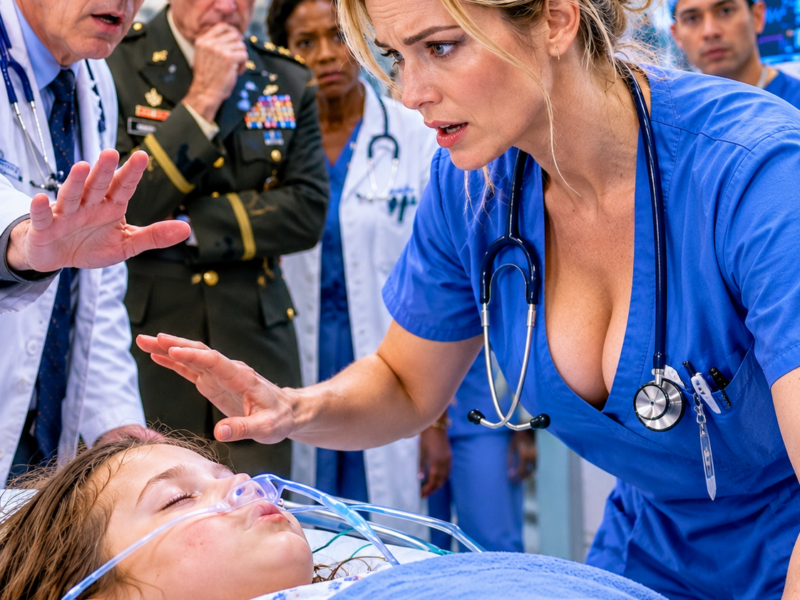
“I watched my father, a decorated four-star general, sign the papers declaring me dead while I was still lying unconscious in a hospital bed
The door handle turned slowly.
I shoved the folded document beneath my palm and forced my fingers to relax.
The door opened.
It wasn’t Emily.
A tall man in a charcoal suit stepped inside, carrying a leather folder.
I recognized him immediately.
Colonel James Mercer.
He had served under my father for nearly fifteen years and had been present at every major family event since I was a child.
He had given the toast at my college graduation.
He had stood beside my father at my mother’s funeral.
And he had once told me that if I ever needed help in the military, I should call him before calling anyone else.
He looked at the monitor, then at my face.
“Still unconscious?”
A nurse I didn’t recognize nodded.
“Yes, sir. No meaningful response.”
Mercer walked to the foot of my bed.
“General Whitmore asked me to collect her personal effects.”
The nurse hesitated.
“Those are secured by hospital administration.”
Mercer opened his folder and showed her something.
I couldn’t see the document, but whatever was printed on it changed her expression.
“Of course,” she said.
She left without another word.
Mercer waited until the door closed.
Then he pulled a chair beside my bed.
For several seconds, he simply watched me.
“Claire,” he whispered.
My stomach tightened.
He knew my name.
Everyone did.
But the way he said it sounded almost like an apology.
“I don’t know whether you can hear me,” he continued, “but if you can, you need to understand something.”
He leaned closer.
“Your father isn’t the only person looking for you.”
I wanted to open my eyes.
I wanted to grab his sleeve and demand an explanation.
Instead, I focused on the paper hidden beneath my hand.
Mercer reached into his folder and removed a photograph.
He placed it on the bedside table.
“She was supposed to be there when your vehicle was recovered.”
A pause.
“But she wasn’t.”
He looked toward the door.
“That’s the part nobody can explain.”
Then he stood, took the photograph, and slipped it back into his folder.
Before leaving, he glanced at me one last time.
“Don’t let them transfer you.”
The door clicked shut.
I lay motionless, trying to process what had just happened.
My father had arranged a transfer to a military installation that officially didn’t exist.
Mercer knew someone else was searching for me.
And Emily had risked everything to warn me.
There were too many people hiding pieces of the same story.
The only person who seemed to know the whole truth was the man who had just signed my death certificate.
A few minutes later, Emily returned.
She looked as though she’d been running.
“Did anyone come in?”
I moved my index finger twice.
Her expression tightened.
“Mercer?”
One movement.
She exhaled.
“Then it’s worse than I thought.”
She pulled the curtain halfway across the room and checked the hallway.
“Claire, I need you to listen. I’m going to help you get out of this hospital, but you have to do exactly what I say.”
My fingers moved again.
Emily pulled the folded paper from beneath my hand.
Her eyes moved across the document.
Then she closed them.
“Where did you get this?”
I couldn’t answer.
She looked at the signature.
“I knew it.”
She placed the paper on the bed.
“Your father didn’t just authorize a transfer. He requested a specific medical team.”
She tapped the bottom of the page.
“Look at the name of the physician.”
I focused as hard as I could.
Dr. Nathaniel Shaw.
The name meant nothing to me.
Emily noticed my confusion.
“He used to work at this hospital,” she said. “He was removed from the medical staff after a patient died during an experimental neurological procedure.”
She paused.
“That patient was a soldier.”
A cold sensation moved through my chest.
“Three years ago, Dr. Shaw was accused of conducting treatments without informed consent. The hospital investigated, but the records disappeared. He resigned before the case could go to court.”
She looked toward the ceiling camera.
“Two weeks ago, he came back.”
My breathing became uneven.
Emily lowered her voice.
“And he wasn’t asking about the hospital.”
She looked directly at me.
“He was asking about you.”
Before I could process that, she heard footsteps.
She grabbed the document and pushed it into her pocket.
“Close your eyes,” she whispered.
I did.
The door opened.
“Good evening, Ms. Carter.”
It was my father.
“How is our patient?”
Emily’s voice was steady.
“Unchanged, General.”
He walked toward the bed.
“Have you noticed anything unusual?”
“No, sir.”
“Any movement?”
“None.”
My father stood beside me for several seconds.
Then he asked a question that made Emily pause.
“Did she ever tell you about the warehouse?”
Emily didn’t answer immediately.
“No, sir.”
My father’s voice became quieter.
“She was always curious about things that didn’t concern her.”
He adjusted the blanket near my shoulder.
“Some people don’t understand when to leave the past alone.”
Then he walked out.
I waited until the sound of his shoes disappeared.
Emily pulled the chair closer.
“Claire, what warehouse?”
I searched my memory.
Nothing came.
But then I remembered the night before the crash.
I had been driving home from Fort Liberty after reviewing a classified intelligence file.
The file concerned a series of missing military medical records.
At first, the assignment seemed administrative.
An internal audit had identified several inconsistencies involving medical transfers of wounded personnel from overseas operations.
The patients had been sent to different facilities.
Some had returned to duty.
Others had disappeared from the system entirely.
One name appeared repeatedly in the transfer records.
Dr. Nathaniel Shaw.
I had reported the discrepancy to my commanding officer.
Two days later, my father called.
He asked why I had been reviewing medical files.
I told him it was part of an investigation.
He became unusually quiet.
Then he said, “Claire, some records are incomplete for a reason. Don’t turn an administrative problem into a personal crusade.”
At the time, I thought he was worried about my career.
Now, I wasn’t so sure.
Emily touched my arm.
“Do you remember something?”
I managed to move my fingers against the blanket.
She leaned closer.
“The warehouse,” she whispered.
I moved my index finger once.
Yes.
Her expression changed.
“Then we need to get you out before tomorrow morning.”
I wanted to know why she was helping me.
She seemed to read the question in my eyes.
“My younger brother was in the Army,” she said quietly. “His name was Daniel.”
She swallowed.
“He was injured during an overseas deployment. They told us he had been transferred to a rehabilitation facility in Virginia.”
Her voice cracked.
“Six months later, we received a letter saying he had died.”
She looked down at her hands.
“But the death certificate had the wrong date. And the hospital listed on the document had never treated him.”
I understood then that Emily wasn’t simply a nurse who had stumbled across something suspicious.
She had been searching for answers long before I arrived.
“Did you find him?” I tried to ask.
Only a faint sound escaped my throat.
Emily shook her head.
“Not yet.”
She reached into her pocket and took out a small photograph.
A young man stood beside her in Army fatigues, one arm around her shoulders.
“He was twenty-four,” she said. “He used to call me every Sunday, even when he had nothing to say.”
She placed the photograph beside my hand.
“Your file was the first time I saw the same transfer code.”
She took a breath.
“I don’t know whether your father is responsible for what happened to Daniel. But I know he signed the document that sent you somewhere you weren’t supposed to go.”
The next morning, the hospital began preparing my transfer.
I heard staff discussing medication schedules and transportation.
A security guard was stationed outside my room.
At 8:15 a.m., a doctor entered with two orderlies.
“Good morning, Claire.”
He checked my pupils.
I recognized him from the photograph on my medical chart.
Dr. Nathaniel Shaw.
His hair was neatly combed, and his expression was almost pleasant.
“Your condition has been stable,” he said.
He adjusted the light above my bed.
“Your father has arranged for you to receive specialized care.”
I tried to move.
He noticed the slight movement in my hand.
His eyes narrowed.
For a second, his professional expression disappeared.
Then he smiled.
“Interesting.”
He leaned closer.
“Can you hear me, Claire?”
I kept my eyes closed.
He looked toward the orderly.
“Increase the sedative.”
Emily appeared in the doorway.
“Doctor, her current dosage is already at the maximum prescribed level.”
Shaw turned.
“Are you questioning my medical judgment?”
“I’m questioning the order.”
He stepped closer to her.
“You should be careful, Ms. Carter. You’re not responsible for this patient’s treatment plan.”
Emily didn’t move.
“Then why are you giving medication without updating her chart?”
His expression hardened.
“Get out.”
Emily looked at me.
I moved my finger.
Once.
She understood.
She left the room, but I heard her speaking to someone in the hallway.
A few minutes later, the monitor beside my bed began making an unfamiliar sound.
Shaw looked at it.
“What happened?”
An alarm sounded.
One of the orderlies moved toward the equipment.
I didn’t know what Emily had done, but suddenly the room was full of activity.
“Get the nurse,” Shaw ordered.
While everyone was distracted, I forced my eyelids open.
The light burned.
My vision blurred.
But I saw him.
Shaw was standing beside the monitor.
I tried to speak.
At first, nothing came out.
Then a broken whisper escaped my throat.
“Don’t…”
He turned.
My eyes focused on his face.
“…transfer me.”
His expression changed completely.
He looked toward the door.
“She’s awake.”
The room erupted.
An orderly called for assistance.
Someone reached for the emergency button.
Shaw grabbed my wrist.
“Claire, you need to remain calm.”
I pulled my hand away with what little strength I had.
“Where… are you taking me?”
He didn’t answer.
The door opened.
My father entered.
For the first time since I had regained consciousness, I saw genuine fear on his face.
Not grief.
Not anger.
Fear.
“Everyone out,” he ordered.
Shaw hesitated.
“General, she’s conscious. We need to—”
“I said OUT.”
The orderlies left.
Shaw followed reluctantly.
My father closed the door.
Then he looked at me.
“Claire.”
His voice was softer than I had heard in years.
“You’re awake.”
I tried to sit up, but pain shot through my neck.
“Why did you sign the papers?”
He closed his eyes briefly.
“Because I was trying to protect you.”
I almost laughed.
The sound came out as a painful cough.
“By declaring me dead?”
He pulled the chair beside my bed.
“There’s something you don’t understand.”
“Then explain it.”
He looked toward the door.
“Not here.”
“Where?”
He didn’t answer.
I stared at him.
“You knew about the transfer before the crash.”
His jaw tightened.
“Who gave you that document?”
“Does it matter?”
“Yes.”
“Why?”
“Because whoever gave it to you may have put you in more danger.”
I looked at him for a long moment.
“Was the accident an accident?”
He looked away.
That was answer enough.
“Did you know someone was following me?”
He rubbed his forehead.
“I knew your investigation had become dangerous.”
“That’s not what I asked.”
He stood.
“Claire, I have spent my entire life making decisions that kept people alive. Sometimes those decisions look terrible from the outside.”
“And sometimes they’re terrible because they are.”
He flinched.
It was a small movement, but I saw it.
For the first time, I wondered whether the man I had spent my life trying to impress had ever really known how to be a father.
He reached for my hand.
I pulled it away.
“Please,” he said. “Just give me until tonight.”
I shook my head.
“You’ve had three weeks.”
He stood silently.
Then he placed something on the bedside table.
A small brass key.
“Your mother kept this,” he said. “I should have given it to you years ago.”
I stared at it.
“What does it open?”
“The storage room beneath our old house.”
He looked toward the window.
“There’s something inside that I couldn’t destroy.”
Then he left.
I didn’t touch the key until Emily returned.
She closed the door and looked at the brass object.
“Where did you get that?”
“My father.”
She picked it up.
Her fingers began to tremble.
“Claire…”
“What?”
She turned it over.
On the back were three engraved letters.
DAN.
Daniel.
Her brother’s name.
She sat down slowly.
“Why would your father have this?”
I didn’t know.
But suddenly the story was no longer just about my accident.
It was about a dead soldier, missing medical records, and a warehouse my father had warned me to stay away from.
And somehow, all three were connected.
That afternoon, Emily contacted Colonel Mercer.
She didn’t trust him completely, but she knew he had been investigating the same transfers.
He arrived after sunset, wearing civilian clothes.
He looked older than I remembered.
“You shouldn’t have called me,” he said.
Emily crossed her arms.
“Then why did you come?”
He glanced at me.
“Because she’s alive.”
He pulled a chair closer.
“Claire, I need you to understand something. Your father isn’t the only one who signed those transfer orders.”
He placed a photograph on the bed.
It showed a large brick building surrounded by fencing and trees.
A faded sign hung above the entrance.
FORT ALDER MEDICAL ANNEX.
I recognized the name from the document.
“The facility was officially decommissioned eleven years ago,” Mercer explained. “But someone has been using it.”
“For what?”
He hesitated.
“Experimental rehabilitation programs.”
I stared at him.
“What kind of programs?”
He lowered his voice.
“Programs designed to return injured soldiers to active service without waiting for the normal recovery process.”
Emily looked sick.
“And Daniel?”
Mercer nodded slowly.
“His name appears in the transfer records.”
Emily covered her mouth.
“He’s alive?”
“I don’t know.”
The answer seemed to knock the air out of her.
Mercer continued.
“But I found a maintenance report from four months ago. It lists a patient identification number matching his original military medical file.”
Emily stood.
“Why didn’t you tell me?”
“Because the report was buried inside a classified system, and I couldn’t prove it was authentic.”
She turned away.
For a moment, I saw the same helplessness I had felt while lying in that hospital bed.
Then Mercer placed another document on the blanket.
It was a copy of the accident investigation.
“Your vehicle was found with its rear brake line cut.”
I looked at him.
“Cut?”
He nodded.
“The initial report classified it as mechanical failure. The revised report changed the finding to deliberate sabotage.”
“Who changed it?”
Mercer looked at me.
“Your father.”
I stared at the document.
“Why would he do that?”
“Because he believed someone was trying to kill you.”
“Then why did he sign my death certificate?”
Mercer didn’t answer immediately.
Instead, he reached into his coat and removed a small digital recorder.
“Your father told me to destroy this.”
He placed it on the table.
“I didn’t.”
Emily looked at him suspiciously.
“What’s on it?”
“A conversation from the night before Claire’s accident.”
He pressed play.
At first, there was static.
Then my father’s voice.
“She has the records.”
Another man answered.
“Then the operation is compromised.”
“She doesn’t understand what she’s looking at.”
“She understands enough.”
My father’s voice became sharper.
“I will handle my daughter.”
A pause.
Then the other man spoke again.
“General, if she talks, you lose everything.”
The recording ended.
I looked at Mercer.
“Who was the other man?”
He swallowed.
“Dr. Nathaniel Shaw.”
Emily gripped the edge of the bed.
My father had known Shaw was involved.
He had known I had the records.
And he had said he would handle me.
I turned toward Mercer.
“Why didn’t you arrest him?”
“Because the recording doesn’t prove what he intended. And because the general controls access to the files that would establish the full operation.”
I looked at the brass key.
“Then we need to get to the house.”
Mercer shook his head.
“Your father will expect that.”
“Good.”
He looked surprised.
I continued.
“If he gave me the key, he wants me to find something.”
“Or he wants to know whether you trust him enough to follow it.”
Neither possibility made me feel better.
But I knew one thing.
I wasn’t going to spend another day waiting for other people to decide what happened to me.
The following morning, Mercer arranged a private discharge under the supervision of an independent physician.
Emily came with me.
She had refused to leave my side.
We drove to my father’s house outside Fayetteville.
It was the same white colonial home where I had grown up.
The front porch still had the wooden swing my mother loved.
The garden was overgrown.
My father had apparently stopped maintaining it after she died.
I stood in the driveway for a moment, looking at the windows.
“Are you ready?” Emily asked.
“No.”
She nodded.
“Neither am I.”
The storage room was beneath the old house, behind a narrow door in the basement.
The brass key turned with difficulty.
Inside, the air smelled of dust and damp wood.
There were old furniture pieces, cardboard boxes, and several military storage containers.
My father had left a small lamp on a shelf.
I switched it on.
At the far end of the room stood a metal filing cabinet.
The top drawer was unlocked.
Inside were folders arranged by year.
I recognized several names from my investigation.
Some belonged to soldiers who had supposedly died overseas.
Others were marked as medical transfers.
One folder had Daniel Carter’s name.
Emily made a small sound.
She picked it up with both hands.
Inside was a photograph of her brother, taken in what appeared to be a hospital corridor.
He looked thinner than in the photograph she had shown me.
But he was unmistakably alive.
The date printed on the back was six months after his official death.
Emily pressed the photograph against her chest.
For a moment, she couldn’t speak.
Then she found a second page.
It was a handwritten note.
“Patient D.C. remains responsive. Family notification suspended pending program completion.”
Emily’s knees weakened.
I caught her arm.
“He’s alive,” I whispered.
She shook her head.
“Why wouldn’t they let him come home?”
I looked through the remaining papers.
A medical report explained that Daniel had suffered severe nerve damage after an explosion overseas.
Instead of being transferred to a rehabilitation facility, he had been moved to Fort Alder.
The program had promised accelerated recovery.
But the notes described experimental treatments, repeated neurological assessments, and medication administered without proper consent.
Daniel had refused to participate.
After that, his family had been told he died.
The next folder contained the name of another soldier.
Then another.
There were at least twenty-three.
I felt sick.
These weren’t isolated errors.
Someone had built an entire system around making wounded soldiers disappear from official records.
At the bottom of the cabinet was a sealed envelope with my name written on it.
The handwriting was my mother’s.
I knew it immediately.
My hands began to shake.
I opened it carefully.
Inside was a letter.
“Claire,
If you’re reading this, then your father has finally decided that keeping the truth hidden is more important than keeping our family together.
I hope I am wrong.
I learned about the medical program several years ago. Richard believed he was helping soldiers who had been abandoned by a system that moved too slowly.
At first, he thought the treatments were legitimate.
Then he discovered that the patients were being used without their consent.
He wanted to stop it.
But by then, he had already signed the authorizations that made it possible.
I begged him to tell the truth.
He said he would handle it.
I told him that secrets don’t disappear simply because a powerful man orders them to.
He never forgave me for saying that.
If he gives you the brass key, it means he has finally run out of ways to protect himself.
Please don’t make the same mistake I did.
Don’t confuse loving someone with believing everything they tell you.
Love,
Mom.”
I read the letter twice.
Then I sat down on an old wooden chair.
My father hadn’t created the program.
But he had helped it survive.
And when he realized I was investigating it, he had tried to control what happened next.
The room felt smaller.
Emily sat beside me, holding Daniel’s photograph.
Mercer was examining another folder.
“There’s something else,” he said.
He pulled out a document signed by General Whitmore.
It was a transfer authorization for Daniel.
The date was two years earlier.
My father had personally approved the transfer.
But beside his signature was a handwritten note.
“Family contact prohibited. Patient has requested immediate release.”
I stared at it.
“Daniel wanted to leave.”
Mercer nodded.
“Yes.”
Emily wiped her eyes.
“Then why did they keep him?”
“Because Shaw classified him as medically unstable,” Mercer replied.
Emily looked at the document again.
“And my brother never got to tell me.”
Before anyone could answer, a car door slammed upstairs.
Mercer reached for his weapon.
I heard footsteps moving across the kitchen.
Then my father’s voice.
“Claire?”
He knew we were there.
I stood.
“Down here.”
The basement door opened.
My father descended slowly.
He looked at the files scattered across the table.
Then he saw my mother’s letter in my hand.
His expression changed.
“You found it.”
I held up the letter.
“How long have you known?”
He looked at the floor.
“Too long.”
“Did you know Daniel was alive?”
He nodded.
“Yes.”
Emily stepped forward.
“Then you let me bury my brother.”
My father looked at her.
“I didn’t know what Shaw had done to him.”
“You knew he was being held.”
“I knew he was receiving treatment.”
“He asked to go home!”
My father had no answer.
Emily’s voice broke.
“His mother died believing he was dead. I spent two years visiting a grave with no body in it.”
My father closed his eyes.
“I’m sorry.”
She shook her head.
“That doesn’t bring back two years.”
I looked at him.
“Why did you sign my death certificate?”
He pulled out a chair and sat down.
“Because Shaw had access to the hospital records. He knew you had survived the crash. He knew you were being treated under an unidentified patient designation.”
“How?”
“Someone at the hospital was reporting your condition to him.”
“Who?”
“I don’t know.”
Mercer stepped forward.
“General, you knew the program was using unauthorized medical procedures. You had the authority to report it.”
My father looked at him.
“I tried.”
“Not hard enough.”
My father didn’t argue.
He turned toward me.
“When I found out you had obtained the transfer records, I knew Shaw would come after you.”
“So you ordered the transfer?”
“I thought I could get you out of the hospital before he reached you.”
“To Fort Alder?”
“Because I believed Shaw had lost control of the facility. I thought I could move you somewhere I could protect you.”
I stared at him.
“You were sending me to the same place where they held Daniel.”
He nodded.
“I know how that sounds.”
“It sounds like you were willing to put me in a cage to keep me quiet.”
His face tightened.
“I was trying to keep you alive.”
“Then why did you tell the hospital to declare me dead?”
He took a long breath.
“Because Shaw had a contact in the records department. If he believed you were dead, he would stop looking for you.”
I looked at the papers.
“That would have given you time.”
“Yes.”
“Time to do what?”
He glanced at Mercer.
“To secure the records and prepare a case against Shaw.”
Mercer gave a bitter laugh.
“You had years.”
My father looked older than I had ever seen him.
“I was afraid.”
The words surprised me.
General Richard Whitmore had never admitted fear.
He had always taught me that fear was something you acknowledged privately and overcame before making a decision.
But now he was sitting in a dusty basement, surrounded by documents bearing his signature.
“I thought I could fix it without destroying the people involved,” he continued.
“People like you?”
He nodded.
“People like me. People like Mercer. The soldiers. The families.”
He looked at Emily.
“I told myself I was protecting them.”
Emily’s eyes were red.
“You protected the people who hurt them.”
My father lowered his head.
Nobody spoke for a while.
Then Mercer picked up the recorder.
“General, I need you to come with me.”
My father looked at him.
“James.”
“You’re going to give a full statement. Every authorization. Every conversation. Every name.”
My father looked toward me.
For a moment, I thought he would refuse.
Instead, he reached into his jacket and placed a small flash drive on the table.
“These are the original program records,” he said.
Mercer took it.
“Where did you get them?”
“From Shaw’s office. I copied them three days ago.”
“Why didn’t you turn them over?”
My father looked at me.
“Because I wanted to see whether my daughter would survive long enough to know the truth.”
I felt the anger rising again.
“You could have trusted me.”
He nodded slowly.
“Yes.”
Then he stood.
“I should have.”
That was the first honest thing he had said since I woke up.
The investigation lasted eleven months.
Dr. Shaw was arrested after federal investigators recovered the original patient records, financial transfers, and internal communications from Fort Alder.
Several senior officers were charged with conspiracy, obstruction, and unlawful medical experimentation.
The hospital conducted its own investigation.
The doctor who had falsified my initial medical reports lost his license.
The security guard who had been assigned outside my room eventually admitted he had been paid to report when I showed signs of consciousness.
Emily’s brother, Daniel, was found alive at Fort Alder.
He had been moved to another facility after refusing further treatment.
His physical recovery was slow.
His memory was uneven, and he had difficulty walking without assistance.
But when Emily entered his room for the first time, he recognized her.
She stood in the doorway for several seconds, unable to move.
Then he smiled weakly.
“You’re late,” he whispered.
Emily covered her mouth.
She crossed the room and held him as carefully as if he were made of glass.
“I’m sorry,” she cried.
Daniel rested his forehead against her shoulder.
“You came.”
That was all he said.
But it was enough.
My father cooperated with investigators.
He pleaded guilty to charges related to his role in concealing the unlawful transfers and falsifying official records.
He was stripped of his command and later sentenced to prison.
Some people called him a hero who had made mistakes.
Others called him a criminal who had finally been caught.
I stopped trying to decide which description was correct.
Both could be true.
He had served his country.
He had also failed the people who trusted him.
The hardest part was visiting him after sentencing.
For months, I avoided it.
Then, one afternoon, I received a letter.
It contained no excuses.
No explanation about military pressure or impossible decisions.
Just a short message.
“I don’t expect you to forgive me. I only hope that one day you remember that I loved you, even when I was too afraid to do what love required.”
I read it several times.
Then I drove to the correctional facility.
He looked smaller behind the glass.
Without his uniform, without the polished shoes and the rows of ribbons, he seemed like an ordinary older man.
He picked up the phone.
“Claire.”
I held mine against my ear.
“Hi, Dad.”
His eyes filled.
“I didn’t think you’d come.”
“I almost didn’t.”
He nodded.
“I understand.”
For a while, we talked about nothing important.
The weather.
The house.
The garden my mother had planted.
Then he asked whether I had kept her letter.
I told him I had.
“She was braver than I was,” he said.
“Yes,” I replied.
He looked down.
“I should have listened to her.”
I didn’t tell him that I agreed.
I didn’t tell him that I forgave him.
Some wounds don’t close simply because the person who caused them finally admits they exist.
But I also didn’t hang up.
When the visit ended, I stood outside the facility for a long time.
The sun was low, and the air smelled like rain.
I thought about the girl I had been before the accident.
The daughter who believed that loyalty meant never questioning the person who raised her.
I wasn’t that girl anymore.
A year later, I attended a small ceremony honoring the soldiers whose records had been erased.
Daniel was there with Emily.
He walked slowly, using a cane, but he insisted on standing without help when the names were read.
Twenty-three names.
Twenty-three people who had been reduced to paperwork, signatures, and missing files.
When the final name was announced, the room remained silent.
Then Daniel reached for Emily’s hand.
She squeezed it.
I stood near the back, holding my mother’s letter inside my jacket pocket.
After the ceremony, Emily approached me.
She looked healthier than she had in the hospital.
There was still sadness in her eyes, but it no longer seemed to own every part of her.
“Do you ever think about that night?” she asked.
“Every day.”
She glanced at the old photograph of Daniel.
“Those four words you heard from me…”
I smiled faintly.
“Don’t trust your father.”
She nodded.
“I was afraid you’d hate me for saying it.”
“I did, for about five minutes.”
She laughed softly.
Then I looked at her.
“But you gave me the chance to find the truth.”
She shook her head.
“You did the hard part.”
I thought about the hospital bed, the paper beneath my blanket, and the signature that had almost cost me my life.
“No,” I said. “We both did.”
That evening, I went home and placed my mother’s letter in a small wooden box beside her photograph.
I didn’t keep it there as a reminder of what my father had done.
I kept it because of what she had taught me.
Love could survive disappointment.
It could even survive betrayal.
But love was never supposed to require silence.
For years, I had believed that being my father’s daughter meant standing behind him no matter what he did.
Now I understood that sometimes the most loyal thing you can do for someone is refuse to help them hide from the truth.
And when I think back to the hospital room where my father signed the papers declaring me dead, I no longer remember the pen scratching across the page.
I remember the nurse who stayed long enough to whisper four words.
Those words didn’t just save my life.
They gave twenty-three missing soldiers their names back.
THE END.









