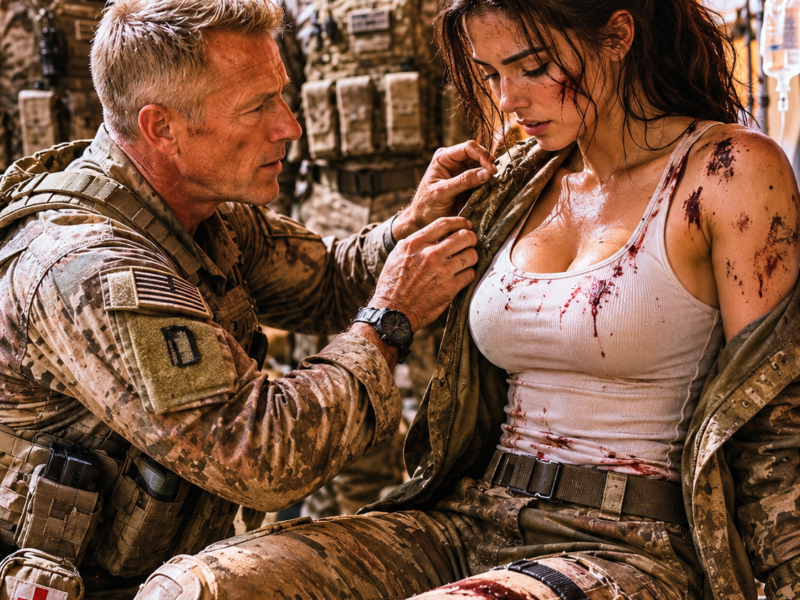
“I watched my commanding officer call a wounded Navy corpsman a disgrace in front of eighteen elite candidates, but when she smiled at him and asked permission to finish teaching
Gans did not sit down.
He remained standing beside the conference table, his eyes fixed on Hayes.
“Has Emma Whitaker told you what happened to Michael?”
Hayes shook his head.
“No.”
Gans looked toward the closed door.
“Then I suggest you hear it from her before you decide what she belongs on your team to do.”
Hayes folded his arms.
“I don’t put people on my team without understanding what they’re capable of.”
“That’s not what I’m warning you about, Commander.”
Gans lowered his voice.
“I’m warning you about what happened the last time someone decided Emma Whitaker was capable of surviving something no one else could.”
For several seconds, nobody spoke.
Master Chief Keller stood near the window.
He had spent twenty-three years learning when to ask questions and when to let silence do the work.
This was one of those moments.
Hayes finally asked, “Who was Michael?”
Gans looked directly at him.
“Michael Voss. Petty Officer First Class. Combat medic. And the closest thing Emma ever had to a brother.”
“Where did they serve together?”
Gans hesitated.
“Not somewhere you’ll find in her personnel file.”
He placed a thin folder on the table.
The cover bore a classification marking and a date from fourteen months earlier.
Hayes opened it.
The first page contained two photographs.
One showed Emma, younger by a year, standing beside a broad-shouldered man with a crooked smile.
The other showed a remote compound surrounded by mountains.
A red stamp crossed the second photograph.
OPERATION NIGHT GLASS.
Hayes looked up.
“I’ve never heard of this operation.”
“You weren’t supposed to,” Gans replied.
Keller stepped closer.
“Is this the missing fourteen months?”
“Yes.”
“Why was her record replaced with administrative support?”
“Because the people who approved that assignment wanted the world to believe she had spent those months behind a desk.”
Hayes turned another page.
There were names, dates, coordinates, and several lines blacked out.
At the bottom was a casualty report.
Michael Voss.
Status: presumed killed in action.
Hayes stared at it.
“Presumed?”
Gans nodded.
“We never recovered his body.”
“Then why does Emma believe he’s dead?”
“Because she watched him disappear.”
Gans paused.
“And because she was the one who had to leave him behind.”
The words seemed to settle over the room.
Keller’s expression changed.
He remembered Emma’s silence in the medical bay.
He remembered the way she had looked at the blood on her gloves.
And suddenly, her reaction made sense.
Hayes closed the folder.
“Bring her in.”
Gans shook his head.
“She should decide whether she wants to tell you.”
“She is already part of this situation.”
“No,” Gans said sharply.
“She is a person who survived it. Don’t confuse those things.”
Hayes looked at him for a long moment.
Then he nodded.
“Find out if she’ll speak with us.”
I was outside the operations building when Emma returned.
Her left arm was still secured in a sling.
A strip of medical tape crossed the inside of her elbow.
She walked slowly, but she refused the assistance of the corpsman escorting her.
The moment she entered the room, she noticed the folder.
Her expression barely changed.
But her right hand tightened around the strap of her bag.
“Who opened that?”
Hayes stood.
“Thomas Gans.”
Emma looked at him.
“Of course.”
Gans approached her carefully.
“Emma, we need to talk.”
“We talked fourteen months ago.”
“I know.”
“No, sir. You gave me an order. That’s not the same thing.”
Gans accepted the rebuke without arguing.
Hayes pulled out a chair.
“You don’t have to tell us anything you don’t want to.”
Emma looked at the photographs.
For the first time since I had known her, she seemed uncertain where to place her eyes.
“Michael Voss,” she said quietly.
“Petty Officer First Class. Combat medic. He was assigned to my team during Night Glass.”
Gans remained silent.
Emma continued.
“We were sent to extract three civilians from a remote facility. Intelligence said the compound was lightly guarded. It wasn’t.”
She pulled the chair back and sat down.
“The first night, we found two families hiding beneath the floor of a storage building. The youngest child was maybe six. He had a broken wrist and a piece of metal in his leg.”
Her voice remained steady.
“Michael treated him while I watched the entrance.”
She looked at Hayes.
“He always talked to frightened people. Even when there was no time. He said fear made people feel alone, and a voice reminded them they weren’t.”
Keller lowered his eyes.
Emma glanced down at her sling.
“On the third night, we were compromised.”
The room seemed to grow smaller.
“Our extraction route was blocked. Communications were unreliable. We had wounded civilians, limited medical supplies, and an enemy force moving toward our position.”
“What happened to Michael?” Hayes asked.
Emma looked at the photograph again.
“He stayed behind.”
Gans closed his eyes briefly.
Emma continued.
“We had reached a narrow passage between two buildings. Michael was treating one of our injured men when the first explosion hit. The second collapsed part of the passage.”
She swallowed.
“Michael was trapped on the other side.”
“Were you able to reach him?” Keller asked.
“We tried.”
Her answer came immediately.
“Three times.”
She described the smoke, the broken concrete, and the sound of distant gunfire.
She described crawling through a gap barely wide enough for her shoulders.
She described finding Michael alive beneath a section of fallen wall.
“He had a serious wound in his abdomen. He was conscious. He knew exactly what was happening.”
Emma’s eyes became distant.
“He told me to get the civilians out first.”
Hayes leaned forward.
“And you refused.”
“I did.”
A faint, bitter smile crossed her face.
“He called me stubborn. Then he told me I was wasting time arguing with a dying man.”
No one interrupted.
“I started working on him. I packed the wound and tried to control the bleeding. He kept asking about the others.”
Her voice cracked for the first time.
“I told him they were moving. I told him everyone was going to make it.”
She looked at Gans.
“I lied.”
Gans said nothing.
Emma pressed her lips together.
“The enemy was closing in. We had one route left, and the civilians couldn’t move fast enough without help. Michael understood before I did.”
“What did he tell you?” Hayes asked.
“He told me to take them through the eastern passage.”
“And you did?”
“I said no.”
She looked down at her hands.
“He grabbed my wrist. He made me look at him. Then he said, ‘You don’t save people by dying beside them. You save them by getting the ones still breathing out.’”
The silence that followed was almost unbearable.
“He gave me his radio. He told me to call for extraction once we reached the ridge.”
Emma took a slow breath.
“I carried one child. Another civilian was holding onto my vest. I had two injured men moving between us.”
She stopped.
“Michael stayed behind to cover the passage.”
Hayes asked the question nobody else wanted to ask.
“Did you hear him again?”
Emma shook her head.
“Once.”
Her voice was barely audible.
“Just once.”
She explained that the radio had come alive during the final movement.
There had been static.
Then Michael’s voice.
He was still giving directions.
Still telling her where to move.
Still trying to keep the others alive.
Then came a burst of gunfire.
And nothing.
“When we reached the extraction point, I asked the team to go back.”
“Were they able to?”
“No.”
She looked at Gans.
“He gave the order to withdraw.”
Gans didn’t deny it.
“The extraction aircraft was taking fire,” he said. “We had two critical casualties, three civilians, and a compromised landing zone. A second attempt would have risked everyone.”
Emma nodded.
“I know the calculation.”
Her eyes hardened.
“I’ve memorized it.”
Gans lowered his head.
“I made the decision I believed would save the most lives.”
“And I followed it.”
Emma’s voice was quiet, not angry.
“That doesn’t mean I stopped hearing him.”
Keller finally spoke.
“Why didn’t you tell anyone?”
“Because the official report said Michael was missing and presumed dead. It didn’t mention that I had been the last person to hear him alive.”
She glanced at the folder.
“It didn’t mention the three attempts to reach him. It didn’t mention that I had to leave him there.”
“Your wounds?” Hayes asked.
“Shrapnel. A bullet fragment. A few other things.”
“Your scars?”
“From that operation.”
Hayes looked at the medical report.
“Why were they left out of your record?”
Gans answered.
“The operation was sealed. The medical details were included in a restricted casualty file. Her public record was deliberately simplified to protect the identities of the people involved.”
Emma looked at him.
“You could have told them I had been wounded.”
“That would have exposed the operation.”
“You could have told them I wasn’t an administrative clerk.”
Gans had no answer.
Emma leaned back.
“I spent fourteen months trying to become someone who could walk into a room without checking every exit.”
Her eyes moved toward the door.
“I thought if I kept working, kept teaching, kept treating people, eventually I wouldn’t hear that radio anymore.”
She paused.
“But every time someone bleeds, I remember Michael.”
Hayes spoke gently.
“You think you failed him.”
“I left him.”
“You got the civilians out.”
“I left him.”
“You followed his order.”
“I left him.”
Her voice finally rose.
“Do you understand? I can explain the mission. I can explain the tactical decision. I can explain why the extraction team couldn’t go back.”
She looked at each of us.
“But none of those explanations change the fact that my friend was alive when I walked away.”
Nobody tried to correct her.
For the first time, I understood why Emma had never answered Keller’s question about seeing that much blood before.
She hadn’t been hiding some impressive combat history.
She had been carrying a memory she believed she had no right to share.
Hayes pushed the folder aside.
“I want to make something clear.”
Emma looked at him.
“You don’t owe my team a performance. You don’t owe us a demonstration of how tough you are. And you don’t have to prove that you can survive another operation.”
“Then why did you bring me here?”
“Because I saw what you did during the training explosion.”
Emma looked away.
“You treated a wounded candidate while you were bleeding yourself. You finished teaching because the candidates needed the information. You noticed details other people missed.”
He paused.
“Those are qualities I respect. But they aren’t a reason to put you in danger.”
“Your team needs a medic,” she said.
“My team needs people who can trust one another.”
Hayes leaned forward.
“If you join us, you won’t be asked to bury what happened. You’ll be expected to speak up when something is wrong. You’ll be allowed to say no when you’re not ready.”
Emma gave a small, skeptical laugh.
“That’s not how most commands work.”
“Then most commands need to improve.”
Keller stepped forward.
“Commander Brandt’s conduct during the training exercise is being reviewed. His remarks about your role were unacceptable.”
Emma’s expression remained neutral.
“I don’t need an apology.”
“Maybe not,” Keller replied. “But the next corpsman who walks into that training area shouldn’t have to earn basic respect by nearly bleeding out.”
Gans looked toward the door.
“There’s something else.”
Emma went still.
“What?”
“Night Glass wasn’t the only file we recovered.”
He removed a second document from the folder.
It was a short intelligence summary.
The date was six days after the extraction.
A field team had intercepted an encrypted transmission from the region.
The transmission included a medical request.
One name appeared in the translated text.
Michael Voss.
Emma stopped breathing for a moment.
“Where did you get this?”
“An allied intelligence service provided it three weeks ago.”
“Why wasn’t I told?”
“Because the transmission wasn’t authenticated.”
Hayes took the paper.
“What does it say?”
Gans answered carefully.
“It refers to an American medic being held at a temporary detention site. The description is incomplete. The date is uncertain. We couldn’t establish whether the name was genuine.”
Emma stared at him.
“You knew there was a possibility.”
“We knew there was a report.”
“You let me believe there was nothing.”
“We didn’t want to give you false hope.”
Emma stood so quickly that the chair scraped backward.
“False hope?”
Gans didn’t move.
“You have no idea what false hope feels like.”
“I understand that.”
“No. You understand paperwork.”
Her voice shook.
“You have spent fourteen months protecting a file. I have spent fourteen months wondering whether I abandoned a man who might still be alive.”
Hayes raised one hand.
“Emma. Sit down.”
She looked at him, breathing hard.
Then she sat.
Hayes studied the intelligence summary.
“Is there a way to verify it?”
“Possibly,” Gans said. “But it would require cooperation with the allied service and a careful review of the original source.”
“Then start the review.”
Gans nodded.
“I’ve already requested it.”
Emma’s eyes remained on the paper.
“Don’t promise me he’s alive.”
“I won’t.”
“Don’t tell me we’re going to bring him home.”
“I won’t do that either.”
She looked up.
“Then tell me what you can do.”
Gans met her gaze.
“I can make sure we don’t ignore a credible lead. I can make sure the people who have the authority to investigate actually investigate. And I can make sure you are told what we learn.”
Emma slowly nodded.
It was not forgiveness.
But it was a beginning.
The following weeks were difficult.
Emma’s shoulder needed time to heal.
She attended physical therapy, completed her medical evaluations, and returned to the training center only after her surgeon cleared her for light duties.
She did not immediately join Hayes’s team.
Instead, Hayes offered her a temporary role reviewing combat casualty procedures and training new corpsmen.
It was not a consolation prize.
He wanted her experience.
More importantly, he wanted her to have a place where she could contribute without being pushed into a situation she wasn’t ready to face.
Emma accepted.
Brandt’s review concluded with a formal reprimand and removal from his position overseeing the medical training module.
He was required to complete leadership and professional conduct training.
When he eventually encountered Emma in the corridor, he stopped.
“Petty Officer Whitaker.”
She turned.
“I owe you an apology.”
She waited.
“I was wrong about your place in that exercise. And I was wrong to question your competence in front of the candidates.”
Emma studied him for a moment.
“Thank you for saying that, sir.”
Brandt seemed to expect more.
A smile.
A declaration that everything was settled.
But Emma simply nodded and continued down the corridor.
She had learned that accepting an apology did not require pretending the damage had never happened.
Meanwhile, Keller helped establish a new training protocol.
Every instructor, regardless of rank or specialty, would receive the same medical safety briefing.
No one would be expected to continue teaching through an injury.
And no candidate would be punished for requesting medical assistance.
The changes were small.
But they mattered.
One afternoon, Marcus Doyle visited Emma’s office.
The candidate whose calf she had treated during the explosion was walking without a limp.
He placed a folded piece of paper on her desk.
“What is this?” she asked.
“A letter.”
“For whom?”
“For you.”
She unfolded it.
It was a short note from the candidates of Class 247.
They thanked her for finishing the lesson.
But the sentence that made her pause was written near the bottom.
You taught us that staying alive is part of the mission.
Emma read it twice.
Then she folded the paper and placed it inside her desk.
For a while, that was enough.
Five weeks after Gans first visited Coronado, he returned.
This time, he brought no folder.
He carried a single sealed envelope.
Emma was in the training room when he arrived.
She was reviewing a casualty simulation with three junior corpsmen.
When she saw him, she dismissed the group and closed the door.
Gans held out the envelope.
“We received confirmation.”
Emma did not take it immediately.
“Of what?”
“The original transmission was genuine.”
Her face went pale.
“Michael?”
“We believe he was alive six days after the extraction.”
Emma gripped the edge of the table.
“Where is he now?”
“The detention site was abandoned. We found records indicating that several prisoners were transferred.”
“To where?”
“We’re still tracing the transfer.”
“Is there a name?”
Gans nodded.
“An allied team has identified a possible medical facility connected to the transfer. They are working to verify whether Michael was among the prisoners.”
Emma looked down at the envelope.
“Why bring me this?”
“Because you deserved to know the lead was real.”
She opened it.
Inside was a photograph of a handwritten register.
Most of the writing was faded.
But one entry had been highlighted.
M. Voss.
The date was clear.
The location was not.
Emma touched the edge of the paper.
“He was alive.”
“At least on that date.”
She closed her eyes.
For fourteen months, she had carried the certainty that she had left Michael to die.
Now that certainty was gone.
In its place was something far more complicated.
Hope.
Fear.
And the knowledge that she might never receive the answer she wanted.
Gans waited.
Finally, Emma asked, “What happens next?”
“The investigation continues. If we confirm his location, the appropriate command will determine what recovery options are possible.”
She nodded.
“I understand.”
Gans hesitated.
“Emma, I should have told you about the report sooner.”
“Yes.”
“I thought withholding it would protect you.”
“It didn’t.”
“I know that now.”
She placed the photograph back in the envelope.
“Then don’t make that decision for me again.”
“I won’t.”
He turned to leave.
“Sir?”
Gans stopped.
“Thank you for bringing it.”
He nodded once and walked out.
Emma remained alone in the training room.
She looked at the empty chairs where the junior corpsmen had been sitting.
Then she took a breath and returned to work.
The final confirmation came two months later.
Michael Voss had been transferred through three detention facilities.
He had survived the initial injuries, though he had suffered complications that required prolonged treatment.
The allied service had located him at a medical rehabilitation center outside the region.
His identity was confirmed through fingerprints, dental records, and a scar documented in his original service file.
He was alive.
When Gans delivered the news, Emma did not cry immediately.
She simply stared at him.
“Can I speak to him?”
“Yes. The medical team has approved a secure call.”
Gans arranged it for that afternoon.
Emma sat alone in a small conference room.
Her left shoulder had healed enough that she no longer needed the sling.
Her hands rested flat on the table.
The screen flickered.
A man appeared.
His hair was shorter.
His face was thinner.
There was a pale scar near his jaw.
But the crooked smile was unmistakable.
“Hey, Whitaker.”
Emma’s breath caught.
For several seconds, she could not speak.
Then she whispered, “Michael.”
He smiled.
“Took you long enough.”
A laugh escaped her, broken by tears.
“You were supposed to come home.”
“I know.”
“I tried to get back to you.”
“I know that too.”
“How?”
“Because you never stopped talking on the radio.”
Emma covered her mouth.
Michael looked down for a moment.
“They told me the others made it out.”
“They did.”
“The little boy?”
“Recovered. His family got home.”
Michael nodded.
“Good.”
His eyes returned to hers.
“You got them out.”
Emma shook her head.
“I left you.”
“You followed the order.”
“I should have found another way.”
“Maybe.”
He did not pretend it had been easy.
He did not offer a perfect answer.
Instead, he said something that made her go still.
“Emma, I was the one who told you to leave. I knew what I was doing. You didn’t abandon me.”
She wiped her face.
“I heard the gunfire.”
“I know.”
“I thought you were dead.”
“I thought so too, for a while.”
He gave a tired smile.
“Turns out I’m harder to get rid of than either of us expected.”
Emma laughed through her tears.
They spoke for nearly an hour.
They talked about the civilians.
About the team.
About the years before Night Glass.
They avoided the details they weren’t ready to discuss.
Before the call ended, Michael looked directly into the camera.
“Listen to me, Emma.”
She nodded.
“You don’t have to keep paying for the fact that I survived.”
She looked down.
“I don’t know how to stop.”
“Then start small.”
He smiled.
“Go teach someone. Eat a decent meal. Sleep without checking the door every ten minutes. Let other people help you.”
Emma laughed softly.
“You always did give terrible orders.”
“Yeah. But you usually followed them.”
The connection ended a few minutes later.
Emma remained seated.
For the first time in fourteen months, the silence did not feel like a punishment.
It felt like space.
Three months later, Emma stood in front of a new class of Navy corpsmen.
The training room was full.
At the front, a large display showed the title of her lesson.
Treat the Casualty. Protect the Team. Bring Everyone Home.
She looked across the room.
Some students were nervous.
Others were eager.
One young corpsman kept glancing toward the exit.
Emma recognized the habit.
She didn’t call him out.
She simply began.
“Today, we’re going to discuss what happens when the plan fails.”
She moved to the demonstration table.
“Because it will. Eventually, something will happen that wasn’t in the briefing. Someone will get hurt. Communications may fail. You may have less time, less equipment, and less help than you need.”
She paused.
“And when that happens, your job is not to be fearless.”
The room became quiet.
“Your job is to think clearly, communicate honestly, and take care of the people who are still counting on you.”
She demonstrated a tourniquet.
Then wound packing.
Then the assessment of a casualty with a severe junctional injury.
She did not hide the difficulty.
She did not romanticize sacrifice.
And she did not teach them that being a good corpsman meant ignoring their own injuries.
At the end of the lesson, the young corpsman who had been watching the exit approached her.
“Petty Officer Whitaker?”
“Yes?”
“Can I ask you something?”
“Of course.”
“How do you know when you’ve done enough?”
Emma considered the question.
She remembered Michael beneath the concrete.
She remembered the radio.
She remembered the long months when she had believed survival was something she had stolen from someone else.
Then she looked at the young corpsman.
“You do everything you reasonably can,” she said. “You ask for help when you need it. You make the best decision you can with the information you have.”
He nodded.
“And afterward?”
“Afterward, you let yourself be human.”
He seemed surprised by the answer.
Emma smiled.
“That’s part of the job too.”
Later that afternoon, Hayes visited the training center.
He found Emma packing her equipment.
“I have an offer,” he said.
She raised an eyebrow.
“Another test?”
“No.”
He placed a document on the table.
It was an invitation to join a specialized medical training element supporting Naval Special Warfare.
The position included field instruction, operational medical planning, and the opportunity to work alongside teams when her medical clearance permitted.
Emma read it carefully.
“You’re not asking me to forget what happened.”
“No.”
“Or prove I can do it again.”
“No.”
“Then what are you asking?”
Hayes smiled.
“I’m asking whether you want to keep doing the work you’re good at, with a team that understands what it costs.”
Emma looked at the document.
Then she looked through the window toward the training field.
The candidates were moving through an exercise.
A corpsman knelt beside a simulated casualty.
Another student called out the injury.
The instructor corrected their positioning.
Nobody was pretending the work was easy.
Nobody was pretending that one person could do everything alone.
Emma signed the acceptance line.
“I’ll take it.”
Hayes held out his hand.
“Welcome aboard.”
She shook it.
That evening, Emma received a message from Michael.
It contained a photograph of him sitting outside in the sunlight.
He looked tired.
But he was smiling.
The message beneath it read:
Still here. Still difficult. Tell Keller I expect him to stop worrying.
Emma laughed.
She typed a reply.
No promises. He’s a master chief.
Then she looked at the photograph for a long moment.
She could not recover the fourteen months.
She could not change the decision at the passage.
She could not erase the sound of the radio going silent.
But she could stop treating that silence as proof that she had failed.
The next morning, she arrived at the training center before sunrise.
Habit made her notice the exits.
Experience made her check the equipment.
But this time, she chose a seat near the center of the room.
Not because she had forgotten what happened.
Because she was no longer letting it decide where she could stand.
When the first corpsman entered, Emma greeted him.
When the rest of the team arrived, she joined them.
And when Hayes called the briefing to order, she listened without looking over her shoulder.
The missing fourteen months would always be part of her record.
Michael would always be part of her story.
But neither would be the only thing that defined her.
Emma Whitaker had spent a long time believing that leaving someone behind was the worst thing a person could do.
Now she understood something Michael had tried to teach her from the beginning.
Sometimes saving lives means moving forward.
Sometimes courage means asking for help.
And sometimes the hardest mission is learning to live after the mission is over.
She had not forgotten Michael.
She had not forgiven herself for everything.
But she had finally stopped confusing guilt with loyalty.
And that was enough to begin again.
the end









