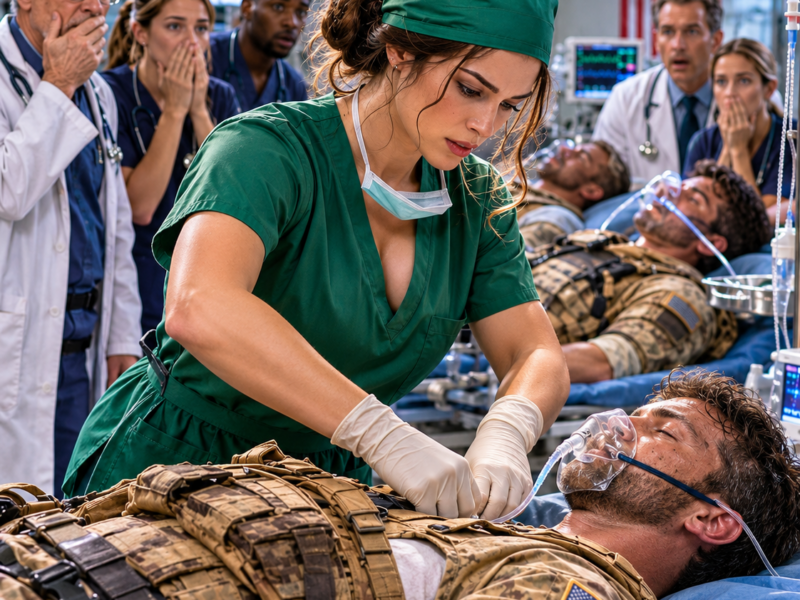
“I watched four wounded Navy SEALs roll into our emergency room, and every doctor seemed to forget how to move
The room remained silent after the man said her name.
“Compass.”
Reese Calder stood beside the trauma cart, her gloved hands resting against its metal edge. She could feel every pair of eyes in the room turning toward her.
The man in the flight suit stepped closer.
“Staff Sergeant Reese Calder,” he repeated. “United States Air Force Pararescue. Call sign Compass.”
Dr. Foster Lang looked from him to Reese.
“Pararescue?” he asked.
The man nodded. “You heard me.”
Lang swallowed. “But she’s a nurse.”
“She is a nurse now,” the man replied. “Before that, she was one of the finest combat rescue specialists I’ve ever served with.”
Reese looked down.
“Sergeant, you don’t need to do this.”
He gave her a tired smile.
“Apparently, I do. You spent six months letting these people believe you were just another quiet nurse. Meanwhile, you just saved four men who might not have made it through the next ten minutes.”
His eyes moved toward the beds.
“Two of them owe you their lives twice over.”
Reese felt her throat tighten.
She knew exactly which two he meant.
Two years earlier, she had pulled them from a burning helicopter in the mountains of Afghanistan. She remembered the heat, the smoke, the weight of a wounded man across her shoulders.
She also remembered the man she hadn’t been able to reach.
That memory had followed her home.
And it had followed her into this hospital.
“What’s your name?” Lang asked the man.
“Master Sergeant Daniel Hayes. I was leading the recovery team when our aircraft went down.”
He looked at Reese again.
“She was the one who came through the smoke when everyone else was trying to get out.”
Reese shook her head.
“That’s enough, Daniel.”
He studied her face.
Then he understood.
He had said too much.
“Right,” he murmured. “Sorry, Compass.”
The nickname sounded different in the hospital.
Here, it didn’t feel like an honor.
It felt like a door opening onto a room she had spent two years trying to keep locked.
The four patients were transferred to the intensive care unit after the trauma team completed its initial stabilization.
The youngest operator, a man named Tyler Brooks, had suffered a serious chest injury. His oxygen levels had improved, but he still needed close monitoring and a chest tube.
The second patient, Marcus Bell, had lost a dangerous amount of blood. The team began transfusions and prepared him for surgery.
The third, whose airway Reese had helped secure, remained critical but stable.
The fourth had a painful arm wound and a collection of complaints about hospital food.
That last one was a good sign.
Reese stood outside the ICU doors, reading the updated patient reports.
She should have felt relieved.
Instead, her hands had started shaking.
It was subtle at first. A small tremor in her fingertips.
Then she noticed the paper moving.
She folded it and slipped it into her pocket.
“You all right?”
Dana Marsh stood beside her.
Reese nodded.
“I’m fine.”
Dana looked at her for a moment.
“You just helped stabilize four critically injured service members. You don’t have to pretend nothing happened.”
“I wasn’t pretending.”
“Reese.”
The charge nurse’s voice softened.
“I’ve worked trauma for twenty years. I’ve seen people shake after losing a patient. I’ve seen them shake after saving one. Sometimes the body waits until the danger is over before it remembers what happened.”
Reese stared through the glass at the ICU.
“I thought I’d gotten better at that.”
“At what?”
“Being here.”
Dana leaned against the wall.
“You’ve been here six months. You’ve done your job. You’ve been reliable. But you’ve also made yourself almost invisible.”
“That’s what I wanted.”
“Why?”
Reese didn’t answer immediately.
A nurse passed them carrying a tray of medication. Somewhere down the hall, a monitor beeped steadily.
Finally, Reese spoke.
“Because people expect something from you when they know what you’ve done.”
“And that’s bad?”
“It can be.”
She looked at Dana.
“They expect you to be fearless. They expect you to have an answer. They expect you to walk into a room where everyone else is panicking and somehow know what to do.”
“And you don’t want that anymore?”
“I don’t know if I can do it anymore.”
Dana studied her face.
“Yet you did it today.”
Reese looked away.
“Today wasn’t a choice.”
“Maybe that’s the problem,” Dana said. “You keep telling yourself you don’t have a choice when it comes to helping people, but you think you have a choice about whether you deserve to keep doing it.”
Reese had no answer.
Before she could find one, Lang appeared at the end of the hallway.
“Calder. Can I speak with you?”
Dana glanced at Reese.
“I’m going to check on the other beds.”
She walked away, leaving the two of them alone.
Lang looked uncomfortable.
His usual confidence had disappeared. He had taken off his white coat, and his sleeves were rolled up. A faint red mark crossed his forehead where he had pushed his glasses up repeatedly.
“I owe you an apology,” he said.
Reese waited.
“I should have listened when you first spoke up. I saw the falling oxygen level, but I didn’t recognize the pattern quickly enough.”
“You were under pressure.”
“That doesn’t excuse it.”
“No,” Reese agreed. “It doesn’t.”
He looked down.
“For six months, I’ve treated you like you didn’t know anything. I’ve interrupted you during rounds. I’ve dismissed your observations. Once, I corrected you in front of a patient’s family without even checking whether you were right.”
“I remember.”
“I know you do.”
He took a breath.
“I want you to understand something. When that first patient started crashing, I wasn’t just confused. I was afraid. I knew something was wrong, and I couldn’t identify it fast enough.”
Reese looked at him.
“Fear isn’t the problem, Doctor.”
“What is?”
“Pretending you aren’t afraid. That’s when you stop listening.”
Lang nodded slowly.
“I suppose I learned that the hard way.”
“You’re not the first.”
He looked toward the ICU.
“Will you tell me how you recognized it so quickly?”
Reese hesitated.
Then she explained what she had seen: the changing oxygen saturation, the neck veins, the tracheal shift, the patient’s worsening respiratory distress.
She didn’t make the explanation dramatic.
She didn’t describe the mountains or the helicopter or the men she had carried through smoke.
She simply explained the signs.
Lang listened without interrupting.
When she finished, he nodded.
“Thank you.”
It was the first time he had ever said those words to her without sounding as though he were doing her a favor.
The hospital’s medical director arrived less than an hour later.
Dr. Evelyn Price was a precise woman who rarely raised her voice. She had spent fifteen years overseeing clinical operations and had little patience for surprises.
Unfortunately, Reese had become a very large surprise.
“Ms. Calder,” she said, entering the small conference room. “Please sit.”
Reese sat.
Lang was already there, along with Dana and a hospital administrator named Paul Mercer.
Dr. Price opened a folder.
“I’ve reviewed the preliminary incident report. According to the documentation, you performed several emergency interventions during the mass-casualty response.”
“I assisted the team,” Reese said.
“That’s not how the report reads.”
“Then the report needs to be corrected.”
Dr. Price looked up.
“You understand that certain procedures require specific authorization?”
“Yes.”
“And you understand that your nursing license does not automatically authorize you to perform every emergency intervention you may have learned during military service?”
“Yes.”
“Then why did you proceed?”
Reese folded her hands.
“Because the patient was deteriorating, and the team wasn’t responding quickly enough.”
Dr. Price’s expression remained controlled.
“That is a serious statement.”
“So were the patients’ injuries.”
Paul Mercer shifted in his chair.
“Let’s be careful here. We’re trying to establish exactly what happened.”
“Then establish it,” Reese replied.
Dr. Price glanced at Lang.
“Dr. Lang, were you directing the response at the time?”
Lang straightened.
“I was the lead resident.”
“And did you authorize Ms. Calder to perform those interventions?”
There was a pause.
Reese knew what he could say.
He could protect himself by describing the situation as confusion. He could claim she had acted without permission. He could allow the hospital to place the entire incident on her shoulders.
Instead, Lang leaned forward.
“I failed to recognize the emergency quickly enough. Ms. Calder identified the problem and called for immediate action. I did not respond appropriately.”
Dr. Price’s eyes narrowed.
“Are you saying she was correct to intervene?”
“I’m saying her assessment was correct, and I should have acted sooner.”
“That’s not the same thing as saying every action she took was within her authorized scope.”
“No,” Lang said. “But it is the reason those patients are alive.”
The room went quiet.
Reese looked at him.
She hadn’t expected him to defend her.
Dr. Price closed the folder.
“This matter will require a formal review. We will need documentation of your military training, your current credentials, and the precise interventions performed.”
“Understood,” Reese said.
“And until that review is complete, I expect you to follow the hospital’s established protocols.”
“I always have.”
Dr. Price stood.
“I hope that’s true.”
After she left, Paul Mercer gathered his papers.
Lang remained seated.
“I meant what I said,” he told Reese. “I’m not going to let them rewrite what happened just because it’s uncomfortable.”
Reese looked at him.
“Thank you.”
It wasn’t forgiveness.
Not yet.
But it was a beginning.
That evening, Reese went to the ICU.
Tyler Brooks was awake.
His face was pale, and a bandage covered part of his chest. A monitor tracked his heartbeat while a nurse checked his IV line.
He turned his head when Reese entered.
“Hey,” he said weakly.
“Hello, Tyler.”
“You’re the nurse from the emergency room.”
“That’s right.”
He studied her for a moment.
“I remember you telling somebody to move.”
Reese smiled faintly.
“I remember that too.”
“I thought you were going to yell at the doctor.”
“I was trying to get his attention.”
Tyler gave a quiet laugh, then winced.
“Worth it.”
She checked his chart and reviewed his vital signs.
“Your breathing looks better. The team will keep monitoring you, but you’re moving in the right direction.”
He looked at her hands.
“Were you scared?”
The question caught her off guard.
“Why do you ask?”
“Because everybody else looked scared. You didn’t.”
Reese considered giving him the usual answer.
Instead, she pulled a chair closer.
“I was scared.”
Tyler frowned.
“You didn’t look it.”
“Being scared doesn’t mean you have to stop thinking.”
He looked toward the ceiling.
“That’s what our instructor used to tell us.”
“Sounds like a good instructor.”
“He was. Mean as hell, though.”
Reese laughed softly.
For a moment, she saw the young man beneath the uniform and the injuries. Not an operator, not a casualty, not another name on a chart.
Just someone who had nearly died and was beginning to understand that he might get another chance.
“Get some rest,” she told him.
As she turned to leave, he called after her.
“Hey, Nurse Calder?”
She looked back.
“Thank you.”
Reese nodded.
“You’re welcome.”
She walked out before he could see her eyes fill.
At two in the morning, Reese finally went home.
Her apartment was small and quiet. A narrow kitchen opened into a living room with a worn couch and a bookshelf filled mostly with nursing textbooks.
There were no photographs on the walls.
No medals.
No military memorabilia.
Nothing that would tell a visitor who she had been.
She placed her keys on the counter and stood in the darkness.
Then she opened the bottom drawer of her desk.
Inside was a small wooden box.
She hadn’t touched it in months.
The lid creaked when she lifted it.
A folded flag.
A worn identification patch.
A photograph of three people standing beside a rescue helicopter, their faces covered in dust and exhaustion.
Reese picked up the photograph.
The man on the left was Daniel Hayes.
The man in the middle was Reese.
The man on the right was Staff Sergeant Nathan Cole.
Nathan had been her closest friend.
He had been the one who could make her laugh during the worst missions. The one who always complained about the coffee. The one who insisted that every rescue team needed someone willing to tell the pilot when he was being an idiot.
He was also the one she had lost.
The night everything changed, their team had responded to a helicopter crash in a remote mountain valley.
The aircraft had gone down under hostile fire. Fuel was leaking. Smoke was rising from the wreckage.
Reese had reached two injured men.
She had pulled one through the debris and carried another away from the burning aircraft.
Nathan had been trapped near the rear cabin.
She remembered shouting his name.
She remembered him telling her to get the others out.
She remembered promising she would come back.
But the fire reached the fuel line before she could return.
The explosion threw her to the ground.
By the time the team could approach the wreckage again, Nathan was gone.
Reese had survived.
Two others had survived.
But she had spent the following months replaying the same question.
What if she had moved faster?
What if she had chosen differently?
What if she had ignored Nathan’s order and gone back for him?
The investigation had cleared her of wrongdoing. Her commanding officers had praised her actions. Daniel had told her repeatedly that she had done everything possible.
None of it changed what she believed.
She had been the rescue specialist.
She had been responsible for bringing people home.
And one night, she hadn’t.
After leaving the teams, Reese had struggled to recognize herself without that responsibility. She couldn’t sleep properly. Sudden noises made her heart race. Helicopter sounds could pull her straight back into the valley.
Eventually, she accepted that she needed a different life.
She trained as a nurse.
She found a job at Anchorpoint.
She told herself that she could still help people without carrying the weight of being the person everyone depended on.
But the truth was harder.
She had not simply left the military.
She had left the version of herself she believed had failed.
Reese returned the photograph to the box.
Then she closed the lid.
For the first time in months, she didn’t put it back in the drawer.
She placed it on her desk.
The following morning, Anchorpoint was already talking.
News of the four wounded operators had spread through the hospital.
Some people wanted to know how Reese had recognized the injuries so quickly. Others wanted to know why nobody had known about her background.
A few seemed more interested in the fact that a nurse had taken action when a resident hesitated.
Reese ignored most of it.
She arrived for her shift, tied her hair back, and checked the patient assignments.
Dana was waiting at the nurses’ station.
“Morning, Compass.”
Reese stopped.
“Don’t.”
Dana raised both hands.
“Sorry. Reese, then.”
“Much better.”
Dana smiled.
“I spoke with the medical director. The review is underway, but there’s something else you should know.”
“What?”
“She wants a meeting with you and the training department.”
Reese frowned.
“About the incident?”
“Partly. But I think she has another idea.”
Reese wasn’t sure she wanted another idea.
She had spent years being told what she should do next.
She wanted to be allowed to work quietly.
But the hospital had changed overnight, and there was no pretending otherwise.
At ten o’clock, she entered the administrative conference room.
Dr. Price sat at the head of the table. Lang was beside her, along with Dana and two representatives from the hospital’s education department.
A large screen displayed a title:
MASS-CASUALTY RESPONSE AND EARLY TRAUMA RECOGNITION
Dr. Price gestured toward a chair.
“Ms. Calder, thank you for coming.”
Reese sat.
“We’ve reviewed your service records and spoken with the military medical training office. Your background is considerably more extensive than we understood.”
“That’s true.”
“You completed advanced rescue and combat casualty training?”
“Yes.”
“You served in multiple high-risk recovery operations?”
“Yes.”
“And you have experience training other personnel?”
Reese nodded.
Dr. Price folded her hands.
“Then I want to discuss a proposal.”
The education director took over.
“Anchorpoint has an emergency response training program, but much of it is based on conventional hospital scenarios. We want to expand it to include mass-casualty incidents, combat-related trauma, and situations where medical teams have to make rapid decisions with limited resources.”
Reese looked at the presentation.
“What does that have to do with me?”
“We would like you to help design and lead the program.”
She stared at them.
“You want me to teach?”
“We want you to teach what you know,” Dr. Price said.
Reese leaned back.
“I’m a nurse. I wasn’t hired to run a military training program.”
“No,” Dr. Price replied. “But you have experience that very few people here possess.”
Lang spoke up.
“And I think the staff would benefit from learning from someone who knows what happens when hesitation costs time.”
Reese looked at him.
“You’re volunteering for the class?”
“If you’ll let me.”
She almost smiled.
Then she looked back at Dr. Price.
“I need to be clear about something.”
“Go ahead.”
“I won’t teach people that the loudest person in the room is always right. I won’t teach them that rank or job title matters more than what they’re seeing in front of them. And I won’t stand in front of a room full of nurses and tell them to stay quiet because a doctor doesn’t like being challenged.”
Dr. Price nodded.
“That’s reasonable.”
“It’s more than reasonable. It’s the point.”
The education director exchanged a glance with Dr. Price.
Then she smiled.
“I think we can work with that.”
Reese looked down at the proposal.
For six months, she had tried to make herself smaller.
Now someone was asking her to stand in front of a room and speak.
It frightened her more than she expected.
But she also felt something she hadn’t felt in years.
Purpose.
“All right,” she said. “I’ll help.”
Her first training session was scheduled for the following Monday.
The classroom was larger than she expected.
Thirty-two people sat in rows: nurses, doctors, paramedics, residents, and several military medical personnel from the base.
Lang sat in the front row.
Dana stood near the back with a clipboard.
Reese placed a small equipment case on the table.
She looked at the faces waiting for her.
For a moment, her mind went blank.
Then she remembered the four gurneys.
The falling oxygen levels.
The silence that had settled over the trauma bay when nobody knew what to do.
She took a breath.
“My name is Reese Calder,” she began. “Most of you know me as a nurse here at Anchorpoint. Some of you know what happened in the emergency department last week.”
She paused.
“I want to start with something important. I’m not here to tell you that you should never be afraid. Fear is normal. It can even be useful. But you cannot allow fear, pride, or professional hierarchy to stop you from recognizing what is happening in front of you.”
She opened the equipment case.
Inside were training supplies and demonstration materials.
“Today, we’re going to discuss what happens when several patients arrive at once and the usual routines stop being enough.”
She walked them through the importance of rapid assessment, communication, recognizing signs of deterioration, and understanding when to escalate an emergency.
She didn’t glorify combat.
She didn’t describe violence as adventure.
She focused on the human consequences of decisions.
At one point, she asked the room:
“What do you do when you recognize a problem, but the person in charge doesn’t?”
Nobody answered.
Reese looked toward Lang.
He raised his hand.
“You speak up. Clearly. You state what you’re seeing, explain why it’s urgent, and keep escalating until someone acts.”
“Good,” Reese said.
“And if they still don’t listen?” a young nurse asked.
“Then you find another person who will. You don’t abandon the patient because someone with a higher title refuses to hear you.”
The nurse nodded.
Reese looked around the room.
“Your responsibility is to the patient. Never forget that.”
For the first time in a long time, she felt comfortable being seen.
The next few weeks changed Anchorpoint.
The hospital introduced new training exercises. Teams practiced responding to multiple casualties, communicating under pressure, and identifying emergencies before patients reached the point of collapse.
Reese led the sessions.
Lang attended every one.
He wasn’t always comfortable. Sometimes his answers were wrong. Sometimes he hesitated. But he kept showing up.
During one exercise, he missed an important sign in a simulated patient.
Reese stopped the scenario.
“Start again,” she said.
Lang frowned.
“I thought I had it.”
“You thought you had it. That’s different.”
A few people laughed nervously.
Lang looked at the monitor again.
Then he identified the problem.
“Right,” he said. “I see it now.”
“Good. Remember it.”
Afterward, he approached her.
“I think I understand something now.”
“What?”
“Why you kept speaking up that day.”
Reese packed the equipment into its case.
“Because the patient needed someone to.”
“I used to think leadership meant having the answer.”
“And now?”
“Maybe it means recognizing when someone else has it.”
Reese looked at him.
“That’ll serve you better than pretending to know everything.”
He smiled.
“I’ve noticed.”
Their relationship didn’t become perfect overnight. Trust took longer than an apology. But Lang stopped talking over nurses during rounds, began asking for their observations, and made a point of acknowledging people who identified problems early.
For Reese, that mattered more than any formal recognition.
One afternoon, Daniel Hayes returned to Anchorpoint.
This time, he wasn’t wearing a flight suit. He had changed into civilian clothes and carried a paper bag from a nearby restaurant.
He found Reese in the training room, arranging equipment.
“Thought you might be hungry,” he said.
She looked inside the bag.
“Coffee and sandwiches?”
“Your favorite.”
“You remembered.”
“I remember everything about the people who kept me alive.”
Reese smiled faintly.
They sat at the edge of the training table.
For a while, they talked about ordinary things: the hospital, the weather, the ridiculous price of coffee, and the four operators who were recovering faster than expected.
Then Daniel became quiet.
“Tyler’s been asking about you.”
“He’s doing well?”
“Walking around the ward and irritating everybody. So, yes.”
“Good.”
Daniel watched her.
“He also asked why someone like you ended up hiding in a hospital.”
Reese lowered her sandwich.
“What did you tell him?”
“That I didn’t know. I figured you should answer that yourself.”
She looked at the equipment case.
“I thought leaving the teams would make things easier.”
“Did it?”
“Not exactly.”
Daniel nodded.
“It’s been two years, Reese.”
“I know.”
“Nathan wouldn’t want you spending the rest of your life punishing yourself.”
She looked away.
“You don’t know that.”
“I knew him.”
“So did I.”
Daniel let the silence settle.
Then he said something she hadn’t expected.
“Do you remember what Nathan told you before that last extraction?”
Reese’s fingers tightened around the paper bag.
She remembered every word.
“He told me to get the others out.”
“That’s right.”
“He told me to come back.”
Daniel nodded.
“And you tried.”
“Not hard enough.”
“That’s not true.”
“You weren’t there when the aircraft exploded.”
“No. But I was there when the investigation happened. I read the reports. I spoke to the team. I know what happened.”
Reese stared at him.
Daniel leaned forward.
“Nathan made a decision. You made one too. Neither of you knew what would happen next. You don’t get to rewrite the past just because the outcome hurt.”
She felt her eyes burn.
“I promised him.”
“You did everything you could to keep that promise.”
“I couldn’t bring him home.”
Daniel reached across the table and placed his hand over hers.
“You brought the others home. And you’ve spent two years acting like that doesn’t count.”
Reese looked down.
For the first time, she allowed herself to cry in front of someone who understood.
Not loudly.
Not dramatically.
Just the quiet release of a grief she had been carrying for far too long.
Daniel didn’t tell her to stop.
He simply stayed.
The hospital’s formal review concluded several days later.
The findings recognized Reese’s advanced training and acknowledged the extreme circumstances of the mass-casualty event. The review also identified gaps in the hospital’s emergency response procedures and recommended clearer escalation protocols for future incidents.
Reese was not disciplined.
Instead, Anchorpoint formally appointed her as a clinical emergency response educator, working alongside the medical training department.
Dr. Price announced the decision at a staff meeting.
“Ms. Calder’s experience has shown us that expertise does not always come with the title we expect. Our responsibility is to build a system where critical observations are heard and acted upon.”
Reese stood near the back of the room.
She didn’t enjoy being the center of attention.
But this time, she didn’t try to disappear.
After the meeting, Lang approached her.
“I wanted to say something.”
“Go ahead.”
“I’ve spent a lot of time thinking about that first day.”
“Me too.”
“I was worried about making a mistake in front of everyone. I was more concerned with looking capable than being useful.”
Reese nodded.
“That’s a dangerous habit.”
“I know.”
He held out a small notebook.
“I’ve started writing down the questions I should ask during trauma assessments. I thought you might look at them.”
She took the notebook.
“Sure.”
He hesitated.
“And Reese?”
“Yes?”
“Thank you for not giving up on me.”
She studied him.
“I didn’t save you, Doctor. I corrected you.”
He laughed.
“Fair enough.”
Then she added:
“But you listened afterward. That counts.”
Three months later, Anchorpoint held a ceremony recognizing the medical and military personnel involved in the mass-casualty response.
The four operators had recovered enough to attend.
Tyler Brooks walked with a slight limp. Marcus Bell still had a bandage across his upper thigh. The third operator had recovered from his airway injury and was already joking about how much he hated hospital food.
The fourth, whose arm wound had been the least serious, complained that nobody had taken his complaints seriously.
Reese stood beside Dana as the men entered the auditorium.
Tyler spotted her first.
“Compass!”
She shook her head.
“Not here.”
He grinned.
“Sorry. Nurse Calder!”
“That’s better.”
The men approached.
Tyler held out a small envelope.
“We wanted to give you something.”
Reese opened it.
Inside was a photograph of the four operators standing together outside the hospital. They were thinner than before, still recovering, but smiling.
On the back, someone had written:
Four men came in. Four men went home. We won’t forget who stood up when it mattered.
Reese looked at the message for a long moment.
“Thank you,” she said quietly.
Marcus nodded.
“You gave us another chance.”
Reese shook her head.
“The whole team helped you.”
“Maybe,” he replied. “But we remember who spoke first.”
The ceremony continued.
Dr. Price spoke about the importance of emergency preparedness. Lang discussed the new training program and acknowledged the staff who had helped improve it.
Then Daniel Hayes was invited to the stage.
He spoke briefly about the dangers of rescue operations and the importance of medical professionals who could make clear decisions under pressure.
Finally, he looked toward Reese.
“Some people are defined by the uniform they wear. Others are defined by what they do when someone needs help. Reese Calder has worn more than one uniform, but she’s never stopped being the person who runs toward the injured instead of away from them.”
The room applauded.
Reese stood.
For a moment, she felt the old instinct to lower her head and avoid attention.
Then she remembered Nathan.
She remembered Tyler breathing again.
She remembered the four gurneys and the monitors settling into steady rhythms.
She walked to the stage.
Daniel handed her a small presentation case.
Inside was a commemorative patch bearing the words:
COMPASS — ALWAYS FIND A WAY HOME
Her eyes filled.
She looked at Daniel.
“You didn’t have to do this.”
“I know.”
He smiled.
“But we wanted to.”
Reese held the patch carefully.
For two years, she had believed that her identity had ended in a burning helicopter in a mountain valley.
Now she understood something different.
She hadn’t stopped being a rescuer when she left the teams.
She had simply lost sight of the direction.
Later that evening, Reese returned to the emergency department.
The shift was quiet.
A nurse was updating charts. A resident was checking a patient’s medication list. Someone had left a half-empty coffee cup beside the computer.
Everything looked ordinary.
Dana approached with two cups of coffee.
“Celebration drink?”
Reese accepted one.
“Is this the good coffee?”
“No. Don’t get carried away.”
They laughed.
A young nurse named Olivia Chen came around the corner carrying a chart.
“Reese? Can I ask you something?”
“Of course.”
Olivia hesitated.
“I noticed something unusual in one of my patients earlier. I told the resident, but he said it was probably nothing. I wasn’t sure whether I should push it.”
Reese put down her coffee.
“What did you notice?”
Olivia explained the symptoms.
Reese listened carefully, then asked a few questions.
“Did you document what you observed?”
“Yes.”
“Did you repeat the assessment?”
“Yes.”
“Then don’t stop there. Tell the charge nurse. Ask for another evaluation. If you’re concerned that the patient is deteriorating, keep escalating.”
Olivia looked nervous.
“What if they think I’m being difficult?”
Reese gave her a small smile.
“Then they can think whatever they want. Your job is to make sure the patient gets the care they need.”
Olivia nodded.
“Thank you.”
As the young nurse walked away, Dana looked at Reese.
“You know, six months ago, you would have given her the shortest possible answer and gone back to restocking gauze.”
“Probably.”
“And now?”
Reese picked up her coffee.
“Now I know better.”
A monitor sounded from one of the nearby rooms.
A nurse called for assistance.
Reese turned toward the sound.
Not because she was trying to prove anything.
Not because she wanted recognition.
Because someone needed help.
And that was enough.
She walked down the hallway, her steps steady beneath the fluorescent lights.
For a long time, Reese had believed that being strong meant never allowing anyone to see the wounds she carried.
Now she understood that strength could mean something else.
It could mean asking for help.
It could mean teaching someone younger.
It could mean admitting that a person you lost will always matter, without allowing that loss to decide the rest of your life.
And sometimes, it meant speaking up when everyone else was silent.
She had once been called Compass because she could find her way through smoke, darkness, and dangerous terrain.
But perhaps the name had always meant something more.
A compass didn’t erase the storm.
It simply helped people find their direction through it.
Reese looked through the glass doors toward the trauma bay.
Four months earlier, she had stood in that same hallway, trying to make herself invisible.
Now she walked into the room without lowering her eyes.
She was a nurse.
She was a veteran.
She was a teacher.
She was a woman still learning how to live with what she had lost.
And she was still a rescuer.
The uniform had changed.
The mission had not.
The end.









