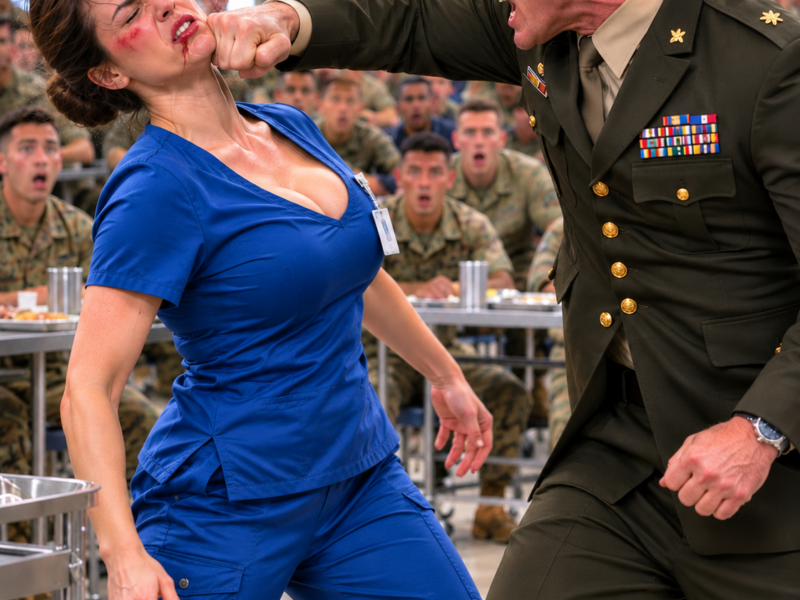
“I watched Captain Derek Voss slap me across the face in front of 400 soldiers, then laugh as blood touched my lip
General Whitaker didn’t tell me what was in the folder immediately.
He looked at Captain Voss first.
“Take him into custody,” he ordered.
Two military police officers stepped forward. Voss didn’t resist, but his expression had changed. The confidence he’d worn in front of four hundred soldiers was gone. In its place was something much closer to fear.
“General, this is a misunderstanding,” he said. “That photograph doesn’t prove anything.”
“No,” Whitaker replied. “But your reaction to it tells me we’re finally asking the right questions.”
Voss glanced at me.
For the first time since I’d met him, he didn’t look angry.
He looked terrified.
Colonel Steven Marsh was escorted into the medical center’s conference room less than twenty minutes later. He arrived in a pressed uniform, his silver hair perfectly arranged, and the same calm expression I’d seen in official photographs from my years in military medical operations.
He looked at me as though I were an inconvenience.
“General, I assume there’s a reason I’ve been pulled away from my command.”
“There is.”
Whitaker placed the black folder on the table.
“Three years ago, during the evacuation operation outside Kandahar, Lieutenant Samuel Carter was recorded as deceased at 0217 hours. His remains were never returned. His family received a death notification. His unit held a memorial service.”
Marsh folded his hands.
“I remember the incident.”
“Do you remember authorizing the casualty report?”
“I signed dozens of reports that week.”
“Then you won’t mind explaining why the medical evacuation manifest lists Carter as a living patient at 0446 hours.”
For the first time, Marsh’s expression shifted.
Only slightly.
But I saw it.
“I can’t speak to a document I haven’t reviewed.”
Whitaker opened the folder and slid a copy across the table.
“Then review it.”
Marsh stared at the page.
I knew what he was seeing. The same discrepancy that had haunted me for three years.
I remembered the evacuation tent. The dust. The smell of fuel and blood. The frantic voices calling for supplies. I remembered a young lieutenant whose uniform had been soaked through, whose pulse was weak beneath my fingers.
I remembered holding pressure against his chest while someone shouted that the aircraft was ready.
And I remembered being told, hours later, that he hadn’t survived.
I’d been the last medical specialist assigned to his stabilization team.
The official report said I’d failed to recognize the extent of his internal injuries.
It said I had delayed the evacuation.
It said my actions had contributed to his death.
I had spent three years believing that my mistake had cost a man his life.
Marsh pushed the manifest away.
“This is classified operational material. It should not be discussed in this room.”
“That’s why we’re discussing it under military investigative authority,” Whitaker said. “And why the people who altered it are being questioned.”
Marsh turned toward me.
“You shouldn’t be here, Sinclair.”
The words landed harder than I expected.
Not because they frightened me.
Because they sounded exactly like the words I’d heard three years earlier, when I’d asked why Carter’s medical file had been sealed.
General Whitaker leaned forward.
“She has every reason to be here.”
“She’s a nurse.”
“She was also the senior medical specialist on that evacuation team.”
Marsh’s eyes narrowed.
“Her involvement was reviewed.”
“By a board that relied on the very records we’re now investigating.”
He fell silent.
Whitaker turned to me.
“Ara, there’s something you need to understand before we proceed. Samuel Carter is alive.”
For a moment, the room seemed to lose all sound.
I stared at him.
“Alive?”
“He was evacuated under a different patient designation. He received emergency surgery at a secure facility. His identity was concealed while an investigation into the operation was conducted.”
“Why?”
“Because the evacuation wasn’t simply a medical emergency. It was connected to an intelligence operation that had been compromised.”
I gripped the edge of the table.
“You let his family believe he was dead?”
Whitaker didn’t look away.
“The original decision was made under a classified protection order. The deception was supposed to last only until the threat was contained.”
“Three years?”
“I know.”
“No, General. You don’t know.”
My voice came out quieter than I intended.
“You don’t know what it was like to sit in a room while someone told me a man had died because I hadn’t done enough. You don’t know what it was like to read an official report describing every second I supposedly wasted. You don’t know what it was like to wake up remembering his pulse beneath my fingers.”
Whitaker accepted every word without interruption.
Then he pushed another document toward me.
“That’s why I asked you to come.”
It was a medical record.
The patient name was different, but the date, time, and injury pattern matched Carter’s case.
The surgical notes described massive internal bleeding, a damaged lung, and a fractured pelvis. The attending surgeon had documented that the patient arrived with a faint but measurable pulse.
The next page contained a handwritten note.
Patient stabilized. Evacuation team credited with rapid intervention. No indication of preventable delay.
I read it twice.
Then a third time.
“Who wrote this?”
“Dr. Elaine Mercer. She was the surgeon at the receiving facility.”
“She never testified.”
“She was told the patient had died before the report was finalized. By the time she discovered the discrepancy, her access to the original case file had been revoked.”
I looked up.
“And the report that blamed me?”
“Altered.”
The word was so simple.
It didn’t seem large enough to hold three years of shame.
Whitaker continued.
“The original record showed that you requested immediate evacuation at 0209. The revised record changed that time to 0318. It also removed two requests for additional blood products and replaced your assessment with a statement suggesting you had underestimated the injuries.”
I remembered writing those requests.
I remembered the radio operator confirming them.
I remembered Marsh arriving at the field station and asking why I had refused to release the patient.
I had told him I hadn’t.
He’d looked at me with cold disappointment.
Then he’d ordered me to stand down.
I had obeyed because he outranked me.
And afterward, the record said I had caused the delay.
“Why would they do that?” I asked.
Whitaker opened the folder to a photograph.
It showed a damaged communications device recovered near the evacuation site.
“Carter was carrying intelligence that suggested someone inside the command structure had been diverting medical supplies and manipulating evacuation priorities. His unit had discovered that requests for emergency blood products were being redirected. Some casualties were being marked as unrecoverable before their evacuation requests were even reviewed.”
My stomach tightened.
“People were being left behind?”
“Some were. Others were evacuated under false identities. The operation was being used to conceal the movement of personnel and equipment.”
“And Carter found out.”
“He documented it. He intended to report it.”
I looked at Marsh.
He hadn’t moved.
“Colonel,” Whitaker said, “would you like to explain why your signature appears on the revised casualty report?”
Marsh’s jaw tightened.
“I followed the instructions provided by the operational command.”
“Whose instructions?”
“I don’t recall.”
“Your signature appears on the authorization to change Sinclair’s evacuation timeline.”
“I signed what was placed before me.”
“And Captain Voss?”
Marsh looked toward the door.
Voss was standing outside with the military police.
Whitaker continued.
“Captain Voss was responsible for maintaining the evacuation manifest. He changed Carter’s identity designation and removed the original radio logs from the medical packet. He also submitted a statement claiming Sinclair had delayed treatment.”
Marsh’s expression hardened.
“Captain Voss was a junior officer. He didn’t make those decisions independently.”
It was the first time Marsh had said anything that sounded like a defense.
Whitaker noticed it.
“So you agree he was acting under orders?”
“I didn’t say that.”
“You implied it.”
Marsh stood.
“This conversation is becoming inappropriate.”
“Sit down.”
The General didn’t raise his voice.
He didn’t need to.
Marsh slowly returned to his chair.
I looked at the photograph of the damaged communications device.
“Was that why Carter was hidden?”
“Partly,” Whitaker said. “He was a witness. The people involved couldn’t risk him being questioned before the evidence was secured.”
“Then why didn’t anyone tell me he was alive?”
Whitaker took a breath.
“Because the investigation was compromised from the beginning. Your name appeared in the altered report. The original team believed you might have been involved, or that you had been pressured into silence.”
I stared at him.
“So you suspected me.”
“We suspected everyone who had access to the records.”
“And instead of asking me, you let me carry the blame.”
His face showed genuine regret.
“Yes.”
I looked away.
That answer hurt more than an excuse would have.
A knock sounded at the door.
A military police officer entered.
“General, Lieutenant Carter has arrived.”
My heart seemed to stop.
Whitaker stood.
“Bring him in.”
The door opened.
A man entered using a dark walking cane.
He was thinner than I remembered. His hair was shorter, and a pale scar ran from beneath his collar toward his jaw. He moved carefully, favoring his left leg.
But I recognized his eyes immediately.
Samuel Carter.
For three years, I’d remembered him as a young officer lying beneath the harsh lights of a field medical tent.
Now he was standing in front of me.
Alive.
He stopped when he saw me.
“Ara.”
I couldn’t speak.
He looked at the folder, then at the officers, then back at me.
“I heard they finally found the original records.”
I stood so quickly that my chair scraped across the floor.
“You’re alive.”
He gave a small, tired smile.
“I am.”
I took one step toward him.
Then another.
My hands were trembling.
“I thought you died.”
“I know.”
“I was told you died because I didn’t get you out in time.”
His expression changed.
“They told me you were the reason I made it to the aircraft.”
I looked at him.
“What?”
“You kept me conscious. You got the bleeding controlled. You refused to let them move me until the evacuation crew had the equipment you requested.”
He swallowed.
“I remember you telling me to keep talking. You asked me about my sister. You made me describe the house where I grew up.”
I felt tears pressing against my eyes.
“I was trying to keep you awake.”
“You did.”
He stepped closer.
“I remember the aircraft doors closing. I remember someone saying we’d lost too much blood. Then I remember waking up in a surgical ward weeks later.”
I covered my mouth.
“Why didn’t you contact me?”
“I tried.”
The answer came quickly.
“What?”
“After I was stable, I asked about the people who had been with me. They told me the evacuation team had been reassigned. Later, when I learned your name had appeared in the investigation, I requested permission to give a statement.”
He glanced at Whitaker.
“My request was denied.”
Whitaker’s expression tightened.
“That decision is under review.”
Carter nodded.
“I understand.”
Then he looked back at me.
“I never believed you caused the delay.”
I had imagined hearing those words for three years.
In my mind, I had rehearsed what I would say if I ever learned the truth.
But now that he was standing in front of me, I had nothing prepared.
“I should have done more,” I whispered.
“No.”
His answer was firm.
“You did everything you could.”
The room remained silent.
Even Marsh seemed to understand that there were moments when an officer’s rank meant nothing.
Carter reached into his jacket and removed a small folded piece of paper.
“I kept this.”
He handed it to me.
It was a copy of the original evacuation request.
My handwriting was unmistakable.
The time stamp read 0209.
Below it was my signature.
I stared at it until the numbers blurred.
“Where did you get this?”
“It was attached to my original medical packet. Someone removed it from the version submitted to the review board, but a copy remained with the receiving surgeon.”
I pressed the paper against the table.
For three years, I had questioned every decision I’d made that night.
Now I was holding proof that I had done exactly what I was supposed to do.
And I still couldn’t stop shaking.
Whitaker gave us a moment before returning to the investigation.
“Lieutenant Carter, are you prepared to make a formal statement?”
“Yes.”
“Do you understand that your testimony may expose you to questions about the classified operation?”
“I do.”
“Then we’ll proceed.”
Carter turned toward Marsh.
“I know what happened to the original manifest.”
Marsh’s expression didn’t change.
“Be careful, Lieutenant.”
“I am.”
Carter placed a second document on the table.
“This is a copy of the radio log. It records the request for evacuation at 0209, the confirmation at 0212, and the order to hold the aircraft until the command cleared the passenger list.”
Whitaker studied the page.
“Who issued that order?”
Carter pointed to the authorization code.
“Colonel Marsh.”
Marsh shook his head.
“That code was accessible to multiple personnel.”
“Not that night,” Carter replied. “I was the communications officer. I know who entered it.”
Voss, still visible through the open doorway, suddenly spoke.
“That’s not what happened.”
Every head turned.
The military police officer moved closer to him.
Whitaker looked at Voss.
“Then tell us what happened.”
Voss’s face had gone pale.
“Marsh told me Carter couldn’t be listed under his own name. He said it was an intelligence restriction.”
“And the revised medical timeline?”
Voss hesitated.
“He said the original logs had to be removed.”
“Why?”
“Because the aircraft was held.”
“Who ordered the hold?”
Voss looked at Marsh.
The colonel’s voice turned sharp.
“Captain, you will not speculate.”
Voss flinched.
Then, for the first time, he looked directly at the General.
“I entered the changes because Colonel Marsh told me to. He said the original record would expose a sensitive operation. He said the nurse’s report could be corrected later.”
My stomach turned.
“Corrected later?” I repeated.
Voss looked at me.
“I didn’t know they would blame you.”
“You signed the report.”
“I was following orders.”
“You watched me lose my position.”
His eyes dropped.
“You knew I was being investigated.”
“I thought it would be temporary.”
“You knew I was removed from medical operations.”
He didn’t answer.
I stepped closer to the table.
“You knew I spent three years believing I had killed a man.”
Voss’s face tightened.
“I didn’t know that.”
“You didn’t ask.”
There was no shouting.
No dramatic speech.
Just the truth, placed between us.
He had never needed to know what happened to me.
He had only needed to follow an order and keep walking.
Whitaker turned to the military police.
“Captain Voss is to remain in custody pending formal charges. Colonel Marsh is to be relieved of command and escorted to investigative headquarters.”
Marsh stood abruptly.
“You can’t do this based on one witness and an old photograph.”
“It’s not one witness,” Whitaker replied. “We have the original manifest, the receiving surgeon’s notes, the radio logs, and your authorization codes. We’re also reviewing the financial records connected to the diverted medical supplies.”
Marsh’s composure finally broke.
“You don’t understand what was at stake.”
“Then you’ll have an opportunity to explain it during the investigation.”
Marsh looked at me.
For a moment, I saw the man who had stood over my medical station three years earlier and told me I had failed.
“You should have stayed out of this, Sinclair.”
I met his gaze.
“I tried.”
He was escorted away.
Voss followed.
As he passed me, he stopped.
“Ara.”
I didn’t move.
“I am sorry.”
I studied him.
Part of me wanted to hear something more substantial. An explanation. An admission that he had understood the damage he was causing.
But an apology couldn’t restore three years.
It couldn’t return the nights I’d spent replaying a medical emergency that had never been my fault.
And it couldn’t make the slap he’d delivered in front of four hundred soldiers disappear.
“You should be sorry,” I said.
Then I turned away.
The formal investigation lasted several months.
The original evacuation records were authenticated. Dr. Mercer provided a sworn statement confirming Carter’s condition when he arrived. The radio logs established that the aircraft had been held under Marsh’s authorization, not because of any delay caused by me.
The review board formally cleared my name.
The finding was short and unmistakable: I had followed medical protocol, requested evacuation at the earliest appropriate moment, and provided lifesaving care under extreme conditions.
The revised report had been deliberately falsified.
Marsh was charged with obstruction, falsification of official records, abuse of authority, and conspiracy related to the diversion of medical supplies. Voss was charged for his role in altering the manifest and submitting a false statement. His assault on me was handled separately, with witness accounts and medical documentation supporting the complaint.
The case didn’t disappear behind closed doors.
The military issued a formal correction to my service record. My professional standing was restored, and the review board sent a written apology acknowledging that the earlier inquiry had relied on manipulated evidence.
It was not enough to erase what had happened.
But it mattered.
Carter’s family was finally told the truth.
His sister had spent three years keeping a small memorial photograph on her kitchen counter. When he called her, he told me later, she didn’t say anything at first.
Then she asked him whether he was really coming home.
He told her yes.
I attended their reunion at a quiet military guest facility outside the city.
I almost didn’t go.
I wasn’t sure I could watch a family reclaim someone they’d already mourned without breaking down.
But Carter had asked me to be there.
When I arrived, his sister was waiting near the entrance.
She was younger than him, with the same dark eyes.
She approached me cautiously.
“You’re Ara?”
“Yes.”
She took both my hands.
“My brother told me what you did.”
I looked down.
“I was only doing my job.”
“He said you stayed with him when he thought he wasn’t going to make it.”
My throat tightened.
“I didn’t want him to be alone.”
She hugged me.
And that was when I finally cried.
Not because the investigation was over.
Not because my name had been cleared.
Because the person I’d thought I had failed was standing alive in the next room, and someone who loved him was able to hold him again.
Afterward, Carter and I sat outside beneath a pale afternoon sky.
He moved slowly, but he no longer needed the cane every day.
“I heard about the incident with Voss,” he said.
I gave a tired laugh.
“Apparently, the entire command knows.”
“I wish I’d been there.”
“You had enough to deal with.”
He looked toward the parking lot.
“Did you ever think about leaving?”
“More times than I can count.”
“Why didn’t you?”
I considered the question.
At first, I thought it was because I couldn’t imagine doing anything else.
Then I realized that wasn’t entirely true.
“I didn’t want the worst thing that happened to me to decide what I was allowed to become.”
Carter nodded.
“That sounds like you.”
I looked at him.
“You barely know me.”
“I remember you.”
He smiled faintly.
“You told me that if I survived, I had to go home and annoy my sister for the rest of my life.”
I laughed through the tears.
“I said that?”
“You did.”
“Then I expect you to keep your promise.”
“I intend to.”
A few weeks later, I returned to Harmon Ridge.
The hospital hadn’t changed much. The same polished floors. The same early-morning announcements. The same smell of disinfectant and coffee drifting from the staff lounge.
But I had changed.
I no longer checked every doorway before entering a room.
I no longer felt my stomach tighten whenever someone mentioned the evacuation operation.
And I no longer carried the weight of a death that had never happened.
On my first shift back, a young corpsman approached me near the nurses’ station.
“Ma’am, are you Ara Sinclair?”
“Yes.”
He looked nervous.
“I heard what happened with Captain Voss.”
I waited.
“My unit was there when he hit you. I wanted to say something that day, but I didn’t know if I was allowed.”
“You don’t need permission to tell the truth.”
He nodded slowly.
“I should have spoken up.”
I considered his words.
“Then speak up next time. Not because someone is watching. Because someone needs you to.”
He straightened.
“Yes, ma’am.”
I watched him walk away.
For years, I had believed that the most important moment of my career was the night I failed to save a patient.
Now I understood that the moment that mattered most might have been the one when I refused to let someone else decide whether my voice had value.
I still remembered the slap.
I didn’t pretend it hadn’t happened.
Sometimes, when a door closed too sharply behind me, my body remembered before my mind could catch up.
But I had stopped confusing survival with silence.
Voss had believed that rank gave him the right to humiliate me.
Marsh had believed that authority gave him the right to rewrite the truth.
Both had been wrong.
And neither had been brought down by a secret weapon, a dramatic speech, or some hidden power I had been waiting to reveal.
They had been brought down by the records they thought no one would ever find, the witnesses they assumed would remain quiet, and the truth they had mistaken for something they could control.
One morning, I received a letter from the military review board.
It contained the final correction to my record and a formal acknowledgment that the allegations against me had been unfounded.
I folded it carefully and placed it in my desk.
Then I returned to work.
Because the people who came through those doors didn’t need to know how long it had taken me to stand there again.
They only needed someone ready to help.
And when I walked into the treatment room that afternoon, I saw a young soldier waiting beside his mother.
He looked frightened.
I pulled up a chair and sat beside him.
“Hey,” I said gently. “I’m Ara. You’re safe here. Tell me what happened.”
His shoulders loosened.
And for the first time in three years, I felt no need to prove anything to anyone.
I was exactly where I was supposed to be.
THE END.









