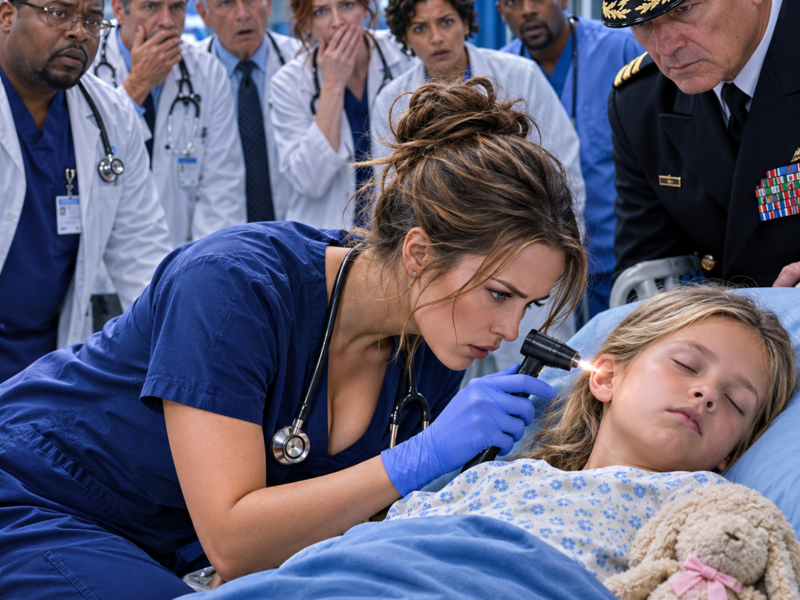
“I watched a seven-year-old girl’s heart rate fall in Trauma Room 3 while a celebrated neurosurgeon told me to step away from her bed
“Because I know exactly what a rescue swimmer is trained to do,” Admiral Reed said, his eyes fixed on me. “And I also know what happens when people with the authority to act refuse to listen to the person who sees the danger first.”
The clinical operations director, a woman named Patricia Lawson, folded her arms.
“Admiral, with respect, this is an internal hospital matter.”
Reed looked at her without changing his expression.
“Then handle it internally. But don’t confuse an internal review with an excuse to intimidate someone who may have saved a child’s life.”
Patricia glanced at me.
“Maya, I still need your written statement before the end of your shift.”
“I’ll provide it.”
“Good. And I expect you to be factual.”
“I always am.”
She gave a tight nod and walked away.
For several seconds, none of us spoke.
The operating room doors remained closed.
I could hear the faint mechanical hum of the ventilation system and the distant sound of a telephone ringing at the nurses’ station.
Admiral Reed finally turned toward me.
“Eight years in the Coast Guard?”
“Yes, sir.”
“Where were you stationed?”
“Mostly Atlantic operations. A few years out of Elizabeth City, North Carolina, and later assignments along the Gulf Coast.”
He nodded slowly.
“Night rescues?”
“Quite a few.”
“Open water?”
“Most of them.”
He looked down at my hands.
“Then you understand something about emergencies that most people don’t.”
I didn’t answer.
He continued.
“When you’re in the middle of a rescue, there isn’t always time to wait for someone with a higher rank to approve what your eyes are telling you.”
I looked toward the operating room.
“That’s true.”
“Then why did you leave?”
The question caught me off guard.
I had answered it many times on employment forms, during interviews, and whenever someone noticed the gap between my military service and nursing career.
But I had never liked answering it.
“An injury,” I said.
“What kind?”
“My shoulder.”
He waited.
I knew he wasn’t going to fill the silence for me.
“During a training exercise, a hoist operation went wrong. I was injured, and I couldn’t safely perform the work anymore.”
“Could you have stayed in another position?”
“Possibly. But I didn’t want to spend the rest of my career watching other people do the work I’d trained my entire life to do.”
Reed studied me.
“That must have been difficult.”
I gave a small shrug.
“It was what it was.”
He didn’t look convinced, but he didn’t push.
Instead, he sat in one of the chairs outside the operating room.
“My son was supposed to be driving Emma home tonight.”
I turned toward him.
“Your son?”
“Daniel. Emma’s father.”
He rubbed his forehead.
“He was called into work unexpectedly. His wife had already left town for a family emergency, so I offered to pick Emma up from school and keep her for the evening.”
He looked at the floor.
“I was supposed to bring her home.”
I had seen guilt on the faces of parents and spouses in emergency departments.
It often arrived before the diagnosis.
“Sir, you didn’t cause the accident.”
“I know what the police report will say.”
He paused.
“But knowing something and believing it are two different things.”
I sat in the chair opposite him.
“Emma is getting the treatment she needs. That’s what matters right now.”
He nodded.
For the next twenty minutes, neither of us said much.
Then the operating room doors opened.
Dr. Keller stepped into the hallway, removed his surgical cap, and looked toward us.
Reed stood immediately.
“Doctor?”
Keller took a breath.
“The procedure went well.”
Reed’s mouth opened slightly.
“We found a significant epidural hematoma. There was pressure building inside her skull, and we were able to evacuate the blood before it caused further damage.”
“Is she alive?”
“Yes, Admiral. She’s alive. Her vital signs are stable.”
Reed closed his eyes.
His shoulders dropped, and one hand went to the wall beside him.
For the first time since arriving at the hospital, he looked like a grandfather instead of a military officer.
“Can I see her?”
“Not yet. She’s going to the pediatric intensive care unit. We’ll monitor her closely overnight.”
“Will she wake up?”
Keller hesitated.
“That’s what we’re hoping. We have to give her brain time to recover.”
Reed nodded.
Then Keller turned toward me.
“Maya.”
“Doctor.”
He walked closer.
“I owe you an apology.”
I wasn’t expecting that.
He looked uncomfortable, but he continued.
“When you first mentioned the fluid behind her ear, I dismissed it. When you pointed out the changes in her breathing and pupils, I should have taken your concerns more seriously.”
I folded my arms.
“She’s alive.”
“Because we acted in time.”
He extended his hand.
“I was wrong.”
I shook it.
“Thank you for saying that.”
He glanced toward the operating room.
“I’ve been doing pediatric neurosurgery for twenty years. Sometimes experience makes you confident. Sometimes it makes you slower to question your first impression.”
I appreciated his honesty.
But before I could answer, Patricia Lawson returned.
She had a folder in her hand.
“Dr. Keller, I need to speak with you.”
“About what?”
“The incident in Trauma Room 3.”
Keller looked at me, then at her.
“There’s no incident to investigate beyond the clinical review.”
“An RN gave direct treatment instructions and challenged your authority in front of the team.”
“She raised concerns about a deteriorating patient.”
“That’s not what I’m asking.”
Keller’s expression hardened.
“Then ask the question you want answered.”
Patricia opened the folder.
“Did Nurse Collins act outside her scope of practice?”
He took a moment.
“No. She identified concerning clinical findings, communicated them, and advocated for immediate evaluation. I made the decision to proceed with imaging and surgery.”
Patricia looked displeased.
“That’s your official position?”
“That’s what happened.”
She closed the folder.
“Fine. We’ll document your statement.”
Then she walked away.
I watched her disappear around the corner.
“She doesn’t like being challenged,” I said.
Keller gave a tired smile.
“Neither do I, apparently.”
For the first time that night, I almost laughed.
But the exhaustion was catching up with me.
I finished my shift after sunrise, submitted my written statement, and went home.
I slept for three hours.
Then I woke up and checked my phone.
There was a message from an unknown number.
It read:
This is Thomas Reed. Emma is stable. I wanted you to know before you heard it from someone else. Thank you for staying with her.
I read it twice.
Then I placed my phone on the kitchen counter and made coffee.
I didn’t know why those simple words affected me so much.
Maybe because I had spent years believing that the work I did before nursing no longer mattered.
Maybe because someone had finally seen the connection.
Or maybe because a little girl I had known for less than an hour had somehow reminded me of the person I used to be.
Three days later, I returned to the hospital.
I wasn’t scheduled to work in pediatrics, but I had a medication delivery to make on the fourth floor.
As I passed the pediatric unit, I heard a familiar voice.
“Excuse me!”
I turned.
Emma Reed was sitting upright in her hospital bed.
A white bandage covered part of her head, and her hair was brushed neatly behind her ears.
The pink stuffed elephant rested beside her pillow.
Her grandfather was sitting near the window with a newspaper folded on his lap.
When he saw me, he stood.
“Maya. Come in.”
I smiled.
“How are you feeling, Emma?”
She lifted a juice box.
“Better.”
“That’s good.”
“My head hurts a little.”
“That’s understandable. Your doctors are going to take good care of you.”
She looked at me for a moment.
“Grandpa says you saved me.”
I glanced at Reed.
“Your grandfather tells some pretty dramatic stories.”
“I’m not dramatic,” he said.
Emma giggled.
Then she picked up her stuffed elephant.
“This is Rosie. She was with me in the car.”
I looked at the elephant.
“She’s a very brave passenger.”
Emma nodded seriously.
“She helped me.”
“I’m sure she did.”
She studied my badge.
“What’s your name again?”
“Maya.”
“Maya.”
“That’s right.”
She held out her small hand.
“Thank you for finding my head.”
I laughed softly.
“I think the doctors found your head. I just noticed something important.”
Emma shook her head.
“No. Grandpa said you noticed before everybody else.”
I looked away for a second.
There are things people say to you during an ordinary workday that stay with you longer than you expect.
That was one of them.
Reed approached with a large envelope.
“I have something for you.”
I looked at it.
“What’s this?”
“An invitation. And a proposal.”
I opened the envelope.
Inside was a letter from the hospital’s board of directors.
They were proposing a new emergency recognition and training initiative for nurses and support staff.
The program would focus on early trauma assessment, neurological warning signs, communication under pressure, and recognizing deterioration before it became catastrophic.
They wanted me to help develop and lead it.
I read the letter twice.
Then I looked up.
“Why me?”
Reed pulled a chair closer.
“Because you saw something others missed.”
“Dr. Keller performed the surgery. The trauma team did the work.”
“And you helped make sure they had the opportunity.”
I looked at the letter again.
“I don’t have academic credentials for something like this.”
“You have eight years of rescue experience and years of emergency nursing.”
“That’s different from teaching.”
“Then teach them what you know.”
I hesitated.
It wasn’t that I didn’t want the opportunity.
It was that I had spent so long trying to build a quiet life after leaving the Coast Guard that the idea of standing in front of a room full of people made me uncomfortable.
I had put away my old uniform.
I rarely spoke about my service.
Even my coworkers knew very little about the years I had spent jumping into the ocean.
“I don’t know if I’m the right person,” I said.
Reed leaned forward.
“May I tell you something?”
I nodded.
“My wife died six years ago. Emma was very close to her.”
He paused, looking at his granddaughter.
“After she passed, Emma had a difficult time. She stopped sleeping in her own room. She carried that elephant everywhere.”
He smiled faintly.
“Rosie belonged to my wife when she was a little girl. Emma’s grandmother gave it to her before she died.”
I looked at the worn pink fabric.
“That’s why she was holding it.”
“Yes. It was the one thing she insisted on taking everywhere.”
He glanced toward Emma.
“That night, when I saw her lying on that stretcher, all I could think about was that I might lose the last piece of my wife I had left.”
His voice became quieter.
“And I couldn’t do anything.”
I looked at him.
“You got her here. You stayed with her. You made sure she had people fighting for her.”
He shook his head.
“That wasn’t enough for me.”
“It was what you could do.”
For a moment, he didn’t respond.
Then Emma interrupted us.
“Grandpa?”
“Yes, sweetheart?”
“Can I show Maya my picture?”
She reached for a sheet of paper on the bedside table.
It was a drawing made with crayons.
There was a helicopter in the sky, a little girl near a large blue area of water, and a woman reaching toward her.
The woman wore a dark uniform.
I stared at the picture.
“That’s beautiful, Emma.”
She pointed at the woman.
“That’s you.”
I looked at her.
“Me?”
“You were the lady who came to get me.”
I smiled.
“That night, I was in the hospital.”
Emma frowned as though I had misunderstood something obvious.
“But you were still the rescue lady.”
I didn’t know what to say.
I had never told her about the Coast Guard.
I hadn’t told her about the helicopters, the ocean, or the years I had spent pulling strangers out of dangerous water.
I looked at Reed.
He gave me a small, knowing smile.
“She asked me what you did before you became a nurse. I told her you used to rescue people from the ocean.”
I looked back at the drawing.
For a long time, I had thought that the accident that ended my rescue career had taken something permanent from me.
My shoulder healed enough for ordinary work, but I could no longer perform the physical demands of a rescue swimmer.
I had struggled with that more than I admitted.
I missed the aircraft.
I missed the training.
I missed the certainty of knowing exactly what my job was when someone needed help.
And sometimes, during a quiet night shift, I wondered whether I had simply become someone who handed out medication and completed paperwork.
But that little girl had seen something I had forgotten.
The work had never been about the helicopter.
It had never been about the uniform.
It had always been about noticing the person who needed help.
I folded the drawing carefully.
“I’d like to accept the position,” I said.
Reed smiled.
“Good.”
“But I have one condition.”
“What’s that?”
“I don’t want this program to become another set of rules that people are afraid to question.”
He waited.
“I want nurses, technicians, paramedics, and everyone involved in patient care to understand that they can speak up when something doesn’t look right. I want them to know that raising a concern isn’t disrespect.”
Reed nodded.
“Agreed.”
“And I want Dr. Keller involved.”
Reed raised an eyebrow.
“After what happened?”
“Especially after what happened. He listened eventually. And I think the program will mean more if the people who make decisions are part of it.”
Reed smiled.
“Then we’ll ask him.”
A week later, the hospital announced the initiative.
The first training session was scheduled for the following month.
I expected a small group of nurses.
Instead, nearly forty people showed up.
Some were new graduates.
Some had worked in emergency medicine for decades.
A few paramedics sat near the back, still wearing their department uniforms.
Dr. Keller stood beside me at the front of the room.
Patricia Lawson was there too.
She sat in the second row with a notebook.
I had prepared slides, clinical examples, and several case studies.
But when I looked at the people in front of me, I decided to begin differently.
I placed a photograph on the screen.
It showed a Coast Guard helicopter hovering over dark ocean water.
The waves looked enormous even in the photograph.
“This is where I learned one of the most important lessons of my career,” I said.
I told them about the training exercises.
I explained how difficult it could be to recognize injuries in poor visibility, how small changes in breathing or consciousness could signal something serious, and how important it was to communicate clearly when seconds mattered.
Then I told them about Emma.
I didn’t make myself the hero.
I explained what I had noticed, what I had reported, and how the team had responded.
I also explained what I had missed in other emergencies and how those experiences had changed the way I practiced.
When I finished, a young nurse near the front raised her hand.
“What if the attending doesn’t listen?”
The room became quiet.
I looked at her.
“Then you escalate your concern through the appropriate emergency channels. You document what you observe, communicate clearly, and keep advocating for the patient.”
She nodded.
“But what if they get angry?”
I remembered Keller standing between me and the bed.
I remembered Patricia with her folder.
I remembered Admiral Reed watching the monitors while his granddaughter’s condition changed.
“Sometimes they will,” I said. “But your responsibility is to the patient. Be respectful, be accurate, and don’t confuse someone’s reaction with whether your observation matters.”
Dr. Keller stepped forward.
“May I add something?”
I nodded.
He faced the room.
“I was the attending physician in Emma Reed’s case. Maya raised concerns that I initially dismissed. I was wrong to dismiss them.”
Nobody moved.
He continued.
“She identified signs of a potentially life-threatening injury. We acted, and the child survived. I have been a physician for twenty years, and I learned something that night.”
He looked toward me.
“Being the most experienced person in the room doesn’t mean you’re the only person who can see what’s happening.”
The young nurse lowered her hand.
But I noticed she was smiling.
The program grew over the next several months.
We added practical trauma exercises, communication drills, and case reviews.
I invited experienced paramedics to speak about field assessment.
We encouraged nurses to discuss situations in which they had noticed something unusual but hesitated to raise the concern.
Some stories were difficult to hear.
One nurse described a patient whose subtle confusion had been dismissed as exhaustion.
A respiratory therapist explained how a small change in breathing had alerted her to a problem before the monitor showed it.
A young technician talked about noticing that a patient was suddenly unable to follow a simple instruction.
None of them had been the attending physician.
All of them had noticed something important.
And slowly, the culture began to change.
Not because people stopped respecting authority, but because they began to understand that authority and attention were not the same thing.
About six months after Emma’s accident, I received an invitation to the hospital’s annual recognition ceremony.
I almost declined.
I wasn’t particularly comfortable with awards.
I preferred working behind the scenes.
But the invitation included a handwritten note from Admiral Reed.
Emma wants you there. So do I.
I arrived that evening wearing a simple navy dress.
The hospital auditorium was full of physicians, nurses, administrators, and families.
I saw Keller near the stage.
He waved when he noticed me.
Patricia Lawson was sitting with the board members.
When my name was announced, I walked toward the stage expecting a brief introduction and a certificate.
Instead, the hospital president explained that the board had approved a permanent clinical recognition program named after no individual.
It would be called the Early Recognition and Patient Advocacy Initiative.
The goal, he said, was to ensure that observations from every member of the care team were heard and taken seriously.
Then he invited Emma Reed to the stage.
She walked slowly beside her grandfather.
Her hair had grown back around the small surgical scar, and she was holding Rosie by one leg.
When she reached the microphone, she looked out at the audience.
“My grandpa says Maya helped save my life,” she said.
A few people smiled.
Emma looked down at her stuffed elephant.
“But I think she was brave because she told the doctor what she saw, even when he didn’t want to listen.”
The auditorium became silent.
Then she held up a folded piece of paper.
It was another drawing.
This time, the helicopter was much smaller.
The woman was standing beside a hospital bed.
The little girl was sitting up, holding a pink elephant.
At the top, Emma had written three words in uneven purple crayon.
“THANK YOU, MAYA.”
I accepted the drawing with both hands.
“Thank you, Emma.”
She stepped closer and whispered something only I could hear.
“Rosie still remembers you.”
I laughed, and my eyes filled before I could stop them.
After the ceremony, Reed found me near the exit.
“How’s your shoulder?”
“Better.”
“Still hurts?”
“Sometimes.”
He nodded.
“Mine does too. Old injuries have a way of reminding us where we’ve been.”
We stood together for a moment, watching Emma talk to Dr. Keller.
Then Reed said, “I never properly thanked you for something else.”
“What?”
“For not giving up when someone told you to step away.”
I looked across the room.
“I wasn’t thinking about being brave.”
“What were you thinking about?”
I considered the question.
“That little girl had a family waiting for her. She deserved every chance we could give her.”
Reed nodded.
“That’s probably what makes the difference.”
I smiled.
Before leaving, I walked over to Emma.
She was sitting at a table, coloring another picture.
“What’s this one?”
She showed me a drawing of a large pink elephant wearing a little blue hat.
“Rosie is going to be a doctor,” she announced.
“That’s a very important job.”
“She wants to help children.”
“I think she’d be good at it.”
Emma handed me the picture.
“Can you keep this one?”
I took it.
“Of course.”
That night, when I got home, I placed both drawings on my refrigerator.
The first showed a helicopter over the ocean.
The second showed a hospital bed and a little girl who had survived.
I stood there for a while, looking at them.
For years, I had thought my life as a rescuer ended the day I could no longer jump from a helicopter.
I had treated that chapter like something that belonged to another person.
But it hadn’t disappeared.
It had followed me into the emergency department, into the quiet hours of night shift, and into every moment when I noticed a detail someone else had overlooked.
I still missed the ocean sometimes.
I missed the sound of the rotor blades and the feeling of cold air rushing past my face before a rescue.
But I no longer believed that the most important part of me had been left behind.
A few weeks later, during another night shift, a new nurse approached me at the medication cart.
She looked nervous.
“Maya, can I ask you something?”
“Of course.”
“What do you do when you think something is wrong, but the doctor says everything looks fine?”
I put down my pen.
“Tell me what you’ve noticed.”
She described the patient carefully.
I listened without interrupting, then walked with her to the bedside.
We checked the patient together, reviewed the observations, and contacted the physician with our concerns.
This time, the doctor came immediately.
There was no argument.
No raised voice.
Just a team of people looking at the same patient and deciding what needed to happen next.
As I returned to the nurses’ station, I glanced at the small photograph taped inside my locker.
It showed a Coast Guard helicopter above the Atlantic.
I had kept it for years without really knowing why.
Now I understood.
I hadn’t needed to become the person I used to be again.
I had needed to stop believing that she was gone.
And somewhere in the pediatric unit, a little girl was growing stronger, carrying a pink stuffed elephant that had survived a car crash.
Sometimes I wondered whether she would remember the details of that night when she was older.
Maybe she wouldn’t.
Maybe all she would remember was waking up in a hospital and seeing her grandfather beside her bed.
That was enough.
Because I would remember.
I would remember the falling numbers on the monitor, the clear fluid behind her ear, and the moment a frightened grandfather chose to trust someone whose title was smaller than the doctor’s.
Most of all, I would remember that a life can change in the space between noticing something and deciding to speak.
And every time a new nurse asked whether her voice mattered, I gave her the same answer.
“Your job title doesn’t determine the value of what you see. Your experience doesn’t disappear because someone outranks you. If something doesn’t look right, speak up.”
I used to think my greatest rescues were somewhere behind me, buried beneath years of salt water and memories.
I was wrong.
Some rescues begin with a helicopter.
Others begin with a nurse quietly saying, “Doctor, I need you to look at this.”
The End.









