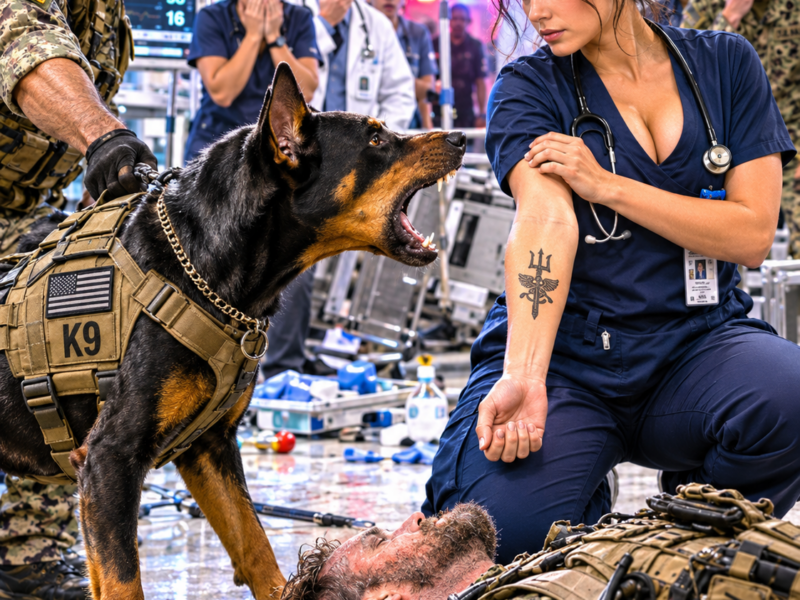
“I watched a Navy SEAL collapse on the floor of Trauma Room 1 while his military dog threatened to tear apart anyone who approached him
The phone trembled slightly in Commander Alcott’s hand.
I could see the recording on the screen, its date displayed in small white numbers.
Eight years earlier.
The night Danny Quinn died.
But Mason was losing blood, and the monitor was screaming.
“Not yet,” I told Alcott. “Whatever Danny said, it can wait until Mason is out of surgery.”
Alcott looked at me.
“That’s what Mason said, too.”
I turned toward him.
“What?”
“He told me not to play it unless you were ready. He wanted you to hear it from him, but he also knew there might not be another chance.”
A nurse pushed a blood cooler through the doorway.
“Two units are ready!”
I turned back to Mason.
“Then let’s make sure there is another chance.”
Dr. Albright was already pulling on a fresh pair of gloves.
“Call the operating room. Tell Dr. Nandakumar we’re bringing him up immediately.”
Monica moved toward the medication cart.
I leaned over Mason and checked his pulse again.
It was weak, fast, and irregular.
Atlas stayed pressed against my knee.
“Stay with him, boy,” I whispered.
The dog looked at me, then rested his chin beside Mason’s hand.
For the next several minutes, the trauma room became a controlled storm.
Blood bags swung from their hooks.
The ultrasound machine was wheeled away.
A resident cut through the remaining straps on Mason’s tactical vest while another nurse secured the second IV line.
I kept my palm against Mason’s abdomen, applying pressure as the team prepared him for surgery.
“Senior Chief Trent, can you hear me?” I said.
There was no response.
“You’re not allowed to leave before you tell me why you came looking for me.”
His eyelids didn’t move.
I bent closer.
“And you still owe me an explanation for that dog.”
Atlas gave a quiet whine.
For the first time in eight years, I almost smiled.
Then the monitor alarm changed.
“Pressure’s dropping!” someone shouted.
“Move!”
The surgical team rushed in with a transport bed.
Dr. Nandakumar, a compact woman with dark hair tucked beneath her surgical cap, took one look at Mason.
“What’s the suspected injury?”
“Internal bleeding, left upper quadrant,” I answered. “Possible splenic injury with a retained fragment.”
She looked at me.
“How long has he been unstable?”
“His body was compensating when he arrived. The pressure has collapsed in the last few minutes.”
She glanced at the ultrasound images.
“Get him upstairs. Now.”
The team lifted Mason onto the bed.
Atlas immediately stood.
His leash tightened.
“He’s coming with us,” I said.
Albright shook his head.
“Absolutely not. We cannot bring an animal into the operating suite.”
Atlas barked once.
Doyle pulled the leash close.
“Senior Chief Trent trained him to stay with him. If we separate them, he’s going to fight.”
“Then take him somewhere secure,” Albright replied.
I crouched in front of Atlas.
“Listen to me, old boy. Mason needs help. You have to let them take him.”
The dog stared at me.
I put my palm against his cheek.
“Stay with Garrett. I’ll come back.”
He lowered his head.
Then, slowly, he stepped away from the bed.
It was the hardest thing I had seen him do all afternoon.
The transport team disappeared through the double doors.
I stood there watching until they were gone.
“Doc.”
I turned.
Commander Alcott was waiting beside the wall.
“Come with me.”
“I can’t. I need to stay available.”
“There’s nothing you can do in that operating room.”
He held up his phone.
“But there is something you need to hear.”
I looked at the screen again.
The recording was still open.
My hands felt cold.
“Where did you get that?”
“From the Navy’s sealed mission archive. Mason spent years filing requests. Most were denied.”
“Why would they deny him?”
“Because the official investigation was closed, and the last transmission was classified.”
I stared at him.
“Then how did he get it?”
“Last month, a review board finally released it to him.”
I leaned against the counter.
“Commander, I don’t understand. What does Danny’s last message have to do with me?”
Alcott didn’t answer immediately.
Instead, he looked at the tattoo on my arm.
“Do you remember what Danny used to say about Harrow Medical?”
I nodded.
“He said we were a family.”
“He meant it.”
I looked away.
“Families don’t leave people behind.”
Alcott’s voice hardened.
“You didn’t leave Danny behind.”
I shook my head.
“I was there.”
“I know.”
“I heard the helicopter. I watched the dust rise. I knew he was still on the ground.”
“I know, Iris.”
“And I chose Mason.”
Alcott stepped closer.
“You followed the order of the wounded team leader. That’s what happened.”
I pressed my fingertips against the edge of the counter.
“That’s not how I remember it.”
“Then perhaps it’s time you heard how Danny remembered it.”
He pressed play.
Static filled the small room.
Then came the familiar sound of distant gunfire.
A man’s voice emerged, weak but unmistakable.
“Raven Two, this is Harrow Actual. Do you copy?”
I closed my eyes.
Danny.
Even through the distortion, I recognized the slight rasp in his voice.
A second voice answered.
“Go ahead, Harrow Actual.”
“Requesting immediate extraction. Two casualties. One critical. We need the bird now.”
There was a burst of static.
Then Danny spoke again.
“Tell Doc to take Trent first.”
My eyes opened.
Alcott paused the recording.
“That’s where the original mission report ends.”
“Play the rest.”
He hesitated.
“There’s more.”
“Please.”
He pressed play again.
The recording crackled.
Then Danny’s voice returned.
“Doc, if you’re hearing this, stop arguing with me.”
A faint laugh came through the static.
It was exactly the laugh I remembered.
The kind that always came when Danny knew he was about to get his way.
“Take Mason. He’s got a family waiting for him. He’s got a little girl who thinks her daddy can fix anything.”
I covered my mouth.
Mason had a daughter.
I hadn’t known.
Danny continued.
“And don’t you dare make this about choosing one man over another. You’re doing your job. You’re saving the one you can reach.”
The static grew louder.
Then I heard a different voice.
It was Mason.
“Quinn, we’re coming back for you.”
Danny answered immediately.
“No, you’re not. Listen to me, Mason. Get Doc on that bird.”
“That’s an order?”
“That’s a promise. Get her out.”
A pause followed.
Then Danny spoke one last time.
“And somebody tell Atlas he’s a good boy.”
The recording ended.
I stared at the phone.
For several seconds, I couldn’t make a sound.
Then Alcott replayed the final few seconds.
I heard Danny’s voice again.
“And somebody tell Atlas he’s a good boy.”
The words were simple.
Almost ordinary.
But they broke something open inside me.
I slid down the wall until I was sitting on the floor.
For eight years, I had remembered Danny lying in the dirt.
I had remembered his blood on my gloves.
I had remembered the helicopter lifting Mason away while Atlas stayed beside Danny.
I had remembered the radio going silent.
But I had never heard the words Danny had spoken after I left.
“Why didn’t anyone tell me?” I whispered.
Alcott crouched beside me.
“We tried.”
I looked at him.
“What?”
“The Navy sent letters to your last registered address. They contacted your former unit. Your commanding officer tried to reach you.”
“I never received anything.”
“You resigned your commission six months after the incident and disappeared from the system.”
I looked down at my hands.
“I couldn’t stay.”
“I know.”
“No, Commander. You don’t.”
My voice came out sharper than I intended.
“You weren’t the one who had to write the casualty report. You weren’t the one who had to list Danny Quinn as deceased while his dog was still waiting for him to come back.”
Alcott lowered his eyes.
“You’re right. I wasn’t.”
For a while, neither of us spoke.
Then I wiped my face with the back of my hand.
“Was there anything else?”
Alcott nodded.
“There’s another part of the recording. It was recovered from a secondary radio channel.”
He hesitated.
“Mason insisted I bring it.”
“Play it.”
Alcott tapped the screen.
A burst of static.
Then Mason’s younger voice.
“Danny, I swear to God, I’m coming back for you.”
Danny sounded irritated.
“You’re not coming back. You hear me?”
“You’re bleeding.”
“So are you.”
“I can still move.”
“Then move toward the helicopter.”
A long pause followed.
Then Danny said something that made me sit up straighter.
“Tell Iris about the ledger.”
I frowned.
“What ledger?”
Alcott stopped the recording.
“I was hoping you could tell me.”
“I don’t know what he’s talking about.”
“Neither did Mason, at first.”
He put the phone away.
“But he found something in the mission archive.”
“What?”
“A missing equipment report. Three days before the operation, someone removed a medical evacuation beacon from your team’s supply inventory.”
I stared at him.
“That’s impossible.”
“That’s what the report said.”
“Who signed it?”
Alcott looked toward the hallway.
“That’s the part Mason wanted to discuss with you.”
Before I could answer, a nurse appeared at the door.
“Commander? Dr. Nandakumar needs the senior chief’s medical history. She’s asking about a previous abdominal injury.”
I stood immediately.
“I can help with that.”
Alcott put the phone away.
“We’ll talk afterward.”
I nodded.
But as I walked toward the surgical corridor, one thought stayed with me.
Danny hadn’t only been talking about my decision.
He had mentioned a ledger.
And someone had removed an evacuation beacon before we went into the field.
For the first time in eight years, I wondered whether the night Danny died had been as straightforward as I had been told.
Two hours passed before Dr. Nandakumar came out of surgery.
I was standing near the recovery room doors, holding a cup of coffee that had gone cold.
Atlas lay beside Garrett Doyle.
He hadn’t eaten, drunk, or taken his eyes off the operating room entrance.
When the surgeon approached, I stood.
“How is he?”
Nandakumar pulled down her mask.
“We repaired a significant splenic injury and removed a metal fragment that had migrated from the old wound.”
I closed my eyes briefly.
“How much blood did he lose?”
“Enough that I don’t want him trying to be a hero again.”
She gave a tired smile.
“He was fortunate you recognized the signs before his pressure collapsed completely.”
“Will he recover?”
“Assuming there are no complications, yes. He’ll need time.”
I nodded.
“Thank you.”
She touched my shoulder.
“You did good work today, Iris.”
I wanted to tell her that I hadn’t done anything extraordinary.
I had simply recognized an injury.
I had listened to a dog.
I had done what I had once been trained to do.
But the words wouldn’t come.
When the recovery room doors opened, Atlas stood immediately.
Doyle tightened the leash.
“Easy, boy.”
A nurse approached.
“One visitor at a time.”
I looked at Atlas.
“Let him go with me.”
The nurse hesitated.
“He’s a military working dog.”
“He’s also the reason we found the problem before it was too late.”
Nandakumar glanced at the dog.
“Let him in. Just keep him away from the sterile equipment.”
Atlas walked through the doorway beside me.
Mason was pale beneath the white hospital blanket.
A bandage covered his left side, and several lines ran from his arms to the monitoring equipment.
His eyes were closed.
Atlas approached the bed, sniffed the blanket, then carefully lowered himself onto the floor.
His tail moved twice.
Mason opened his eyes.
It took him a moment to focus.
Then he saw me.
“Doc.”
The word was barely audible.
I moved closer.
“Hello, Senior Chief.”
He attempted a smile.
“Still calling me that?”
“You’re still wearing the uniform.”
He glanced down at the hospital gown.
“Not exactly regulation.”
I laughed softly.
It was the first real laugh I’d had in years.
His eyes moved to my left arm.
The tattoo was still visible.
“You finally showed it.”
I looked at him.
“You came all the way here because of a tattoo?”
“Partly.”
“What was the other part?”
He glanced at Atlas.
“That dog refused to retire until he found you.”
I looked down.
Atlas had placed his head beside Mason’s hand.
“He remembered me?”
“Every day.”
Mason’s voice grew quieter.
“After Danny died, Atlas stopped eating for three days. Wouldn’t let anyone near him. Then one morning, he found Danny’s old field jacket and slept on it.”
I swallowed.
“I thought he stayed with Danny.”
“He did. Until we recovered him.”
I looked up sharply.
“Recovered him?”
Mason nodded.
“Search and rescue found Atlas beside Danny’s body. He was injured, but he wouldn’t leave.”
I lowered myself into the chair.
“Why didn’t anyone tell me?”
“Because you were gone by then.”
“I was at the hospital for two days.”
“And then you resigned.”
I looked at my hands.
Mason continued.
“I tried to find you. I called the hospital where you were recovering. I contacted the unit. I even asked the commanding officer to give me your personal number.”
“What did he say?”
“He said you didn’t want to speak to anyone.”
I remembered that.
I had told the hospital administrator not to forward any calls from the Navy.
At the time, I thought I was protecting myself.
Now I wondered how many people had been trying to reach me.
“Why didn’t you come sooner?”
Mason looked toward the window.
“Because I didn’t have the full recording.”
He took a slow breath.
“And because I didn’t know what had happened to the evacuation beacon.”
My attention sharpened.
“Alcott mentioned that.”
Mason nodded.
“Someone removed it three days before the mission.”
“Who?”
“That’s what I was trying to find out.”
He shifted slightly and winced.
“Easy,” I said.
“Don’t start giving me orders.”
“I’ve been giving you orders since you arrived.”
He gave a weak laugh.
Then his expression changed.
“Iris, there’s something I need you to understand.”
I waited.
“That night, Danny didn’t just order you to take me. He knew something about the operation that the rest of us didn’t.”
“What?”
Mason looked at the doorway.
“Commander Alcott has the report. Bring him in.”
Alcott arrived ten minutes later carrying a thin folder.
He placed it on the bedside table.
“Before I explain anything, I want to make one thing clear. The original investigation found no evidence that anyone deliberately abandoned Danny Quinn.”
“Then why was the beacon removed?” I asked.
“That’s what the second review is investigating.”
He opened the folder.
Inside were copies of inventory sheets, radio logs, and a photograph of a supply crate.
I recognized the crate immediately.
It had belonged to Harrow Medical.
The metal seal on the side had been broken.
“That was our emergency equipment,” I said.
Alcott nodded.
“The missing beacon was assigned to your medical team. According to the original report, it was checked out for routine maintenance.”
“Who signed the paperwork?”
Alcott turned the page.
A name appeared at the bottom.
Lieutenant Colonel Richard Harlan.
I stared at it.
Harlan had been our logistics officer.
He was responsible for making sure our team had everything we needed before deployment.
He had also been the man who signed my discharge recommendation.
“He told us the equipment was complete,” I said.
“Apparently, it wasn’t.”
Mason shifted in the bed.
“Harlan retired two years after the operation. He died last winter.”
I looked at Alcott.
“So that’s it?”
“Not exactly.”
He placed another document on the table.
“This is the original supply ledger. The copy we received last month was missing two pages.”
“Where did you get this?”
“From Danny’s personal effects.”
My throat tightened.
“His belongings were recovered?”
“Most of them.”
Alcott opened the folder to a handwritten page.
The writing was uneven, but I recognized it immediately.
Danny’s handwriting.
He had a habit of making his capital letters larger than the rest.
At the top were three words.
HARROW MEDICAL INVENTORY.
Below them were several equipment numbers.
One had been circled.
The missing evacuation beacon.
Beside it, Danny had written:
DO NOT TRUST THE SIGNED COPY.
I looked at Mason.
“Did Danny know someone had taken it?”
“He suspected something was wrong.”
“Why didn’t he tell us?”
“He was going to. He wanted to verify the serial number first.”
I looked back at the page.
There was a second note beneath the inventory list.
A single sentence.
IF WE DON’T MAKE IT BACK, IRIS HAS THE ORIGINAL.
My hands went cold.
“What does that mean?”
Alcott and Mason exchanged a look.
Then Mason answered.
“Do you remember the small metal case you carried in your medical pack?”
I closed my eyes.
I remembered.
It had contained medical supplies, emergency documents, and a waterproof notebook.
Danny had insisted that I keep it with me during every operation.
He used to joke that I was the only person he trusted not to lose paperwork.
“I thought it was destroyed.”
“It wasn’t,” Mason said.
“Where is it?”
“That’s the problem. It was never included in the recovered equipment inventory.”
I stared at the two men.
“Are you saying someone took it?”
Alcott nodded.
“We believe it may have contained the original beacon inspection record.”
For several seconds, I couldn’t speak.
Then I remembered something.
A small metal latch.
A red strip of tape.
And a handwritten number on the inside cover.
I looked at Mason.
“I kept that case.”
His eyes widened.
“What?”
“Not at the unit. At my apartment.”
Alcott leaned forward.
“Where is it now?”
I swallowed.
“I brought it with me when I left the Navy. I couldn’t bring myself to throw it away.”
“Do you still have it?”
I nodded.
“It’s in a storage unit outside Port Alder.”
Mason closed his eyes.
For the first time since I had met him again, he looked relieved.
“Then we may finally know what happened.”
I couldn’t leave the hospital immediately.
Mason was still recovering, and Dr. Nandakumar had made it clear that he wasn’t going anywhere for at least another two days.
I returned to my apartment after my shift and barely slept.
The storage facility was twenty minutes away.
I arrived just after sunrise.
The air was cold, and the metal doors rattled in the wind.
I unlocked unit 214.
Inside were boxes of clothes, old books, photographs, and several containers I hadn’t opened since moving to Virginia.
I found the metal case beneath a folded military blanket.
For a moment, I simply stared at it.
Dust covered the surface.
The latch was still intact.
I ran my fingers over the red tape on the corner.
Then I opened it.
The first thing I saw was my old medical notebook.
The second was a folded photograph.
Danny stood beside Atlas, one hand resting on the dog’s head.
Mason was behind them, laughing at something outside the frame.
I was standing at the far edge, holding a clipboard.
I looked younger.
Happier.
And completely unaware of how much I would lose.
I turned the photograph over.
Danny had written something on the back.
Four idiots and one very good dog.
I pressed the picture against my chest.
Then I noticed a small envelope tucked beneath the notebook.
My name was written across it.
DOC.
The handwriting was Danny’s.
My knees weakened.
I sat on the concrete floor and carefully opened it.
Inside was a single sheet of paper.
Iris,
If you’re reading this, something has gone wrong.
Don’t assume the first report tells the whole story.
I found a discrepancy in the equipment ledger. Harlan says the beacon was inspected, but the serial number doesn’t match the unit assigned to us.
I don’t know whether it’s a mistake or something worse.
I made a copy of the original inspection record and put it in the waterproof pocket of your medical case.
Keep it safe.
Don’t give it to anyone until you know who signed the replacement.
And Doc, if anything happens to me, don’t blame yourself for following an order.
You are the best medic I have ever worked with.
You don’t owe the rest of us your life.
Go home when your time comes.
Danny.
I read it twice.
Then a third time.
The paper shook between my fingers.
He had known I might blame myself.
He had known I might spend years carrying something that wasn’t mine to carry.
And he had tried to stop it before it happened.
I searched the waterproof pocket.
At first, I found nothing.
Then my fingers touched a small plastic sleeve hidden behind the notebook.
Inside was a folded document.
The original beacon inspection record.
I opened it.
The serial number matched the unit assigned to Harrow Medical.
But the inspection date was different.
The official report said the beacon had been serviced three days before the mission.
The original document showed that the service had been postponed because of a damaged transmitter.
At the bottom was a signature.
Richard Harlan.
And beneath it, in a different handwriting, was a note.
REPLACEMENT UNIT NOT RECEIVED.
I stared at the page.
The beacon hadn’t simply gone missing.
The replacement had never arrived.
Someone had signed off on equipment that wasn’t there.
And our team had gone into the field believing we had an emergency signal that could save our lives.
I took pictures of every page.
Then I called Commander Alcott.
He answered immediately.
“Doc?”
“I found it.”
There was silence.
“You’re sure?”
“I have the original inspection record.”
“Don’t touch anything else. I’ll send someone to collect it.”
“Commander, there’s something you need to know.”
“What?”
“Danny knew. He had the original document before the operation.”
Alcott’s voice became very quiet.
“Then we need to get this to the review board.”
I looked at the photograph on the floor.
Danny was smiling.
Atlas was looking directly at the camera.
“I think we also need to find out why he was the only one who knew.”
The investigation took several weeks.
The Navy review board confirmed that the emergency beacon assigned to Harrow Medical had never been replaced.
The paperwork had been falsified.
Harlan had approved the equipment status without completing the required inspection.
However, the investigators couldn’t establish that he had deliberately caused the failure.
They also discovered that the original radio logs had been improperly summarized in the first investigation.
Danny’s final transmission had been omitted from the report.
Not because it contained classified operational information.
But because the recording had been stored under the wrong mission identifier and never properly reviewed.
The omission had changed how everyone understood the final minutes of that operation.
The board amended its findings.
Danny Quinn’s actions were formally recognized as deliberate and courageous.
My conduct was cleared.
Not that I had ever been charged with wrongdoing.
But for eight years, I had lived as though I had been.
When Commander Alcott called with the final report, I sat on my kitchen floor and listened without speaking.
After he finished, I asked one question.
“Does Mason know?”
“He was in the room when the board signed the amendment.”
I closed my eyes.
“Thank you.”
“Iris?”
“Yes?”
“Mason asked me to tell you something.”
I waited.
“He says Danny would have been very disappointed if you had spent the rest of your life hiding that tattoo.”
I looked down at my arm.
For the first time, I didn’t pull my sleeve over it.
Mason stayed in the hospital for another week.
When he was finally cleared for discharge, he was walking slowly with a cane.
Atlas followed him everywhere.
But there was one complication.
The Navy’s medical team had decided that Mason could no longer return to operational duty.
His abdominal injury, combined with the damage from the retained fragment, meant his field career was over.
He took the news quietly.
I found him sitting beside the hospital window on his last afternoon.
His uniform lay folded in a chair.
The small Navy pin on his bedside table caught the sunlight.
“You okay?” I asked.
He shrugged.
“I’ve had better days.”
I pulled up a chair.
“You’re allowed to be upset.”
“I’m not upset about leaving the field.”
I raised an eyebrow.
“You’re not?”
He shook his head.
“I’ve spent twenty years missing birthdays, school plays, and Christmas mornings. My daughter is twenty-one now. She has a life of her own.”
He looked at the uniform.
“I think I’ve done enough.”
“Then what bothers you?”
He rubbed his thumb against the edge of the blanket.
“I don’t know who I am without the job.”
I understood that feeling better than he knew.
For years, I had believed that leaving the Navy meant leaving the person I had been.
I had tried to become someone else.
Someone quiet.
Someone ordinary.
Someone who never had to remember a battlefield.
But the past hadn’t disappeared.
It had simply waited.
“Maybe you don’t have to figure it out today,” I said.
Mason looked at me.
“That’s what Danny would have said.”
A small smile appeared.
“He was good at that.”
We sat quietly for a while.
Then he looked toward Atlas.
“There’s another decision I need to make.”
I followed his gaze.
The dog was sleeping near the door, his paws stretched out in front of him.
“The Navy is retiring him, too,” Mason said. “He won’t be going back to active duty.”
I nodded.
“That’s probably best.”
“He’s been with me for years. But I don’t know whether my apartment is the right place for him.”
“Why?”
“Because he’s still waiting for Danny.”
I looked at the dog.
Atlas opened one eye when he heard his name.
Mason continued.
“Every night, he goes to the front door around nine. That’s when Danny used to come back from his evening checks.”
My throat tightened.
“Does he still do it?”
“Every night.”
Mason looked at me.
“And lately, he waits for you, too.”
I didn’t know what to say.
He took a breath.
“I know it’s a lot to ask. But I wanted to know if you’d consider taking him.”
I looked down at Atlas.
“Are you sure?”
“He’s already chosen.”
As if he understood, Atlas stood, crossed the room, and sat directly beside my chair.
His tail tapped once against the floor.
I rested my hand on his head.
“You’re not making this easy, are you?”
Mason smiled.
“He learned from Danny.”
I looked at the dog for a long time.
Then I nodded.
“All right.”
Atlas leaned against my leg.
“But we’re going to have to discuss the furniture rules.”
Mason laughed.
For a moment, the hospital room sounded like the old Harrow team.
And that hurt.
But it didn’t hurt in the same way anymore.
Three months later, I stood outside a small house on the edge of Port Alder, holding a set of keys.
It wasn’t much.
Two bedrooms, a narrow kitchen, a little fenced yard, and a porch that needed repainting.
But it was mine.
Atlas stood beside me.
He sniffed the front steps, inspected the mailbox, and walked around the yard with the seriousness of a security officer checking a new installation.
Mason stood near the driveway.
He had come to help me move.
His daughter, Emily, was visiting that weekend, and he had promised to take her to dinner afterward.
He looked healthier.
Still thinner than before the surgery, but stronger.
He walked without the cane now.
“Think he’ll approve?” he asked.
I watched Atlas inspect the fence.
“He seems concerned about the perimeter.”
“That’s his job.”
“Well, tell him the neighbors have a very friendly golden retriever.”
Mason grimaced.
“That might be a problem.”
We laughed.
Then his expression softened.
“Iris, thank you.”
I looked at him.
“For what?”
“For letting us find you.”
I shook my head.
“You didn’t find me. Atlas did.”
Mason glanced toward the dog.
“That’s probably true.”
He reached into his jacket and handed me a small envelope.
“What’s this?”
“Something from Danny’s effects. The review board released it after the investigation.”
I opened it carefully.
Inside was a small metal unit patch.
Harrow Medical.
The same design as my tattoo.
On the back, someone had engraved three words.
STAY WITH YOUR TEAM.
I ran my thumb over the lettering.
“He had this made?”
Mason nodded.
“He ordered one for every member of the unit. Yours was never delivered.”
I looked at the patch.
For years, I had thought the tattoo was the last piece of Harrow I had left.
Now I held something Danny had intended for me to keep.
I placed it in my pocket.
“Tell Emily I said hello.”
“I will.”
Mason started toward his truck, then turned back.
“One more thing.”
“Yes?”
“Danny’s daughter is coming to visit me next month. She found out about the recording.”
I nodded.
“How old is she now?”
“Twenty-three.”
I looked at him.
“She was the little girl he talked about?”
Mason smiled.
“That’s the one.”
He hesitated.
“She wants to meet you.”
I felt my chest tighten.
“Why?”
“Because her father used to tell her about a medic named Doc who could fix anything.”
I looked away.
“I couldn’t fix everything.”
“No,” Mason said gently. “Nobody can.”
He opened his truck door.
“But you helped save the people he loved.”
Then he drove away.
I stood on the porch until the sound of the engine faded.
Atlas came and leaned against my leg.
I looked down.
“Well, old boy. Looks like we’re home.”
The following month, I met Danny’s daughter at a small diner near the hospital.
Her name was Lily.
She had her father’s dark eyes and the same habit of listening with her head slightly tilted.
When she walked through the door, I recognized her immediately.
Not because I had seen her before.
But because Danny had shown me so many photographs.
She was six years old in the last picture I remembered.
Now she was a grown woman with a university sweatshirt and a nervous smile.
“Ms. Callahan?”
“Please, call me Iris.”
She sat across from me.
For a few seconds, she looked at the table.
Then she reached into her bag and pulled out a photograph.
It showed Danny standing beside Atlas.
He was holding a little girl on his shoulders.
Lily.
“That’s my favorite picture,” she said.
I smiled.
“He used to show it to us.”
“Did he talk about me?”
“All the time.”
She looked up.
“What did he say?”
I told her about the stories he used to share.
How he kept a picture of her inside his locker.
How he talked about teaching her to drive.
How he complained that she was growing too quickly.
Lily laughed.
Then her eyes filled.
“He missed my graduation.”
I nodded.
“I’m sorry.”
“He missed everything after that.”
She looked down at the photograph.
“People always told me he died doing his job. I know that. But sometimes I wondered whether he was scared.”
I thought about Danny’s final transmission.
His calm voice.
His terrible jokes.
His concern for Mason.
His last words about Atlas.
“He was scared,” I said honestly.
Lily looked up.
“But he wasn’t thinking about himself.”
She wiped her cheek.
“That sounds like him.”
I reached across the table and placed my hand over hers.
For a while, we talked about ordinary things.
Her classes.
Mason’s retirement.
The dog who apparently refused to sleep anywhere except beside my bedroom door.
Before we left, Lily asked to see the tattoo.
I rolled up my sleeve.
She studied the faded black ink.
“My dad designed that?”
“He helped design it.”
She traced the outline in the air without touching my skin.
“He must have been proud of you.”
I swallowed.
“I hope so.”
She smiled.
“I know so.”
And for the first time, I believed her.
I still work at Sebrook Regional Medical Center.
I still take the overnight shifts when the schedule gets difficult.
I still speak softly, and I still drink too much coffee.
But I don’t hide my arms anymore.
The tattoo has faded over the years.
The edges aren’t as sharp as they once were, and one small section has blurred beneath the winged serpent.
I considered having it touched up.
Then I decided against it.
It has earned every faded line.
Atlas spends most of his days in my backyard.
He has a favorite patch of sunlight near the porch and a water bowl that he guards with the same seriousness he once reserved for military equipment.
He also has a new friend.
A golden retriever from two houses down who visits whenever the gate is open.
Atlas pretends to dislike him.
They usually end up sleeping beside each other.
Mason visits every few weeks.
Sometimes he brings his daughter.
Sometimes he brings groceries.
Sometimes he simply sits on the porch while Atlas rests his head on his boots.
He and I rarely talk about the operation now.
We don’t need to.
The Navy corrected the record.
Danny’s final transmission was added to the official archive.
The investigation established that the missing beacon was the result of falsified equipment records and serious negligence, though it never proved that anyone had intended to cause a death.
The truth wasn’t as simple as a villain and a victim.
It was a chain of mistakes, decisions, and failures that had cost a good man his life.
But one thing was no longer in question.
I had not abandoned Danny.
I had followed his order.
And he had wanted me to live.
On the anniversary of the mission, I took Atlas to a quiet stretch of beach outside Port Alder.
The wind moved through his fur.
The ocean was gray beneath the morning sky.
I brought Danny’s photograph and the little Harrow patch Mason had given me.
I sat on the sand and placed them beside me.
Atlas lowered himself at my feet.
For a while, we watched the waves.
Then I touched the tattoo on my arm.
“Do you remember him?” I asked.
Atlas lifted his head.
His ears moved toward the water.
I smiled.
“I know you do.”
I took the patch from my pocket and placed it inside my jacket.
The old guilt was still somewhere inside me.
I didn’t expect it to vanish.
Some losses don’t disappear just because the truth finally arrives.
But I no longer mistook guilt for loyalty.
Danny had given me an order that night.
He had asked me to save the man I could reach.
And eight years later, that man had found his way back to me, carrying the last words of a friend who had never stopped believing in me.
Atlas rested his head on my knee.
I ran my fingers through the fur behind his ears.
“Come on, old boy,” I whispered. “Let’s go home.”
He stood beside me.
For eight years, I had believed that leaving the battlefield meant leaving my team behind.
But as I walked toward the car with Danny’s dog at my side, I finally understood something I should have known all along.
I hadn’t carried everyone home that night. But the ones who survived had carried a piece of me home, too.
The end.









