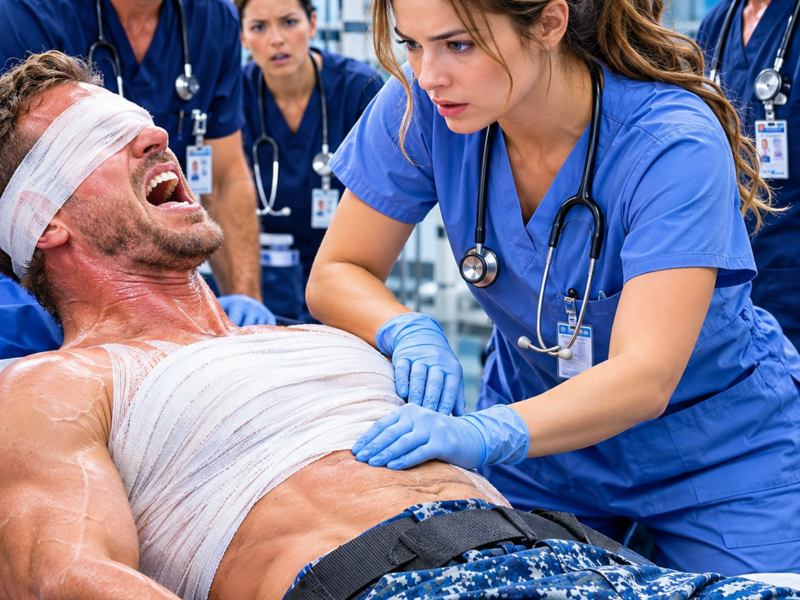
“I watched a Navy chief throw two hospital orderlies across a trauma bay, blood running beneath the bandages covering his eyes
viết task 2 có The end ở cuối
The first thing I did was smile at Captain Peterson.
Not because I trusted him.
Because I needed him to believe I did.
“Of course, sir,” I said, stepping away from Logan’s bed. “I’ll finish my charting.”
Peterson gave me a small nod.
“Good. And Nurse Stone?”
I turned.
“Yes, sir?”
“Don’t discuss anything the patient said with anyone. His condition is extremely sensitive. Understood?”
“Absolutely.”
He held my gaze for another second before turning toward the monitors.
I walked out of the room without looking back.
Only when the elevator doors closed did I realize my hands were trembling.
Three years.
Three years of telling myself that the men I’d lost were gone because war was unpredictable, because bad intelligence happened, because sometimes even the best-trained people couldn’t prevent a tragedy.
Now a wounded man had whispered one name.
Peterson.
And I had a feeling that name had been sitting inside my nightmares all along.
I waited until the shift change before going to the staff locker room.
The room smelled of disinfectant, old coffee, and damp uniforms.
I locked myself in the last stall, sat on the closed toilet lid, and took the olive-green bracelet from my pocket.
I’d removed it from Logan’s wrist while adjusting his IV.
I’d left a hospital identification band in its place, hoping nobody would notice the difference.
The paracord was stiff with dried blood.
I turned it beneath the fluorescent light.
At first, it looked exactly as I remembered.
Then I felt the knots.
There were extra knots woven between the original cobra stitches.
Small, tight overhand knots that didn’t belong there.
My breathing changed.
Years earlier, our team had developed a simple communication system for situations when radios were compromised and written notes could be intercepted.
Short knots represented numbers.
Double knots marked breaks.
We’d used it to communicate coordinates, times, and short coded messages.
I’d invented the system during a long night in Bahrain.
The others had laughed at me until they realized it worked.
Logan had been particularly enthusiastic.
“Doc, you realize you’re making us all learn knitting, right?”
I’d thrown a sock at him.
Now I was counting knots under the light of my phone.
The first group gave me four letters.
WFLU.
The next group was a seven-digit container number.
4418207.
Then came a date, three weeks away.
The final group took longer.
I counted twice, checked the spacing, and translated each number into letters.
One name appeared.
PETERSON.
I stared at it until the letters seemed to blur.
West Freight Logistics.
I knew that company.
It was a commercial shipping contractor operating out of the Port of San Diego, with Navy contracts involving medical supplies and overseas deliveries.
Medical supplies.
I looked down at the bracelet again.
Three years earlier, our convoy had been sent into the mountains to investigate an intelligence report involving stolen weapons.
We’d been told the weapons were coming through an illegal supply route.
Instead, we found American-made rifles with their serial numbers ground away.
Our convoy was attacked before we could secure the shipment.
The route had been compromised.
Nine men died.
One of them was nineteen-year-old Seaman Dylan Ortiz.
I had pulled Dylan from a burning vehicle.
He was conscious when I reached him.
He kept asking whether his mother would be told he’d done his job.
I’d promised him she would.
I had kept that promise.
But I’d never been able to answer the question he’d asked just before he died.
“Doc, how did they know where we were?”
Now I might finally know.
My phone vibrated.
A message from Wanda appeared.
“Where are you? Captain Peterson wants every nurse off the fourth floor except the two he selected. Something isn’t right.”
I typed back.
“Stomach trouble. I’ll be back shortly.”
Then I opened a contact I hadn’t touched in three years.
Commander Nathan Garcia.
He had been our commanding officer before the operation that destroyed our team.
He’d tried to contact me after my discharge.
I’d never answered.
I pressed call.
He picked up on the second ring.
“Garcia.”
“Sir, it’s Chelsea Stone.”
Silence.
Then a quiet breath.
“Stone?”
“Yes, sir.”
“Good Lord. I’ve been trying to reach you for three years.”
“I know.”
“Are you all right?”
I looked at the bracelet.
“No, sir. But I need you to listen carefully.”
I told him about Logan.
I told him about Peterson.
I gave him the container number and the date.
When I finished, he didn’t speak for several seconds.
“Do you understand what you’re telling me?”
“Yes, sir.”
“Peterson is a Navy captain. He’s been cleared through every security review for years.”
“Logan recognized his voice.”
“That isn’t enough to make an arrest.”
“I know.”
“And a shipping number isn’t proof of a murder conspiracy.”
“I know that too.”
Garcia exhaled.
“Then what do you have?”
I looked at the bracelet again.
“A witness, a coded message, and a man who wants to kill the witness.”
“Stone, I need you to stay away from Peterson.”
“Sir, he’s already in the room with Logan.”
“Then get another nurse in there.”
“He chose the nurses on that floor himself.”
The silence returned.
Finally, Garcia spoke.
“I’m contacting NCIS. Don’t confront him. Don’t attempt to recover anything. Keep Logan alive and stay where people can see you.”
“Understood.”
“And Chelsea?”
“Yes, sir?”
“You’re not back on that team. You don’t have to prove anything to me.”
I closed my eyes.
“I know, sir.”
But we both knew I wasn’t going to walk away.
An hour later, I returned to the fourth floor.
The two nurses Peterson had selected were sitting at the station.
Neither looked particularly comfortable.
One of them, a young man named Tyler, glanced at me.
“Captain Peterson said nobody was supposed to go into Myers’ room without his approval.”
“Did he say why?”
“He said it’s a security issue.”
I checked the medication cart.
There was something strange about the room assignment.
Logan had been moved to a private ICU room, but his monitoring orders had been changed.
His neurological observations were supposed to be performed every fifteen minutes.
The new chart showed every hour.
I checked the electronic record.
The change had been authorized under Peterson’s credentials.
I restored the original observation schedule and documented the correction.
Then I went to Logan’s room.
He was sleeping.
His breathing was shallow but regular.
I checked his pulse, his IV lines, and the dressing around his abdomen.
The replacement identification band was still on his wrist.
I carefully lifted it and checked the skin underneath.
The bracelet had left a faint green mark.
I put the band back down.
“Stay with me, Chief,” I whispered.
He didn’t move.
I was about to leave when I noticed something on the bedside table.
A folded piece of paper.
It hadn’t been there earlier.
I opened it.
There were only six words.
“Stop looking. You already lost enough.”
No signature.
No explanation.
I looked toward the hallway.
Nobody was there.
I folded the paper and slipped it into my pocket.
Then I made a decision.
I wasn’t going to investigate Peterson alone.
I was going to make sure he knew I had stopped being afraid of him.
At 11:40 that night, Wanda found me checking Logan’s medication chart.
She stood beside me with her arms folded.
“You’re a terrible liar, Chelsea.”
I looked up.
“Excuse me?”
“You’ve been acting strangely all day. You haven’t eaten. You keep checking the hallway. And you look at Captain Peterson like you’re waiting for him to pull a knife.”
I said nothing.
Wanda lowered her voice.
“Twenty-two years in this hospital. I’ve seen frightened families, dying sailors, doctors who can’t handle losing a patient, and administrators who think a badge makes them untouchable.”
She pulled a chair closer.
“I don’t know what happened to you before you came here, but I know you’re not telling me everything.”
I looked at her.
“Would you believe me if I told you a Navy captain was trying to kill one of his own patients?”
Wanda didn’t laugh.
She didn’t even look surprised.
“Show me.”
I placed the folded paper on the desk.
Then I told her about the bracelet.
I didn’t explain every detail of my former assignment, but I told her enough.
When I finished, she sat quietly.
“Peterson chose the staff on that floor?”
“Yes.”
“Changed the observation schedule?”
“Yes.”
“And left you a threat?”
“Yes.”
Wanda rubbed her forehead.
“That man has been in this hospital longer than I’ve been a nurse.”
“I know.”
“He’s treated hundreds of people.”
“I know.”
She looked toward Logan’s room.
“Then we need to be absolutely certain.”
I nodded.
“That’s why I called someone.”
“Who?”
“Commander Garcia. He’s contacting NCIS.”
Wanda stared at me for a moment.
Then she stood.
“All right. Until they get here, nobody enters that room without one of us knowing.”
I almost smiled.
“Thank you.”
“Don’t thank me. I’m too old to enjoy being involved in whatever this is.”
At 12:36 a.m., my phone vibrated.
A message from Garcia.
“NCIS team en route. Keep your phone available. Do not initiate contact with Peterson.”
I read it twice.
Then I looked at the clock.
Twenty-four minutes.
I went to Logan’s room and checked his monitors.
His blood pressure had dropped slightly.
I called the ICU physician and reported the change.
The physician ordered repeat bloodwork and another assessment.
Everything was documented.
At 1:15, Peterson appeared at the nurses’ station.
He was wearing his white coat.
His hair was neatly combed.
He looked exactly like the kind of doctor families trusted with their children’s lives.
“How’s our patient?”
Wanda answered before I could.
“Stable, sir.”
“Good.”
His eyes moved to me.
“Nurse Stone, a word.”
I followed him into the corridor.
He stopped beside a window overlooking the parking lot.
“How long have you been working here?”
“Nineteen days, sir.”
“And before that?”
“School. Clinical rotations.”
He nodded.
“Your personnel file says you served in the Navy.”
“Yes, sir.”
“What did you do?”
“Medical support.”
“Where?”
“Several places.”
His smile was faint.
“That’s rather vague.”
I kept my expression neutral.
“My discharge records are available through the appropriate channels.”
“Of course.”
He looked through the window.
“Do you know what happens to people who spend too long in combat?”
I didn’t answer.
“They begin to see enemies everywhere. They mistake coincidence for conspiracy. They believe every uncomfortable feeling is a warning.”
He turned toward me.
“Sometimes they become dangerous to themselves and others.”
I looked at him.
“Are you talking about Chief Myers?”
“I’m talking about you.”
For a moment, neither of us spoke.
Then he leaned closer.
“Stay away from his medical records. Stay away from his belongings. And stop pretending you know more than you do.”
I lowered my eyes.
“Yes, sir.”
He walked away.
I waited until he turned the corner.
Then I checked my phone.
Garcia had sent another message.
“Team delayed at main entrance. Hospital security requesting authorization. Stand by.”
My stomach tightened.
Peterson was already inside the hospital.
And he knew something was happening.
At 1:52 a.m., I went back to Logan’s room.
He was awake.
His eyes were still covered, but his head turned when I entered.
“Doc?”
I approached the bed.
“I’m here.”
“Is it dark?”
“Not completely. You’re in your room.”
He swallowed.
“Did you read it?”
“The cord?”
He nodded.
“Yes.”
“Then you know.”
“I know Peterson’s name was in the message.”
His fingers moved across the blanket.
“There’s more.”
I leaned closer.
“Tell me.”
He took a shallow breath.
“The container isn’t the shipment.”
“What do you mean?”
“Container’s a decoy. The real cargo moves after inspection.”
My mind raced.
“Where?”
“Another manifest. Same company. Different number.”
“Do you remember it?”
He struggled to speak.
“Not the whole thing.”
“Logan, listen to me. You need to rest.”
“Ren…”
“I’m here.”
“Don’t let him get the ledger.”
“What ledger?”
He reached toward my hand.
“The names. Payments. Routes. Everybody.”
His fingers closed around mine.
“I hid it.”
“Where?”
His lips moved.
I leaned closer.
“Logan?”
“Not here.”
His grip tightened.
“Somebody else has it.”
Before I could ask another question, the monitor began alarming.
I called for assistance.
The ICU physician arrived within seconds, followed by Wanda.
Logan’s blood pressure was dropping again.
We began the emergency assessment.
Peterson appeared in the doorway.
“What happened?”
“Sudden hypotension,” I said. “We’re checking for internal bleeding.”
He stepped toward the bed.
“Move aside.”
The physician shook his head.
“Captain, I have this.”
Peterson looked at me.
“Stone, step out.”
I didn’t move.
“Sir, I’m assigned to this patient.”
“That’s an order.”
Wanda moved beside me.
“She’s assisting with the assessment.”
Peterson’s expression hardened.
For a moment, I thought he would argue.
Then he looked at the monitor and stepped back.
The physician ordered another blood transfusion.
The next twenty minutes were spent stabilizing Logan.
By 2:30 a.m., his blood pressure was improving.
Peterson left without saying another word.
I knew he was running out of time.
And I knew he was becoming desperate.
At 2:47, a message appeared on my phone.
“Do not approach the patient. We are inside the building.”
It was Garcia.
I looked toward the stairwell.
A woman in a dark jacket was speaking quietly with hospital security.
She wore an NCIS badge.
Behind her stood two men in plain clothes.
Garcia was with them.
He looked older than I remembered.
His hair had turned almost completely gray, and there were deeper lines around his eyes.
But when he saw me, his expression changed.
“Stone.”
“Commander.”
He looked toward Logan’s room.
“Is he alive?”
“Yes, sir.”
“Can he talk?”
“Not for long.”
Garcia nodded.
The NCIS agent introduced herself as Special Agent Melissa Grant.
She was in her early forties, with dark hair pulled into a tight bun and a voice that carried no unnecessary emotion.
“Do you have the coded bracelet?”
I handed it to her.
She examined it carefully.
“This is enough to establish a lead. Not enough to establish the entire case.”
“Logan says there’s a ledger.”
“Where is it?”
“He doesn’t know yet. He says somebody else has it.”
Grant looked at Garcia.
“We need to secure Myers and preserve all medical records.”
Garcia nodded.
“Then let’s do it.”
But before they could move, the elevator doors opened.
Captain Peterson stepped out.
He was holding a medical tray.
On it sat a syringe and a small vial.
His expression changed when he saw the NCIS agent.
“What is this?”
Grant showed him her badge.
“Captain, we need to speak with you.”
Peterson looked at Garcia.
Then at me.
Then at the room behind us.
“Is this about the patient?”
“We’ll explain everything in a moment.”
Peterson set the tray down.
“There’s a patient in critical condition. I need to attend to him.”
Grant stepped between him and the door.
“Not yet.”
His voice became sharper.
“You have no authority to interfere with patient care.”
“Actually, Captain, we do.”
For several seconds, nobody moved.
Then Peterson looked at me.
“You did this.”
I didn’t answer.
He gave a small, bitter smile.
“After everything I’ve done for this hospital, you think a former corpsman and a confused patient can destroy my career?”
Garcia stepped forward.
“This isn’t about your career.”
Peterson’s eyes narrowed.
“Then what is it about?”
Grant held up the bracelet.
“West Freight Logistics. Container WFLU 4418207. A coded payment account connected to your name.”
Peterson laughed.
It sounded almost genuine.
“That’s absurd.”
“Then you won’t mind answering some questions.”
He looked toward the hallway.
“I want the hospital commander.”
“You can speak with him after we secure the patient.”
Peterson’s jaw tightened.
Then he looked at me again.
“Do you even understand what you’ve gotten yourself into?”
I met his eyes.
“More than you think.”
He was silent.
For the first time since I’d met him, he looked genuinely uncertain.
Grant instructed the security officers to remain with him while she and Garcia went into Logan’s room.
I followed.
The syringe remained on the tray.
Grant noticed it.
“Captain, what is this medication for?”
Peterson didn’t answer.
The ICU physician examined the vial.
His expression changed.
“That’s potassium chloride.”
Grant looked at him.
“Why is it on the tray?”
Peterson spoke quickly.
“It was prepared for another patient.”
“Which patient?”
He didn’t answer.
The physician checked the label.
There was no patient name.
No dosage.
No administration time.
Nothing.
Grant turned to the security officers.
“Secure the tray. Photograph everything.”
Peterson took one step backward.
One of the officers blocked his path.
“Sir, please remain here.”
Peterson looked around the corridor.
Then he lowered his head.
For a few seconds, I thought he might finally understand that it was over.
But he suddenly lunged toward the tray.
The officer caught his arm before he reached it.
The syringe fell.
It struck the floor and broke.
“Get your hands off me!” Peterson shouted.
Two more officers rushed forward.
They forced him against the wall and secured his wrists.
His white coat slipped from one shoulder.
A nurse standing at the far end of the corridor covered her mouth.
Wanda stared at him with tears in her eyes.
Peterson turned his head toward me.
“You have no idea what you’ve done.”
I looked at the broken syringe on the floor.
“Neither did Dylan Ortiz.”
For the first time, he had no answer.
The arrest happened at 3:18 a.m.
But the truth was still incomplete.
Peterson refused to speak.
He denied the shipping company.
He denied the coded account.
He denied knowing anything about the operation that had killed our team.
He claimed Logan was confused and that I was suffering from combat-related trauma.
The hospital placed him on administrative leave pending investigation.
NCIS took possession of his office, computer, and medical records.
Logan remained under close supervision.
And I stayed beside him.
At sunrise, Garcia found me sitting outside the ICU.
He handed me a paper cup of coffee.
“You look terrible.”
“I’ve been told.”
He sat beside me.
For a while, neither of us spoke.
Then he said, “I owe you an apology.”
I looked at him.
“For what?”
“For not finding the leak three years ago.”
I stared at the coffee.
“You didn’t know.”
“I was responsible for those men.”
“So was I.”
He turned toward me.
“Don’t do that.”
“Do what?”
“Take responsibility for something that wasn’t yours to carry.”
I didn’t answer.
Garcia leaned back.
“Nine men died that night. You were the only one who made it back alive with a clear enough memory to tell us what happened.”
“I wasn’t the only one.”
“Logan was missing for three years.”
I looked through the glass at his room.
“He’s here now.”
“Yes.”
Garcia placed a hand on my shoulder.
“And so are you.”
I looked away before he could see my eyes fill.
Two days later, the shipping container was located at the Port of San Diego.
The manifest listed medical gauze, surgical dressings, and emergency supplies.
The inspection team discovered a false floor.
Beneath it were 140 rifles.
Every serial number had been ground away.
The weapons were American-made.
Exactly like the ones we’d found three years earlier.
But the discovery was only the beginning.
The container number had been deliberately entered into the system as a decoy.
The real shipments had moved through a second logistics channel, using medical supply deliveries to conceal weapons transfers.
NCIS found payments routed through shell companies.
One account led to a shipping executive.
Another led to a retired Navy officer.
A third belonged to a financial consultant who had been processing payments for years.
And then they found the ledger.
It wasn’t in the hospital.
It wasn’t in Logan’s belongings.
It was inside a storage unit in Chula Vista, registered under the name of a woman who had died eighteen months earlier.
Logan had given the unit number to a fellow team member before their final operation.
That man had survived.
His name was Marcus Reed.
He had been medically discharged after suffering severe injuries during the attack.
For three years, he’d lived quietly in Arizona.
He had kept the ledger because he knew that if the information ever became public, the people responsible would come looking for him.
When NCIS contacted him, he initially refused to cooperate.
Then he heard that Logan was alive.
He drove to San Diego that same night.
I was in Logan’s room when Marcus entered.
He was taller than I remembered, thinner around the face, and walked with a slight limp.
He stopped at the doorway.
“Well, I’ll be damned.”
Logan turned his head.
“Marcus?”
“Still ugly, Chief.”
Logan laughed weakly.
“Thought you were dead.”
“People keep saying that about me.”
Marcus approached the bed.
For a moment, the two men simply looked at each other.
Then Marcus placed a hand on Logan’s shoulder.
“I should’ve found you sooner.”
“You didn’t know where I was.”
“I should’ve looked harder.”
Logan shook his head.
“Don’t.”
Marcus glanced at me.
“Doc.”
I managed a small smile.
“Marcus.”
He reached into his jacket and pulled out a small envelope.
“This is what you wanted.”
Logan’s expression changed.
“Everything?”
“Every name. Every payment. Every shipment.”
Marcus placed it in the hands of Special Agent Grant, who had accompanied him.
“There’s enough here to bury half the people who signed those manifests.”
Grant opened the envelope.
Inside were copies of financial transfers, shipment schedules, handwritten notes, and photographs of meetings.
One photograph showed Peterson standing beside a West Freight executive at a private dock.
Another showed a naval officer handing an envelope to a man whose face I recognized immediately.
I had seen him three years earlier.
He had attended our mission briefing.
He had told us the route was safe.
His name was Commander Alan Whitmore.
I looked at Garcia.
He stared at the photograph without speaking.
“That’s impossible,” he finally said.
Grant studied him.
“Do you know him?”
Garcia nodded slowly.
“He was the intelligence officer who approved our route.”
The room seemed to become smaller.
Peterson hadn’t simply helped move weapons.
He had been part of the chain that had sent our team into an ambush.
The investigation expanded overnight.
Several officers were suspended.
Search warrants were issued.
Financial records were subpoenaed.
And for the first time, the families of the nine men who had died were given an explanation that wasn’t buried beneath classified language.
Peterson was eventually charged with conspiracy, weapons trafficking, obstruction of justice, and attempted murder.
The evidence against him included the recorded conversation, the shipping records, the financial ledger, and the medication prepared in Logan’s room.
He pleaded not guilty.
His attorneys argued that he had been acting under pressure from other officers.
They claimed he had never intended to harm Logan.
But the evidence told a different story.
During the trial, Logan testified.
He was still recovering.
His eyesight had returned partially, and he needed assistance walking into the courtroom.
But when the prosecutor asked whether he recognized Peterson’s voice, he answered without hesitation.
“I’d recognize that voice in a burning building.”
Then he identified the captain.
Peterson stared straight ahead.
Logan told the jury about the briefing.
He described the weapons shipment, the altered route, and the moment he realized their location had been compromised.
He explained how he’d hidden the ledger’s existence and encoded the container information in the bracelet.
When the prosecutor asked why he’d chosen to trust me, Logan looked toward the courtroom gallery.
“Because she was the only person who ever treated us like human beings instead of equipment.”
I lowered my head.
I didn’t want anyone to see my face.
The trial lasted six weeks.
Peterson was convicted.
Several other men involved in the operation were also charged.
The investigation confirmed that the weapons network had been operating for years, using legitimate military supply contracts to hide illegal shipments.
Peterson received a lengthy federal prison sentence.
Commander Whitmore was convicted on separate charges.
And the nine families finally learned that their sons and husbands hadn’t died because of a careless mistake or an unfortunate coincidence.
Someone had sold their lives for money.
But justice didn’t bring those men back.
It didn’t erase the empty chairs at family tables.
It didn’t make Dylan Ortiz’s mother stop keeping his room exactly as he’d left it.
And it didn’t give me back the three years I’d spent believing I had somehow failed everyone.
The hardest part came after the trial.
Logan was discharged from the hospital six weeks after his arrival.
His eyesight was improving, although the doctors warned that full recovery could take time.
On his final morning, I found him sitting in a chair beside the window.
Sunlight fell across his hands.
He was holding the bracelet.
I’d cleaned it carefully and repaired the damaged knots.
The brass bead had been polished until it shone.
“Still carrying that thing?” I asked.
He smiled.
“Sentimental value.”
“You called it ugly when I gave it to you.”
“It was ugly.”
“Then why keep it?”
He looked down at the cord.
“Because you made it.”
I sat beside him.
For a while, neither of us spoke.
Then he asked the question I’d been avoiding.
“Why did you leave?”
I looked at the sunlight on the floor.
“I couldn’t do it anymore.”
“Do what?”
“Be the person everyone expected me to be.”
He nodded slowly.
“After Dylan?”
“After all of you.”
Logan turned the bracelet between his fingers.
“You know what I remember about that night?”
I shook my head.
“I remember waking up in the ditch. I remember the smoke. I remember hearing somebody calling for help.”
He paused.
“And I remember you crawling through the mud toward me.”
My eyes burned.
“You were bleeding.”
“You were too.”
“I was fine.”
He gave me a look.
“You always said that.”
I laughed softly.
He looked toward the window again.
“Doc, you didn’t lose us.”
I stared at my hands.
“I couldn’t save Dylan.”
“No. You couldn’t.”
His answer was gentle, but it hurt more than a comforting lie would have.
“Neither could I,” he continued. “Neither could Marcus. Neither could Garcia. We all wanted to.”
He reached for my hand.
“But you stayed with him. You listened. You promised his mother would know he was brave.”
I swallowed.
“She deserved the truth.”
“She got it because you kept going.”
I looked down at the bracelet.
For three years, I’d thought leaving the military meant I’d abandoned the people I’d served with.
I had believed that if I stopped being Wren, the memories might eventually stop following me.
But Logan had never asked me to become that person again.
He had only needed someone he trusted.
And I’d been there.
A week later, I visited Dylan Ortiz’s mother.
Her name was Margaret.
She lived in a small house outside Oceanside, with a white fence and a garden full of roses.
I’d visited her once after the operation, before my discharge.
I hadn’t returned.
She opened the door and recognized me immediately.
“Chelsea.”
Her voice trembled.
I couldn’t find the right words.
She stepped forward and hugged me.
For a long moment, neither of us moved.
Then she invited me inside.
Dylan’s photograph still stood on the mantel.
He was smiling in his uniform, looking impossibly young.
Margaret brought out a box of letters and photographs.
“I heard about the trial,” she said.
“They told me what happened.”
She nodded.
“I’ve waited three years to know why.”
I looked at Dylan’s photograph.
“I’m sorry.”
She reached across the table and took my hand.
“You don’t have to apologize for bringing him home in your heart.”
I began to cry.
She did too.
We sat together for nearly two hours, remembering a nineteen-year-old boy who loved baseball, hated broccoli, and had once called his mother from overseas just to ask how her tomato plants were doing.
Before I left, Margaret handed me a small envelope.
Inside was a photograph of Dylan standing beside the rest of our team.
He had one arm around Logan.
I was in the background, laughing at something outside the frame.
On the back, Margaret had written:
“Thank you for remembering my son as more than the way he died.”
I kept that photograph on my kitchen table.
Months passed.
I returned to work at Naval Medical Center San Diego.
I didn’t return to the special warfare unit.
I didn’t need to.
I was still a nurse.
Wanda eventually stopped calling me the new girl.
She started calling me Stone, usually when she needed someone to handle a difficult patient.
One afternoon, a frightened young sailor arrived in the emergency department after a training accident.
He was shaking so badly he couldn’t answer the doctor’s questions.
His parents stood nearby, looking terrified.
The young man kept asking whether he was going to die.
The other nurses were trying to calm him down.
I approached the bed and rested my hand on the rail.
“Hey. Look at me.”
He turned toward my voice.
“What’s your name?”
“Matthew.”
“All right, Matthew. I’m Chelsea. I’m going to stay right here while we figure this out.”
His breathing slowed slightly.
“Am I going to be okay?”
I looked at the monitor, then back at him.
“We’re going to take care of you. One thing at a time.”
He nodded.
I pulled a blanket over his shoulders.
And as I did, I noticed Wanda watching me from the doorway.
She smiled.
Later that evening, I found the old paracord bracelet in my locker.
I had thought about putting it away somewhere safe.
Instead, I tied it around the handle of my locker door.
The green cord was faded.
The brass bead was scratched.
The knots were still there.
A reminder of the men who had trusted me.
A reminder of the man who had survived.
And a reminder that being brave didn’t always mean running toward gunfire.
Sometimes it meant walking into a hospital room when everyone else had given up.
Sometimes it meant telling the truth when a powerful man wanted silence.
And sometimes it meant allowing yourself to stay when the memories told you to run.
I still thought about those nine men.
I still missed them.
But I no longer believed that leaving the battlefield meant leaving them behind.
One evening, as I was finishing my shift, my phone buzzed.
A message from Logan appeared.
“Doc. Cold hands?”
I smiled and typed back.
“Always. You know the rules.”
A few seconds later, he replied.
“Warm them first.”
I slipped the phone into my pocket and walked down the quiet hospital corridor.
Outside, the San Diego sky was turning orange over the Pacific.
For the first time in three years, I didn’t feel like I was running away from my past.
I felt like I had finally found a place where I could carry it without letting it carry me.
And somewhere in a small house outside Oceanside, Dylan Ortiz’s mother had his photograph beside her roses.
He was still nineteen in that picture.
Still smiling.
Still surrounded by the people who had loved him.
I couldn’t save every life.
But I could make sure his was never reduced to a number in a report.
The End.









