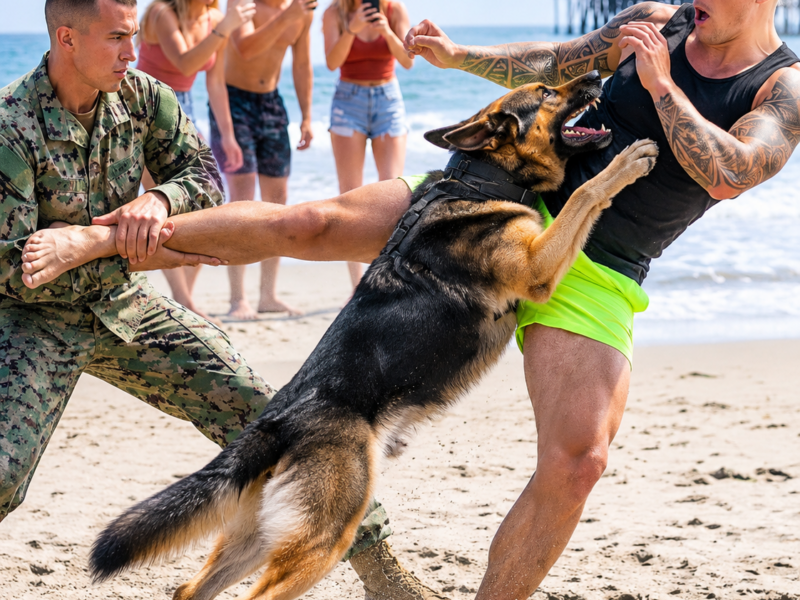
“I watched a muscle-bound MMA influencer raise his boot toward my German Shepherd on a crowded Florida beach, then laugh when I told him to back off
“Operation Harbor Ghost,” Blake whispered. “Mason said the dog was never supposed to survive.”
For several seconds, I couldn’t hear the waves.
The words seemed to hang between us, heavier than the humid Florida air.
I looked at Blake.
“Who told you that?”
He shook his head, glancing nervously toward the black SUV.
“I don’t know what you think this is, but I swear I didn’t know who you were until I saw your tattoo.”
“Then start explaining.”
Blake rubbed the back of his neck.
His two friends had stopped recording. One of them was slowly lowering his phone.
The SUV stopped near the beach access gate.
Its engine remained running.
I looked down at Rex.
His ears were forward, his body rigid.
He was no longer watching Blake.
He was watching the vehicle.
I had seen that posture before.
Four years earlier, in a place where the air smelled of diesel fuel and burning electrical wires, Rex had stood exactly like that before a door opened.
I had learned to trust him long before I learned to trust most people.
“Blake,” I said quietly. “Get your friends behind me.”
He stared at me.
“What?”
“Now.”
For once, he didn’t argue.
A man stepped out of the SUV.
He was in his late forties, wearing a light blue polo shirt, khaki pants, and expensive sunglasses.
He looked like someone who belonged on a golf course rather than a beach.
He closed the vehicle door and adjusted his watch.
Then he smiled.
“Well, well. Daniel Hayes.”
I hadn’t heard my full name spoken that way in years.
I kept my hand on Rex’s collar.
“Mason.”
The man removed his sunglasses.
He was older than I remembered, but I recognized the narrow scar running from his left temple toward his cheek.
Mason Reed had been a civilian logistics contractor attached to our unit during our final deployment.
He had managed equipment, transport schedules, and communications between military personnel and several private contractors.
He had also been the last person I remembered seeing before our operation went wrong.
“What a coincidence,” Mason said.
I didn’t smile.
“Is it?”
He glanced at Rex.
“Still keeping that old dog around?”
Rex gave a low growl.
Mason’s smile weakened.
“Easy there.”
I stepped between them.
“Don’t talk to him.”
Mason raised both hands.
“Relax, Daniel. I’m not here to cause trouble.”
“Then you picked a strange way to introduce yourself.”
His gaze moved briefly toward Blake.
“You’ve been filming again?”
Blake looked uncomfortable.
“I wasn’t expecting this.”
Mason sighed.
“You’re always doing things you don’t understand.”
Something about the way he spoke to Blake bothered me.
It wasn’t the tone of a stranger correcting another stranger.
It sounded like someone dealing with an employee who had made an expensive mistake.
I looked at Blake.
“How do you know him?”
Blake hesitated.
Mason answered for him.
“Business.”
“What kind of business?”
“Fitness sponsorships. Security demonstrations. Content partnerships.”
I studied the SUV.
There were no company logos.
No visible license plate frame.
The rear windows were tinted almost black.
Mason noticed me looking.
“You’re retired, Daniel. You don’t need to turn every conversation into an interrogation.”
“You’re right.”
I paused.
“But you do need to explain why a man I have never met was told to identify my dog.”
Mason’s expression hardened.
“You’re making assumptions.”
I took my phone from my pocket.
“Then let’s call the police and clear everything up.”
For the first time, Mason looked genuinely irritated.
“There’s no need for that.”
“Why?”
He looked at Blake.
Then at Rex.
“Because I think we can settle this privately.”
I almost laughed.
Four years ago, Mason had used almost the same words.
Privately.
Quietly.
Without paperwork.
That was how people disappeared from official reports.
That was how mistakes became secrets.
And that was how a good man could spend years wondering whether the last mission of his career had been his fault.
I had never forgotten that night.
***
Four years earlier, our team had been operating outside a small industrial settlement.
The mission was supposed to be a routine extraction.
A local source had reported that several civilians were being held inside an abandoned warehouse.
Our team was tasked with locating the captives and securing a route for evacuation.
Rex was attached to me as a military working dog.
He had been trained to detect explosives, locate hidden individuals, and respond to commands under conditions most animals could never tolerate.
He was extraordinary.
Not because he was fearless.
Because he could be frightened and still do his job.
During the operation, our communications suddenly failed.
A vehicle exploded near the eastern entrance.
Two members of our team were injured.
I remembered carrying one of them behind a concrete barrier while Rex searched the nearby building.
Then I heard his bark.
It wasn’t his normal alert.
It was the sharp, repeated bark he used when he had found someone alive.
I followed him through a narrow service corridor.
Behind a metal storage door, we found a young woman and a little boy.
The woman was unconscious.
The child was awake, holding a small stuffed rabbit.
Rex lay down beside him.
He didn’t move until I reached them.
I still remembered the boy’s fingers gripping Rex’s fur.
He had been crying so hard he could barely speak.
“Is he going to eat me?”
I told him no.
I told him Rex was there to help.
We got them out.
But something happened during the evacuation.
A security camera had recorded a man entering the warehouse shortly before the explosion.
The footage was incomplete, but I recognized his jacket.
It belonged to a contractor working under Mason’s logistics division.
When I reported what I had seen, Mason told me the camera system had malfunctioned.
He said the contractor had already been cleared.
I didn’t believe him.
Before I could investigate further, our unit received orders to leave the area.
The official report blamed a communications failure and an unexpected explosive device.
The civilians we rescued were transferred to another facility.
The contractor was never mentioned again.
And Rex?
Rex had been injured during the evacuation.
A piece of metal had cut his shoulder, and he had suffered damage to one of his front legs.
The military veterinarian eventually cleared him for retirement.
I brought him home.
I thought that chapter was finished.
Then, six months later, I received a notice that several mission records had been sealed pending an internal review.
I contacted the appropriate people.
I filed requests.
I waited.
Nothing happened.
Eventually, I stopped asking.
Not because I had forgotten.
Because I had a dog to care for, a civilian life to rebuild, and too many memories that refused to stay quiet.
Now Mason Reed was standing in front of me on a Florida beach.
And he knew Rex.
***
“Daniel?”
Blake’s voice pulled me back to the present.
He was looking at me with an expression I couldn’t quite read.
Mason took a step closer.
“Let’s get out of the sun. We can talk somewhere comfortable.”
“No.”
His eyebrows lifted.
“No?”
“You can talk right here.”
Mason glanced at the growing group of beachgoers.
Several people were still recording.
A father had moved his children farther away.
An older woman stood beside her umbrella, holding her phone against her chest.
Mason didn’t like having an audience.
I could tell.
“Fine,” he said. “But you’re misunderstanding what happened.”
He turned toward Blake.
“Tell him.”
Blake swallowed.
“Tell him what?”
“About the project.”
Blake looked down.
Mason’s voice became sharper.
“Now.”
Blake took a breath.
“I was hired to make promotional videos for a private security company. They wanted demonstrations involving trained dogs.”
I kept my eyes on him.
“What does that have to do with Rex?”
“Nothing at first.”
“Go on.”
Blake rubbed his palms against his shorts.
“They gave me a list of dogs that had been used in military programs. Retired dogs. Working dogs. Dogs that had been involved in certain operations.”
My jaw tightened.
“Why?”
“To find animals that could be used for demonstrations. They said they wanted to show how easily a dog could be provoked into attacking someone.”
I looked at Mason.
He didn’t deny it.
Blake continued.
“I was told the dog on the list was called Rex. German Shepherd. Black and tan. Retired from military service.”
“Who gave you the list?”
“Mason’s company.”
Mason stepped forward.
“That’s enough.”
But Blake wasn’t finished.
“They told me if I found him, I should test his response to a sound device.”
I looked at his pocket.
“The object you were holding?”
Blake nodded.
“Yes.”
“What’s it supposed to do?”
“I don’t know exactly. They called it a behavioral response unit.”
I had heard enough corporate language to know when someone was hiding behind it.
“Did you use it on other dogs?”
Blake looked away.
“Once.”
“What happened?”
His voice dropped.
“The dog panicked. It hurt itself trying to get away.”
Mason interrupted.
“That was an isolated training incident.”
Blake turned toward him.
“You told me the animal was fine.”
“Because it was.”
“You said it didn’t matter.”
“Blake.”
The warning in Mason’s voice was unmistakable.
I looked at Blake.
“Did you know the device could hurt Rex?”
He shook his head.
“I thought it was just a loud sound.”
“Then why did you raise your boot at him?”
Blake didn’t answer.
His eyes moved toward the people recording.
Finally, he said, “I wanted him to react. They told me it would make the footage more dramatic.”
The admission landed harder than I expected.
Not because I was surprised that someone would mistreat an animal for attention.
Because Blake had looked directly into a camera while doing it.
He had expected strangers to laugh.
He had expected Rex to become entertainment.
Mason sighed.
“This is getting ridiculous.”
I turned toward him.
“Why was Rex on your list?”
Mason’s expression became unreadable.
“Because he was part of a historical project.”
“What project?”
“An evaluation of military working dog programs.”
“Four years after the mission?”
“Some records take time to review.”
I watched him for several seconds.
Then I asked the question I had been holding back.
“Was the warehouse explosion connected to your contractor?”
Mason’s face changed.
Only slightly.
But enough.
“I don’t know what you’re talking about.”
“Your contractor was on camera.”
“That footage was never authenticated.”
“Because it disappeared.”
“Because it was corrupted.”
I nodded slowly.
“That’s an interesting coincidence.”
Mason took another step closer.
“Listen carefully. You’re retired. You have a good life. You have your dog. Whatever happened overseas is finished.”
I looked at Rex.
His muzzle had gone gray.
His front leg still stiffened when he walked too long.
He had earned every peaceful morning he had ever received.
Mason had no right to tell me what was finished.
“Then why are you here?”
He lowered his voice.
“Because you were never supposed to find out.”
The beach seemed to grow quieter around us.
Blake stared at him.
“What did you just say?”
Mason realized his mistake.
He looked toward the SUV.
Then he turned to me.
“Forget I said that.”
I pulled out my phone.
“Too late.”
***
A siren sounded in the distance.
One of the beachgoers had called the police after Blake threatened me.
Two officers approached from the parking area.
Mason immediately changed his expression.
His shoulders relaxed.
His voice became polite.
“Officers. Thank goodness. There’s been a misunderstanding.”
I kept my hands visible.
Blake looked like he wanted to disappear into the sand.
The first officer asked what had happened.
Mason began speaking before I could answer.
He explained that Blake had been filming a fitness video when I became aggressive.
He claimed I had grabbed Blake without provocation.
He said Rex had frightened several families.
It was a carefully prepared story.
But there was one problem.
Half a dozen people had recorded the confrontation.
A woman in a wide-brimmed hat stepped forward.
“I have the whole thing.”
She held up her phone.
“I recorded him trying to kick that dog.”
Another man nodded.
“So did I.”
The officer looked at Mason.
“Sir, can you step away from the vehicle?”
Mason’s polite expression disappeared.
“This is absurd. Do you know who I am?”
The officer didn’t blink.
“No, sir. And right now, that doesn’t matter.”
Blake looked at his phone.
Then he looked at Mason.
“I have the messages.”
Mason turned sharply.
“What?”
Blake’s voice shook.
“The messages you sent me. The instructions. The list. Everything.”
Mason stepped toward him.
“Put your phone away.”
“No.”
It was the first time Blake had spoken to him without fear.
Mason’s jaw tightened.
“You have no idea what you’re doing.”
“Maybe not,” Blake replied. “But I know what I did to that other dog.”
The officer immediately asked him to hand over the device.
Blake hesitated.
Then he unlocked his phone and placed it in the officer’s hand.
Mason looked at me.
For the first time that morning, there was no smile on his face.
“You think this makes you a hero?”
“No.”
I looked down at Rex.
“I just want the truth.”
***
The investigation took several weeks.
The beach confrontation became public after one of the videos spread online.
People argued about Blake, his behavior, and whether his apology was genuine.
His sponsorships began disappearing.
Several companies issued statements distancing themselves from him.
But the videos weren’t the most important evidence.
It was what investigators found inside his phone.
The messages showed that Mason had arranged for Blake to locate retired military working dogs.
The stated purpose was to produce dramatic footage for a private security company’s promotional campaign.
The real purpose was less innocent.
The company had been developing a behavioral testing system designed to provoke controlled stress responses in dogs.
Its promotional material claimed the system could identify weaknesses in working animals and improve their performance.
But the instructions Blake received told a different story.
He was encouraged to provoke fear, confusion, and defensive behavior.
The company wanted footage showing dogs reacting aggressively so it could market its equipment to private security clients.
And Rex had been selected because of his history.
His old mission records contained something the company wanted.
During the warehouse operation, Rex had detected an unusual chemical compound on a contractor’s equipment.
At the time, I had assumed it was residue from the explosives used in the attack.
Later, investigators discovered that the contractor had been transporting restricted industrial chemicals through an unauthorized supply route.
The warehouse had not been selected randomly.
It had been used to store materials connected to an illegal procurement operation.
The civilians held inside had witnessed something they were never supposed to see.
The explosion was intended to destroy the evidence and make the entire incident look like an operational accident.
Rex’s alert had led us to the people who survived.
And the security footage had captured the contractor entering the building shortly before the blast.
Mason had spent years trying to keep that connection buried.
The company wanted Rex because his records could expose the old operation.
They wanted to test whether his trained response could be manipulated.
They also wanted to know whether he still reacted to the chemical marker associated with the contractor.
That was why the device had been brought to the beach.
That was why Blake had been told to look for him.
And that was why Mason had reacted with such fear when he saw Rex standing beside me.
The investigation eventually connected Mason to the contractor and several falsified logistics records.
He was arrested after investigators uncovered financial transactions and communications linking him to the cover-up.
The company lost its government contracts.
Its executives faced multiple charges.
Several former employees agreed to cooperate with investigators.
The official report from our old operation was reopened.
For the first time in four years, the families of the civilians we had rescued received a complete account of what happened that night.
I received a letter from the investigative team.
It confirmed that the communications failure had not been accidental.
Someone had deliberately interfered with our operation.
The report also cleared my team of responsibility for the explosion.
I read that paragraph three times.
Then I put the letter down.
Rex was asleep beside my chair.
His nose rested against my boot.
I reached down and scratched behind his ear.
“Looks like we weren’t imagining things, old man.”
His tail moved once against the floor.
***
Blake contacted me about a month later.
I almost ignored his message.
Then I saw that he had asked to meet in person without cameras.
We met at a small outdoor café near the marina.
He arrived alone.
No sunglasses.
No friends.
No phone held up in front of him.
He looked smaller without the performance.
“I owe you an apology,” he said.
I took a sip of coffee.
“Yes, you do.”
He nodded.
“I’ve been thinking about that morning.”
“Good.”
“I could have hurt him.”
“Yes.”
He looked down at his hands.
“I keep telling myself I didn’t know what the device really did. But that’s not an excuse.”
I didn’t respond.
He continued.
“I saw a dog, a camera, and an opportunity to get attention. I didn’t think about the animal. I didn’t think about you. I just wanted the video to go viral.”
For a moment, I saw something that looked like genuine shame.
Not the embarrassment of being caught.
The discomfort of finally seeing himself clearly.
“Why are you telling me this?” I asked.
“Because I don’t want you to think I’m only sorry because I lost sponsors.”
I studied him.
“Are you?”
He shook his head.
“I don’t know how to prove that yet.”
That was the first honest answer he had given me.
I looked toward the marina.
A couple was walking along the water with a golden retriever.
The dog stopped to investigate a palm tree while its owner waited patiently.
“Then don’t try to prove it with words,” I said.
Blake nodded.
“I understand.”
I stood up.
Before leaving, I looked back at him.
“One more thing.”
He raised his eyes.
“Never use an animal’s fear as entertainment again.”
“I won’t.”
I believed he meant it.
Whether he would live up to it was no longer my responsibility.
***
The following spring, Rex and I returned to the same beach.
I had considered avoiding it.
The memories were still there, and every time I saw a black SUV, I found myself checking the driver.
But Rex had always loved the ocean.
He liked walking along the wet sand where the waves reached his paws.
He liked watching children build sandcastles.
And he had never cared about the things that made people uncomfortable.
So we went back.
The beach was quieter that morning.
A little boy was throwing a tennis ball for his Labrador near the water.
A woman was reading under a blue umbrella.
The breeze carried the smell of salt and sunscreen.
Rex walked beside me, his pace slower than it had been when we were younger.
I noticed the stiffness in his front leg.
“Take your time, buddy.”
He stopped.
A small girl approached with her father.
She couldn’t have been older than six.
She pointed at Rex.
“Can I pet him?”
I looked at her father.
He smiled.
“Only if it’s okay with you.”
I crouched beside Rex.
“Easy, old man.”
The girl extended her hand slowly.
Rex sniffed it.
Then he leaned forward and allowed her to scratch the white fur beneath his chin.
Her face lit up.
“He’s so soft!”
Her father laughed.
“What’s his name?”
“Rex.”
“Is he a police dog?”
“Something like that.”
The little girl looked at his gray muzzle.
“Is he a superhero?”
I smiled.
“No. He’s just a very good dog.”
She considered that answer.
Then she looked at Rex and said, “I think he’s a superhero.”
Rex wagged his tail.
For the first time in months, I laughed without thinking about the past.
We stayed until the sun began to lower.
When it was time to leave, I knelt beside Rex and brushed the sand from his paws.
His eyes were tired.
His breathing was calm.
He looked at me the same way he had looked at me during our first mission together.
Trusting.
Patient.
Waiting for the next instruction.
I had spent years thinking that my duty was to protect him.
That was true.
But somewhere along the way, I had forgotten how much he had done for me.
He had helped me find people when the world was dark.
He had stayed beside me when I was injured.
He had carried me through the silence that followed retirement.
And when someone tried to turn his courage into a weakness, he had reminded me that the truth didn’t always need a loud voice.
Sometimes it only needed someone willing to stand beside it.
I clipped his leash to my belt and started toward the parking lot.
Halfway there, Rex stopped to look back at the water.
I waited.
There was no hurry.
No mission.
No radio crackling in my ear.
No orders waiting for us.
Just the ocean, the warm sand, and an old dog who had finally earned the right to walk wherever he wanted.
I rested my hand on his back.
“Come on, partner. Let’s go home.”
And this time, when Rex followed me, I knew we were both leaving the past behind.
The end.









