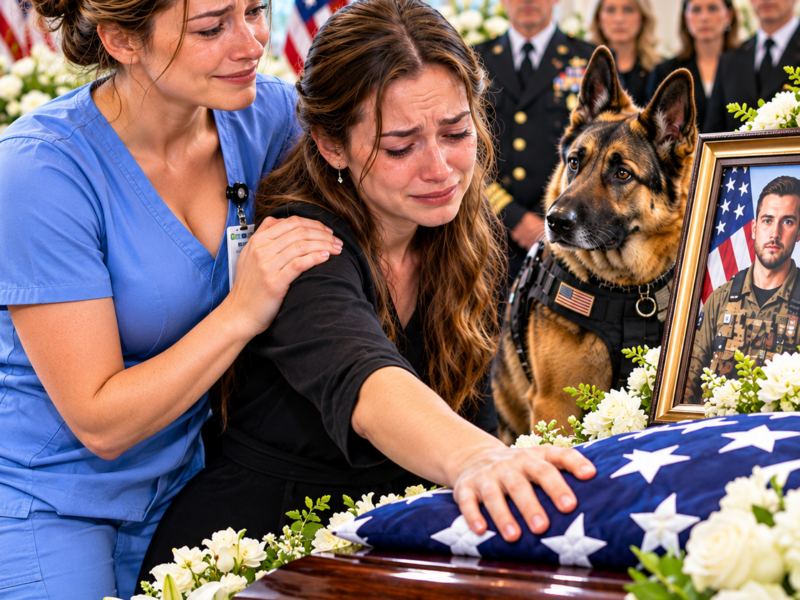
“I watched a military K9 physically block a grieving daughter from touching her Navy SEAL father’s folded burial flag, but when the dog suddenly turned toward me
The military review officer looked at the administrator override report for several seconds before placing it on the table.
“Who authorized this?” Quinton Thornberry asked.
The hospice administrator, a woman named Marlene, adjusted the collar of her jacket.
“An administrator override doesn’t necessarily indicate misconduct. We sometimes use it when a system needs maintenance.”
“Was there maintenance that night?” I asked.
Marlene looked at me.
“That information will have to be checked.”
“Then check it.”
My voice sounded calmer than I felt.
I had spent years caring for people who were approaching the end of their lives. I had learned to recognize the difference between a patient who was frightened and one who was trying to hide pain.
I had also learned that the last thing a family needed was someone turning their grief into an administrative inconvenience.
Barnaby deserved better.
And so did Eleanor.
Quinton instructed the review team to preserve the original access logs.
One officer left the room to contact hospice security.
Eleanor remained beside the table, staring at the three versions of her father’s medical record.
“Can I ask you something?” she said.
“Of course.”
“When my father asked about the flag, was he confused?”
“No.”
“You’re sure?”
I looked directly at her.
“He knew exactly what he was asking.”
She pressed her lips together.
“He told me he wanted to see it before…”
Her voice broke.
She looked down at the folded program in her hands.
“I told him we’d have plenty of time.”
I didn’t know what to say.
There are moments in hospice care when even the kindest words feel like an intrusion.
So I let her have the silence.
Then Ranger lifted his head.
The dog was still near the chapel entrance, watching the room.
He wasn’t barking or pulling at his leash.
He seemed to be waiting.
Quinton returned his attention to the evidence.
“We have the first security result.”
He placed a new report beside the override record.
“Terminal four was accessed at 8:32 p.m. using an administrator override. At 8:40, Evelyn’s nursing credentials were used to amend the medication entry.”
“Who was in the records room?” Eleanor asked.
“The camera system should tell us.”
“And the medication cabinet?”
Quinton looked at her.
“What about it?”
“If someone changed the medication record, wouldn’t they also have to change what was taken from the cabinet?”
I turned toward her.
It was a good question.
A very good one.
“Exactly,” I said.
Quinton immediately requested the medication cabinet access history.
The report arrived several minutes later.
At 8:39 p.m., Barnaby’s assigned medication drawer had been opened under my active nursing session.
Marlene pointed at the screen.
“There’s your account again.”
I leaned forward.
“Which cabinet?”
“Medication room two.”
“I wasn’t there.”
Eleanor looked at me.
“You were with my father?”
“Yes.”
“But how can your account open the cabinet if you weren’t there?”
I studied the report.
“My session was still active. I authenticated at 7:54 when I prepared his scheduled medications.”
Quinton checked the system details.
“Normally, how long would that session remain open?”
“Until automatic logout after inactivity.”
He read the next line.
“That setting was changed at 8:11.”
I looked at him.
“Changed by whom?”
“Another administrator override.”
Marlene’s expression tightened.
“That could have been a routine adjustment.”
“Was it documented?” I asked.
She didn’t answer.
Quinton requested the maintenance records.
There were none.
No system outage.
No reported malfunction.
No scheduled maintenance.
The room became uncomfortable in a way that had nothing to do with the memorial.
Eleanor looked at the administrator.
“You’re telling us someone extended Evelyn’s access, used her credentials, and opened my father’s medication drawer while she was somewhere else?”
Marlene folded her arms.
“I’m telling you the system may have been used incorrectly.”
“By someone with administrator privileges,” Eleanor replied.
Marlene looked away.
I felt Eleanor’s anger building, but I didn’t want her to settle on a suspect before we knew the facts.
“Please,” I said quietly. “Let them finish checking.”
She looked at me.
“How can you keep being so calm?”
“I’m not calm, Eleanor.”
I glanced at my name on the disputed record.
“I’m trying not to let someone else’s actions become another person’s accusation.”
A few minutes later, a security officer returned carrying a clear evidence bag.
Inside was my old access badge.
A narrow crack crossed the magnetic strip.
I recognized it immediately.
“That happened during my shift,” I said.
Quinton asked what I remembered.
“The medication room reader rejected it twice at 8:17. I reported it to the front desk and requested a temporary badge.”
“Did you receive one?”
“No. Not before Barnaby died.”
The officer checked the badge history.
“There was no temporary badge issued under your name.”
I looked at the report.
“Then somebody needs to check who was physically in the medication room.”
Quinton nodded.
The review team requested hallway footage, bedside call records, nurse station logs, and the original handwritten nursing notes.
While they waited, Eleanor walked toward the window.
She stood with her back to us.
I knew she was trying not to cry.
Her father had served his country for years.
He had spent his final months fighting an illness he knew he would not defeat.
And now, even his final medical record had become something she couldn’t trust.
I walked over but stopped a few feet away.
“Your father was very proud of you,” I said.
She gave a small, bitter laugh.
“He never said that.”
“He didn’t always use those exact words.”
“What did he say?”
I remembered Barnaby watching Eleanor leave the hospice unit one evening.
She had been late for work and had apologized three times before walking out.
He had watched the door long after she disappeared.
Then he had said, “That girl carries more responsibility than she should.”
I told Eleanor.
She lowered her head.
“He always worried about me.”
“Yes.”
“I thought I had more time to ask him about everything.”
I had no answer for that.
Neither did anyone else.
Then Quinton’s phone rang.
He listened for several seconds before asking the officer to repeat something.
“You’re certain?”
He ended the call and placed the phone on the table.
“We have the bedside call system records.”
He turned the screen toward us.
At 8:36 p.m., Barnaby had activated his call button.
At 8:38, hallway footage showed me entering his room.
At 8:41, I was still there.
The medication record had been amended at 8:40.
Eleanor stared at the timestamps.
“So she couldn’t have been in the records room.”
“Correct,” Quinton said.
Marlene leaned forward.
“She could still have provided someone with her password.”
“Then check the password reset history,” I replied.
“Check failed logins, terminal access, and who had physical access to the room.”
Quinton gave the review officer a nod.
I wasn’t interested in being believed because I was a nurse.
I wanted the evidence to speak clearly enough that nobody could twist it afterward.
The next report arrived twenty minutes later.
There had been no password reset under my name.
No failed login from my account before the disputed amendment.
But terminal four had been accessed through an administrator override.
And the session used my credentials after that.
Quinton looked at the officer.
“Who had administrator access that evening?”
The officer handed him a list.
He read it.
Then he looked toward Marlene.
She noticed.
“What’s on that list?”
Quinton didn’t answer immediately.
“There were three authorized administrators on duty.”
Marlene nodded.
“That’s standard.”
“One of those accounts was used to extend the nursing session.”
Her face lost some color.
“Which one?”
Quinton read the name.
It belonged to the hospice’s director of clinical operations, Martin Vale.
Marlene shook her head.
“Martin wasn’t even in the building that evening.”
Quinton looked up.
“His account was.”
I watched her carefully.
“Those aren’t the same thing,” I said.
For the first time, Marlene didn’t argue.
The review team requested Martin’s login records, office access history, and remote connection logs.
Then they brought in the original handwritten nursing sheet.
It was inside the archived transfer packet.
I recognized my handwriting immediately.
The paper was slightly creased along one edge, but the ink was clear.
At 8:42 p.m., I had written:
Patient awake, oriented, communicating appropriately. Requested window be closed. Asked whether military flag had arrived.
Eleanor read it twice.
“That’s exactly what you told us.”
“Yes.”
She touched the paper lightly.
“He really was awake.”
“Yes.”
She looked at the final sentence.
“What happened after that?”
I remembered sitting beside Barnaby’s bed.
He had looked toward the window.
The rain had stopped, and the streetlights were reflected in the glass.
He asked whether Eleanor had called.
I told him she had left a message.
He nodded.
Then he said something I had not written down because it seemed too personal to include in a routine nursing note.
He said, “Tell her she doesn’t have to be strong every minute.”
I looked at Eleanor.
“He said that about you.”
Her eyes filled.
She turned away before the tears fell.
Quinton carefully compared the handwritten note with the electronic version.
“Someone didn’t just alter a medication entry,” he said.
“They created a different account of his final condition.”
I nodded.
“And they used my credentials to make it appear that the account came from the nurse who was actually there.”
The room fell silent.
Then the military review officer returned with another document.
“We checked the medication inventory.”
He placed it beside the handwritten note.
“The package listed in the disputed electronic record does not match the package withdrawn from the medication cabinet at 7:54.”
I leaned closer.
I recognized the lot number from my original notes.
The medication I had prepared was accounted for.
The package listed in the disputed record came from a separate locked supply area.
Eleanor looked at the officer.
“Could it have been assigned to my father later?”
“Not according to the inventory.”
“Then how did it get into his medical record?”
The officer glanced toward the sealed container.
“That’s what the independent examination needs to establish.”
I looked at Ranger.
He had risen from his resting position.
He was watching the container again.
His handler gently shortened the leash.
“He’s been focused on that since the beginning,” Quinton said.
I nodded.
“Then we need to stop treating the container as an ordinary transfer item.”
Quinton authorized an independent forensic examination.
The container, the original notes, the medication inventory, and the disputed records were photographed and transferred under documented custody.
Before it left, the review officer inspected the seal.
Under a portable light, a second adhesive line became visible.
It ran along the edge beneath the current strip.
An older seal.
I felt my stomach tighten.
“That’s not mine,” I said.
Quinton looked at me.
“You’re certain?”
“I remember removing the first strip because it was crooked. I cleaned the edge before applying the final seal. This line is farther along the rim.”
He photographed it.
Nobody opened the container in the memorial room.
The evidence team took it away.
For the first time since the ceremony had been interrupted, Eleanor sat down.
She looked exhausted.
“How long will this take?”
“An initial examination may be available today,” Quinton said. “A complete investigation will take longer.”
She nodded.
Then she looked at me.
“I owe you an apology.”
I shook my head.
“You don’t owe me anything.”
“I looked at your name and thought…”
She stopped.
“I know.”
“I thought you might have given him something that made him unable to speak.”
I sat across from her.
“I understand why the record frightened you.”
“But I should have asked what happened before I believed it.”
I didn’t tell her not to feel guilty.
She was already carrying enough.
Instead, I said, “Your father knew you loved him. He never questioned that.”
She pressed her fingers against the memorial program.
“I wish I’d been there longer.”
“I know.”
We sat together until Quinton returned.
He had a preliminary report from the independent examiner.
His expression told me it wasn’t routine.
“The packages inside the container were opened after the documented treatment window.”
Eleanor stood.
“What does that mean?”
“The examiner can establish that the packaging was opened later than the treatment sequence recorded in Evelyn’s original notes.”
“And the medication?”
Quinton turned the page.
“The residue inside the opened packages does not match the medication recorded as administered from those packages.”
I looked at the report again.
It confirmed what I had feared.
The physical evidence did not support the disputed medical record.
Someone had placed later medication packaging into Barnaby’s transfer materials.
The packages had been opened.
And their contents did not match the treatment history attached to his final record.
Eleanor gripped the back of her chair.
“Why would anyone do that?”
Quinton answered carefully.
“We don’t yet know the motive. We know the physical evidence was manipulated.”
“Was my father given the wrong medication?”
“No evidence currently establishes that.”
“Then what was the purpose?”
I looked at the original handwritten note.
“To make it appear that something happened during his final treatment that didn’t happen.”
Eleanor’s eyes moved to me.
“To make it look like you did it.”
I didn’t answer.
Because that was what the evidence increasingly suggested.
But there was still one question we hadn’t answered.
Who had actually handled the container after I sealed it?
And why?
Quinton received the full chain-of-custody report later that afternoon.
He spread the transfer documents across the conference room table.
The container had left the hospice unit at 6:12 the following morning.
The transfer was recorded under Martin Vale’s authorization.
At 6:26, it entered the central records holding area.
At 7:03, it was signed out for preparation of the military memorial packet.
At 7:19, it was returned.
The last signature belonged to a records technician named Daniel Price.
Quinton studied the form.
“Who had access to the holding area?”
The review officer checked the access roster.
“Martin Vale, Daniel Price, and two members of the transfer team.”
“Any camera footage?”
“Yes.”
They requested it.
The footage showed Daniel entering the holding area at 6:58 a.m.
He carried a clipboard and a small supply case.
Seven minutes later, he left with the same case.
At first, nothing about the footage appeared unusual.
Then the officer slowed it down.
Daniel had entered carrying one folder.
He left carrying two.
The second folder was thin and clear.
Eleanor leaned toward the screen.
“What’s that?”
“Possibly the evidence sleeve.”
Quinton requested a closer examination.
The image was grainy, but the shape matched the packaging used for the medical transfer documents.
The officer checked the inventory.
One original sleeve had been replaced by another.
The replacement was logged as a routine administrative correction.
No explanation was attached.
Eleanor looked at Marlene.
“Who approved that?”
Marlene didn’t answer.
Quinton read the authorization field.
Martin Vale.
The name appeared again.
For a moment, I thought we had finally reached the person responsible.
But Quinton wasn’t satisfied.
“Where is Martin now?”
“At the hospice administrative office.”
“Bring him here.”
The request went out immediately.
While we waited, Eleanor asked to see the corrected timeline.
Quinton placed the original nursing sheet beside the verified medication inventory.
The two records agreed.
Barnaby had received the medication documented in my handwritten notes.
He had remained awake afterward.
He had spoken with me.
He had asked about his flag.
Nothing in the independent examination supported the later medication account.
Eleanor read the corrected sequence slowly.
“Can they restore this to his official file?”
“Yes,” Quinton said. “The disputed version will remain preserved as evidence, but it will no longer be treated as the verified account.”
She nodded.
Then she touched the page where I had written that her father was awake and oriented.
“I thought I’d imagined how clearly he spoke that night.”
“You didn’t,” I said.
She looked at me.
“Thank you for remembering him accurately.”
I looked down.
“It was my job.”
“No,” she said quietly. “It was more than that.”
Before I could respond, the conference room door opened.
Martin Vale walked in.
He was in his early fifties, clean-shaven, wearing a dark suit and a silver watch.
He looked at the people around the table.
Then his eyes settled on the container photograph.
“What is this about?”
Quinton gestured toward an empty chair.
“Please sit down.”
Martin didn’t sit immediately.
He looked at Marlene.
She avoided his eyes.
Quinton began with the access records.
“Your administrator credentials were used to extend Evelyn Hargrove’s nursing session at 8:11 p.m.”
Martin folded his hands.
“I have no recollection of making that adjustment.”
“Your account was also used to open records room terminal four.”
“Then someone may have accessed my account.”
“Your credentials authorized the replacement of Barnaby Albbright’s evidence sleeve.”
Martin looked toward the report.
“That is an administrative process.”
“Where is the original sleeve?”
“I don’t know.”
“Who authorized its replacement?”
“I would need to review the records.”
Quinton placed the footage photograph in front of him.
“You are already in the authorization field.”
Martin’s expression barely changed.
“Then I assume the records speak for themselves.”
I watched him.
There was something familiar about his tone.
Not fear.
Not surprise.
The practiced patience of someone accustomed to ending conversations by referring people to a policy.
Quinton turned to the access report.
“Your account was used to alter the medication session, authorize a disputed record, and replace physical evidence.”
Martin finally sat down.
“I did not administer medication to that patient.”
“Nobody has accused you of doing that.”
“Then what exactly are you suggesting?”
Quinton looked at him.
“That someone used your authority to make an inaccurate medical history appear legitimate.”
Martin glanced at me.
“Perhaps the nurse made an error.”
I felt Eleanor move beside me.
Quinton raised one hand.
“Her presence at the bedside has been independently documented.”
Martin continued.
“Memory is unreliable.”
I answered before I could stop myself.
“That’s why I wrote it down.”
He looked at me.
For the first time, his expression changed.
Only slightly.
But I saw it.
Quinton placed the handwritten note in front of him.
“Do you recognize this?”
Martin glanced at the page.
“Yes.”
“Did you review it before the transfer?”
“I review hundreds of documents.”
“Did you notice the discrepancy between this note and the electronic record?”
Martin paused.
“I don’t recall.”
Quinton placed another document beside it.
It was an internal audit request dated two days after Barnaby’s death.
The request had been submitted by Martin.
Its subject line read: Final Medication Record Reconciliation.
I read it twice.
Eleanor looked at Quinton.
“What does that mean?”
“It means someone requested a review of Barnaby’s medication history after his death.”
Martin shifted in his chair.
“That was standard procedure.”
Quinton turned the page.
“Then why was the original nursing note excluded from the reconciliation?”
Martin didn’t answer.
“Why was Evelyn’s active session extended?”
Silence.
“Why was the medication package replaced?”
Martin looked at the table.
Quinton continued.
“And why was the evidence sleeve replaced under your authorization?”
Martin finally spoke.
“The hospice was facing a serious compliance review. There were several unresolved medication documentation issues across the unit.”
I felt the room change.
“What issues?” I asked.
He looked at me.
“Not all of them concerned Barnaby.”
“Then why did you use his record?”
Martin rubbed his forehead.
“Because his file was already being reviewed.”
“By whom?”
“An external compliance team.”
Quinton leaned forward.
“Was Barnaby’s death being used to close a larger investigation?”
Martin didn’t answer.
Marlene looked down at her hands.
I understood then that the altered record might not have been about one medication.
It might have been about a system that someone wanted to protect.
Quinton asked for the internal compliance report.
Martin said it was confidential.
Quinton informed him that the military review team had already requested its preservation.
The report arrived forty minutes later.
It contained several pages of unresolved medication discrepancies from the previous six months.
Three entries had been amended after patient transfers.
Two involved extended nursing sessions.
One involved a medication package that had been replaced after a patient’s death.
The names were different.
The procedure was not.
Eleanor read the final page.
“How many families were given records that might not be accurate?”
Nobody answered.
Martin stared at the table.
The review officer closed the report.
“Your access has been suspended pending investigation.”
Martin stood.
“You can’t suspend me based on an incomplete review.”
“We aren’t making a final finding,” Quinton replied. “We’re preserving evidence and preventing further changes.”
Martin looked toward Marlene.
She remained seated.
For the first time, he had no one immediately stepping forward to defend him.
He left with the review officer.
The room stayed quiet after the door closed.
I expected to feel relief.
Instead, I felt tired.
There were other families.
Other records.
Other people who might have spent months believing something that had never happened.
Eleanor sat down.
“Was my father the only one?”
I looked at the report.
“I hope so.”
She looked at the names.
“But you don’t think he was.”
I couldn’t lie.
“No.”
Quinton gathered the documents.
“The broader investigation will continue. Every affected record will be reviewed. We cannot determine the outcome for those families today.”
Eleanor nodded.
She seemed to understand that the truth was not always delivered in one dramatic moment.
Sometimes it came in pages.
In timestamps.
In a signature that should not have been there.
And sometimes the most important thing was refusing to stop looking.
By late afternoon, the review team had formally restored Barnaby’s verified bedside timeline.
My original handwritten notes were authenticated.
The medication cabinet inventory matched the documented treatment.
The independent examination confirmed that the packaging inside the container had been opened after the treatment window and did not support the disputed medication account.
My credentials had been used while video and bedside records placed me with Barnaby.
The evidence did not support the claim that I had administered the medication shown in the altered record.
The false version was preserved for the investigation.
It was no longer accepted as the verified medical history.
Quinton handed Eleanor a copy.
She read the first page.
Then she turned to the last.
“His final hours are correct now?”
“Yes,” Quinton said.
She looked at me.
“Will this stay corrected?”
“It should,” I replied. “And the original records will remain preserved.”
She nodded.
For several seconds, she simply held the folder.
Then she asked something I hadn’t expected.
“Can we have the memorial tomorrow?”
Quinton looked toward the chapel.
“Yes. The flag has been separated from the disputed evidence. The review team has photographed and documented the transfer. The ceremony can proceed.”
Eleanor looked at the urn.
“Tomorrow, then.”
That evening, I returned to the hospice unit.
My locker was still where I had left it.
The cracked badge sat inside its evidence bag.
My name was still printed across the front.
I looked at it for a long time.
I had spent years working in a profession where people trusted me with the most vulnerable moments of their lives.
I had never imagined that one day my own identity would be used to make a family question the last hours of someone they loved.
I put the badge away.
Then I went to Barnaby’s room.
The bed had already been cleaned.
The window was closed.
A small indentation remained in the pillow where his head had rested.
I stood there longer than I intended.
“Your record is right now,” I whispered.
It wasn’t an answer to anything.
But it was something I wished I could have told him while he was still there to hear it.
The next morning, the memorial room looked different.
The urn stood beneath the chapel window.
Barnaby’s service photograph rested beside it.
The folded American flag waited on a clean stand.
There were no medical records beneath it.
No evidence sleeve.
No medication container.
No disputed paperwork.
Those materials remained in secure custody.
Eleanor entered alone.
She wore the same black dress, but her hair was loose this time.
Her eyes were still swollen from crying.
Quinton stood near the back of the room with the corrected record.
I remained by the doorway.
Ranger was already there.
He sat beside the memorial table, his service harness neatly fastened.
Eleanor stopped when she saw him.
“Yesterday, he wouldn’t let me near the flag.”
I nodded.
“Yesterday, we didn’t know what had traveled with it.”
She looked at the dog.
“Do we know now?”
Quinton stepped forward.
“We know enough to separate your father’s flag from the altered medical evidence. His verified bedside record has been restored. The disputed version remains preserved for the ongoing investigation.”
Eleanor looked toward me.
“And you?”
“My original documentation matches the independent evidence.”
She nodded slowly.
“Thank you.”
I didn’t know what to say.
Ranger watched her approach the table.
One step.
Then another.
He remained perfectly still.
Eleanor stopped within reach of the flag.
She looked at the dog.
Then she raised her hand.
Ranger glanced at her fingers.
Then he turned his head toward me.
It was the same look he had given me the day before.
For a moment, I remembered the first ceremony.
His body between Eleanor and the flag.
His nose against the altered container.
His refusal to let anyone move the evidence before it could be examined.
I had spent the previous day trying to understand what he had recognized.
I still couldn’t know exactly what he had sensed.
He wasn’t a forensic examiner.
He couldn’t identify a fraudulent signature or explain a medication audit.
But he had noticed something that made him stop.
And that had given us the time to look closer.
I stayed where I was.
Ranger looked back at Eleanor.
Then he stood.
Slowly, he stepped to the side.
The path opened.
Eleanor reached for her father’s flag.
She lifted it with both hands and held it against her chest.
For several seconds, she couldn’t speak.
Then she closed her eyes.
“My dad wanted to see this.”
I remembered Barnaby asking me about it.
“He did,” I said.
Eleanor looked up.
“What did you tell him?”
“That it had arrived.”
She waited.
I hesitated.
There was something else I had remembered from that night.
Something I had never written in the medical notes because it wasn’t a clinical observation.
Barnaby had been looking toward the window after I told him the flag had arrived.
He had seemed satisfied.
Then he had said, “Good. Then she’ll have it when she’s ready.”
I repeated his words.
Eleanor lowered her head.
A tear slipped down her cheek and landed on the blue fabric.
“He knew me,” she whispered.
“He knew you better than you think.”
She held the flag closer.
“I kept telling him I would come back tomorrow. I thought there would always be another tomorrow.”
I looked at the photograph beside the urn.
“Sometimes people know they’re loved even when we don’t get to say everything.”
She didn’t answer.
She simply rested her cheek against the folded flag.
Ranger walked toward her.
This time, he didn’t stand between her and the table.
He sat beside her.
Eleanor lowered one hand and rested it on his shoulder.
The dog leaned gently against her leg.
Quinton closed the corrected record.
Nobody read another official statement.
Nobody needed to.
The ceremony began quietly.
A military officer approached the urn.
The flag was formally presented.
Eleanor accepted it with both hands.
When the officer stepped back, she looked at the photograph of her father.
For the first time since the investigation began, she smiled.
It was small and tired, but it was real.
After the ceremony, she found me near the chapel doors.
“I don’t know how to thank you.”
“You don’t have to.”
“I do, though.”
She glanced back at Ranger, who was lying beside the table.
“Yesterday, I thought he was keeping me away from my father.”
I looked at the dog.
“Maybe he was keeping you away from something that didn’t belong with him.”
She nodded.
Then she looked down at the flag in her arms.
“I wish Dad could have seen this.”
“So do I.”
She walked toward the exit, carrying the flag carefully.
Ranger watched her go.
This time, he didn’t follow to block her path.
He simply rested his head on his paws.
I stayed behind for a moment.
The medical investigation would continue.
Other families would need answers.
Martin Vale would have to account for the administrator access, the altered records, and the replaced evidence.
There would be interviews, audits, and consequences that might take months.
But Barnaby’s final hours no longer belonged to a false record.
His daughter knew he had been awake.
She knew he had spoken.
She knew he had asked about her.
And she knew that when he looked toward the window that rainy night, he had been thinking about the flag she would eventually hold.
I glanced at the empty place where the evidence container had sat.
Then I looked at Ranger.
He raised his head and met my eyes.
For the first time, there was nothing left for him to guard.
I turned off the chapel lights and closed the door.
Somewhere outside, Eleanor was carrying her father’s flag home.
And this time, nobody could rewrite what it meant.
The End.









