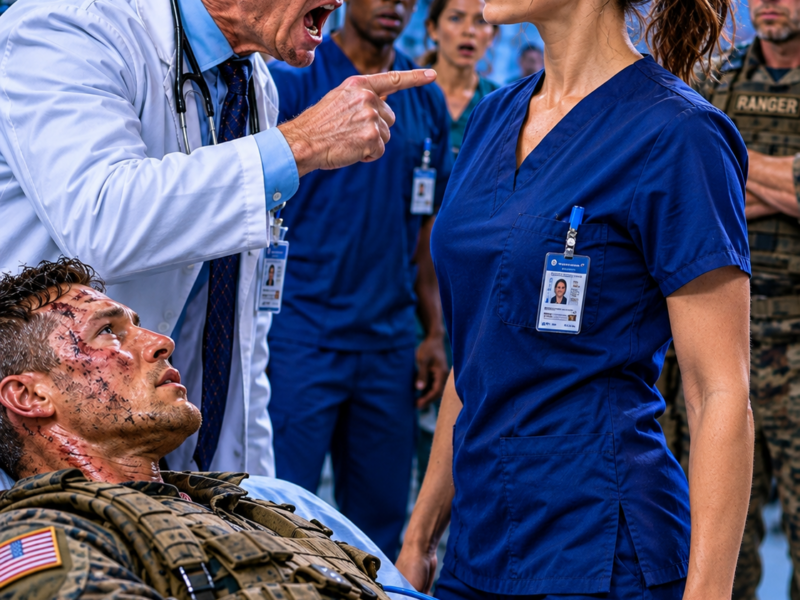
“I watched a dying forest ranger grab the doctor’s wrist in the middle of the emergency room and whisper, ‘I don’t need a nurse
The man in the green jacket lowered his hand and stepped into the elevator.
I moved before the doors closed.
“Dr. Harris, I need you to do something for me.”
He looked at my face, then at the operating room.
“Emily, whatever this is, now is not the time.”
“Call hospital security. Tell them to lock down the emergency department entrances and check the identity of every person who entered with Daniel Mercer.”
His expression tightened.
“Why?”
“Because I think the man who tried to kill him is standing in this hospital.”
Dr. Harris glanced toward the elevator.
“Did you see someone?”
“Green jacket. No hospital badge. He was watching the operating room.”
He took a breath and reached for his phone.
“Stay here.”
I almost laughed.
Stay here.
Seven years ago, that was exactly what I had been told before three people disappeared into the Montana wilderness.
And I had obeyed.
I wasn’t going to make that mistake again.
I walked into the nurses’ station, found an empty computer, and checked the visitor log.
Daniel had arrived at 11:42 p.m.
The paramedics had listed his pickup location as Forest Service Road 18, approximately twelve miles outside Missoula.
The transport crew consisted of two people.
One was a woman named Rachel Boone.
The other was listed as Thomas Reed.
I recognized neither name.
But something about the report bothered me.
The ambulance number was correct.
The vehicle registration was correct.
Even the dispatch timestamp matched.
Only one detail didn’t.
The paramedics had recorded Daniel’s condition as unconscious upon arrival at the scene.
Yet he had been found with a handwritten note in his pocket.
The note was mentioned nowhere in the report.
I stared at the screen.
Then I heard someone behind me.
“Looking for something?”
I turned.
It was the second paramedic, the woman.
Rachel Boone.
She had returned to the nurses’ station carrying a paper cup.
“I thought you two had left,” I said.
“Forgot my jacket.”
She smiled.
Her eyes moved to the computer.
“Everything okay?”
I minimized the report.
“Just finishing paperwork.”
She nodded and walked toward the supply room.
I waited until she disappeared.
Then I opened the incident attachment.
There was a scanned photograph of the note.
The handwriting was Daniel’s.
I knew it because I had seen it before.
Seven years earlier, Daniel had written the same distinctive capital letters on the margins of our field maps.
The note contained one sentence.
If Cipher is alive, give her the original.
Beneath it was a second line.
Not the copy.
I read it again.
The original what?
The ledger?
I pulled the black object from my pocket.
The little metal case was heavier than it looked.
I pressed the broken clasp.
Nothing happened.
Then I noticed a tiny groove along the bottom.
It was not a decorative mark.
It was a key slot.
The four numbers engraved on the back weren’t an access code for a locker.
They were part of a serial number.
My phone vibrated.
Another unknown number.
Don’t open the case at the hospital.
I looked around.
Nobody was watching me.
A second message appeared.
They already know you have it.
I put the phone down.
For several seconds, I simply stood there, trying to decide whether the sender was warning me or threatening me.
Then a voice spoke from behind the supply room door.
“Rachel, did you get the key?”
I recognized the voice.
It belonged to the man in the green jacket.
I moved toward the door without making a sound.
Rachel answered quietly.
“Not yet. She has the case.”
“Then get it.”
“What about Mercer?”
“He won’t make it through the night.”
A pause followed.
Then Rachel said something that made the floor seem to shift beneath me.
“And if he does?”
The man answered.
“Then we finish what we started at Black Pine.”
I backed away.
My shoulder struck a cabinet.
A box of gloves fell to the floor.
The conversation stopped.
“Who’s there?” Rachel called.
I ran.
Not toward the main entrance.
Toward the surgical corridor.
I needed Dr. Harris.
I needed security.
And more than anything, I needed to know whether Daniel Mercer was still alive.
When I reached the operating room, Dr. Harris was speaking to another surgeon.
His face told me the situation had become worse.
“Emily?”
“Where is he?”
The surgeon looked at me.
“His condition is critical. We found evidence of internal bleeding that wasn’t apparent on the initial scan.”
“Was it caused by the wound?”
“Possibly. There are also signs of an older injury.”
I swallowed.
“Can I see him?”
“Not yet.”
I looked through the small window.
Daniel was surrounded by machines and medical equipment.
A nurse adjusted his IV.
His face looked gray beneath the surgical lights.
I had spent seven years trying not to remember the last time I saw someone from Black Pine lying motionless.
I couldn’t let Daniel become another name in an unfinished report.
“Doctor,” I said, “there’s something you need to know.”
I told him about the paramedic.
I told him about the green jacket.
I showed him the messages.
I did not mention the black case.
Not yet.
The surgeon’s expression changed.
“Have you contacted the police?”
“Not yet.”
“Then we will.”
He reached for the phone.
But before he could dial, a nurse came running down the corridor.
“Dr. Harris! The emergency department just reported a security incident.”
“What kind of incident?”
“One of the ambulance crew members tried to access the surgical recovery area using a borrowed badge.”
My stomach tightened.
“Rachel?”
The nurse nodded.
Security had stopped her near the elevators.
The man in the green jacket was gone.
I felt a small measure of relief.
Then Dr. Harris’s phone rang.
He answered.
Listened.
And slowly lowered it.
“What?” I asked.
He looked at me.
“Daniel is asking for you.”
I entered the recovery area wearing a protective gown.
The machines hummed softly.
Daniel’s eyes were closed, and his breathing was assisted.
A nurse told me he had briefly regained consciousness after surgery.
I stood beside his bed.
“Daniel?”
His eyelids moved.
Then he opened them.
For a moment, he looked confused.
Then he recognized me.
“Cipher.”
“I’m here.”
His fingers shifted against the blanket.
“Did you get it?”
I looked at the small case in my pocket.
“Yes.”
He closed his eyes.
“Good.”
“Daniel, what happened at Black Pine?”
His jaw tightened.
“Not here.”
“People are looking for you.”
“I know.”
“One of them was inside the hospital.”
He tried to lift his hand.
I leaned closer.
“Listen carefully,” he whispered. “The ledger isn’t a book.”
I frowned.
“What do you mean?”
“It’s a recording.”
I looked at him.
“An audio recording?”
He shook his head as much as his condition allowed.
“Original field data. Every transmission. Every command. Every location change.”
My mind began connecting pieces.
At Black Pine, our communications system had been compromised during a search operation.
Three members of our team had been sent to retrieve a missing survey crew.
The official report said their coordinates were corrupted by a damaged relay station.
But Daniel was telling me the data had been preserved.
“Who has the recording?”
He stared at me.
“You.”
I stepped back.
“What?”
“The original was split into two pieces. One went into the case. The other was hidden before the station was evacuated.”
“Where?”
He tried to answer, but a coughing fit interrupted him.
I waited until he could breathe again.
“Daniel, where is it?”
He looked at my wrist.
At the crescent-shaped scar.
“Under the old bridge.”
I remembered.
The wooden footbridge near Black Pine Station.
The place where I had cut my wrist during the evacuation.
The place where our team had gathered on the final night.
“Why would you hide it there?”
“Because you were the only one they couldn’t suspect.”
I shook my head.
“That’s impossible. I didn’t know anything about a recording.”
“I know.”
His eyes filled with tears.
“That’s why it worked.”
I wanted to ask him a hundred questions.
But then he gripped my hand.
“Emily, you need to hear this before you trust anyone.”
“Who?”
He struggled to form the words.
“Your supervisor.”
I stopped breathing for a moment.
“My supervisor is dead.”
Daniel stared at me.
“No.”
He swallowed.
“Martin Vale is alive.”
The name landed harder than any physical blow.
Martin Vale had been the senior field coordinator at Black Pine.
He had recruited me when I was twenty-two, trained me in emergency communications, and taught me how to distinguish a real distress signal from a false one.
He had been the closest thing I had to a mentor.
He had also been the man who signed the report declaring the three missing team members dead.
I had attended his memorial service two years later.
There had been a photograph, a flag, and a closed coffin.
“That’s not possible,” I whispered.
Daniel’s eyes remained fixed on mine.
“He was there.”
“At the station?”
He nodded.
“On the night it happened.”
I couldn’t make sense of it.
“Then whose funeral did we attend?”
Daniel’s lips moved.
But before he could answer, the monitor beside him began beeping rapidly.
A nurse rushed over.
“Emily, step back.”
Daniel’s hand slipped from mine.
His eyes closed.
I moved out of the way while the medical team worked.
For the next several minutes, I stood behind the glass, unable to do anything except watch.
When the doctor finally came out, his expression was serious.
“He’s stable, but he needs rest. No more questioning tonight.”
I nodded.
I understood.
But the information he had given me had already changed everything.
Martin Vale was alive.
And if Daniel was telling the truth, the man I had trusted most had been responsible for the disaster that ended my career.
I went to the staff locker room.
I sat on the bench and took out the metal case.
There was a tiny inscription inside the broken clasp.
Three letters.
M.V.
Martin Vale.
I stared at it until my eyes hurt.
Then I noticed something else.
The case had a removable bottom.
Using the edge of a locker key, I carefully pried it open.
A thin memory module slid into my palm.
It was old, the kind used by our field equipment before secure cloud storage became standard.
A strip of faded tape was wrapped around it.
On the tape, someone had written:
BLACK PINE — ORIGINAL / DO NOT DUPLICATE
I put the module back.
I was not going to play it in a hospital.
Not with people I couldn’t identify moving through the corridors.
I needed someone I could trust.
There was only one person I could think of.
Sarah Whitmore.
Sarah had been our field medic at Black Pine.
She had disappeared from the program after the incident, just as I had.
Unlike me, she had stayed in Montana.
We hadn’t spoken in four years.
I found her number in an old contact list.
My thumb hovered over the call button.
Then I pressed it.
She answered after three rings.
“Hello?”
“It’s Emily.”
Silence.
Then a sharp breath.
“Emily Carter?”
“Yes.”
“Where have you been?”
I almost laughed.
“Trying to live a normal life.”
“Well, that didn’t work.”
I looked down at the case.
“No. It didn’t.”
She was quiet for a moment.
Then she asked, “Is Daniel alive?”
I stood up.
“How did you know?”
“Because someone called me twenty minutes ago and asked whether I’d heard from you.”
I felt cold.
“Who called?”
“I don’t know. They wouldn’t give a name.”
“Sarah, I need to see you.”
“Where?”
“Somewhere public.”
“Not the hospital.”
“Agreed.”
She gave me the address of a small diner outside town.
Then she said something I hadn’t expected.
“Emily, bring the case.”
I didn’t answer.
“How do you know about the case?” I asked.
Her voice dropped.
“Because I was the one who put it in Daniel’s truck.”
The call ended.
I stood there, staring at my phone.
For the first time that night, I wondered whether Sarah had been part of the betrayal all along.
But I also remembered her on the last night at Black Pine.
She had been holding the hand of a wounded teammate, refusing to leave him behind even after the evacuation order came through.
I couldn’t reconcile that woman with someone who might have helped hide evidence.
I slipped the case into my coat and left the hospital through the staff entrance.
The diner was nearly empty.
Rain tapped against the windows.
Sarah sat in a booth at the back, her gray hair pulled into a loose ponytail.
She looked older than I remembered.
There were faint lines around her eyes, and she held her coffee cup with both hands.
When she saw me, she stood.
For a second, neither of us moved.
Then she came around the table and hugged me.
It was brief and awkward.
Neither of us knew what to say.
“You look tired,” she said.
“So do you.”
She smiled sadly.
“That’s what happens when people survive things they never talk about.”
We sat down.
I placed the metal case on the table.
Sarah didn’t touch it.
“Is Daniel really alive?”
“He’s in recovery.”
“Thank God.”
“Sarah, what happened at Black Pine?”
She looked toward the window.
“I’ve been waiting seven years for someone to ask me that.”
“Then tell me.”
She took a long breath.
“Martin Vale didn’t die.”
“I know.”
Her eyes snapped toward me.
“Daniel told you?”
“Yes.”
She looked down at her coffee.
“Then you know more than I thought.”
“Who died in his place?”
Sarah rubbed her forehead.
“A contractor named Paul Dwyer. He was part of the transport team. His body was badly burned in the vehicle explosion. Martin arranged the identification using records from a different operation.”
I stared at her.
“How could he do that?”
“Because the investigation was controlled by people who wanted the operation closed.”
“Who?”
“People higher up than Martin.”
I felt anger rising.
“Why did he do it?”
Sarah looked at me.
“Money.”
I waited.
“Black Pine wasn’t just a search-and-rescue station,” she continued. “It was monitoring illegal logging and land deals inside protected federal territory. Some powerful people were using the operation to move equipment and materials through restricted areas.”
I frowned.
“We were a rescue unit.”
“That was the official purpose.”
She lowered her voice.
“Martin was feeding location data to a private security company. They knew which patrols were active, which roads were being watched, and when the area would be empty.”
I remembered the false distress signal.
The altered coordinates.
The sudden radio silence.
“The three missing team members,” I whispered.
“Tom Alvarez, Ben Keller, and Julia Ross.”
I nodded.
I could still see their faces.
Tom’s ridiculous jokes.
Ben’s habit of carrying too many maps.
Julia’s bright yellow scarf.
“They weren’t killed by a communications failure,” Sarah said.
“No.”
“They were sent into an ambush.”
My hands tightened around the edge of the table.
“Did they die?”
Sarah didn’t answer immediately.
That was answer enough.
“Why didn’t you tell anyone?”
“Because Martin threatened my family.”
I looked up.
“Your daughter?”
Sarah nodded.
“He knew where she went to school. He knew my husband’s work schedule. He had photographs of our house.”
Her voice trembled.
“I thought if I stayed quiet, he’d leave us alone.”
I wanted to condemn her.
I wanted to tell her that three people had died because everyone had been afraid.
But then I remembered how fear had kept me from returning to Black Pine.
How I had spent seven years building a life around avoiding questions.
I knew what it meant to be trapped by something you couldn’t prove.
“Why now?” I asked.
“Because Daniel found something.”
She reached into her purse and pulled out a folded photograph.
It showed the old wooden bridge near Black Pine Station.
Underneath it was a small metal box attached to one of the support beams.
I recognized the place immediately.
“The second half of the recording,” I said.
Sarah nodded.
“Martin knows about the box. He has been searching for it since the station closed.”
“Why hasn’t he found it?”
“Because the bridge was replaced two years ago.”
I looked at the photograph again.
“Where is it now?”
Sarah leaned forward.
“At the county storage yard. They kept the old beams when they dismantled it.”
I stared at her.
“How do you know?”
“Because I moved the box.”
The diner suddenly felt very quiet.
“You hid it?”
“I thought I was protecting it.”
“From Martin?”
“From everyone.”
She took a small key from her purse.
“This opens the second container.”
I didn’t take it.
“Why should I trust you?”
Sarah’s eyes filled.
“You shouldn’t have to.”
She placed the key beside the case.
“But you deserve to know what happened.”
For several seconds, I couldn’t speak.
Then she said something that made me look up.
“Emily, there is something else.”
“What?”
“Daniel wasn’t the only one who survived the night at Black Pine.”
I gripped the table.
“Who else?”
Sarah looked directly at me.
“Julia Ross.”
I shook my head.
“No. Julia was listed as deceased.”
“She was injured, but alive when they took her.”
“Who took her?”
“Martin.”
I felt as though someone had pulled the air from the room.
“Where is she?”
Sarah shook her head.
“I don’t know. But the recording might.”
I looked at the case.
For seven years, I had believed the story was over.
Now I understood that the story had never ended.
It had simply been hidden.
I took the key.
“Let’s get the recording.”
Sarah looked at me carefully.
“Not tonight. Martin will be watching the hospital. He may be watching me too.”
“Then when?”
“At first light.”
I wanted to argue.
But I knew she was right.
We agreed to meet at the county storage yard at six in the morning.
Before I left, Sarah caught my hand.
“Emily?”
I turned.
“I’m sorry.”
I looked at her for a long moment.
“I know.”
It wasn’t forgiveness.
Not yet.
But it was the first honest thing either of us had said in years.
When I returned to the hospital, the night shift was changing.
Dr. Harris found me near the elevators.
“Where have you been?”
“Getting answers.”
“From whom?”
“Someone who was there.”
He looked at me for a moment.
Then he handed me a small plastic evidence bag.
Inside was my phone.
The screen was cracked.
I stared at it.
“Where did you find this?”
“Outside the staff entrance. Security found it after a patrol.”
I looked at the screen.
There was a new message from the unknown number.
You have until sunrise. Leave Montana, or the next body won’t be a stranger.
I showed Dr. Harris.
His expression hardened.
“That’s enough. I’m calling the sheriff.”
“Do it.”
He hesitated.
“Emily, I also need to tell you something.”
“What?”
“Daniel asked for you again. Before he fell asleep, he said there was one person he trusted.”
“Who?”
Dr. Harris looked at me.
“You.”
I swallowed.
Then he added, “He also said to tell you that you were never responsible for the failed transmission.”
I looked away.
For seven years, I had carried that blame.
I had replayed the last radio call in my head until I could remember every second of it.
The signal had vanished while I was monitoring the relay.
I had believed that if I had recognized the interference sooner, Tom, Ben, and Julia might have come home.
Daniel knew that.
And he had waited seven years to tell me I wasn’t the reason they disappeared.
I went to his room.
He was sleeping.
I stood beside the bed and watched his chest rise and fall.
“I’m going to find her,” I whispered.
I wasn’t sure whether he heard me.
At six in the morning, I met Sarah outside the county storage yard.
The sky was pale and cold.
A thin layer of frost covered the gravel.
The yard manager, a tired man named George, had agreed to let us inspect the old bridge beams after Sarah explained that we were retrieving a piece of personal property.
He looked at our identification.
Then at the photograph.
“That bridge was dismantled in October,” he said. “The beams are in the back.”
He pointed toward a fenced area.
We walked between stacks of lumber and rusted equipment.
The old bridge beams were piled beneath a blue tarp.
Sarah stopped at the third one.
“This is it.”
She crouched and ran her fingers along the underside.
There was a small metal plate attached to the wood.
She inserted the key.
The lock turned.
Inside was a sealed waterproof container.
I opened it carefully.
There was another memory module, wrapped in plastic.
Beside it was a folded sheet of paper.
The handwriting was familiar.
Martin Vale.
I unfolded it.
If this is being read, then the people who buried Black Pine have failed.
Below that were three names.
Tom Alvarez.
Ben Keller.
Julia Ross.
And beneath them, one sentence.
The fourth survivor was never supposed to be found.
I looked at Sarah.
“Who is the fourth survivor?”
She was staring at the paper.
“I don’t know.”
Before I could ask anything else, a vehicle engine started nearby.
A black SUV rolled slowly toward the storage yard gate.
Sarah stood.
“Emily, put the container away.”
The SUV stopped.
The driver’s door opened.
A man stepped out.
He was older than the photograph I remembered.
His hair was almost entirely gray, and he walked with a slight limp.
But I knew his face.
Martin Vale.
He looked directly at me.
Then he smiled.
“Emily Carter.”
Sarah moved in front of me.
“Don’t come any closer.”
Martin ignored her.
“I see you found the recording.”
I held the container against my chest.
“Why did you send them into the forest?”
His smile faded.
“Because you still don’t understand what Black Pine was.”
“I understand enough.”
“No, you don’t.”
He glanced at Sarah.
“She told you about the money, didn’t she?”
Sarah said nothing.
Martin sighed.
“Sarah always did mistake fear for loyalty.”
I stepped forward.
“Where is Julia?”
For the first time, his expression changed.
Not much.
Just enough.
“Julia made a choice.”
“What choice?”
“She decided to help us.”
I shook my head.
“That’s a lie.”
“Is it?”
He looked at the container in my arms.
“Play the recording, Emily. You’ll find out.”
I wanted to run at him.
I wanted to demand answers.
But something in his voice stopped me.
He wasn’t afraid of the recording.
He wanted me to hear it.
That was when I noticed the SUV’s passenger door opening.
A woman stepped out.
She was wearing a dark coat and a wool hat.
Her hair was shorter than I remembered.
Her face was thinner.
But when she looked at me, I recognized her immediately.
Julia Ross.
She was alive.
For seven years, I had imagined her last moments in the forest.
I had wondered whether she had been afraid.
Whether she had called for help.
Whether she had known we were coming.
Now she stood less than twenty feet away.
“Emily,” she said.
Her voice was almost unchanged.
Sarah covered her mouth.
I couldn’t move.
Martin looked between us.
“Well,” he said quietly, “now that everyone is here, perhaps we should stop pretending.”
Julia stepped toward me.
“Don’t listen to him.”
Her eyes were wet.
“Please. Before he tells you another lie, listen to the recording.”
I held the container tighter.
Martin’s face hardened.
“Julia, that’s enough.”
She ignored him.
“Emily, I need you to know something.”
“What?”
She looked down at my wrist.
At the crescent-shaped scar.
Then she said the words I had never expected to hear.
“That night at Black Pine, I was the one who shut down your signal.”
I stared at her.
Sarah turned toward Julia.
“What?”
Julia began crying.
“I didn’t know they would send the team into the ravine. I thought I was delaying a transmission for a few minutes.”
My mouth went dry.
“You shut down the signal?”
She nodded.
“Martin told me the message was compromised. He said there was an armed group in the area and that if I let the coordinates go through, everyone would be killed.”
I looked at Martin.
He didn’t deny it.
Instead, he said, “She made the decision.”
Julia wiped her face.
“I was twenty-six. I believed him.”
“And Tom, Ben, and the others?”
“I didn’t know where they were going until it was too late.”
The silence between us felt heavier than the cold air.
I wanted to hate her.
Part of me already did.
But I also remembered how easily Martin had manipulated all of us.
He had known our fears, our loyalties, and exactly which words would make us obey.
“Why did you disappear?” I asked.
Julia looked at Martin.
“Because he kept me alive.”
Martin stepped closer.
“Because I protected her.”
Julia shook her head.
“No. You kept me hidden.”
She turned to me.
“I tried to send evidence out twice. He intercepted both attempts. When Daniel finally escaped, I knew the truth might have a chance.”
Martin’s expression became cold.
“You are making a mistake.”
Julia reached into her coat.
For one terrifying second, I thought she had a weapon.
Instead, she pulled out a small recorder.
“I made another copy.”
Martin lunged.
Sarah stepped between them.
I moved backward, clutching the container.
The storage yard manager shouted from the office.
A security alarm began sounding.
And somewhere beyond the fence, sirens grew louder.
Martin stopped.
He looked at the three of us.
Then he looked at Julia.
“You have no idea what you’ve done.”
Julia met his eyes.
“I know exactly what I’ve done.”
The first sheriff’s vehicle entered the yard.
Martin tried to return to the SUV, but two deputies reached him before he could get inside.
He didn’t fight.
He simply looked at me as they placed handcuffs around his wrists.
“You think the recording will save you?” he said.
I didn’t answer.
He leaned closer.
“Listen carefully, Cipher. The truth doesn’t always make people innocent.”
Then the deputies led him away.
For a few moments, nobody spoke.
Sarah was crying silently.
Julia stood with her arms wrapped around herself.
I looked down at the container.
The recording was still inside.
We had found the truth.
But I wasn’t sure I was ready to hear it.
The sheriff took our statements and secured both memory modules.
An evidence technician made verified copies under supervision.
The investigation would take months.
There would be interviews, warrants, forensic analysis, and court hearings.
But before any of that, I wanted to hear what Daniel had spent seven years trying to protect.
The sheriff arranged a secure room at the station.
Sarah and Julia sat beside me.
An investigator connected the original field module to an old playback device.
The screen flickered.
A list of transmissions appeared.
Most were ordinary field updates.
Weather reports.
Coordinates.
Routine status checks.
Then the investigator opened the final file.
The date was seven years earlier.
The time was 2:17 a.m.
My hands went cold.
That was the moment our communications system had failed.
A voice came through the speakers.
My voice.
“Black Pine relay, this is Cipher. Confirming team positions.”
A burst of static followed.
Then Martin’s voice.
“Hold the transmission.”
My younger voice answered.
“Copy. Why?”
“Possible compromise. Stand by.”
There was a pause.
Then another voice.
Tom Alvarez.
“Cipher, we’re at the southern ridge. We have visual contact with the missing survey crew.”
I closed my eyes.
I could almost see him standing in the rain, one hand holding his radio, the other pointing toward the trees.
Then Julia’s voice came through.
“Relay shutdown initiated.”
I looked at her.
She was staring at the floor.
The recording continued.
Martin’s voice returned.
“All units, change route. Proceed to the lower ravine.”
A second voice interrupted.
Daniel Mercer.
“Negative. The lower ravine is exposed. We have no visibility.”
Martin answered.
“That’s an order.”
Daniel’s voice grew sharper.
“Who authorized the route change?”
Silence.
Then Martin said something that made Sarah gasp.
“Your authorization is no longer required.”
A loud burst of static followed.
The recording continued for several seconds.
Then I heard a sound I would remember for the rest of my life.
Three gunshots.
After that, a voice whispered.
“Tom?”
No answer.
“Ben?”
Nothing.
Then Julia, crying.
“Oh God. What did I do?”
The file ended.
Nobody moved.
I stared at the dark screen.
The truth was worse than I had imagined.
Martin had ordered the route change.
Julia had disabled the signal.
And the three men who trusted us had walked into a trap.
But there was another file.
The investigator opened it.
A different voice came through.
Daniel.
He sounded younger, stronger.
“Emergency backup. If anyone receives this, the original signal was deliberately suppressed.”
A pause.
“Tom Alvarez, Ben Keller, and Julia Ross were sent to the lower ravine under false instructions.”
Then another voice.
A woman.
I leaned forward.
It was Julia.
“Daniel, get out of there. Martin knows.”
Daniel answered.
“Not without the others.”
The recording ended.
Julia covered her face.
“I told him to leave.”
Sarah reached for her hand.
Julia pulled away.
“I told him to save himself.”
I looked at her.
“And he didn’t.”
She shook her head.
“No.”
For a long time, we sat without speaking.
Then the investigator opened the last file.
Its title was simply:
FOURTH SURVIVOR.
A voice appeared through the speakers.
A young man.
Frightened.
Breathing hard.
“Emergency channel. This is Ben Keller. If anyone can hear me, I’m alive.”
Sarah made a small sound.
I stared at the screen.
Ben.
Ben Keller.
One of the three people listed as dead.
The recording continued.
“I found Tom. He’s gone. I can’t find Julia. Daniel is coming back for us.”
A pause.
Then a second voice.
Daniel.
“Ben, keep talking. I’m close.”
The file cut off.
I looked at the investigator.
“Is there more?”
He checked the metadata.
“Yes. But the next recording was made eleven days later.”
Eleven days.
I felt my throat tighten.
“Play it.”
The investigator hesitated.
Then he pressed the button.
Ben’s voice returned.
This time, it was calmer.
“To whoever is listening, my name is Ben Keller. I’m alive. I’m being held at a private property outside the Black Pine district.”
I leaned forward.
“Who is holding you?”
The answer came in a whisper.
“Martin Vale.”
I looked at Sarah.
She was crying openly now.
Ben continued.
“He’s moving equipment through the forest. He says if I cooperate, he’ll let me go. I won’t.”
There was a long pause.
Then he said:
“Daniel, if you hear this, don’t come alone.”
The recording ended.
I felt sick.
For seven years, we had mourned Ben.
But he had survived.
And someone had kept him alive long enough to make sure he could never tell anyone what happened.
The investigator closed the file.
“We’ll need to locate the property.”
Julia looked up.
“I know where it is.”
Everyone turned toward her.
She wiped her face.
“Martin kept me in a cabin near the western boundary. There was another building behind it. A storage shed with reinforced doors.”
“Did you see Ben?” I asked.
She nodded.
“Once.”
My voice barely worked.
“Was he alive?”
“Yes.”
I pressed my fingers against my forehead.
“Why didn’t you tell anyone?”
Julia looked at me.
“Because Martin told me Ben had already been moved. He said if I tried to contact anyone, he’d make sure Daniel was the next one to disappear.”
I looked down.
It was a terrible explanation.
But it was an explanation.
And it was one more piece of evidence against the man who had manipulated us.
The sheriff immediately organized a search team.
They found the property that afternoon.
The cabin was empty.
The storage shed was locked from the outside.
Inside, they discovered old medical supplies, food containers, restraints, and a collection of photographs.
One showed Ben Keller sitting on a narrow cot.
He looked thinner than I remembered.
But he was alive when the photograph was taken.
The date on the back was only six months old.
The search team found no sign of him.
But they found something else.
A receipt for a storage unit in Helena.
It had been rented under an alias connected to Martin.
Inside the unit were boxes of field equipment, false identification documents, and handwritten notes.
There was also a sealed envelope addressed to Daniel Mercer.
The sheriff called me when they found it.
“Emily, I think you should see this.”
I arrived at the station an hour later.
The envelope was yellowed and creased.
Daniel’s name was written across the front.
Inside was a single sheet of paper.
It contained a message in the old Black Pine code.
I read it once.
Then again.
It said:
BEN IS ALIVE. DO NOT TRUST THE RECOVERY TEAM.
Beneath it was a date.
Three months earlier.
I looked at the sheriff.
“Daniel knew.”
He nodded.
“Looks that way.”
“Then why didn’t he tell us?”
“Maybe he was trying to find Ben before Martin realized he’d discovered the truth.”
I thought about Daniel arriving at the hospital with that terrible wound.
The black case.
The message.
The way he had looked at me when I answered in the old language.
He hadn’t come to Missoula to expose Martin.
He had come because he needed help bringing Ben home.
And he had chosen me because I was the one person who knew how the original communications system worked.
I returned to the hospital that evening.
Daniel was awake.
His face was pale, but his eyes were clear.
I sat beside him.
“Ben is alive.”
He closed his eyes.
For a moment, he looked like a man who had been carrying something too heavy for too long.
Then a tear slipped down his cheek.
“Did you find him?”
“Not yet.”
He nodded.
“Then we’re not finished.”
I took his hand.
“Daniel, why didn’t you tell me about the fourth survivor?”
He looked toward the window.
“Because I didn’t know whether the message was real.”
“What?”
“The first recording was damaged. I heard Ben’s voice, but I couldn’t confirm the location. Martin had been sending false transmissions for years.”
“Then why come to me?”
“Because you were the only person who could identify the original signal pattern.”
He looked at my wrist.
“And because I owed you the truth.”
I sat quietly.
Then I asked the question I had avoided for seven years.
“Was it my fault?”
Daniel turned toward me.
“No.”
His answer came without hesitation.
“You followed the procedure. Martin changed the route. Julia shut down the relay because she believed there was a threat. None of that was your decision.”
“But I was listening.”
“You were following orders from someone who had already betrayed you.”
His voice softened.
“Emily, you cannot spend the rest of your life apologizing for a crime you didn’t commit.”
I looked down at our hands.
For seven years, I had believed my silence was the price of surviving.
Now I understood that silence had been the thing Martin counted on.
Daniel squeezed my fingers.
“Will you help me find Ben?”
I nodded.
“Yes.”
The next three days were spent with investigators.
They compared the original recordings with the recovered field data.
They traced the false transmissions to a private communications contractor.
They found payments to shell companies connected to Martin and several former officials.
The case grew larger with every recovered document.
Martin was charged with conspiracy, evidence tampering, kidnapping, and multiple related offenses.
Julia agreed to cooperate.
She gave a complete statement, including her own role in disabling the relay.
She didn’t ask for forgiveness.
She didn’t try to make herself sound innocent.
She told the truth.
Sarah did the same.
And I gave investigators everything I remembered about the night at Black Pine.
For the first time in seven years, I stopped trying to protect the version of myself who had survived.
I told them what I had heard.
What I had missed.
What I should have questioned.
And what I now knew had never been mine to carry.
A week later, the sheriff received a call from a property manager near Helena.
A man had been asking about a storage building rented under one of Martin’s aliases.
The property manager recognized Ben from the photograph.
He had seen him leaving the building several times.
The sheriff’s team arrived before dawn.
Ben was there.
He was forty-one years old, though the years had taken more from him than anyone should have to lose.
His beard was long.
His clothes hung loosely from his shoulders.
When the deputies opened the door, he raised both hands.
“Don’t shoot,” he said.
“I’m Ben Keller.”
They lowered their weapons.
A medic checked him immediately.
He was dehydrated, malnourished, and suffering from an untreated leg injury.
But he was alive.
Daniel was still in the hospital when the sheriff called.
I was standing beside his bed.
I answered on speaker.
“Daniel,” the sheriff said, “we found him.”
Daniel stared at the phone.
“Who?”
“Ben Keller.”
For a moment, he didn’t speak.
Then his face crumpled.
“Is he alive?”
“Yes.”
Daniel covered his mouth with one hand.
I turned away to give him a little privacy.
But he reached for my sleeve.
“Emily.”
I looked back.
He was crying.
Not loudly.
Not dramatically.
Just the quiet tears of someone who had spent seven years refusing to imagine a good outcome.
“He’s coming home,” I told him.
Daniel nodded.
“Tell him I kept looking.”
“I will.”
The reunion happened two weeks later.
Ben was transferred to a rehabilitation center near Missoula.
Daniel had been discharged from the hospital and was still recovering at home.
I drove him there.
He insisted on walking inside without a wheelchair, even though his steps were slow and uneven.
When Ben saw him, he stared for several seconds.
Then he began to cry.
Daniel stopped in the doorway.
“Hey, Keller.”
Ben shook his head.
“You’re late.”
Daniel laughed through his tears.
“Traffic.”
They embraced carefully.
Both men were trembling.
I stood near the door, unable to look away.
Sarah arrived a few minutes later.
Julia came last.
She stopped several feet from Ben.
“I don’t expect you to forgive me,” she said.
Ben looked at her for a long time.
Then he glanced at Daniel.
“Did she tell the truth?”
Daniel nodded.
“All of it.”
Ben turned back to Julia.
“Then I guess that’s a start.”
Julia began to cry.
He didn’t hug her.
He didn’t tell her everything was okay.
But he didn’t ask her to leave.
For that day, it was enough.
The legal case continued for months.
The evidence from the original recording helped investigators establish the sequence of events.
Martin’s defense argued that the communications failure had been accidental and that he had acted under emergency authority.
But the recordings contradicted him.
The false route orders.
The suppressed distress calls.
The payments.
The fabricated death report.
And the evidence that Ben had been held against his will.
The jury found him guilty on the major charges.
When the verdict was read, I sat beside Sarah and Daniel.
Nobody cheered.
Nobody smiled.
We simply sat there.
Three people had never come home.
One had lost seven years.
And the truth, even when finally spoken, could not return any of it.
After the hearing, Martin asked to speak with me.
I considered refusing.
Then I agreed.
He was brought into a small room with two deputies present.
He looked older than he had at the storage yard.
Without his uniform, his authority, and his carefully controlled expression, he seemed smaller.
“Emily,” he said.
I remained standing.
“Don’t call me that like you know me.”
He studied me.
“You were always the best one on the team.”
I said nothing.
“I made mistakes.”
“You made decisions.”
He looked down.
“You don’t understand what was at stake.”
“Three people were sent into an ambush. Ben was imprisoned. Daniel nearly died. Sarah spent years afraid for her daughter. Julia spent seven years living with what you made her do.”
He rubbed his hands together.
“I was trying to keep the operation running.”
“No. You were trying to keep yourself safe.”
His eyes lifted.
For the first time, I saw something that might have been regret.
But I didn’t need him to admit anything.
The evidence had already spoken.
I turned toward the door.
“Emily.”
I stopped without looking back.
“Do you think you could ever forgive me?”
I considered the question.
Then I answered honestly.
“I don’t know. But I know I don’t have to forgive you to stop carrying what you did.”
I walked out.
Outside, Daniel was waiting near the courthouse steps.
The afternoon sun was falling across the pavement.
He looked at me.
“Are you okay?”
I nodded.
“Not completely.”
He smiled faintly.
“That’s fair.”
We walked toward the parking lot.
For the first time since Black Pine, I wasn’t thinking about what I should have done differently.
I was thinking about what came next.
A month later, I returned to work at St. Mary’s.
Dr. Harris had kept my position open.
He didn’t ask for the entire story.
He simply handed me a fresh badge and said, “We could use someone who knows how to listen.”
I laughed.
It was the first time in a long while that the sound came easily.
I continued working as a nurse.
I also agreed to help the investigators review old emergency communication protocols.
Not because I wanted to return to the life I had left.
But because I no longer wanted the people who had abused that system to be the only ones who understood it.
Sarah started volunteering with a wilderness rescue organization.
Ben moved into a small apartment near the river.
His recovery was slow.
Some mornings were good.
Others were difficult.
Daniel visited him whenever he could.
Julia accepted responsibility for her part in the incident and began cooperating with the families of the missing team members.
She knew that some people would never forgive her.
She also knew that asking them to understand would be unfair.
One Saturday afternoon, I drove out to the site of the old Black Pine Station.
Most of the buildings were gone.
The clearing had begun to grow over, and young pine trees were pushing through the earth where our equipment shed had once stood.
I carried a small wooden box.
Inside were three photographs.
Tom Alvarez.
Ben Keller.
Julia Ross.
I placed Tom’s photograph near the old trail marker.
Ben’s went beside it.
Julia’s stayed in my hand for a moment longer.
Then I placed it with the others.
There was no ceremony.
No speech.
Just the wind moving through the trees.
Daniel joined me a few minutes later.
He stood beside me, leaning slightly on his walking stick.
“Do you think they’ll ever know everything?” he asked.
I looked at the photographs.
“Maybe not.”
He nodded.
“Some things don’t come back.”
“No.”
We stood there quietly.
Then Daniel reached into his jacket and handed me a small envelope.
I opened it.
Inside was a new identification card.
Not a government credential.
Not an operational badge.
Just a simple card with my name printed across the top.
EMILY CARTER.
Below it was one word.
CIPHER.
I looked at him.
“What’s this?”
He smiled.
“An old friend wanted you to have it.”
“Who?”
“Ben.”
I turned the card over.
On the back, in Ben’s handwriting, were six words.
You were listening when nobody else was.
I held it between my fingers.
For years, I had thought the name Cipher belonged to the worst night of my life.
To the failed signal.
To the missing team.
To the guilt I carried into every quiet room.
But standing there among the pines, I understood something I hadn’t understood before.
Cipher had never meant the person who failed to save them.
It meant the person who kept listening until the truth could finally be heard.
I slipped the card into my pocket.
Then Daniel and I walked back toward the road.
Behind us, the trees moved gently in the wind, covering the old footprints one season at a time.
The end.









