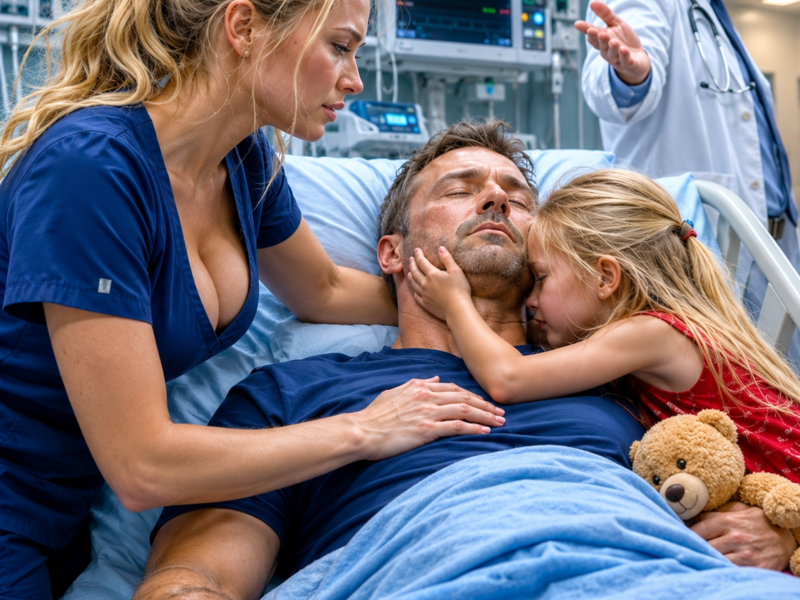
“I watched a doctor write 4:47 p.m. on a dead soldier’s chart while his five-year-old daughter stood outside the trauma room clutching a teddy bear
The man standing in the doorway took another step into Trauma Bay 3.
He was tall, broad-shouldered, and probably in his late fifties. His gray hair was cut short, and the retired military jacket he wore had the unmistakable look of something that had spent more time outdoors than inside a closet.
His eyes never left my face.
“Kate Ellison,” he repeated. “I was hoping I’d find you here.”
I glanced toward Ryan’s bed.
“Who are you?”
“Colonel Grant Whitmore. Retired Air Force. I commanded a pararescue unit for nearly thirty years.”
The name meant something to me, although it took a second to place it.
Then I remembered.
Colonel Whitmore had been the senior officer overseeing our operations in Alaska during my final years in the service.
He had signed the report after the Bering Sea accident.
He had also been the man who stood outside the medical facility when I was told Petey Doran hadn’t survived.
I hadn’t seen him since.
“What are you doing here?” I asked.
“I’m visiting a friend upstairs. I heard something interesting happened in this emergency department.”
His gaze moved to the monitor.
“Someone told me a nurse refused to stop a hypothermic resuscitation after a doctor declared the patient dead.”
“That nurse was me.”
“I know.”
His answer unsettled me.
Dr. Ashcroft approached, still visibly processing what had happened.
“Colonel Whitmore, I presume?”
“That’s right.”
“Then perhaps you can help us understand exactly what Nurse Ellison was doing. She used a procedure that isn’t part of our hospital’s current emergency protocol.”
Whitmore looked at him.
“She used a procedure that should have been.”
Ashcroft folded his arms.
“That’s an interesting distinction.”
“It’s an important one.”
Whitmore turned back to me.
“Forced-air warming, warmed fluids, controlled compressions, delayed defibrillation until the patient reached an appropriate temperature. That’s Guardian Angel training.”
I said nothing.
He gave a small nod.
“I thought so.”
I felt the old instinct to retreat into silence.
For three years, I had made an entire life out of not discussing those things.
But there was no hiding now.
“I used to be a combat rescue officer,” I said. “United States Air Force. Nine years.”
The resident looked at me as if he were seeing a different person.
Angela stood just behind him, her expression somewhere between surprise and disbelief.
Whitmore pulled a chair toward the wall.
“Then you understand why I wanted to speak with you.”
“About Ryan?”
“Partly.”
He paused.
“Mostly about Petey.”
The room seemed to grow smaller.
I looked at him.
“Please don’t.”
“I know this is difficult.”
“You weren’t there when we pulled him out.”
Whitmore lowered his eyes.
“No. But I trained him.”
That stopped me.
He continued quietly.
“Peter Doran was one of the best young pararescue candidates I’d seen in years. Smart, stubborn, and convinced he could solve every problem with enough effort.”
I looked down at my hands.
“That sounds like him.”
“He talked about you after his first joint exercise. Said you were the kind of officer he’d follow into any weather.”
I swallowed.
“Colonel, I don’t think I can do this right now.”
“I understand.”
He stood.
“But there’s something I want you to hear before I leave.”
I looked up.
“I read your after-action report. Every page. I also reviewed the medical evaluation.”
He paused.
“You did everything possible to save that young man, Kate. Everything.”
My jaw tightened.
“Apparently not enough.”
Whitmore didn’t argue immediately.
Instead, he looked at Ryan’s bed, where a respiratory therapist was checking his breathing.
“Today, you kept working when the room had decided the outcome was already written.”
He turned back toward me.
“That doesn’t mean you could have saved Petey. It means you haven’t forgotten how to fight for someone.”
I wanted to believe him.
I really did.
But guilt doesn’t disappear because someone with a higher rank tells you to put it down.
Before I could answer, a small voice came from behind me.
“Is my daddy okay?”
Ivy was standing beside Angela, rubbing her eyes.
I knelt.
“He’s doing much better, sweetheart. The doctors are taking him to intensive care so they can watch him closely.”
“Can I go with him?”
“Not right this minute, but someone will help you see him soon.”
She looked at Colonel Whitmore.
“Are you a doctor?”
“No, ma’am.”
“Then why are you wearing that?”
Whitmore glanced down at his jacket.
“Old work clothes.”
Ivy considered that.
“My daddy has work clothes too. They’re green.”
Whitmore smiled.
“Then your daddy and I probably understand each other.”
She held out Colonel Bear.
“He’s in charge of the hospital until Daddy wakes up.”
Whitmore accepted the teddy bear with complete seriousness.
“Understood. I’ll make sure he gets the respect his rank deserves.”
For the first time that afternoon, I laughed.
It wasn’t much.
But it was real.
Ryan spent the next several hours in intensive care.
His body temperature was carefully monitored as the team continued controlled rewarming. The neurologist explained that the next twenty-four hours would be important, even though the return of spontaneous circulation was an encouraging sign.
I stayed until the transfer was complete.
By then, my shift had ended hours earlier.
Angela found me sitting in the staff lounge, staring at a paper cup of coffee I had forgotten to drink.
“You know,” she said, taking the chair opposite me, “I’ve worked with you for three years.”
I looked up.
“And?”
“And I thought you were just private. Maybe a little guarded. I never imagined you had spent nine years pulling people out of freezing oceans.”
I looked toward the window.
“I didn’t want to be that person anymore.”
“Why?”
I rubbed my thumb against the side of the cup.
“Because I couldn’t save everyone.”
Angela was quiet for a moment.
“Nobody can, Kate.”
“I know that.”
“Do you?”
I didn’t answer.
She leaned forward.
“Because from where I was standing today, you looked like someone who was trying to punish herself for something that happened years ago.”
Her words landed harder than I expected.
I looked down at my fingers.
Two of them still had pale scars from the Bering Sea.
“I watched a young man die,” I said. “I was responsible for getting him out of that water. I did everything I knew how to do, but he never made it.”
Angela reached across the table and covered my hand.
“And today?”
“Today, I got lucky.”
“No,” she said. “Today, you knew what to do.”
I wanted to correct her.
Instead, I let the silence remain.
At 9:18 that evening, a nurse from intensive care came looking for me.
“Kate? Captain Delacroix is awake.”
I stood so quickly that my chair scraped against the floor.
“He’s asking for you.”
I followed her upstairs.
Ryan looked much better than he had in the trauma bay, although he was still pale and exhausted. An IV ran into his arm, and a warming blanket covered his legs.
Colonel Bear rested against his chest.
Ivy was curled up in a chair beside him, asleep with one hand holding his fingers.
Ryan turned his head when I entered.
“You’re the nurse.”
I smiled.
“That’s what my badge says.”
He tried to laugh, then winced.
“Apparently, I owe you a pretty big thank-you.”
“You owe your daughter one first.”
He looked down at Ivy.
“She hasn’t let go of me since I woke up.”
“She was here the entire time.”
Ryan’s eyes softened.
“She was in the truck?”
“Yes.”
“Did she get hurt?”
“Nothing serious. She’s been checked over.”
He closed his eyes briefly.
“Thank God.”
I pulled a chair beside his bed.
“How are you feeling?”
“Like someone parked a truck on my chest.”
“That’s understandable.”
He looked at me again.
“They told me you argued with the attending physician.”
“That sounds exaggerated.”
“One of the paramedics said you practically ordered everyone around.”
I smiled faintly.
“That sounds more accurate.”
He studied me for a moment.
“Air Force?”
I nodded.
“Formerly.”
“What unit?”
“Combat rescue.”
Ryan’s expression changed.
He looked away, then back at me.
“Guardian Angel?”
“Yes.”
For several seconds, he said nothing.
Then he spoke slowly.
“Three years ago, I was involved in a joint cold-weather training exercise in Alaska.”
I felt my shoulders tighten.
“Near the Bering Sea?”
He nodded.
“We had a downed aircraft scenario. A young pararescue airman went into the water. There was a rescue helicopter overhead, and I was on the support vessel.”
My mouth went dry.
“Petey?”
Ryan looked directly at me.
“Peter Doran.”
I stared at him.
He continued.
“I remember watching the rescue officer descend into that water. She worked on him after they brought him up. I remember thinking she was going to freeze herself before she gave up.”
I couldn’t speak.
“I never learned her name,” he said. “But I never forgot what she did.”
I looked toward Ivy.
She was still asleep, her cheek pressed against the chair cushion.
“That was me,” I whispered.
Ryan’s expression softened.
“I thought it might be.”
I looked down.
“You watched?”
“I did.”
“Then you know.”
He waited.
“You know I couldn’t save him.”
Ryan took a careful breath.
“I know you tried.”
“That’s not the same thing.”
“No,” he agreed. “It isn’t.”
His honesty surprised me.
He didn’t offer a comforting speech or tell me everything happened for a reason.
He simply looked at me.
“I was on that boat, Kate. I watched the team bring him aboard. I watched you keep working when the rest of us had already started accepting what was happening.”
My eyes began to sting.
“I should have been faster.”
“Maybe you wish you had been. But that doesn’t mean you were responsible for what the water did.”
I pressed my lips together.
Ryan glanced at his daughter.
“I have a five-year-old. I know what it means to want more time than the world gives you.”
He looked back at me.
“Today, she got her father back.”
I couldn’t hold his gaze.
“And Petey?” I asked.
Ryan’s voice was gentle.
“Petey had someone who refused to leave him alone in his final moments.”
For the first time in three years, I allowed myself to cry in front of another person.
Not loudly.
Not dramatically.
Just enough that I had to turn my face away and wipe my cheeks with my sleeve.
Ryan didn’t look uncomfortable.
He simply rested his hand near the edge of the blanket.
“Thank you,” he said.
I nodded.
It was all I could manage.
The following morning, Dr. Ashcroft found me outside the ICU.
He was holding a folder.
“Do you have a moment?”
I looked at the folder.
“Am I in trouble?”
He hesitated.
“Not exactly.”
We walked into an empty consultation room.
He closed the door and sat opposite me.
“I reviewed the resuscitation record.”
I waited.
“The patient had a core temperature of 81.4 degrees when he arrived. Our protocol did not adequately address prolonged resuscitation in severe accidental hypothermia.”
I nodded.
“That’s correct.”
He turned a page.
“I’ve spent twenty-two years practicing emergency medicine. I’ve treated hypothermia, frostbite, exposure injuries. But I’ve never encountered a case quite like this.”
“Most civilian hospitals don’t see many severe cold-water submersion cases.”
“Clearly.”
He looked down at his notes.
“I want to apologize.”
I hadn’t expected that.
“For what?”
“For dismissing your concerns because of your position. You were right to raise them. I should have listened before making the declaration.”
I folded my hands.
“You were working with the protocol you knew.”
“That isn’t an excuse.”
“No. But it’s something we can fix.”
He looked up.
“That’s why I’m here.”
He explained that he wanted to propose a hospital-wide review of the hypothermia response guidelines.
He also wanted to establish a specialized training program for emergency and intensive care staff.
“I’d like you to lead it,” he said.
I stared at him.
“I’m a medical-surgical nurse.”
“You’re also a former combat rescue officer with nine years of relevant field experience.”
“Those are two different jobs.”
“Yes. And I think our hospital would benefit from both.”
I didn’t answer immediately.
For three years, I had avoided anything that reminded me of my former career.
Now a man who had dismissed me less than twenty-four hours earlier was asking me to bring that experience back into the building.
“I’ll need time to think about it,” I said.
“Of course.”
He stood, then hesitated.
“One more thing.”
I looked up.
“Colonel Whitmore spoke with the chief of surgery this morning. Apparently, he has some strong opinions about the training gaps in civilian hospitals.”
That sounded exactly like Whitmore.
I almost smiled.
The next few weeks were not easy.
The hospital’s risk management department wanted a formal review of the incident.
A woman named Diane Kessler called me into a conference room and placed several documents on the table.
“I want to make sure we’re all clear,” she said. “A nurse continued resuscitation after an attending physician had documented a time of death.”
I nodded.
“Yes.”
“Without direct authorization.”
“Initially, yes.”
She folded her hands.
“If the patient had not survived, this would have created serious legal concerns.”
I looked at her.
“If we had stopped when his temperature was 81.4 degrees, we might never have discovered whether his heart could recover.”
“That’s not what I’m asking.”
“I understand.”
She opened another folder.
“Can you demonstrate that the procedure you used is supported by recognized medical evidence and can be safely incorporated into our emergency response?”
“Yes.”
“Can you provide a training plan?”
“Yes.”
“Can you explain why the existing hospital guidelines failed to address this situation?”
I looked at Dr. Ashcroft, who was seated beside her.
He spoke before I could.
“Because we had not adequately incorporated specialized hypothermia resuscitation guidance into our protocol.”
Kessler looked at him.
“Doctor, you were the attending.”
“I was.”
“And you support Nurse Ellison’s actions?”
He sat straighter.
“I support a review of the clinical decisions made that day, and I support creating a protocol that reflects current evidence rather than relying exclusively on our existing guidelines.”
Kessler studied him.
Then she looked at me.
“All right. Show me what you can build.”
It took three meetings, a revised proposal, and a formal review by the emergency department leadership.
Colonel Whitmore also provided documentation of my military training and previous rescue experience.
Eventually, the hospital approved a pilot program.
I was asked to help develop the curriculum and train the first group of emergency department and ICU staff.
The first training session was scheduled for a Thursday morning.
I arrived early.
The conference room was almost empty, except for Angela, who had brought two cups of coffee.
“One for the instructor,” she said, placing it beside my notes.
“Thank you.”
She looked at the whiteboard.
“You nervous?”
“A little.”
“Good. Means you care.”
I smiled.
When the room began filling, I noticed Dr. Ashcroft taking a seat in the front row.
He had a notebook open.
Colonel Whitmore sat near the back.
For a moment, I imagined myself standing in front of a group of young rescue personnel again, explaining how to work in conditions where ordinary rules stopped being enough.
My hands trembled slightly.
Then I saw a familiar brown teddy bear on the table.
Ivy had left it with me the day before.
A small note was tied around its neck.
It read, “Colonel Bear says you can do it.”
I took a breath.
“All right,” I began. “Let’s talk about what happens when the cold changes the rules.”
And for the next two hours, I taught.
Not because I wanted recognition.
Not because I needed anyone to know who I had once been.
But because I understood what could happen when the right knowledge arrived too late.
Ryan was discharged eleven days after the accident.
The first time I saw him walking through the hospital lobby, he had Ivy’s hand in one of his and Colonel Bear tucked beneath his other arm.
He looked tired but healthy.
I was finishing a chart when Ivy spotted me.
“Kate!”
She ran across the lobby.
I crouched just in time for her to throw her arms around my neck.
“You’re supposed to be taking it easy,” I said, laughing.
“Daddy says I’m allowed to run when I’m happy.”
Ryan approached, smiling.
“Apparently, that’s a medical exemption.”
I stood.
“How are you feeling?”
“Better every day.”
“Good.”
He looked at the hospital doors.
“Feels strange leaving through the front entrance instead of the ambulance bay.”
I understood.
Some people spend their entire lives passing through hospital doors without ever thinking about what they mean.
For Ryan, those doors represented something he had almost never gotten to do again.
Ivy tugged at my sleeve.
“I brought you something.”
She handed me a folded piece of construction paper.
Inside was a drawing of a woman in blue scrubs holding a brown teddy bear.
The woman had yellow hair, enormous blue eyes, and a smile that stretched nearly across the page.
Underneath, Ivy had written:
“THANK YOU FOR SAVING MY DADDY.”
I swallowed.
“That’s beautiful.”
“Colonel Bear helped me draw it.”
“He’s very talented.”
Ryan smiled.
“She insisted on making it herself.”
I folded the card carefully.
“I’ll keep it.”
Ivy looked at me.
“Can Colonel Bear stay with you?”
I glanced at the teddy bear tucked under Ryan’s arm.
“Won’t you miss him?”
She shook her head.
“Daddy says soldiers sometimes have to go help other people.”
Ryan looked down at his daughter.
“I believe I said something like that.”
Ivy nodded seriously.
“He can help the next person who needs a captain.”
I looked at Ryan.
He handed me the bear.
Its fur was worn thin around the ears, and one button eye was slightly loose.
I accepted it with both hands.
“Then I’ll make sure he has an important job.”
Ivy smiled.
“Good.”
A month later, I received a letter from Colonel Whitmore.
It wasn’t long.
He wrote that the hospital’s new training program had attracted attention from several regional emergency departments.
He also mentioned that the Air Force rescue community was reviewing the possibility of sharing some of its civilian cold-water training materials with local hospitals.
At the bottom, he had written one sentence.
“Peter Doran would be proud of the work you’re doing.”
I read it twice.
Then I placed the letter inside the locked box in my closet.
For years, that box had held my medals, service records, and the pieces of a life I thought I had failed.
I had never been able to open it without feeling that I was looking at evidence of something I hadn’t done well enough.
That evening, I opened it again.
I picked up one of my old identification patches.
Then I found Petey’s photograph.
He was standing beside a rescue helicopter, grinning at the camera with his helmet tucked under one arm.
He looked impossibly young.
I sat on the floor for a long time.
“I didn’t forget you,” I whispered.
The apartment was quiet.
For the first time, the silence didn’t feel like punishment.
The following spring, Ridgeview Memorial held a small recognition ceremony for the medical staff involved in Ryan’s rescue.
I hadn’t wanted to attend.
I wasn’t comfortable standing in front of people while they applauded something I had always considered part of my job.
Angela convinced me.
“You’re going,” she said, handing me my jacket.
“Why?”
“Because sometimes people need to say thank you in person. And sometimes you need to let them.”
I arrived ten minutes before the ceremony.
Ryan and Ivy were already there.
Ryan wore a dark blue suit.
Ivy wore a yellow dress and carried Colonel Bear’s smaller replacement, which she had apparently decided was now his deputy.
When she saw me, she ran over.
“Kate! Daddy has something!”
Ryan approached with a framed photograph.
It showed the three of us in the ICU, taken shortly after he had regained consciousness.
Ivy was sitting beside him, holding his hand.
I was standing near the bed, still wearing my blue scrubs, looking exhausted.
On the back, Ryan had written:
“For the person who refused to let the worst moment of our lives become the last one.”
I looked at him.
“Thank you.”
He nodded.
“I’ve wanted to ask you something.”
“What?”
“Do you miss the Air Force?”
I considered the question.
“Sometimes.”
“Do you regret leaving?”
I looked at Ivy, who was busy explaining to Angela that Colonel Bear’s deputy had been promoted.
“I used to think leaving meant I had lost the only thing I was good at.”
Ryan waited.
“But I don’t think that anymore.”
“Why?”
I looked toward the framed photograph in my hands.
“Because I thought the uniform was what made me useful. It wasn’t. The training was still there. The experience was still there. I just needed to stop being afraid of remembering where it came from.”
Ryan nodded.
“I understand that more than you know.”
The ceremony began.
Dr. Ashcroft spoke first.
He acknowledged the emergency department staff and described the importance of reviewing medical protocols when new evidence or specialized expertise reveals a gap.
Then he invited me to the front.
I hadn’t prepared a speech.
I looked at the room full of nurses, physicians, technicians, and paramedics.
“I want to thank everyone who helped that afternoon,” I began. “There wasn’t one person who brought Ryan back. There was a team that kept working, learned quickly, and refused to let uncertainty become an excuse to stop thinking.”
I glanced toward Ashcroft.
“Protocols matter. They save lives. But they must also leave room for knowledge, experience, and the willingness to recognize when something needs to change.”
I paused.
“Three years ago, I lost someone in freezing water. I spent a long time believing that failure was the only thing I had brought home from that rescue.”
The room became quiet.
“Then a little girl came into our emergency department holding a teddy bear and asking us to save her father.”
I looked at Ivy.
“She reminded me that the person on the bed is never just a patient. Someone is waiting for them. Someone is hoping they’ll come home.”
I stopped.
There wasn’t much else I needed to say.
After the ceremony, Ivy approached me with her deputy bear.
“Kate?”
“Yes?”
“Daddy says when you save somebody, you get to be happy.”
I smiled.
“Your daddy sounds like a smart man.”
She looked at me thoughtfully.
“Are you happy now?”
I glanced at Ryan.
Then at the framed photograph.
Then at the little brown teddy bear resting on a chair beside me.
“Yes, sweetheart,” I said. “I think I’m getting there.”
That night, after my shift ended, I returned to the medical-surgical floor.
The hospital was quiet.
The lights had been dimmed, and the familiar sounds of monitors and distant conversations drifted through the corridors.
I stopped at the nurses’ station.
Colonel Bear sat on the shelf above my workstation.
His little fabric uniform was faded, and one ear leaned sideways.
I picked him up and straightened his collar.
For three years, I had thought that the hardest thing I would ever carry was the memory of the person I couldn’t save.
I had been wrong.
The hardest thing was believing that the loss meant I no longer had anything left to give.
Petey’s death would always be part of my story.
Nothing could change that.
But it no longer had to be the only part.
I returned the teddy bear to the shelf and reached for my next patient’s chart.
Outside, the first snow of the season had begun falling against the hospital windows.
I watched it for a moment.
Then I heard a call light.
I turned toward the hallway and walked to answer it.
My old uniform was gone.
My old life was gone.
But the hands that had once reached into freezing water were still here.
And somewhere in the building, a little girl was growing up with her father because, on one afternoon when the world had nearly given up, someone had remembered that cold and death were not always the same thing.
I no longer needed to disappear.
The End.









