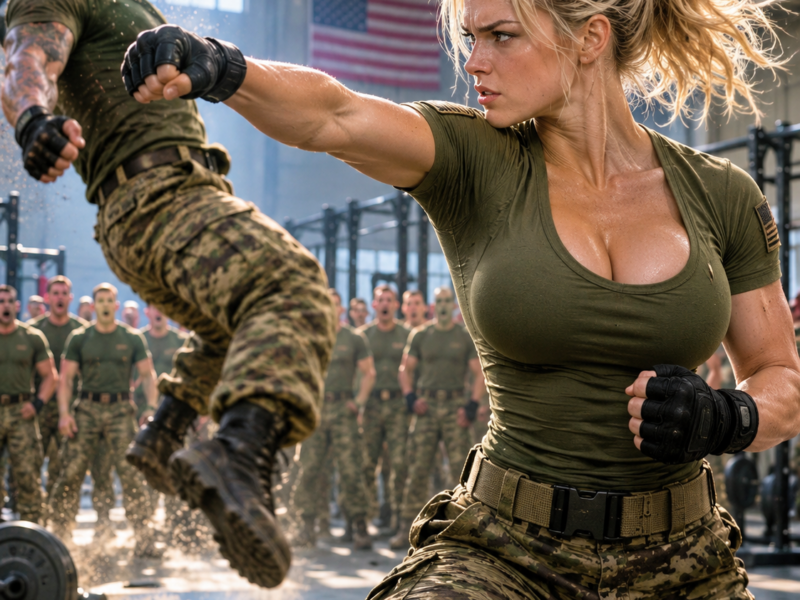
“I watched a decorated Navy SEAL grab a young woman by the arm in front of more than a hundred Marines, then laugh when she warned him to let go
Three hours after Sarah Chen walked out of the dining hall, Colonel James Harrison was sitting behind his desk, staring at a folder he wished had never landed in his hands.
His office phone had rung twice.
The second call came directly from the Pentagon.
“Colonel Harrison, this is Deputy Director Collins with the Defense Intelligence Agency. I assume you’re aware of the incident involving Agent Sarah Chen this morning.”
“Yes, sir. I’ve received an initial report.”
“Then you need to understand that this is no longer an ordinary disciplinary matter.”
Colonel Harrison straightened in his chair.
“Understood, sir.”
“Agent Chen is conducting a formal investigation into allegations of misconduct involving personnel assigned to your installation. Staff Sergeant Marcus Rodriguez is one of the subjects.”
Harrison glanced toward the folder on his desk.
“May I ask what kind of misconduct?”
“Sexual harassment, intimidation, retaliation against junior personnel, abuse of authority, and interference with reporting procedures.”
The colonel slowly removed his glasses.
“How long has this been going on?”
“Eighteen months. Possibly longer.”
Harrison leaned back.
He had commanded Camp Lejeune long enough to know that complaints didn’t always reach his office.
But eighteen months of documented allegations involving a senior enlisted operator was something else entirely.
“Why wasn’t I informed?”
“Because the investigation includes allegations that complaints were improperly handled within the chain of command. We needed to establish where the failures occurred before alerting everyone involved.”
Harrison looked at the closed office door.
“Are you suggesting someone under my command has been suppressing reports?”
“I’m telling you that Agent Chen is investigating exactly that possibility.”
The call ended with a clear instruction.
Rodriguez was to be placed on immediate administrative leave. His access to classified systems would be suspended pending review, and he was not to contact potential witnesses.
Harrison called Major Jennifer Walsh into his office.
When she arrived, he told her everything.
She listened without interrupting.
Finally, she asked, “Sir, does that mean the incident this morning was part of the investigation?”
“Apparently, Agent Chen wasn’t here by accident.”
Major Walsh looked down at her notes.
“Then she knew Rodriguez would approach her?”
“Possibly. But we shouldn’t assume anything until we speak with her.”
The colonel pressed the intercom.
“Get First Sergeant Hayes in here. And I want a complete list of everyone who witnessed the dining hall incident.”
Within twenty minutes, the administrative machinery was moving.
But while the colonel was trying to regain control of his installation, Tank was sitting in a small office across the base, attempting to convince himself that he was still in control of his life.
First Sergeant William Hayes stood in front of him.
“Staff Sergeant Rodriguez, your security access has been suspended pending investigation. You’re being placed on administrative leave.”
Tank stared at him.
“You’re kidding.”
“I’m not.”
“Over a misunderstanding with a civilian?”
“Agent Chen is a federal investigator.”
Tank’s face tightened.
“So that’s what this is? She gets to walk in here, assault a decorated operator, and nobody asks questions?”
Hayes placed a document on the desk.
“You grabbed her arm after she told you to let go. More than a hundred people witnessed it.”
“She attacked me!”
“After you initiated physical contact.”
“She put me on the floor!”
“Then you should have listened when she told you to release her.”
Tank pushed the document away.
“I’ve served this country for fifteen years.”
Hayes didn’t raise his voice.
“And that service deserves recognition. It doesn’t give you permission to ignore the rules.”
Tank looked away.
For once, there was no audience to impress.
No young Marine waiting for another story about Afghanistan.
No one laughing at his jokes.
Just a document stating that he was no longer authorized to perform his duties.
Meanwhile, Sarah Chen was sitting in a conference room on the opposite side of the installation.
A laptop was open in front of her.
Beside it sat two folders, a digital recorder, and a paper cup of coffee that had gone cold.
Special Agent David Miller, her investigative partner, entered carrying a stack of printed reports.
“How bad was the dining hall?”
Sarah looked up.
“Four seconds of poor judgment.”
Miller almost smiled.
“That’s one way to describe it.”
“Did you get the footage?”
“That’s why I’m here.”
He placed a small encrypted drive on the table.
“The surveillance system recorded the confrontation. We secured the original files, including the server backup.”
“Good. Anything unusual?”
Miller pulled out a chair.
“Actually, yes. Three separate personnel complaints were entered into the base reporting system during the last eighteen months. All three were marked resolved within forty-eight hours.”
“Who resolved them?”
“That’s the interesting part. The same administrative office processed all three.”
Sarah opened the first folder.
Inside was a report from a young female Marine named Corporal Emily Carter.
Emily had alleged that Tank repeatedly made inappropriate comments about her appearance, sent her personal messages outside working hours, and threatened to damage her career when she rejected his advances.
The report was closed after she allegedly withdrew her complaint.
Sarah studied the final page.
“Did she actually withdraw it?”
Miller shook his head.
“She says she never did.”
Sarah looked up.
“Where is she now?”
“Still assigned to Camp Lejeune. Administrative support unit.”
“Arrange an interview.”
“She’s agreed to speak?”
“Not yet. But she needs to know she’s not walking into that room alone.”
Miller nodded.
Sarah closed the folder.
There was a reason she had requested the original surveillance footage.
In the previous two investigations, the official records had contained suspicious gaps.
One complaint had been marked withdrawn even though the person who filed it insisted she had never signed the withdrawal.
Another had been closed with a supervisor’s approval that appeared to have been entered after the alleged complainant had already transferred units.
Sarah wasn’t simply investigating Tank’s behavior.
She was trying to establish whether someone had been protecting him.
And she suspected that person had access to the reporting system.
The following morning, Corporal Emily Carter arrived at the investigative office.
She was twenty-four years old, with dark hair pulled into a tight bun and a nervous habit of rubbing the edge of her identification card.
Sarah greeted her at the door.
“Corporal Carter? I’m Sarah Chen. Thank you for coming.”
Emily glanced at the empty chairs.
“Is anyone else going to be here?”
“Just my partner, Agent Miller. You can ask for a break whenever you need one.”
Emily nodded and sat down.
For several seconds, she didn’t speak.
Sarah didn’t rush her.
Finally, Emily opened her bag and removed a folded piece of paper.
“I brought something.”
She placed it on the table.
It was a printed email.
The message had been sent from an account belonging to Marcus Rodriguez.
The subject line read: PRIVATE CONVERSATION.
Emily’s voice became quieter.
“He told me I was making a mistake by refusing to meet him outside work.”
Sarah read the email carefully.
The message wasn’t openly threatening.
That was what made it particularly revealing.
Tank had written that he had invested time in Emily’s career and expected loyalty in return.
He suggested that her next assignment could be affected by how she chose to handle their relationship.
“Did you respond?”
“I told him I wasn’t interested and asked him to keep our conversations professional.”
“What happened afterward?”
Emily swallowed.
“My training recommendation disappeared.”
Sarah looked up.
“Who told you why?”
“He said I wasn’t a team player. Then he told my supervisor I had an attitude problem.”
“Did you report it?”
“I did.”
“To whom?”
“Lieutenant Scott.”
Sarah wrote down the name.
Emily stared at her hands.
“Two days later, I was called into an office and told the matter had been resolved. They said I had withdrawn my complaint.”
“Did you sign anything?”
“No.”
“Did anyone ask you to?”
Emily shook her head.
“They told me that if I kept pushing, I could be transferred somewhere that would hurt my career.”
Sarah leaned forward slightly.
“Emily, I need you to understand something. You’re not responsible for what someone else chose to do with your complaint.”
Emily’s eyes filled.
“I’ve spent a year thinking I ruined my own career.”
Sarah let the silence sit between them.
Then she asked one more question.
“Do you still have the original email?”
Emily nodded.
“I kept everything.”
She reached into her bag and produced a small flash drive.
It contained emails, text messages, and screenshots she had saved before losing access to her work account.
Sarah looked at Miller.
For the first time that morning, he didn’t need to ask what she was thinking.
They had their first substantial piece of evidence.
But it wasn’t the last.
Over the next four days, Sarah and her team interviewed eleven personnel.
Some were willing to speak immediately.
Others requested time to think.
A few initially denied witnessing anything, only to return later with details they had been afraid to share.
One of them was Staff Sergeant Jenny Martinez.
Jenny had served alongside Tank for eight years.
She knew his strengths, his combat record, and the difference between the man he had been overseas and the man he had gradually become.
When she entered the interview room, she looked exhausted.
Sarah offered her water.
“Thank you for coming, Staff Sergeant.”
Jenny sat down.
“I don’t know how much I can help.”
“That’s all right. Just tell us what you’ve seen.”
Jenny looked toward the recorder.
Then she began.
“Tank is a good operator. He knows his job. But he started acting like his rank and reputation made him untouchable.”
“Can you give me an example?”
Jenny described an incident involving a junior Marine who had questioned an order.
Tank had publicly humiliated the young man, threatened to ruin his promotion prospects, and later described the incident as a necessary lesson in discipline.
She also described how Tank used his combat decorations to discourage criticism.
“If someone complained, he’d remind them that he’d been shot at while they were still learning to shave.”
Sarah listened.
“Did you ever challenge him?”
Jenny’s eyes dropped.
“Once.”
“What happened?”
“He stopped speaking to me professionally. He left me off planning meetings and told people I wasn’t loyal to the team.”
“Did you report that?”
“No.”
“Why not?”
Jenny took a breath.
“Because I was afraid I’d be next.”
Sarah closed her notebook.
“Thank you for being honest.”
Jenny hesitated before standing.
“There’s something else.”
Sarah looked up.
Jenny reached into her jacket and removed a folded sheet of paper.
“I found this in my desk about six months ago. I didn’t know what to do with it.”
Sarah unfolded the paper.
It was a handwritten note.
The writing was brief.
Stop asking questions about Rodriguez. Some careers aren’t worth sacrificing.
There was no signature.
Sarah read it twice.
“Why didn’t you bring this forward sooner?”
Jenny’s jaw tightened.
“Because I thought it might have come from someone with enough authority to make good on it.”
Sarah placed the note inside an evidence sleeve.
“Do you recognize the handwriting?”
Jenny shook her head.
“No. But I remember the day I found it.”
“Why?”
“Because that was the same day my supervisor told me to stop asking why Emily Carter’s complaint had disappeared.”
Sarah looked toward Miller.
Another connection.
Another piece of the same pattern.
That afternoon, Miller returned from the records office carrying a thick binder.
“We found the administrative officer who processed the complaints.”
Sarah opened the binder.
The name was Lieutenant Daniel Scott.
He had served as the administrative liaison for the special operations unit for almost four years.
He was responsible for routing personnel complaints, maintaining documentation, and forwarding certain disciplinary matters to the appropriate authorities.
He had also approved all three complaint closures.
Sarah studied the signature blocks.
“Where is he now?”
“Still on base. He’s scheduled to be in the command building tomorrow.”
“Then we’ll speak with him.”
The next morning, Lieutenant Scott arrived for his interview wearing a perfectly pressed uniform.
He was in his late thirties, polite, composed, and visibly irritated by the request.
“I don’t understand why this requires a federal investigation,” he began.
Sarah placed three personnel records on the table.
“These complaints were marked withdrawn by the reporting individuals. Two of them say they never withdrew anything.”
Scott glanced at the documents.
“Administrative errors happen.”
“Three separate errors involving the same staff sergeant?”
“I wouldn’t characterize them that way.”
“Then how would you characterize them?”
Scott folded his hands.
“Staff Sergeant Rodriguez is an experienced operator. He’s demanding. Sometimes junior personnel interpret professional criticism as personal mistreatment.”
Sarah watched him carefully.
“Did you personally speak with Corporal Carter before closing her complaint?”
“I don’t recall.”
“Did you obtain her written withdrawal?”
“I believe the appropriate paperwork was completed.”
“That’s not what I asked.”
Scott shifted in his chair.
“I would have to review the records.”
Sarah opened another folder.
“We already reviewed them.”
She slid a printed system log across the table.
The electronic closure had been entered using Scott’s credentials at 8:43 p.m.
But the attached withdrawal form had been uploaded two days later.
And the document’s digital signature didn’t match Carter’s verified signature.
Scott stared at the page.
For the first time, his composure slipped.
“Where did you get that?”
“From the original system records.”
He said nothing.
Sarah leaned back.
“Lieutenant, this is your opportunity to explain how a complaint was closed before its withdrawal form existed.”
Scott looked toward the door.
“I’d like to speak with legal counsel.”
“That’s your right.”
The interview ended.
But Sarah wasn’t satisfied.
Scott’s behavior suggested he knew more than he had admitted.
And the digital records indicated that someone had altered the reporting process deliberately.
The investigation now had a second major subject.
By Friday, Tank’s situation had deteriorated considerably.
His administrative leave had been extended.
His access to operational facilities remained suspended.
He had received instructions not to contact witnesses or discuss the investigation with anyone involved.
He spent most of his time at home, ignoring calls from old teammates.
One afternoon, Jenny called him.
He stared at the phone for several seconds before answering.
“What?”
“Marcus, we need to talk.”
“About what?”
“About what’s happening.”
He gave a bitter laugh.
“Everyone seems to have something to say now.”
Jenny was quiet.
“Maybe because people were afraid to say it before.”
Tank rubbed his forehead.
“So you’re taking her side?”
“I’m taking the side of what actually happened.”
“She put me on the floor.”
“You grabbed her first.”
“She humiliated me.”
“You humiliated yourself.”
The words landed harder than Jenny intended.
Tank stood and walked toward the kitchen.
“Eight years, Jenny. Eight years we’ve worked together.”
“I know.”
“After everything I’ve done for this team, you’re going to turn against me?”
Jenny’s voice softened.
“I’m not turning against you, Marcus. I’m telling you that the way you’ve been treating people isn’t right.”
He didn’t answer.
She continued.
“Do you remember Corporal Carter?”
“What’s that got to do with anything?”
“She was afraid to come to work because of you.”
“That’s ridiculous.”
“She kept copies of your messages.”
Tank stopped walking.
“What messages?”
Jenny sighed.
“Marcus, I can’t do this conversation for you.”
“Wait. What did you tell them?”
“I told them what I saw.”
Then she ended the call.
Tank stood in the kitchen with the phone in his hand.
He could handle being disliked.
He could even handle being investigated.
But the thought that people he had served with might testify against him was something he had never seriously considered.
He opened his contacts and scrolled to a name he hadn’t called in years.
A retired former team leader named Chief Petty Officer Daniel Brooks.
Brooks had been the man who first taught Tank what leadership meant.
He had also been the last person to challenge Tank before their relationship fell apart.
Tank pressed call.
Brooks answered after four rings.
“Marcus?”
“Chief. I need some advice.”
There was a pause.
“What’s happened?”
Tank tried to explain the dining hall incident without mentioning the complaints.
He described Sarah as an investigator who had provoked him, then used her training to embarrass him.
Brooks listened until he finished.
Then he asked a question.
“Did you grab her?”
Tank looked at the floor.
“She was walking away.”
“That’s not what I asked.”
“Yes.”
Another silence.
“Then you already know the answer, Marcus.”
Tank’s voice sharpened.
“You’re supposed to be helping me.”
“I am.”
“How?”
“By telling you the truth before somebody else has to.”
Tank ended the call.
For the next two days, he didn’t contact anyone.
Meanwhile, Sarah was reviewing the original surveillance footage.
The recording from the dining hall had captured the entire confrontation from two angles.
It showed Tank approaching Sarah.
It showed him sitting down without permission.
It showed the conversation becoming increasingly uncomfortable.
Most importantly, it showed the exact moment he grabbed her arm.
Sarah watched it once.
Then again.
Miller stood beside the monitor.
“There’s no ambiguity.”
“No.”
“His lawyer is going to argue that he believed she posed a security threat.”
“Then we need the full context. Not just the physical contact.”
Sarah paused the footage.
She pointed toward the background.
A young Marine was seated two tables behind Tank.
He had been watching the entire conversation.
“Who is that?”
Miller enlarged the image.
“Corporal Ryan Mitchell. He’s assigned to Rodriguez’s unit.”
“Has he been interviewed?”
“Not yet.”
“Why not?”
“He was listed as a witness, but he hasn’t responded to our interview request.”
Sarah studied the young man’s expression.
He wasn’t looking at Tank.
He was watching Sarah.
“Find him.”
The following afternoon, Corporal Mitchell entered the investigative office.
He looked barely twenty-two.
His hands trembled slightly as he sat down.
Sarah introduced herself and explained the purpose of the interview.
“You were present in the dining hall on Tuesday morning?”
“Yes, ma’am.”
“Did you see Staff Sergeant Rodriguez approach me?”
“Yes.”
“Did you see him grab my arm?”
Mitchell nodded.
“Yes, ma’am.”
“Did you see anything else that might be relevant to this investigation?”
He stared at the table.
“I don’t know.”
Sarah waited.
Finally, he looked up.
“Can I ask something first?”
“Of course.”
“If I tell you something, will it stay confidential?”
Sarah chose her words carefully.
“We’ll protect your information as much as the investigation allows, but I can’t promise that every detail will remain confidential. If it becomes evidence, it may have to be disclosed through the proper process.”
Mitchell swallowed.
“Then I need to tell you something important.”
He reached into his pocket and removed his phone.
He opened a folder containing several photographs.
The first showed a printed personnel complaint.
The second showed a text message.
The third showed an email conversation.
Sarah leaned forward.
“Where did you get these?”
“Staff Sergeant Rodriguez asked me to delete some files from a shared office computer about six months ago.”
Sarah’s expression remained neutral.
“Did you?”
“No.”
“Why not?”
Mitchell looked down.
“Because I recognized Corporal Carter’s name. I knew she had complained about him.”
He turned the phone around.
“I took pictures before deleting anything. I didn’t know if they would ever matter.”
Sarah examined the images.
One document appeared to be a draft complaint closure.
Another contained instructions to mark the matter resolved without contacting the complainant.
The final message had been sent from Scott’s account.
It read:
Keep this out of the commander’s weekly report. Rodriguez’s team is already under enough scrutiny.
Sarah looked at Mitchell.
“Did anyone else see these?”
“No, ma’am.”
“Why are you bringing them forward now?”
His eyes reddened.
“Because I watched him grab you. And everyone saw it. I kept thinking about what would have happened if he had done that to somebody who couldn’t defend herself.”
Sarah closed the folder.
“Thank you, Corporal.”
Mitchell nodded, but didn’t stand.
“There’s one more thing.”
“What is it?”
He looked at Miller.
Then back at Sarah.
“Lieutenant Scott told me to change the dates on the computer logs. He said it was just administrative cleanup.”
Sarah remained still.
“Did you change them?”
“No.”
“Do you have proof?”
Mitchell nodded slowly.
“I saved the original logs.”
That was the turning point.
The investigation had moved beyond complaints and conflicting recollections.
They now had evidence suggesting deliberate manipulation of official records.
Sarah immediately contacted the appropriate investigative authorities.
Within forty-eight hours, Scott was ordered to surrender his government devices and was placed under separate review.
The evidence was also forwarded to the military justice authorities for assessment.
Colonel Harrison requested an urgent briefing.
When Sarah entered his office, he stood.
“Agent Chen.”
“Colonel.”
“I understand we’ve uncovered some serious problems.”
“Yes, sir.”
“How serious?”
Sarah placed a folder on his desk.
“Serious enough that we believe personnel complaints were altered, reporting procedures were bypassed, and junior service members were discouraged from pursuing legitimate allegations.”
Harrison opened the folder.
His expression darkened as he read.
“Lieutenant Scott?”
“His actions are under investigation.”
“And Rodriguez?”
“His conduct is documented in several independent accounts. We also have digital evidence that supports portions of those accounts.”
The colonel removed his glasses.
“I want you to know that this behavior is not representative of the Marines and sailors serving here.”
“I understand that, Colonel.”
“Some of these young people have spent months believing nobody would listen.”
Sarah nodded.
“That’s why we need to get this right.”
Harrison looked toward the window.
“Do you believe the chain of command failed them?”
Sarah didn’t answer immediately.
“I believe some people failed to act when they had a responsibility to act. Whether that failure was deliberate or negligent is something the investigation will establish.”
The colonel nodded.
“Then you have my full cooperation.”
For the first time since the dining hall incident, Sarah allowed herself to relax slightly.
But the hardest part was still ahead.
Tank had requested a formal meeting with the command team.
He wanted to defend his record and challenge the allegations.
His attorney was present.
So was Colonel Harrison, Major Walsh, First Sergeant Hayes, and Sarah.
Tank entered wearing his dress uniform.
His medals were arranged perfectly.
He looked almost exactly like the man who had walked into the dining hall that Tuesday morning.
But his eyes were different.
He sat across from Sarah.
“I’d like to make something clear,” he began. “I never intended to hurt anyone.”
Sarah listened.
“I’ve spent fifteen years serving this country. I’ve been through things most people can’t imagine. I’ve lost friends. I’ve watched people die. I’ve done everything asked of me.”
Colonel Harrison folded his hands.
“Nobody is questioning that you served.”
“Then why am I being treated like a criminal?”
Sarah opened her notebook.
“Because the investigation concerns your conduct, not whether you served.”
Tank shook his head.
“Those complaints are exaggerated. People don’t understand the pressure we operate under.”
“Corporal Carter’s emails are not exaggerated.”
He looked at her.
“She misunderstood my intentions.”
“Did you tell her that her career could suffer if she refused to meet you outside work?”
Tank’s jaw tightened.
“I was trying to mentor her.”
“Did you tell her that her training recommendation could be affected?”
“I don’t remember saying that.”
Sarah placed a printed message on the table.
“Would you like to read it?”
Tank looked at the page.
His attorney leaned closer.
“Don’t answer that question right now.”
Sarah nodded.
“That’s your right.”
She turned to another document.
“Did you ask Corporal Mitchell to delete personnel records?”
Tank looked toward the attorney.
“I don’t recall.”
“Did you know that Lieutenant Scott had entered complaint closures using your unit’s administrative records?”
“I don’t handle paperwork.”
“Then you should have no difficulty explaining why your name appears in the correspondence.”
Tank’s face tightened.
For several seconds, he said nothing.
Then he looked directly at Sarah.
“You came here looking for me.”
Sarah closed the folder.
“I came here because several people reported misconduct. Your name appeared in the evidence.”
“You knew I would react badly.”
“I had no way of knowing exactly how you would behave.”
Tank leaned back.
“So the dining hall was a setup.”
“No, Staff Sergeant. You were free to walk away at any point. You chose to grab my arm.”
His attorney placed a hand on the table.
“We’re going to pause here.”
The meeting ended shortly afterward.
Tank left with his attorney.
But the investigation continued.
Over the following weeks, the evidence was reviewed by the appropriate military and federal authorities.
Corporal Carter’s original complaint was restored to the investigative record.
Mitchell’s preserved files were authenticated.
The surveillance footage was retained as evidence.
Jenny Martinez provided a sworn statement.
And several other service members came forward after learning that the investigation was being handled outside the unit’s ordinary reporting structure.
The case against Scott developed separately.
Investigators established that he had improperly closed complaints and altered administrative records.
Whether his actions were motivated by loyalty, pressure, or an attempt to protect the unit remained part of the legal inquiry.
But the documentary evidence was no longer something he could dismiss as an administrative mistake.
Tank’s case also moved forward.
His security access remained suspended.
His operational duties were reassigned.
After reviewing the evidence, military authorities initiated formal proceedings concerning his conduct.
He was eventually removed from his special operations assignment.
The process took months.
There were legal reviews, statements, hearings, and difficult conversations.
His decorations were not erased.
His combat service was not rewritten.
But his achievements could no longer shield him from the consequences of his actions.
The most difficult moment came when he finally met Corporal Carter in a formal proceeding.
Emily sat across the room with her attorney.
Tank looked older than he had in the dining hall.
When asked whether he wished to address her, he stood.
“I want to apologize.”
Emily didn’t move.
“I know that doesn’t fix anything,” he continued. “I know I made your life harder.”
She looked at him.
“You didn’t just make my life harder, Staff Sergeant.”
Tank lowered his eyes.
“You made me believe that if I spoke up, nobody would believe me. You made me think my career was already over before I had even started.”
He swallowed.
“I was wrong.”
Emily took a breath.
“I wanted to become a leader because I thought people like you were supposed to protect the people coming up behind them.”
Tank said nothing.
“I don’t need you to tell me you’re sorry because you’re losing your position. I needed you to understand what you were doing when I still had to report to you every morning.”
Her words settled over the room.
For the first time, Tank seemed to understand that the consequences weren’t limited to his career.
He had taken something from people who had trusted him.
And an apology couldn’t simply return it.
After the proceeding, Sarah found Emily standing in the hallway.
“Are you all right?”
Emily nodded.
“I think so.”
“That took courage.”
Emily looked down at her identification card.
“I almost didn’t come.”
“But you did.”
A small smile appeared.
“Yes, ma’am. I did.”
Several months later, Sarah returned to Camp Lejeune for the final review of the investigation.
The dining hall looked exactly as it had on the morning she first arrived.
The same tables.
The same fluorescent lights.
The same coffee machines.
But the atmosphere felt different.
Personnel had completed additional training on reporting misconduct and professional boundaries.
The command had established clearer procedures for receiving complaints outside the immediate unit.
Witnesses were given access to independent reporting channels.
Most importantly, complaints could no longer be quietly closed by the same people responsible for forwarding them.
Major Walsh met Sarah near the entrance.
“Good to see you again, Agent Chen.”
“Good to see you too, Major.”
“Things have been quieter.”
“Quiet isn’t always a bad thing.”
Walsh smiled faintly.
“Emily Carter received her training recommendation last month. She’s been selected for an advanced leadership program.”
Sarah’s expression softened.
“That’s good news.”
“She earned it.”
They stood watching Marines move through the serving line.
After a moment, Walsh asked, “Do you ever think about what happened that morning?”
Sarah looked toward the corner table where she had been sitting.
“Sometimes.”
“Do you think Rodriguez will ever understand?”
Sarah considered the question.
“I think understanding begins when someone stops blaming everyone else.”
Major Walsh nodded.
A few minutes later, Sarah collected her coffee and walked toward the exit.
She had one final appointment before leaving the installation.
It was with Jenny Martinez.
Jenny was waiting outside the command building.
“Agent Chen.”
“Staff Sergeant.”
Jenny looked uncomfortable.
“I wanted to thank you.”
“For what?”
“For giving people a chance to tell the truth.”
Sarah smiled slightly.
“They did the difficult part themselves.”
Jenny nodded.
“Tank used to say that fear was what made people follow a leader.”
Sarah looked at her.
“And what do you think now?”
Jenny glanced toward the training grounds.
“I think people follow someone they trust. Fear just makes them look for a way out.”
Sarah didn’t answer.
She didn’t need to.
A week later, Tank received formal notice of the outcome of the administrative proceedings.
His special operations assignment was permanently terminated.
His security clearance remained revoked, and further disciplinary action followed through the appropriate military process.
His career in the unit he had spent years building his identity around was over.
He still had his memories.
He still had his medals.
He still had the friends who remembered the man he had once been.
But he could no longer use those things as permission to avoid responsibility.
One evening, he drove past the base entrance and pulled into a small parking area overlooking the water.
He sat in his truck for nearly an hour.
On the passenger seat was an old photograph from his first deployment.
He was younger in it, smiling beside three members of his team.
One of them had never come home.
Tank picked up the photograph.
For years, he had told stories about the men he had lost.
He had used their sacrifice as a reason people should respect him.
But he had rarely asked himself whether the way he treated people reflected the values those men had lived by.
He thought about Chief Brooks.
He thought about Jenny.
He thought about Emily sitting across from him in the hearing room.
And finally, he thought about Sarah Chen.
He had believed that being strong meant making sure nobody could challenge him.
Now he understood that he had confused authority with respect.
It didn’t undo what he had done.
It didn’t restore the trust he had broken.
But it was the first honest thought he had allowed himself in a long time.
Months later, Emily passed through the dining hall on her way to morning formation.
She stopped at the table near the windows.
For a moment, she remembered the morning when a stranger had sat there reading a technical manual while a decorated Staff Sergeant tried to make her feel small.
Emily smiled to herself.
Then she picked up her coffee and continued toward the door.
The dining hall was full again.
People were talking, laughing, and rushing to finish breakfast.
Nobody needed to announce their medals.
Nobody needed to remind anyone how important they were.
And somewhere among those young Marines was another person learning what leadership meant.
Sarah Chen had never come to Camp Lejeune to prove that she could defeat a Navy SEAL.
She had come because people who had been afraid to speak deserved someone willing to listen.
The most important thing that happened that morning wasn’t that Tank Rodriguez ended up on the floor.
It was that, afterward, people who had spent months keeping their heads down finally stood up and told the truth.
The End.









