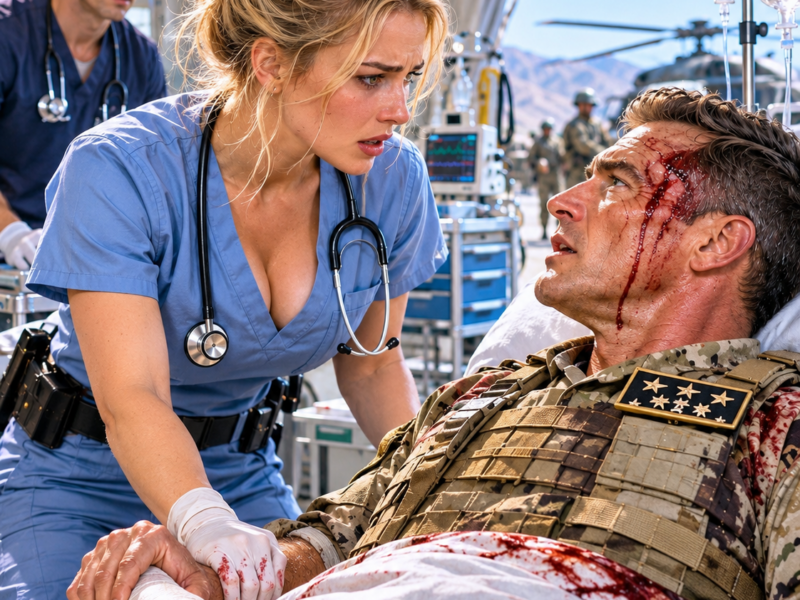
“I watched a decorated military surgeon take credit for saving a nineteen-year-old soldier’s leg, even though I had disobeyed his orders to save it
General Waywright’s words hung over the operating table.
“Dear God… that technique. You’re the surgeon from Kandahar.”
For a moment, nobody moved.
Dr. Harrison Cole looked from the general to me, his expression caught somewhere between confusion and disbelief.
“Sir, she’s a nurse. Whatever you think you recognize, this is not the time for stories.”
I didn’t look at him.
Jonathan’s heart monitor was still screaming, and his oxygen saturation was falling.
“General, I need you to make a decision,” I said. “Either clear this room and let me work, or explain to his family why he died while we argued about my job title.”
Waywright studied my face.
Then he turned toward the military police officers standing near the entrance.
“Nobody touches Dr. Mitchell. Dr. Cole, step away from the table.”
Cole’s mouth fell open.
“General, you cannot seriously be authorizing this.”
“That wasn’t a request.”
Cole stepped back, but his eyes promised that this wasn’t over.
I turned toward Danny.
“Fourteen-gauge decompression needle. Now.”
Danny was already moving.
He had seen me recognize danger before anyone else in that tent. He had watched me save Thomas Miller’s leg when a senior surgeon had refused to listen.
But this was different.
This was the highest-ranking operational commander in the theater.
And there was no second chance.
I located the appropriate insertion site and relieved the pressure building inside Jonathan’s chest.
A sharp hiss escaped.
His oxygen levels began to recover.
“Good,” I said. “Now prepare for thoracic exploration. Massive transfusion protocol. Six units of O negative. I need suction, a thoracic tray, and a second set of hands.”
A young anesthesiologist stared at me.
“Doctor, are you sure?”
I met his eyes.
“I have never been more sure of anything.”
The next several minutes passed in a blur of movement.
The damage inside Jonathan’s chest was extensive.
Shrapnel had torn through his lung, and a major vessel was bleeding.
There was no time to wait for a specialist from another base.
I opened the chest and began the difficult work of controlling the bleeding.
“Clamp.”
Danny placed the instrument into my hand.
“Suction.”
He cleared the field.
“Keep your eyes on the monitors, Danny. Don’t let the numbers distract you from what your hands are doing.”
“Yes, ma’am.”
I worked with a concentration that made the rest of the room disappear.
I knew the anatomy.
I knew the damage.
And I knew the particular way Jonathan’s body reacted under extreme stress.
Four years earlier, I’d watched him walk away from a hospital room believing that our marriage could survive the scandal that was about to destroy my career.
Now I was standing over him again, fighting to keep his heart beating.
I refused to let the memory interfere.
After nearly forty-five minutes, the bleeding was controlled.
The anesthesiologist looked at the monitor.
“Blood pressure is stabilizing.”
Danny let out a breath.
“He’s holding.”
I placed the final sutures and stepped back.
Only then did I notice that my hands were shaking.
General Waywright approached the table.
He looked at Jonathan, then at me.
“That was the same double-loop vascular technique used by the classified surgical team in Kandahar.”
I removed my gloves.
“Yes, sir.”
“Who trained you?”
I looked at him.
“I led that team.”
The general slowly lowered his head.
“I knew it.”
Dr. Cole gave a short, disbelieving laugh.
“This is absurd. She’s inventing a story to justify what she’s done.”
Waywright turned toward him.
“Do you know what happened in Kandahar five years ago, Harrison?”
Cole crossed his arms.
“I know enough to understand that this woman has been practicing outside her authority.”
“Then perhaps you should listen before embarrassing yourself further.”
The general looked back at me.
“Tell them.”
I glanced at Jonathan.
He was unconscious, but his heartbeat was steady.
I had spent four years avoiding this conversation.
Apparently, that was over.
“Five years ago, I was the lead trauma surgeon assigned to a classified Joint Special Operations Command medical unit.”
The room became quiet.
“I was responsible for a small team operating in locations where evacuation was sometimes impossible. We treated injuries that ordinary field hospitals couldn’t handle.”
Danny stared at me.
“You’re saying you were a surgeon?”
“Yes.”
“How did you end up here?”
I looked down at my hands.
“Because I protected the wrong people.”
Five years earlier, my life had looked nothing like it did at FOB Griffin.
I was a military surgeon with a distinguished record, a medical team I trusted, and a husband who understood what it meant to spend nights waiting for a helicopter carrying wounded soldiers.
Jonathan and I had met during an overseas deployment.
He was a young officer then, already known for bringing his men home when other commanders would have called the mission impossible.
We married quietly.
Neither of us wanted a military ceremony or a newspaper announcement.
He used to joke that the only person who could make him follow orders was me.
I used to tell him that was because he was a terrible patient.
We were happy.
Not in a perfect, movie-like way.
We argued about missed calls, dangerous assignments, and the fact that neither of us knew how to take a proper vacation.
But we trusted each other.
Then came the diplomatic medical incident.
A foreign diplomat had been injured during an attack and was flown to a secure military hospital.
The operation was complicated, but manageable.
Captain Gregory Hayes, a surgeon assigned to my team, was responsible for one part of the procedure.
He made a mistake.
A serious one.
He damaged a major artery.
I immediately took over and spent hours trying to save the patient.
We eventually stabilized him, but he suffered permanent complications.
The incident should have triggered a routine medical investigation.
Instead, it became a political crisis.
Gregory was the son of Senator Richard Hayes, a powerful man with influence over military appointments and defense funding.
Within days, the story changed.
The official account claimed I had made the fatal surgical error.
The medical records were altered.
Statements from junior staff disappeared.
And the video footage from the operating room was classified.
I knew what had happened.
So did my team.
But Senator Hayes made it clear that if I challenged the report, he would destroy everyone who had worked under me.
He knew their names.
He knew their families.
He knew where their children went to school.
I could have fought.
But I had a team of twelve people whose careers and futures were suddenly being held hostage.
So I accepted responsibility.
The medical board revoked my license.
My rank was reduced, and my career as a surgeon was effectively over.
Jonathan begged me not to accept the decision.
We argued for weeks.
“You cannot let them do this to you,” he told me one night.
“They’ll go after the others.”
“Then we fight together.”
“No, John. They will destroy you, too.”
“I don’t care about my career.”
“I do.”
He stared at me.
I remember the way he stood in our kitchen, still wearing his uniform, his dinner untouched on the counter.
“You’re my wife, Raven. You’re not a liability I can simply walk away from.”
I wanted to believe him.
But the threats kept coming.
Eventually, we made a decision that neither of us wanted.
We divorced on paper.
Jonathan believed that separating our records might protect him from the political fallout.
I accepted a nursing position under my maiden name and disappeared into ordinary military medical work.
The arrangement was supposed to last until the investigation was reopened.
It never happened.
We stopped calling.
Then we stopped writing.
And eventually, four years passed.
“I thought the records were sealed,” General Waywright said.
“They were.”
“Then why did you come back to the military?”
I looked toward the trauma bay entrance.
“Because I couldn’t stop being a doctor just because somebody took away my title.”
Nobody spoke.
Even Danny seemed unable to find words.
Then Dr. Cole broke the silence.
“That’s a touching story, but it doesn’t change the fact that she performed an unauthorized thoracotomy.”
Waywright turned slowly.
“You’re right about one thing, Harrison. It doesn’t.”
Cole straightened.
“Thank you, sir.”
“But it does raise a more important question.”
The general pointed toward the operating table.
“Why were you about to make an incision that would have killed him?”
Cole’s face tightened.
“I was under pressure.”
“You were about to cut into the wrong anatomical area.”
“The patient was deteriorating.”
“And Dr. Mitchell recognized the problem.”
Cole looked around the room.
Nobody supported him.
He turned to me.
“This isn’t finished.”
I nodded.
“No, Harrison. It isn’t.”
Jonathan was transferred to intensive care.
The first twenty-four hours were difficult.
His blood pressure fluctuated, and the surgeons monitoring him worried about complications.
I remained nearby, but I didn’t enter his room unless I was needed.
I had no idea what he wanted from me.
I also wasn’t sure what I wanted from him.
Three days later, Chloe found me sitting outside the ICU with a cup of coffee I’d forgotten to drink.
“You look terrible,” she said.
“Thank you.”
“You’re welcome.”
She sat beside me.
For a while, neither of us spoke.
Then she asked, “You really were married to him?”
I nodded.
“Four years.”
“Why didn’t you tell me?”
“Because I didn’t want to be the woman everyone whispered about.”
Chloe considered that.
“Well, you’ve got a bigger problem now.”
I looked at her.
“What?”
“Dr. Cole has filed charges.”
I closed my eyes.
“Of course he has.”
“Unauthorized medical practice, assault, insubordination. He’s also demanding that you be arrested and removed from the base.”
“Does General Waywright know?”
“He does. But Cole has been making calls to people in the medical command.”
I looked through the ICU window.
Jonathan was asleep.
“Let him make his calls,” I said.
Chloe frowned.
“You’re not worried?”
“I’ve been worried for four years. I’m tired.”
She placed a hand on my shoulder.
“Then maybe it’s time someone else did the worrying.”
That afternoon, Jonathan woke up.
I was sitting beside his bed when his fingers moved.
At first, I thought it was an involuntary reaction.
Then he opened his eyes.
“Raven?”
I leaned forward.
“I’m here.”
He tried to speak, but the movement made him cough.
“Don’t talk yet.”
He looked at me with those familiar blue eyes.
Even with tubes and bandages surrounding him, he somehow managed to look stubborn.
“Still giving orders,” he whispered.
“Somebody has to.”
A faint smile crossed his face.
Then his expression changed.
“How long?”
“Three days.”
He looked toward the window.
“Did everyone make it?”
“Not everyone.”
His jaw tightened.
“Who?”
I told him the names of the soldiers who had died.
He closed his eyes after the last one.
For several seconds, the only sound was the steady rhythm of the monitor.
Then he whispered, “I should have brought them home.”
I reached for his hand.
“You brought home the ones you could.”
He shook his head slightly.
“That’s what commanders say when they can’t sleep.”
I didn’t have an answer.
After a moment, he turned his head toward me.
“You still wear your wedding ring?”
I looked down at my hand.
The ring was no longer there.
“I took it off when the divorce became final.”
He swallowed.
“I kept mine.”
I stared at him.
“Why?”
“Because I never believed the divorce was what either of us wanted.”
I looked away.
“John, you signed the papers.”
“So did you.”
“I thought I was protecting you.”
“And I thought I was protecting you.”
His voice cracked slightly.
“Turns out we were both very good at making decisions for the other person.”
I didn’t respond.
He squeezed my fingers.
“I didn’t stop loving you, Raven.”
I looked at him again.
“That doesn’t undo four years.”
“No. It doesn’t.”
For once, he didn’t try to defend himself.
He simply held my hand until the medication pulled him back to sleep.
The following morning, Dr. Cole arrived with two military police officers and a thick manila folder.
He didn’t knock.
“Nurse Mitchell.”
I stood.
“Doctor.”
He placed the folder on the counter.
“You are relieved of duty pending investigation.”
General Waywright entered behind him.
Cole opened the folder.
“These are the formal charges. Unauthorized surgical practice, aggravated assault, falsification of medical authority, and disobedience of a direct order.”
One of the MPs stepped toward me.
“Please place your hands behind your back.”
I looked at General Waywright.
He said nothing.
For one brief moment, I wondered whether he had changed his mind.
Then Jonathan’s voice came from the bed.
“Put those handcuffs away.”
Everyone turned.
He had pushed himself upright, ignoring the pain.
Cole looked irritated.
“Colonel, you need to remain in bed.”
Jonathan looked at him.
“Doctor, I believe I’ve had quite enough of your medical advice.”
“Sir, this is a military disciplinary matter.”
“Then let’s discuss military matters.”
He turned toward Waywright.
“General, did Cyber Command recover the data drives from my tactical vest?”
Waywright nodded.
“They recovered most of the contents. The encryption was damaged, but the files were extracted.”
“Did they send you the surgical footage?”
The general’s expression changed.
“Yes.”
Cole looked between them.
“What surgical footage?”
Jonathan didn’t answer him.
He looked at me.
“Raven, I need you to understand something.”
I stepped closer.
“What did you do?”
“Four months ago, I received information that the original operating room footage from the diplomat incident had never been destroyed.”
My mouth went dry.
“What?”
“It was copied onto an encrypted drive before the official investigation. The person who took it disappeared, but the data eventually reached a broker operating in this valley.”
I stared at him.
“You knew?”
“I suspected.”
“And you went on that mission to find it?”
He nodded.
I felt the blood drain from my face.
“You walked into an ambush for a recording?”
“For the truth.”
“John, you could have died.”
“I know.”
“You could have told me.”
He looked down.
“I wanted to bring you something more than another promise.”
My eyes filled, but I refused to let the tears fall.
“You’re an idiot.”
“I’ve been told.”
General Waywright removed an encrypted tablet from his briefcase.
“Colonel, the footage is already in the secure evidence system.”
He activated the recording.
A black-and-white video appeared.
The operating room came into view.
I recognized it immediately.
The lights.
The surgical table.
The equipment.
And the people.
There I was, standing on the left side of the operating table, wearing my surgical gown.
Gregory Hayes was opposite me.
The recording showed the moment he made the mistake.
His hand slipped.
The patient’s blood pressure dropped.
I immediately moved toward him.
“Clamp the vessel!” I heard my own voice say through the recording.
But the footage continued.
It showed me taking over the procedure.
It showed me controlling the bleeding.
It showed the entire team working to stabilize the diplomat.
Then came the part I had never known existed.
Gregory stepped away from the table.
He removed his gloves.
And he looked directly at the camera.
“Make sure that part doesn’t go into the final report.”
A technician’s voice answered.
“Sir, the entire procedure is recorded.”
Gregory stepped closer.
“My father will handle the report.”
The recording ended.
Nobody moved.
Dr. Cole looked at the screen.
Then at me.
Then at Jonathan.
“That proves nothing,” he said.
General Waywright’s voice was cold.
“It proves that the original investigation was built on falsified evidence.”
He tapped the screen again.
“Cyber Command recovered the associated metadata, including the original file timestamps and the names of the people who accessed the records.”
He turned toward Cole.
“And it appears Senator Hayes wasn’t the only person involved in suppressing evidence.”
Cole’s face had gone pale.
“What does that mean?”
“It means we’re conducting a wider investigation.”
Waywright opened another file.
A series of medical reports appeared.
I recognized several of them.
Thomas Miller’s report.
A soldier with a complicated abdominal injury.
Another patient who had suffered internal bleeding after a vehicle accident.
Each report listed Dr. Harrison Cole as the lead surgeon.
I looked at the general.
“Why are these here?”
“Because the medical command requested an audit of the base’s trauma records after Colonel Bradley’s emergency surgery.”
He looked directly at Cole.
“Your reports contain multiple discrepancies.”
Cole shook his head.
“Those were routine documentation errors.”
“Some of them are not.”
Waywright opened the next document.
“Thomas Miller’s report states that you personally identified and treated his compartment syndrome.”
I stared at the screen.
Cole shifted his weight.
“That was a collaborative procedure.”
“According to three witnesses, you weren’t even in the trauma bay when it happened.”
Danny Higgins, who had been standing near the door, stepped forward.
“I can confirm that, sir.”
Cole turned toward him.
“Corporal, be careful.”
Danny swallowed.
Then he continued.
“Dr. Mitchell performed the procedure. I assisted her. Dr. Cole came back afterward and ordered us to change the report.”
The room became very quiet.
I looked at Danny.
He had been afraid of losing his future.
He was still afraid.
But he was speaking anyway.
Waywright nodded.
“Thank you, Corporal.”
Cole’s voice rose.
“This is ridiculous. You’re allowing an enlisted medic to challenge a senior surgeon?”
“No,” Waywright replied. “I’m allowing witnesses to tell the truth.”
The general turned to the military police.
“Stand down. Dr. Mitchell is not under arrest.”
Then he faced Cole.
“Effective immediately, you’re relieved of your position as chief of surgery pending a formal investigation into professional misconduct, negligence, and falsification of medical records.”
Cole stared at him.
“You can’t do that. I have commendations.”
Waywright didn’t blink.
“Commendations are not immunity.”
The MPs moved toward Cole.
For the first time since I’d known him, he looked genuinely frightened.
He turned toward me.
“You could have ruined me years ago.”
I looked at him.
“I was too busy keeping your patients alive.”
He opened his mouth.
But nothing came out.
The officers escorted him from the room.
The man who had spent four years making sure nobody knew my name disappeared through the same doorway he’d once used to announce his achievements.
I didn’t feel victorious.
I felt tired.
And strangely sad.
Because every soldier whose name had been hidden beneath his reports had deserved better.
The investigation lasted several weeks.
The recovered footage was authenticated.
The medical board reopened my case.
Gregory Hayes was summoned to testify, and the original surgical team members were contacted.
The evidence was overwhelming.
Gregory eventually admitted that he had caused the injury and participated in altering the report.
Senator Hayes denied knowing about the falsification, but investigators uncovered communications that contradicted his statements.
His political influence could no longer protect his son.
My medical license was formally reinstated.
The military restored my rank and recognized the service record that had been erased.
General Waywright personally delivered the paperwork.
He found me in the trauma tent, checking the inventory of emergency supplies.
“Dr. Mitchell.”
I turned.
“Sir.”
He held out a folder.
“Your reinstatement is official.”
I took it carefully.
For a moment, I couldn’t bring myself to open it.
Four years of believing that part of my life was gone had made the simple sight of an official document almost unbearable.
Waywright waited.
Then he smiled.
“There’s something else.”
I looked up.
“FOB Griffin needs a new chief of surgery.”
I blinked.
“Sir?”
“I’d like you to take the position.”
I looked around the tent.
At the trauma beds.
The oxygen tanks.
The equipment I’d used every night.
“Why me?”
The general gave me a puzzled look.
“Because I’ve watched you save lives without recognition for four years. I’d say you’ve demonstrated the qualifications.”
I lowered my eyes.
“I have one condition.”
“Go ahead.”
“When the helicopters arrive, I want to be with the medics. I don’t want to spend every day behind a desk reviewing reports.”
Waywright nodded.
“I was hoping you’d say that.”
I accepted.
But the biggest change didn’t happen in my career.
It happened in the quiet moments after the investigation ended.
Jonathan remained in the ICU for several more weeks.
His recovery was slow.
He hated being dependent on other people, and I hated watching him pretend that his pain wasn’t serious.
One morning, I found him trying to reach for a glass of water.
“John.”
He stopped.
“I can do it.”
“You can also tear your stitches.”
He looked at me.
“You’re enjoying this.”
“More than I should.”
I handed him the glass.
He took a sip and settled back against the pillows.
Then he looked at the small silver ring on my right hand.
It wasn’t my old wedding ring.
It was a simple band I’d bought at the base exchange after my reinstatement.
“What’s that for?” he asked.
“A reminder.”
“Of what?”
“That I belong to myself before I belong to anyone else.”
He studied the ring.
Then nodded.
“I think that’s fair.”
I sat beside him.
For a while, we listened to the wind moving against the ICU windows.
Eventually, he spoke.
“I owe you an apology.”
I looked at him.
“For what?”
“For letting four years pass without fighting harder to get you back.”
I took a breath.
“You were trying to protect me.”
“I was also afraid.”
He turned his head toward me.
“I thought if I stayed away, you’d have a chance to rebuild your life without me dragging my name through it.”
I looked at his bandaged chest.
“And I thought if I stayed away, you’d have a chance to become the commander you wanted to be.”
He gave a small, tired smile.
“Seems we both made a mess of things.”
“We did.”
I didn’t tell him everything was forgiven.
It wasn’t.
There were nights I had spent alone wondering whether he had stopped loving me.
There were birthdays he had missed.
There were letters I had written and never sent.
A person couldn’t erase those things with one recovered recording.
But I could decide what happened next.
“John,” I said quietly, “I don’t know if we can go back to what we were.”
He nodded.
“I’m not asking you to.”
“Then what are you asking?”
He took my hand.
“Let me get to know the woman you became.”
I looked at him for a long time.
Then I smiled.
“Start by following your discharge instructions.”
He laughed, but the movement hurt his chest.
“Yes, Doctor.”
“That’s better.”
Two months later, Jonathan was medically cleared for light duty.
He remained at FOB Griffin while completing his recovery and helping coordinate the transition for Viper Company.
I returned to the trauma tent as its chief surgeon.
The first thing I changed was the medical reporting system.
Every nurse, medic, and physician involved in a procedure would be documented accurately.
No one would be allowed to erase another person’s contribution.
The second change was a weekly case review where junior personnel could question decisions without fear of retaliation.
Some senior doctors disliked it.
They adjusted.
Danny Higgins was promoted to a training position and eventually qualified for an advanced combat medical program.
Thomas Miller sent me a letter from Ohio.
He had returned home, completed rehabilitation, and was learning to walk without assistance.
He included a photograph of himself standing beside an old red tractor on his family’s farm.
On the back, he’d written:
“Dear Dr. Mitchell, you told me I’d walk again. You were right. I hope you’re doing well. My mom says I owe you a lifetime of dinners.”
I laughed when I read it.
Then I pinned the photograph beside my desk.
A week later, I received another unexpected visitor.
A young woman in a lieutenant’s uniform stood outside my office holding a folder.
“Dr. Mitchell?”
“Yes?”
“I’m Lieutenant Sarah Collins. I’m assigned to the incoming surgical unit.”
She looked nervous.
“Ma’am, I read the investigation report about what happened here.”
I gestured toward the chair.
“That’s a lot of reading for someone who just arrived.”
She smiled faintly.
“Can I ask you something?”
“Of course.”
“How did you keep going when nobody believed you?”
I looked at the photograph of Thomas.
Then at the rows of medical files on my desk.
“I stopped waiting for people to believe me.”
She frowned slightly.
“Then what did you do?”
“I made sure the person on the table had someone who wouldn’t give up on them.”
Sarah nodded.
I could see that she was trying to remember every word.
Before she left, I handed her a copy of our new reporting policy.
“One more thing,” I said.
“Yes, ma’am?”
“If you ever see something that could hurt a patient, speak up. Your rank doesn’t make your eyes less useful.”
She smiled.
“Understood, Doctor.”
That evening, I walked outside the medical compound.
The sun was disappearing behind the mountains, and the desert wind carried the familiar smell of dust and fuel.
Jonathan was waiting near the helicopter landing zone.
He wore his uniform, although he was still recovering and had been instructed not to carry anything heavier than a small field pack.
“You shouldn’t be standing out here,” I told him.
“Good evening to you, too.”
I stopped beside him.
He held out a small envelope.
“What’s this?”
“Something I should have given you years ago.”
Inside was a photograph.
It showed us on our wedding day.
I was wearing a simple white dress.
Jonathan had his arm around my waist, and both of us were laughing at something outside the frame.
I hadn’t seen the picture in years.
“Where did you find this?”
“In my old deployment box.”
I ran my thumb along the edge.
“I thought you threw everything away.”
“I tried.”
He looked toward the mountains.
“I couldn’t.”
I folded the photograph carefully and placed it back in the envelope.
“John, we need to talk about what happens when you leave here.”
“I know.”
“Your career will take you somewhere else.”
“Probably.”
“And I’m not giving up this position.”
“I wouldn’t ask you to.”
I studied his face.
He wasn’t making promises.
He wasn’t asking me to abandon the life I’d fought to rebuild.
For the first time in years, we were standing beside each other without either of us trying to decide what was best for the other.
“Maybe we could start with dinner,” I said.
His eyebrows lifted.
“Is that an invitation?”
“It’s an assessment. I need to determine whether you’re still capable of sitting through a meal without discussing military operations.”
He smiled.
“I’ll do my best.”
“Tomorrow night.”
“Tomorrow night.”
He reached for my hand.
I let him take it.
There was no dramatic kiss.
No promise that the past had disappeared.
Just two people who had once loved each other, standing in the desert and trying to decide whether there was enough left to begin again.
The following morning, the medical tent received another casualty helicopter.
I was already in my scrubs when the doors opened.
Danny came running toward me.
“Doctor, we’ve got three incoming. One critical.”
I pulled on my gloves.
“Get the trauma bays ready.”
The helicopter blades grew louder.
A stretcher appeared through the entrance.
The soldier lying on it looked terrified.
He couldn’t have been older than twenty.
His eyes found mine.
“Am I going to die?”
I took his hand.
“Not if I have anything to say about it.”
The room filled with movement.
Monitors beeped.
Medics called out vital signs.
Somewhere behind me, Danny began preparing the equipment.
And I returned to the work I had never stopped loving.
For four years, I’d been a ghost because powerful people had decided that my name was inconvenient.
But a name was never what made a surgeon.
It was never the uniform, the medals, or the title embroidered across a chest.
It was the willingness to stay when someone needed you most.
Later that night, I walked past the wall where the unit displayed photographs of its medical personnel.
A new photograph had been placed in the center.
It showed me in my surgical scrubs, standing beside Danny and the rest of the trauma team.
Underneath it was a small brass plaque.
DR. RAVEN MITCHELL
CHIEF OF SURGERY — FOB GRIFFIN
I stood there for a moment, looking at the name.
Then I heard Jonathan’s voice behind me.
“Looks right.”
I turned.
He was holding two cups of coffee.
“One of those for me?”
“Unless you’ve decided to stop drinking coffee.”
I took the cup.
“Thank you.”
He glanced at the photograph.
“You know, I always hated that you wanted to disappear.”
I looked at him.
“I didn’t want to disappear. I wanted to keep saving people without becoming a target.”
He nodded.
“There’s a difference.”
“Yes, there is.”
We stood together beneath the photograph while the evening shift began.
For the first time in four years, I didn’t feel the need to hide when someone called my name.
And when the next wounded soldier came through those doors, I knew exactly where I belonged.
Not in the shadows.
Not beneath someone else’s medals.
But right where I’d always been needed.
THE END.









