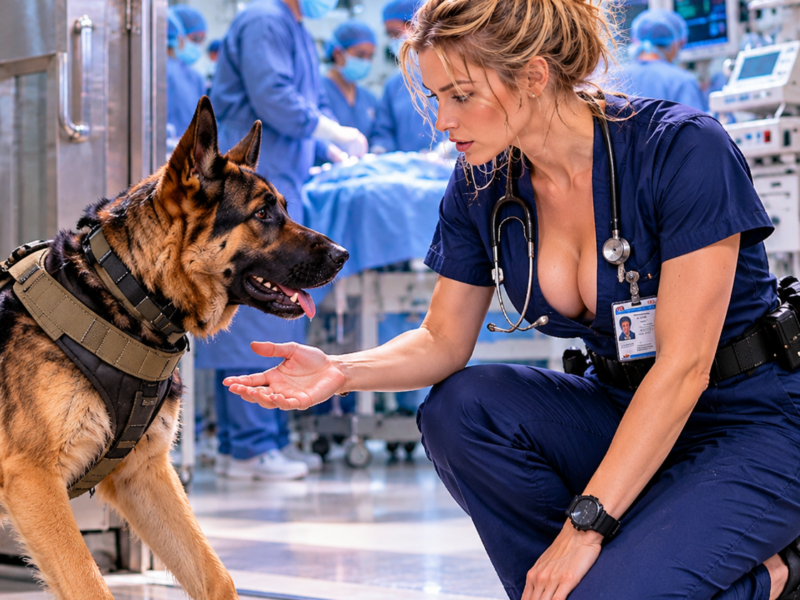
“I watched a bleeding police dog nearly tear a veterinarian’s throat out in an emergency room in downtown Chicago
The serial number was still visible beneath the dried blood.
I knew it before I finished reading it.
My fingers tightened around the edge of the surgical table, and for a moment, the bright operating lights disappeared.
I was back in the Coronal Valley.
I could hear the helicopter blades struggling against the wind, the metallic scream of twisting steel, and David Reynolds shouting my name through the smoke.
“Abigail!”
Dr. Harrison’s voice pulled me back.
“Do you recognize it?”
I forced myself to look at him.
“Yes.”
“What is it?”
“Part of the rotor housing from an MH-60 Black Hawk.”
Harrison glanced at the fragment.
“That’s impossible. This thing has been inside Titan for years.”
“I know.”
“How?”
I didn’t answer.
I reached for the instrument tray and placed the fragment inside a sterile container.
“Preserve it. Don’t clean it, don’t send it for routine disposal, and don’t let anyone remove it from this room.”
Harrison frowned.
“Abigail, this is a veterinary hospital. We don’t usually handle military aircraft evidence.”
“Tonight, we’re going to make an exception.”
He studied my face.
For the first time since I’d started working at Oakridge, he seemed to understand that there was a part of me he had never met.
“Is this connected to that dog?”
I looked at Titan.
His breathing had become more regular. The monitor showed a slowly stabilizing heart rate, and the repaired artery was no longer bleeding.
“It’s connected to something that happened nine years ago.”
Harrison lowered his voice.
“Should I be worried?”
I thought about the insignia on Titan’s harness.
Then I thought about the sealed coffin delivered to a grieving mother.
“Yes,” I said. “But not because of the dog.”
I finished assisting with the closure, and Harrison worked carefully to stabilize the damaged shoulder.
Titan would survive, although he would never return to active police duty.
When the final bandage was secured, I stepped into the hallway.
Sergeant Tommy Reynolds was still waiting.
He stood beneath the fluorescent lights, his arms folded tightly across his chest.
He had the same dark hair as David, although his face was younger and less worn.
There was something familiar about the way he held his jaw when he was trying not to cry.
“Sit down,” I said.
“I’m fine.”
“You’re standing like someone who’s about to punch a wall.”
He glanced at his hands.
“I might.”
I pulled a chair away from the wall and sat opposite him.
For several seconds, neither of us spoke.
Then he asked the question I’d been expecting.
“Was my brother alive after the helicopter crashed?”
I looked down at my hands.
“Yes.”
His expression changed.
Not dramatically.
It was smaller than that.
His shoulders dropped, and his mouth opened slightly, as though his body had prepared itself for an answer his mind couldn’t accept.
“How long?”
“Long enough to save me.”
He sat down slowly.
“Tell me.”
I took a breath.
“Nine years ago, Task Force 73 was deployed to the Coronal Valley. We were supposed to recover an intelligence officer who had disappeared during an operation. The mission was classified, but the extraction plan was simple.”
I paused.
“Someone gave the enemy our coordinates.”
Tommy stared at me.
“Someone on our side?”
“Yes.”
“Who?”
“We didn’t know then.”
I could still remember the briefing room.
David had been sitting across from me, cleaning his rifle while our commanding officer reviewed the extraction route.
He had always been the one who made the others laugh.
He called our medic bag the magic suitcase because I could produce almost anything from it.
When the briefing ended, he’d tossed me a packet of peanut butter crackers.
“Eat something, Hayes. You look like you haven’t slept in a week.”
“I slept yesterday.”
“That’s not the same thing.”
It was the last ordinary conversation we ever had.
“Your brother was our point man,” I continued. “He was also the person who made sure everyone got home.”
Tommy rubbed his forehead.
“That’s what my mother always said.”
I nodded.
“During the extraction, our helicopter was hit by an RPG. The rotor assembly broke apart before the pilot could regain control. We went down hard.”
I looked toward the operating room.
“Titan was with us. He belonged to another member of the team, a handler named Marcus Cole. When the aircraft crashed, Titan was thrown clear. He found me under a collapsed section of the fuselage.”
“How did he survive?”
“He’s tougher than most people I’ve met.”
Tommy gave a faint, painful smile.
“Sounds like him.”
“Your brother found us later. He had been wounded, but he dragged me away from the wreckage and covered me beneath a rock shelf.”
I could still feel the heat of the burning aircraft against my face.
David had been bleeding through his uniform.
His left hand was shaking, but he kept his rifle steady.
“Stay here,” he’d told me.
“You’re not leaving me.”
He looked down at the blood covering my chest.
“Abby, listen to me. If they come back, you stay under that rock. You don’t move until someone you trust gives you the correct call sign.”
Then he’d smiled.
Not because anything was funny.
Because he knew I was scared.
“Your brother saved my life,” I told Tommy. “He stayed behind with the others to hold the position.”
Tommy swallowed.
“Did he make it?”
I couldn’t bring myself to look away.
“When the rescue team arrived, he was still alive.”
Tommy’s eyes filled.
“Then why did they tell us he died in the crash?”
“Because the people who caused the ambush needed the story to end there.”
He stood abruptly.
“Who caused it?”
“I don’t know the whole answer yet.”
“You expect me to believe the government buried my brother’s death to protect someone?”
“I expect you to understand that I was ordered to disappear before I could ask the same questions.”
He paced toward the window.
For a while, the only sound was the rainwater dripping from the roof outside.
Then he turned.
“Why didn’t you contact my family?”
The question hurt more than I expected.
“I wanted to.”
“That’s not an answer.”
“I know.”
I pulled the collar of my sweater aside, exposing a thin line of burn scars that disappeared toward my shoulder.
“I spent three years recovering in a military medical facility. I couldn’t walk without assistance for months. When I finally regained enough strength to leave, I was told that my identity had been erased for my protection.”
Tommy looked at the scars.
“They told you to stay away from us?”
“They told me anyone connected to the operation could be in danger. They gave me a new identity and a place to disappear.”
“And you just did it?”
I looked at him.
“I was twenty-six years old, Sergeant. I had watched almost everyone I loved die. I was afraid that if I went looking for your family, I’d lead the people responsible straight to your mother’s front door.”
His anger didn’t disappear.
But it changed.
He sat down again and stared at the floor.
“My mother kept his bedroom exactly the way he left it.”
I closed my eyes briefly.
“She used to call the military every Christmas. They stopped answering after the second year.”
Tommy wiped his face with his sleeve.
“She died last winter.”
I felt something tighten beneath my ribs.
“I’m sorry.”
“She never knew.”
There was no accusation in his voice now.
That somehow made it worse.
“She deserved the truth,” I whispered.
“Yes,” he said. “She did.”
Neither of us spoke for a long time.
Then Tommy looked toward the recovery room.
“Can I see Titan?”
“He’s still under anesthesia. Give him a little time.”
He nodded.
Before he could say anything else, my phone vibrated inside my pocket.
I almost ignored it.
Then I saw the number.
Unknown.
No caller identification.
Just a message.
You should not have opened the dog.
My blood went cold.
A second message appeared.
Leave the fragment where it is. Go home.
I stared at the screen.
Tommy noticed my expression.
“What happened?”
I turned the phone toward him.
He read both messages.
His face hardened.
“Who sent that?”
“I don’t know.”
“Can you trace it?”
“Not from this phone.”
He pulled his own device from his pocket.
“I’m calling my captain.”
“Don’t.”
He looked at me.
“Someone just threatened you.”
“And if that person is connected to the operation, calling your precinct could alert the wrong people.”
“You’re telling me we can’t trust the police?”
“I’m telling you I don’t know who we can trust.”
He lowered his phone.
For the first time, he seemed to realize that the problem wasn’t confined to a dead military unit or an old helicopter.
Someone knew what had happened tonight.
Someone knew what we had found.
And someone was watching.
At 6:12 a.m., Dr. Harrison came out of the recovery room carrying a clipboard.
“Titan is awake.”
Tommy immediately stood.
“Can I see him?”
“One person at a time. He’s groggy, and I don’t want him getting excited.”
Tommy looked at me.
“You go first.”
I shook my head.
“He’s your partner.”
“He’s alive because of you.”
I didn’t argue.
We entered together.
Titan was lying on a padded recovery bed, his injured shoulder heavily bandaged.
A monitoring lead was attached to his chest, and a clear fluid line ran into his front leg.
His eyes opened when he heard Tommy’s footsteps.
“Hey, buddy.”
Tommy knelt beside him.
“You’re going to be okay.”
Titan lifted his head weakly.
His tail moved once against the blanket.
Tommy laughed through the tears.
“Yeah. I know. You hate hospitals.”
I stood near the door.
Titan turned his head toward me.
His ears lifted.
I approached slowly and rested my hand against his neck.
“Still with us, soldier?”
He let out a quiet breath.
Tommy watched us.
“Marcus used to say Titan only trusted three people.”
I looked at him.
“Who?”
“Marcus, David, and whoever was holding the food.”
A small smile crossed my face.
“That sounds about right.”
Tommy reached into his jacket and pulled out a photograph.
It was old, slightly bent, and faded around the edges.
He held it toward me.
“Found this in my mother’s things after she died.”
I took it.
The photograph showed six soldiers standing beside a helicopter.
David was in the middle, grinning with one arm around another man.
I recognized the others immediately.
Marcus Cole.
Daniel Price.
Ethan Brooks.
And two more members of the team.
I was behind the camera that day.
Tommy pointed at the man standing beside David.
“That’s Marcus?”
“Yes.”
“He’s the one who handled Titan?”
I nodded.
Tommy studied the photograph.
“There’s something I’ve never understood.”
“What?”
“Why did the military tell us David was one of the pilots who died? He wasn’t a pilot. He was an infantry operator.”
I looked down.
That was a detail I hadn’t known.
“Who told your family that?”
“An officer came to the house. He gave my mother a certificate and said there had been a catastrophic aircraft failure.”
“What was his name?”
Tommy frowned.
“I don’t remember. But I remember his face.”
He took the photograph back and turned it over.
There was handwriting on the back.
David’s handwriting.
I recognized it instantly.
It read:
If anything happens to us, ask about the second extraction.
I stared at the words.
Tommy leaned closer.
“What does that mean?”
I felt my stomach tighten.
There had never been a second extraction in the official mission plan.
But I remembered something from the final hours before the crash.
A transmission from headquarters.
A new coordinate.
A second landing zone.
David had received it through the encrypted radio and refused to acknowledge the order.
At the time, I’d assumed he had lost confidence in the command structure.
Now I wasn’t so sure.
“Abigail?”
I looked at Tommy.
“I need to see the original mission records.”
“Where?”
“Washington.”
He studied my face.
“You think the photograph is connected to the fragment?”
“I think your brother left us something he expected someone to find.”
Tommy looked down at Titan.
“Then we’re going to find it.”
By noon, the rain had stopped.
Chicago was beginning to wake up, but inside Oakridge, the morning felt strangely suspended.
Dr. Harrison had moved the titanium fragment into a secure storage cabinet.
He was not happy about any of it.
“I went to veterinary school to save animals,” he muttered as he locked the cabinet. “Not to become part of a classified military investigation.”
“You can still do that,” I told him.
He gave me a tired look.
“Abigail, two men in dark suits came through the front entrance fifteen minutes ago.”
My attention sharpened.
“What did they say?”
“They asked for you.”
Tommy stepped closer.
“Did you give them anything?”
“I told them my staff was busy.”
“Did they identify themselves?”
Harrison shook his head.
“No badges. No paperwork. One of them said they were from a federal office and needed to retrieve evidence.”
I glanced toward the cabinet.
“Did they see the fragment?”
“Not yet.”
I checked the security monitor on the wall.
Two men stood near reception.
One was tall, wearing a charcoal coat.
The other was shorter, with silver hair and a leather folder.
I knew the taller man’s posture.
It was too controlled to be accidental.
I had seen men stand like that in secure facilities.
“Tommy,” I said quietly. “Take Dr. Harrison to the recovery room.”
“What?”
“Now.”
The shorter man looked directly at the security camera.
Then he smiled.
My phone vibrated again.
This time, the message contained only six words.
You have one chance to disappear.
I looked at the photograph in Tommy’s hand.
Then at the men on the monitor.
“Don’t let them near Titan.”
Tommy’s expression hardened.
“Abigail, who are these people?”
I took a breath.
“People who know what happened to your brother.”
The front entrance opened before we reached the corridor.
The silver-haired man walked in as though he owned the building.
He wore an expensive navy suit and carried a leather folder beneath one arm.
The taller man followed him.
“Ms. Hayes,” he said.
I stopped.
“That’s not my name.”
He smiled faintly.
“Perhaps not anymore.”
Tommy stepped between us.
“Who are you?”
The man produced a government identification card.
“Special Operations Liaison Office. We’re here regarding a matter of national security.”
Tommy examined the badge.
“That doesn’t answer my question.”
“Sergeant, this matter is outside your jurisdiction.”
“My dog was shot in a police operation. Your people are threatening a hospital employee. I think it concerns me.”
The man’s smile disappeared.
“Your dog is alive because of our intervention.”
I stared at him.
“You haven’t intervened in anything.”
He looked at me for several seconds.
Then he said something that made my blood run cold.
“Your brother would have wanted you to leave this alone.”
I stepped forward.
“Don’t use his name.”
The man opened his folder.
Inside was a photograph.
It showed David sitting against the wreckage of the helicopter, his uniform torn, his face covered in blood.
He was alive.
My fingers went numb.
“Where did you get that?”
“From a classified recovery archive.”
“When was it taken?”
“Nine years ago.”
I looked at the photograph again.
David was holding a radio.
There was a timestamp in the lower corner.
The image had been captured almost two hours after the official time of his reported death.
“Who took it?”
The man closed the folder.
“That’s not relevant.”
“It is to me.”
“Ms. Hayes, your brother made a decision that saved your life. Don’t dishonor it by reopening something that has already been resolved.”
Tommy stepped forward.
“What happened to him?”
The man ignored him.
“We are prepared to offer you a clean departure. A new location, financial support, and a guarantee that no further questions will be asked.”
I almost laughed.
Nine years ago, they’d offered me the same thing.
A new name.
A new life.
A place to hide.
And I had accepted because I believed everyone else was dead.
Now they were offering it again.
“What happens to the evidence?” I asked.
“That fragment is government property.”
“Then show me the paperwork.”
The man sighed.
“Don’t make this difficult.”
I looked at Tommy.
Then at the recovery room.
Then back at the man.
“No.”
His expression hardened.
“Excuse me?”
“I said no.”
He took a small step closer.
“You have no idea what you’re dealing with.”
“You’re right. I don’t know who ordered the ambush. I don’t know who signed the false death reports. I don’t know why Titan was allowed to carry a piece of that aircraft for nine years.”
I paused.
“But I know my brother was alive after the crash. And I know someone has spent a great deal of time making sure his family never learns that.”
The man’s jaw tightened.
For a moment, the room was completely silent.
Then he turned to his companion.
“Secure the evidence.”
Tommy immediately moved between them and the cabinet.
“Touch it and you’ll need a warrant.”
The taller man reached inside his coat.
I recognized the movement before Tommy did.
“Don’t,” I said.
The man stopped.
A second later, Dr. Harrison appeared at the end of the hallway holding his phone.
“I’ve already called the Chicago Police Department,” he announced. “And I have the entire security feed recording.”
The silver-haired man looked furious.
“You’ve made a serious mistake, Doctor.”
Harrison swallowed.
“Maybe. But I’m getting a little tired of people telling me what I can and can’t do in my own hospital.”
The two men exchanged a glance.
Then the silver-haired man closed his folder.
“This isn’t over.”
He turned and walked toward the entrance.
His companion followed.
Tommy watched until they disappeared outside.
Then he looked at me.
“That photograph.”
I nodded.
“We need to know where it came from.”
The first real break came from a woman named Captain Laura Mitchell.
Tommy called her after the men left.
She had served in military intelligence before retiring and becoming a police captain.
She was one of the few people Tommy trusted enough to involve.
When she arrived at Oakridge, she examined the photograph for several minutes without speaking.
Then she turned it over.
“Where did you get this?”
“My mother kept it,” Tommy said. “It belonged to David.”
Mitchell looked at me.
“You’re Abigail Hayes?”
“Yes.”
She gave a small, humorless smile.
“That’s the name they gave you.”
I nodded.
She placed the photograph on the desk.
“The timestamp is authentic. This image was recovered from a military surveillance archive that was never officially released.”
“Can you identify the location?” I asked.
Mitchell examined the background.
“Possibly. The ridge line looks like the western extraction zone.”
She opened her laptop.
“I need the original file.”
Tommy shook his head.
“This is all we have.”
Mitchell stared at the photograph again.
“Then we need someone who still has access to the original mission database.”
I already knew the answer.
“Colonel Nathaniel Cross.”
Mitchell looked up sharply.
“You know him?”
“He was our mission commander.”
“He’s retired.”
“He’s also the man who approved the second extraction.”
The room went quiet.
Tommy leaned forward.
“What second extraction?”
I explained the radio transmission.
The new coordinates.
David’s refusal.
The order that had arrived shortly before the helicopter went down.
Mitchell listened without interrupting.
When I finished, she closed the laptop.
“There’s something you should know.”
She hesitated.
“Colonel Cross was promoted after the Coronal Valley operation. He now sits on a federal defense oversight committee.”
Tommy let out a bitter laugh.
“So the man who sent them there got promoted?”
“Apparently.”
I looked at the photograph.
“Then we need to speak to him.”
Mitchell nodded.
“I can arrange a meeting.”
“How?”
She gave me a look.
“By reminding him that some of us still remember what happened.”
Two days later, Titan was stable enough to move into a private recovery room.
His shoulder remained heavily bandaged, and he could barely stand without assistance.
Tommy refused to leave his side.
I spent most of my time at Oakridge, helping Harrison monitor his recovery.
The investigation moved more slowly.
Mitchell discovered that several mission records had been sealed under a special classification order.
The original extraction coordinates were missing.
The second extraction request had been deleted from the operational archive.
And the officer who had signed the final casualty report had died three years earlier.
Every trail seemed to lead to a locked door.
Then, on the third evening, I received a call from an unfamiliar number.
“Hayes.”
The voice was older, rougher, and unmistakable.
“Colonel Cross.”
“I heard you’ve been asking questions.”
“I’ve been asking them for nine years.”
There was a pause.
“Meet me tomorrow. Eight in the morning. Navy Pier.”
“Why?”
“Because I don’t want to discuss this over a phone.”
The line went dead.
I stared at the screen.
Tommy was sitting beside Titan.
He looked up.
“Who was that?”
“Cross.”
Tommy stood.
“I’m coming.”
I nodded.
But something about the call bothered me.
Cross hadn’t sounded surprised that I was alive.
He had sounded irritated that I had finally started talking.
At eight the next morning, the lake was gray beneath a low ceiling of clouds.
Colonel Nathaniel Cross stood near the railing, wearing a dark overcoat.
He was older than I remembered.
His hair had turned almost completely white, and he walked with a slight limp.
But his eyes were the same.
Cold.
Calculating.
“Hayes,” he said.
“Colonel.”
His gaze moved to Tommy.
“Who’s this?”
“Sergeant Tommy Reynolds. David Reynolds was my brother.”
Cross’s expression barely changed.
“I’m sorry for your loss.”
Tommy stepped closer.
“Don’t.”
Cross looked at him.
“Excuse me?”
“Don’t pretend you care about my brother.”
I placed a hand against Tommy’s arm.
“Let him speak.”
Cross sighed.
“I assume you’ve found something.”
I took out the photograph.
He looked at it.
For the first time, his expression changed.
Only slightly.
But I saw it.
“You recognize it,” I said.
“Where did you get this?”
“From David’s family.”
Cross examined the timestamp.
Then he handed it back.
“This photograph proves nothing.”
“It proves he was alive two hours after the official time of death.”
“Your brother was declared dead following a combat operation.”
“That isn’t what I asked.”
Cross looked toward the lake.
“Some operations are more complicated than the reports suggest.”
Tommy’s hands clenched.
“Was he alive when you left him?”
Cross didn’t answer.
I stepped closer.
“Who gave the enemy our coordinates?”
He turned toward me.
“Careful.”
“Was it an intelligence asset?”
His jaw tightened.
“Where did you hear that?”
I looked at him.
“That’s an interesting response.”
For several seconds, he said nothing.
Then he spoke quietly.
“The operation was compromised before your team reached the valley.”
“Who compromised it?”
“I never received confirmation.”
“That’s a lie.”
His eyes sharpened.
“You have no idea how many lives were at stake.”
I thought of David beneath the rock shelf.
His blood on my hands.
His voice telling me to stay alive.
“Then tell me the truth.”
Cross looked at Tommy.
“Your brother was a brave man.”
Tommy’s voice broke.
“Was he alive?”
Cross closed his eyes briefly.
“Yes.”
The word seemed to empty the air around us.
Tommy stepped backward.
I felt my knees weaken, but I kept my eyes on Cross.
“How long?”
“Long enough to be evacuated.”
“Then why did you report him dead?”
Cross rubbed his forehead.
“Because the extraction was compromised, and we had orders to preserve the intelligence network.”
“Who gave those orders?”
He hesitated.
Then he reached into his coat and produced a small envelope.
“I kept this because I knew one day someone would come looking.”
He handed it to me.
Inside was a folded document.
The top line read:
CORONAL VALLEY — SECOND EXTRACTION AUTHORIZATION
Below it were the coordinates.
The approval signature belonged to Cross.
But there was another name.
A civilian intelligence officer named Richard Voss.
I recognized it immediately.
Voss had been the source whose information supposedly led us into the valley.
He had been presented to us as a trusted intelligence asset.
Cross looked at me.
“Voss sold the coordinates to the insurgents. The second extraction was designed to recover him, not your team.”
Tommy stared at the document.
“You’re saying they were willing to sacrifice my brother to protect that man?”
Cross lowered his eyes.
“I’m saying the people above me believed the intelligence network was worth more than the lives of seven operators.”
“Seven?” Tommy asked.
I looked at him.
“Eight.”
He glanced at me.
“There were eight of you?”
I nodded.
“Seven soldiers and me.”
Cross looked toward the water.
“David refused the second extraction order. He realized the coordinates had been compromised and understood that the new landing zone was another trap.”
I remembered the radio transmission.
David’s face.
The way he had looked at me when he told me not to move.
“Why did you leave him?”
Cross’s face tightened.
“Because I was ordered to.”
Tommy stepped forward.
“You’re a coward.”
Cross didn’t argue.
“I know.”
The admission was so quiet that Tommy seemed momentarily unsure what to do with it.
Then Cross continued.
“David survived the crash. He and two other operators held the western ridge while the rest of the surviving team moved toward the secondary position.”
“Where did they go?” I asked.
“To a temporary medical station.”
I stared at him.
“Which one?”
Cross shook his head.
“I don’t know.”
“You were the commander.”
“I was removed from operational control after the crash.”
“By whom?”
He looked at me.
“Richard Voss.”
The name hung between us.
“Voss controlled the official investigation,” Cross continued. “He controlled the intelligence reports, the casualty records, and the recovery team. By the time I realized what had happened, the story had already been written.”
Tommy took the document from my hand.
“Then where is Voss now?”
Cross hesitated.
“Washington.”
“Is he still working?”
“He’s retired.”
I looked at the signature on the document.
“Then why did he send people to Oakridge?”
Cross’s face changed.
“What?”
I showed him the messages on my phone.
He read them carefully.
Then he looked at me with genuine concern.
“Voss knows about the fragment?”
“Apparently.”
Cross took a step back.
“Then you need to understand something. That fragment is not just aircraft debris.”
I waited.
“It contains part of a serial identification assembly from the aircraft’s flight recording system.”
I looked at the envelope.
The numbers suddenly made sense.
“You’re telling me the fragment could contain flight data?”
“Not the full recording. But potentially enough to establish when the aircraft was damaged and which coordinates were transmitted before the crash.”
Tommy’s face hardened.
“Evidence.”
Cross nodded.
“Evidence that could destroy Voss.”
I folded the document.
“Then we’ll preserve it.”
Cross looked at me.
“Hayes, if you pursue this, there will be consequences.”
I thought of Titan.
Of David.
Of the photograph in Tommy’s hands.
“There’s already been nine years of consequences.”
We returned to Chicago that evening.
Mitchell had arranged for the fragment to be transferred to an independent forensic laboratory under police supervision.
The plan was simple.
Preserve the object.
Document its markings.
Determine whether it contained recoverable data.
But when we arrived at Oakridge, the storage cabinet was open.
The container was gone.
Dr. Harrison stood in the hallway, his face pale.
“Someone entered the building around six.”
Tommy rushed toward the security office.
“Where’s the footage?”
Harrison pointed to the monitor.
“Deleted.”
I looked at the cabinet.
The lock had been broken cleanly.
No signs of a struggle.
Whoever had taken the fragment knew exactly where it was stored.
Then I noticed something on the floor.
A small piece of white paper.
I picked it up.
There were four words written in black ink.
HE WAS NOT THE ONLY SURVIVOR.
I read them twice.
Tommy leaned over my shoulder.
“What does that mean?”
I couldn’t answer.
My mind was racing through the names of everyone who had been in the valley.
David.
Marcus.
Daniel.
Ethan.
The other members of the unit.
The rescue team.
The intelligence officer.
Then I remembered something.
During the first night after the crash, while I was hiding beneath the rock shelf, Titan had disappeared for several hours.
When he returned, he had been carrying a torn piece of fabric in his mouth.
A dark green sleeve.
I had assumed it belonged to one of the men who had died.
But Titan had guarded that piece of fabric for the rest of the evacuation.
I turned toward his recovery room.
“Tommy, I need to ask you something.”
He followed my gaze.
“What?”
“Where did Titan come from after the military retired him?”
“An adoption program. A federal handler transferred him to our department two years ago.”
“Do you remember the handler’s name?”
Tommy nodded.
“Marcus Cole.”
I looked at him.
“Marcus was our point man’s handler.”
Tommy’s face changed.
“Wait. You’re saying Marcus might still be alive?”
“I don’t know.”
I looked at the paper again.
“But someone wants us to believe there was another survivor.”
We didn’t sleep that night.
Tommy contacted the retired federal handler through an old personnel number.
It took three calls before anyone answered.
A man’s voice came through, tired and guarded.
“Who is this?”
“Sergeant Tommy Reynolds. Chicago Police Department. I’m calling about a Belgian Malinois named Titan.”
There was a long silence.
Then the man said, “Is he alive?”
Tommy looked at me.
“Yes.”
The voice changed.
“Thank God.”
“Mr. Cole?”
Another silence.
“Yes.”
I took the phone.
“Marcus?”
The man stopped breathing for a moment.
Then he whispered my name.
“Abby?”
My eyes filled.
“You’re alive.”
“So are you.”
I closed my eyes.
For nine years, I’d imagined hearing that voice again.
I hadn’t imagined it would hurt so much.
“Where are you?” I asked.
“Not somewhere we should discuss over the phone.”
“Marcus, we found the fragment.”
His breathing changed.
“Then Voss knows.”
“He already sent people after it.”
“I know.”
I looked at Tommy.
“Who else survived?”
Marcus was quiet for several seconds.
Then he answered.
“David.”
The room seemed to tilt.
Tommy grabbed the edge of the table.
“What?”
Marcus continued.
“David was alive when they evacuated him. I was there.”
I pressed the phone closer to my ear.
“Where is he?”
“Abby, listen to me. There’s something you need to understand. David didn’t just survive the crash.”
“What do you mean?”
“He found out who betrayed us.”
My throat tightened.
“And?”
“He had the original transmission record. The one proving Voss redirected the extraction.”
I looked at the paper.
HE WAS NOT THE ONLY SURVIVOR.
“Where is he now?”
Marcus exhaled.
“He’s been living under another name.”
Tommy stepped forward.
“Is he coming home?”
Marcus hesitated.
“That’s the problem.”
“What problem?”
“David doesn’t know whether he can trust anyone.”
I stared at the wall.
“Does he know about Tommy?”
“Yes.”
“Does he know his mother died?”
The silence answered before Marcus did.
“No.”
I covered my mouth.
Tommy lowered his head.
For a moment, neither of us could speak.
Then Marcus said something that changed the entire direction of the conversation.
“Abby, there’s one more thing.”
“What?”
“The fragment you found in Titan wasn’t from the helicopter alone.”
I looked at the empty cabinet.
“What are you saying?”
“David hid something inside the aircraft before the crash. Something he wanted recovered if the operation went bad.”
My hand tightened around the phone.
“What did he hide?”
“A data capsule.”
I felt the blood drain from my face.
“Where?”
Marcus’s voice dropped.
“Inside the rotor housing. The fragment Titan carried all these years was part of the casing around it.”
I looked at Tommy.
The evidence we had found wasn’t simply a piece of old aircraft.
It was the reason someone had spent nine years keeping the truth buried.
“Marcus, where can we find David?”
“I’ll send you a location. But you have to promise me something.”
“What?”
“Don’t bring the police.”
Tommy immediately shook his head.
I looked at him.
“Why?”
“Because one of the people who signed the original recovery order is still working with Voss.”
The call ended.
A few seconds later, a message appeared.
It contained an address in rural Wisconsin.
And beneath it, one final sentence.
If you want David alive, come before midnight.
The drive north took nearly three hours.
Tommy drove while I sat beside him, holding David’s old photograph.
The highway was dark, and the winter air had turned the fields along the road into stretches of black earth and pale frost.
Neither of us spoke much.
At one point, Tommy reached into the glove compartment and pulled out a small envelope.
“My mother wrote this before she died.”
He handed it to me.
Inside was a letter addressed to David.
The handwriting was careful and slightly uneven.
Dear David,
I don’t know if you’ll ever read this. The military says you’re gone, but I still find myself listening for your truck in the driveway.
Your brother says I should stop waiting.
I tell him that mothers don’t stop waiting just because someone gives them a piece of paper.
If you are somewhere, please know that your room is still yours.
I couldn’t finish the letter.
Tommy took it back gently.
“She wrote one every birthday.”
I stared through the windshield.
“I’m sorry.”
He shook his head.
“I don’t need you to apologize for surviving.”
I turned toward him.
He kept his eyes on the road.
“I was angry when you told me about David. I wanted to blame you because you were there and I wasn’t.”
He paused.
“But I know my brother. If he stayed behind, it was because he thought you had a chance.”
I looked down at my hands.
“He did.”
“Then he made the right choice.”
I wanted to believe that.
I wasn’t sure I ever would.
The address led to an isolated property outside a small Wisconsin town.
A weathered farmhouse stood behind a line of pine trees.
There were no lights in the windows.
Tommy parked near the road.
“Could be a trap.”
“Yes.”
He looked at me.
“You’re still going in?”
I nodded.
He reached beneath his jacket and checked his sidearm.
“I’ll go first.”
“No.”
“Abigail.”
“If someone is waiting for us, they’re expecting an armed police officer. They’re not expecting a woman carrying an old photograph.”
He gave me a tired look.
“That’s not much of a plan.”
“It’s the only one we’ve got.”
We approached the farmhouse together.
The front door was unlocked.
Inside, the air smelled of wood smoke and old coffee.
A small lamp illuminated a kitchen table.
On it sat a photograph.
David.
Older than I remembered.
His hair was shorter, his face thinner, and there was a pale scar running from his left temple toward his jaw.
But it was him.
Tommy stopped breathing.
A floorboard creaked behind us.
I turned.
A man stood in the doorway.
He was wearing a dark sweater and faded jeans.
For a second, none of us moved.
Then he looked at me.
“Abby?”
My knees nearly gave way.
“David.”
He looked exactly as he had in my memories, except for the years that had passed without us.
I took one step toward him.
He lifted a hand.
“Wait.”
I stopped.
His eyes moved to Tommy.
“That’s my brother?”
Tommy’s face crumpled.
“Yeah.”
David stared at him for several seconds.
Then he said the words I had waited nine years to hear.
“You’re all grown up.”
Tommy laughed once, a broken sound that turned into a sob.
“You missed a lot.”
David lowered his head.
“I know.”
Tommy crossed the room.
He didn’t hesitate.
He wrapped both arms around his brother.
David stood rigidly at first, as though he didn’t know what to do with the embrace.
Then his hands closed around Tommy’s back.
I looked away.
Some reunions are too private to watch.
We sat at the kitchen table until after midnight.
David told us what happened after the crash.
He had been evacuated with two other survivors.
One died during transport.
Marcus survived.
David was taken to a military medical facility under a false identity.
His injuries were severe.
He had multiple fractures, internal bleeding, and damage to his left leg.
When he finally recovered enough to walk, Voss’s people visited him.
“They told me the official report was already signed,” David said. “They said the team was dead and the operation had been closed.”
“Did you know about the cover-up?” I asked.
“Not at first.”
He rubbed the scar on his jaw.
“Then I saw the transmission record.”
The second extraction authorization had been sent from a command station that was supposed to be offline.
The coordinates had been changed after the mission began.
The enemy had received them within minutes.
David realized someone had deliberately redirected the helicopter into a prepared ambush.
He copied the data and hid it in a protective capsule inside the damaged aircraft.
“Why didn’t you release it?” Tommy asked.
David looked down.
“Because Voss had people everywhere. He told me that if I contacted my family, they’d become targets.”
Tommy’s jaw tightened.
“So you let us believe you were dead?”
David closed his eyes.
“I thought I was protecting you.”
“Mom died thinking you were gone.”
David’s face collapsed.
“I know.”
“No, you don’t.”
Tommy stood.
“She kept your room. She kept your birthday cake recipe. She called the military every Christmas until they stopped answering.”
David looked at the table.
“I know.”
“She waited for you.”
David’s voice broke.
“I know.”
Tommy walked toward the window.
I stayed quiet.
There are wounds that cannot be stitched with an apology.
After a while, David reached into a drawer and removed a small metal case.
“This is what they were looking for.”
He opened it.
Inside was a sealed data capsule, no larger than a thumb drive.
I stared at it.
“That’s the original recording?”
“Part of it. The rest is backed up in a secure archive Marcus helped preserve.”
“Does it identify Voss?”
David nodded.
“His authorization code is on the transmission. So is the location of the source who received the coordinates.”
Tommy leaned forward.
“Then we take it to the authorities.”
David shook his head.
“Not yet.”
“Why?”
“Because Voss knows this exists. If we release it without making copies and establishing a public chain of custody, it’ll disappear.”
I looked at the capsule.
“Then we need someone outside the original command structure.”
David nodded.
“That’s why Marcus contacted you.”
I thought of Captain Mitchell.
“She can help.”
David considered it.
“Can we trust her?”
“Yes.”
He looked at me.
“You’ve changed.”
“So have you.”
A faint smile crossed his face.
“Not as much as you think.”
Then his expression grew serious.
“There’s something else. Voss didn’t just hide the crash report. He arranged for the surviving team members to be separated. Some were given new identities. Others were told the others had died.”
“Why?”
“Because if we ever compared stories, we’d discover the same thing.”
He placed the capsule on the table.
“Someone inside the command structure deliberately sent us into that valley.”
The next morning, Captain Mitchell arrived with two federal investigators from an independent military oversight office.
She brought a secure evidence kit and a written authorization for the transfer of the data capsule.
David hesitated before handing it over.
“I want copies made in front of me.”
Mitchell nodded.
“That’s reasonable.”
The investigators verified the capsule’s serial number, documented its condition, and created a forensic image.
The data was partially corrupted.
But the transmission record survived.
The evidence showed that Richard Voss had approved the altered coordinates.
It also showed that the second extraction order had been issued after the helicopter was already under attack.
There was no legitimate military reason for the change.
The record had been deliberately manipulated.
A second file contained a communication between Voss and an unnamed contact.
The message was short.
The team will not be recovered. Ensure the report reflects total loss.
Mitchell read it twice.
Then she looked at David.
“That’s enough to reopen the investigation.”
David nodded.
“Good.”
But the final file contained something none of us expected.
A list of names.
Eight members of Task Force 73.
Beside seven names were the words:
CASUALTY CONFIRMED.
Beside mine was:
SURVIVOR — REMOVE FROM OFFICIAL RECORD.
And beside David’s:
SURVIVOR — MONITOR.
Tommy looked at his brother.
“They knew you were alive.”
David nodded.
“They knew.”
“Then why didn’t they come after you?”
“Because they believed I had no evidence.”
I stared at the screen.
“Until Titan.”
David looked toward the dog.
For the first time, he smiled.
“That stubborn animal kept the last piece of our story safe.”
The investigation lasted eleven months.
Richard Voss was eventually arrested after the forensic evidence was matched against archived communications and financial records.
Several officials were questioned.
Two retired intelligence officers resigned before formal charges were announced.
Colonel Cross cooperated with investigators and admitted that he had signed the false casualty report under pressure.
He also admitted that he had known David survived.
He had not known where David was taken.
The government eventually issued a corrected account of the Coronal Valley operation.
The families of the fallen soldiers were contacted.
Their records were amended.
And for the first time in nine years, the people who had been told their loved ones died in an ordinary aircraft accident learned the truth.
It wasn’t a perfect victory.
No investigation could return the years we’d lost.
No court could give Tommy back the chance to speak to his brother before their mother died.
And no apology could make those nine years disappear.
But the truth was finally written down.
Not as a classified footnote.
Not as a convenient casualty report.
As the truth.
David returned to Chicago six months after the investigation began.
He visited his mother’s grave with Tommy.
I went with them.
Tommy placed a folded letter on the headstone.
It was the last birthday letter their mother had written.
David stood silently for a long time.
Then he knelt and placed his hand against the cold stone.
“I’m sorry, Mom.”
His voice was barely audible.
“I’m home.”
Tommy put a hand on his brother’s shoulder.
Neither of them tried to hide their tears.
I stood a few feet away, remembering the woman who had once written letters to a son she believed was buried in the desert.
I wished I could have told her that he had survived.
I wished she could have heard his voice one more time.
But grief doesn’t always give us the ending we want.
Sometimes all we can do is tell the truth before another generation grows up believing a lie.
Titan recovered slowly.
His shoulder never regained full strength, and he could no longer work as a police K-9.
Dr. Harrison insisted on monitoring him for several months.
He complained every time Titan chewed through a toy, stole food from the treatment cart, or refused to cooperate with physical therapy.
“He is the most expensive patient in this building,” Harrison told Tommy one afternoon.
Tommy laughed.
“He’s worth it.”
Eventually, Titan was officially retired.
Tommy offered to keep him.
But David had another suggestion.
“He spent enough years protecting people,” he said. “Maybe he deserves somewhere quiet.”
I looked at Titan.
He was lying near the window, his injured leg resting on a padded blanket.
His eyes followed me when I moved.
I knelt beside him.
“Would you like to come home with me, old soldier?”
His tail moved once.
Tommy smiled.
“Looks like he already decided.”
I took a leave of absence from Oakridge.
For the first time in years, I wasn’t running from a memory or hiding behind a new name.
I had a small house outside Chicago, with a fenced yard and a patch of grass that Titan immediately claimed as his own.
David visited most weekends.
Tommy came by after his shifts.
Sometimes the three of us sat on the porch while Titan slept between our chairs.
We didn’t talk about the Coronal Valley every day.
We talked about ordinary things.
The weather.
Bad coffee.
The Chicago Cubs.
The neighbor’s dog who barked at every passing truck.
It took time to learn how to live without expecting the next disaster.
One afternoon, David brought an old photograph.
It was the picture from the helicopter.
The team stood together, young and exhausted, with Titan sitting proudly at Marcus’s feet.
I looked at the faces.
I remembered the jokes, the arguments, the terrible food, and the people who had never made it home.
David placed the photograph on the table.
“I thought we should keep this somewhere visible.”
I nodded.
“Not to remember how we died.”
He looked at me.
“To remember how we lived.”
That evening, Tommy came over with a small wooden box.
Inside was his mother’s final birthday letter to David, along with the silver military insignia she had kept beside his photograph.
He placed it next to the picture.
Then he looked at me.
“She would have liked you.”
I smiled.
“I think I would have liked her, too.”
Titan lifted his head.
His ears moved toward the sound of the old cadence I began humming without thinking.
Silver spades and concertina wire.
David joined in quietly.
Tommy listened.
When we reached the final line, Titan let out a soft, contented sigh and rested his muzzle across my feet.
For nine years, I had believed that surviving meant learning to live without the people I’d lost.
I had been wrong.
Sometimes surviving means allowing the people who remain to find their way back to you.
And sometimes, the bravest thing a soldier can do is finally come home.
The end.









