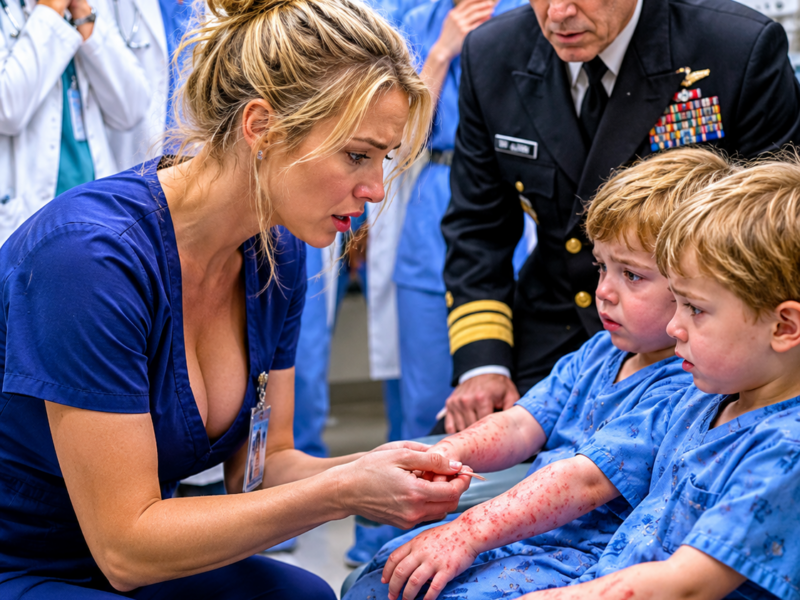
“I was told to step aside because I was ‘just a nurse’ while two three-year-old boys screamed in pain—but when I spotted a tiny silver bead rolling across the hospital bed
“Nora Bennett,” the admiral whispered. “You were in Baltimore.”
Eli’s body was still jerking against the mattress.
The monitor screamed.
I looked at the admiral for half a second, then turned back to the child.
“Sir, whatever you think you recognize, we need to deal with your grandson first.”
Something changed in his expression.
He stepped away from the bed.
“Tell me what you need.”
I looked at Dr. Alvarez.
“Alvarez, oxygen. Non-rebreather mask. Get suction ready. Turn Eli onto his side and protect his head. Don’t put anything in his mouth.”
Alvarez moved immediately.
“What’s his weight?”
“Fourteen kilos.”
I checked the monitor again.
His heart rate was dangerously high, and his blood pressure had climbed even further.
“Call the pediatric emergency team. We need the attending physician and toxicology at the bedside now.”
Dr. Vance finally moved.
“You’re not running this case.”
I didn’t turn around.
“Then take responsibility for what happens if nobody does.”
The room went silent.
Vance stared at me.
For a moment, I thought he might order security to remove me anyway.
Then Eli’s arms jerked violently again.
“Doctor,” Alvarez said, “he needs treatment now.”
Vance looked at the boy.
His expression shifted from anger to uncertainty.
I knew that expression.
It was the moment a person realized the situation had become bigger than their authority.
“Proceed with the seizure protocol,” Vance said.
I looked at Alvarez.
“Use the pediatric emergency protocol and confirm the dose with the attending and pharmacy. We need continuous airway monitoring.”
He nodded and began preparing the medication.
The seizure continued for several more seconds.
Then Eli’s movements began to slow.
His little arms relaxed.
His breathing remained shallow, but his color was stable.
I counted his breaths.
One.
Two.
Three.
“He’s breathing,” Alvarez said.
“Keep watching him.”
The room gradually began moving again.
A pediatric intensivist arrived with the respiratory therapist.
The team took over the stabilization process while the toxicologist remained on the phone.
Caleb, who had been watching his brother with frightened eyes, began crying.
I moved beside him.
“Hey, buddy.”
He reached for my hand.
I offered him one finger.
His small fingers closed around it.
“Is Eli okay?” he whispered.
“We’re helping him. You’re both going to get help.”
He looked down at his pink hands.
“They hurt.”
“I know.”
He pressed his face against my arm.
I felt something tighten in my chest.
Six weeks.
Six weeks of pain.
Six weeks of adults telling these boys that nothing serious was happening.
I looked at their grandfather.
“Admiral, we need to find every possible source of exposure. Where did they spend most of their time?”
“My house. Mostly the study and the playroom next to it.”
“Did they play on the carpet?”
He nodded slowly.
“They played there every day.”
I looked toward the silver droplets.
“Then the house needs to be treated as a contaminated environment until specialists determine otherwise. Nobody should vacuum, sweep, or attempt to clean it themselves.”
“I understand.”
“And the vacuum cleaner?”
“I still have it.”
“Don’t use it again. Don’t open the bag. Tell the hazardous-materials team exactly what happened.”
He pulled out his phone.
“I’ll make the call.”
Dr. Vance stepped toward me.
“You’re making a lot of assumptions.”
I finally faced him.
“I’m describing a potential exposure that matches the symptoms. The toxicologist agrees it needs immediate investigation.”
“You don’t have the authority to order a hazardous-materials response.”
“The admiral does.”
Vance looked toward Rear Admiral Dunning.
The admiral was already speaking to the naval station.
“Send the hazardous-materials team to my residence. I want an environmental assessment and medical coordination immediately.”
He paused.
“Yes. This is Rear Admiral Dunning. Both children are in the emergency department. Treat the house as a potential mercury contamination site.”
Vance looked away.
For the first time that morning, nobody was listening to him.
And that seemed to frighten him more than the medical emergency.
The pediatric intensive care team transferred both boys to a specialized treatment area.
Eli remained under close observation after the seizure.
Caleb was awake but exhausted.
The toxicologist recommended urgent blood and urine testing, continued monitoring, and evaluation for chelation therapy.
The hospital contacted its environmental safety officer.
A hazardous-materials team arrived shortly afterward.
They wore protective suits and brought specialized equipment to assess the children’s clothing and belongings.
I gave them a brief report.
“The suspected source is an antique mercury barometer that broke six weeks ago. The grandfather vacuumed the carpet twice. Both children have had prolonged symptoms consistent with mercury exposure.”
The team leader nodded.
“Any other suspected sources?”
“Not yet. We need the study, adjacent playroom, carpet, baseboards, and vacuum cleaner assessed.”
He looked at me carefully.
“Have you worked environmental contamination scenes before?”
I paused.
“Yes.”
“What agency?”
I glanced at the admiral.
He was standing several feet away, watching me.
Before I could answer, he spoke.
“She was an ATF National Response Team specialist.”
The team leader straightened.
“National Response Team?”
I nodded.
“I resigned a year ago.”
He studied my face.
“That explains the scene brief.”
I said nothing.
He glanced at the silver droplets.
“Most hospital staff wouldn’t know what they’re looking at.”
“Most hospital staff aren’t expected to.”
“Fair enough.”
He turned to his team.
“Let’s get the evidence properly contained and the environmental assessment started.”
They moved toward the isolation area.
Dr. Alvarez approached me.
“Nora?”
I looked at him.
“Yes?”
He seemed embarrassed.
“I knew something was wrong with the boys. I just couldn’t figure out what.”
“You noticed their symptoms?”
“Yes. I mentioned the blood pressure to Dr. Vance yesterday. He told me to stop worrying about isolated readings.”
I studied him.
“Next time, don’t let the conversation end there.”
He nodded.
“I was afraid he’d think I was challenging him.”
I looked toward the room where Eli was being monitored.
“Being afraid of looking foolish is understandable. Being afraid to speak when a child is in danger is something we have to work on.”
He lowered his eyes.
“You’re right.”
I didn’t make him feel worse.
He had come close to making the same mistake I had spent years trying to prevent.
At least he had called Poison Control.
That mattered.
At 11:40 that morning, Dr. Lillian Shaw arrived.
She was the hospital’s chief medical officer.
She entered the treatment area with a tablet in one hand and a worried expression.
“Where are the boys?”
“In pediatric intensive care,” I answered. “Eli had a seizure. He’s stable now, but both children need continued monitoring and toxicology management.”
She looked at me.
“Nora, I received the incident report. Is that accurate?”
“Yes.”
“And the suspected exposure?”
“Mercury from a broken antique barometer. The environmental team is investigating.”
She glanced toward the sealed evidence containers.
Then she turned to Dr. Vance.
“Why wasn’t this possibility considered earlier?”
Vance folded his arms.
“The symptoms were nonspecific. We were investigating a possible endocrine condition.”
“That explains the diagnostic pathway. It doesn’t explain why the nurse’s concerns were dismissed.”
“She went beyond her scope.”
Dr. Shaw looked at him.
“She asked for testing and contacted Poison Control through a physician. Is that correct?”
Vance didn’t answer.
Alvarez stepped forward.
“I called Poison Control after Nurse Bennett identified the suspected exposure.”
Dr. Shaw nodded.
“Thank you, Doctor.”
Vance’s expression hardened.
“This is becoming a circus. She stripped two patients, collected unidentified material, and started directing the department.”
I kept my voice level.
“The clothing was contaminated. I used protective equipment, preserved the material, and requested a specialist assessment.”
“You had no authority to do that.”
“Then let’s review the protocol.”
Dr. Shaw raised a hand.
“Enough.”
She looked at me.
“Nora, I’d like you to provide a written account of everything you observed, including the vital signs you reported before the scan was ordered.”
“Of course.”
Then she turned toward Vance.
“Until this incident is reviewed, you are stepping away from your position as chief of pediatrics.”
His face went pale.
“You cannot be serious.”
“I am entirely serious.”
“I’m the most experienced pediatrician in this hospital.”
“And that is why I expect you to understand the seriousness of what happened.”
He looked around the room.
Nobody defended him.
Not even Alvarez.
Vance turned toward me.
“This isn’t over.”
I met his eyes.
“No, Doctor. It isn’t.”
That afternoon, the first laboratory samples were sent to a reference facility.
The toxicologist explained that the results would take time.
Mercury exposure wasn’t something that could be confirmed by looking at a child’s skin.
The team needed reliable testing and a full clinical assessment to determine the extent of exposure and the best treatment plan.
Both boys remained under observation.
Eli was exhausted.
Caleb kept asking when he could go home.
Their grandfather sat between their beds.
He had changed out of his dress uniform.
Without the gold stripes and polished buttons, he looked like an ordinary man who hadn’t slept in days.
I brought him a cup of coffee.
He accepted it without looking away from the boys.
“I thought I was protecting them,” he said.
I pulled up a chair.
“You didn’t know what had happened.”
“I broke that barometer myself. I watched the glass fall. I vacuumed the carpet because I thought I was being careful.”
He rubbed his forehead.
“My father served on a destroyer for twenty-eight years. That barometer was the one thing I kept from his ship.”
He looked at the boys.
“They loved that study. They played on the carpet. They used to hide under my desk.”
His voice broke.
“And I let them.”
I leaned forward.
“Admiral, you brought them here. You kept asking questions. You didn’t give up.”
“I should have known.”
“You aren’t a hazardous-materials specialist. You couldn’t have known what that vacuum was doing.”
He stared at the coffee.
“Will they recover?”
I didn’t make a promise I couldn’t keep.
“The medical team is treating them. The next few days will tell us more. But we found a possible source, and we’ve stopped them from going back into it.”
He nodded.
After a moment, he looked at my arm.
“That scar. Baltimore.”
My stomach tightened.
“Yes, sir.”
“I remember the incident.”
I stared at him.
“How?”
“I was involved in the Navy’s coordination with federal agencies after the warehouse explosion. Your name appeared in the briefing documents.”
I looked away.
“That was a long time ago.”
“Your partner’s name was Dale Moreno.”
The coffee cup trembled slightly in my hand.
I set it down.
“Please don’t.”
The admiral lowered his voice.
“I knew him by reputation. He was a good man.”
I looked at the boys.
“I need to check on Eli.”
“Nora.”
I stopped.
“Whatever happened in Baltimore, I don’t believe you should carry it alone.”
I couldn’t answer.
Not yet.
The Baltimore incident had happened two years before I joined Harborview.
At the time, I was a special agent with the Bureau of Alcohol, Tobacco, Firearms and Explosives.
I had spent years investigating fires, explosions, and hazardous devices.
My training included explosive scene analysis and specialized response work.
I had been assigned to the National Response Team.
It was demanding work.
It was dangerous.
And I loved it.
Dale Moreno had been my partner for nearly four years.
He was the kind of person who could make a room laugh after a sixteen-hour shift.
He carried peppermint candies in his jacket pocket.
He called every new agent “rookie,” even if they’d been working cases longer than he had.
He also had a habit of checking everything twice.
“Nobody ever got hurt because we took an extra minute,” he used to say.
I would roll my eyes.
“Nobody ever got home early because of it, either.”
He’d laugh.
“That’s why you’re the rookie.”
We were investigating a warehouse outside Baltimore.
The building was suspected of being used to store materials connected to an illegal weapons operation.
Our team was responsible for assessing the scene before other personnel entered.
The initial inspection appeared straightforward.
The building had been abandoned.
The doors were damaged.
The electrical system was unstable.
We found evidence of a device near one of the interior access points.
Dale and I worked carefully.
We documented the visible hazards.
We followed the established procedures.
Then we reached the final section of the warehouse.
There was a secondary area behind a metal door.
I examined the visible surroundings.
Nothing appeared unusual.
Dale stood behind me.
“Are we clear?”
I checked again.
“Looks clear.”
He moved toward the doorway.
The explosion happened before either of us could react.
I remember a white flash.
Then a sound so violent that it seemed to erase every other noise in the world.
I woke up on the concrete.
My left arm was burning.
My ears rang.
Smoke filled the air.
And Dale was on the ground.
I crawled toward him.
He was conscious, but badly injured.
I pressed my hands against the wound.
“Stay with me.”
He looked at me.
His face was pale.
“Nora.”
“Don’t talk.”
He tried to smile.
“Still giving orders.”
I began calling for help.
My hands were shaking.
I kept telling him that the team was coming.
He looked toward the damaged doorway.
Then back at me.
“You did everything right,” he whispered.
I shook my head.
“Don’t say that.”
“Listen to me.”
His breathing became uneven.
“Don’t let this take you out of the work.”
I pressed harder against the wound.
“Dale, please.”
He looked at me one final time.
Then his eyes closed.
He died before the evacuation team could get him out.
The investigation determined that the device had been deliberately concealed and designed to defeat the ordinary inspection process.
The final review found no negligence on my part.
But I never read the report.
I had already decided what I believed.
I had said the area was clear.
Dale had trusted me.
And he had died.
I resigned before the review board finished its work.
I left the agency.
I stopped answering calls from former colleagues.
I moved to a different city.
Then I became a nurse.
I thought I could build a life where the worst thing I had to recognize was a fever or a broken bone.
I thought I could leave the past behind by refusing to look at it.
But scars have a way of remembering what people try to forget.
Three days after the boys were admitted, the laboratory results arrived.
I was in the medication room when Dr. Shaw called me.
“Nora, can you come to my office?”
I knew from her voice that the results had come in.
I walked down the hallway.
Dr. Alvarez was already inside.
The admiral sat near the window.
Dr. Shaw held two pages.
“The reference laboratory has confirmed elevated mercury levels in both children.”
I exhaled.
“How high?”
She gave me the results.
Both boys had levels far above the expected range.
The toxicology team had already begun a treatment plan that included chelation therapy under specialist supervision.
Their kidney function and neurological status would continue to be monitored.
Dr. Shaw placed the reports on her desk.
“The environmental team also completed its initial assessment.”
The admiral leaned forward.
“What did they find?”
“Mercury contamination in the study carpet, along the baseboards, and inside the vacuum cleaner.”
He closed his eyes.
Dr. Shaw continued.
“The residence has been declared unsafe until remediation is complete. Your family has been moved to temporary housing.”
The admiral nodded slowly.
“Thank you.”
He looked at me.
“You were right.”
I shook my head.
“The tests confirmed the exposure. That’s what matters.”
“No, Nurse Bennett. You were right when nobody wanted to listen.”
He stood.
“I owe you more than I can say.”
I looked at the reports.
I thought about the six weeks those children had spent suffering.
I thought about the specialists who had missed the pattern.
And I thought about how easily the entire situation could have continued if I had obeyed the order to step aside.
“You don’t owe me anything,” I said. “Just make sure they get better.”
The boys began responding to treatment.
Eli’s seizures did not return.
His heart rate gradually improved.
The redness in his hands started fading.
Caleb became more energetic.
He began asking for food again and complained that the hospital applesauce tasted like “squishy dinosaurs.”
Tessa brought them coloring books.
Alvarez brought plastic toy cars.
The admiral brought a small box of picture books from his temporary quarters.
On the sixth morning, I entered their room carrying two cups of applesauce.
Caleb was sitting upright.
He had arranged several medicine cups into a tower.
Eli was watching him.
“That’s a tall one,” I said.
Caleb grinned.
Then Eli opened his fist.
A small plastic dinosaur rested in his palm.
He held it toward me.
“For you.”
I smiled.
“Thank you, sweetheart.”
“Because you came back.”
My throat tightened.
I sat beside him.
“I promised I’d check on you.”
He pushed the dinosaur into my hand.
I closed my fingers around it.
Behind me, someone cleared his throat.
The admiral stood in the doorway.
He was wearing a gray sweater.
No uniform.
No gold stripes.
Just a grandfather who had nearly lost two children.
“Special Agent Bennett,” he said.
I looked up.
“I’m a nurse, sir.”
He smiled faintly.
“You can be both.”
He stepped into the room.
“I made some calls. Your service record was confirmed. So was the Baltimore investigation.”
My shoulders tightened.
“What about it?”
“The final review was completed eight months ago.”
I didn’t answer.
He continued.
“The board found no negligence. The device was deliberately concealed. The review concluded that the incident could not reasonably have been prevented through the procedures available to your team.”
I looked down at the dinosaur in my hand.
“I never read it.”
“I know.”
He sat beside Caleb’s bed.
“Your partner, Dale Moreno, submitted a statement before the incident. He described you as one of the most careful investigators he’d ever worked with.”
I felt my eyes burning.
The admiral took a folded document from his jacket.
“He said you never stopped looking when something didn’t feel right.”
I looked at the paper.
I couldn’t bring myself to touch it.
“Did he really say that?”
“Yes.”
The room blurred.
For two years, I had carried the belief that I had failed him.
I had built an entire life around that belief.
And now a man who had never met Dale personally was telling me what my partner had thought of me.
I pressed the dinosaur against my palm.
“I thought I got him killed.”
The admiral shook his head.
“You didn’t.”
I looked at him.
“He trusted my judgment.”
“And he trusted your character. Those are not the same as being able to predict a hidden device.”
I swallowed.
“He told me not to let the incident take me out of the work.”
“Then perhaps it’s time you listened.”
A tear slid down my cheek.
For the first time in years, I didn’t wipe it away immediately.
Dr. Vance came to see me that afternoon.
He stood outside the twins’ room with his hands folded in front of him.
His white coat was wrinkled.
He looked tired.
“Nurse Bennett.”
I turned.
“Doctor.”
“May I speak with you?”
I stepped into the hallway.
He glanced through the glass at the boys.
Then he looked back at me.
“I owe you an apology.”
I waited.
“I dismissed your observations. I embarrassed you in front of the staff and the admiral. I treated your position as though it made your judgment less valuable.”
He paused.
“I was wrong.”
I didn’t rush to reassure him.
He continued.
“I’ve spent my career believing that experience and credentials made me a good physician. But I allowed my pride to get in the way of listening.”
He looked down.
“I have requested that the hospital board review my conduct. I am stepping aside as chief of pediatrics until that review is complete.”
I nodded.
“Thank you for saying that.”
“I know an apology doesn’t undo what happened.”
“No, it doesn’t.”
He looked surprised by my answer.
I continued.
“But what you do next matters.”
He nodded slowly.
“You’re right.”
Dr. Alvarez approached from the nurses’ station.
Vance turned toward him.
“Doctor Alvarez.”
Alvarez stopped.
“I owe you an apology, too. You tried to raise concerns, and I shut you down.”
Alvarez looked uncomfortable.
Vance extended his hand.
“You made the right call when you contacted Poison Control.”
Alvarez shook it.
“Thank you, Doctor.”
Vance looked between us.
“I hope the department learns from this.”
I met his eyes.
“So do I.”
He walked away.
I didn’t feel victorious.
I felt tired.
But something had changed.
For once, the lesson wasn’t going to end with a nurse being told to keep quiet.
A week later, Dr. Shaw called me into her office.
She had a folder on her desk.
“Have a seat, Nora.”
I sat down.
She opened the folder.
“The hospital board has reviewed the incident. The boys’ treatment is progressing, and the environmental investigation confirmed the suspected source.”
I nodded.
“Good.”
“We also reviewed your employment history.”
I felt my shoulders tighten.
“Is there a problem?”
“No.”
She smiled.
“Quite the opposite.”
She slid the folder toward me.
“The board wants to establish a pediatric environmental exposure response program.”
I looked down.
The proposal included training for nurses and physicians on recognizing unusual exposure patterns, coordinating with poison control, and identifying environmental hazards that could affect children.
It would also create a formal reporting pathway so that staff could raise urgent clinical concerns without being dismissed because of their rank or position.
Dr. Shaw continued.
“We want you to lead it.”
I looked up.
“Me?”
“You have experience that this hospital needs. You understand emergency medicine, environmental hazards, and how to communicate with specialized response teams.”
“I haven’t worked for the ATF in a year.”
“Your training didn’t disappear when you resigned.”
I stared at the folder.
For a year, I had hidden my past because I thought it made me dangerous to the people around me.
Now the hospital was asking me to use that experience to protect them.
“What would the position involve?”
“Developing protocols, training clinical staff, coordinating with environmental specialists, and helping us respond to unusual pediatric cases.”
I read the proposal again.
Then I looked at Dr. Shaw.
“I have one condition.”
“What’s that?”
“I stay a nurse.”
She smiled.
“Of course.”
“I don’t want a title that makes people think I’m above the people doing the work.”
Dr. Shaw nodded.
“Then we’ll make sure the title reflects what you actually do.”
I signed the acceptance form.
My hand didn’t shake.
The new program began three weeks later.
The hospital converted a training room into a pediatric emergency education center.
Nurses, physicians, laboratory staff, and emergency technicians attended the first session.
Dr. Alvarez sat near the front.
Tessa stood beside the door, holding a clipboard.
The admiral had sent a letter thanking the staff and confirming that his grandsons were continuing their recovery.
I placed a photograph on the table.
It showed Caleb and Eli sitting together in their temporary home.
Both boys were smiling.
Caleb held a toy car.
Eli held a plastic dinosaur.
I looked at the people in front of me.
“Before we begin, I want to tell you something.”
The room became quiet.
“Those two children were sick for six weeks. Their symptoms were visible. Their vital signs were concerning. And several people noticed that something wasn’t right.”
I paused.
“But the right question wasn’t asked until someone looked beyond the diagnosis everyone had already chosen.”
I turned toward the screen.
The first slide showed a simple sentence.
LISTEN TO THE PERSON WHO NOTICES.
I continued.
“Medicine requires knowledge. It requires experience. It requires people who are willing to study, question, and make difficult decisions.”
I looked around the room.
“But no degree makes someone incapable of being wrong.”
Dr. Alvarez nodded.
“And no job title makes someone’s observation worthless.”
A nurse in the second row raised her hand.
“What if you’re sure something is wrong, but the attending physician disagrees?”
I recognized the fear in her voice.
It was the same fear I had carried for years.
“Document what you observe. Explain the concern clearly. Use the appropriate escalation process. Ask for a second opinion when necessary.”
I paused.
“And if a patient is in immediate danger, don’t let embarrassment stop you from speaking up.”
The nurse nodded.
Tessa smiled.
I moved to the next slide.
It showed the symptoms the twins had presented with and the questions that eventually led to identifying the source.
We discussed environmental exposure, the importance of a careful history, and the need to involve specialists.
I made sure everyone understood that the program was not about turning nurses into toxicologists.
It was about recognizing when a situation required expertise beyond the usual pathway.
At the end of the session, Dr. Alvarez approached me.
“I’ve been thinking about what you said.”
“Which part?”
“That fear is normal, but silence can become dangerous.”
He looked toward the training room.
“I want to be better at speaking up.”
I smiled.
“Then start with the next patient.”
He nodded.
“I will.”
Two months later, Caleb and Eli returned to Harborview for a follow-up appointment.
They were both healthier.
Their hands had healed.
Their energy had returned.
They still needed medical monitoring, but their progress was encouraging.
The admiral brought them into the pediatric clinic just before lunch.
Eli ran toward me as soon as he saw me.
“Nora!”
I crouched to meet him.
“Hello, sweetheart.”
He held out his plastic dinosaur.
I laughed.
“You brought him back?”
“He wanted to see you.”
Caleb came over holding a toy airplane.
“Grandpa says we’re going to the beach.”
“That sounds wonderful.”
The admiral watched them with a smile.
“They’re getting their lives back.”
I stood.
“I’m glad.”
He looked at me for a long moment.
“I also wanted to give you something.”
He handed me a small envelope.
Inside was a photograph of the boys standing between him and their parents.
Everyone was smiling.
On the back, he had written:
To Nora Bennett, who saw what others missed and gave our family a future.
I looked at the words.
Then I looked at him.
“Thank you, sir.”
He nodded.
“You gave me my grandsons back.”
I shook my head.
“The whole team helped.”
“That’s true.”
He smiled.
“But you were the one who spoke when nobody wanted to listen.”
I put the photograph into my pocket.
For years, I had believed that the most important moment of my life was the day Dale died.
I had treated everything that came afterward as something I had to endure.
But these children had reminded me that a life could contain more than one defining moment.
And sometimes the next one came when you least expected it.
That evening, I stayed late in the pediatric department.
The hallways were quieter than usual.
I stopped outside the nurses’ station to review the next week’s training schedule.
A young nurse named Emily was speaking with a physician about a child who had come in with an unusual rash.
The physician looked impatient.
“We’ve already ruled out the common causes.”
Emily hesitated.
“But the child has been vomiting, too. And the parents said the symptoms started after they moved into the new apartment.”
The physician glanced at the chart.
“That’s probably unrelated.”
Emily looked down.
I saw her fingers tighten around the clipboard.
Then she tried again.
“Could we ask about the apartment’s heating system?”
The physician stopped.
“What makes you ask that?”
Emily explained what the parents had said.
The physician listened.
Then he turned back toward the room.
“Let’s get a more detailed exposure history.”
Emily looked surprised.
I didn’t interrupt.
I watched them walk back into the patient’s room together.
Nobody raised their voice.
Nobody told her to step aside.
They simply listened.
Tessa appeared beside me.
“You look happy.”
I smiled.
“I think we might be getting somewhere.”
She glanced toward the room.
“Because of the training?”
“Because someone spoke up.”
Tessa leaned against the counter.
“Do you still miss the ATF?”
I considered the question.
“Sometimes.”
“Do you miss the work?”
“Parts of it.”
“And Dale?”
I looked down at my left arm.
The scar was still there.
It would always be there.
“Every day.”
Tessa nodded.
“Do you still blame yourself?”
I took a breath.
“Not the way I used to.”
I had finally read the review board’s report.
I had spoken with former colleagues.
I had learned what Dale had written about me.
And I had accepted that the explosion was not something I could have predicted or prevented with certainty.
I still wished he were alive.
I still wished I could hear his terrible jokes and watch him steal the last peppermint from my jacket.
But I no longer believed that his death meant I had to spend the rest of my life hiding.
I reached into my pocket and touched the small photograph of the twins.
Then I looked at the framed picture on my desk.
Dale stood beside me in front of an ATF vehicle.
He was holding a paper coffee cup and laughing at something outside the frame.
I remembered what he had said during our first year together.
“Nobody ever got hurt because we took an extra minute.”
I smiled.
“Especially when we’re tired.”
Tessa looked at me.
“What?”
“Something my old partner used to say.”
I put the photograph back.
Then I rolled up my sleeves.
For a year, I had hidden the scars.
I had believed they were evidence of a failure I could never repair.
Now they were simply part of me.
A reminder of the people I had loved, the work I had done, and the lives I could still help protect.
I walked toward the pediatric unit.
A little boy was crying in the next room.
His nurse was sitting beside him, listening carefully while his mother explained what had happened at home.
I stopped at the doorway.
The nurse looked up.
“Can I help you?”
I smiled.
“Just checking in.”
She nodded and returned her attention to the child.
And I kept walking.
I was still Nora Bennett.
I was still a nurse.
I was also the woman who had once walked into a warehouse believing she had failed someone she loved.
I could not change that night.
But I could choose what I did with the life that came afterward.
Respect wasn’t something a person received because of a title, a uniform, or a degree.
It was earned through character.
And sometimes the most important person in a room was the one everyone else had overlooked.
The quiet nurse.
The young resident.
The technician who noticed one strange reading.
The person who asked one more question when everyone else was ready to move on.
I had spent a year trying to make myself invisible.
Now I understood that the world didn’t need me to disappear.
It needed me to keep looking.
And when something didn’t feel right, it needed me to speak.
Because the next life that depended on being heard might belong to a child who couldn’t explain what was wrong.
I would never again let someone convince me that silence was the same thing as humility.
the end.









