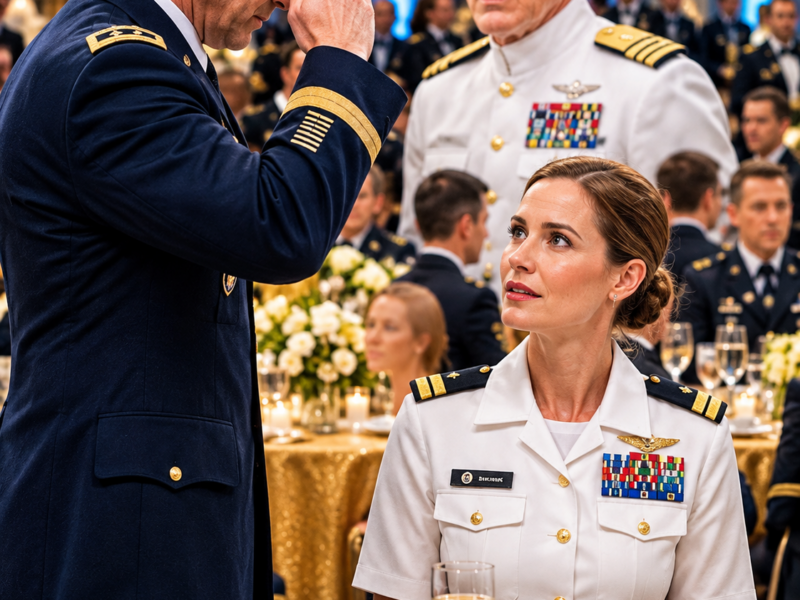
“I was told to leave the family table at my own father’s military celebration and sit with the regular guests because, according to him
“Colonel Bennett, I don’t believe you’ve told everyone what your daughter did for the men and women under your command.”
Major General Carter’s words hung in the ballroom.
My father blinked.
For a moment, he looked as though he hadn’t understood the sentence.
Then he forced a smile.
“Sir, I’m afraid there must be some confusion. Emily has never served under my command.”
The general nodded.
“That’s true. She hasn’t.”
He turned toward me.
“But she has done something that many people in uniform will remember for the rest of their lives.”
I looked down at my hands.
“Sir, I don’t think this is the right time.”
He gave me a gentle smile.
“Emily, I think it’s exactly the right time.”
My father stepped closer.
“General, perhaps we should discuss this privately.”
Carter looked at him.
“Why privately, Colonel?”
My father didn’t answer.
The host remained beside the microphone, unsure whether to continue the program.
Margaret gently touched my arm.
“Emily, what is happening?”
I shook my head.
“I honestly don’t know.”
The general turned toward the room.
“Some of you may remember the severe flooding that struck parts of Kentucky and Tennessee two years ago. Several military families were displaced. Some lost their homes. Others spent months trying to find temporary housing.”
A few officers nodded.
“During that period, a civilian-led support network helped hundreds of military families find emergency accommodation, medical transportation, replacement equipment, and temporary childcare.”
He paused.
“That network was organized by a woman who refused to accept payment for her work.”
My stomach tightened.
I knew exactly what he was talking about.
I had started that network after receiving a call from a former colleague whose husband was stationed overseas.
Her home had flooded.
She had two young children, no transportation, and nowhere to go.
The first night, I found them a hotel room.
The second night, I helped another family.
Then another.
Eventually, I was coordinating volunteers across several states.
But I had never considered it something extraordinary.
I had simply seen people who needed help.
The general continued.
“The woman who coordinated that effort was Emily Bennett.”
The room became quiet.
I heard someone whisper my name.
My father looked at me.
“You organized that?”
I nodded.
“Yes.”
“When?”
“About two years ago.”
He stared at me.
“Why didn’t you tell me?”
I almost answered that I had tried.
Instead, I said, “I didn’t think you were interested.”
The general heard me.
He didn’t interrupt.
He simply continued.
“Emily’s work didn’t stop with emergency housing. She later helped establish a nonprofit that assists military families dealing with medical hardship, unexpected relocation, and the loss of a service member.”
A woman near the front began applauding.
Then another joined her.
Within seconds, the ballroom filled with applause.
I stood there, uncomfortable with the attention.
The host approached the general.
“Sir, would you like to say a few words about the organization?”
“Certainly.”
He turned toward the audience.
“The organization is called Open Arms for Service Families. It now works with volunteers in eleven states. It has helped families navigate emergency housing, medical transportation, food assistance, and other services.”
He looked at me again.
“Emily never asked for recognition. In fact, when we offered to nominate her for a civilian service award, she declined.”
My father slowly lowered his head.
I remembered that conversation.
I had declined because one of the families we were helping had recently lost their son.
I didn’t feel comfortable accepting an award while his mother was still trying to arrange his funeral.
The general reached into his jacket and removed a small envelope.
“Emily, there is something else.”
He handed it to me.
Inside was a formal letter.
It announced that I had been selected to receive a Department of Defense civilian community service recognition.
I stared at the document.
My eyes began to sting.
“I didn’t know this was happening tonight.”
“That was intentional,” he said. “We wanted to surprise you.”
A few people laughed softly.
My father didn’t.
He looked at the letter, then at me.
“Emily, why didn’t you tell me about any of this?”
I finally looked directly at him.
“I tried, Dad.”
He frowned.
“When?”
“Last Christmas. I called to tell you we had found housing for thirty-seven military families. You said you were preparing for a meeting.”
He said nothing.
“I called again when we opened the nonprofit. You told me you were busy with the retirement planning.”
My voice remained calm.
“I sent you the website. I don’t know if you ever opened it.”
The general quietly looked away, giving us a moment.
My father swallowed.
“I don’t remember that.”
“I know.”
Those two words seemed to affect him more than anything else I could have said.
Because I wasn’t accusing him of forgetting a date.
I was telling him that I had stopped expecting him to remember the important parts of my life.
The host finally approached the microphone.
“Perhaps we should allow Major General Carter to present the recognition.”
The general nodded.
“Emily, would you join me near the stage?”
I hesitated.
Then Margaret whispered, “Go on, sweetheart.”
I walked toward the front.
As I passed my father, he moved as though he wanted to stop me.
But he didn’t.
The general shook my hand and presented the framed certificate.
The applause lasted longer than I expected.
For a few seconds, I couldn’t look up.
I thought of the families who had slept in cars before we found them temporary apartments.
I thought of the volunteers who had driven through storms.
I thought of the elderly military widow who had called me every week because she was afraid of losing the house her husband had built.
They were the reason I was standing there.
Not because I had done everything myself.
But because I had helped people find one another when they needed it most.
When the applause ended, the general leaned toward the microphone.
“There’s one more thing I’d like to share.”
My father looked up.
“During my career, I’ve worked with thousands of outstanding officers. But tonight isn’t about rank. It’s about character.”
He paused.
“I first learned about Emily when one of the families she helped wrote to my office. The mother explained that she had been ready to leave the military community because she felt abandoned during her husband’s deployment.”
He looked at the audience.
“Emily didn’t simply find that family a place to stay. She helped them find stability. She helped the children return to school. She helped the mother get transportation to work.”
His voice softened.
“That family is still doing well today.”
I wiped my eyes.
The general continued.
“One of the most important responsibilities of leadership is making sure people are not forgotten when they are no longer standing in front of us.”
My father’s expression changed.
He knew the sentence was directed at more than the audience.
The host invited everyone to take their seats.
But before the program continued, my father walked toward the stage.
“General Carter, may I say something?”
The general stepped aside.
“Of course, Colonel.”
My father took the microphone.
For the first time that evening, he didn’t look like a decorated military officer.
He looked like a man who had just realized he had made a mistake in front of people he respected.
“I would like to apologize to my daughter.”
The ballroom became quiet again.
He looked at me.
“Emily, I was wrong to send you to the back table.”
I didn’t move.
He continued.
“I was concerned about the seating arrangements and the guests attending tonight. I thought I was protecting the formality of the event.”
I stared at him.
“By making me feel like I didn’t belong?”
His mouth tightened.
“Yes.”
He lowered the microphone.
“I was wrong.”
The words were simple.
But they were not enough.
Not yet.
I looked at him and said, “Dad, I didn’t need a seat beside the generals.”
He nodded.
“I know.”
“I needed my father to be happy I came.”
His eyes filled.
For several seconds, neither of us spoke.
Then he put the microphone down.
“I was happy you came.”
I looked at the floor.
“Then why didn’t you say that?”
He had no answer.
And for once, I didn’t try to supply one for him.
The ceremony continued after a short pause.
The general returned to his seat.
I went back to Margaret’s table, carrying the certificate.
People stopped to congratulate me.
Several military spouses told me about their own experiences with Open Arms.
One woman said the organization had helped her brother find temporary housing after a medical emergency.
Another told me she had volunteered because of a family we had helped.
Their stories meant more to me than the certificate.
But I noticed that my father kept looking toward me.
He didn’t approach again until the dinner was served.
He stood beside my chair.
“Would you come sit with me?”
I looked at him.
“Where?”
He glanced toward the main table.
“With the family.”
I hesitated.
Margaret looked up from her plate.
“Only if you want to, Emily.”
I appreciated that she didn’t tell me what to do.
I picked up my handbag and stood.
“All right.”
My father walked beside me.
For the first time that evening, he didn’t walk ahead as though I were supposed to follow.
He pulled out a chair at the family table.
I sat.
A few guests smiled.
Someone made room for my certificate.
Dinner began.
My father barely touched his food.
He kept glancing at me.
Eventually, he leaned closer.
“Can we talk after the event?”
I nodded.
“Yes.”
But I didn’t promise him that everything would be fine.
That was a promise I no longer knew how to make.
After dinner, the ballroom gradually emptied.
Officers said their goodbyes.
The host thanked the volunteers.
Margaret came over and hugged me.
“I’m glad I sat beside you.”
I smiled.
“Me too.”
She turned to my father.
“Colonel, you have a wonderful daughter.”
He looked at her.
“I know.”
I wondered whether he truly did.
When the last guests left, my father asked me to accompany him to his office.
It was a small room at the end of the hallway, decorated with photographs from his military career.
A younger version of him stood beside a tank.
Another showed him receiving a medal.
There was one photograph of my mother holding me as a baby.
I hadn’t seen that picture in years.
My father noticed me looking at it.
“Your mother put that there.”
I stepped closer.
“She always said you kept that picture because you missed us.”
He nodded.
“I did.”
I turned toward him.
“Then why was it so hard to make room for me?”
He sat down.
For a while, he stared at his hands.
“I don’t have a good answer.”
I waited.
He finally spoke.
“When your mother died, I didn’t know how to be a father without her. I buried myself in work. I thought providing for you financially was enough.”
I sat opposite him.
“You were already doing that before she died.”
He nodded.
“I know.”
He rubbed his forehead.
“I kept telling myself that I would make time when things settled down. When I retired. When the next assignment ended. When the next inspection was over.”
He gave a sad laugh.
“There was always another thing.”
I looked at the photograph of my mother.
“Do you know what I remember most about growing up?”
He looked at me.
“What?”
“Waiting.”
His eyes filled.
“I remember waiting for you to come home from deployments. Waiting for you to call on my birthday. Waiting for you to notice when I did something I was proud of.”
I swallowed.
“And tonight, when you sent me to that table, it felt like being a little girl again.”
He covered his mouth.
“I’m sorry, Emily.”
I didn’t answer immediately.
I had imagined hearing those words for years.
I had imagined they would make everything better.
But they didn’t erase the memories.
They simply made it possible to begin talking about them.
My father opened the bottom drawer of his desk.
He removed a small wooden box.
“I wanted to give you this tonight.”
He placed it on the desk.
I opened it.
Inside was a silver bracelet.
It was the one my mother had worn every day.
I recognized the tiny engraving on the clasp.
“To Emily, with all my love.”
My eyes filled.
“Why are you giving me Mom’s bracelet?”
“Because I think it’s time you had it.”
I lifted it carefully.
“I thought you had lost this.”
“I kept it in a safe.”
He paused.
“Your mother wanted you to have it when you were old enough to understand what it meant.”
I looked at him.
“What did it mean?”
He smiled faintly.
“She used to say that family wasn’t a seating arrangement. It was the people who made sure you never felt alone.”
I looked down at the bracelet.
For the first time that night, I felt my father’s apology reach somewhere deeper than the embarrassment of being sent away from the main table.
But I still had something to say.
“Dad, I love you.”
He nodded.
“I love you too.”
“But I can’t go back to pretending everything is fine just because you apologized tonight.”
“I understand.”
“I don’t want another promise that you’ll call every Sunday and then disappear for three months.”
He looked at me carefully.
“What do you want?”
I thought about it.
“I want something ordinary. I want you to ask how my day was and actually listen to the answer. I want you to remember what matters to me. I want to be able to visit without wondering whether I’m interrupting something more important.”
He nodded slowly.
“I can try.”
“Don’t try for one evening. Try because you want to know me.”
He lowered his eyes.
“You’re right.”
I closed the wooden box.
Then he asked something I hadn’t expected.
“Would you have come tonight if I hadn’t sent that invitation?”
I considered the question.
“Probably.”
“Even after everything?”
“You’re my father.”
He looked at me.
“But I can’t keep being the only person who tries.”
He nodded.
“I don’t want that anymore.”
I left the office that night without knowing exactly what would happen between us.
I drove home with the silver bracelet in my handbag and the recognition certificate on the passenger seat.
The road was quiet.
I thought about how strange the evening had been.
I had arrived hoping for a place at my father’s table.
I had left with an award, an apology, and a much clearer understanding of what I needed from him.
But the most meaningful change didn’t happen in the ballroom.
It happened three weeks later.
I was sitting at my desk on a Tuesday morning when my phone rang.
It was Dad.
I almost let it go to voicemail out of habit.
Then I answered.
“Hi, Dad.”
“Hi, Em.”
There was a pause.
“Are you busy?”
I glanced at my computer.
“Not really. What’s up?”
“I was wondering how your nonprofit meeting went yesterday.”
I stopped typing.
He remembered.
“The meeting went well. We’re trying to expand our emergency housing program.”
“How many families are you helping now?”
I told him.
He asked about the volunteers.
He asked how we funded the program.
He even remembered the name of a woman I had mentioned the previous week.
We spoke for twenty minutes.
Before hanging up, he said, “I hope you’ll tell me more next time.”
I smiled.
“I will.”
The following Sunday, he called again.
Not because I reminded him.
Not because I sent a message first.
He simply called.
A month later, he visited my home.
He arrived carrying a small grocery bag.
Inside were fresh strawberries and the coffee I liked.
“I wasn’t sure what you had in the refrigerator,” he said.
I laughed.
“You didn’t have to bring anything.”
“I know.”
He looked around my living room.
“Can I see where you work on the nonprofit?”
I showed him my desk, the shelves of files, and the photographs of families we had helped.
He stood in front of one picture for a long time.
It showed a young mother with two children standing outside their temporary apartment.
“She looks happy,” he said.
“She is. Her husband returned from deployment last month.”
He nodded.
Then he looked at me.
“I’m proud of you.”
I didn’t answer right away.
Those three words had been missing from so much of my childhood that hearing them now almost hurt.
“Thank you, Dad.”
He stepped closer.
“I should have said that a long time ago.”
“Yes,” I replied.
He nodded.
“I know.”
We sat at the kitchen table and talked.
Not about military awards.
Not about his retirement.
Not about what other people thought of us.
We talked about ordinary things.
The weather.
My work.
His garden.
A documentary he had watched.
It wasn’t a perfect relationship.
Sometimes he still became distant.
Sometimes I still felt the old disappointment when he forgot something important.
But now I told him.
And, more importantly, he listened.
Six months after the celebration, my father attended one of our nonprofit’s volunteer events.
He arrived early and helped carry boxes of donated supplies.
A young soldier’s wife recognized him.
“Colonel Bennett? I heard you retired.”
He smiled.
“I did.”
She glanced toward me.
“Your daughter helped us when we were looking for housing last year. I don’t know what we would have done without her.”
My father looked at me.
Then he turned toward the woman.
“She’s been doing this for a long time. I should have paid more attention.”
I smiled.
He didn’t say it loudly.
He didn’t need to.
Later that afternoon, we stood beside the supply tables.
He handed me a box.
“Where does this one go?”
I pointed toward the storage area.
“Over there.”
He nodded and carried it.
A few minutes later, he returned.
“Emily?”
“Yes?”
“Would you like to have dinner with me next Friday?”
I looked at him.
“Just us?”
“Just us.”
I smiled.
“I’d like that.”
That Friday, we went to a small Italian restaurant near his house.
There were no military flags.
No senior officers.
No speeches.
Just two people sitting across from each other, trying to learn how to be family again.
Halfway through dinner, my father looked at me.
“I’ve been thinking about that night.”
I set down my fork.
“So have I.”
He took a breath.
“I spent my entire career teaching people about responsibility, loyalty, and leadership. I received medals for service, but I didn’t always understand that those same values had to exist at home.”
I watched him.
“I thought being a good provider meant I had fulfilled my responsibility as a father.”
He shook his head.
“It didn’t.”
I reached across the table and touched his hand.
“No, it didn’t.”
He squeezed my fingers.
“I’m sorry it took me so long to understand.”
I looked at the man who had once sent me to the back of a ballroom because he thought my presence might embarrass him.
Then I looked at the father who had finally begun asking about my life.
I didn’t pretend the past had disappeared.
But I also didn’t want to spend the rest of my life punishing him for finally trying.
“I can’t change the years we lost,” I said. “But we can decide what we do with the years we have left.”
He nodded.
“That’s what I’d like.”
When dinner ended, he walked me to my car.
Before I got inside, he stopped me.
“Emily?”
I turned.
“Yes, Dad?”
“Next time there’s a family event, I want you sitting beside me.”
I smiled.
“Then save me a seat.”
He laughed.
“I will.”
And this time, I believed he understood what that promise meant.
The bracelet my mother had left me now rests on my dresser.
Sometimes I wear it when I attend events with the nonprofit.
Not because it reminds me of the evening a general recognized me in front of an entire ballroom.
It reminds me of something much quieter.
I had spent years believing that if I worked hard enough, achieved enough, and made my father proud enough, he would finally make room for me.
That night taught me that recognition from strangers could never replace the love I had wanted from my own family.
The general had given me an honor.
Margaret had given me kindness.
But my father had given me something I had waited a lifetime to hear: an honest apology, followed by the effort to become a better father.
And perhaps the most important part was that I no longer needed to sit at the head table to know my worth.
I only needed to know that I belonged.
The End.









