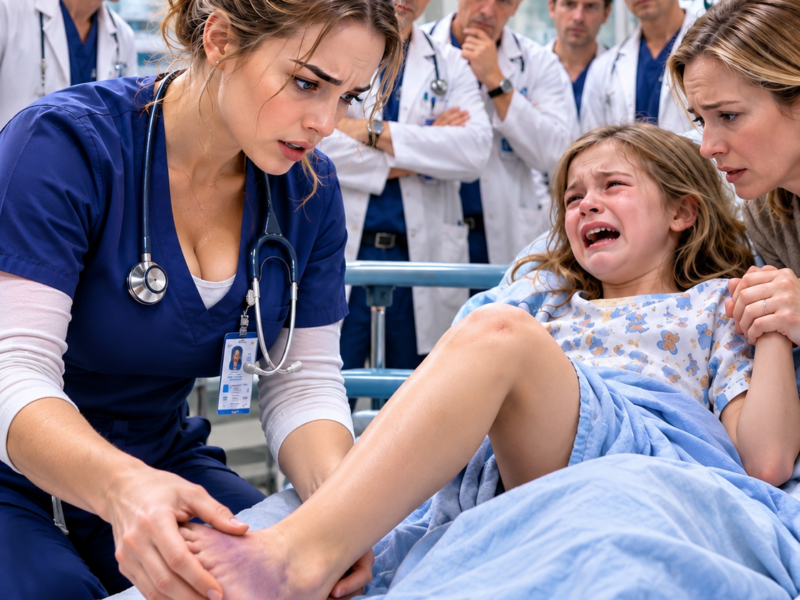
“I was told to discharge a 12-year-old girl after six physicians declared her knee injury harmless, but when I noticed her right foot growing colder every time she straightened her leg
I looked down at Megan’s small hand wrapped around my sleeve.
“What is it, sweetheart?”
She glanced at her mother, then back at me.
“Am I going to lose my leg?”
Rachel immediately leaned forward.
“Megan, honey, don’t think like that.”
But Megan didn’t look away from me.
She had heard the doctors talking. She had noticed the way Daniel’s expression changed when he checked her pulse.
And she was old enough to understand that adults sometimes became quiet when something frightened them.
I pulled a chair closer to her bed.
“I don’t know what’s causing the changes yet. But we’ve noticed them, and the doctors are investigating. You’re not being sent home without answers.”
“Promise?”
“I promise I’ll tell you the truth about what I know.”
She loosened her grip on my sleeve.
Daniel was already speaking with the vascular coordinator.
“Keep her knee supported. Nobody needs to straighten it again until vascular evaluates her.”
Then he looked at me.
“Emily, come with us. I want your timeline.”
I glanced at the assignment board.
I still had two other patients.
Daniel noticed.
“I’ll arrange coverage.”
I nodded and picked up Megan’s chart.
For the first time since I had started working on that floor, I wasn’t worried about whether I was making the right impression.
I was worried about a twelve-year-old girl who had spent hours trying to make adults understand that something hurt.
And I wasn’t going to let her explanation disappear into a stack of completed paperwork.
The vascular technician arrived twenty minutes later.
He introduced himself to Rachel and Megan, explained the ultrasound, and adjusted the equipment around the position Megan found comfortable.
“Tell me if anything hurts,” he said.
Megan looked at him suspiciously.
“Are you going to straighten it?”
“Not unless we need a small movement for the images. And if we do, I’ll explain it first.”
She looked at me.
I gave her a reassuring nod.
The technician placed the ultrasound probe behind her knee.
A dark image appeared on the monitor.
He moved slowly, following the blood vessel through the injured area.
“Interesting,” he murmured.
I stepped closer.
“What are you seeing?”
He didn’t answer immediately.
He adjusted the probe and captured another image.
“Let me get a comparison.”
He examined the blood flow with the knee supported, then made a very small adjustment in its position.
Megan’s fingers tightened around the blanket.
“Stop.”
The technician stopped immediately.
He looked at the monitor.
The sound from the Doppler had changed.
He returned her knee to its supported position.
The signal strengthened again.
He saved both images.
Then he picked up the phone.
“I need Dr. Blake to review these.”
Rachel’s face had gone pale.
“What did you find?”
The technician turned the screen slightly toward her.
“I’ve found a change in blood flow that needs a vascular physician to interpret. I don’t want to guess beyond that.”
He left the room.
Megan stared at the ceiling.
“Mom?”
Rachel took her hand.
“I’m here.”
“Was I really hurting for a reason?”
Rachel’s eyes filled.
“Yes, baby.”
Megan turned her face toward the wall.
I pretended to be checking the monitor so she wouldn’t feel watched while she cried.
A few minutes later, Dr. Aaron Blake entered with a portable Doppler.
He was a vascular surgeon with a calm voice and the habit of reading the patient’s face before reading the chart.
He reviewed the ultrasound images, then looked at me.
“You’re Emily?”
“Yes.”
“Walk me through what happened.”
I explained the sequence.
The pain behind the knee.
The burning down the calf.
The cooler right foot.
The weaker pulse when the knee approached extension.
The improvement when it returned to a bent position.
He listened without interrupting.
Then he turned to Megan.
“What happens before the pain gets really bad?”
She looked at him.
“It burns down my calf.”
“Anything else?”
“My foot gets numb.”
I looked at her.
That was new information.
“When did you notice the numbness?”
“Earlier. I thought it was because I was scared.”
Aaron glanced at the images.
“That’s important. Thank you for telling me.”
He placed a stool beside the bed.
“I want you to know something. You don’t have to scream to make us believe you. If something changes, tell us. We’ll listen.”
Megan nodded slowly.
Aaron stepped outside to speak with the attending vascular physician.
Rachel turned toward me.
“Emily, what do you think is happening?”
I took a breath.
“I think we need to let the vascular team explain what the images show. What I can tell you is that the circulation changes with her knee position, and they are taking it seriously.”
Rachel looked down at her daughter’s leg.
“How could six doctors miss that?”
I didn’t have an easy answer.
“Sometimes an examination captures what is happening at one particular moment. Her pulse was present when I first checked it, too. The difference was what happened when her position changed.”
Rachel wiped her cheek.
“She kept telling them it hurt.”
“I know.”
“And they kept telling her the X-rays were fine.”
I glanced at the chart.
“An X-ray can show a fracture. It doesn’t show everything that can happen to the blood vessels.”
She nodded, although she still looked frightened.
When Aaron returned, another physician came with him.
Dr. Karen Whitmore was the vascular attending.
She pulled the ultrasound images onto the larger monitor.
“I want to explain what we’re seeing,” she said.
Rachel moved closer.
Karen pointed to the vessel behind Megan’s knee.
“This is the artery supplying blood to the lower leg. In the supported position, we can see blood moving through it. As the knee approaches extension, the vessel becomes compressed, and the amount of blood passing through decreases.”
Rachel stared at the screen.
“Compressed by what?”
“We’re still determining the exact cause. It could involve swelling or an underlying structural problem around the injured area. But the important thing is that the change is real.”
Megan looked at the monitor.
“So that’s why my foot was cold?”
“That may explain it, yes.”
“And why it hurt?”
Karen pulled her stool closer.
“Your pain was a warning that something was changing. You were right to tell us.”
Megan’s lower lip trembled.
“Nobody believed me.”
Karen paused.
“I can’t speak for every examination you’ve had today. But I can tell you that we’re listening now, and we’re going to be careful.”
Rachel covered her mouth.
I looked at Daniel.
He stood near the doorway, watching the images.
One of the physicians who had examined Megan earlier entered and reviewed the ultrasound.
He looked uncomfortable.
“Her pulse was present during my examination.”
Karen nodded.
“That doesn’t rule out a positional obstruction.”
He studied the screen.
“So the circulation could look acceptable in one position and deteriorate in another?”
“Exactly.”
Daniel folded his arms.
“Then we need to make sure everyone understands the positioning restriction.”
Karen agreed.
Until the vascular team determined the cause, Megan’s knee would remain supported in the position that maintained better blood flow.
No unnecessary straightening.
No routine examination that reproduced the symptoms just to confirm what they already knew.
And no discharge.
Rachel asked the question I had been expecting.
“Does she need surgery?”
Karen didn’t rush her answer.
“Possibly. We need more information before recommending a specific procedure. Our priority is protecting blood flow and preventing further injury.”
Megan looked down at her knee.
“Will I play soccer again?”
Nobody answered immediately.
Karen pulled her chair closer.
“I know that’s important to you. I can’t promise a date or an outcome today. But we’re going to do everything appropriate to protect your leg and give you the best chance of recovering.”
Megan nodded.
It wasn’t the answer she wanted, but it was an honest one.
And I suspected that mattered more than anyone realized.
By early evening, Megan had been transferred to the vascular unit.
Her knee remained supported by a foam wedge.
Rachel walked beside the stretcher, carrying a small bag of clothes and the soccer jersey she had brought from home.
I went with them to complete the handoff.
The receiving nurse, Sarah, read the orders carefully.
“Right knee flexed and supported. Monitor temperature, color, sensation, pain, and distal pulses. Report any deterioration immediately.”
She looked at Megan.
“Can you tell me what you feel when something changes?”
Megan hesitated.
“It starts behind my knee. Then it burns down my calf. Sometimes my foot gets numb.”
Sarah wrote it down.
“Good. That’s exactly what I need to know.”
Megan glanced at me.
I smiled.
“See? You already know how to explain it.”
She looked pleased, but she still held the edge of my sleeve.
“Are you leaving?”
“I have other patients downstairs.”
Her expression fell.
I crouched beside her.
“Sarah has your information, your doctors know what we found, and your mom is staying with you. I’ll come back when I can.”
“Promise?”
“I’ll come see you before I finish my shift.”
She finally released my sleeve.
I handed Sarah the completed timeline.
Then I watched the stretcher disappear through the double doors.
Daniel was waiting outside.
He handed me a chart.
“Room eleven needs an assessment.”
I accepted it.
“How’s Megan?”
“Vascular is arranging further evaluation. She’s in the right place.”
I nodded.
Then Daniel said something I hadn’t expected.
“I owe you an apology.”
I looked up.
“For what?”
“For treating your concern like an inconvenience.”
I didn’t know what to say.
He continued.
“I had six previous assessments in front of me, a crowded floor, and a patient who appeared ready for discharge. I focused on the completed workup instead of asking what had changed.”
I glanced toward the elevator.
“Her foot was warmer when I first checked it.”
“Exactly. You noticed the difference.”
He paused.
“I should have listened sooner.”
I appreciated the apology, but I didn’t want it to become a conversation about me.
“Megan’s the one who kept telling us something was wrong.”
Daniel nodded.
“You’re right.”
Then he walked toward room eleven.
I followed him.
That night, I went back to see Megan before leaving.
She was awake, watching a television show while Rachel sat beside her.
Sarah was checking her circulation.
“Temperature is stable,” Sarah said. “Pulse is present. Sensation is intact.”
Megan looked at me.
“You came back.”
“I said I would.”
She smiled.
Then she looked toward the foam support.
“Are they going to make me straighten it tomorrow?”
“Not unless the doctors decide there’s a medical reason to do something different. And they’ll explain it first.”
She seemed satisfied with that.
Rachel stood and hugged me.
“I don’t know how to thank you.”
“You don’t need to.”
“Yes, I do.”
Her voice broke.
“I was so close to putting her in that wheelchair.”
I looked at the sneaker sitting beneath the chair.
“I know.”
Rachel wiped her eyes.
“I thought maybe she was just scared. Everyone kept saying the same thing, and eventually I started wondering if I was making it worse by worrying.”
I placed a hand gently on her shoulder.
“Trust that you know your daughter. And when something changes, keep telling the people caring for her.”
She nodded.
As I turned to leave, Megan called after me.
“Emily?”
I looked back.
“Yeah?”
“Thank you for stopping when I said stop.”
For a moment, I couldn’t find the right words.
“You’re welcome, Megan.”
I left the room with that sentence following me down the hallway.
The next morning, Karen came to speak with Rachel and Megan.
Additional imaging had helped clarify the problem.
The artery behind Megan’s knee was being compressed by an abnormal structure in the surrounding tissue. The trauma from soccer had made the symptoms more noticeable, but the underlying anatomical problem had likely been present before the injury.
Karen explained that the condition was consistent with popliteal artery entrapment.
The artery normally travels behind the knee, but in Megan’s case, an abnormal relationship between the vessel and nearby muscle was causing it to narrow when her knee moved toward extension.
That explained the strange sequence.
The pain came first.
Then the burning.
Then the numbness and changes in the foot’s temperature and pulse.
The original knee X-rays had never been capable of showing that problem.
Rachel listened with both hands wrapped around her coffee cup.
“Can you fix it?”
Karen nodded.
“There are surgical options. We need to release the compression and make sure the artery is healthy. Depending on what we find, we may need to repair the vessel as well.”
“How soon?”
“Because the blood flow is changing, we don’t want to delay unnecessarily. We’ll discuss the risks, benefits, and alternatives with you and Megan.”
Megan looked at her mother.
“Does that mean surgery?”
“It means we’re considering it,” Karen answered. “You and your mom will have time to ask questions.”
Megan thought for a moment.
“Will it hurt?”
“Recovery will involve some discomfort. We’ll make a pain-management plan, and we’ll explain everything before we do anything.”
Rachel held her daughter’s hand.
“Do you want to ask something?”
Megan looked at Karen.
“If you fix it, will my foot get warm again?”
Karen smiled gently.
“That’s one of the things we’re hoping to restore.”
Megan nodded.
“Then I want to do it.”
Rachel’s eyes filled.
“Are you sure, honey?”
Megan squeezed her hand.
“I don’t want to keep being scared every time I move.”
The surgery was scheduled for that afternoon.
Before the procedure, the team reviewed the plan with Rachel and Megan.
Karen explained that she would release the tissue causing compression and assess the artery directly.
If the vessel had been damaged, she would repair it.
Megan asked several questions.
Some were about pain.
Others were about whether she would be able to walk.
One was about whether she could keep her soccer jersey nearby.
Karen answered every one.
Then she looked at Rachel.
“Do you have any questions before we proceed?”
Rachel glanced at her daughter.
“Just one. If something doesn’t look right while you’re operating, will you tell us?”
“Absolutely.”
Rachel signed the consent.
The transport team arrived shortly afterward.
As they prepared to move Megan, one technician began adjusting the stretcher.
Sarah stopped him.
“Keep the knee supported.”
He checked the order and repositioned the equipment.
Megan watched.
Nobody had to tell him twice.
Before the doors closed, she looked toward Rachel.
“Mom, bring my jersey.”
Rachel smiled through her tears.
“I’ll bring it.”
Then Megan looked at me.
I had come upstairs during my break after hearing that she was going to surgery.
“Will you be here when I wake up?”
“I’ll be working downstairs, but your mom and the recovery nurses will be with you. I’ll come see you as soon as I’m able.”
Megan nodded.
“Okay.”
The doors closed.
Rachel stayed outside the operating area.
I sat with her for a few minutes.
She kept looking at the clock.
“She was supposed to be home yesterday,” she whispered.
I didn’t know what to say.
Instead, I sat beside her.
Sometimes the most useful thing a person can do is remain in the room when there is nothing comforting left to promise.
The operation lasted several hours.
Karen came out to speak with Rachel when it was finished.
The abnormal tissue had been released, relieving the compression on the artery.
The vessel itself had remained healthy enough that no major reconstruction was necessary.
The blood flow was now significantly improved.
Rachel covered her face and cried.
“Is she okay?”
“She’s stable. We’ll continue monitoring her circulation closely, but the procedure went as planned.”
I felt my shoulders relax.
Not because the entire journey was over.
There would be recovery, rehabilitation, and follow-up appointments.
But Megan had made it through the operation.
And the circulation problem had been addressed.
When I finally saw her in recovery, she was sleepy and pale.
Her right leg was still supported.
Rachel sat beside her, holding her hand.
Megan opened her eyes when I spoke.
“Hey, soccer star.”
Her lips moved.
“Emily?”
“I’m here.”
She looked down toward her foot.
“Is it warm?”
I glanced at the nurse.
He checked both feet and smiled.
“Both are warm. The pulses are strong.”
Megan closed her eyes.
A small smile appeared.
“Good.”
Rachel leaned down and kissed her forehead.
“You did it, sweetheart.”
Megan was too tired to answer.
I adjusted the blanket around her shoulders.
Then I stepped back so her mother could stay beside her.
Over the next several days, her circulation remained stable.
The medical team gradually advanced her activity according to the recovery plan.
Physical therapy began with small, carefully supervised movements.
Megan hated the exercises.
She complained about them every morning.
But she did them.
Sometimes she cried.
Sometimes she asked for a break.
And every time she asked, the therapist explained what they were doing and gave her time.
She began to trust that not every person approaching her bed intended to make her hurt.
On the fourth day after surgery, I walked past the vascular unit and heard a familiar voice.
“That’s not fair. My left leg gets to do everything.”
I looked inside.
Megan was sitting at the edge of the bed while a physical therapist helped her practice standing.
Rachel was laughing.
“Your left leg has been showing off all week.”
Megan spotted me.
“Emily!”
I entered the room.
“Look who’s standing.”
“Not very well.”
“You’re standing. That’s a pretty good start.”
She carefully shifted her weight.
The therapist stayed beside her.
“Take your time.”
Megan took one step.
Then another.
Her face tightened, but she didn’t scream.
She sat back down and looked at her mother.
“I did it.”
Rachel hugged her carefully.
“You did.”
Megan looked at me.
“I think I can play soccer again.”
I smiled.
“Let’s get you walking comfortably first.”
She rolled her eyes.
“Everybody keeps saying that.”
“Because everybody wants you healthy enough to enjoy it.”
She considered that.
Then she nodded.
A few days later, she was discharged with a recovery plan, follow-up appointments, and physical therapy instructions.
Before leaving, she handed me a folded piece of paper.
“Don’t read it until I’m gone.”
I laughed.
“All right.”
She hugged me, then walked carefully toward the elevator with Rachel.
After they left, I opened the paper.
It was a drawing of a hospital bed.
A little girl was lying in it with one knee bent.
Beside her stood a nurse with brown hair and a stethoscope.
At the top, Megan had written:
“Thank you for listening when I couldn’t explain it.”
I folded the paper carefully and placed it in my locker.
For the next few weeks, I carried on with my shifts.
There were difficult nights, anxious parents, and children who needed more patience than the schedule allowed.
Daniel changed, too.
Not overnight.
He was still demanding, still busy, and still expected us to work efficiently.
But I noticed him asking more questions before signing discharge orders.
He started asking children to describe their pain in their own words.
He also began reminding physicians that a normal test result did not necessarily explain every symptom.
One afternoon, I heard him tell a new resident:
“Don’t just ask whether the pain is there. Ask what changes it.”
I looked up from my chart.
He caught my eye.
Neither of us said anything.
Three weeks after surgery, Megan returned for a follow-up appointment.
I was working in the pediatric clinic that day when I heard her voice near the reception desk.
“Mom, I can carry my own bag.”
Rachel smiled.
“All right, all right.”
Megan was walking without the wheelchair.
She still wore a light brace, and her steps were careful, but she was smiling.
When she saw me, she stopped.
“Emily!”
I walked over.
“How are you doing?”
“Good. I can walk farther now. Physical therapy is boring, though.”
“That’s usually how you know it’s working.”
She laughed.
Rachel handed me the follow-up paperwork.
“The surgeon says the blood flow looks good. No more numbness, no more cold foot.”
I glanced at Megan.
“How does your knee feel?”
She thought about it.
“Sometimes sore. But it’s not that burning feeling anymore.”
“That’s good.”
She looked at me for a moment.
Then she asked something I hadn’t expected.
“Do you think I was brave?”
I crouched so we were at eye level.
“I think you were brave every time you told someone what was happening, even when you were scared they wouldn’t believe you.”
She looked down at her shoes.
“I almost stopped telling them.”
I felt a lump rise in my throat.
“I’m glad you didn’t.”
Rachel reached for her daughter’s hand.
“Me too.”
Megan smiled.
Then she held up her phone.
“I made something.”
It was a photograph of the drawing she had given me, followed by a picture of her standing beside her mother in the hospital hallway.
Underneath, she had written:
“Sometimes being listened to is the first step toward getting better.”
I read it twice.
“That’s really good, Megan.”
She shrugged.
“My mom helped with the spelling.”
Rachel laughed.
Megan turned toward the clinic hallway.
“Come on, Mom. I have therapy after this.”
She took a few steps, then looked back.
“Emily?”
“Yeah?”
“Next time I say something hurts, don’t let them make me do it six times.”
I smiled.
“I’ll remember.”
She nodded and continued down the hall.
I watched until the clinic door closed behind her.
That evening, Daniel found me at the nurse’s station.
He placed a chart on the desk.
“Room six is ready for discharge.”
I picked it up.
“Anything I should know?”
“Nothing unusual. Vitals are stable. Tests are reassuring.”
He paused.
“Still, I’d like you to speak with the family before we send them home.”
I looked at him.
“Of course.”
He nodded toward the room.
“Ask them what they’re worried about.”
I walked inside.
A little boy sat beside his mother, holding a stuffed dinosaur.
His mother looked exhausted.
I pulled up a chair.
“Before we go through the paperwork, tell me what questions you still have.”
She began explaining.
I listened.
I didn’t interrupt.
I didn’t look at the clock.
And as she spoke, I thought about Megan’s cold foot, the discharge papers beneath the chart, and the twenty minutes that had nearly been too short.
I had once believed that being a good nurse meant knowing the right answers.
That day taught me something I would carry for the rest of my career.
Sometimes the most important thing I can do is recognize when I don’t have an answer yet—and stay long enough to make sure the person asking for help isn’t ignored.
On the wall above my locker, Megan’s drawing remained tucked behind the glass.
The little girl in the picture still had one knee bent.
And the nurse beside her was still listening.
The End









